• Overview • Filing applications • Screening process • Review process • Refiled applications • Reconsideration process • Appendices Date published: November 21, 2025 (version 5)Effective date: February 2, 2026Replaces: Guidance Document: Management of Applications for Medical Device Licences (April 1, 2020) Date | Location (section, paragraph) | Nature of and reason for change November 21, 2025 | Appendices | Included maps for the application management process and the reconsideration process. November 21, 2025 | Reconsideration process | Updated to reflect the revamped reconsideration process. November 21, 2025 | Deficient applications - additional information letter | Included information on the different types of additional information letters. November 21, 2025 | Withdrawal letter (under Screening process) | Included information on withdrawing an application during the screening process. November 21, 2025 | Deficient applications - screening deficiency letter | Adjusted response times to screening deficiency letters to ensure consistency across applications. November 21, 2025 | Clarification request (under Regulatory screening) | Included information on clarification requests during regulatory screening. November 21, 2025 | Market authorization time | Added information on market authorization time and extension requests. November 21, 2025 | How to send applications | Included information on the requirement to file applications using the Regulatory Enrolment Process. November 21, 2025 | Full document | Edited to make clearer and enhance flow and readability. April 1, 2020 | Full document | Made significant changes as new fees and a revised fee policy came into force on April 1, 2020. November 4, 2019 | Full document | Revised the format of the guidance document. January 11, 2019 | Full document | Rewrote content to make clearer and conform to good guidance practices. January 11, 2019 | Full document | Removed information on investigational testing authorizations as this information is now published in a separate guidance titled Applications for Medical Device Investigational Testing Authorizations Guidance Document - Summary. January 11, 2019 | Full document | Added information on new and amendment private label licence applications. January 11, 2019 | Full document | Updated text in fee status sections throughout document for clarity and consistency. January 11, 2019 | Pause the clock | Included information resulting from "pause the clock" consultation. Organization: Health Canada Published: 2025-11-21
Overview — Overview
Purpose
Medical devices are classified into 1 of 4 classes, where Class I represents the lowest risk and Class IV represents the highest risk. Under the Medical Devices Regulations (regulations), a manufacturer of a Class II, III or IV medical device must hold a medical device licence (MDL) or an amended MDL for the device before they can import or sell it in Canada. This guidance document outlines how Health Canada manages applications for MDLs.
Scope and application
This guidance document applies to the following types of MDL applications submitted under Part 1 of the regulations: • new and amendment Class II applications • new and amendment (significant change) Class III applications • new and amendment (significant change) Class IV applications • minor change applications and • new and amendment private label applications Learn more: • Medical device application forms • Guidance on how to interpret 'significant change' of a medical device It does not apply to applications for authorizations submitted under Part 1.1 of the regulations. For information on Part 1.1, consult: • Guidance on medical devices for an urgent public health need
Policy objectives
Our goal in providing guidance on the processes for managing MDL applications is to ensure consistency and predictability. For this reason, we have included target timelines and performance standards at key steps along the way.
Note about guidance documents in general
Guidance documents provide assistance to industry on how to comply with governing statutes and regulations. They also provide guidance to Health Canada staff on how mandates and objectives should be met fairly, consistently and effectively. Guidance documents are administrative, not legal, instruments. This means that flexibility can be applied. However, to be acceptable, alternate approaches to the principles and practices described in this document must be supported by adequate justification. They should be discussed in advance with the relevant program area to avoid the possible finding that applicable statutory or regulatory requirements have not been met. As always, Health Canada reserves the right to request information or material, or define conditions not specifically described in this document, to help us adequately assess the safety, effectiveness or quality of a medical device. We are committed to ensuring that such requests are justifiable and that decisions are clearly documented. This document should be read along with the relevant sections of the regulations and other applicable guidance documents.
Filing applications — Filing applications
• Overview • Filing applications • Screening process • Review process • Refiled applications • Reconsideration process • Appendices
Resources
There are numerous resources available to help manufacturers prepare and file medical device licence (MDL) applications. If you’re a manufacturer, or an authorized regulatory correspondent for the manufacturer, and wish to file an MDL application, you should consult the following forms, tools, policies and guidelines: • MDL application forms • Device Advice: e-Learning tool • Policy documents on medical devices • Guidance documents on medical devices You may also contact Health Canada’s Medical Devices Directorate (MDD) at meddevices-instrumentsmed@hc-sc.gc.ca before filing an MDL application if you still have questions. MDD also offers pre-submission meetings. Learn about the Medical Device Meeting Program.
Fees
For information on MDL application fees, consult: • Guidance document: Fees for the review of medical device licence applications
How to send applications
New and amendment MDL applications, and all other application-related regulatory transactions (for example, solicited and unsolicited information), must be filed using the Regulatory Enrolment Process (REP) and submitted through the Common Electronic Submissions Gateway (CESG). Learn about: • REP for medical devices • CESG
Target timelines and performance standards
The following table gives the target timelines and performance standards for each type of MDL application. Table 1: Target timelines and performance standards (in calendar days) for MDL applications Type of application | New and amendment Class II applicationsFootnote 1 | New and amendment (significant change) Class III applications | New and amendment (significant change) Class IV applications | Minor change applications | New and amendment private label applications Administrative screening | 4Footnote 2 | 4Footnote 2 | 4Footnote 2 | 4Footnote 2 | 4Footnote 2 Screening period | Screening period | Screening period | Screening period | Screening period | Screening period Regulatory screening | 12Footnote 2 | 5Footnote 2 | 5Footnote 2 | 4Footnote 2 | 12Footnote 2 Technical screening | n/a | 7Footnote 2 | 7Footnote 2 | n/a | n/a Administrative processing | 3Footnote 2 | 3Footnote 2 | 3Footnote 2 | 3Footnote 2 | 3Footnote 2 Target performance standardFootnote 3 | 15Footnote 3 | n/a | n/a | n/a | 15Footnote 3 Review period | Review period | Review period | Review period | Review period | Review period Review 1Footnote 4 | n/a | 57Footnote 2 | 72Footnote 2 | n/a | n/a Administrative processing | n/a | 3Footnote 2 | 3Footnote 2 | n/a | n/a Target performance standardFootnote 3 | n/a | 60Footnote 3 | 75Footnote 3 | n/a | n/a Review 2Footnote 5 | n/a | 42Footnote 2 | 42Footnote 2 | n/a | n/a Administrative processing | n/a | 3Footnote 2 | 3Footnote 2 | n/a | n/a n/a: not applicable Footnote 1 In some cases, Health Canada may review a Class II application before making a decision. In such cases, the target performance standard may not be met. Return to footnote 1 referrer Footnote 2 Target timeline for the application type. Return to footnote 2 referrer Footnote 3 Target performance standard is the number of days from the date an application is accepted for regulatory screening (Class II or private label) or review (Class III or Class IV) to the date of first decision. Return to footnote 3 referrer Footnote 4 Period from the date an application is accepted for review (date of screening acceptance letter) to the date of first decision. Excludes 3 days for administrative processing and clock pauses. Return to footnote 4 referrer Footnote 5 Period from the date a response to an additional information letter is received to the date of subsequent decision. Excludes 3 days for administrative processing and clock pauses. Return to footnote 5 referrer | n/a: not applicable Footnote 1 In some cases, Health Canada may review a Class II application before making a decision. In such cases, the target performance standard may not be met. Return to footnote 1 referrer Footnote 2 Target timeline for the application type. Return to footnote 2 referrer Footnote 3 Target performance standard is the number of days from the date an application is accepted for regulatory screening (Class II or private label) or review (Class III or Class IV) to the date of first decision. Return to footnote 3 referrer Footnote 4 Period from the date an application is accepted for review (date of screening acceptance letter) to the date of first decision. Excludes 3 days for administrative processing and clock pauses. Return to footnote 4 referrer Footnote 5 Period from the date a response to an additional information letter is received to the date of subsequent decision. Excludes 3 days for administrative processing and clock pauses. Return to footnote 5 referrer | n/a: not applicable Footnote 1 In some cases, Health Canada may review a Class II application before making a decision. In such cases, the target performance standard may not be met. Return to footnote 1 referrer Footnote 2 Target timeline for the application type. Return to footnote 2 referrer Footnote 3 Target performance standard is the number of days from the date an application is accepted for regulatory screening (Class II or private label) or review (Class III or Class IV) to the date of first decision. Return to footnote 3 referrer Footnote 4 Period from the date an application is accepted for review (date of screening acceptance letter) to the date of first decision. Excludes 3 days for administrative processing and clock pauses. Return to footnote 4 referrer Footnote 5 Period from the date a response to an additional information letter is received to the date of subsequent decision. Excludes 3 days for administrative processing and clock pauses. Return to footnote 5 referrer | n/a: not applicable Footnote 1 In some cases, Health Canada may review a Class II application before making a decision. In such cases, the target performance standard may not be met. Return to footnote 1 referrer Footnote 2 Target timeline for the application type. Return to footnote 2 referrer Footnote 3 Target performance standard is the number of days from the date an application is accepted for regulatory screening (Class II or private label) or review (Class III or Class IV) to the date of first decision. Return to footnote 3 referrer Footnote 4 Period from the date an application is accepted for review (date of screening acceptance letter) to the date of first decision. Excludes 3 days for administrative processing and clock pauses. Return to footnote 4 referrer Footnote 5 Period from the date a response to an additional information letter is received to the date of subsequent decision. Excludes 3 days for administrative processing and clock pauses. Return to footnote 5 referrer | n/a: not applicable Footnote 1 In some cases, Health Canada may review a Class II application before making a decision. In such cases, the target performance standard may not be met. Return to footnote 1 referrer Footnote 2 Target timeline for the application type. Return to footnote 2 referrer Footnote 3 Target performance standard is the number of days from the date an application is accepted for regulatory screening (Class II or private label) or review (Class III or Class IV) to the date of first decision. Return to footnote 3 referrer Footnote 4 Period from the date an application is accepted for review (date of screening acceptance letter) to the date of first decision. Excludes 3 days for administrative processing and clock pauses. Return to footnote 4 referrer Footnote 5 Period from the date a response to an additional information letter is received to the date of subsequent decision. Excludes 3 days for administrative processing and clock pauses. Return to footnote 5 referrer | n/a: not applicable Footnote 1 In some cases, Health Canada may review a Class II application before making a decision. In such cases, the target performance standard may not be met. Return to footnote 1 referrer Footnote 2 Target timeline for the application type. Return to footnote 2 referrer Footnote 3 Target performance standard is the number of days from the date an application is accepted for regulatory screening (Class II or private label) or review (Class III or Class IV) to the date of first decision. Return to footnote 3 referrer Footnote 4 Period from the date an application is accepted for review (date of screening acceptance letter) to the date of first decision. Excludes 3 days for administrative processing and clock pauses. Return to footnote 4 referrer Footnote 5 Period from the date a response to an additional information letter is received to the date of subsequent decision. Excludes 3 days for administrative processing and clock pauses. Return to footnote 5 referrer
Market authorization time
Market authorization time is the average time between when an MDL application is received and an MDL is issued. This period covers the entire application management process, including any time during which additional information is requested, the manufacturer’s response time, and the subsequent evaluation of the submitted information. You may be asked to provide more information through a screening deficiency letter or an additional information letter. If you can’t provide the requested information within the original timeframe, you can ask for an extension through the REP. Submit your extension request as early as possible. The request must include a reason and a new proposed timeline that doesn’t exceed the original duration. Each request is reviewed on a case-by-case basis. Approval is not guaranteed. Any time granted through an approved extension counts toward the market authorization time and may extend it. You can stay informed about our latest average market authorization times by visiting Medical devices - market authorization time.
Screening process — Screening process
• Overview • Filing applications • Screening process • Review process • Refiled applications • Reconsideration process • Appendices
Administrative screening
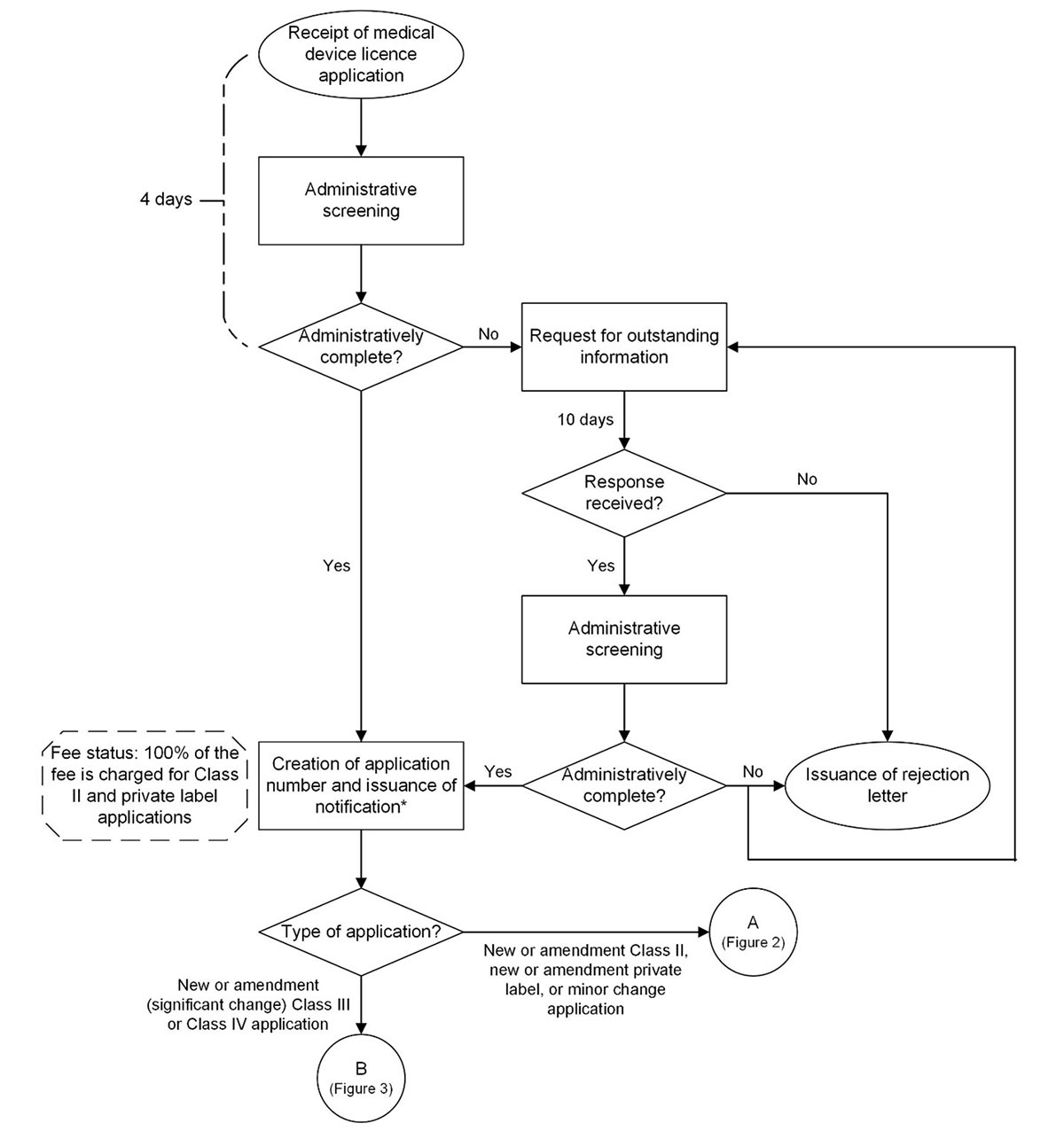
Health Canada’s Medical Devices Directorate screens all medical device licence (MDL) applications for administrative completeness. For example, we check that the fee form is complete and the folder structure, file naming convention and file formats are acceptable. Learn about Health Canada’s International Medical Device Regulators Forum (IMDRF) Table of Contents (ToC) structure for MDL applications. Our goal is to complete this part of the screening process within 4 calendar days of receiving an application. The process map for administrative screening is included in Appendix A (see Figure 1). Acceptable applications Once your application is found to be administratively complete, it is assigned a unique application number and forwarded for regulatory screening. If your application is a new or amendment Class II application, a new private label application, or a new or amendment (significant change) Class III or IV application, you will be notified at this stage. Fee status: For new and amendment Class II applications and new and amendment private label applications, 100% of the applicable fee is charged once an application is considered administratively complete. Deficient applications We will issue a request for outstanding information for an administratively deficient application. You have 10 calendar days to provide this information. Rejection letter We may issue a rejection letter if you fail to respond to a request for outstanding information within the specified timeframe or the information that's provided is deficient or not complete. You may resubmit your application at any time. Rejection of the previous application does not prejudice refiling. We will process the refiled application as a new application. Learn more about refiling an application. Fee status: We do not charge fees if an application is rejected at the administrative screening stage.
Regulatory screening
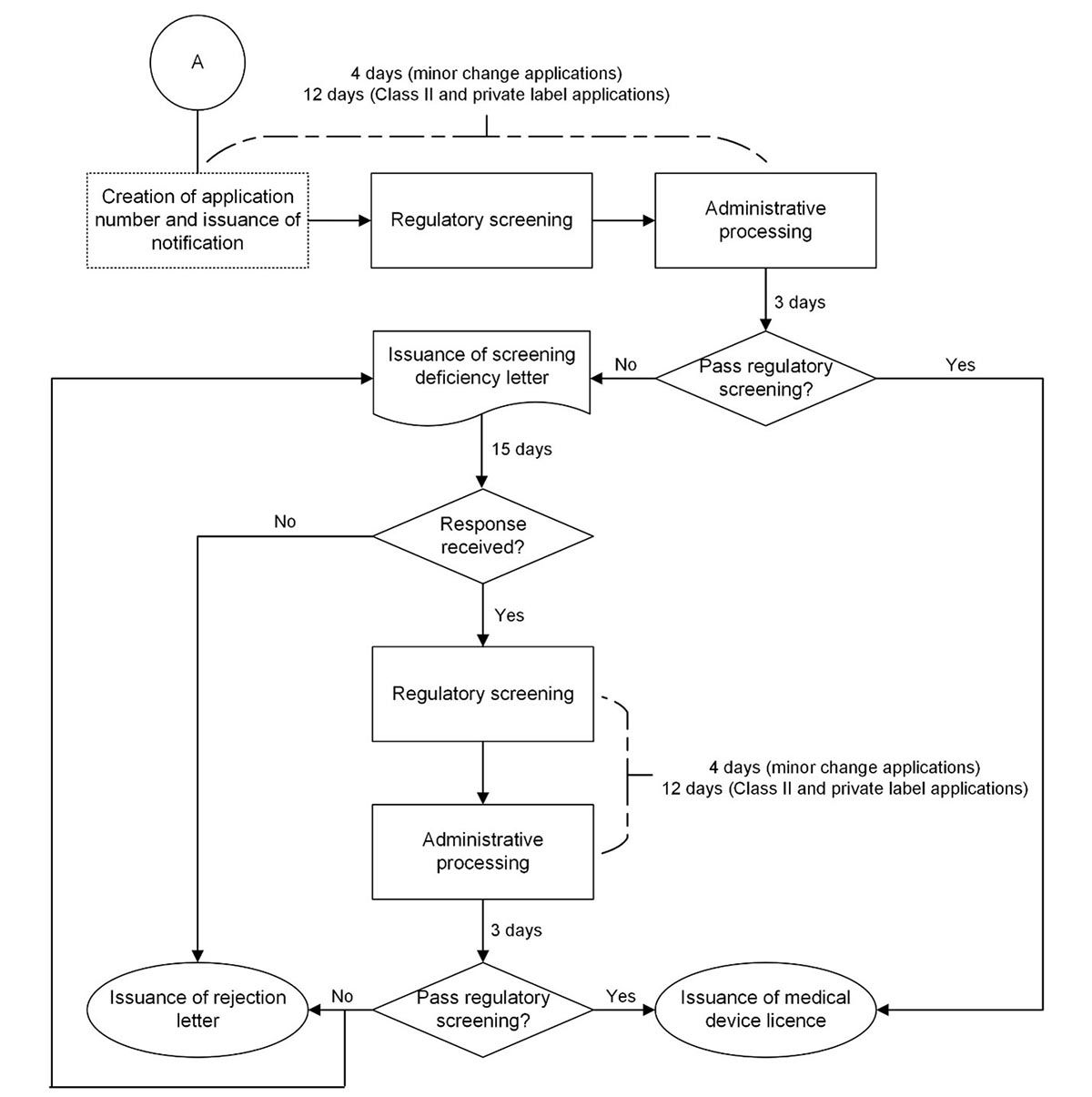
Administratively complete MDL applications are examined for validity of the regulatory information. In this stage, we validate the: • device risk classification • licence application type • manufacturer's quality management system certification • device labelling and • supporting information (information that's not scientific evidence) To learn about these regulatory components, consult: • Guidance documents for medical devices The process maps for the screening period are included in Appendix A (see Figures 2 and 3). Acceptable applications New and amendment Class II applications, and new and amendment private label applications New and amendment Class II applications, and new and amendment private label applications are examined for validity of the regulatory information. Our goal when we receive an administratively complete application is to complete this examination within 15 calendar days (12 days for regulatory screening and 3 days for administrative processing). We intend to issue an MDL (or amended MDL) within this period if the device that's the subject of the application meets the applicable requirements of the Medical Devices Regulations (regulations). Learn more about target timelines and performance standards. New and amendment (significant change) Class III and Class IV applications New and amendment (significant change) Class III and IV applications are examined for validity of the regulatory information. Our goal when we receive an administratively complete application is to complete this examination within 5 calendar days. A new or amendment (significant change) Class III or IV application is also subject to technical screening. Learn more about technical screening. Minor change applications Minor change applications are examined for validity of the regulatory information. Our goal when we receive an administratively complete application is to complete this examination within 7 calendar days (4 days for regulatory screening and 3 days for administrative processing). We intend to issue an amended MDL within this period if the device that's the subject of the amendment application meets the applicable requirements of the regulations. Clarification request You may be asked to clarify or add more details to information provided in an application at any point during the regulatory screening process. To be considered a clarification request, the information that’s requested will be minor (for example, to clarify the associations between active applications, or between active applications and existing licences). We will not ask for new information as part of a clarification request. There is no limit on the number of clarification requests that we may issue for 1 application. We will, however, not repeat the same request. You may have as few as 2 calendar days to submit the requested information. The clock does not stop when we issue a clarification request. A screening deficiency letter (SDL) may be issued if the requested information is not provided within the specified timeframe or the information provided is deficient or incomplete. Deficient applications - screening deficiency letter New and amendment Class II applications, and new and amendment private label applications An SDL is issued when we identify deficiencies while examining the validity of a new or amendment Class II application or new or amendment private label application. You have 15 calendar days from the date of the SDL to submit the requested information. Your response to the SDL is acknowledged upon receipt. A new 15-calendar day screening period starts when we receive an administratively complete response (12 days for regulatory screening and 3 days for administrative processing). New and amendment (significant change) Class III and Class IV applications A new or amendment (significant change) Class III or IV application identified as deficient following regulatory screening typically undergoes technical screening before an SDL is issued. In some cases, if an application has major regulatory deficiencies (for example, relating to device classification or the quality management system certificate), Health Canada may issue an SDL before technical screening. If the regulatory deficiencies are resolved, the application will still go through technical screening. In both scenarios, you have 15 calendar days from the date of the SDL to submit the requested information. Your response to the SDL is acknowledged upon receipt. A new 15-calendar day screening period starts when we receive an administratively complete response ( 12 days for screening and 3 days for administrative processing). Learn more about technical screening. Minor change applications An SDL is issued when we identify deficiencies while examining the validity of a minor change application. You have 15 calendar days from the date of the SDL to submit the requested information. Your response to the SDL is acknowledged upon receipt. A new 7-calendar day screening period starts when we receive an administratively complete response (4 days for regulatory screening and 3 days for administrative processing). Rejection letter Before a decision is made, you are given an opportunity to address deficiencies in your application using the SDL mechanism. We may issue a rejection letter if you: • fail to submit the information requested in the SDL within the time specified or • submit incomplete or deficient information You may resubmit your application at any time. Rejection of the previous application does not prejudice refiling. The refiled application is processed as a new application. Learn more about refiling an application. As an alternative, you may ask for the decision to reject your application to be reconsidered. Learn about the reconsideration process.
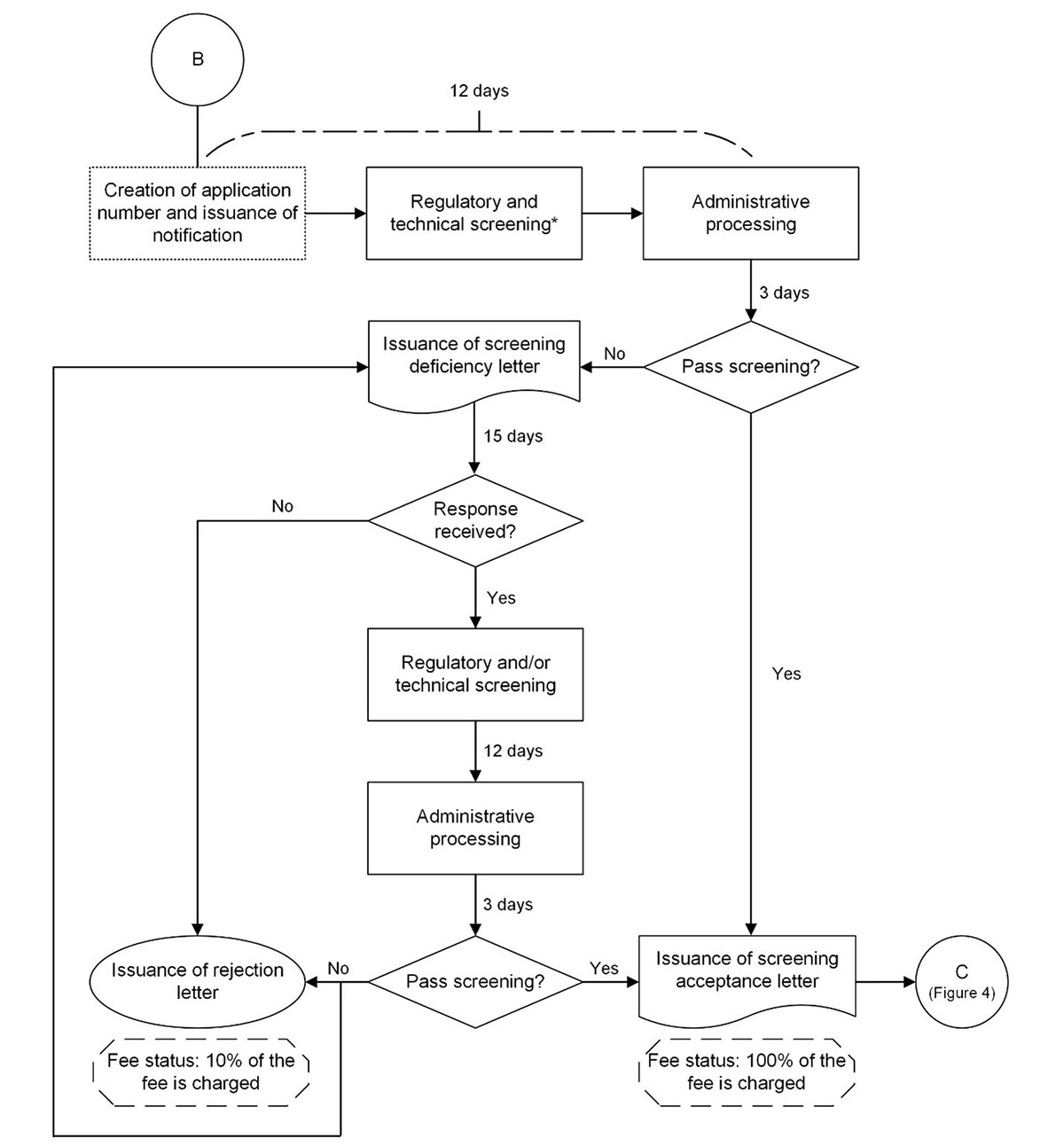
Technical screening
New and amendment (significant change) Class III and Class IV MDL applications are screened for technical completeness. Our goal is to ensure the necessary scientific evidence used to support the application is included. The required scientific evidence is defined in the regulations and described in various guidance documents. Learn about supporting evidence requirements. The process map for the screening period is included in Appendix A (see Figure 3). Acceptable applications After regulatory screening, new and amendment (significant change) Class III and IV applications are screened for technical completeness. Our goal when we receive an administratively complete application is to complete the screening within 15 calendar days (5 days for regulatory screening, 7 days for technical screening, and 3 days for administrative processing). A screening acceptance letter (SAL) is issued when the information and material submitted is considered acceptable for review. Fee status: For new and amendment (significant change) Class III and IV applications, 100% of the applicable fee is charged when an SAL is issued. Deficient applications - screening deficiency letter An SDL is issued when we identify deficiencies during the regulatory screening, technical screening, or both, of a new or amendment (significant change) Class III or IV application. An application is deficient if the required information is not provided or does not contain enough detail. The information that’s required is defined in the regulations and described in various guidance documents. Learn about submission requirements. You have 15 calendar days from the date of the SDL to submit the requested information. Your response is acknowledged upon receipt. A new 15-calendar day screening period starts when we receive an administratively complete response ( 12 days for screening and 3 days for administrative processing). Rejection letter Before a decision is made, you are given an opportunity to address deficiencies in your application using the SDL mechanism. We may issue a rejection letter if you: • fail to submit the information requested in the SDL within the time specified or • submit incomplete or deficient information You may resubmit your application at any time. Rejection of the previous application does not prejudice refiling. The refiled application is processed as a new application. Learn more about refiling an application. As an alternative, you may ask for the decision to reject your application to be reconsidered. Learn about the reconsideration process. Fee status: For new and amendment (significant change) Class III and IV applications, 10% of the applicable fee is charged when a rejection letter is issued.
Withdrawal letter
You may withdraw your MDL application at any time during the screening process by filing a withdrawal request using the Regulatory Enrolment Process (REP). Learn about the REP for medical devices. An acknowledgement is issued once we receive the request. You may resubmit your application at any time. Withdrawing the application does not prejudice refiling. The refiled application is processed as a new application. Learn more about refiling an application. Fee status: For new and amendment (significant change) Class III and IV applications, 10% of the applicable fee is charged when an application is withdrawn (after the SDL is issued but before the application is accepted into review).
Administrative processing
There is a 3-day administrative processing period for all MDL applications. During this period, we will: • generate and issue the appropriate regulatory decision letter or • issue an MDL or amended MDL
Review process — Review process
• Overview • Filing applications • Screening process • Review process • Refiled applications • Reconsideration process • Appendices
Target performance standards
Once a screening acceptance letter (SAL) is issued, new and amendment (significant change) Class III and IV medical device licence (MDL) applications enter the review queue. The target performance standard for review (number of days from the date of the SAL to the date of the first decision, including 3 days for administrative processing) is: • 60 calendar days for new and amendment (significant change) Class III applications • 75 calendar days for new and amendment (significant change) Class IV applications The process map for the review period is included in Appendix A (see Figure 4).
Acceptable applications
Our goal is to issue or amend an MDL within the target performance standards if the device that’s the subject of the application meets the applicable requirements of the Medical Devices Regulations (regulations). Note that an MDL could also be issued with terms and conditions. Learn more about terms and conditions for medical devices.
Clarification request
During the review process, we may ask you to clarify or add more details to the information or data in your MDL application. To be considered a clarification request, the information that's requested will be minor, such as to clarify: • if the evidence provided in the test report includes the subject device • the software version of the device used in testing We will not ask for new information as part of a clarification request. There is no limit to the number of clarification requests that may be issued for 1 application. We will not, however, repeat the same request. You may have as few as 2 calendar days to submit the requested information. The review clock does not stop with a clarification request. We may issue an additional information (AI) letter if the requested information is not provided within the specified timeframe or the information provided is deficient or incomplete.
Deficient applications - additional information letter
During or following a review of a new or amendment (significant change) Class III or IV MDL application, we will notify you of any deficiencies or missing information in an AI letter. The review clock is stopped from the date of the letter. An acknowledgement is issued once we receive the requested information in response to the AI letter. Your application is then placed back in queue for review and a new 45-calendar day review period begins (including 3 days for administrative processing). We reserve the right during this stage to ask for clarification of the information submitted. The information above applies to both types of AI letters described below. Additional information - deficiency letter An additional information - deficiency (AI-D) letter is sent if we find the application is incomplete or deficient after reviewing it. The letter will specify the issues that make the application deficient or incomplete. You have 60 calendar days from the date of the letter to submit the requested information. Usually, no more than 2 AI–D letters are issued, but additional letters may be issued in certain situations (for example, if the review of a response to a second AI–D letter identifies a new deficiency, such as an oversight in the response or a misinterpretation of the request). Additional information - noncompliance letter An additional information - noncompliance (AI-N) letter is sent if we: • identify significant deficiencies or omissions that make it challenging to continue reviewing the application • find you have made a false or misleading statement in the application You have 10 calendar days from the date of the letter to submit the requested information. (Note: The response timeline is 50 calendar days shorter than for an AI–D scenario and the review of the application is not complete when an AI–N letter is issued.) More than 1 AI-N letter may be issued for an application and an AI-N letter may be followed by an AI-D letter or a refusal letter.
Unsolicited information
During the review process, you may submit: • updated information on the regulatory status of your medical device in other countries and • updated information on the safe use of the device • includes updated safety-related labelling and problem reports submitted to other regulatory agencies The above unsolicited information does not include significant changes to the device under review or to the scope of the review (this requires a new application). When filing unsolicited information, you should clearly indicate it is unsolicited and reference the relevant application number in the cover letter so we can forward this new information to the appropriate review team.
Pause the clock
Pause the clock is a mechanism that allows for the clock to be formally paused under certain circumstances. When there’s a pause, the target date is changed to account for the amount of time the clock has been paused. The clock can pause only in the following cases: • For a combination product that is subject to the Medical Devices Regulations, the device clock could pause when the review of the device portion of the product results in a positive recommendation, but the review of the drug portion is ongoing. • You are notified of the pause and the clock resumes when the drug review is completed. • For linked MDL applications where different timelines apply (for example, a Class III implantable device and its associated Class II delivery system, where a system licence application type may not be possible), the clock could pause when the review of the application with the shorter timeline is complete, but the review of the linked device application is outstanding. • You are notified of the pause and the clock resumes when we have completed the review of the linked device application. Learn about combination products.
Withdrawal letter
You may withdraw your MDL application at any time during the review process by submitting a withdrawal request using the Regulatory Enrolment Process (REP) . Learn about the REP for medical devices. An acknowledgement is issued once we receive the request. You may resubmit your application at any time. Withdrawing the application does not prejudice refiling. The refiled application is processed as a new application. Learn more about refiling an application.
Refusal letter
Before a decision is made, you are given an opportunity to address deficiencies in your MDL application using the AI letter mechanism. We may issue a refusal letter if you: • fail to submit the information requested in the AI letter within the time specified • submit an incomplete or deficient response • fail to comply with the regulations or any provisions of the Food and Drugs Act relating to medical devices or • make a false or misleading statement The refusal letter contains the specific reasons or deficiencies that resulted in the decision to refuse to issue or amend an MDL. You may resubmit your application at any time. Refusal of the previous application does not prejudice refiling. The refiled application is processed as a new application. Learn more about refiling an application. As an alternative, you may ask for the refusal decision to be reconsidered. Learn about the reconsideration process.
Administrative processing
New and amendment (significant change) Class III and IV MDL applications are subject to a 3-day administrative processing period. During this period, we will: • generate and issue the appropriate regulatory decision letter or • issue an MDL or amended MDL
Review reports
If you receive a refusal letter or choose to withdraw your application after receiving an AI letter, you may request the review reports through the REP. We try to provide a copy of the requested reports within 15 calendar days of receiving the request. Learn about the REP for medical devices.
Refiled applications — Refiled applications
• Overview • Filing applications • Screening process • Review process • Refiled applications • Reconsideration process • Appendices
Introduction
You may refile a medical device licence (MDL) application that was withdrawn previously or an application that received a rejection letter or refusal letter. A refiled application is considered a new application. You are notified once your refiled application is found to be administratively complete and is assigned a new application number. A refiled application is managed according to this guidance document and is subject to new policies, procedures and guidance documents that may be in effect at the time of refiling. Fee status: Refiled applications are subject to the same application fees and fee schedules as original applications.
Refiling within 6 months
If an MDL application is refiled within 6 months of a refusal letter or withdrawal letter, you have the option to submit only the material requested in the outstanding AI letter or listed in the refusal letter. However, the original material previously filed must be cross-referenced. If you cross-reference the original material, you must in the refiled application: • certify the original material remains unchanged • clearly identify new and previously submitted information
Refiling after 6 months
If an MDL application is refiled after 6 months of a refusal letter or withdrawal letter, you must submit a completely new application (no cross-referencing to previously submitted material is allowed). This approach reflects the dynamic nature of medical device development. In the refiled application, you should: • indicate the components that were previously filed • certify the information that remains unchanged • highlight any revisions
Refiling after a rejection letter
If an MDL application is refiled following a rejection letter, you must submit a completely new application (no cross-referencing to previously submitted material is allowed).
Reconsideration process — Reconsideration process
• Overview • Filing applications • Screening process • Review process • Refiled applications • Reconsideration process • Appendices
Introduction
When a negative decision is issued for a new or amendment medical device licence (MDL) application, the manufacturer may ask for the decision to be reconsidered. This is set out in paragraph 38(3) of the Medical Devices Regulations (regulations). The reconsideration process provides a mechanism for reopening the decision to ensure it was made fairly and in accordance with the regulations. During the reconsideration process, you may present and explain your position. However, you can only base your position on information that was available to Health Canada's Medical Devices Directorate (MDD) when the original decision was made. Independent scientific, medical or regulatory experts will consider your position and make a recommendation to MDD’s Director General or delegate (DG). The DG will let you know if the original decision is upheld, partially amended or fully amended.
Key steps
In this section, we outline the key steps in the reconsideration process. Timelines for MDD are target timelines and while we make every effort to meet these targets, unforeseen delays can occur. A process map showing the key steps and timelines is included in Appendix B (see Figure 5). Decisions eligible for reconsideration You may file a request for reconsideration to the DG following a: • rejection letter or • refusal letter A request for reconsideration should be based on the issues identified in the decision letter. Examples of issues that may lead to a request for reconsideration include: • applied methodology • interpretation of available data • relative weight given to data and its impact on the risk-benefit assessment Request for reconsideration You should submit a request for reconsideration within 30 calendar days of receiving the negative decision letter. The request must be filed using the Regulatory Enrolment Process (REP). Learn about the REP for medical devices. The request for reconsideration should include: • a copy of the negative decision letter for which the reconsideration is requested and • your position and rationale for each issue for which you are requesting reconsideration • should cross-reference to points in the decision letter and previously submitted information, as applicable Reconsideration is based only on the information that was contained in the application at the time of the original decision. While you may clarify previously submitted information, you may not reference or include new information in the request for reconsideration. Information that alters the original application (such as new data, studies, labelling or quality management system certificate, or different analyses of existing data) will not be considered. If you do not file a request for reconsideration or if you withdraw a request, the original negative decision stands. Screening of the reconsideration request MDD staff not previously involved in the original decision will screen the request for reconsideration. Within 15 calendar days of its receipt, a letter will be issued to you indicating whether your request is eligible or ineligible for reconsideration, or if it is deficient (for example, missing information or containing new information). If the request is deficient, you will have an opportunity to address the deficiencies. If it is eligible, the letter of eligibility will identify the reconsideration process pathway that the DG selected (internal review or external panel review). Reconsideration process pathways The reconsideration process may involve a review by independent Health Canada experts or, in exceptional circumstances, an external panel of experts. Selection of a reconsideration process pathway is at the sole discretion of the DG . When selecting a pathway, every effort is taken to ensure fairness, impartiality and responsible stewardship of resources. Selection is also based on the type of issues under reconsideration and the availability of expertise within Health Canada. The target timeframes (period from the date the request for reconsideration is received to the date the reconsideration decision is issued) for the reconsideration process pathways are: • internal review based on written submissions: 50 calendar days • internal review based on written submissions and a reconsideration meeting: 85 calendar days • external panel review based on written submissions and a reconsideration meeting: 140 calendar days Internal review The internal reconsideration review staff are identified within 10 calendar days of the date of the letter of eligibility. To uphold fairness and impartiality, the internal review process pathway provides for an independent review by 1 or more experts within Health Canada who were not involved in the original decision. The staff involved in the original decision (original bureau) may be asked, however, to clarify their decision. Reconsideration of the original decision may also involve consulting an internal or external expert. You may choose to have the internal reconsideration review be based on written submissions or written submissions and a reconsideration meeting. You should indicate your preference following receipt of the letter of eligibility. External panel review The pathway involving a review by a panel of scientific or medical experts outside of the federal government may be chosen if: • an internal expert who was not previously involved is not available • MDD determines that external perspectives are required • the review involves highly specialized scientific or clinical matters The DG may consider a request for reconsideration without referring to an external panel if MDD has a recent outside independent expert opinion on the specific issue. Also, issues that concern the submission of false or misleading information are not appropriate for review by an external panel. Establishment of an external panel An external panel consists of 3 members: • 1 member selected by the DG from nominations by the manufacturer • 1 member selected by the DG from nominations by the original bureau • 1 member appointed by the DG who will chair the panel Eligibility and selection of external panelists The manufacturer and original bureau are both asked to provide, within 10 calendar days of the date of the letter of eligibility, a list of nominees with expertise relevant to the issues being reconsidered. External panel members must meet conflict of interest (COI) and security clearance requirements. To enable nominees to comply with COI requirements, the manufacturer and original bureau must not contact the nominees or provide them with any material for review. Learn more about Health Canada's conflict of interest policy for external advisory bodies. The DG selects panel members after the screening process and within 15 calendar days of receiving the names of the nominees. Selection is based on eligibility (pending security clearance), experience, expertise and analytical skills relevant to the issues being reconsidered. Questions for the external panel You and the original bureau will be asked to submit questions for the external panel within 10 calendar days of the date of the letter of eligibility. The questions help the panel focus its deliberations on the specific issues being reconsidered. The questions should draw upon the expertise of the panelists so that a response to a specific issue can be provided to the DG. They should not: • lead • for example, framed in a way to obtain a desired answer • be general and unrelated to the scientific or regulatory merits of the submission • for example, "should the device be approved?" The questions will be used to develop the final questions for the panel, which will be shared with all attendees in advance of the reconsideration meeting. Reconsideration meeting At a reconsideration meeting, you have an opportunity to share points in the application that support your position with: • the DG • designated independent reconsideration advisor within MDD • internal reconsideration review staff or members of the external panel At this meeting, there will not be: • a debate of the issues • a reconsideration decision made • any new information shared If an internal review pathway is selected, a reconsideration meeting (if requested) is held within 35 calendar days from the date that the internal reconsideration review staff are identified. If an external panel review pathway is selected, a reconsideration meeting is held within 70 calendar days from the date the panel is chosen. In both cases, you will be asked to: • submit a presentation at least 15 calendar days before the meeting date • make a formal presentation at the meeting Following the presentation, questions of clarification for you or the original bureau may be allowed (at the chair's discretion). Recommendations to the Director General All relevant material is provided to the internal reconsideration review staff or external panel members for review and consideration. The reconsideration is based on the information available when the original decision was being made, the manufacturer's request for reconsideration and the meeting presentation (if applicable). New information that alters the original application will not be considered. If an internal review pathway is selected, the results are presented to a designated independent reconsideration advisor within MDD (who was not involved in the original decision) for consideration. The advisor submits their recommendations to the DG within 20 calendar days from the date that the internal reconsideration review staff are identified or from the date of the meeting (if applicable). If an external panel review pathway is selected, the panel submits a report containing their recommendations for the DG within 15 calendar days from the meeting date. Each recommendation must have the support of at least 2 of the 3 panel members. Consistent with its advisory role, the panel is not asked to make a decision on the application. Rather, advice is solicited through questions provided earlier to the panel. The reconsideration advisor prepares and presents a summary of the key points in the report along with their own recommendations to the DG within 10 calendar days of receiving the panel’s report. Possible outcomes of a reconsideration The DG takes the recommendations from the reconsideration advisor and external panel (if applicable) into consideration before making a decision. The decision is issued within 5 calendar days from when the recommendations were received. The reconsideration decision letter gives the decision and the reasons behind it. There are 3 possible outcomes of a reconsideration. 1. Decision upheld • Application is rejected or refused if the original decision is upheld for the issues under reconsideration. • Reconsideration decision letter becomes the final decision. • You may refile your application, making the necessary changes to address the issues that led to the negative decision. Learn more about refiling an application. 2. Decision partially amended • Application is rejected or refused if the reconsideration results in the original decision being amended for some, but not all of the issues. • Reconsideration decision letter becomes the final decision. • You may refile your application, making the necessary changes to address the outstanding issues. Learn more about refiling an application. 3. Decision fully amended • Application is returned to the application management process for follow-up actions if the reconsideration results in the original decision being amended for all of the issues identified in the original decision letter. • The status of the application may trigger 1 of the following actions: • the Minister will issue or amend, as appropriate, the MDL for the subject medical device if the device meets the applicable requirements of sections 10 to 20 of the regulations • the application will be reinstated and processed in accordance with the application management process, target timelines and performance standards if: • a full review of the application, if applicable, was not carried out before the original decision was made (for example, rejected Class III or IV application) or • there are outstanding deficiencies that were not part of the basis of the original negative decision
Appendices — Appendices
• Overview • Filing applications • Screening process • Review process • Refiled applications • Reconsideration process • Appendices
Appendix A – Application management process maps
The following process maps show the key steps and timelines (in calendar days) for managing medical device licence applications. The timelines for the Medical Devices Directorate are target timelines. * Notification applies to new and amendment Class II applications, new private label applications, and new and amendment (significant change) Class III and IV applications. * In certain cases, at the discretion of Health Canada, a Class II application may also undergo a review before a decision is made. * In certain cases where an application has significant regulatory deficiencies, a screening deficiency letter may be issued before technical screening. * Review 1 – Period from the date an application is accepted for review (date of screening acceptance letter) to the date of first decision. Excludes 3 days for administrative processing and clock pauses. † 10 days for additional information – noncompliance letter and 60 days for additional information – deficiency letter. ‡ Review 2 – Period from the date a response to an additional information letter is received to the date of subsequent decision. Excludes 3 days for administrative processing and clock pauses. Usually, no more than 2 additional information letters are issued, but additional letters may be issued in certain situations.

Appendix B – Reconsideration process map
The following map shows the key steps and timelines (in calendar days) in the reconsideration process. The timelines for the Medical Devices Directorate are target timelines. RR request for reconsideration DG Director General or delegate
