Notice 10/2024 — Guidelines on the Use of Licence Exempt Spectrum Bands in Eswatini, 2024
Currentness under review. Whether this instrument remains applicable is under review. Consult the later instruments and source context below before relying on it.
Link directly to a passage with its anchor — for example #pdf-page-1 — to open it highlighted. This reference version is generated from the authority’s publication and does not replace it. Language: English.
Contents
Notice 10/2024: Guidelines on The
Use of Licence Exempt Spectrum
Bands in Eswatini, 2024
October 2023
The Eswatini Communications Commission (‘the Commission’) hereby publishes
the Guidelines on the use of Licence-Exempt Spectrum Bands in terms of section
38(b) of the Eswatini Communications Commission Act, 2013 read together with
sections 40, 41 and 42 of the Electronic Communications Act, 2013.
Original PDF page 1 — retained source fields, tables and layout.
(1) Citation
These Guidelines may be cited as the “Guidelines on the use of licence exempt spectrum
bands, 2024”.
(2) Power to issue the guidelines.
These guidelines are issued in accordance with section 38(b) of the Eswatini Communications
Commission Act, 2013 read together with sections 40, 41 and 42 of the Electronic
Communications Act, 2013.
(3) Application
The guidelines shall apply to:
(i)
all spectrum users holding a valid individual and or general licence issued by the
Commission including operators and electronic communication service providers.
(ii)
all users of apparatus that utilize licence exempt spectrum bands in accordance
with the Electronic Communications Act, 2013 and Electronic Communications
(Radio Frequency Spectrum) Regulations, 2016.
(4) Purpose of the guidelines
The purpose of the guidelines is:
to review the existing provisions on apparatus exempt from radio frequency spectrum
licenses.
to provide guidance on the applicable technical standards and requirements for operating
SRD’s, including emerging technologies in Eswatini.
to give guidance on the use of license exempt spectrum bands for wireless access systems
(WAS/RLAN) in Broadband Fixed Wireless Access (BFWA) applications, to ensure that users
of these bands do not experience any harmful interference.
(5) Interpretations
For the purpose of these guidelines;
Licence exempt apparatus shall mean a device that operates on a licence exempt basis on
licence exempt bands and any other licenced bands in a non-interference non-protection basis.
2
Original PDF page 2 — retained source fields, tables and layout.
This includes low power devices and short-range devices designed to work on a licence-
exempt basis.
Licence Exempt Spectrum shall mean radio frequency spectrum designated for the use of
licence exempt devices based on defined technical specifications and standards.
Broadband Fixed Wireless Access (BFWA) networks are based on a central radio
base station, which communicates with equipment located in a multiplicity of subscriber
premises in the surrounding area.
Type Approval The authorization of communications equipment for importation and usage
in Eswatini. This is done through verification of the equipment/device compliance to the
standards and other regulatory requirements.
ICNIRP International Commission on Non-Ionizing Radiation Protection
DFS Dynamic Frequency Selection is a channel allocation scheme designed to prevent
harmful interference by automatically selecting the channel with least interference.
ERC European Radiocommunications Committee
CEPT European Conference of Postal and Telecommunications Administrations
ETSI European Telecommunications Standards Institute
R&TTE Radio & Telecommunication Terminal Equipment directive
ISM radio bands are frequencies reserved internationally for the use of radio frequency
(RF) energy for industrial, scientific and medical.
EIRP Effective Isotropic Radiated Power
RLAN Radio local area network
WAS Wireless access system
UWB Ultra wide band
(6) General Requirements
All users of licence-exempt apparatus in the country should comply with these requirements:
(i)
Ensure that the equipment that they intend to use is type approved by the
Commission and follows all Type Approval regulations set by the Commission.
3
Original PDF page 3 — retained source fields, tables and layout.
(ii)
Ensure that the equipment operates on the permissible frequency bands as
outlined in the Appendix of these guidelines.
(iii)
Ensure that the equipment operates in accordance with the permissible power
limits as outlined in the Appendix of these guidelines.
(iv)
The devices (Sensors, actuators, aggregators, appliances, etc.), used in the
deployment of a network, shall comply with the International Commission on
Non-Ionizing Radiation Protection (ICNIRP) guidelines for limiting exposure to
time-varying electric, magnetic, and electromagnetic fields.
(v)
Suitable IP addressing in IPv4 is permitted, however, migration to IPv6 is
encouraged.
(vi)
The licencees providing the IoT services must comply with all the applicable,
existing, or future laws, regulations, and requirements issued by the Commission
or other authorities concerning data management including security, privacy,
retention, and protection of data.
(vii)
Backhauling services are not permitted on all SRD bands.
(viii)
Dynamic Frequency Selection (DFS) is not permitted on WAS/RLAN access
systems for BFWA. Only static frequency selection is permitted in accordance with
the channelling arrangements in Appendix 3 of this document.
(7) AI / IoT device requirements
Internet of Things and Artificial Intelligence devices that fall within the licence exempt bands
shown in the Appendix of these guidelines shall be allowed to operate on a licence exempt
basis subject to the following conditions:
i).
All devices under this category shall comply with the limits/parameters, allowed
applications, general operating conditions etc. as per the Appendix of these
guidelines.
ii).
All devices under this category as specified in Appendix, shall require type approval
from the Commission.
iii).
All devices under this category shall be allowed to operate on a secondary non-
interference non-protection basis as well as shall not cause interference with other
authorized radio communication services and be able to tolerate any interference
caused by other radio communication services.
4
Original PDF page 4 — retained source fields, tables and layout.
iv).
If any IoT or AI devices are found to be interfering with any primary service, the
operation will be shut down immediately.
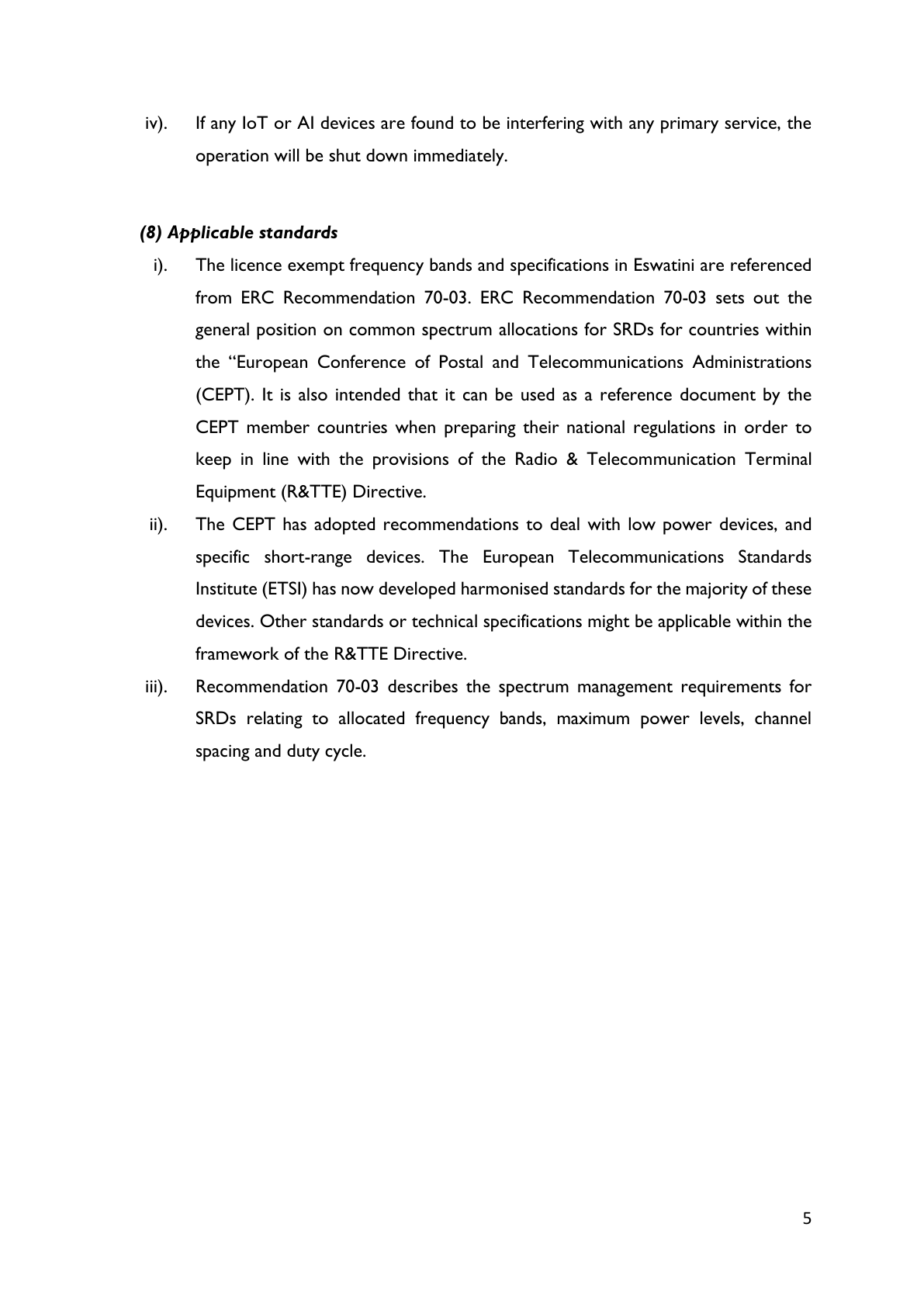
(8) Applicable standards
i).
The licence exempt frequency bands and specifications in Eswatini are referenced
from ERC Recommendation 70-03. ERC Recommendation 70-03 sets out the
general position on common spectrum allocations for SRDs for countries within
the “European Conference of Postal and Telecommunications Administrations
(CEPT). It is also intended that it can be used as a reference document by the
CEPT member countries when preparing their national regulations in order to
keep in line with the provisions of the Radio & Telecommunication Terminal
Equipment (R&TTE) Directive.
ii).
The CEPT has adopted recommendations to deal with low power devices, and
specific short-range devices. The European Telecommunications Standards
Institute (ETSI) has now developed harmonised standards for the majority of these
devices. Other standards or technical specifications might be applicable within the
framework of the R&TTE Directive.
iii).
Recommendation 70-03 describes the spectrum management requirements for
SRDs relating to allocated frequency bands, maximum power levels, channel
spacing and duty cycle.
5
Original PDF page 5 — retained source fields, tables and layout.
Notice 10/2024 Guidelines on The Use of Licence Exempt Spectrum Bands in Eswatini
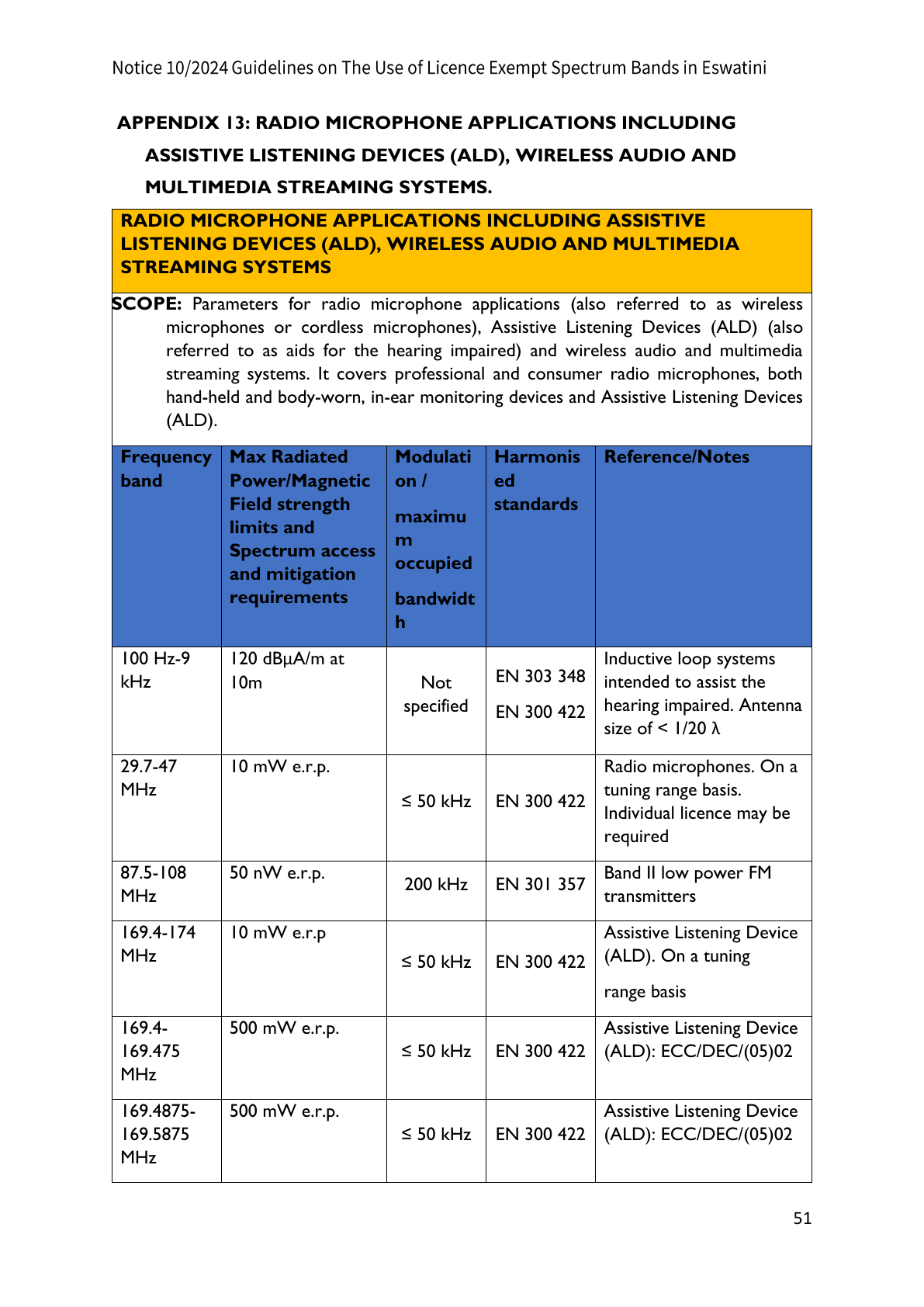
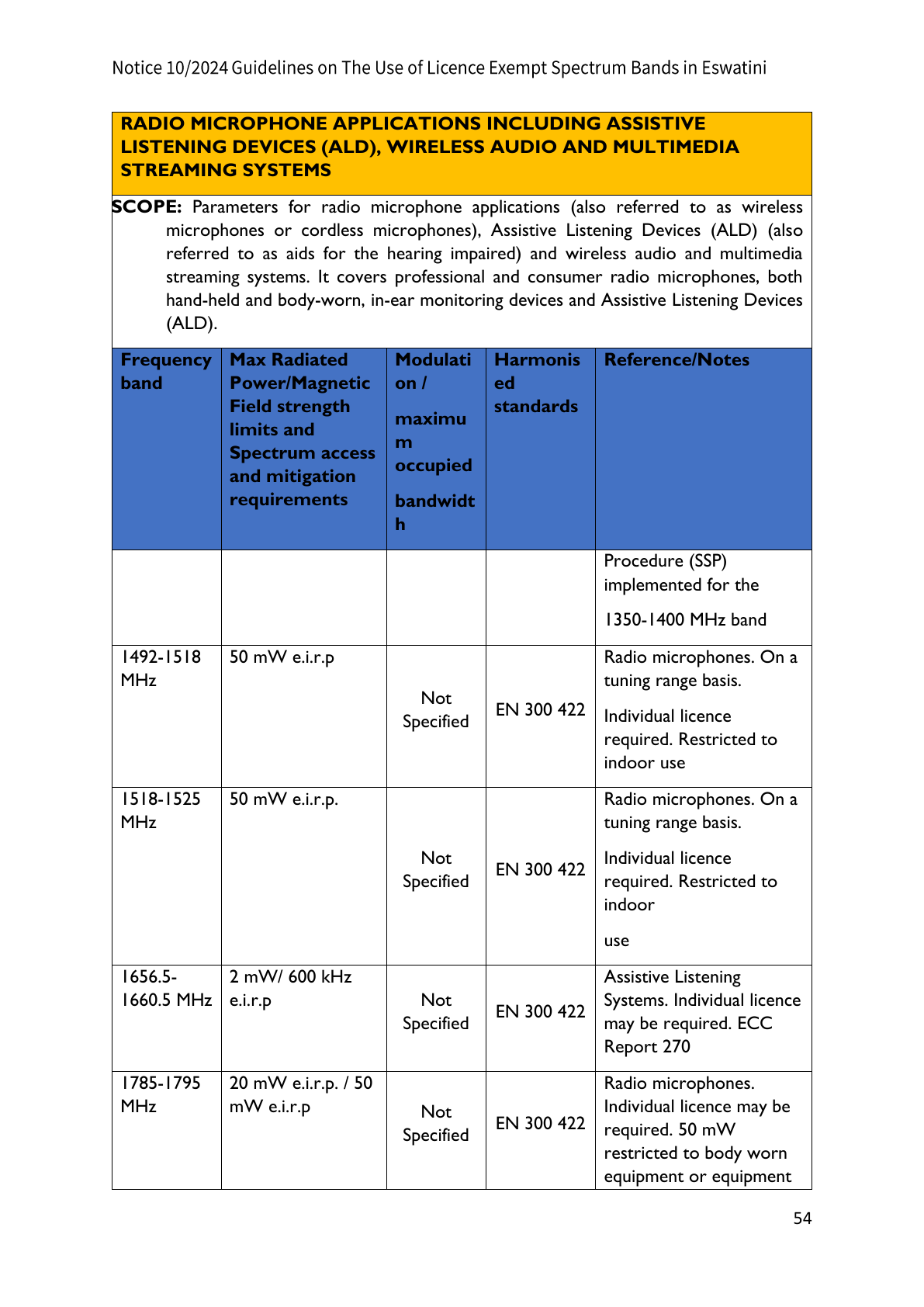
APPENDIX 13: RADIO MICROPHONE APPLICATIONS INCLUDING ASSISTIVE LISTENING DEVICES (ALD), WIRELESS AUDIO AND MULTIMEDIA STREAMING SYSTEMS.
RADIO MICROPHONE APPLICATIONS INCLUDING ASSISTIVE LISTENING DEVICES (ALD), WIRELESS AUDIO AND MULTIMEDIA STREAMING SYSTEMS
SCOPE: Parameters for radio microphone applications (also referred to as wireless microphones or cordless microphones), Assistive Listening Devices (ALD) (also referred to as aids for the hearing impaired) and wireless audio and multimedia streaming systems. It covers professional and consumer radio microphones, both hand-held and body-worn, in-ear monitoring devices and Assistive Listening Devices (ALD).
Frequency band
Max Radiated Power/Magnetic Field strength limits and Spectrum access and mitigation requirements
Modulation / maximum occupied bandwidth
Harmonised standards
Reference/Notes
100 Hz-9 kHz
120 dBμA/m at 10m
Not specified
EN 303 348
EN 300 422
Inductive loop systems intended to assist the hearing impaired. Antenna size of < 1/20 λ
29.7-47 MHz
10 mW e.r.p.
≤ 50 kHz
EN 300 422
Radio microphones. On a tuning range basis. Individual licence may be required
87.5-108 MHz
50 nW e.r.p.
200 kHz
EN 301 357
Band II low power FM transmitters
169.4-174 MHz
10 mW e.r.p
≤ 50 kHz
EN 300 422
Assistive Listening Device (ALD). On a tuning range basis
169.4-169.475 MHz
500 mW e.r.p.
≤ 50 kHz
EN 300 422
Assistive Listening Device (ALD): ECC/DEC/(05)02
169.4875-169.5875 MHz
500 mW e.r.p.
≤ 50 kHz
EN 300 422
Assistive Listening Device (ALD): ECC/DEC/(05)02
51
Original PDF page 51 — retained source fields, tables and layout.
Notice 10/2024 Guidelines on The Use of Licence Exempt Spectrum Bands in Eswatini
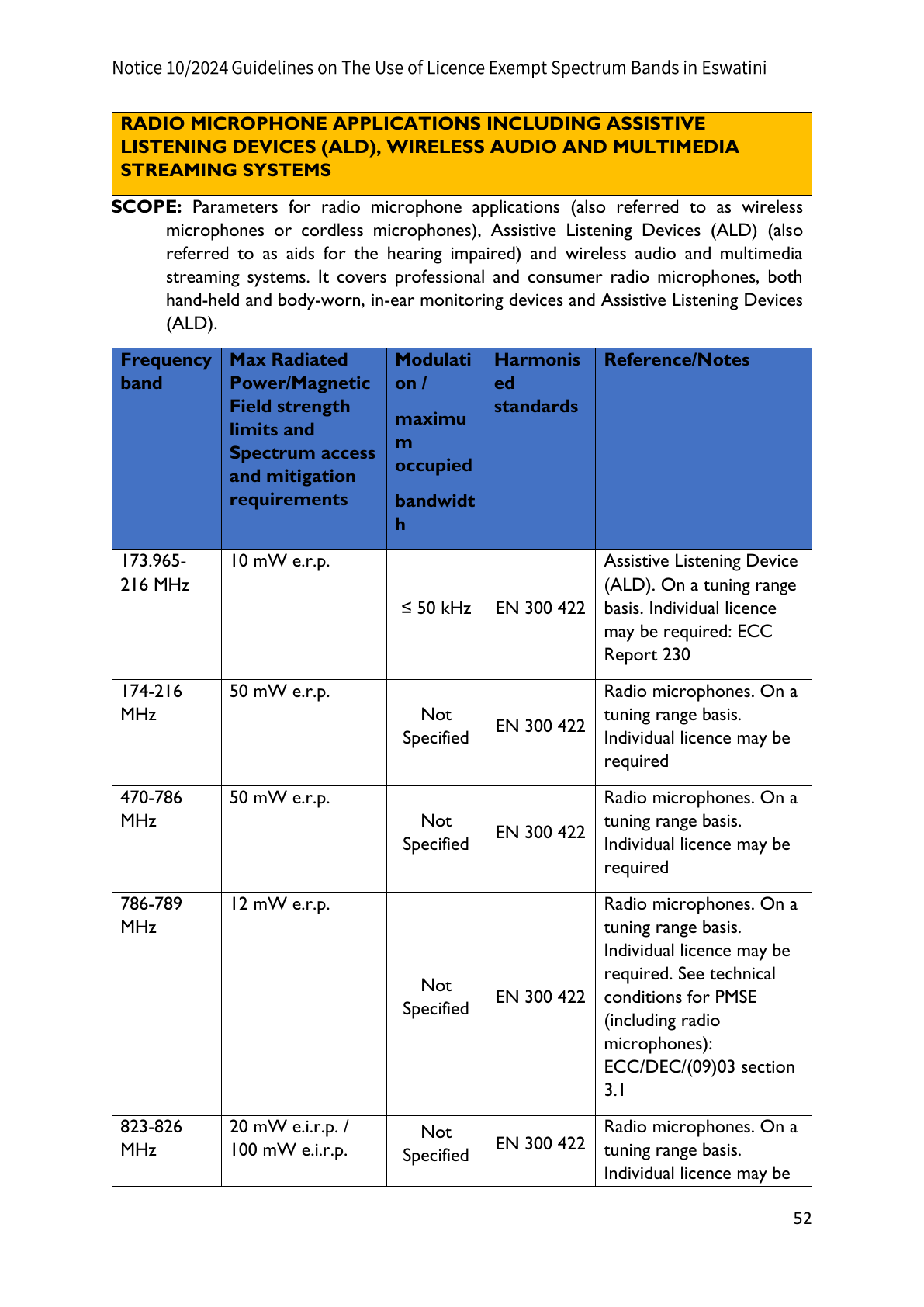
RADIO MICROPHONE APPLICATIONS INCLUDING ASSISTIVE LISTENING DEVICES (ALD), WIRELESS AUDIO AND MULTIMEDIA STREAMING SYSTEMS
SCOPE: Parameters for radio microphone applications (also referred to as wireless microphones or cordless microphones), Assistive Listening Devices (ALD) (also referred to as aids for the hearing impaired) and wireless audio and multimedia streaming systems. It covers professional and consumer radio microphones, both hand-held and body-worn, in-ear monitoring devices and Assistive Listening Devices (ALD).
Frequency band
Max Radiated Power/Magnetic Field strength limits and Spectrum access and mitigation requirements
Modulation / maximum occupied bandwidth
Harmonised standards
Reference/Notes
173.965-216 MHz
10 mW e.r.p.
≤ 50 kHz
EN 300 422
Assistive Listening Device (ALD). On a tuning range basis. Individual licence may be required: ECC Report 230
174-216 MHz
50 mW e.r.p.
Not Specified
EN 300 422
Radio microphones. On a tuning range basis. Individual licence may be required
470-786 MHz
50 mW e.r.p.
Not Specified
EN 300 422
Radio microphones. On a tuning range basis. Individual licence may be required
786-789 MHz
12 mW e.r.p.
Not Specified
EN 300 422
Radio microphones. On a tuning range basis. Individual licence may be required. See technical conditions for PMSE (including radio microphones): ECC/DEC/(09)03 section 3.1
823-826 MHz
20 mW e.i.r.p. / 100 mW e.i.r.p.
Not Specified
EN 300 422
Radio microphones. On a tuning range basis. Individual licence may be
52
Original PDF page 52 — retained source fields, tables and layout.
Notice 10/2024 Guidelines on The Use of Licence Exempt Spectrum Bands in Eswatini
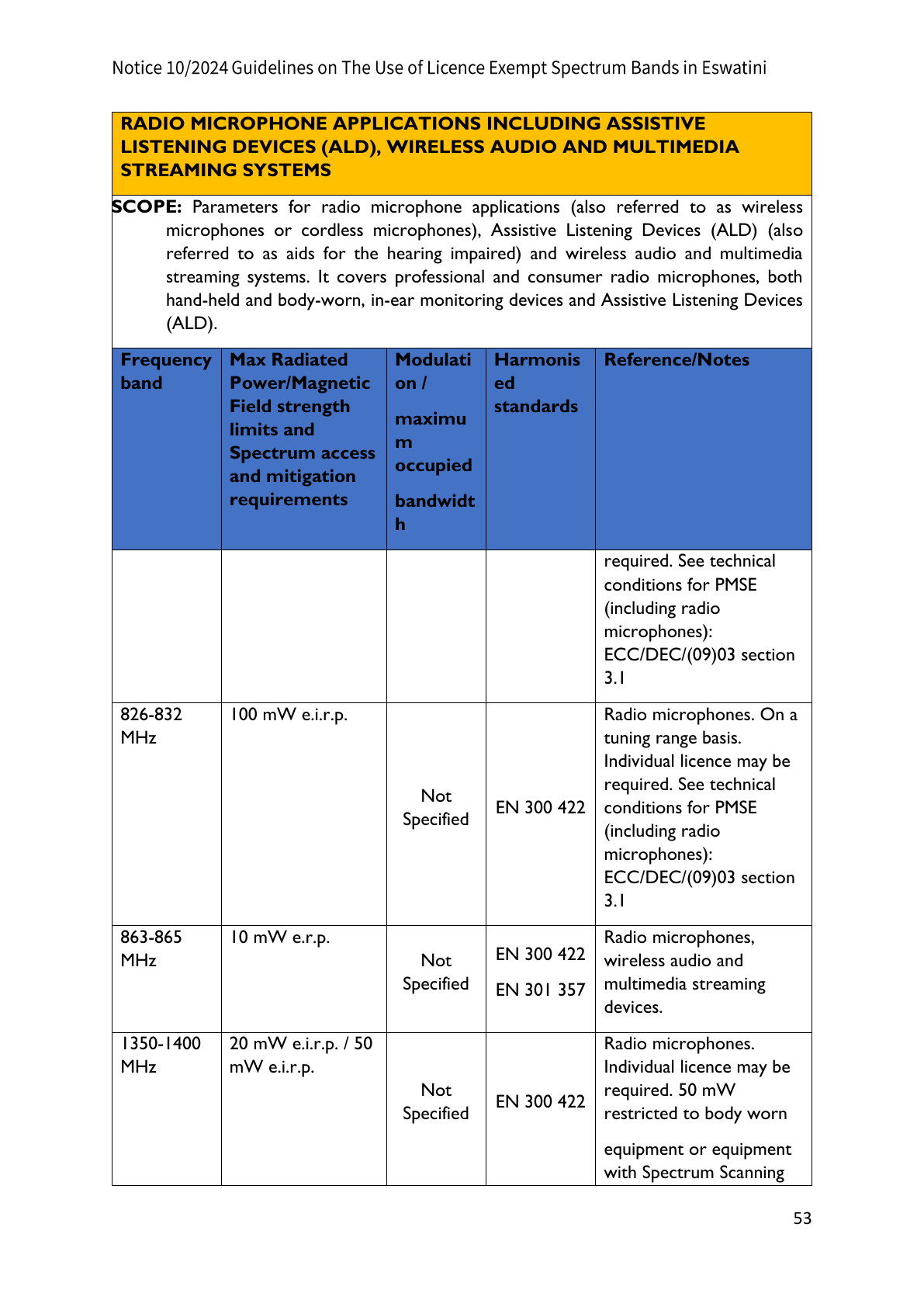
RADIO MICROPHONE APPLICATIONS INCLUDING ASSISTIVE LISTENING DEVICES (ALD), WIRELESS AUDIO AND MULTIMEDIA STREAMING SYSTEMS
SCOPE: Parameters for radio microphone applications (also referred to as wireless microphones or cordless microphones), Assistive Listening Devices (ALD) (also referred to as aids for the hearing impaired) and wireless audio and multimedia streaming systems. It covers professional and consumer radio microphones, both hand-held and body-worn, in-ear monitoring devices and Assistive Listening Devices (ALD).
Frequency band
Max Radiated Power/Magnetic Field strength limits and Spectrum access and mitigation requirements
Modulation / maximum occupied bandwidth
Harmonised standards
Reference/Notes
required. See technical conditions for PMSE (including radio microphones): ECC/DEC/(09)03 section 3.1
826-832 MHz
100 mW e.i.r.p.
Not Specified
EN 300 422
Radio microphones. On a tuning range basis. Individual licence may be required. See technical conditions for PMSE (including radio microphones): ECC/DEC/(09)03 section 3.1
863-865 MHz
10 mW e.r.p.
Not Specified
EN 300 422
EN 301 357
Radio microphones, wireless audio and multimedia streaming devices.
1350-1400 MHz
20 mW e.i.r.p. / 50 mW e.i.r.p.
Not Specified
EN 300 422
Radio microphones. Individual licence may be required. 50 mW restricted to body worn equipment or equipment with Spectrum Scanning
53
Original PDF page 53 — retained source fields, tables and layout.
Notice 10/2024 Guidelines on The Use of Licence Exempt Spectrum Bands in Eswatini
RADIO MICROPHONE APPLICATIONS INCLUDING ASSISTIVE LISTENING DEVICES (ALD), WIRELESS AUDIO AND MULTIMEDIA STREAMING SYSTEMS
SCOPE: Parameters for radio microphone applications (also referred to as wireless microphones or cordless microphones), Assistive Listening Devices (ALD) (also referred to as aids for the hearing impaired) and wireless audio and multimedia streaming systems. It covers professional and consumer radio microphones, both hand-held and body-worn, in-ear monitoring devices and Assistive Listening Devices (ALD).
Frequency band
Max Radiated Power/Magnetic Field strength limits and Spectrum access and mitigation requirements
Modulation / maximum occupied bandwidth
Harmonised standards
Reference/Notes
Procedure (SSP) implemented for the 1350-1400 MHz band
1492-1518 MHz
50 mW e.i.r.p
Not Specified
EN 300 422
Radio microphones. On a tuning range basis. Individual licence required. Restricted to indoor use
1518-1525 MHz
50 mW e.i.r.p.
Not Specified
EN 300 422
Radio microphones. On a tuning range basis. Individual licence required. Restricted to indoor use
1656.5-1660.5 MHz
2 mW/ 600 kHz e.i.r.p
Not Specified
EN 300 422
Assistive Listening Systems. Individual licence may be required. ECC Report 270
1785-1795 MHz
20 mW e.i.r.p. / 50 mW e.i.r.p
Not Specified
EN 300 422
Radio microphones. Individual licence may be required. 50 mW restricted to body worn equipment or equipment
54
Original PDF page 54 — retained source fields, tables and layout.
Notice 10/2024 Guidelines on The Use of Licence Exempt Spectrum Bands in Eswatini
RADIO MICROPHONE APPLICATIONS INCLUDING ASSISTIVE LISTENING DEVICES (ALD), WIRELESS AUDIO AND MULTIMEDIA STREAMING SYSTEMS
SCOPE: Parameters for radio microphone applications (also referred to as wireless microphones or cordless microphones), Assistive Listening Devices (ALD) (also referred to as aids for the hearing impaired) and wireless audio and multimedia streaming systems. It covers professional and consumer radio microphones, both hand-held and body-worn, in-ear monitoring devices and Assistive Listening Devices (ALD).
Frequency band
Max Radiated Power/Magnetic Field strength limits and Spectrum access and mitigation requirements
Modulation / maximum occupied bandwidth
Harmonised standards
Reference/Notes
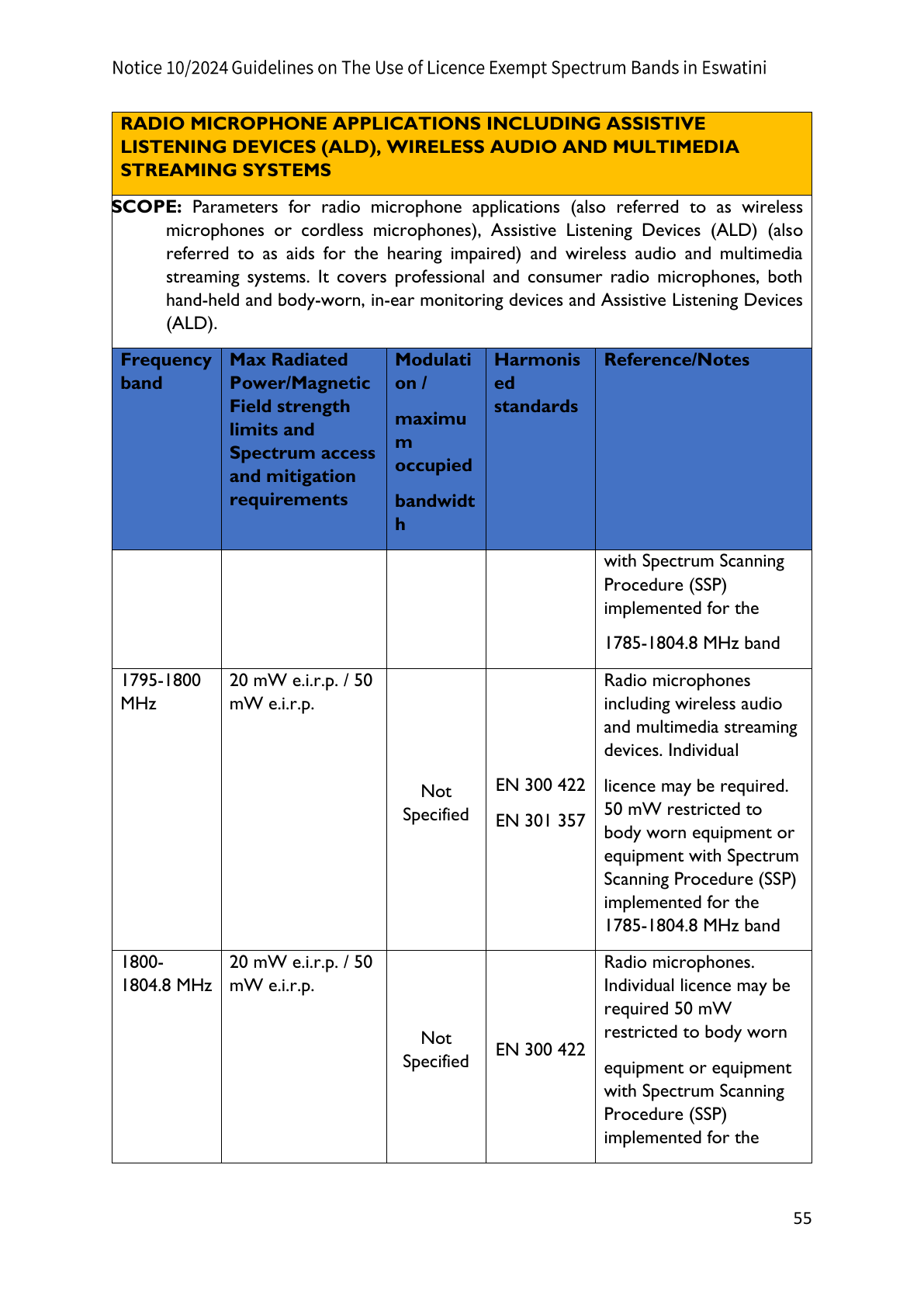
with Spectrum Scanning Procedure (SSP) implemented for the 1785-1804.8 MHz band
1795-1800 MHz
20 mW e.i.r.p. / 50 mW e.i.r.p.
Not Specified
EN 300 422
EN 301 357
Radio microphones including wireless audio and multimedia streaming devices. Individual licence may be required. 50 mW restricted to body worn equipment or equipment with Spectrum Scanning Procedure (SSP) implemented for the 1785-1804.8 MHz band
1800-1804.8 MHz
20 mW e.i.r.p. / 50 mW e.i.r.p.
Not Specified
EN 300 422
Radio microphones. Individual licence may be required 50 mW restricted to body worn equipment or equipment with Spectrum Scanning Procedure (SSP) implemented for the
55
Original PDF page 55 — retained source fields, tables and layout.
Notice 10/2024 Guidelines on The Use of Licence Exempt Spectrum Bands in Eswatini
RADIO MICROPHONE APPLICATIONS INCLUDING ASSISTIVE LISTENING DEVICES (ALD), WIRELESS AUDIO AND MULTIMEDIA STREAMING SYSTEMS
SCOPE: Parameters for radio microphone applications (also referred to as wireless microphones or cordless microphones), Assistive Listening Devices (ALD) (also referred to as aids for the hearing impaired) and wireless audio and multimedia streaming systems. It covers professional and consumer radio microphones, both hand-held and body-worn, in-ear monitoring devices and Assistive Listening Devices (ALD).
Frequency band
Max Radiated Power/Magnetic Field strength limits and Spectrum access and mitigation requirements
Modulation / maximum occupied bandwidth
Harmonised standards
Reference/Notes
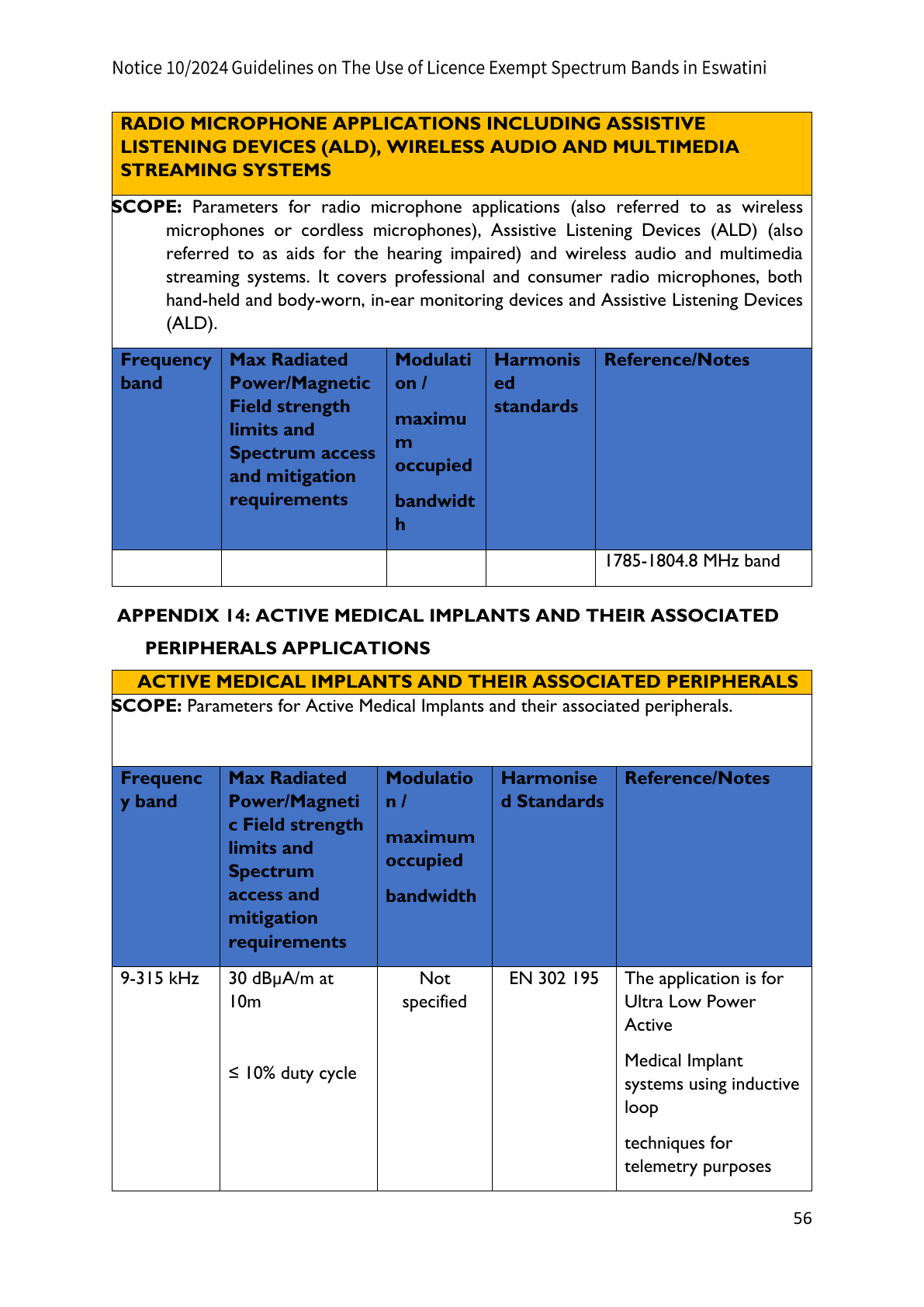
1785-1804.8 MHz band
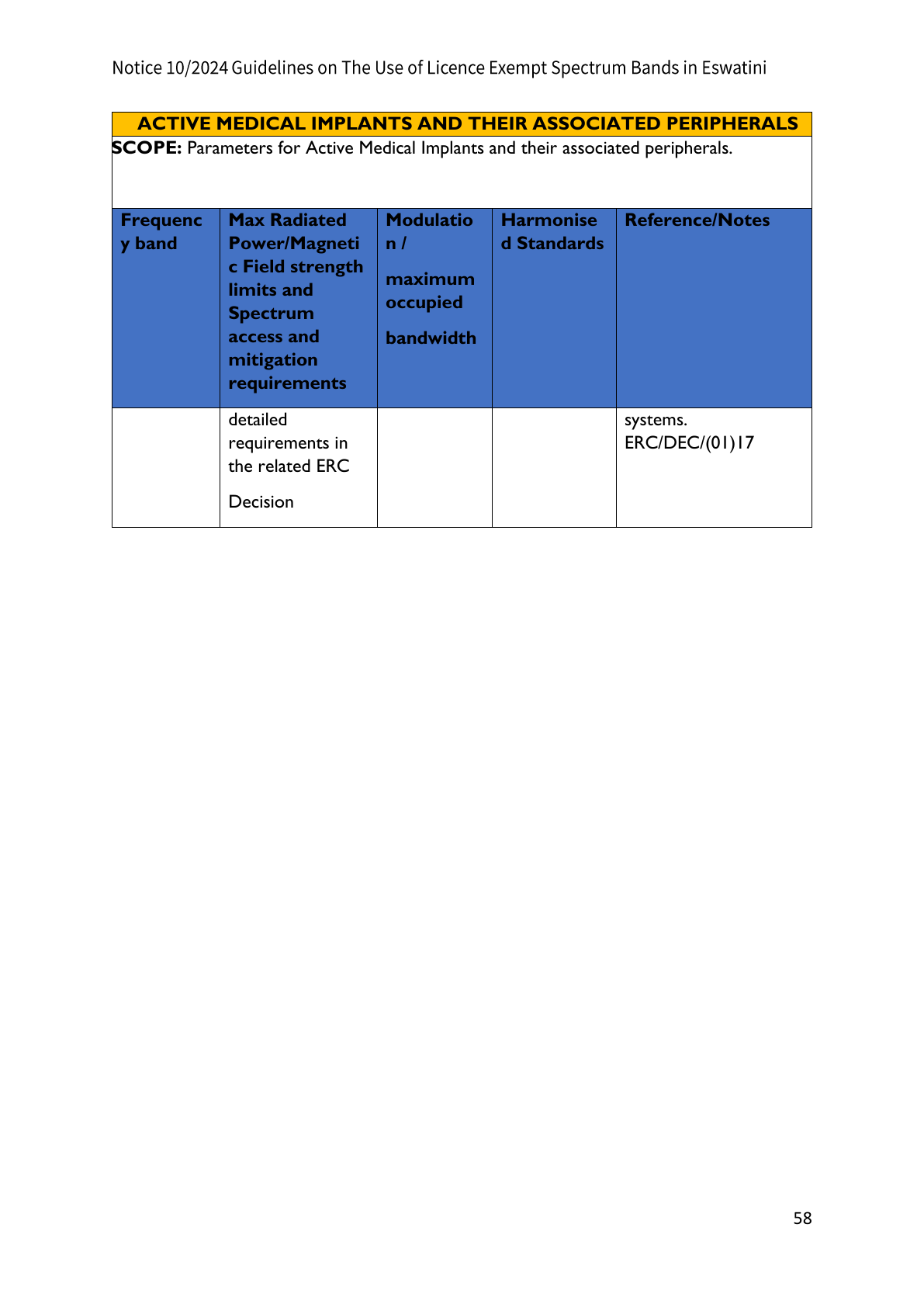
APPENDIX 14: ACTIVE MEDICAL IMPLANTS AND THEIR ASSOCIATED PERIPHERALS APPLICATIONS
ACTIVE MEDICAL IMPLANTS AND THEIR ASSOCIATED PERIPHERALS
SCOPE: Parameters for Active Medical Implants and their associated peripherals.
Frequency band
Max Radiated Power/Magnetic Field strength limits and Spectrum access and mitigation requirements
Modulation / maximum occupied bandwidth
Harmonised Standards
Reference/Notes
9-315 kHz
30 dBµA/m at 10m
≤ 10% duty cycle
Not specified
EN 302 195
The application is for Ultra Low Power Active Medical Implant systems using inductive loop techniques for telemetry purposes
56
Original PDF page 56 — retained source fields, tables and layout.
Notice 10/2024 Guidelines on The Use of Licence Exempt Spectrum Bands in Eswatini
ACTIVE MEDICAL IMPLANTS AND THEIR ASSOCIATED PERIPHERALS
SCOPE: Parameters for Active Medical Implants and their associated peripherals.
Frequency band
Max Radiated Power/Magnetic Field strength limits and Spectrum access and mitigation requirements
Modulation / maximum occupied bandwidth
Harmonised Standards
Reference/Notes
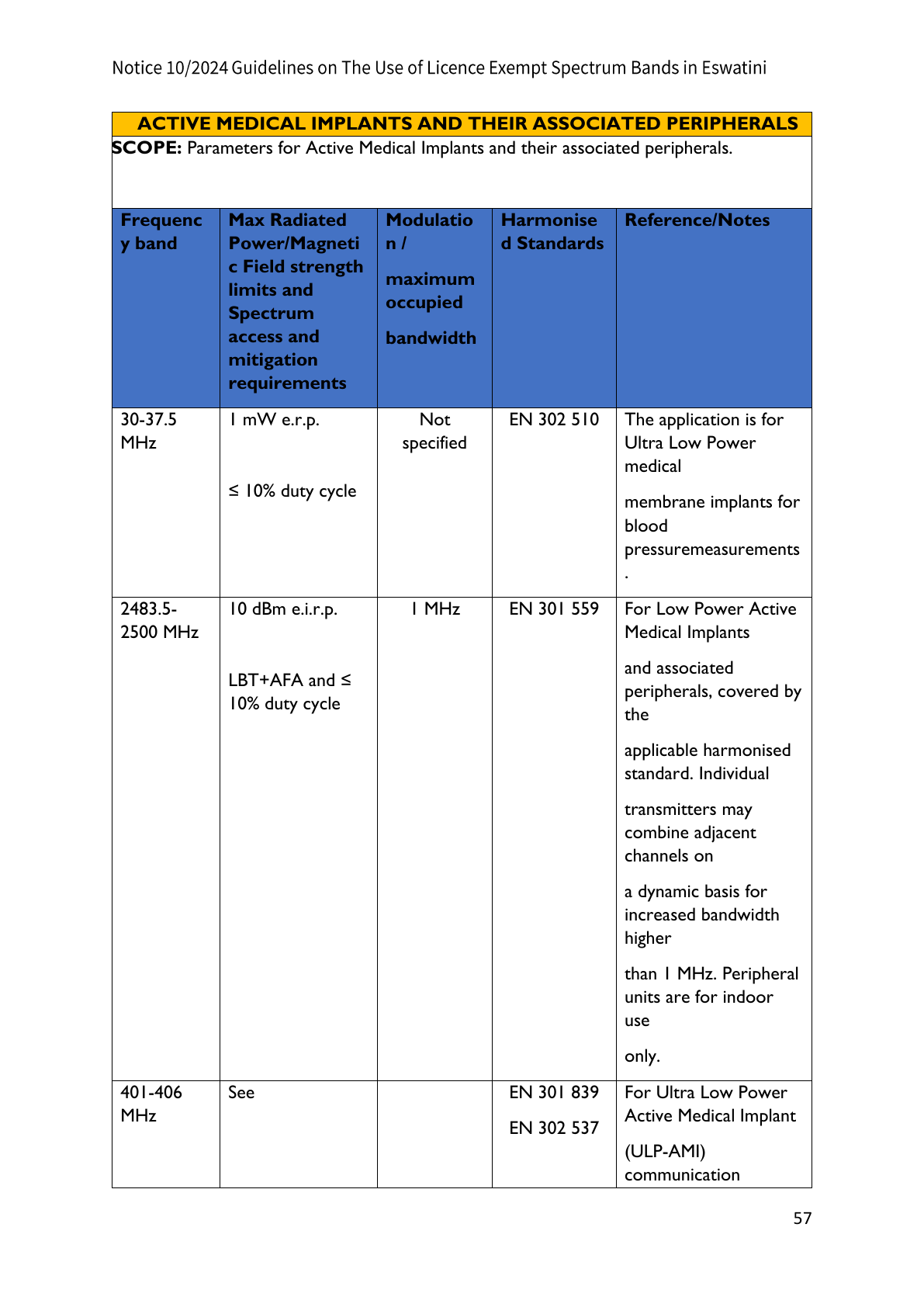
30-37.5 MHz
1 mW e.r.p.
≤ 10% duty cycle
Not specified
EN 302 510
The application is for Ultra Low Power medical membrane implants for blood pressuremeasurements.
2483.5-2500 MHz
10 dBm e.i.r.p.
LBT+AFA and ≤ 10% duty cycle
1 MHz
EN 301 559
For Low Power Active Medical Implants and associated peripherals, covered by the applicable harmonised standard. Individual transmitters may combine adjacent channels on a dynamic basis for increased bandwidth higher than 1 MHz. Peripheral units are for indoor use only.
401-406 MHz
See
EN 301 839
EN 302 537
For Ultra Low Power Active Medical Implant (ULP-AMI) communication
57
Original PDF page 57 — retained source fields, tables and layout.
Notice 10/2024 Guidelines on The Use of Licence Exempt Spectrum Bands in Eswatini
ACTIVE MEDICAL IMPLANTS AND THEIR ASSOCIATED PERIPHERALS
SCOPE: Parameters for Active Medical Implants and their associated peripherals.
Frequency band
Max Radiated Power/Magnetic Field strength limits and Spectrum access and mitigation requirements
Modulation / maximum occupied bandwidth
Harmonised Standards
Reference/Notes
detailed requirements in the related ERC Decision
systems.
ERC/DEC/(01)17
58
Original PDF page 58 — retained source fields, tables and layout.
Notice 10/2024 Guidelines on The Use of Licence Exempt Spectrum Bands in Eswatini
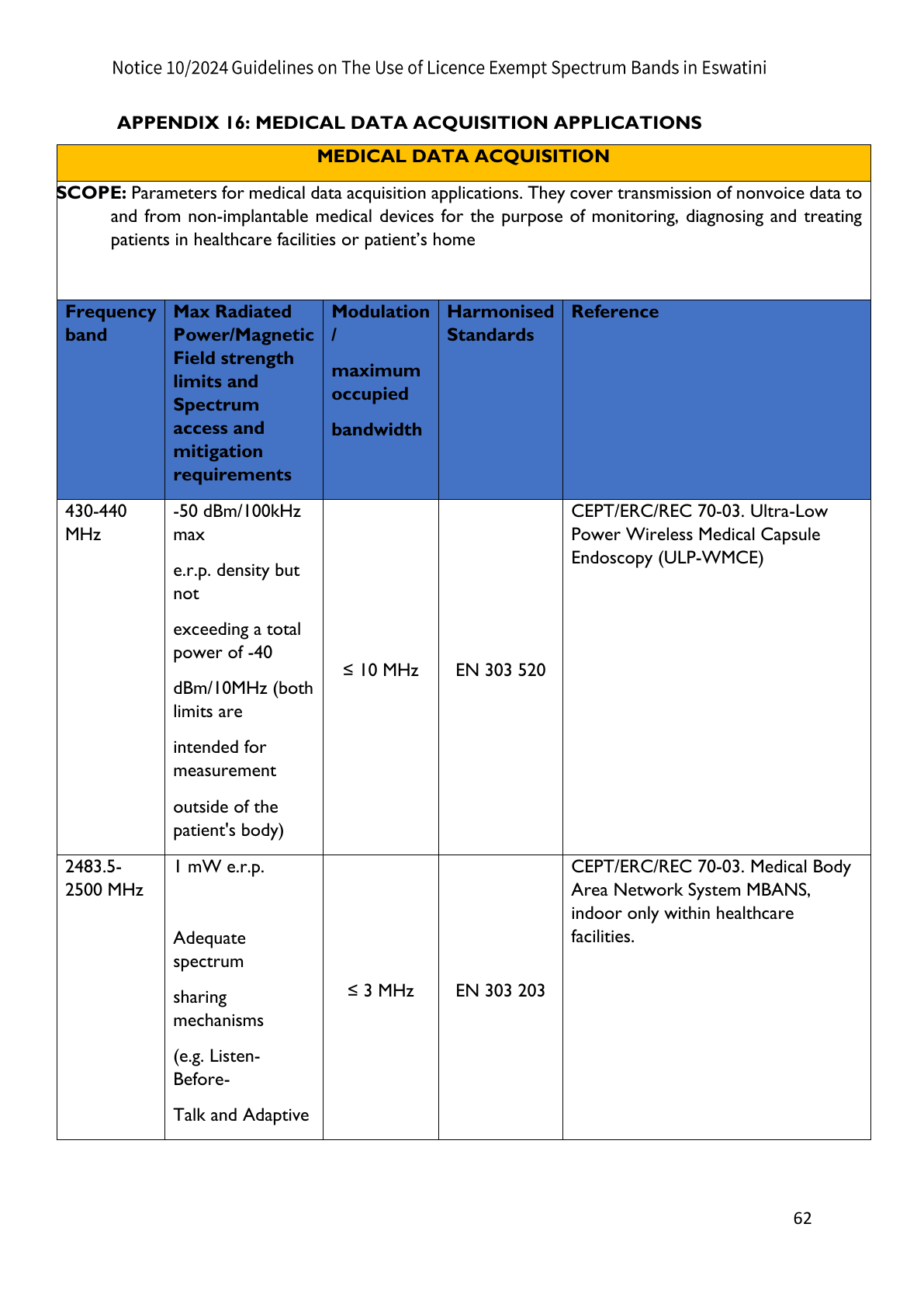
APPENDIX 16: MEDICAL DATA ACQUISITION APPLICATIONS
MEDICAL DATA ACQUISITION
SCOPE: Parameters for medical data acquisition applications. They cover transmission of nonvoice data to and from non-implantable medical devices for the purpose of monitoring, diagnosing and treating patients in healthcare facilities or patient’s home
Frequency band
Max Radiated Power/Magnetic Field strength limits and Spectrum access and mitigation requirements
Modulation / maximum occupied bandwidth
Harmonised Standards
Reference
430-440 MHz
-50 dBm/100kHz max e.r.p. density but not exceeding a total power of -40 dBm/10MHz (both limits are intended for measurement outside of the patient's body)
≤ 10 MHz
EN 303 520
CEPT/ERC/REC 70-03. Ultra-Low Power Wireless Medical Capsule Endoscopy (ULP-WMCE)
2483.5-2500 MHz
1 mW e.r.p.
Adequate spectrum sharing mechanisms (e.g. Listen-Before-Talk and Adaptive
≤ 3 MHz
EN 303 203
CEPT/ERC/REC 70-03. Medical Body Area Network System MBANS, indoor only within healthcare facilities.
62
Original PDF page 62 — retained source fields, tables and layout.
Notice 10/2024 Guidelines on The Use of Licence Exempt Spectrum Bands in Eswatini
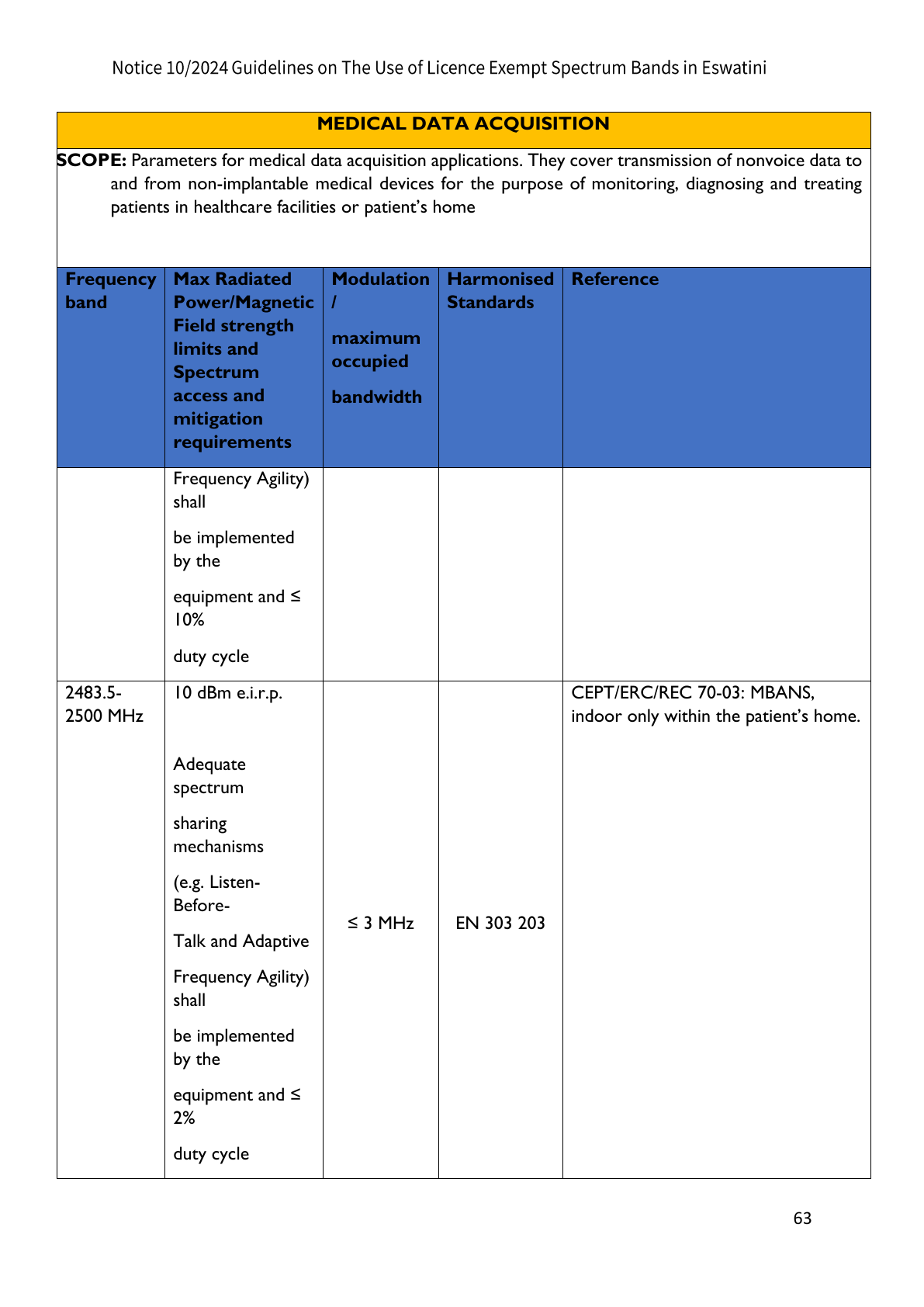
MEDICAL DATA ACQUISITION
SCOPE: Parameters for medical data acquisition applications. They cover transmission of nonvoice data to and from non-implantable medical devices for the purpose of monitoring, diagnosing and treating patients in healthcare facilities or patient’s home
Frequency band
Max Radiated Power/Magnetic Field strength limits and Spectrum access and mitigation requirements
Modulation / maximum occupied bandwidth
Harmonised Standards
Reference
Frequency Agility) shall be implemented by the equipment and ≤ 10% duty cycle
2483.5-2500 MHz
10 dBm e.i.r.p.
Adequate spectrum sharing mechanisms (e.g. Listen-Before-Talk and Adaptive Frequency Agility) shall be implemented by the equipment and ≤ 2% duty cycle
≤ 3 MHz
EN 303 203
CEPT/ERC/REC 70-03: MBANS, indoor only within the patient’s home.
63
Original PDF page 63 — retained source fields, tables and layout.