MCA-GL-501, version 4 — Guideline for Clinical Trials in Humans
Currentness under review. Whether this instrument remains applicable is under review. Consult the later instruments and source context below before relying on it.
Link directly to a passage with its anchor — for example #pdf-page-1 — to open it highlighted. This reference version is generated from the authority’s publication and does not replace it. Language: English.
Original PDF page 1 — retained source fields, tables and layout.
Guideline for Clinical Trials in Humans MCA The Gambia
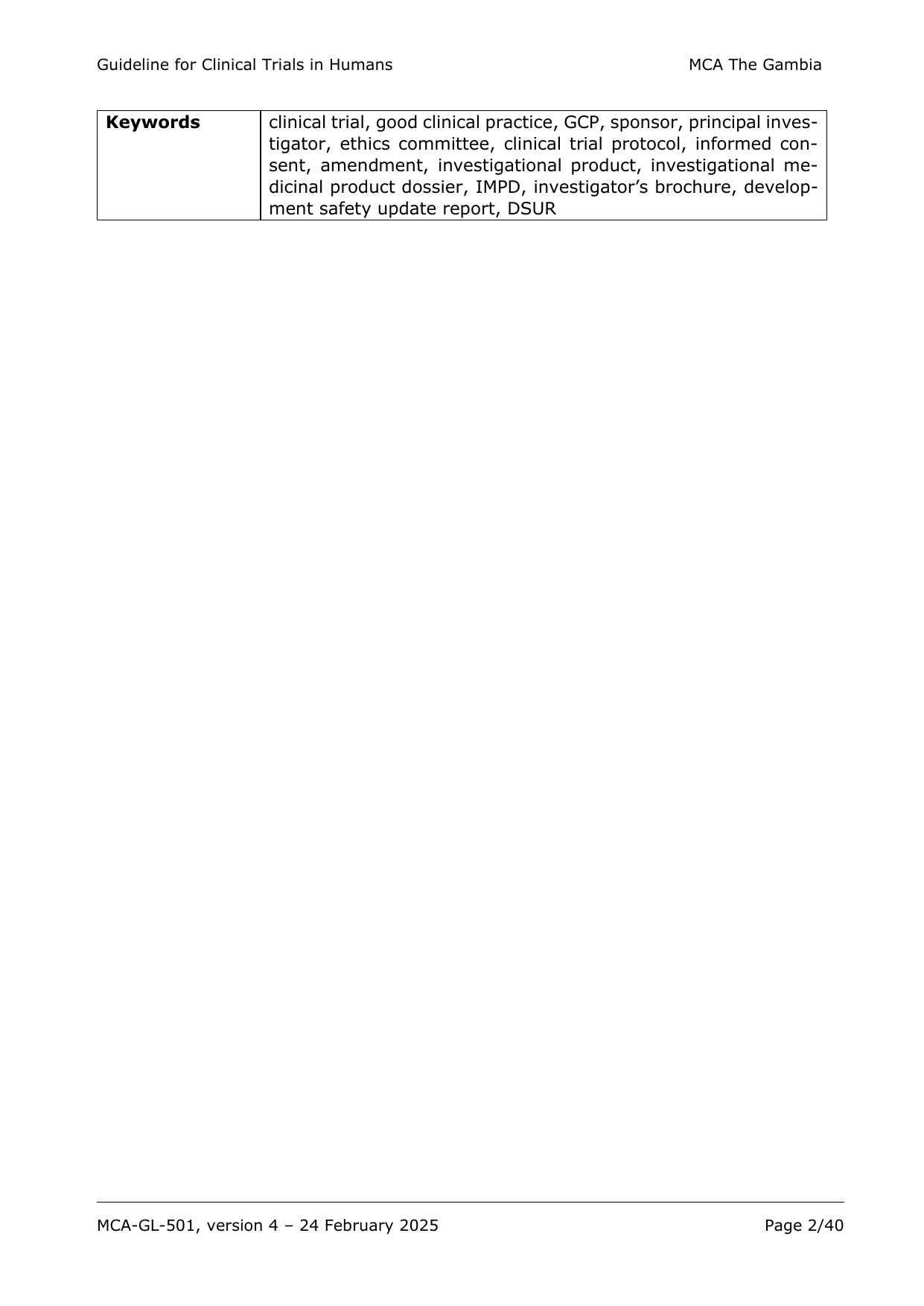
Keywords clinical trial, good clinical practice, GCP, sponsor, principal inves-
tigator, ethics committee, clinical trial protocol, informed con-
sent, amendment, investigational product, investigational me-
dicinal product dossier, IMPD, investigator’s brochure, develop-
ment safety update report, DSUR
MCA-GL-501, version 4 – 24 February 2025 Page 2/40
Original PDF page 2 — retained source fields, tables and layout.
Guideline for Clinical Trials in Humans MCA The Gambia
Guideline for Clinical Trials in Humans
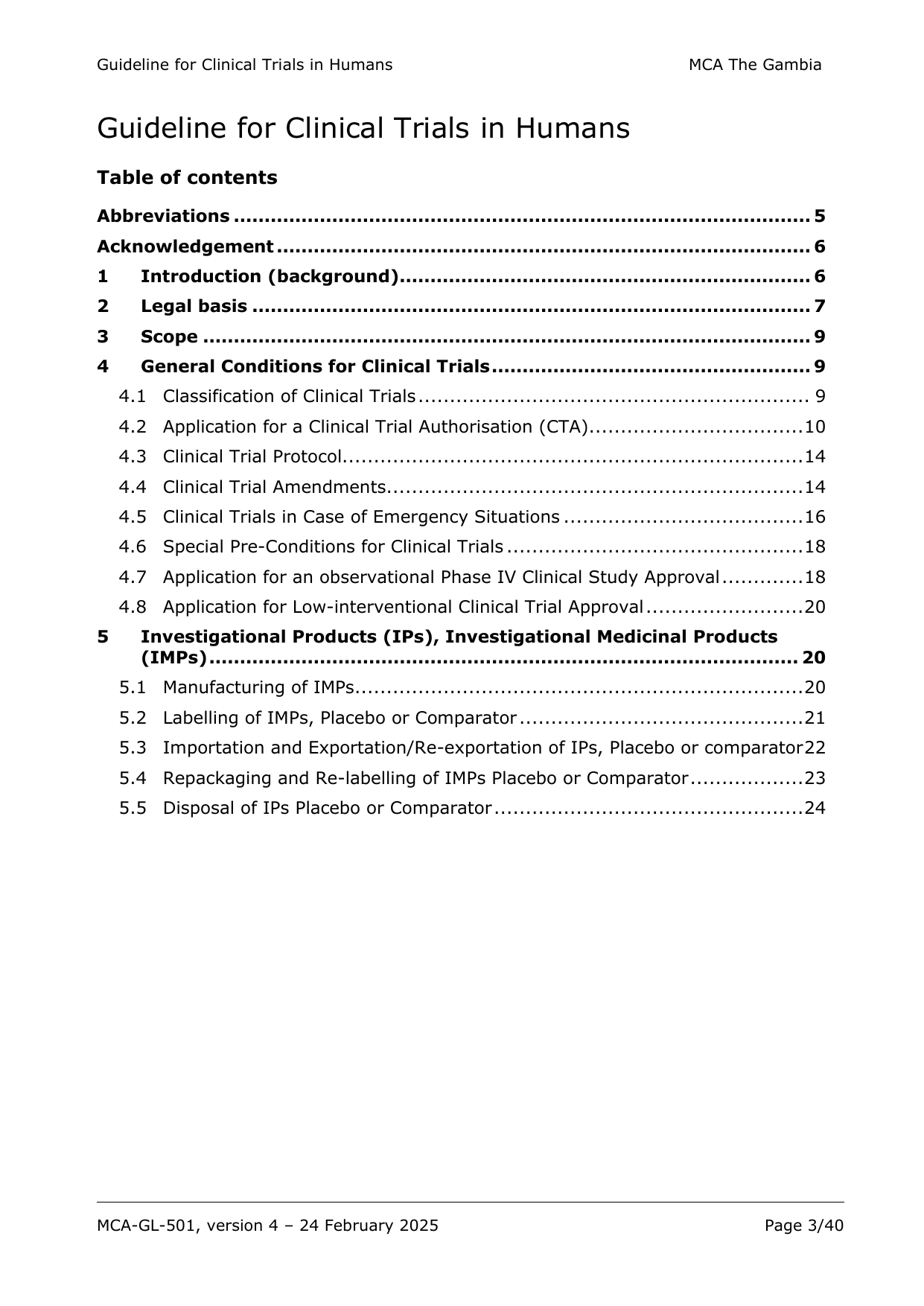
Table of contents
Abbreviations .............................................................................................. 5
Acknowledgement ....................................................................................... 6
1 Introduction (background)................................................................... 6
2 Legal basis ........................................................................................... 7
3 Scope ................................................................................................... 9
4 General Conditions for Clinical Trials .................................................... 9
4.1 Classification of Clinical Trials .............................................................. 9
4.2 Application for a Clinical Trial Authorisation (CTA)..................................10
4.3 Clinical Trial Protocol.........................................................................14
4.4 Clinical Trial Amendments..................................................................14
4.5 Clinical Trials in Case of Emergency Situations ......................................16
4.6 Special Pre-Conditions for Clinical Trials ...............................................18
4.7 Application for an observational Phase IV Clinical Study Approval .............18
4.8 Application for Low-interventional Clinical Trial Approval ......................... 20
5 Investigational Products (IPs), Investigational Medicinal Products
(IMPs) ................................................................................................ 20
5.1 Manufacturing of IMPs.......................................................................20
5.2 Labelling of IMPs, Placebo or Comparator .............................................21
5.3 Importation and Exportation/Re-exportation of IPs, Placebo or comparator 22
5.4 Repackaging and Re-labelling of IMPs Placebo or Comparator ..................23
5.5 Disposal of IPs Placebo or Comparator .................................................24
MCA-GL-501, version 4 – 24 February 2025 Page 3/40
Original PDF page 3 — retained source fields, tables and layout.
Guideline for Clinical Trials in Humans MCA The Gambia
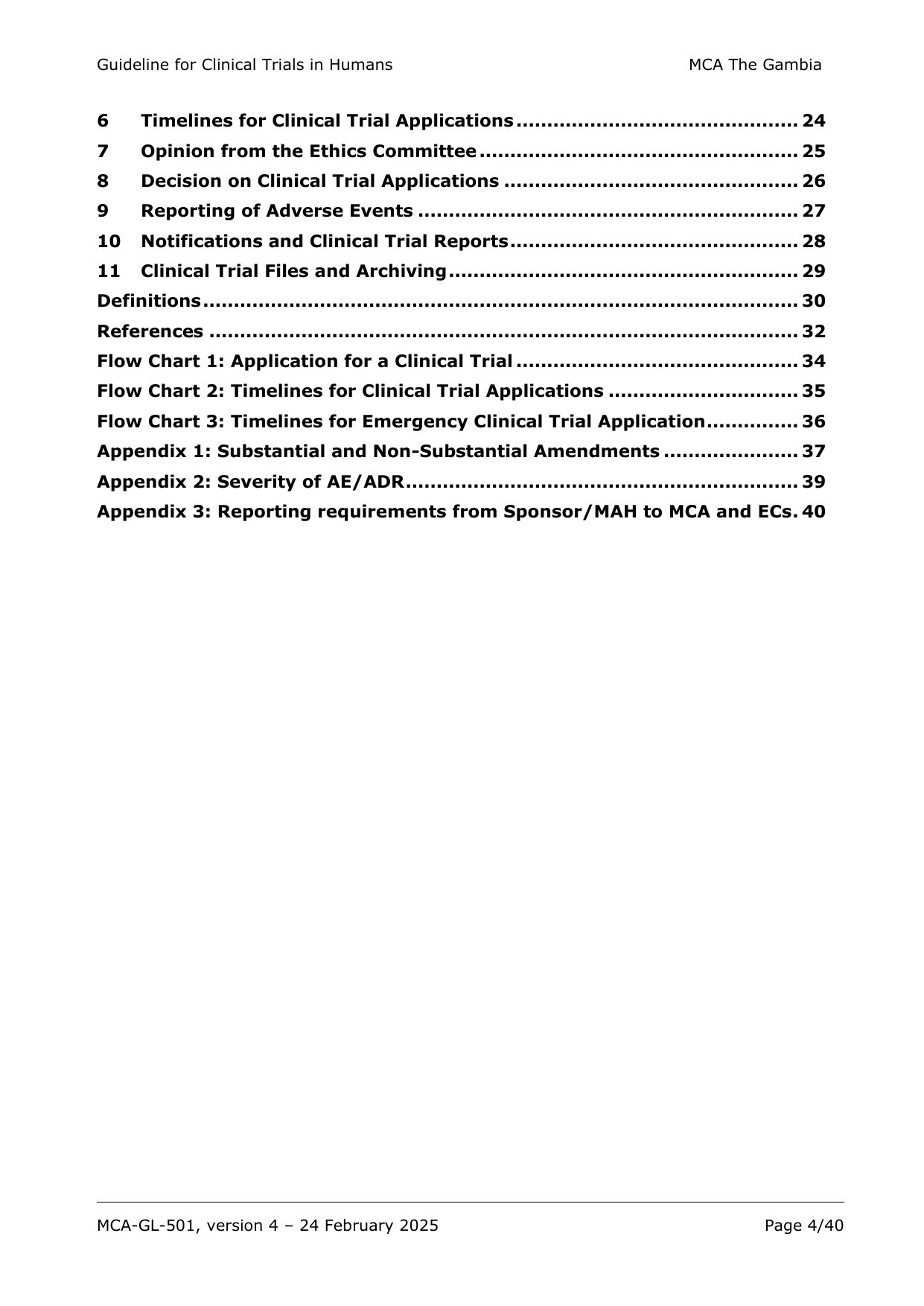
6 Timelines for Clinical Trial Applications .............................................. 24
7 Opinion from the Ethics Committee .................................................... 25
8 Decision on Clinical Trial Applications ................................................ 26
9 Reporting of Adverse Events .............................................................. 27
10 Notifications and Clinical Trial Reports ............................................... 28
11 Clinical Trial Files and Archiving ......................................................... 29
Definitions ................................................................................................. 30
References ................................................................................................ 32
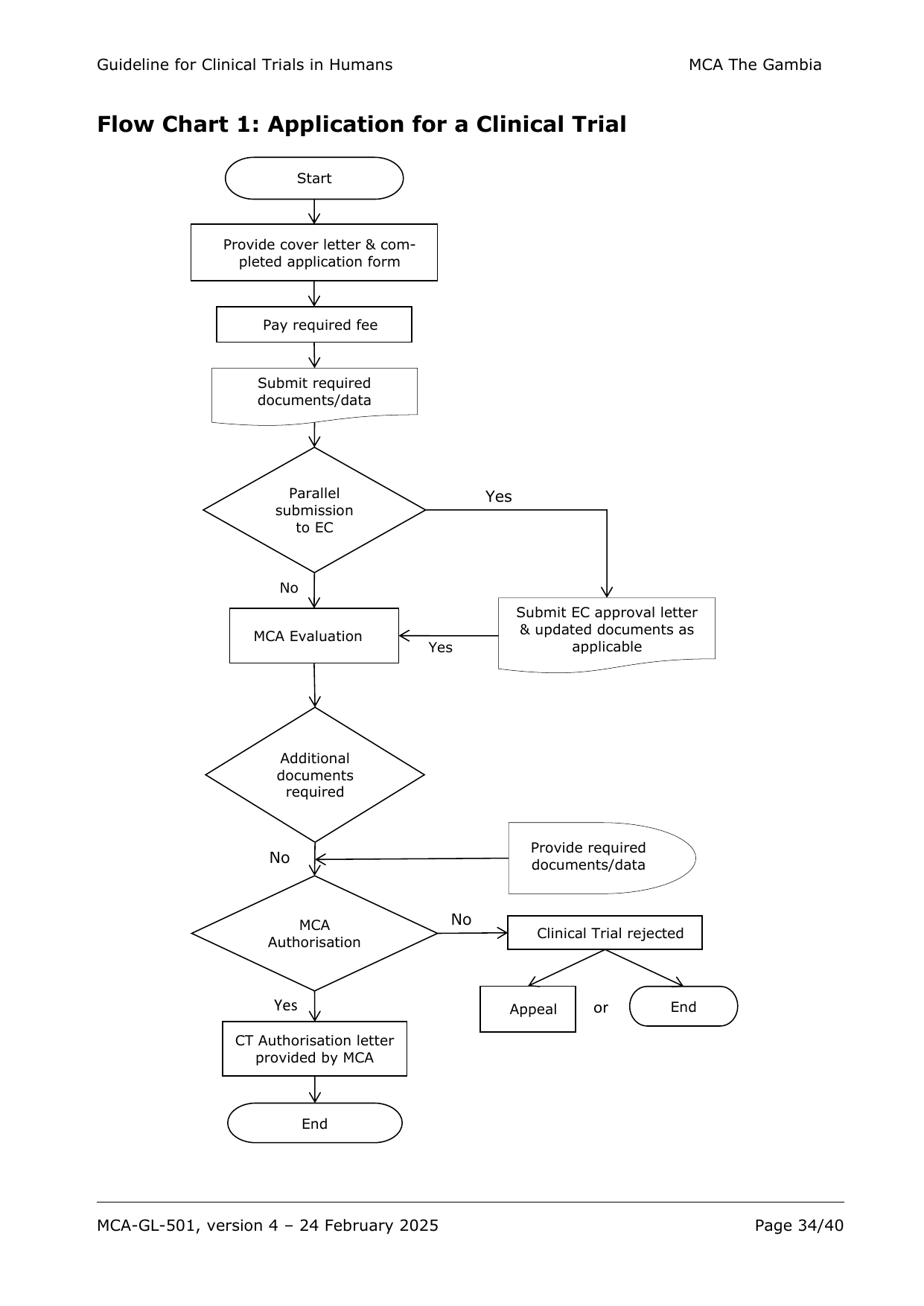
Flow Chart 1: Application for a Clinical Trial .............................................. 34
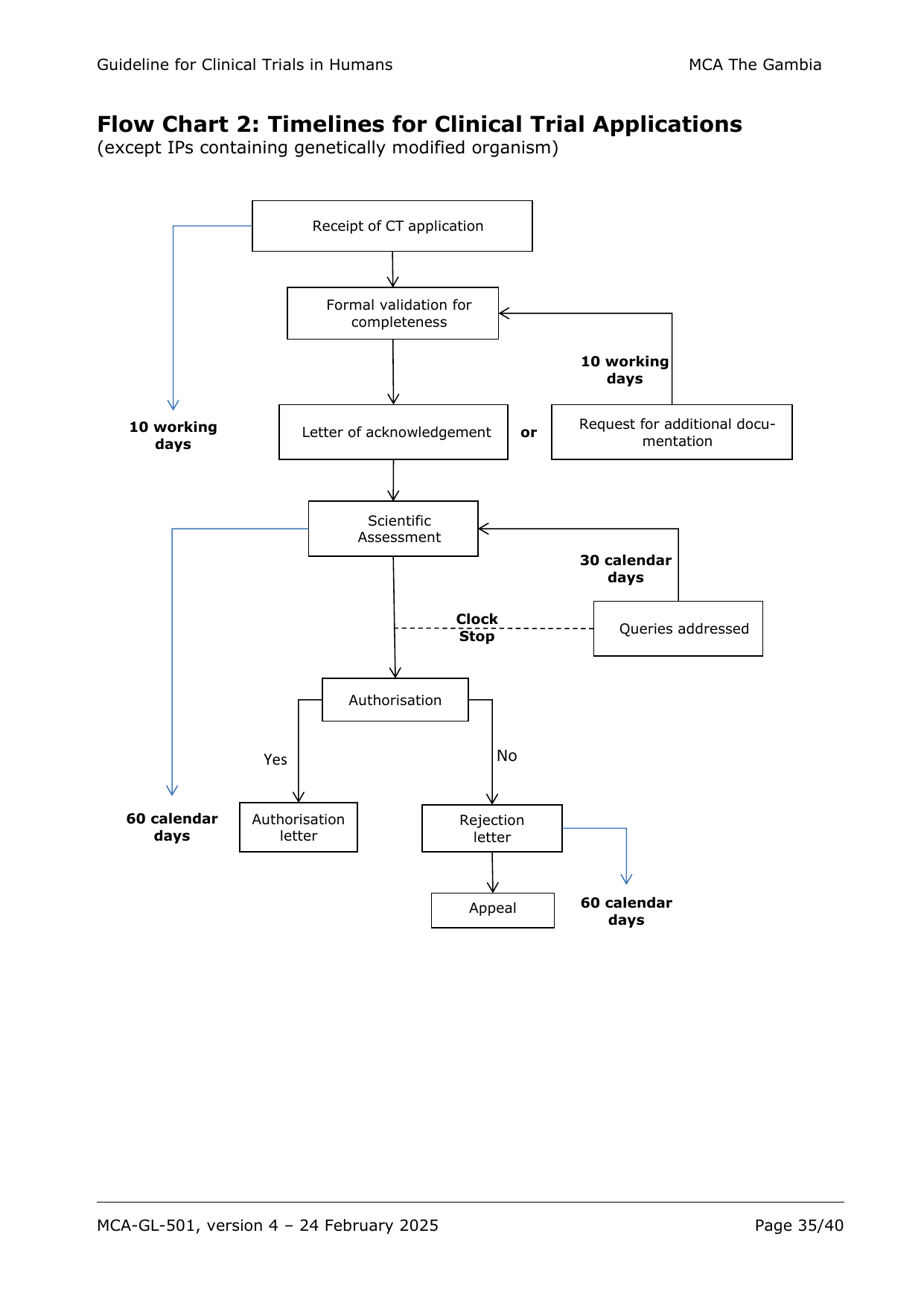
Flow Chart 2: Timelines for Clinical Trial Applications ............................... 35
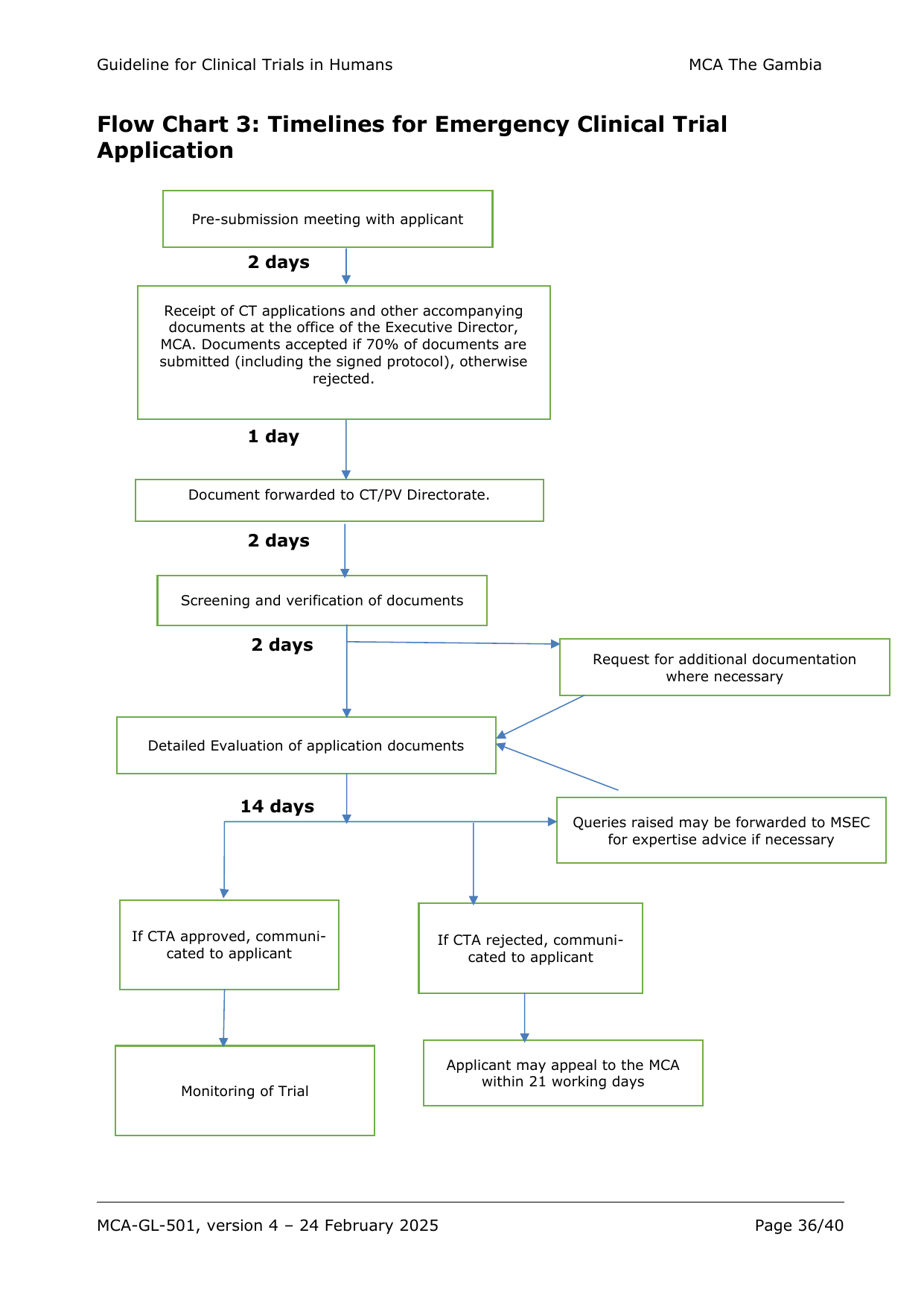
Flow Chart 3: Timelines for Emergency Clinical Trial Application ............... 36
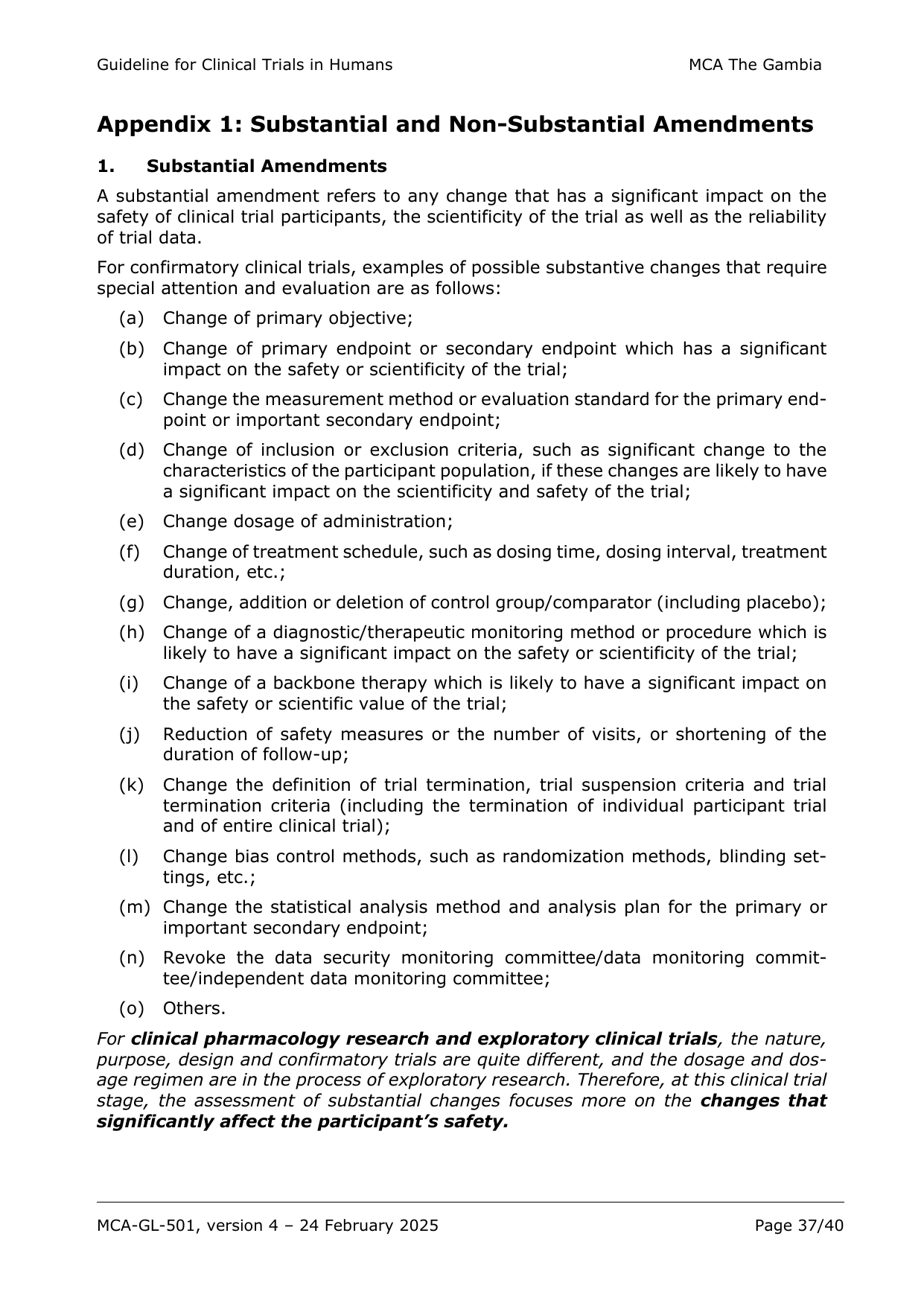
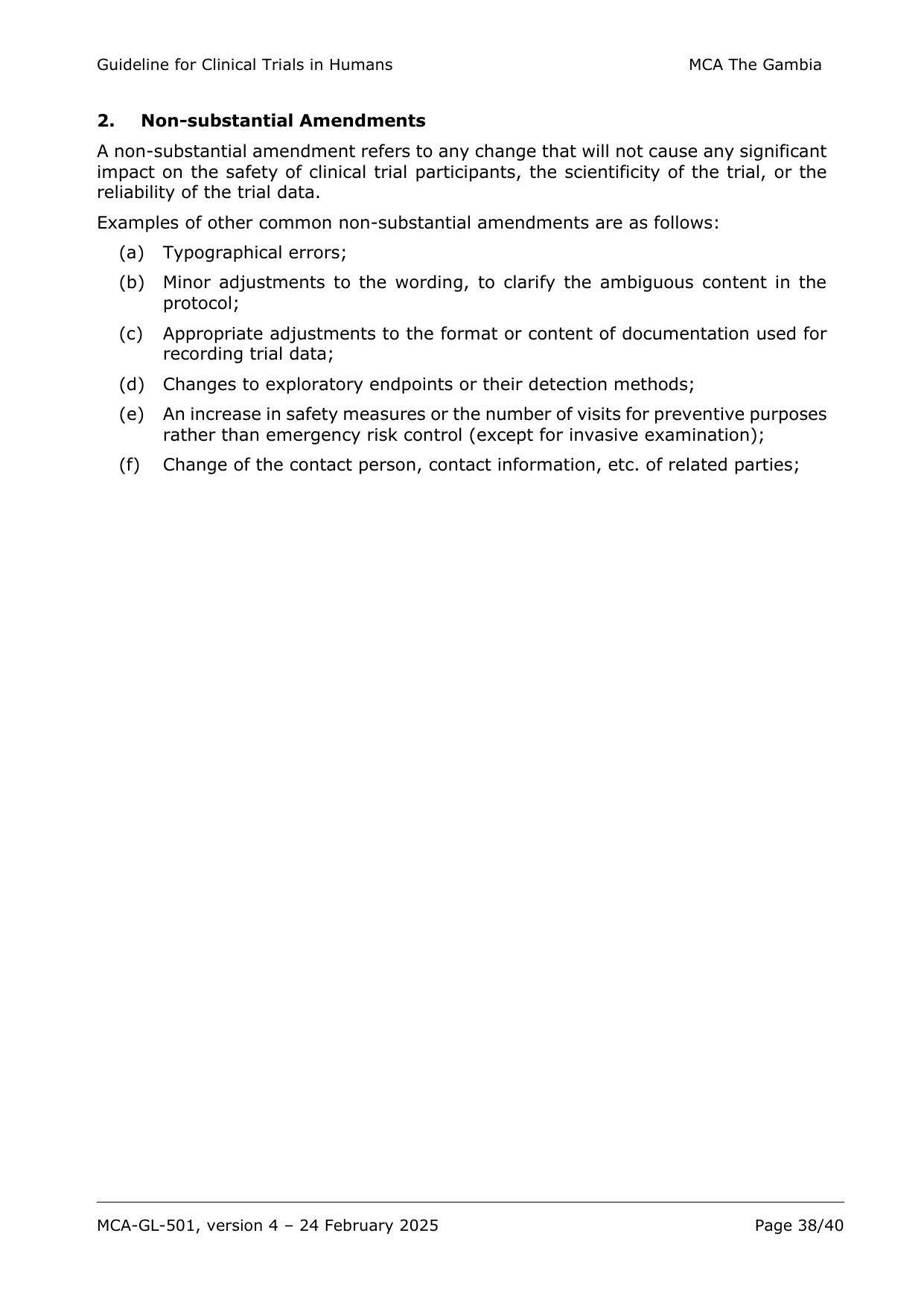
Appendix 1: Substantial and Non-Substantial Amendments ...................... 37
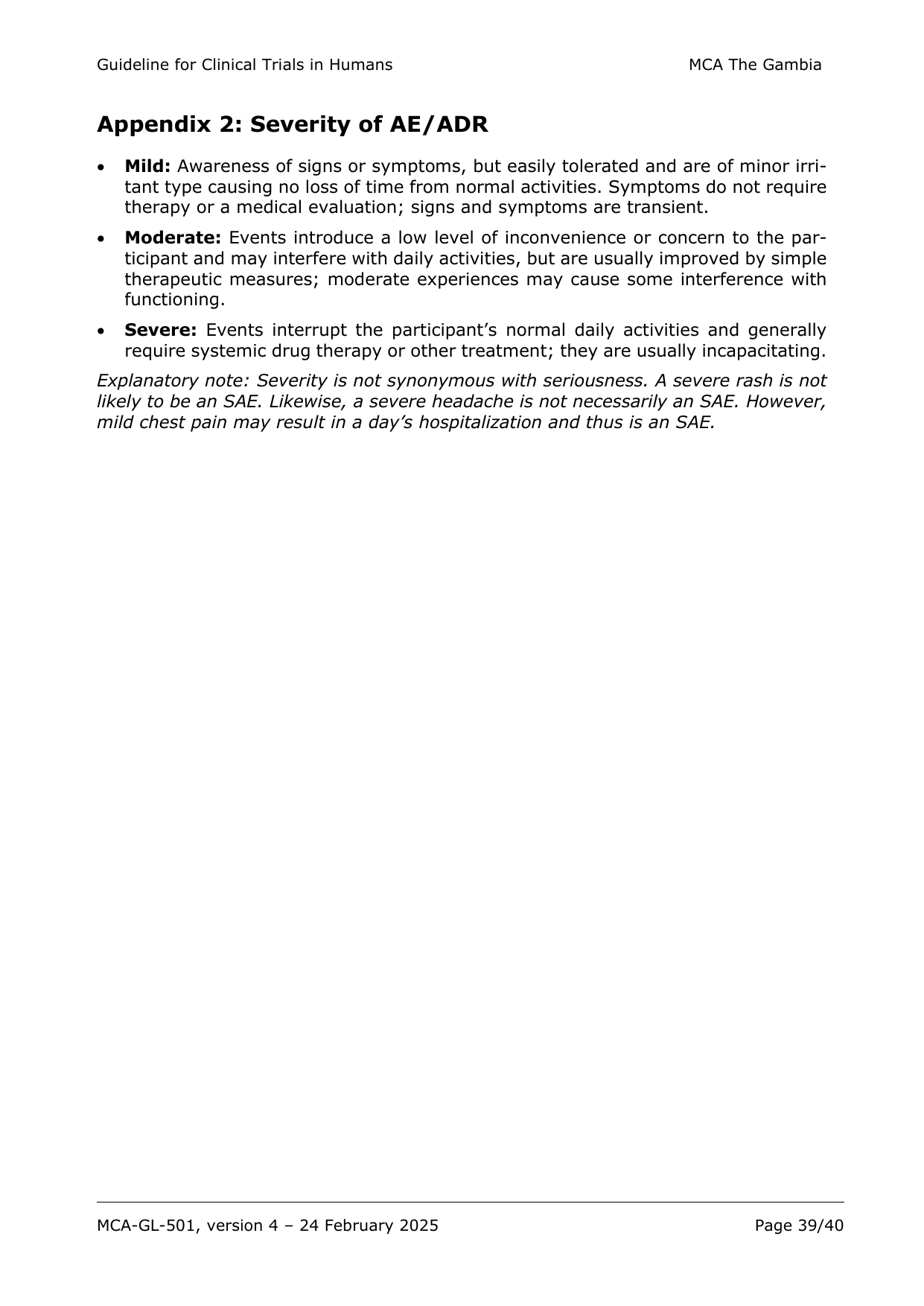
Appendix 2: Severity of AE/ADR ................................................................ 39
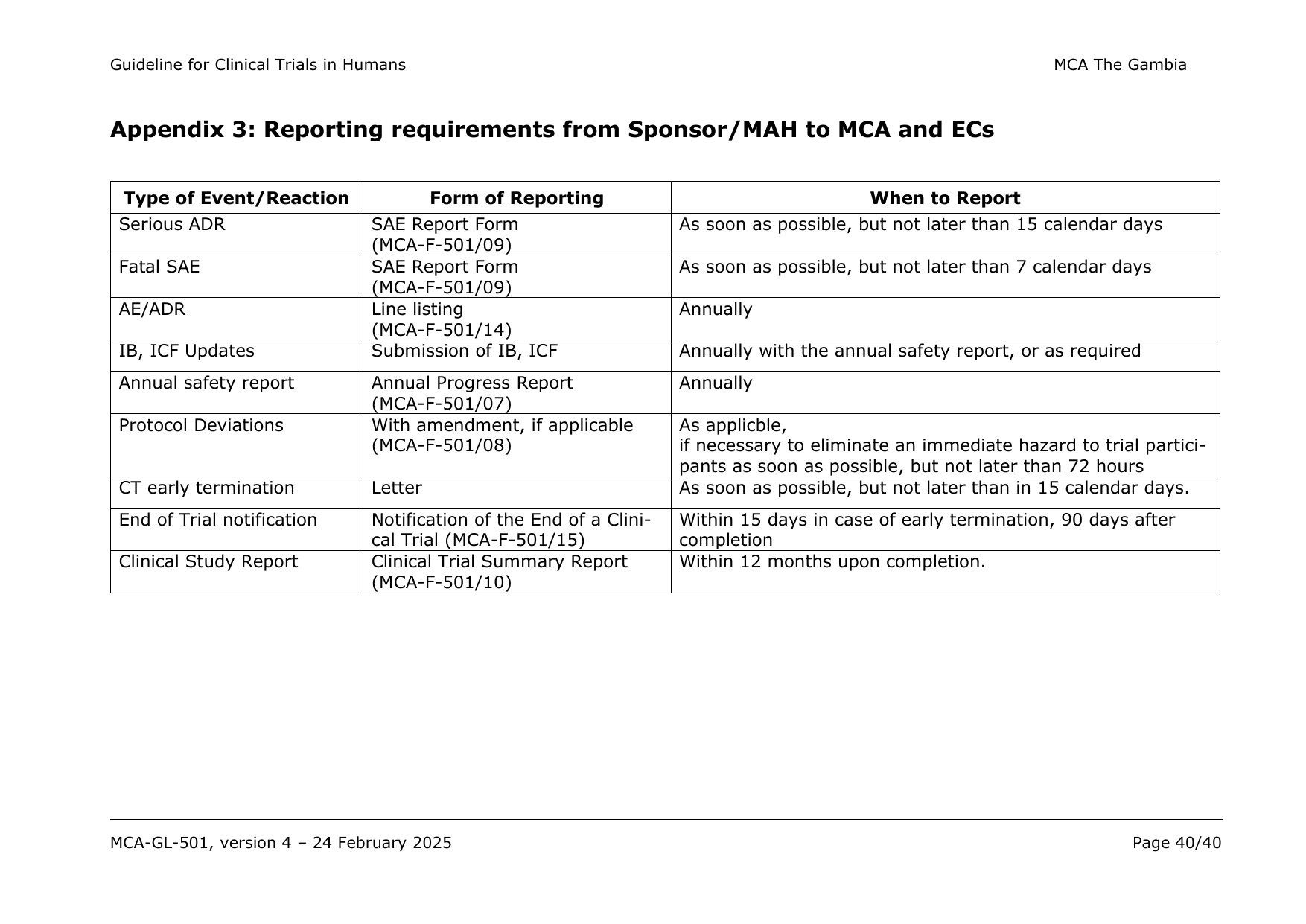
Appendix 3: Reporting requirements from Sponsor/MAH to MCA and ECs . 40
MCA-GL-501, version 4 – 24 February 2025 Page 4/40
Original PDF page 4 — retained source fields, tables and layout.
Guideline for Clinical Trials in Humans MCA The Gambia
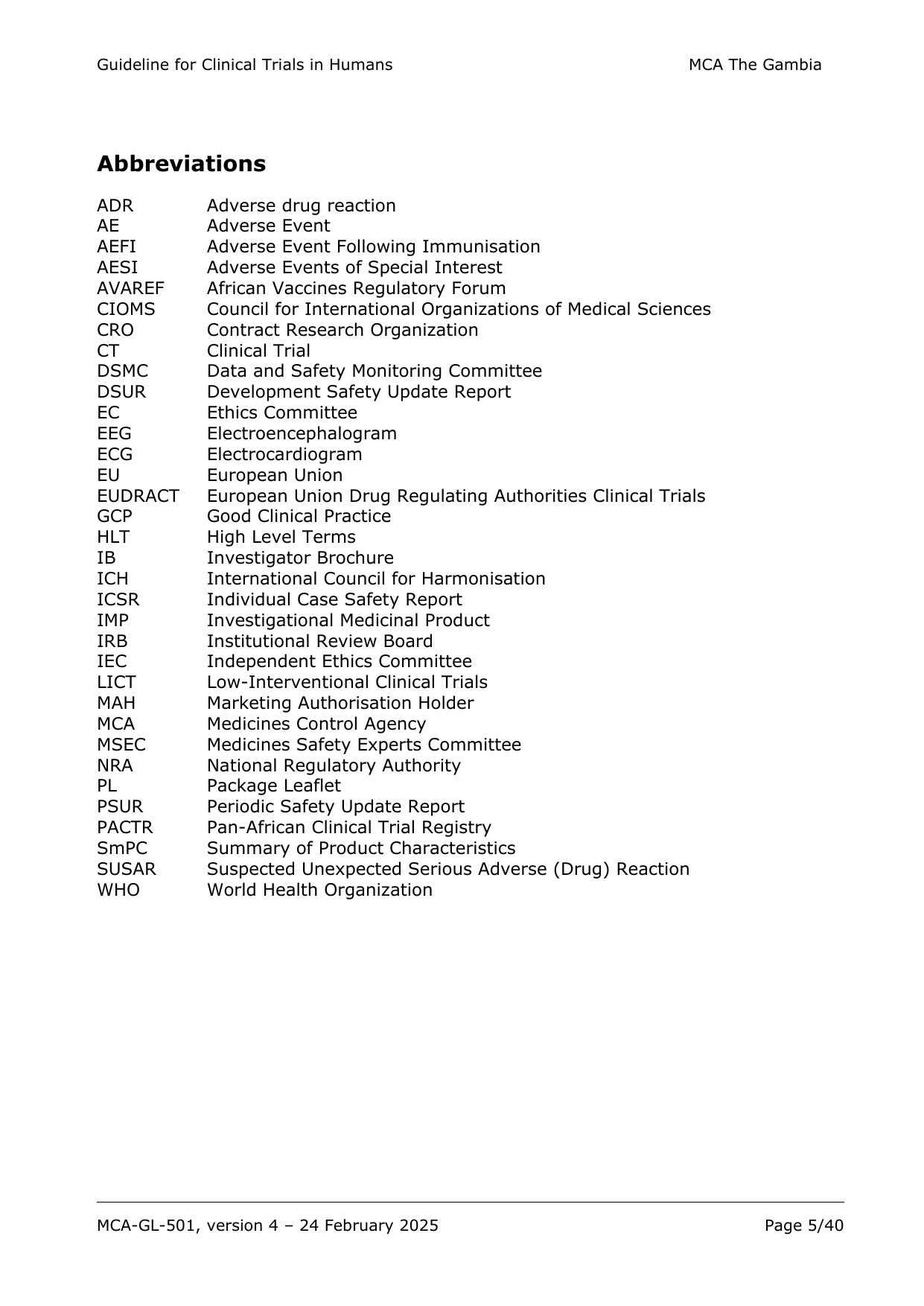
Abbreviations
ADR Adverse drug reaction
AE Adverse Event
AEFI Adverse Event Following Immunisation
AESI Adverse Events of Special Interest
AVAREF African Vaccines Regulatory Forum
CIOMS Council for International Organizations of Medical Sciences
CRO Contract Research Organization
CT Clinical Trial
DSMC Data and Safety Monitoring Committee
DSUR Development Safety Update Report
EC Ethics Committee
EEG Electroencephalogram
ECG Electrocardiogram
EU European Union
EUDRACT European Union Drug Regulating Authorities Clinical Trials
GCP Good Clinical Practice
HLT High Level Terms
IB Investigator Brochure
ICH International Council for Harmonisation
ICSR Individual Case Safety Report
IMP Investigational Medicinal Product
IRB Institutional Review Board
IEC Independent Ethics Committee
LICT Low-Interventional Clinical Trials
MAH Marketing Authorisation Holder
MCA Medicines Control Agency
MSEC Medicines Safety Experts Committee
NRA National Regulatory Authority
PL Package Leaflet
PSUR Periodic Safety Update Report
PACTR Pan-African Clinical Trial Registry
SmPC Summary of Product Characteristics
SUSAR Suspected Unexpected Serious Adverse (Drug) Reaction
WHO World Health Organization
MCA-GL-501, version 4 – 24 February 2025 Page 5/40
Original PDF page 5 — retained source fields, tables and layout.
Guideline for Clinical Trials in Humans MCA The Gambia
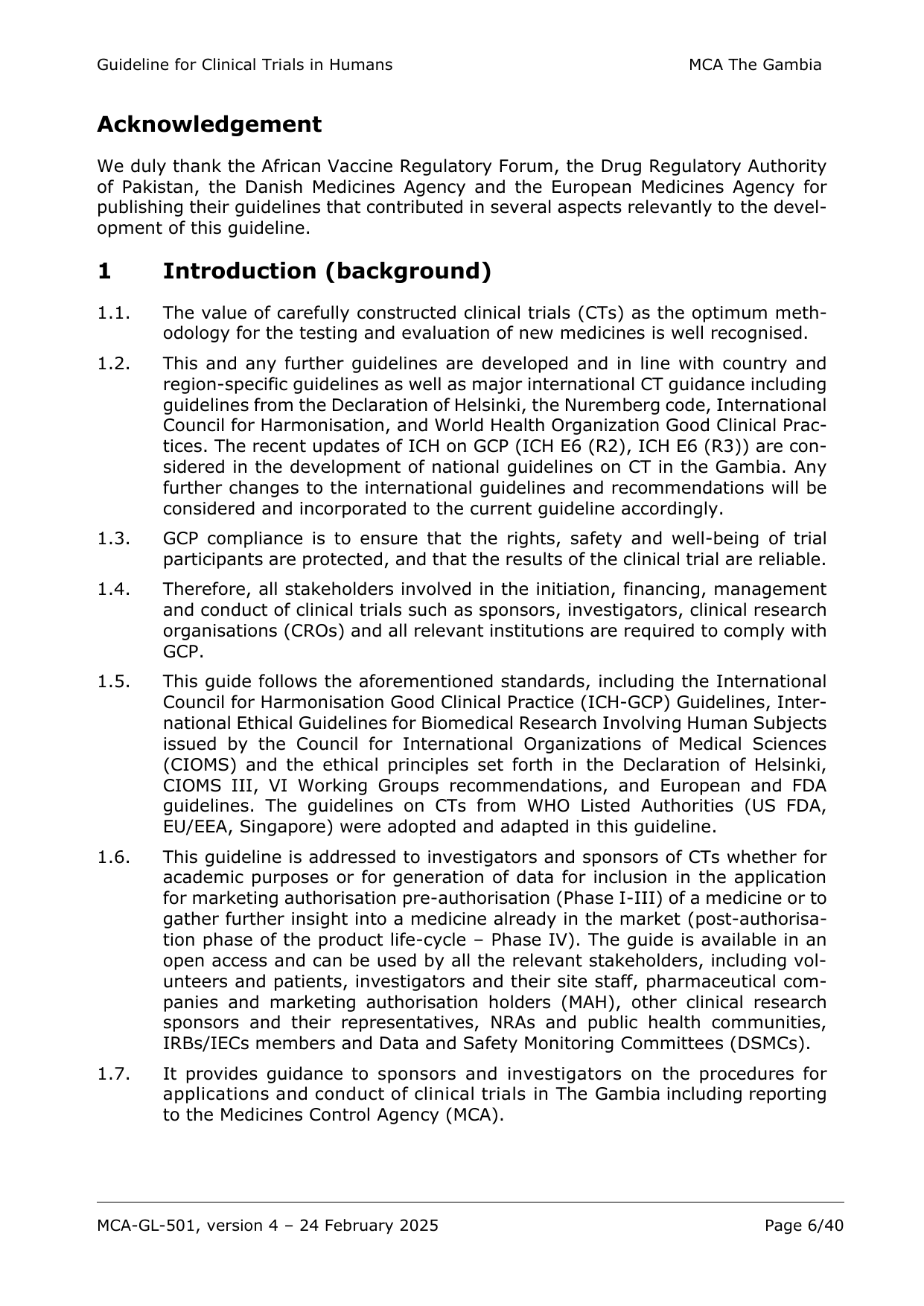
Acknowledgement
We duly thank the African Vaccine Regulatory Forum, the Drug Regulatory Authority
of Pakistan, the Danish Medicines Agency and the European Medicines Agency for
publishing their guidelines that contributed in several aspects relevantly to the devel-
opment of this guideline.
1 Introduction (background)
1.1. The value of carefully constructed clinical trials (CTs) as the optimum meth-
odology for the testing and evaluation of new medicines is well recognised.
1.2. This and any further guidelines are developed and in line with country and
region-specific guidelines as well as major international CT guidance including
guidelines from the Declaration of Helsinki, the Nuremberg code, International
Council for Harmonisation, and World Health Organization Good Clinical Prac-
tices. The recent updates of ICH on GCP (ICH E6 (R2), ICH E6 (R3)) are con-
sidered in the development of national guidelines on CT in the Gambia. Any
further changes to the international guidelines and recommendations will be
considered and incorporated to the current guideline accordingly.
1.3. GCP compliance is to ensure that the rights, safety and well-being of trial
participants are protected, and that the results of the clinical trial are reliable.
1.4. Therefore, all stakeholders involved in the initiation, financing, management
and conduct of clinical trials such as sponsors, investigators, clinical research
organisations (CROs) and all relevant institutions are required to comply with
GCP.
1.5. This guide follows the aforementioned standards, including the International
Council for Harmonisation Good Clinical Practice (ICH-GCP) Guidelines, Inter-
national Ethical Guidelines for Biomedical Research Involving Human Subjects
issued by the Council for International Organizations of Medical Sciences
(CIOMS) and the ethical principles set forth in the Declaration of Helsinki,
CIOMS III, VI Working Groups recommendations, and European and FDA
guidelines. The guidelines on CTs from WHO Listed Authorities (US FDA,
EU/EEA, Singapore) were adopted and adapted in this guideline.
1.6. This guideline is addressed to investigators and sponsors of CTs whether for
academic purposes or for generation of data for inclusion in the application
for marketing authorisation pre-authorisation (Phase I-III) of a medicine or to
gather further insight into a medicine already in the market (post-authorisa-
tion phase of the product life-cycle – Phase IV). The guide is available in an
open access and can be used by all the relevant stakeholders, including vol-
unteers and patients, investigators and their site staff, pharmaceutical com-
panies and marketing authorisation holders (MAH), other clinical research
sponsors and their representatives, NRAs and public health communities,
IRBs/IECs members and Data and Safety Monitoring Committees (DSMCs).
1.7. It provides guidance to sponsors and investigators on the procedures for
applications and conduct of clinical trials in The Gambia including reporting
to the Medicines Control Agency (MCA).
MCA-GL-501, version 4 – 24 February 2025 Page 6/40
Original PDF page 6 — retained source fields, tables and layout.
Guideline for Clinical Trials in Humans MCA The Gambia
1.8. This guideline can support reliance and mutual recognition procedures for CTA
assessment and review of safety and efficacy outcomes of CTs between coun-
tries that apply the same standards and procedures.
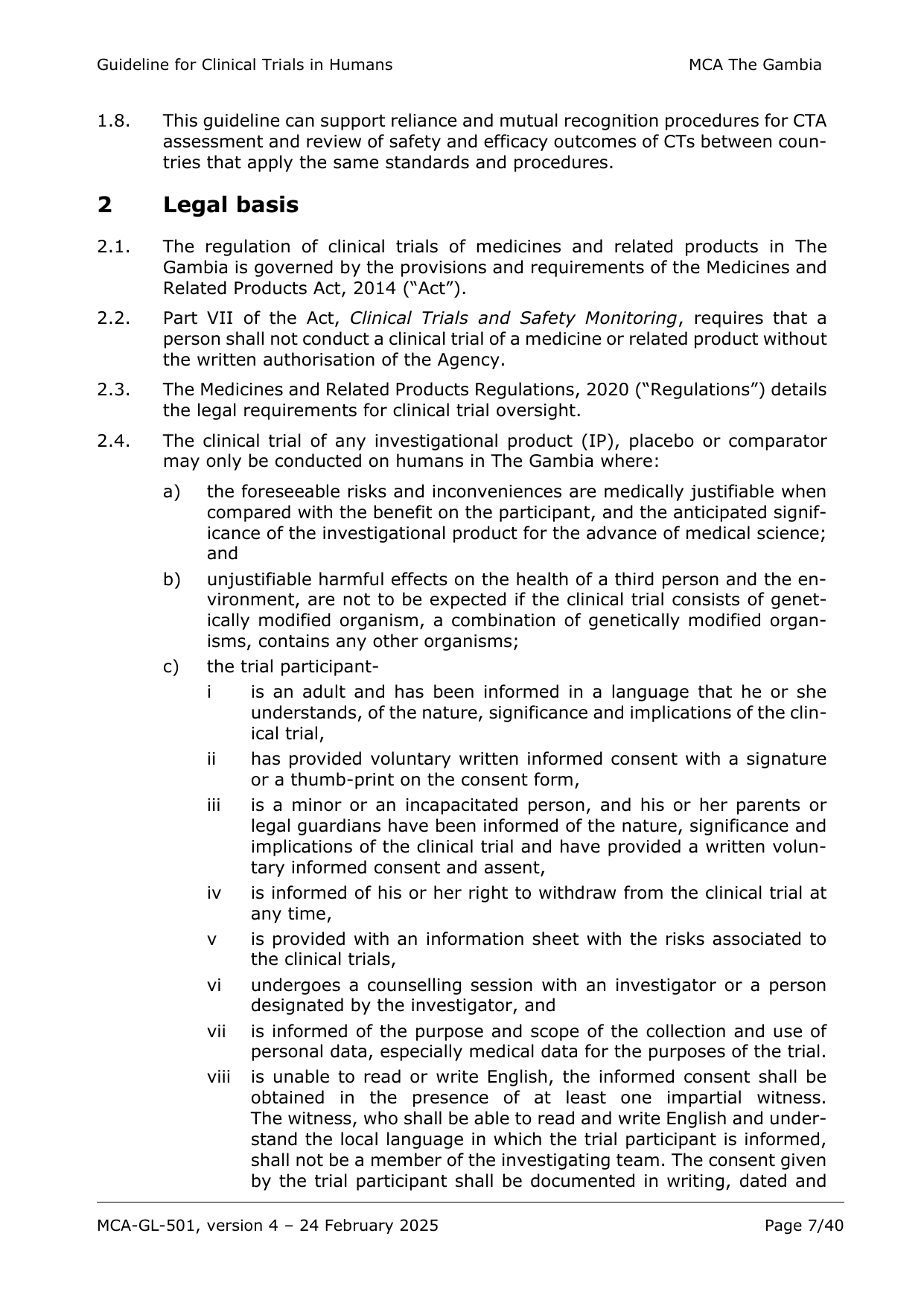
2 Legal basis
2.1. The regulation of clinical trials of medicines and related products in The
Gambia is governed by the provisions and requirements of the Medicines and
Related Products Act, 2014 (“Act”).
2.2. Part VII of the Act, Clinical Trials and Safety Monitoring, requires that a
person shall not conduct a clinical trial of a medicine or related product without
the written authorisation of the Agency.
2.3. The Medicines and Related Products Regulations, 2020 (“Regulations”) details
the legal requirements for clinical trial oversight.
2.4. The clinical trial of any investigational product (IP), placebo or comparator
may only be conducted on humans in The Gambia where:
a) the foreseeable risks and inconveniences are medically justifiable when
compared with the benefit on the participant, and the anticipated signif-
icance of the investigational product for the advance of medical science;
and
b) unjustifiable harmful effects on the health of a third person and the en-
vironment, are not to be expected if the clinical trial consists of genet-
ically modified organism, a combination of genetically modified organ-
isms, contains any other organisms;
c) the trial participant-
i is an adult and has been informed in a language that he or she
understands, of the nature, significance and implications of the clin-
ical trial,
ii has provided voluntary written informed consent with a signature
or a thumb-print on the consent form,
iii is a minor or an incapacitated person, and his or her parents or
legal guardians have been informed of the nature, significance and
implications of the clinical trial and have provided a written volun-
tary informed consent and assent,
iv is informed of his or her right to withdraw from the clinical trial at
any time,
v is provided with an information sheet with the risks associated to
the clinical trials,
vi undergoes a counselling session with an investigator or a person
designated by the investigator, and
vii is informed of the purpose and scope of the collection and use of
personal data, especially medical data for the purposes of the trial.
viii is unable to read or write English, the informed consent shall be
obtained in the presence of at least one impartial witness.
The witness, who shall be able to read and write English and under-
stand the local language in which the trial participant is informed,
shall not be a member of the investigating team. The consent given
by the trial participant shall be documented in writing, dated and
MCA-GL-501, version 4 – 24 February 2025 Page 7/40
Original PDF page 7 — retained source fields, tables and layout.
Guideline for Clinical Trials in Humans MCA The Gambia
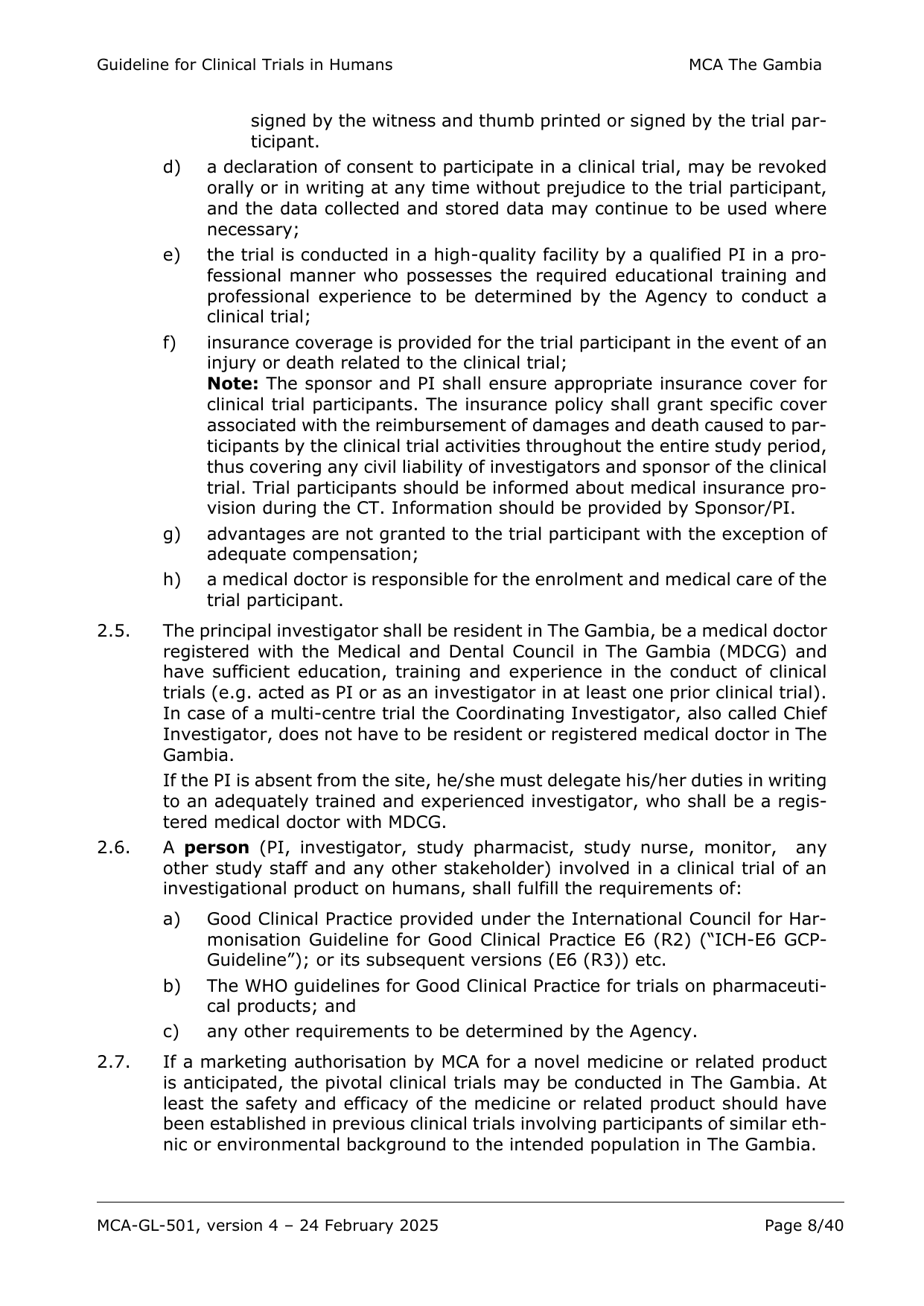
signed by the witness and thumb printed or signed by the trial par-
ticipant.
d) a declaration of consent to participate in a clinical trial, may be revoked
orally or in writing at any time without prejudice to the trial participant,
and the data collected and stored data may continue to be used where
necessary;
e) the trial is conducted in a high-quality facility by a qualified PI in a pro-
fessional manner who possesses the required educational training and
professional experience to be determined by the Agency to conduct a
clinical trial;
f) insurance coverage is provided for the trial participant in the event of an
injury or death related to the clinical trial;
Note: The sponsor and PI shall ensure appropriate insurance cover for
clinical trial participants. The insurance policy shall grant specific cover
associated with the reimbursement of damages and death caused to par-
ticipants by the clinical trial activities throughout the entire study period,
thus covering any civil liability of investigators and sponsor of the clinical
trial. Trial participants should be informed about medical insurance pro-
vision during the CT. Information should be provided by Sponsor/PI.
g) advantages are not granted to the trial participant with the exception of
adequate compensation;
h) a medical doctor is responsible for the enrolment and medical care of the
trial participant.
2.5. The principal investigator shall be resident in The Gambia, be a medical doctor
registered with the Medical and Dental Council in The Gambia (MDCG) and
have sufficient education, training and experience in the conduct of clinical
trials (e.g. acted as PI or as an investigator in at least one prior clinical trial).
In case of a multi-centre trial the Coordinating Investigator, also called Chief
Investigator, does not have to be resident or registered medical doctor in The
Gambia.
If the PI is absent from the site, he/she must delegate his/her duties in writing
to an adequately trained and experienced investigator, who shall be a regis-
tered medical doctor with MDCG.
2.6. A person (PI, investigator, study pharmacist, study nurse, monitor, any
other study staff and any other stakeholder) involved in a clinical trial of an
investigational product on humans, shall fulfill the requirements of:
a) Good Clinical Practice provided under the International Council for Har-
monisation Guideline for Good Clinical Practice E6 (R2) (“ICH-E6 GCP-
Guideline”); or its subsequent versions (E6 (R3)) etc.
b) The WHO guidelines for Good Clinical Practice for trials on pharmaceuti-
cal products; and
c) any other requirements to be determined by the Agency.
2.7. If a marketing authorisation by MCA for a novel medicine or related product
is anticipated, the pivotal clinical trials may be conducted in The Gambia. At
least the safety and efficacy of the medicine or related product should have
been established in previous clinical trials involving participants of similar eth-
nic or environmental background to the intended population in The Gambia.
MCA-GL-501, version 4 – 24 February 2025 Page 8/40
Original PDF page 8 — retained source fields, tables and layout.
Guideline for Clinical Trials in Humans MCA The Gambia
2.8. The Agency charges non-refundable fees for clinical trials, including applica-
tions, protocol amendment(s) and IP import permit clearance as specified in
the in the MCA Fee Schedule published in the Gazette. Evidence of payment
as bank transfer should be submitted alongside the respective application.
Note that any application not accompanied by the requisite proof of completed
payment will not be given consideration.
2.9. Applicants are required to familiarise themselves with this document and
the above stated Act and Regulations before applying for a clinical trial.
3 Scope
3.1. This guideline applies to any investigational product, placebo or comparator
to be used in a clinical trial as defined in this guideline, the Act and
Regulations; whether they are unauthorised or marketed products, including
observational Phase IV clinical studies (e.g. Post Authoriation Safety Studies
and Post Authorisation Efficacy Studies), and to non-investigational products
used in the context of a clinical trial (auxiliary medicines).
4 General Conditions for Clinical Trials
All persons involved in review and approval, preparation, conduction and eval-
uation of CTs following by handling of the data in CTs and publication of the
results, should comply with the ICH GCP, The Declaration of Helsinki and the
national law and regulations on CTs and international guidelines with the pur-
pose to safeguard the individual and public health and human rights for the
population of The Gambia.
4.1 Classification of Clinical Trials
4.1.1. Clinical trials of medicines in humans are generally classified into Phases I to
IV. It is not possible to draw distinct lines between the phases, and diverging
opinions about details and methodology do exist. A brief description of the
individual phases, based on their purposes as related to clinical development
of medicines, is given below:
Phase I
4.1.2. These are the first trials of a new active ingredient or new formulation in
humans, often carried out in healthy volunteers (20-100). Their purpose is to
establish a preliminary evaluation of the safety, and the pharmacokinetic and,
where possible, a pharmacodynamic profile of the active ingredient in
humans.
Phase II
4.1.3. These trials are performed in a limited number of participants (100-300) and
are often, at a later stage, of a comparative (e.g. placebo-controlled) design.
Their purpose is to demonstrate therapeutic activity and to assess short-term
safety of the active ingredient in participants suffering from a disease or
condition (or to prevent the disease or condition in case of vaccines) for which
the active ingredient is intended. This phase also aims at the determination
of appropriate dose ranges or regimens and (if possible) clarification of dose-
response relationships in order to provide an optimal background for the
design of extensive therapeutic trials.
MCA-GL-501, version 4 – 24 February 2025 Page 9/40
Original PDF page 9 — retained source fields, tables and layout.
Guideline for Clinical Trials in Humans MCA The Gambia
Phase III
4.1.4. These are trials in larger (300-3000) and possibly varied participant groups
with the purpose of determining the short and long-term safety/efficacy
balance of formulation(s) of the active ingredient, and of assessing its overall
and relative therapeutic value. The pattern and profile of any frequent adverse
reactions must be investigated and special features of the product must be
explored (e.g. clinically-relevant drug interactions, factors leading to
differences in effect such as age). These trials should preferably be of a
randomised double-blind design, but other designs may be acceptable, e.g.
long-term safety studies. Generally, the conditions under which these trials
are carried out should be as close as possible to normal conditions of use.
Phase IV
4.1.5. These are interventional or observational studies performed after marketing
of the medicine. Trials/studies in phase IV are carried out on the basis of the
product characteristics for which the marketing authorisation was granted and
are normally in the form of post-marketing surveillance, or assessment of
therapeutic value or treatment strategies. Although methods may differ, these
studies should use the same scientific and ethical standards as applied in
premarketing studies.
Note: After a product has been placed on the market, clinical trials designed
to explore new indications, new methods of administration, new combinations,
etc. are normally considered as trials for new medicines.
4.2 Application for a Clinical Trial Authorisation (CTA)
4.2.1. Before commencing a clinical trial in The Gambia, the applicant must obtain a
favourable opinion from a nationally established health research Ethics
Committee and approval from MCA. An application for a clinical trial can be
made to the Ethics Committee and the Agency in either a parallel or sequential
submission.
4.2.2. An application for the authorisation of a clinical trial shall be made in writing
via a completed application form (MCA-F-501/01) available from the MCA
website www.mca.gm, dated and signed by the applicant and accompanied
by a cover letter.
4.2.3. The duly signed cover letter shall be addressed to the Executive Director,
Medicines Control Agency, Off Bertil Harding Highway, Kotu East, Kanifing
Municipality, P.O. BOX 3162, Serekunda, The Gambia.
4.2.4. All documentation submitted shall be in English. If documents are written in
another language, including e.g. product information for auxiliary medicines,
a certified translation is required.
4.2.5. The documents must be submitted electronically in searchable PDF files pro-
vided by email or on a DVD/CD-ROM or USB flash drive and in hard copy, one
(1) of each document.
Note: The application will only be processed after receipt of the hard copies
of the documents.
4.2.6. The documents should be provided in an organised and structured manner
clearly indicating the contents of the application dossier.
4.2.7. The applicant shall submit the following documents as part of the clinical trial
application dossier:
MCA-GL-501, version 4 – 24 February 2025 Page 10/40
Original PDF page 10 — retained source fields, tables and layout.
Guideline for Clinical Trials in Humans MCA The Gambia
a) Clinical Trial Protocol and Protocol Synopsis whose contents and for-
mat should follow the requirements as laid down in the International
Council for Harmonisation Guideline for Good Clinical Practice. It shall
include site specific addendums and be signed and dated by the sponsor
or sponsor’s representative and PI showing their agreement and
committment to the protocol.
i. The protocol should contain a statement that the trial will be
conducted in compliance with the protocol, ICH GCP and the
applicable national and international regulatory requirements and
guidelines. If the protocol does not contain such statement or if it
contains the statement but is not signed and dated by both parties, a
corresponding declaration, signed and dated by both parties shall be
provided to the MCA with the application.
ii. The name, position and full contact details of the Sponsor/CRO.
iii. The name, position and full contact details of the PI and Chief Inves-
tigator who will be responsible for the site(s) where the trial is to be
conducted in The Gambia.
b) Schematic diagram or flow-chart of trial design, procedures and
stages, if not contained in the protocol.
c) Electronic copies of literature that are relevant to the clinical trial, and
that provide background for the clinical trial.
d) Favourable opinion of the Ethics Committee. In case of parallel sub-
mission, a copy of the application letter to the Ethics Committee and
favourable opinion when received including updated versions of docu-
ments or information as requested by the Ethics Committee.
Note: The Agency can reach a decision on the application for a clinical
trial only when those documents are provided and the favourable opinion
of the Ethics Committee is provided.
e) Informed consent form, assent form(s) and participant infor-
mation sheet as applicable, and its translation into local languages,
where applicable (e.g. audio translation, adapted pictorial images for
children, etc).
f) Copy(ies) of recruitment advertisement(s) and questionnaires, if appli-
cable.
g) Certificate of Insurance Cover as evidence of insurance cover for
participants and proof of indemnity provision for investigators and trial
site (see Sponsor Indemnification for Sites and Investigators template,
MCA-T-501/04) or equivalent. Information on Insurance company to be
provided and should be Registered in The Gambia.
h) Signed joint financial declaration between the sponsor, funding body,
if applicable, and the PI concerning sufficient funds to complete the study
(see Declaration of sufficient funds, MCA-F-501/05) or equivalent. Where
the clinical trial is sponsored by an individual, the applicant shall prove
the availability of funds to conduct the trial like:
• co-sponsoring by an institution recognised by the Agency where ap-
plicable; and
• any other conditions as determined by the Agency.
MCA-GL-501, version 4 – 24 February 2025 Page 11/40
Original PDF page 11 — retained source fields, tables and layout.
Guideline for Clinical Trials in Humans MCA The Gambia
i) Documentation on the products (including donations) used in the
trial.
i. Investigator's Brochure (IB) whose contents and format should
follow the requirements as laid down in the International Council for
Harmonisation Guideline for Good Clinical Practice. It shall contain
a description and brief summary of the relevant chemical, physical
and pharmaceutical properties of the IP, and a compilation of the
nonclinical and clinical data on the IP relevant to the clinical trial to
allow investigators to reach a decision on the safety of its use in the
proposed clinical trial. The IB should be reviewed at least annually
and submitted to MCA.
Note: If the IMP is used in accordance with the marketing
authorisation (registration), an IB and IMPD are not required.
ii. Investigational Medicinal Product Dossier (IMPD) or equiva-
lent, as applicable; it shall give detailed information on the quality
of any investigational medicinal product including the manufacture
and its controls, and data from non-clinical studies and from previ-
ous clinical studies, if any. The non-clinical and clinical information
shall include data providing sufficient detail to allow assessors to
reach a decision on the potential toxicity of the investigational me-
dicinal product. If the IMP is a placebo, the information require-
ments shall be limited to quality data.
Note: The IMPD can be submitted directly by the sponsor to the
MCA for confidentiality reasons.
iii. Summary of Products Characteristics (SmPC) or equivalent
professional product information for all marketed products used in
the trial; if the IMP is used in accordance with the marketing
authorisation (registration), an IB or IMPD is not required. If a
comparator other than placebo is used that is not a marketed, reg-
istered product in The Gambia, a justification is required.
iv. Synopsis of previous trials with the investigational product(s), if ap-
plicable and not contained in the protocol or IB.
v. Good Manufacturing Practice (GMP) certificate(s) for the man-
ufacturer(s) of the IMPs, Comparator and Placebo, which must be
issued from the National Regulatory Authority of the country where
the investigational medicinal products, including comparator and
placebo, are manufactured. If the GMP certificate is not available for
justifiable reasons, sufficient information must be provided that will
satisfy the Agency that the product has a defined quality and is safe,
stable and consistent.
vi. Certificates of Analysis (CoA) for each batch of the IMP(s), Com-
parator and Placebo.
vii. Product information and CoA for each batch of rescue medications.
viii. Details and, sample of the labelling of the IP, Comparator and Pla-
cebo if not provided with the clinical trial protocol.
MCA-GL-501, version 4 – 24 February 2025 Page 12/40
Original PDF page 12 — retained source fields, tables and layout.
Guideline for Clinical Trials in Humans MCA The Gambia
j) Documentation on the investigators.
i. Signed declaration by the principal investigator (see Declara-
tion and Workload of Principal Investigator, MCA-F-501/02) or
equivalent that includes a statement on his/her performance, com-
pliance and on any condition that may influence his/her impartiality
and information on his/her current workload.
ii. Signed declaration by all (other) investigators (see Declaration
-Investigator MCA-F-501/11) named in the protocol (e.g. coordinat-
ing investigator, clinical trial coordinator, research clinicians, con-
tract research affiliate(s), if applicable, etc), that includes a state-
ment with any condition, that may influence their impartiality; they
must have no conflict of interest and no history of GCP serious
and/or persistent noncompliance or malpractice.
iii. Signed Curriculum Vitae in a format recommended by MCA (see
CVs MCA-T-501/03) or equivalent and copies of the educational cer-
tificates (qualifications) for all key personnel named in the clinical
trial protocol participating in the conduct of the clinical trial including
contract research affiliate(s), if applicable. The investigators have
to show evidence of previous training or experience obtained from
work with clinical trials and/or patient care.
iv. Good Clinical Practice (GCP) certificates (not older than two
years at the time of application) and proof of training or experience
in other relevant areas in accordance with the delegated tasks and
duties for all trial staff.
v. Proof of registration of the PI and key study staff with a professional
statutory body, if applicable.
k) Details of the location where the trial is to be conducted including:
• a statement on the suitability of the clinical trial site relating to the
nature and use of the investigational product, and
• a description of the suitability of the facilities, equipment, human re-
sources and expertise to be issued by the head of the clinic/hospital
or institution or another responsible person of the clinical trial site
(medical superintendent or medical officer); the statement can be in-
cluded in the cover letter, as appropriate.
l) Licence or equivalent of central and local laboratories to be used in the
clinical trial, evidence of appropriate laboratory quality management sys-
tems or valid certificates of accreditation and normal ranges to be used
for assays of clinical samples.
m) Material Transfer Agreement (MTA), if external laboratories will be
used to analyse samples.
n) Proof of registration on the Pan African Clinical Trials Registry
(PACTR) is mandatory prior to trial approval. Also, registration in any
other international CT registry such as EUDRACT, Clinicaltrials.gov is op-
tional though preferable.
o) Data Safety Monitoring Committee (DSMC) charter and composition,
where applicable.
MCA-GL-501, version 4 – 24 February 2025 Page 13/40
Original PDF page 13 — retained source fields, tables and layout.
Guideline for Clinical Trials in Humans MCA The Gambia
p) Summary of the clinical trial (100-150 words) to be made publicly avail-
able on the MCA website.
q) Case Report Form, patient’s/participant´s Diary, patients/ participant
Reminder Card, Questionnaires, Advertisement materials for CT, where
applicable.
4.2.8. The following should be submitted to the Agency once the trial is authorised
and before database lock:
• Data Management Plan;
• Statistical Analysis Plan; and
• Plan for publication.
4.2.9. The MCA may ask the applicant to supply other information as may be
additionally required to enable reaching a decision on the application.
4.3 Clinical Trial Protocol
4.3.1. According to Part I (2) of the Regulations, the clinical trial protocol is ‘a doc-
ument that describes the objectives, design, methodology, statistical consid-
erations and organisation of a trial’. Thus, the protocol shall provide the back-
ground and rationale for the trial, although these could be provided in other
protocol referenced documents.
4.3.2. The protocol shall be identified by the title, the sponsor’s protocol number
specific for all versions of it (if available), a date and number of version that
will be updated when it is amended, and a short title or name assigned to it.
4.3.3. The content and format of the protocol shall follow the requirements as laid
down in the International Council for Harmonisation Guideline for Good Clinical
Practice and shall thus contain the relevant information for the assessment of
the quality, safety, efficacy and the statistical considerations regarding the
sample size and required IMP/placebo/comparator for the clinical trial.
4.4 Clinical Trial Amendments
4.4.1. Changes to the approved CT can be made. Depending on the nature of a
change, amendments to the trial are regarded as substantial or non-
substantial/ minor amendments.
4.4.2. Following cases are not considered as amendments:
• a change to the documentation submitted to the MCA during the ongoing
assessment (before approval) of the request for clinical trial authorisation
by the MCA, and
• a change to the documentation submitted to the Ethics Committee during
the ongoing assessment (before approval) of the request for favourable
opinion by the Ethics Committee.
4.4.3. Without prejudice to the points listed below, the Agency reserves the right to
direct for an amendment to the clinical trial.
Substantial Amendments
4.4.4. Amendments to a CT are regarded as ‘substantial’ where they are likely to
have a significant impact on the safety or physical or mental integrity of the
CT participants, and/or the scientific value of the trial.
4.4.5. A substantial amendment is an amendment:
MCA-GL-501, version 4 – 24 February 2025 Page 14/40
Original PDF page 14 — retained source fields, tables and layout.
Guideline for Clinical Trials in Humans MCA The Gambia
(a) Which changes a sponsor or principal investigator of the trial or
(b) Which is likely to affect to a significant degree.
(i) The safety, or physical or mental integrity, of any participant of the trial
(ii) The scientific value of the trial
(iii) The conduct or management of the trial; or
(iv) The quality or safety of any investigational product used in the trial.
4.4.6. Substantial amendments to the conduct of the CT may arise from changes to
the protocol, study documentation such as participant information sheets,
consent forms, questionnaires, letters of invitation, or from new information
relating to the scientific documents in support of the trial.
4.4.7. Sponsors are required to submit all substantial amendments of the trial to
MCA and EC for approval or acceptance of notification. The sponsor must not
implement any substantial amendment before MCA and EC approval or ac-
ceptance of notification of the non-substantial amendment, unless the amend-
ment is to protect any participant of a clinical trial against any immediate
hazard to the health or safety of the participant (i.e. urgent safety measure).
In addition, the sponsor is required to keep records of all substantial and non-
substantial amendments to the trial, and provide such records to MCA if re-
quested.
4.4.8. As for any change to a specific clinical trial protocol, the sponsor should make
an in-depth analysis of the specific items, degree and scope of change accord-
ing to the specific trial protocol design, relevant non-clinical and pharmaceu-
tical research results. In addition, the sponsor should evaluate whether the
change indeed have a significant adverse impact on the safety, scientific or
data reliability of the trial. If so, it should be judged as a substantial change.
For example, if the increased dosage does not exceed the safety range sug-
gested by the nonclinical safety studies and existing clinical studies, it is a
non-substantial change; if the increased dosage exceeds the safety range
suggested by the non-clinical safety studies and existing clinical studies, then
it is a substantial change.
4.4.9. Progress reports including safety data as well as annual update of the IB is
not necessarily a substantial amendment. However, the PI and sponsor have
to verify whether data presented or updates require a change to the docu-
mentation submitted with the request for authorisation of the CT. If this
amendment is substantial, the rules for approval of substantial amendments
apply to these changes.
4.4.10. Any substantial changes to the clinical trial protocol, the trial arrangements
or any supporting documents or the IMP or IP shall be approved by the Ethics
Committee and MCA before such amendments are carried out. The PI, sponsor
or sponsor’s representative should apply for amendment to the Ethics
Committee at the same time as to the MCA.
4.4.11. If such amendments are necessary to eliminate an immediate hazard to trial
participants, the urgent amendment may be carried out and the PI, sponsor
or sponsor’s representative shall inform the MCA and Ethics Committee by
writing as soon as possible but not later than 72 hours.
MCA-GL-501, version 4 – 24 February 2025 Page 15/40
Original PDF page 15 — retained source fields, tables and layout.
Guideline for Clinical Trials in Humans MCA The Gambia
4.4.12. The submission of amendment(s) shall be indicated in a cover letter signed
by the applicant identifying the clinical trial, sponsor and applicant, and shall
include:
• A summary of the nature and explanation of the amendment(s);
• Possible consequences for participants already included in the trial; and
• Possible consequences for the evaluation of the results.
4.4.13. The amendment(s) shall be described in a completed Clinical Trial Amendment
form (see Protocol Amendment Form MCA-F-501/08) or equivalent, and the
new versions of the documents, identified by an updated version number and
date, shall be provided.
4.4.14. Where applicable, supporting information shall be included with the submis-
sion.
4.4.15. The favourable opinion of the Ethics Committee is required before MCA can
reach a decision on an amendment. MCA shall provide the decision within ten
(10) working days of receipt of the favourable opinion.
Non-substantial/minor Amendments
4.4.16. Non-substantial/ minor amendments (except substantial) can be implemented
immediately by the sponsor and should always be documented and notified to
the MCA and the Ethics Committee.
4.4.17. For example, a change of the contact person or in the contact details of the
contact person (e.g. a change of e-mail or postal address) is not considered as
a substantial amendment, if the sponsor and legal representative remain
identical. However, the sponsor should ensure that the MCA is aware of this
change as soon as possible, in order to allow the Agency to exercise its clinical
trial oversight function. Documentation of non-substantial amendments
should also be available on request for inspection at the trial site or the spon-
sor premises as appropriate.
4.4.18. Non-substantive changes can be made upon being reviewed or put on records
by the MCA and the EC.
4.5 Clinical Trials in Case of Emergency Situations
4.5.1. Under certain circumstances MCA may deviate from the routine procedure and
accept an expedited application and review process for clinical trials. Examples
of such situations are epidemics, pandemics or other urgent public health in-
terests that require fast utilisation of new medicines or related products
and/or fast gathering of information on products.
4.5.2. The Ministry of Health shall declare a national public health emergency (PHE)
where there is a situation that poses an immediate risk to health or life.
4.5.3. The following documents must at least be submitted in such situations together
with a cover letter and a completed application form, both signed and dated
by the applicant:
• Clinical Trial Protocol;
• Investigator's Brochure or a corresponding product information containing
available chemical, physical and pharmaceutical information about the in-
vestigational product, non-clinical and clinical data on safety and efficacy,
as available;
MCA-GL-501, version 4 – 24 February 2025 Page 16/40
Original PDF page 16 — retained source fields, tables and layout.
Guideline for Clinical Trials in Humans MCA The Gambia
• Certificate of Analysis (CoA);
• GMP certificate, if available;
• The name, position and full contact details of sponsor;
• A list of the planned clinical trial site(s) and the planned number of partic-
ipants at the site(s);
• The name, position and full contact details of the PI who will be responsible
for the sites where the trial is to be conducted and shall be-
○ resident in The Gambia; and
○ registered with the Medical and Dental Council in The Gambia (MDCG);
• Proof of current, relevant and appropriate study insurance for all partici-
pants or professional indemnity provision for all investigators in the event
of an injury or death related to the clinical trial;
• Participant information sheet and informed consent form including assent
information, where applicable;
• Recruitment arrangements;
• The favourable opinion of the Ethics Committee and updated version(s) of
documents or information as requested by the Ethics Committee, if appli-
cable; and
• Proof of payment of the appropriate application fee.
• Full CT application package should be submitted to the Agency. The
acknowledgement of receipt or notification of missing documents to be
shared with applicant. Time clock for the assessment starts after the sub-
mission of the full dossier accepted by the agency.
4.5.4. Depending on the phase and nature of the trial, the MCA shall prescribe other
relevant information to be provided.
4.5.5. The Agency shall upon initial communication with a prospective applicant, and
upon receipt of an application, liaise with relevant stakeholders (including rel-
evant ethics and other oversight bodies) to draw an appropriate plan to facil-
itate a holistic review of an application in a fast-track manner.
4.5.6. The under listed criteria shall be applied in the emergency clinical trial appli-
cations for review:
• Epidemiology of the emergency
• Morbidity / mortality associated with the emergency and/or condition un-
derstudy
• Supporting scientific data/information available of the investigational prod-
uct at the time of submission
• Feasibility of the implementation of the trial design within the context of
the emergency
• Risk-Benefit impact of the intervention and/or trial design;
4.5.7. The MCA will review expedited application within 21 working days (excluding
clock stops).
4.5.8. As part of the application, the sponsor may request an AVAREF Emergency
Joint Review Process of the application.-Such applications shall be considered
MCA-GL-501, version 4 – 24 February 2025 Page 17/40
Original PDF page 17 — retained source fields, tables and layout.
Guideline for Clinical Trials in Humans MCA The Gambia
by the MCA on a case-by-case basis.
4.5.9. Applications for the AVAREF Emergency Joint Review Process shall be submit-
ted at least 14 working days before the proposed date of the joint review.
4.6 Special Pre-Conditions for Clinical Trials
4.6.1. In an emergency where consent cannot be obtained and treatment is required
without delay to save the life of the trial participant, restore good health or
alleviate suffering, the treatment may be commenced and consent shall be
obtained for continued participation.
4.6.2. Where a clinical trial is to be conducted on a minor who suffers or may suffer
from a disease, to be treated by the investigational product the-
a) use of the investigational product shall be indicated according to the find-
ings of medical science to save the life of the person, restore health and
alleviate suffering, or prevent disease;
b) clinical trial shall be of direct benefit to a group of patients suffering from
the same disease as the trial participant;
c) research shall be considered necessary in order to confirm data obtained
in clinical trials on other persons or by means of other research methods;
d) research shall relate to a clinical condition from which the minor con-
cerned is suffering or may suffer; and
e) research may cause only a minimal risk and minimal burden to the trial
participant.
4.6.3. Where a clinical trial is to be conducted on an adult who is incapable of com-
prehending the nature, significance and implications of the clinical trial and
suffers or may suffer from a disease, to be treated by the investigational prod-
uct the
a) use of the investigational product shall be indicated, according to the
findings of medical science to save the life of the trial participant, restore
health and alleviate suffering;
b) research shall relate directly to a life-threatening or highly debilitating
clinical condition suffered by the trial participant;
c) degree of burden and the risk threshold shall be defined specifically in
the trial protocol and monitored constantly by the investigator;
d) clinical trial may only be conducted if there is a justified expectation that
the benefits of the investigational product for the trial participant out-
weigh the risks;
e) consent by the authorised representative may be provided after he or
she has been duly informed; and
f) research shall be absolutely necessary for the confirmation of data ob-
tained from clinical trials conducted on persons capable of granting in-
formed consent or by means of other research methods.
4.7 Application for an observational Phase IV Clinical Study Approval
4.7.1. Before the commencement of an observational Phase IV clinical study like e.g.
a post-authorisation safety or efficacy study (PASS/PAES) in The Gambia, the
responsible person must obtain a favourable opinion from a nationally
established health research Ethics Committee and approval from MCA. An
application for such a Phase IV clinical study can be made to the Ethics
MCA-GL-501, version 4 – 24 February 2025 Page 18/40
Original PDF page 18 — retained source fields, tables and layout.
Guideline for Clinical Trials in Humans MCA The Gambia
Committee and the Agency in either a parallel or sequential submission.
4.7.2. The responsible person is a natural or juristic person responsible for the initi-
ation, organisation, planning, conducting, supervising and financing of the
non-interventional study.
4.7.3. An application for the authorisation of such a Phase IV clinical study shall be
made in writing via a completed application form (see Application Form MCA-
F-501/12) available from the MCA website www.mca.gm, dated and signed
by the applicant and accompanied by a cover letter.
4.7.4. The duly signed cover letter shall be addressed to the Executive Director,
Medicines Control Agency, Off Bertil Harding Highway, Kotu East, Kanifing
Municipality, P.O. BOX 3162, Serekunda, The Gambia.
4.7.5. All documentation submitted shall be in English. If documents are written in
another language, including e.g. product information for auxiliary medicines,
a certified translation is required.
4.7.6. The documents must be submitted electronically in searchable PDF files pro-
vided by email or on a USB flash drive and in hard copy, one (1) of each
document.
4.7.7. The applicant shall submit the following documents:
• Observation plan of the Phase IV clinical study;
• Case Report Forms (CRF), patient´s diaries and questionnaires;
• In case of parallel submission, a copy of the application letter to the Ethics
Committee and favourable opinion when received including updated ver-
sions of documents or information as requested by the Ethics Committee;
• The Summary of the Product Characteristics or other product information
of the products under observation.
4.7.8. In case of a substantial amendment the new version of the oberservation plan
and other changed documents should be submitted.
4.7.9. The responsible person should submit a study summary report (MCA-F-
501/10) or equivalent after six (6) months of the completion of the data
collection and analysis.
4.7.10. If products used in the study are to be imported or exported, the responsible
person should apply for the import or export in accordance with the MCA
Guideline for Import and Export of Medicines and Related Products (MCA-GL-
103).
Publication
4.7.11. For studies that are fully or partially conducted by investigators who are not
employees of the marketing authorisation holder, the marketing authorisation
holder and the investigator should agree in advance on a publication policy
allowing the investigator to independently prepare publications based on the
study results irrespective of data ownership. The marketing authorisation
holder should be entitled to view the results and interpretations included in the
manuscript and provide comments prior to submission of the manuscript for
publication.
4.7.12. In order to allow MCA to review in advance the results and interpretations to
MCA-GL-501, version 4 – 24 February 2025 Page 19/40
Original PDF page 19 — retained source fields, tables and layout.
Guideline for Clinical Trials in Humans MCA The Gambia
be published, the marketing authorisation holder initiating, managing, or fi-
nancing a clinical trial should communicate to the Medicines Control Agency
the final manuscript of the article within two (2) weeks after first acceptance
of publication.
4.8 Application for Low-interventional Clinical Trial Approval
4.8.1. A low-interventional clinical trial (LICT) like e.g. a phase IV clinical trial, is a
trial that fulfils the following conditions:
a) The investigational medicinal products (IMP), excluding placebos, are au-
thorised;
b) Their use should be in accordance with the protocol of the Clinical Trial;
c) The IMPs are used in accordance with the terms of the marketing authori-
sation; or
d) The use of the IMPs is supported by published scientific evidence on the
safety and efficacy including high quality data published in scientific journal
articles, national, regional or institutional treatment protocols, health tech-
nology assessment reports or other appropriate evidence.
4.8.2. A LICT is a trial where the risk is similar to that of standard medical care
and/or established medical practice.
4.8.3. Any additional procedures or additional diagnostics and/or monitoring proce-
dures must not pose more than minimal additional burden or risk to the safety
of the study participants compared to normal local clinical practice. Examples
of minimal additional burden: analysis of saliva, urine, stool samples, meas-
uring weight and/or height, questionnaires, ECG and EEG measurements,
blood withdrawal with minimal additional venepuncture or through a pre-ex-
istent catheter.
4.8.4. LICTs are used for instance to investigate safety and efficacy questions that
have arisen since the issue of marketing authorisation.
4.8.5. LICTs are subject to less stringent rules.
4.8.6. LICT are subject to the same application procedure as any other CT.
4.8.7. The applicant shall submit the following documents:
• Clinical Trial Application Form;
• Cover letter which shall indicate if the CT is considered to be a LICT and
shall contain a detailed justification thereof;
• Clinical Trial protocol;
• SmPC of the already authorised investigational medicinal products (IMPs);
• Labelling.
5 Investigational Products (IPs), Investigational
Medicinal Products (IMPs)
5.1 Manufacturing of IMPs
5.1.1. IMPs must be manufactured in accordance with the Regulations and interna-
tionally recognised current Good Manufacturing Practice requirements, unless
MCA-GL-501, version 4 – 24 February 2025 Page 20/40
Original PDF page 20 — retained source fields, tables and layout.
Guideline for Clinical Trials in Humans MCA The Gambia
it is justified otherwise and approved by MCA.
5.1.2. It is the responsibility of the sponsor to supply the clinical trial site with IMPs
produced in compliance with GMP, where applicable.
5.2 Labelling of IMPs, Placebo or Comparator
5.2.1. The following information should be included on labels of the primary and/or
secondary packaging:
a) Reference number allowing identification of the trial, site, PI and spon-
sor;
b) Medicine(s) to be used by name/identification number, dosage form,
route of administration, quantity of dosage units, and in the case of
open trials the strength/potency;
c) Trial participant identification number to whom the medicine is to be
administered;
d) Name, address and telephone number of the investigator who is the
main contact for information on the product, clinical trial and emer-
gency unblinding;
e) Directions in regard to the manner in which such medicine should be
used or reference to where this information is provided;
f) Date of dispensing, if applicable and use-by or expiry or re-test date, as
applicable;
g) Storage conditions;
h) Batch number or code number;
i) Labelled with “For Clinical Trials Only”;
j) “keep out of reach of children” except when the product is for use in trials
where the product is not taken home by participants; and
k) Any other information as may be required by the Agency.
5.2.2. If the primary container takes the form of blister packs or small units such as
ampoules, the secondary packaging should be provided bearing a label with
the required particulars listed above. The primary container should
nevertheless bear the following:
• name of the investigator who is the main contact for information on the
product, clinical trial and emergency unblinding.
• route of administration (may be excluded for oral solid dosage forms) and
in the case of open trials, the name/ identifier of the IP and strength/
potency;
• batch and/or code number to identify the contents and packaging
operation;
• a trial reference code allowing identification of the trial, site, principal
investigator and sponsor if not given elsewhere;
• the trial participant identification number/treatment number and where
relevant, the visit number.
5.2.3. If the IMP is authorised (registered) to be marketed in The Gambia and used
in accordance with its approved indications and dosage regimen, MCA may
make exemptions from the label requirements as listed in 5.2.1, if justified by
MCA-GL-501, version 4 – 24 February 2025 Page 21/40
Original PDF page 21 — retained source fields, tables and layout.
Guideline for Clinical Trials in Humans MCA The Gambia
the applicant.
Donated IMPs
5.2.4. If the IMP has been donated it must be manufactured in accordance with the
Regulations and internationally recognised current Good Manufacturing Prac-
tice requirements, unless it is justified otherwise and approved by MCA. The
labelling of the donated IMP must follow label requirements as listed in 5.2.1
& 5.2.2 above.
5.3 Importation and Exportation/Re-exportation of IPs, Placebo or com-
parator
Importation
5.3.1. If the IP , placebo, comparator or any auxiliary medicine is to be imported, the
clinical trial must be approved by the MCA before the import can be permitted.
A parallel submission for approval of the clinical trial and permit for the import
is possible. In this case, application for import permit can be included in the
clinical trial application package.
5.3.2. The protocol title, duration of the CT, sample size and required IPs, placebo
comparator or any auxiliary medicine for the clinical should be provided in the
application for importation.
5.3.3. IPs, placebo, comparator or auxiliary medicines may only be imported in a
quantity as required by the clinical trial.
5.3.4. Authorised or registered IPs, placebo, comparator or auxillary medicines may
only be imported if they are not locally available or if the need for importation
is otherwise justified.
5.3.5. The import application form (MCA-F-501/06) available from the MCA website:
www.mca.gm must be completed and duly signed and dated by the PI or
sponsor’s representative.
5.3.6. Application for import permit must include at least, the following information:
• The title and identification number of the CT for which the application is
made;
• The planned CT sites and the planned number of participants at the sites;
• Description of the IP(s), Placebo or Comparator by name or code, strength
and dosage form, as applicable;
• Unit of issue, total quantity, batch number and expiry dates of the prod-
uct(s);
• Justification of the quantity of the IP , Placebo, Comparator,or auxiliary
medicines to be imported relative to the timelines as stated in the CT
protocol (sample size, phase of the protocol and duration of the study,
reasons for additional supply, if necessary); and
• Letter of authorisation of the CT including the MCA CT number.
5.3.7. The completed application form and required documents can be sent
electronically, but a hard copy must be hand delivered or posted to: Executive
Director, Medicines Control Agency, Off Bertil Harding Highway, Kotu East,
MCA-GL-501, version 4 – 24 February 2025 Page 22/40
Original PDF page 22 — retained source fields, tables and layout.
Guideline for Clinical Trials in Humans MCA The Gambia
Kanifing Municipality, P.O. BOX 3162, Serekunda, The Gambia
5.3.8. Approval of an import permit application by the Agency may take up to five
(5) working days.
Exportation/re-exportation
5.3.9. If the IP or any auxiliary medicine needs to be exported/re-exported out of
The Gambia upon completion of the clinical trial, an approval from MCA is
required.
5.3.10. Before exportation or re-exportation, the delivered, used and recovered quan-
tities of IP should be recorded.
5.3.11. Application for export/re-export permit shall be submitted in a letter to the
MCA and must include at least, the following information:
• The title, clinical trial identification number and MCA authorisation number
of the CT concerned;
• Description of the IP(s) or auxiliary medicine concerned;
• Unit of issue, total quantity, batch number and expiry dates of the products
concerned; and
• Justification of the quantity of the IP(s) or auxiliary medicines to be
exported/re-exported and reason for export/re-export.
5.4 Repackaging and Re-labelling of IMPs Placebo or Comparator
5.4.1. Approval for repackaging and/or re-labelling of IPs is required from MCA and
the reason for it must be provided.
5.4.2. If it becomes necessary to change the expiry/use-by date, an additional label
should be affixed to the IP which should state the new use-by date and repeat
the batch number. It may be superimposed on the old date, but for quality
control reasons, not on the original batch number.
5.4.3. The operation should be performed at an appropriately authorised
manufacturing site, but when justified, may be performed at the
investigational site by or under the supervision of preferably the clinical trial
site pharmacist, or the PI or by the clinical trial monitor(s) who should be
appropriately trained.
5.4.4. Further re-labelling or repackaging of IPs may be carried out in health facilities
or other clinical trial sites by pharmacists if the IPs are intended to be used
exclusively in the facilities taking part in the same clinical trial.
5.4.5. Pharmacists must be registered with the Pharmacy Council of The Gambia and
must have at least two years’ experience in manufacturing or quality man-
agement of medicines or related products.
5.4.6. The repackaging or re-labelling operations of IPs should be performed in ac-
cordance with Good Manufacturing Practice principles and specific standard
operating procedures and should be checked by a second person.
5.4.7. Repackaging or re-labelling should be properly documented. To avoid mis-
takes the activities should be carried out in an area which is partitioned or
separated from other activities. A line clearance at the start and end of activity
should be carried out and reconciliation performed. Any discrepancies ob-
served during reconciliation should be investigated and accounted for before
release.
MCA-GL-501, version 4 – 24 February 2025 Page 23/40
Original PDF page 23 — retained source fields, tables and layout.
Guideline for Clinical Trials in Humans MCA The Gambia
5.5 Disposal of IPs Placebo or Comparator
5.5.1. Before disposal, the delivered, used and recovered quantities of IP should be
recorded and an IP(s), placebo or comparator accountability report sent to
MCA, reconciled and verified by or on behalf of the sponsor for each trial site
and each trial period in The Gambia.
5.5.2. The PI must apply to MCA for approval before destruction, indicating the
procedure of disposal and the name, dosage form/strength, batch number,
expiry date and amount of the IP to be destroyed and reason for destruction.
5.5.3. Destruction of unused investigational products should be carried out for a
given trial site or a given trial period only after any discrepancies have been
investigated and satisfactorily explained and the reconciliation has been ac-
cepted by the sponsor.
5.5.4. The disposal of investigational products at investigational site(s) in The
Gambia shall be recorded and conducted in a professional manner by the PI
or sponsor’s representative like the clinical trial monitor.
5.5.5. Recording of destruction operations should be carried out in such a manner
that all operations may be accounted for. The record of disposal shall clearly
identify the batch for disposal, the participant numbers and the quantities to
be destroyed.
5.5.6. The disposal exercise must be witnessed by MCA. When destruction of inves-
tigational products takes place, the MCA shall issue a dated certificate of, or
receipt for destruction, to the sponsor. These documents should clearly iden-
tify, or allow traceability to, the batches and/or participant numbers involved
and the actual quantities destroyed.
6 Timelines for Clinical Trial Applications
6.1. All clinical trial applications and applications for substantial clinical trial
amendments shall be screened by the MCA for completeness.
6.2. MCA shall inform the applicant in writing about the receipt of a valid or
complete clinical trial application or amendment within 10 working days from
the receipt of the complete application. However, if deficiencies are identified
at screening, these would be addressed by a Request for Clarification or a
Screening Rejection Letter specifying the formal grounds for non-acceptance,
also within 10 working days from the receipt of the application. The applicant
shall address formal grounds for non-acceptance within 10 working days.
6.3. The MCA shall inform the applicant in writing about the outcome of the
assessment of the clinical trial within a maximum of sixty (60) calendar days
after validation of a formally complete clinical trial application, or 120 calendar
days if the IP contains a genetically modified organism.
6.4. During evaluation, additional documents or changes may be requested
through a query letter. Once a query has been raised and issued to the
applicant, the process stops until when MCA receives a written response to
the query. If the applicant fails to modify the application correspondingly
within a maximum of 30 calendar days, following the reasoned objections, the
application shall be deemed to be rejected.
6.5. In general, CT applications should be processed as per the prescribed
MCA-GL-501, version 4 – 24 February 2025 Page 24/40
Original PDF page 24 — retained source fields, tables and layout.
Guideline for Clinical Trials in Humans MCA The Gambia
timelines presented in the flowchart.
6.6. Applications on substantial amendments to the clinical trial should be
processed by MCA within thirty (30) calendar days after submission of all
required information and documents.
7 Opinion from the Ethics Committee
7.1. Parallel clinical trial applications to the Ethics Committee and the MCA are
encouraged to streamline or minimise the timelines for the clinical trial au-
thorisation process in The Gambia. A favourable opinion from the Ethics Com-
mittee is required before the MCA can issue the clinical trial authorisation.
7.2. The principal investigator is required to submit the favourable opinion from
the Ethics Committee when issued to the MCA.
7.3. Sequential clinical trial application submission can also be done where the
principal investigator submits first to the Ethics Committee and when the fa-
vourable opinion is issued by the Ethics Committee the clinical trial application
along with this is submitted to the MCA for request of the clinical trial author-
isation.
7.4. An application for a favourable opinion shall be made by the principal
investigator to the Ethics Committee in the prescribed form.
7.5. The principal investigator shall submit any other information as determined
by the Ethics Committee to assess the application.
7.6. The Ethics Committee:
a) may rely on its personal scientific findings, consult experts or request for
an expert opinion to assess any application;
b) shall provide its opinion on an application for a clinical trial based on its
written standard operating procedures;
c) may refuse to grant a favourable opinion where the-
i documents submitted are incomplete and the PI fails to submit the
appropriate documents within the time frame provided by the Ethics
Committee,
ii documents submitted, including the trial protocol, the investigator's
brochure, the modalities for selection of trial participants and the in-
formed consent documents, do not correspond with the scientific
knowledge available and the clinical trial is considered unsuitable to
provide proof of the safety and efficacy of an investigational product;
iii requirements specified under Section 73 of the Regulations are not
fulfilled.
7.7. The Agency shall provide the Ethics Committee with any information of signif-
icance, if required for the assessment of any application for a favourable opin-
ion.
7.8. The Agency shall provide information to the Ethics Committee, when required,
on aborted or prematurely discontinued investigations.
MCA-GL-501, version 4 – 24 February 2025 Page 25/40
Original PDF page 25 — retained source fields, tables and layout.
Guideline for Clinical Trials in Humans MCA The Gambia
8 Decision on Clinical Trial Applications
8.1. All clinical trial applications shall be evaluated with the same set of criteria
based on the up-to-date scientific knowledge and ethics standards, regardless
of the applicant.
8.2. During the CT assessment process, relevant CT decisions, reports or
information from other national regulatory authorities or regional and
international bodies can be recognised or used by the MCA.
8.3. MCA has established the Medicines Safety Experts Committee (MSEC) as an
external advisory committee, for the review of a clinical trial application, if
special expertise is required. The MCA shall establish an Internal Advisory
Committee whose expertise would be utilised for the ad hoc review of clinical
trial applications.
8.4. The MSEC will convene meetings anytime, a minimum of two (2) and a max-
imum of four (4) regular meetings per year and when the need is expressed
by the Executive Director of MCA, or ad hoc meetings, if necessary.
8.5. The MSEC will diligently carry out its functions in accordance with the Terms
of Reference (TOR), Code of Practice, and Guidelines provided by the Agency.
The provision of scientific advice by the MSEC will be conducted based on the
necessity as determined by the Agency and will be completed within the 60-
day Clinical Trial Application (CTA) evaluation period. The committee mem-
bers will adhere to the established protocols and procedures outlined in the
TOR, Code of Practice, and Guidelines to ensure the quality and timeliness of
their recommendations. The MSEC's commitment to upholding professional
standards and regulatory compliance will guide their decision-making process
in providing accurate and reliable scientific advice. The Agency can rely on the
expertise and dedication of the MSEC members to fulfil their responsibilities
effectively and contribute to the overall safety and efficacy of medicinal prod-
ucts under evaluation.
8.6. All MSEC meetings will be planned and agreed with the Director of Clinical
Trials and Pharmacovigilance. The MSEC Chairperson and the Director of Clin-
ical Trials and Pharmacovigilance are responsible for the MSEC meeting
agenda.
8.7. Persuant to the Act, a clinical trial authorisation letter (certificate) shall be
issued to the applicant by MCA upon approval indicating the MCA CT number.
The clinical trial authorisation letter may contain conditions required by MCA
with the respect to the conduct or reporting of the clinical trial.
8.8. If the clinical trial application was rejected, the applicant can appeal which
shall be made in writing to the Executive Director within sixty (60) calendar
days of receipt of the rejection notice, or incase of Emergency CTA which will
be 21 working days.
8.9. No information given in an application shall be disclosed by the MCA to a third
party except:
• MCA technical advisory support (such as MSEC)
• with the written consent of the applicant; or
• in accordance with the directive of the Governing Board of MCA; or
MCA-GL-501, version 4 – 24 February 2025 Page 26/40
Original PDF page 26 — retained source fields, tables and layout.
Guideline for Clinical Trials in Humans MCA The Gambia
• for the purpose of a legal process under the Medicines and Related
Products Act, 2014.
8.10. MCA shall register all clinical trial applications in a database.
8.11. An authorisation may be rejected in accordance with section 40 of the Act
where the-
(a) documents submitted are incomplete and the PI or sponsor fails to sub-
mit the appropriate documents within the time frame provided by the
Agency;
(b) documents submitted, including data on the investigational products,
the trial protocol, investigator's brochure and the investigational medic-
inal product dossier, do not correspond with the scientific knowledge
available and the clinical trial is considered unsuitable to provide proof
of the safety and efficacy of an investigational product;
(c) the requirements stipulated under provision 73 of the Regulations are
not fulfilled; and
(d) the Agency is in possession of findings which indicate that the clinical
trial facility is not a conducive environment for the trial to be conducted.
8.12. The Agency may use relevant clinical trial decisions, reports or information
from other regulatory authorities as the Agency may consider necessary to
assess any application.
8.13. The Agency may use reliance in its decision-making process on clinical trial
authorisation in the following circumstances:
• If the investigational product has already been evaluated and listed as a
WHO Prequalified Product through the WHO PQ collaborative registration
procedure between WHO and NMRAs;
• If the investigational product has already been evaluated and listed as a
product of either the WHO collaborative registration pilot for stringently
authorised products, including through the EU-M4 all Procedure or the
Swiss medic’s Marketing Authorization for Global Health products or the
International Generic Drug Regulatory Programme (launched July, 2014);
• If the investigational product has been authorised in a clinical trial or
granted marketing authorisation by a recognised NMRA (e.g. WHO Listed
Authority); or
• If either the trial or the investigational product has been evaluated and
judged satisfactory at a joint review meeting facilitated by the World
Health Organization under the African Vaccine Regulatory Forum
(AVAREF).
8.14. It is mandatory that all clinical trials shall be registered by the sponsor or PI
in the Pan African Clinical Trials Registry (PACTR) Or international CT registry,
like EUDRACT, clinicaltrials.gov.
9 Reporting of Adverse Events
9.1. For purposes of safety monitoring, procedures for the collection, management
and reporting of suspected adverse reactions/adverse events should be put in
place and summarised in the clinical trial protocol as follows:
MCA-GL-501, version 4 – 24 February 2025 Page 27/40
Original PDF page 27 — retained source fields, tables and layout.
Guideline for Clinical Trials in Humans MCA The Gambia
• in the case of a serious adverse reaction (SAR) including suspected
unexpected serious adverse reaction (SUSARs), not later than fisteen (15)
calendar days after the sponsor became aware of the reaction;
• in the case of a SAR which was initially considered to be non-serious but
which turns out to be serious, as soon as possible and in any event not later
than 7 days after the sponsor became aware of the reaction being serious;
• in the case of a fatal serious adverse event, it shall be reported within seven
(7) calendar days to MCA.
• Cases of non-serious ADRs, whether expected or not, would not normally
be considered reportable on an expedited basis. Non-serious ADRs should
be included in the Line listings and provided in an individual case safety
report (ICSR), annual report and DSUR/PSUR accordingly.
9.2. The sponsor or PI of an ongoing clinical trial shall report to the Agency serious
adverse events suspected to be related to the IMP by using a Serious Adverse
Event Report form provided by MCA (see SAE Report Form MCA-F-501/09),
which is available from the MCA website: www.mca.gm, or an equivalent.
9.3. Any serious adverse event to the investigational product shall receive
immediate medical attention before reporting same to the MCA.
9.4. Fatal serious adverse events shall be reported within seven (7) calendar days
to MCA whether suspected to be related to the IMP or not. They shall be fol-
lowed by a formal or verbal autopsy report. Verbal autopsy shall be conducted
in line with the World Health Organization guideline for verbal autopsy. The
cause of death shall be classified according to current ICD guideline.
9.5. In line with the Regulations stipulated in part XI, section 80 (b) fatal events
should be reported preliminary within 72 hours which can be an informal no-
tification, while a detailed report must be submitted within seven (7) calendar
days.
9.6. Any adverse events that are relevant with respect to nature or frequency shall
be reported to MCA within specified timelines with progress reports.
9.7. The sponsor or PI is required to submit follow-up information as soon as it
becomes available. Additional information may include copies of diagnostic
test results, laboratory reports, or medical record progress notes. All addi-
tional information should be clearly marked as update information and should
include the Protocol Number and Participant Number.
9.8. MCA shall ensure to record and evaluate all reports on suspected serious ad-
verse reactions to an IP which are brought to its attention.
10 Notifications and Clinical Trial Reports
Notifications
10.1. A notification of arrival and receipt confirmation of imported products stating
the name(s) of product(s), batch numbers or code numbers and quantities
received should be sent immediately by scanned email and then delivered in
hard copy to MCA within (5) five working days.
10.2. The sponsor or PI shall notify the MCA of the start of the trial within 15 working
days; the start of the trial is the date when the first act of recruitment of a
MCA-GL-501, version 4 – 24 February 2025 Page 28/40
Original PDF page 28 — retained source fields, tables and layout.
Guideline for Clinical Trials in Humans MCA The Gambia
potential participant was performed (e.g. date of the first contact with poten-
tial trial participants).
10.3. If the trial does not start within six (6) months of issuance of the authorisation
letter or at the date as stipulated by the applicant, the sponsor or PI shall
inform MCA of the planned date of commencement.
10.4. The sponsor or PI shall inform the MCA of early termination or suspension of
a clinical trial by using form MCA-F-501/15 or equivalent immediately and at
the latest within 15 days after the trial is halted clearly explain the reasons,
and describe follow-up measures, if any, taken for safety reasons.
10.5. The sponsor or PI shall notify MCA within 90 days of the end of a clinical trial
by using form MCA-F-501/15 or equivalent; the end of the clinical trial shall
be defined in the clinical trial protocol (e.g. last participant last visit or data-
base lock).
Reports
10.6. The sponsor or PI shall provide progress reports on the clinical trial including
safety data at least annually or as stipulated in the clinical trial authorisation
letter to MCA starting from the date of issuance of the clinical trial authorisa-
tion letter by using the Clinical Trial Progress Report form (MCA-F-501/07).
The report form is available from the MCA website: www.mca.gm.
10.7. A simplified annual safety report is acceptable for low intervention clinical trial
and clinical trials with authorised IMPs.
10.8. The sponsor shall provide to the Agency and the Ethics Committee once a year
for ongoing clinical trials in The Gambia a Development Safety Update Report
(DSUR) for IMPs under development as per International Council for Harmo-
nisation (ICH) format.
Note: The International Council for Harmonisation (ICH) has published ‘model
DSURs’ taking account of the differing knowledge about a medicine, depend-
ing on whether the sponsor holds the marketing authorisation or not.
10.9. The start of the annual period for the DSUR is the date of the sponsor’s first
authorisation to conduct a clinical trial with the IMP(s) concerned in any coun-
try worldwide.
10.10. The sponsor or PI shall submit a clincial trial summary report to MCA within
one year of the end of the clinical trial by using the Clinical Trial Summary
Report form (MCA-F-501/10) or equivalent.
11 Clinical Trial Files and Archiving
11.1. The PI shall keep an Investigator Site File (ISF) and the sponsor a Trial Master
File (TMF) containing the essential documents relating to the clinical trial as
indicated in the ICH E6 GCP guideline, which allow verification of the conduct
of the clinical trial and the quality of the data generated, taking into account
all characteristics of the clinical trial.
11.2. The files shall be readily available, and directly accessible upon request, to
the MCA.
11.3. The sponsor and the PI shall archive the contents of the TMF and ISF, respec-
tively, for at least 10 years for marketed products and 25 years for unauthor-
ised IPs after the end of the clinical trial.
MCA-GL-501, version 4 – 24 February 2025 Page 29/40
Original PDF page 29 — retained source fields, tables and layout.
Guideline for Clinical Trials in Humans MCA The Gambia
11.4. All original and latest approved versions of Clinical Trial protocols,
Investigator’s Brochure, Informed Consent, Ethics Committee favourable
opinion, summary of amendments, and final Clinical Trial report including
summary of safety reports shall be recorded, filed and archived by the Clinical
Trials and Pharmacovigilance Directorate of the MCA for at least five (5) years.
11.5. Stored files shall be accessed only by duly authorized MCA staff and shall be
stored and disposed thereafter in a manner as may be provided by existing
laws, regulations and rules. Disposal of files shall be in coordination with the
Records Section of the MCA and would be in accordance with national guide-
lines, laws and rules.
Definitions
Interpretations and abbreviations contained in the MCA Glossary can be found on the
MCA website: www.mca.gm.
The definitions provided below apply to the terms used in this guideline. They may
have different meanings in other contexts and documents.
The interpretation of terms provided in the Act and Regulations apply, unless further
defined in this guideline.
Applicant
Sponsor or sponsor ’s representative, principal investigator (PI), or sponsor-
investigator.
Assent
The trial participant who is a minor aged between 12 and 17 years agrees to
participate in the clinical trial; it is required in addition to the consent of the legal
guardian of the trial participant.
Auxiliary medicine or Non-Investigational Medicinal Product (NIMP)
Medicines used in the context of a clinical trial (but not as investigational medicinal
products), such as medicines used for background treatment to ensure that adequate
medical care is provided for the participants, challenge agents, rescue/escape
medication, or used to assess end-points in a clinical trial.
Concomitant Medication
Medication unrelated to the design of the clinical trial, and which is permitted or not
permitted before and/or during the trial and their time restrictions.
Indemnity
Provision of legal and financial coverage for the investigator or the institution against
claims arising from the clinical trial, except for claims that arise from malpractice
and/or negligence.
Informed Consent
A process by which an adult participant competent to make the decision voluntarily
confirms his or her willingness to participate in a particular research study, after hav-
ing been informed of all aspects of the study that are relevant to the participant’s
decision to participate
Investigational Product (IP)
Any product used in a clinical trial including medicine, herbal medicine, homeopathic
medicines, food and food/dietary or nutritional supplements, medical device, diag-
nostics, cosmetics and any other related product.
MCA-GL-501, version 4 – 24 February 2025 Page 30/40
Original PDF page 30 — retained source fields, tables and layout.
Guideline for Clinical Trials in Humans MCA The Gambia
Investigational Medicinal Product (IMP)
A medicine or placebo being tested or used as a reference in a clinical trial, including
a product with a marketing authorisation when used or assembled (formulated or
packaged) in a way different from the approved form, or when used for an unapproved
indication, or when used to gain further information about an approved use.
Legal Guardian
A person who is the guardian of a child (aged <18 years) by virtue of the provision
the Children’s Act 2005 or a person lawfully appointed to be guardian of the child by
Deed or Will or by an order of a court of competent jurisdiction or by operation of law.
Adverse Event (AE)
An adverse event is any untoward medical occurrence in a patient administered a
medicinal product and which does not necessarily have to have a causal relationship
with this treatment. An adverse event can therefore be any unfavourable and unin-
tended sign (for example, an abnormal laboratory finding), symptom, or disease tem-
porally associated with the use of a medicinal product, whether or not considered
related to this medicinal product.
Adverse Drug Reaction (ADR)
Adverse drug reactions, as established by regional regulations, guidance, and prac-
tices, concern noxious and unintended responses to a medicinal product. The phrase
“responses to a medicinal product” means that a causal relationship between a me-
dicinal product and an adverse event is at least a reasonable possibility (refer to the
ICH E2A guideline). A reaction, in contrast to an event, is characterized by the fact
that a causal relationship between the drug and the occurrence is suspected. For
regulatory reporting purposes, if an event is spontaneously reported, even if the re-
lationship is unknown or unstated, it meets the definition of an adverse drug reaction.
Serious AE/ADR
In accordance with the ICH E2A guideline, a serious adverse event or reaction is any
untoward medical occurrence that at any dose:
• results in death,
• is life-threatening (NOTE: The term “life-threatening” in the definition of “serious”
refers to an event/reaction in which the patient was at risk of death at the time of
the event/reaction; it does not refer to an event/ reaction which hypothetically
might have caused death if it were more severe),
• requires inpatient hospitalisation or results in prolongation of existing hospitalisa-
tion,
• results in persistent or significant disability/incapacity,
• is a congenital anomaly/birth defect,
• is a medically important event or reaction.
Medical and scientific judgment should be exercised in deciding whether other situa-
tions should be considered serious such as important medical events that might not
be immediately life-threatening or result in death or hospitalisation but might jeop-
ardise the patient or might require intervention to prevent one of the other outcomes
listed in the definition above (e.g., intensive treatment in an emergency room or at
home for allergic bronchospasm, convulsions that do not result in hospitalization, de-
velopment of drug dependency, etc).
MCA-GL-501, version 4 – 24 February 2025 Page 31/40
Original PDF page 31 — retained source fields, tables and layout.
Guideline for Clinical Trials in Humans MCA The Gambia
Non-serious AE
An event or reaction that is nonserious (does not meet any of the criteria for serious-
ness).
Adverse Event Following Immunization (AEFI)
An Adverse Event Following Immunization (AEFI) is defined as any untoward medical
occurrence which follows immunization. An AEFI does not necessarily have a causal
relationship with the usage of the vaccine.
Unexpected ADR
An ADR whose nature, severity, specificity, or outcome is not consistent with the term
or description used in the local/regional product labelling (e.g. Package Leaflet (PL)
or Summary of Product Characteristics (SmPC)) should be considered unexpected.
When a Marketing Authorisation Holder (MAH) is uncertain whether an ADR is ex-
pected or unexpected, the ADR should be treated as unexpected.
An expected ADR with a fatal outcome should be considered unexpected unless the
local/regional product labelling specifically states that the ADR might be associated
with a fatal outcome.
Suspected Adverse Drug Reaction (SADR)
A noxious and unintended response to any dose of a drug or biologic product for which
there is a reasonable possibility that the product caused the response. In this defini-
tion, the phrase “a reasonable possibility” means that the relationship cannot be ruled
out (ICH E2A).
Suspected, Unexpected, Serious Adverse (Drug) Reaction (SUSAR)
An adverse event that occurs in a clinical trial participant, which is assessed by the
sponsor and or study investigator as being unexpected, serious and as having a rea-
sonable possibility of a causal relationship with the study drug. Reports of these re-
actions are subject to expedited submission to health authorities.
Expected ADR
As opposed to “unexpected,” an event that is noted in the Investigator’s Brochure or
labelling (PL or SmPC). Reports which add significant information on specificity or
severity of a known, already documented serious ADR constitute unexpected events.
References
• Medicines and Related Products Act, 2014
• Medicines and Related Products Regulations, 2020
• International Council for Harmonisation (ICH), Integrated Addendum to ICH E6
(R1), Guideline for Good Clinical Practice E6 (R2), 2016
• International Council for Harmonisation (ICH), Development Safety Update Re-
port, E2F, 2010
• Model DSUR for non-commercial sponsors: https://database.ich.org/sites/de-
fault/files/E2F_Example_Non_Commercial_DSUR.pdf
• World Health Organization, Guidelines for good clinical practice (GCP) for trials on
pharmaceutical products, WHO Technical Report Series, No. 850, Annex 3, 1995
• African Vaccine Regulatory Forum (AVAREF), Clinical Trial Application Form, Octo-
ber 2019
• African Vaccine Regulatory Forum (AVAREF), Guideline for Joint and Assisted Re-
views of Clinical Trial Applications, Draft, October 2019
MCA-GL-501, version 4 – 24 February 2025 Page 32/40
Original PDF page 32 — retained source fields, tables and layout.
Guideline for Clinical Trials in Humans MCA The Gambia
• Communication from the Commission (2010/C 82/01), Detailed guidance on the
request to the competent authorities for authorisation of a clinical trial on a me-
dicinal product for human use, the notification of substantial amendments and the
declaration of the end of the trial (CT-1), 30 March 2010
• Regulation (EU) No 536/2014 of the European Parliament and of the Council on
clinical trials on medicinal products for human use, and repealing Directive
2001/20/EC, 16 April 2014
• ICH guidelines:
• E2A: _Guideline Clinical Safety Data Management Definitions and standards for
expedited reporting.
• E2B: _R3__IWG_Concept_Paper_10_July_2013 Electronic submission of ICSRs
• E2C: _R2_Step4 Periodic Benefit -Risk Evaluation Report (PBRER)
• E2D: _Guideline Post approval safety data management- Definitions and stand-
ards for expedited reporting
• E2E: _Guideline Pharmacovigilance Planning
• E2F: _Step_4 Development Safety Update Report
• E2: Clinical Safety Data Management
• E3: Structure and Content of Clinical Study Reports
• E4: Dose-Response Information to Support Drug Registration
• E5: Ethnic Factors in the Acceptability of Foreign Clinical Data
• E6: Good Clinical Practice: Consolidated Guideline
• E8: General Considerations for Clinical Trials
• E9: Statistical Principles for Clinical Trials
• E10: Choice of Control Group in Clinical Trials
• E11: Clinical Investigation of Medicinal Products in the Paediatric Populations
• E11 (R1) Addendum to ICH E11: Clinical Investigation of Medicinal Products in
the Paediatric Population E11(R1)
• M3: Nonclinical Safety Studies for the Conduct of Human Clinical Trials for Phar-
maceuticals
• Council for International Organization for Medical Sciences (CIOMS) Guidelines,
International Ethical Guidelines for Health-related Research Involving Humans,
2016
• Federal Agency for Medicines and Health Products (FAMHP), Guidance for submis-
sion of dossiers to the R&D division, 25.10.2018 (Belgium)
https://www.famhp.be/sites/default/files/content/guidance_for_submis-
sion_of_cta_initial_dossiers_substantial_amendments_and_end_of_trial_notifica-
tions_to_the_rd_division_v1.2_13-11-2018_clear.pdf
(Accessed August 2024)
• Health Sciences Authority, Guidance on Determining whether an Amendment to a
Clinical Trial is a Substantial Amendment, 01 March 2021 (Singapore)
https://www.hsa.gov.sg/docs/default-source/hprg-io-ctb/hsa_gn-ioctb-05_sub-
stantial_amd_1mar2021.pdf
(Accessed August 2024)
• Committee on Strategies for Responsible Sharing of Clinical Trial Data; Board on
Health Sciences Policy; Institute of Medicine. Sharing Clinical Trial Data: Maximiz-
ing Benefits, Minimizing Risk. Washington (DC): National Academies Press (US);
2015 Apr 20. 4, The Clinical Trial Life Cycle and When to Share Data
https://www.ncbi.nlm.nih.gov/books/NBK286004/
(Accessed August 2024)
MCA-GL-501, version 4 – 24 February 2025 Page 33/40
Original PDF page 33 — retained source fields, tables and layout.
Guideline for Clinical Trials in Humans MCA The Gambia
Flow Chart 1: Application for a Clinical Trial
Start
Provide cover letter & com-
pleted application form
Pay required fee
Submit required
documents/data
Parallel Yes
submission
to EC
No
Submit EC approval letter
MCA Evaluation & updated documents as
Yes applicable
Additional
documents
required
Provide required
No documents/data
MCA No
Clinical Trial rejected
Authorisation
Yes Appeal or End
CT Authorisation letter
provided by MCA
End
MCA-GL-501, version 4 – 24 February 2025 Page 34/40
Original PDF page 34 — retained source fields, tables and layout.
Guideline for Clinical Trials in Humans MCA The Gambia
Flow Chart 2: Timelines for Clinical Trial Applications
(except IPs containing genetically modified organism)
Receipt of CT application
Formal validation for
completeness
10 working
days
10 working Request for additional docu-
Letter of acknowledgement or
days mentation
Scientific
Assessment
30 calendar
days
Clock
Queries addressed
Stop
Authorisation
Yes No
60 calendar Authorisation Rejection
days letter letter
Appeal 60 calendar
days
MCA-GL-501, version 4 – 24 February 2025 Page 35/40
Original PDF page 35 — retained source fields, tables and layout.
Guideline for Clinical Trials in Humans MCA The Gambia
Flow Chart 3: Timelines for Emergency Clinical Trial
Application
Pre-submission meeting with applicant
2 days
Receipt of CT applications and other accompanying
documents at the office of the Executive Director,
MCA. Documents accepted if 70% of documents are
submitted (including the signed protocol), otherwise
rejected.
1 day
Document forwarded to CT/PV Directorate.
2 days
Screening and verification of documents
2 days
Request for additional documentation
where necessary
Detailed Evaluation of application documents
14 days
Queries raised may be forwarded to MSEC
for expertise advice if necessary
If CTA approved, communi- If CTA rejected, communi-
cated to applicant cated to applicant
Applicant may appeal to the MCA
within 21 working days
Monitoring of Trial
MCA-GL-501, version 4 – 24 February 2025 Page 36/40
Original PDF page 36 — retained source fields, tables and layout.
Guideline for Clinical Trials in Humans MCA The Gambia
Appendix 1: Substantial and Non-Substantial Amendments
1. Substantial Amendments
A substantial amendment refers to any change that has a significant impact on the
safety of clinical trial participants, the scientificity of the trial as well as the reliability
of trial data.
For confirmatory clinical trials, examples of possible substantive changes that require
special attention and evaluation are as follows:
(a) Change of primary objective;
(b) Change of primary endpoint or secondary endpoint which has a significant
impact on the safety or scientificity of the trial;
(c) Change the measurement method or evaluation standard for the primary end-
point or important secondary endpoint;
(d) Change of inclusion or exclusion criteria, such as significant change to the
characteristics of the participant population, if these changes are likely to have
a significant impact on the scientificity and safety of the trial;
(e) Change dosage of administration;
(f) Change of treatment schedule, such as dosing time, dosing interval, treatment
duration, etc.;
(g) Change, addition or deletion of control group/comparator (including placebo);
(h) Change of a diagnostic/therapeutic monitoring method or procedure which is
likely to have a significant impact on the safety or scientificity of the trial;
(i) Change of a backbone therapy which is likely to have a significant impact on
the safety or scientific value of the trial;
(j) Reduction of safety measures or the number of visits, or shortening of the
duration of follow-up;
(k) Change the definition of trial termination, trial suspension criteria and trial
termination criteria (including the termination of individual participant trial
and of entire clinical trial);
(l) Change bias control methods, such as randomization methods, blinding set-
tings, etc.;
(m) Change the statistical analysis method and analysis plan for the primary or
important secondary endpoint;
(n) Revoke the data security monitoring committee/data monitoring commit-
tee/independent data monitoring committee;
(o) Others.
For clinical pharmacology research and exploratory clinical trials, the nature,
purpose, design and confirmatory trials are quite different, and the dosage and dos-
age regimen are in the process of exploratory research. Therefore, at this clinical trial
stage, the assessment of substantial changes focuses more on the changes that
significantly affect the participant’s safety.
MCA-GL-501, version 4 – 24 February 2025 Page 37/40
Original PDF page 37 — retained source fields, tables and layout.
Guideline for Clinical Trials in Humans MCA The Gambia
2. Non-substantial Amendments
A non-substantial amendment refers to any change that will not cause any significant
impact on the safety of clinical trial participants, the scientificity of the trial, or the
reliability of the trial data.
Examples of other common non-substantial amendments are as follows:
(a) Typographical errors;
(b) Minor adjustments to the wording, to clarify the ambiguous content in the
protocol;
(c) Appropriate adjustments to the format or content of documentation used for
recording trial data;
(d) Changes to exploratory endpoints or their detection methods;
(e) An increase in safety measures or the number of visits for preventive purposes
rather than emergency risk control (except for invasive examination);
(f) Change of the contact person, contact information, etc. of related parties;
MCA-GL-501, version 4 – 24 February 2025 Page 38/40
Original PDF page 38 — retained source fields, tables and layout.
Guideline for Clinical Trials in Humans MCA The Gambia
Appendix 2: Severity of AE/ADR
• Mild: Awareness of signs or symptoms, but easily tolerated and are of minor irri-
tant type causing no loss of time from normal activities. Symptoms do not require
therapy or a medical evaluation; signs and symptoms are transient.
• Moderate: Events introduce a low level of inconvenience or concern to the par-
ticipant and may interfere with daily activities, but are usually improved by simple
therapeutic measures; moderate experiences may cause some interference with
functioning.
• Severe: Events interrupt the participant’s normal daily activities and generally
require systemic drug therapy or other treatment; they are usually incapacitating.
Explanatory note: Severity is not synonymous with seriousness. A severe rash is not
likely to be an SAE. Likewise, a severe headache is not necessarily an SAE. However,
mild chest pain may result in a day’s hospitalization and thus is an SAE.
MCA-GL-501, version 4 – 24 February 2025 Page 39/40
Original PDF page 39 — retained source fields, tables and layout.
Guideline for Clinical Trials in Humans MCA The Gambia
Appendix 3: Reporting requirements from Sponsor/MAH to MCA and ECs
Type of Event/Reaction Form of Reporting When to Report
Serious ADR SAE Report Form As soon as possible, but not later than 15 calendar days
(MCA-F-501/09)
Fatal SAE SAE Report Form As soon as possible, but not later than 7 calendar days
(MCA-F-501/09)
AE/ADR Line listing Annually
(MCA-F-501/14)
IB, ICF Updates Submission of IB, ICF Annually with the annual safety report, or as required
Annual safety report Annual Progress Report Annually
(MCA-F-501/07)
Protocol Deviations With amendment, if applicable As applicble,
(MCA-F-501/08) if necessary to eliminate an immediate hazard to trial partici-
pants as soon as possible, but not later than 72 hours
CT early termination Letter As soon as possible, but not later than in 15 calendar days.
End of Trial notification Notification of the End of a Clini- Within 15 days in case of early termination, 90 days after
cal Trial (MCA-F-501/15) completion
Clinical Study Report Clinical Trial Summary Report Within 12 months upon completion.
(MCA-F-501/10)
MCA-GL-501, version 4 – 24 February 2025 Page 40/40
Original PDF page 40 — retained source fields, tables and layout.