GN-03 — Guidance Notes GN-03 - Guidance Notes for Adverse Event Reporting by Local Responsible Persons
Link directly to a passage with its anchor — for example #sec-1 — to open it highlighted. This reference version is generated from the authority’s publication and does not replace it. Language: English.
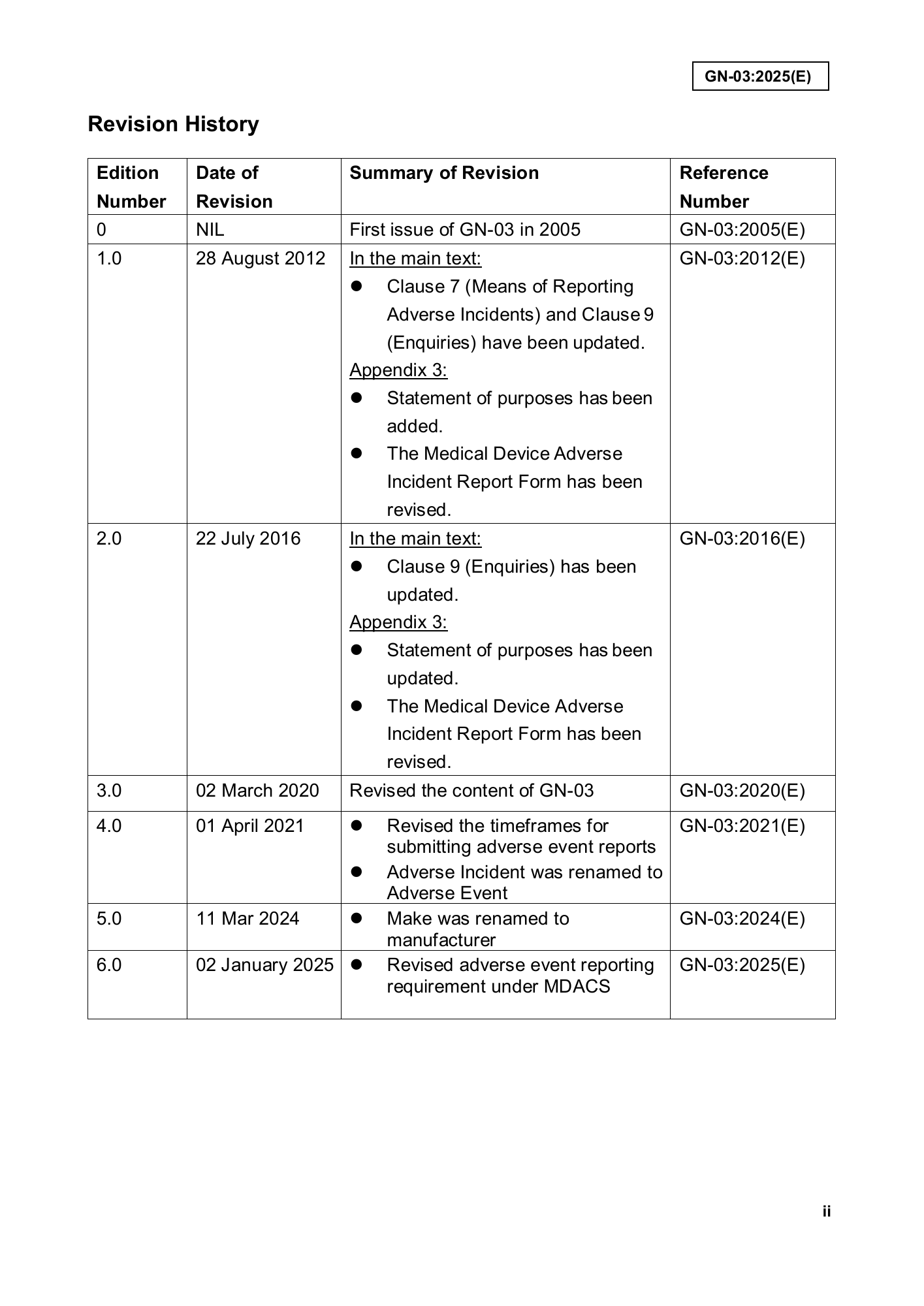
Contents
Edition
Number
Date of
Revision
Summary of Revision Reference
Number
0 NIL First issue of GN-03 in 2005 GN-03:2005(E)
1.0 28 August 2012 In the main text:
Clause 7 (Means of Reporting
Adverse Incidents) and Clause 9
(Enquiries) have been updated.
Appendix 3:
Statement of purpos es has been
added.
The Medical Device Adverse
Incident Report Form has been
revis ed.
GN-03:2012(E)
2.0 22 July 2016 In the main text:
Clause 9 (Enquiries) has been
updated.
Appendix 3:
Statement of purpos es has been
updated.
The Medical Device Adverse
Incident Report Form has been
revis ed.
GN-03:2016(E)
3.0 02 March 2020 Revised the content of GN-03 GN-03:2020(E)
4.0 01 April 2021 Revis ed the timeframes f or
submitting adverse event reports
Adverse Incident was renamed to
Adverse Event
GN-03:2021(E)
5.0 11 Mar 2024
Make was renamed to
manufacturer
GN-03:2024(E)
6.0 02 January 2025 Revis ed adverse event reporting
requirement under MDACS
GN-03:2025(E) (Ed. 6.0) — official PDF page 2; original table columns, symbols and diagram connections
1. Introduction 1.1 The purpose of this Guidance Note (GN) is to assist Local Responsible Persons (LRP) in understanding and complying with the adverse event reporting requirements under the Medical Device Administrative Control System (MDACS). 1.2 The objective of the Adverse Event Reporting System is to improve protection of health and safety of patients, users and others, by disseminating information that may reduce the likelihood of, or to prevent repetition of adverse events associated with medical devices, or to alleviate consequences of such repetition. 1.3 Under the MDACS, the LRPs are required, among other things, to report and manage adverse events happening in Hong Kong concerning their listed medical devices (please also refer to Guidance Notes GN-01). This GN provides guidance on the types of adverse events that should be reported by the LRPs to the Medical Device Division (MDD) of Department of Health (DH) and the timescales f or reporting respective types of adverse events.
2. Scope 2.1 The LRPs are required to report adverse events occurring in Hong Kong with regard to their listed medical devices under the MDACS (please refer to Guidance Notes GN-01). Adverse events occurring outside Hong Kong do not need to be reported. 2.2 Notwithstanding section 2.1 of this GN, if adverse events that occur outside Hong Kong will lead to corrective or preventive actions relevant to listed medical devices in Hong Kong(i.e. safety alerts/recalls either initiated voluntarily by the manufacturer or requested by a regulatory authority), the LRP must also notify MDD of Department of Health (DH) of the related details and actions to be taken in Hong Kong as soon as possible. The report should provide but is not be limited to the following inf ormation: 2.2.1 a description of the medical device, the manufacturer, brand and model designation; 1 GN-03:2025(E) and 2.2.2 the serial numbers or other identification (for instance batch or lot numbers) of the medical devices concerned; and 2.2.3 the actions to be taken and the reasons; and 2.2.4 the distribution volume of the concerned medical device in Hong Kong and the distribution list (if such information is available); and 2.2.5 the contact details of personnel responsible for corrective action in Hong Kong, which should include those for the MDD and those for the general public; and 2.2.6 any advice regarding possible hazards; and 2.2.7 any consequent actions to be taken.
3. Definitions and Abbreviations The following definitions and those given in other Guidance Notes issued by MDD are applicable: 3.1 Abnormal use means intended act or intended omission of an act by the user or operator of medical device as a result of conduct that is beyond any reasonable means of risk control by the manufacturer. Some examples of abnormal use are provided below: 3.1.1 Deliberate failure to conduct device checks prior to each use as provided in the device labelling; or 3.1.2 Filter removed and intentionally not replaced despite clear warnings in the device labelling, resulting in particulate contamination and subsequent device failure; or 3.1.3 The labelling for a centrifugal pump clearly indicates that it is intended for use in by- 2 GN-03:2025(E) pass operations of less than 6 hours in duration. After considering the pump options, a clinician decides that the pump will be used in pediatric extra-corporeal membrane oxygenation (ECMO) procedures, most of which may last several days. A pump fails due to fatigue cracking and patient bleeds to death; or 3.1.4 Alarm is intentionally disabled, preventing detection of risk condition etc. 3.2 Serious injury (also known as serious deterioration in state of health) means either:
3.2.1 Life threatening illness or injury; or 3.2.2 Permanent impairment of a body function or permanent damage to a body structure; or 3.2.3 A condition necessitating medical or surgical intervention to prevent permanent impairment of a body function or permanent damage to a body structure. 3.3 Serious public health concern means any incident type, which results in imminent risk of death, serious injury, or serious illness that may require prompt remedial action to prevent significant risk of substantial harm to the public. 3.4 Service life of a device means the time or usage that a device is intended to remain functional after it is manufactured, placed into use, and maintained as specified by the manufacturer. 3.5 Use error means act or omission of an act that has a different result to that intended by the manufacturer or expected by the operator. Some examples of use error are provided below:
3.5.1. Operator misinterprets the icon and selects the wrong function
3.5.1 Operator misinterprets the icon and selects the wrong function 3.5.2 Operator fails to detect a dangerous increase in heart rate because the alarm limit is mistakenly set too high and operator is over-reliant on alarm system 3 GN-03:2025(E)
4. Adverse Events to be Reported under the MDACS 4.1 Any adverse event that meets all of the following three basic reporting criteria is considered a reportable adverse event and should be reported to the MDD within the timeframe of respective event (pleas e ref er to section 6 of this GN). Examples are given in Appendix 1 of this GN: 4.1.1 The LRP becomes aware of any information regarding an adverse event that has occurred with his listed device(s); and 4.1.2 The LRP’s device may be associated with the adverse event. In assessing the link between the device and the event, the LRP should take into account: 4.1.2.1 The opinion, based on available information, from a healthcare professional;
4.1.3.2. Serious injury of a patient, user or other pers on; or
4.1.3.2 Serious injury of a patient, user or other pers on; or 4.1.3.3 No deaths or serious injuries have occurred but the event may lead to death or serious injury of a patient, user or other person if the event recurs; or
4.2. Use errors meeting any of the following criteria are also reportable:
4.2 Use errors meeting any of the following criteria are also reportable: 4.2.1 Use error that results in death or serious injury or serious public health concern; or 4 GN-03:2025(E) 4.2.2 When the LRP or manufacturer notes a change in trend or a change in pattern of an issue that can potentially lead to death or serious injury or public health concern; or 4.2.3 When the LRP or manufacturer initiates corrective action to prevent death or serious injury or serious public health concern. 4.3 Regardless of the above criteria, if the LRP is not certain whether an adverse event is reportable, he should submit a report to the MDD within the timeframe required by MDD (please refer to section 6 of this GN regarding the timeframes for reporting).
5. Adverse Events that are Exempted from Reporting under the
5. Adverse Events that are Exempted from Reporting under the MDACS 5.1 Whenever any of the following exemption rules can be confirmed by the LRP, the following adverse events do not need to be reported. Explanations of the exemption rules can be found in Appendix 2 of this GN:
5.1.6. Expected and foreseeable documented side eff ects; or
5.1.6 Expected and foreseeable documented side eff ects; or 5.1.7 Adverse events described in an advisory notice previously sent to users, and where no serious injuries or deaths have occurred; or 1 “Malfunction” is synonymous with “Fault” 5 GN-03:2025(E) 5.1.8 Adverse events caused by use errors other than those specified in section 4.2 of this GN; 5.1.9 Adverse events caused by abnormal use of medical devic es. 5.2 Notwithstanding the exemption criteria above, all adverse events involving serious public health concern should be reported to MDD. 5.3 Similarly, those adverse events that are subject to an exemption above will become reportable if changes in the trend (usually an increase in frequency) or pattern are identified. Please refer to GHTF document of ref.: SG2/N36R7:2003 for guidance on trend reporting of adverse incidents.
6. Timeframes for Submitting Adverse Event Reports
6. Timeframes for Submitting Adverse Event Reports 6.1 If the LRP is not certain whether an adverse event is reportable , he should submit a report to the MDD within the timeframe required by MDD. 6.2 Aside from the above, any adverse events that have posed or likely to pose a public health risk, must be reported by the LRP to MDD within 48 hours 6.3 Aside from the above, any adverse events that have resulted in death or serious injury must be reported by the LRP to the MDD as soon as possible, but not later than 10 elapsed calendar days after the LRP becomes aware of the incident. 6.4 Aside from the above, all other reportable adverse events must be reported by the LRP to MDD as soon as possible, but not later than 30 elapsed calendar days after the LRP becomes aware of the event. 6.5 The LRP must submit an initial report to MDD with as much information as possible within the required timeframe. Incomplete information is not an excuse for not meeting reporting requirement. 6.6 In general, the LRP has to follow up with a final report within 30 elapsed calendar 6 GN-03:2025(E) days of the initial reports, detailing the investigation into the AE. If the final report is not available within 30 elapsed calendar days, a f ollow-up report is to be submitted.
7.1. The Medical Device Adverse Event Report Form, Form-Eng AIR-LRP
7.1 The Medical Device Adverse Event Report Form, Form-Eng AIR-LRP (Appendix 3 of this GN) should be used by the LRP to report adverse events that have taken place in Hong Kong. This form is also available on the MDD website at https://www.mdd.gov.hk. 7.2 The LRP may wish to contact MDD immediately after bec oming aware of advers e events that may present serious public health concerns. In this case the LRP should use the telephone and facsimile numbers in this GN to contact MDD within office hours. Outside office hours, the LRP should contact the Duty Officer of the Department of Health by calling 7116 3300 and asking for no. 9178.
8. Important Points to Note 8.1 Submission of an adverse event report does not constitute an admission of manufacturer, LRP, user, or patient liability for the adverse event and its consequences. It does not, in itself, represent a conclusion by the LRP that the content of this report is complete or confirmed, that the device(s) listed failed in any manner. It is also not a conclusion that the device(s) caused or contributed to the adverse event. 8.2 The reporting requirements are conditions for the listing of medical devices under the MDACS (please refer to Guidance Notes GN-01). Failure to comply with the requirements of the MDACS may lead to permanent or temporary delisting of the concerned medical devices (please refer to Guidance Notes GN-01). 8.3 The LRP may wish to have access to the medical device involved in the adverse 7 GN-03:2025(E) event to help in the investigation. Such access would be at the sole discretion of the us er or owner of the medical device.
9. Enquiries 9.1 Enquiries concerning this booklet and the Adverse Event Reporting System should be directed to: Medical Device Division Department of Health Telephone number: 3107 8484 Facsimile number: 3157 1286 Email address: mdd@dh.gov.hk W ebsite: www.mdd.gov.hk Please check for the latest versions of Guidance Notes for the MDACS and the application forms for listing are available at the above website. 8 GN-03:2025(E)
Appendix 1 — Appendix 1
Appendix 1 Examples of Reportable Adverse Events The following are examples of reportable adverse events (extracted from the GHTF document of ref. SG2/N21R8:1999) provided solely for illustration purposes. This list does not replace the reporting requirements as stipulated in this GN. 1. Loss of sensing after a pacemaker has reached end of life. Elective replacement indicator did not show up in due time, although it should have according to device specification. 2. On an X-ray vascular system during patient examination, the C arm had uncontrolled motion. The patient was hit by the image intensifier and his nose was broken. The system was installed, maintained, and used according to manufacturer’s instructions. 3. It was reported that a monitor suspension system fell from the ceiling when the bolts holding the swivel joint broke off. Nobody was injured in the surgical theater at that time but a report is necessary (near incident). The system was installed, maintained, and used according to manufacturer’s instructions. 4. Sterile single use device packaging is labelled with the caution ‘do not use if package is opened or damaged’. The label is placed by incorrect design on inner packaging. Outer package is removed but device is not used during procedure. Device is stored with inner packaging only which does not offer a sufficient sterile barrier. 5. A batc h of out-of-specification blood glucose test strips is released by manufacturer. Patient uses strips according to instructions, but readings provide incorrect values leading to incorrect insulin dosage, resulting in hypoglycemic shock and hospitalization. 6. Premature revision of an orthopedic implant due to loosening. No cause yet determined. 9 GN-03:2025(E) 7. An infusion pump stops, due to a malfunction, but fails to give an alarm. Patient receives under-infusion of needed fluids and requires extra days in hospital to correct. 8. Manufacturer of a pacemaker released on the market identified a software bug. Initial risk assessment determined risk of serious injury as remote. Subsequent failure results in new risk assessment by manufacturer and the determination that the likelihood of occurrence of a serious injury is not remote. 9. Patients undergoing endometrial ablation of the uterus suffered burns to adjacent organs. Burns of adjacent organs due to thin uterine walls were an unanticipated side eff ect of ablation. 10. Manufacturer does not change ablation device label and fails to warn of this side effect which may be produced when the device is working withinspecification. 11. Healthcare professional reported that during implant of a heart valve, the sewing cuff is discovered to be defective. The valve was abandoned and a new valve was implanted and pumping time during surgery was extended. 12. During the use of an external defibrillator on a patient, the defibrillator failed to deliver the programmed level of energy due to malfunction. Patient died. 13. An intravenous set separates, the comatose patient’s blood leaks onto the floor, the patient bleeds to death. Unprotected ECG cable plugged into the main electricity supply – patient died. 14. Fatigue testing performed on a commercialized heart valve bioprosthesis demonstrates premature failure, which resulted in risk to public health. 15. After delivery of an orthopedic implant, errors were discovered in heat treatment records leading to non-conforming material properties, which resulted in risk to public health. 10 GN-03:2025(E) 16. Testing of retained samples identified inadequate manufacturing process, which may lead to detachment of tip electrode of a pacemaker lead, which resulted in risk to public health. 17. Manufacturer provides insufficient details on cleaning methods for reusable surgical instruments used in brain surgery, despite obvious risk of transmission of CJD. 11 GN-03:2025(E)
Appendix 2 — Appendix 2
Appendix 2 Explanations and Examples of Exemption Rules 1. Deficiency of a new device found by the user prior to its use 1.1 Regardless of the existence of provisions in the instruction for use provided by the manufacturer, deficiencies of devices that would normally be detected by the user and where no deaths or serious injuries have occurred, do not need to be reported. 1.2 Some examples of this type of non-reportable adverse events are: 1.2.1 User performs an inflation test prior to inserting the balloon catheter in the patient as required in the instructions for use accompanying the device. Malfunction on inflation is identified. Another balloon is used. Patient is not injured. 1.2.2 Sterile single use device packaging is labeled with the caution ‘do not use if package is opened or damaged’. Open package seals are discovered prior to use, device is not used. 1.2.3 Intravenous administration set tip protector has fallen off the set during distribution resulting in a non-sterile fluid pathway. The intravenous administration set was not us ed. 2 Adverse events caused by the patient’s conditions 2.1 If available information confirms that the root cause of the adverse event is due to the patient’s condition, the event does not need to be reported. These conditions could be preexisting or occurring during device use. 2.2 To justify no reporting, the LRP should have adequate information available to conclude that the device performed as intended and did not cause or contribute to death or serious injury. A person qualified to make a medical judgement would accept the same conclusion. 12 GN-03:2025(E) 2.3 Some examples of this type of non-reportable adverse events are: 2.3.1 Orthopedic surgeon implants a hip joint and warns against sports-related use. Patient chooses to go water skiing and subsequently requires premature revision due to not following directions. 2.3.2 Early revision of an orthopedic implant due to loosening caused by the patient developing osteoporosis. 2.3.3 A patient died after dialysis treatment. The patient had end-stage-renal disease and died of renal failure. 3 Use of a medical device beyond its service life 3.1 When the only cause for the adverse event was that the device exceeded its service life as specified by the manufacturer and the failure mode is not unusual, the adverse event does not need to be reported. 3.2 The service life must be specified by the device manufacturer and included in the master record [technical file] or, where appropriate, the instructions for use (IFU). Reporting assessment must be based on the information in the master record or IFU. 3.3 Some examples of this type of non-reportable adverse events are: 3.3.1 Loss of sensing after a pacemaker has reached end of life. Elective replacement indicator has shown up in due time according to device specification. Surgical explantation of pacemaker required. 3.3.2 A drill bit was used beyond end of specified life. It fractured during invasive operation. Operation time was prolonged due to the difficulty to retrieve the broken parts. 4 Malfunction protection operated correctly and where no death or serious 13 GN-03:2025(E) injury occurs 4.1 Adverse events that did not lead to serious injury or death, because a design feature protected against a malfunction becoming a hazard (in accordance with relevant standards or documented design inputs), do not need to be reported. 4.2 Some examples of this type of non-reportable adverse events are: 4.2.1 An infusion pump stops, due to a malfunction, but gives an appropriate alarm (e.g. in compliance with relevant standards) and there was no injury to the patient. 4.2.2 Microprocessor-controlled radiant warmers malfunction and provide an audible appropriate alarm (e.g., in compliance with relevant standards) and there was no injury to the patient. 4.3.3 During radiation treatment, the automatic exposure control is engaged. Treatment stops. Although patient receives less than optimal dose, patient is not exposed to exc ess radiation. 5 Remote likelihood of occurrence of death or serious injury 5.1 Adverse events that could lead, but have not yet led, to death or serious injury, but have a remote likelihood of causing death or serious injury, and which have been established and documented as acceptable after risk assessment do not need to be reported. 5.2 If an adverse event resulting in death or serious injury occurs, the adverse event is reportable and a reassessment of the risk is necessary. If reassessment determines risk remains remote, previous reports of near incidents of the same type do not need to be reported retrospectively. Decisions not to report subsequent failures of the same type must be documented. Note that any changes in trends of these non- serious outcomes must be reported, as specified in section 5.3 this GN. 14 GN-03:2025(E) 5.3 Some examples of this type of non-reportable adverse events are: 5.3.1 The manufacturer of a pacemaker released on the market identified a software bug and determined that the likelihood of occurrence of a serious injury with a particular setting is remote. No patients experienced adverse health effects. 5.3.2 The manufacturer of blood donor sets obtains repeated complaints of minor leaks of blood from these sets. No patient injury from blood loss or infections of staff have been reported. Chance of infection or blood loss has been reevaluated by manufacturer and deemed remote. 6 Expected and foreseeable documented side effects 6.1 Side effects that are clearly identified in the labelling or are clinically well known as being foreseeable and having a certain functional or numerical predictability when the device was used as intended need not be re ported. 6.2 Some of these events are well known in the medical, scientific, or technology field; others may have been clearly identified during clinical investigation and provided in the labelling. Documentation, including risk assessment, for the particular side effect should be available in the device master record prior to the occurrence of adverse events. It cannot be concluded in the face of events that they are foreseeable unless there is prior supporting information. 6.3 Some examples of this type of non-reportable adverse events are: 6.3.1 A patient receives a second-degree burn during the use in an emergency of an external defibrillator. Risk assessment documents that such a burn has been accepted in view of potential patient benefit and is warned in the instructions for use. The frequency of burns is occurring within range specified in the device master rec ord. 6.3.2 A patient has an undesirable tissue reaction (e.g. nickel allergy) previously known and documented in the device master rec ord. 15 GN-03:2025(E) 6.3.3 Patient who has a mechanical heart valve developed endocarditis ten years after implantation and then died. 6.3.4 Placement of central line catheter results in anxiety reaction and shortness of breath. Both reactions are known and labelled side eff ects. 7 Adverse events described in an advisory notice previously sent to users, and where no serious injuries or deaths have occurred 7.1 Adverse events that occur after the LRP has issued an advisory notice need not be reported individually if these are specified in the notice and have not caused any serious injury or death. The notice should have been previously sent to users and submitted to the MDD prior to the occurrence of adverse events. 7.2 Examples of non-reportable adverse events: 7.2.1 The manufacturer issued an advisory notice and recall of a coronary stent that migrated due to inadequate inflation of an attached balloon mechanism. Subsequent examples of stent migration did not have to be reported if they did not cause any serious injuries or deaths. 8 Adverse events caused by errors in the use other than those specified in section 4.2 of this GN 8.1 Errors in the use of medical devices can be divided into two distinct groups: (i) us e error; and (ii) abnormal use. Not all events caused by such errors are reportable adverse events. Only those caused by use error and meeting any of the criteria specified in section 4.2 of this GN must be reported. However, all of them must be evaluated within the manufacturer’s quality system and the results documented and kept by the manufacturer and the LRP. 8.2 Some examples of non-reportable adverse events are: 8.2.1 Operator enters incorrect sequence and fails to initiate infusion. The device labelling 16 GN-03:2025(E) is consulted and the correct sequence entered. The infusion starts. Patient is not injured. 9 Adverse events caused by abnormal use of medical devices 9.1 Adverse events caused by abnormal use need not be reported under the MDACS. If the LRP becomes aware of abnormal use, they may bring this to the attention of appropriate organizations and healthcare facility personnel. 9.2 Some examples of this type of non-reportable adverse events are: 9.2.1 Contrary to the instructions for use, the device was not sterilized prior to implantation. 17 GN-03:2025(E)
Appendix 3 — Appendix 3
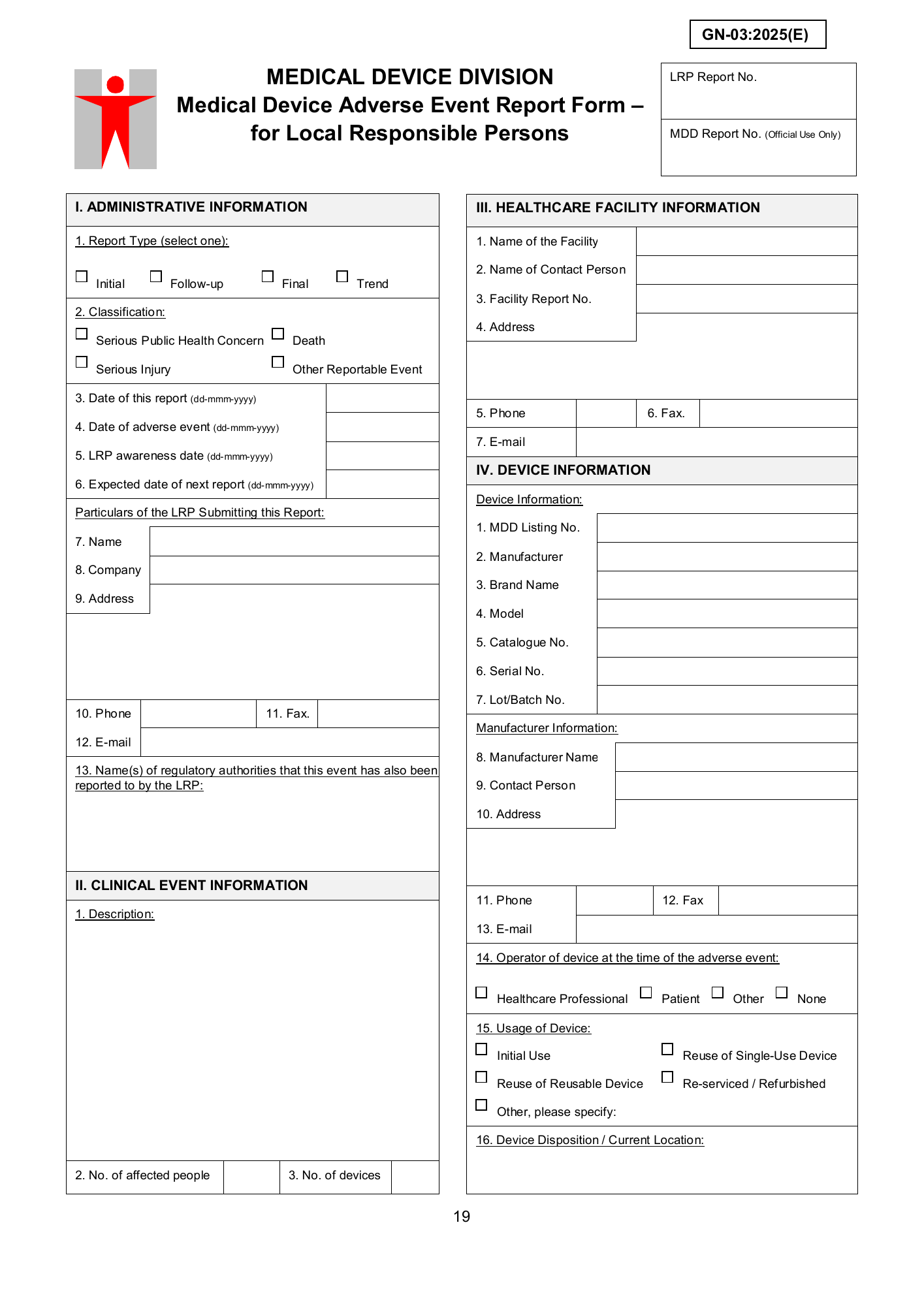
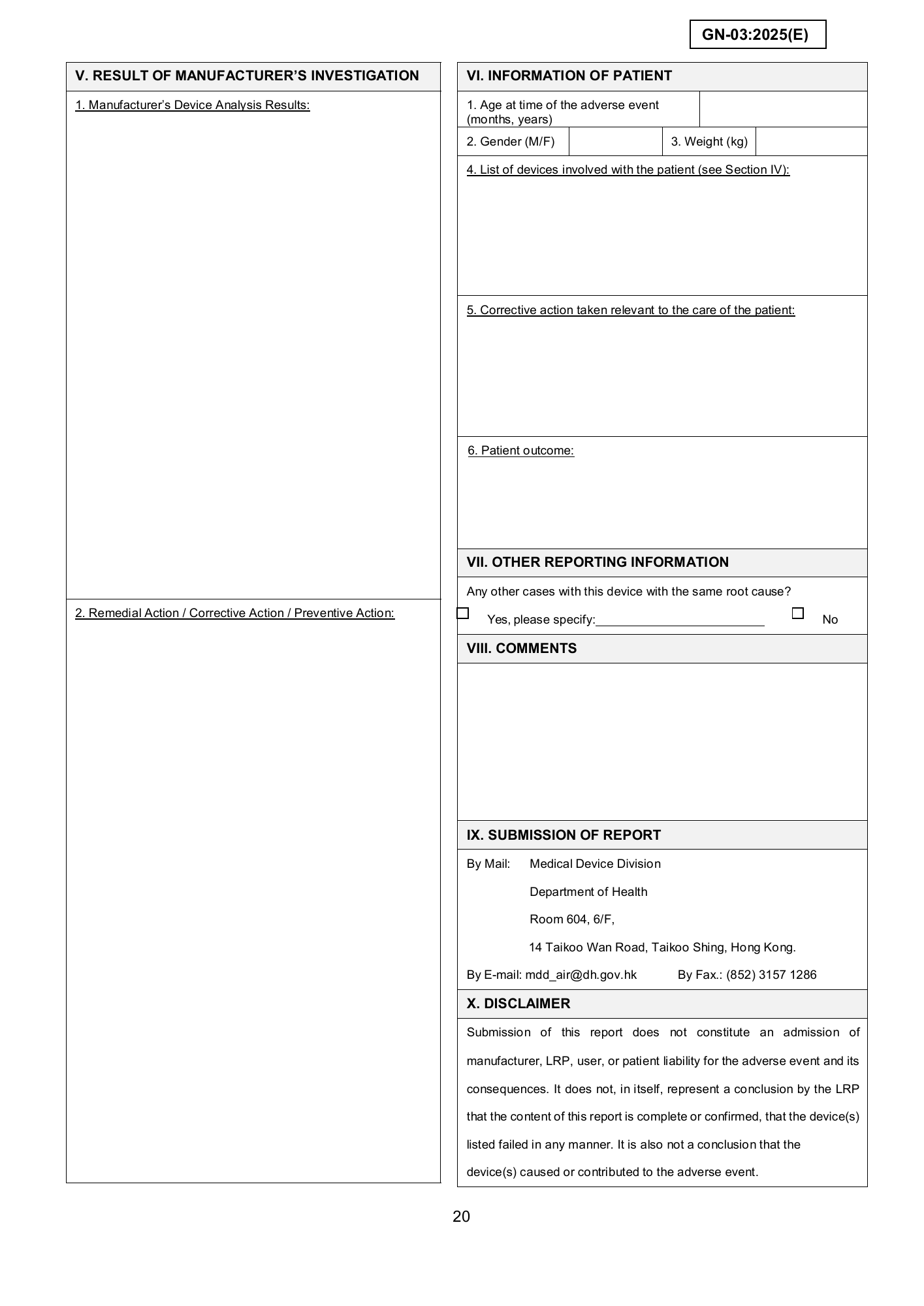
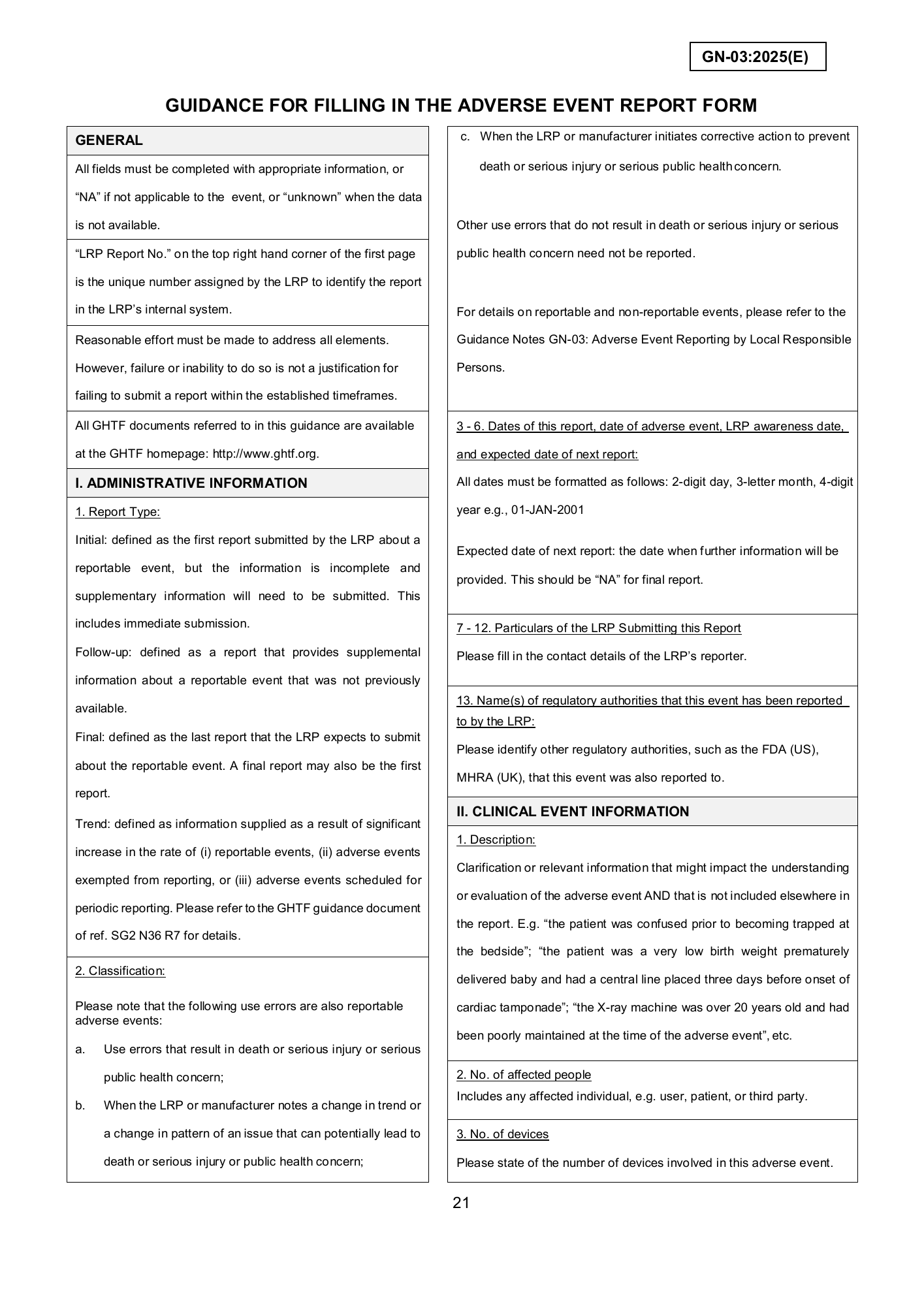
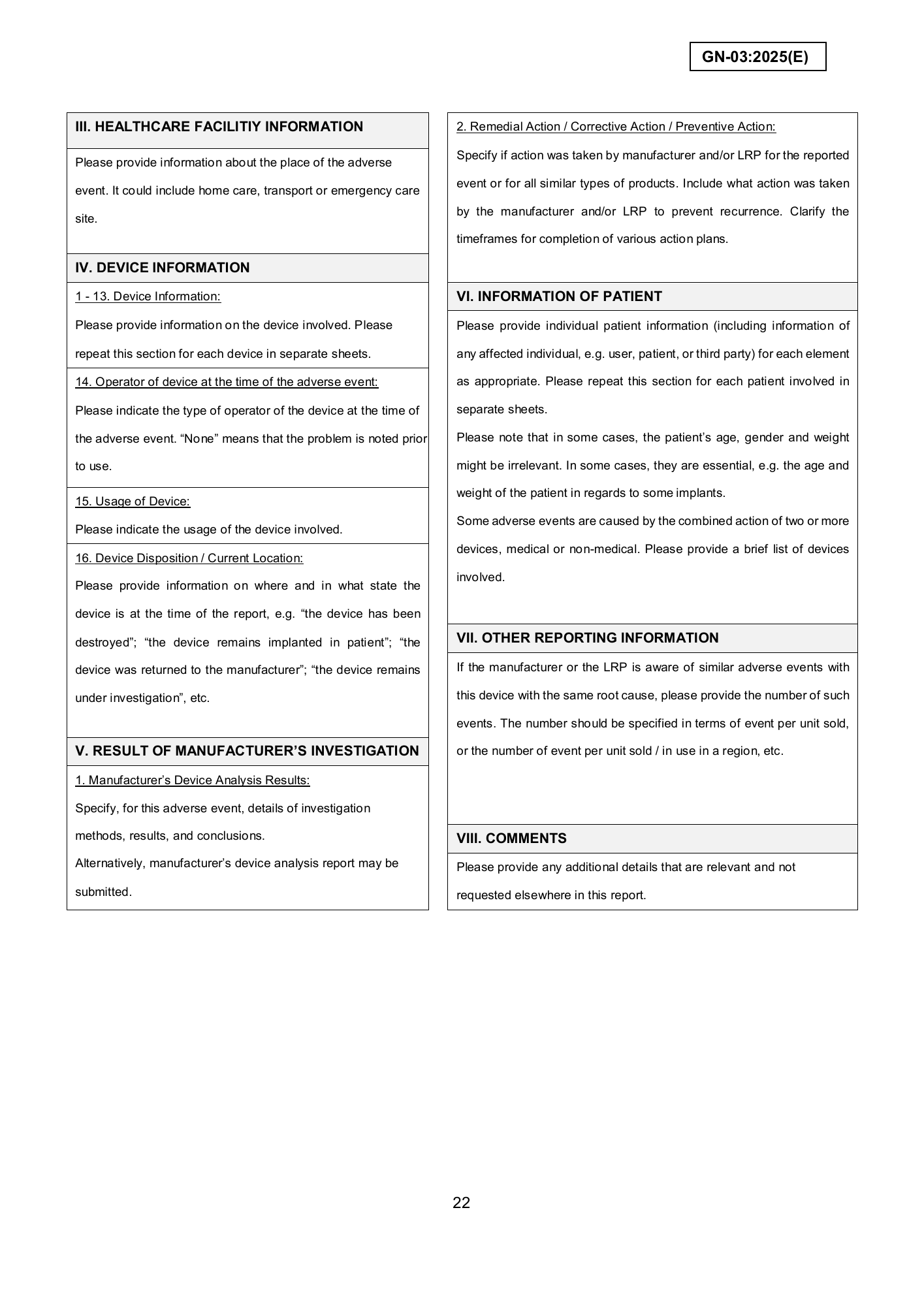
Appendix 3 Statement of Purposes 1. Purpose of Collection The personal data that are provided by you in connection with this Report Form or when you are in contact with the Department of Health (DH) in connection with in this Report Form will be used by the DH for medical device adverse event investigation and management. The provision of personal data is voluntary. If you do not provide sufficient information in the Report Form as specified, we may not be able to provide assistance to you. 2. Classes of Transferees The personal data you provided are mainly for use within the DH but they may also be disclosed to other Government bureaux / departments, or relevant parties for the purpose mentioned in paragraph 1 above, if required. Apart from this, the data may only be disclosed to parties where you have given consent to such disclosure or where such disclosure is allowed under the Personal Data (Privacy) Ordinance. 3. Access to Personal Data You have a right to request access to and correction of your personal data as provided in accordance with the Personal Data (Privacy) Ordinance (Cap. 486). Your right of access includes the right to obtain a copy of your personal data provided during the occasion as mentioned in paragraph 1 above. A fee may be imposed for complying with a data access request. 4. Enquiries Enquiries in relation to the personal data, including requests for making access or corrections to the data, should be addressed to: Exec utive Officer Medical Device Division, Department of Health Room 604, 6/F, 14 Taikoo W an Road, Taikoo Shing, Hong Kong Telephone number: 3107 8453 E-mail address: mdd@dh.gov.hk . Please quote our file reference number when submitting the request. 18 GN-03:2025(E) MEDICAL DEVICE DIVISION Medical Device Adverse Event Report Form – for Local Responsible Persons LRP Report No. MDD Report No. ( Of f i c i al Use On ly ) I. ADMINISTRATIVE INFORMATION 1. Report Type (select one): Initial Follow-up Fi na l Tre nd 2. Classificatio n: Serio us P ub lic Health Co nc er n Death Serio us Injury Other Reportable Event 3. Date of this report (dd-mmm-yyyy) 4. Date of adverse event (dd-mmm-yyyy) 5. LRP awareness date (dd-mmm-yyyy) 6. Expected date of next report (dd-mmm-yyyy) Particulars of the LRP Submitting this Report: 7. Name 8. Company 9. Address 10. P ho ne 11. Fax. 12. E-mail 13. Name(s) of regulatory authorities that this event has also been reported to by the LRP: II. CLINICAL EVENT INFORMATION 1. Descriptio n: 2. No. of affected people 3. No. of devices III. HEALTHCARE FACILITY INFORMATION 1. Name of the Faci lity 2. Name of Contact Perso n 3. Facility Report No. 4. Address 5. P ho ne 6. Fax. 7. E-mail IV. DEVICE INFORMATION Device Information: 1. MDD Listing No. 2. Manufacturer 3. Brand Name 4. Model 5. Catalogue No. 6. Serial No. 7. Lot/Batch No. Manufacturer Information: 8. Manufacturer Name 9. Contact Perso n 10. Address 11. P ho ne 12. Fax 13. E-mail 14. Operator of device at the time of the adverse event: Healthcare Professional Patie nt Ot he r No ne 15. Usage of Device: Initial Use Reuse of Single-Use Device Reuse of Reusable Device Re-serviced / Ref ur bis he d Other, please specify: 16. Device Disposition / Current Location: 19 GN-03:2025(E) V. RESULT OF MANUFACTURER’S INVESTIGATION 1. Manufacturer’s Device Analysis Results: 2. Remedial Action / Corrective Action / Preventive Actio n: VI. INFORMATION OF PATIENT 1. Age at time of the adverse event (mo nths, years) 2. Gender (M/F) 3. Weight (kg) 4. List of devices involved with the patient (see Section IV): 5. Corrective action taken relevant to the care of the patient: 6. Patient o utcome: VII. OTHER REPORTING INFORMATION Any other cases with this device with the same root cause? Yes, please specify: No VIII. COMMENTS IX. SUBMISSION OF REPORT By Mail: Medical Device Division Department of Health Room 604, 6/F, 14 Taikoo Wan Road, Taikoo Shing, Ho ng Ko ng. By E- mai l: mdd_air@dh.gov.hk By Fax.: (852) 3157 1286 X. DISCLAIMER Submission of this report does not constitute an admission of manufacturer, LRP, user, or patient liability for the adverse event and its consequences. It does not, in itself, represent a co nclusion by the LRP t hat t he co nte nt o f this report is complete or confirmed, that the device(s) listed failed in any manner. It is also not a co nclusio n that the device(s) caused or co ntributed to the adverse event. 20 GN-03:2025(E) GUIDANCE FOR FILLING IN THE ADVERSE EVENT REPORT FORM GENERAL All fields must be completed with appropriate informatio n, or “NA” if not applicable to the event, or “unkno wn” when the data is not available. “LRP Report No.” o n the top right hand corner of the first page is the unique number assigned by the LRP to identify the report in the LRP’s internal system. Reaso nable effort must be made to address all elements. However, failure or inability to do so is not a justification for failing to submit a report within the established timeframes. All GHTF documents referred to in this guidance are available at the GHTF ho mepage: http://www.ghtf.org. I. ADMINISTRATIVE INFORMATION 1. Report Type: Initial: defined as the first report submitted by the LRP abo ut a reportable event, but the informatio n is incomplete and supplementary information will need to be submitted. This includes immediate submission. Follow- up: defined as a report that provides supplemental informatio n about a reportable event that was not previously available. Final: defined as the last report that the LRP expects to submit about the reportable event. A final report may also be the first report. Trend: defined as information supplied as a result of significant increase in the rate of (i) reportable events, (ii) adverse events exempted from reporting, or (iii) adverse events scheduled for periodic reporting. Please refer to the GHTF guidance document of ref. SG2 N36 R7 for details. 2. Classificatio n: Please note that the follo wing use errors are also reportable adverse events: a. Use errors that result in death or serio us injury or serious public health co ncern; b. Whe n the LRP or manufacturer notes a change in trend or a change in pattern of an issue that can potentially lead to death or serious injury or public health co nc er n; c. When the LRP or manufacturer initiates corrective actio n to prevent death or serious injury or serious public healthco nce r n. Other use errors that do not result in death or serious injury or serious public health co ncern need not be reported. For details o n reportable and no n-reportable events, please refer to the Guidance Notes GN-03: Adverse Event Reporting by Local Respo nsible Persons. 3 - 6. Dates of this report, date of adverse event, LRP awareness date, and expected date of next report: All dates must be formatted as follows: 2-digit day, 3-letter mo nth, 4- digit year e.g., 01-JAN-2001 Expected date of next report: the date when f urther informatio n will be provided. This sho uld be “NA” for final report. 7 - 12. Particulars of the LRP Submitting this Report Please fill in the co ntact details of the LRP’s reporter. 13. Name(s) of regulatory authorities that this ev e nt has been reported to by the LRP: Please identify other regulatory authorities, such as the FDA (US), MHRA (UK), that this event was also reported to. II. CLINICAL EVENT INFORMATION 1. Descriptio n: Clarification or relevant informatio n that might impact the understanding or evaluatio n of the adverse ev e nt AND t ha t is no t included elsewhere in the report. E.g. “the patient was co nfused prior to becoming trapped at the bedside”; “the patient was a very low birth weight prematurely delivered baby and had a central line placed three days before o nset of cardiac tampo nade”; “the X- ray machine was over 20 years old a nd had been poorly maintained at the time of the adverse event”, etc. 2. No. of affected people Includes any affected individual, e.g. user, patient, or third party. 3. No. of devices Please state of the number of devices invo lved in this adverse event. 21 GN-03:2025(E) III. HEALTHCARE FACILITIY INFORMATION Please provide informatio n abo ut the place of the adverse event. It co uld include home care, transport or emergency care site. IV. DEVICE INFORMATION 1 - 13. Device Information: Please provide informatio n o n the device involved. Please repeat this section for each device in separate sheets. 14. Operator of device at the time of the adverse event: Please indicate the type of operator of the device at the time of the adverse event. “No ne” means that the problem is noted prior to us e. 15. Usage of Device: Please indicate the usage of the device involved. 16. Device Disposition / Current Locatio n: Please provide informatio n o n where and in what state t he device is at the time of the report, e.g. “the device has been destroyed”; “the device remains implanted in patient”; “the device was returned to the manufacturer”; “the device remains under investigatio n”, etc. V. RESULT OF MANUFACTURER’S INVESTIGATION 1. Manufacturer’s Device Analysis Results: Specify, for this adverse event, details of investigatio n methods, results, and conclusio ns. Alternatively, manufacturer’s device analysis report may be submitted. 2. Remedial Action / Corrective Action / Preventive Actio n: Specify if action was taken by manufacturer and/or LRP for t he reported event or for all similar types of products. Include what action was taken by the manufacturer and/or LRP to prevent recurrence. Clarify the timeframes for completio n of various actio n pla ns. VI. INFORMATION OF PATIENT Please provide individual patient informatio n (including informatio n of any affected individual, e.g. user, patient, or third party) for each element as appropriate. Please repeat this section for each patient invo lved in separate sheets. Please note that in some cases, the patient’s age, gender and weight might be irrelevant. In some cases, they are essential, e.g. the age and weight of the patient in regards to some implants. Some adverse events are caused by the combined action of two or more devices, medical or no n-medical. Please provide a brief list of devices involved. VII. OTHER REPORTING INFORMATION If the manufacturer or the LRP is aware of similar adverse events with this device with the same root cause, please provide the number of such events. The number sho uld be specified in terms of event per unit sold, or the number of event per unit sold / in use in a regio n, etc. VIII. COMMENTS Please provide any additio nal details that are relevant and not requested elsewhere in this report. 22
GN-03:2025(E) (Ed. 6.0) — official PDF page 22; original table columns, symbols and diagram connectionsGN-03:2025(E) (Ed. 6.0) — official PDF page 23; original table columns, symbols and diagram connectionsGN-03:2025(E) (Ed. 6.0) — official PDF page 24; original table columns, symbols and diagram connectionsGN-03:2025(E) (Ed. 6.0) — official PDF page 25; original table columns, symbols and diagram connections