Government Notice 22 of 2012 — Atomic Energy Regulations, 2012
Currentness under review. Whether this instrument remains applicable is under review. Consult the later instruments and source context below before relying on it.
Link directly to a passage with its anchor — for example #pdf-page-1 — to open it highlighted. This reference version is generated from the authority’s publication and does not replace it. Language: English.
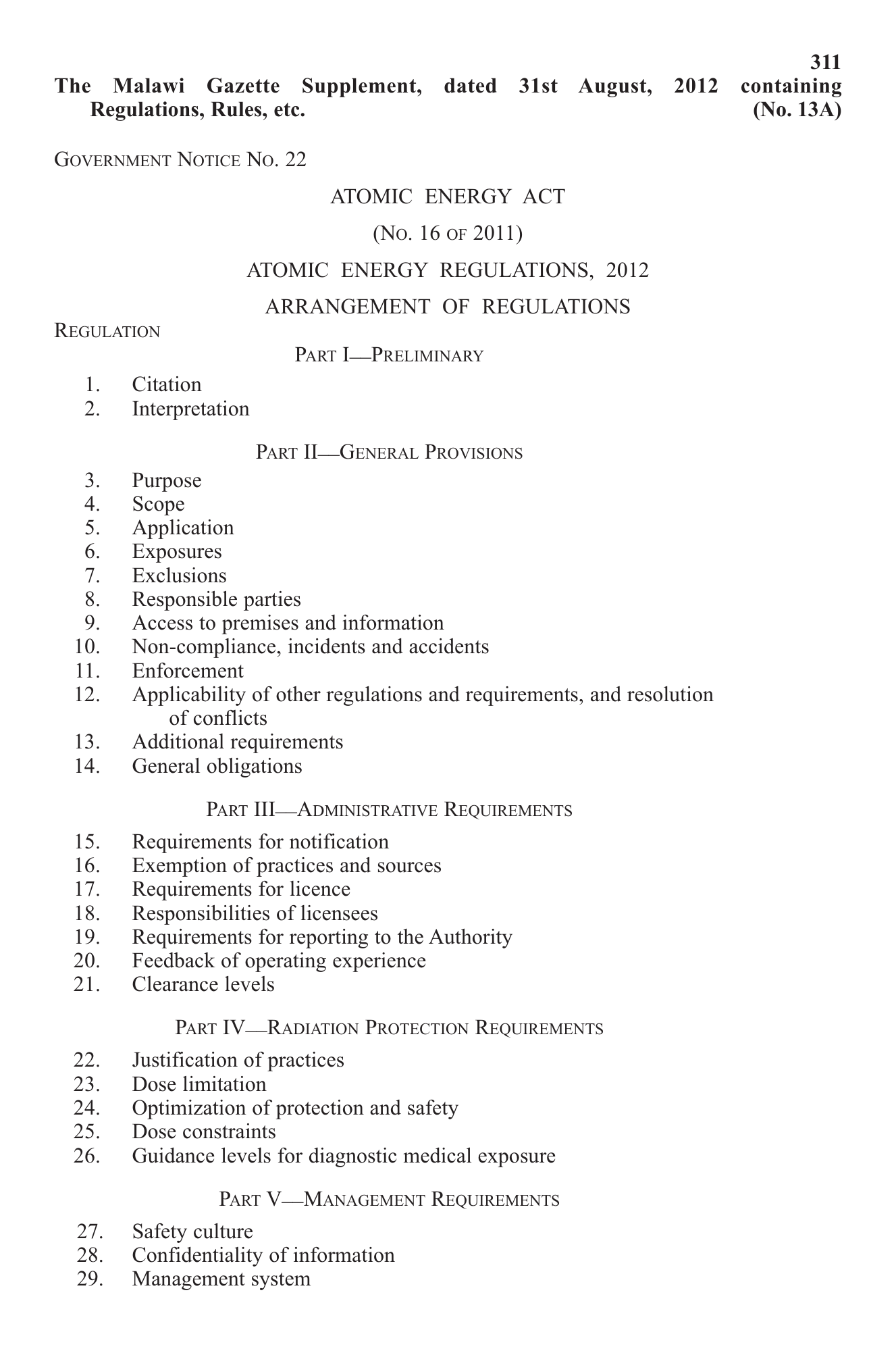
Contents
311
The Malawi Gazette Supplement, dated 31st August, 2012 containing
Regulations, Rules, etc. (No. 13A)
GOVERNMENT NOTICE NO. 22
ATOMIC ENERGY ACT
(NO. 16 OF 2011)
ATOMIC ENERGY REGULATIONS, 2012
ARRANGEMENT OF REGULATIONS
REGULATION
PART I—PRELIMINARY
1. Citation
2. Interpretation
PART II—GENERAL PROVISIONS
3. Purpose
4. Scope
5. Application
6. Exposures
7. Exclusions
8. Responsible parties
9. Access to premises and information
10. Non-compliance, incidents and accidents
11. Enforcement
12. Applicability of other regulations and requirements, and resolution
of conflicts
13. Additional requirements
14. General obligations
PART III—ADMINISTRATIVE REQUIREMENTS
15. Requirements for notification
16. Exemption of practices and sources
17. Requirements for licence
18. Responsibilities of licensees
19. Requirements for reporting to the Authority
20. Feedback of operating experience
21. Clearance levels
PART IV—RADIATION PROTECTION REQUIREMENTS
22. Justification of practices
23. Dose limitation
24. Optimization of protection and safety
25. Dose constraints
26. Guidance levels for diagnostic medical exposure
PART V—MANAGEMENT REQUIREMENTS
27. Safety culture
28. Confidentiality of information
29. Management system
Government Notice 22 of 2012 — official PDF page 1; original table columns, symbols and diagram connections
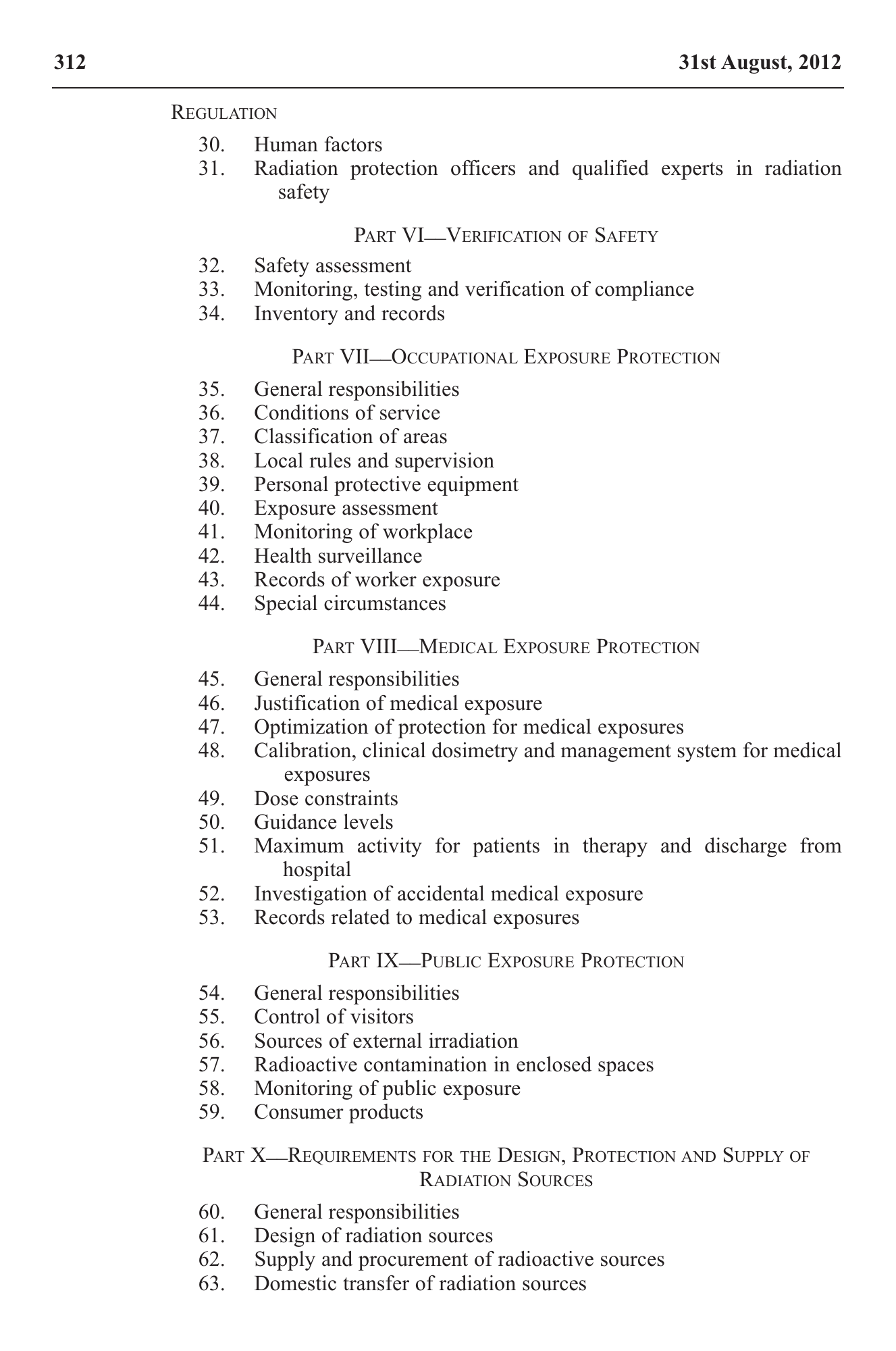
312 31st August, 2012
REGULATION
30. Human factors
31. Radiation protection officers and qualified experts in radiation
safety
PART VI—VERIFICATION OF SAFETY
32. Safety assessment
33. Monitoring, testing and verification of compliance
34. Inventory and records
PART VII—OCCUPATIONAL EXPOSURE PROTECTION
35. General responsibilities
36. Conditions of service
37. Classification of areas
38. Local rules and supervision
39. Personal protective equipment
40. Exposure assessment
41. Monitoring of workplace
42. Health surveillance
43. Records of worker exposure
44. Special circumstances
PART VIII—MEDICAL EXPOSURE PROTECTION
45. General responsibilities
46. Justification of medical exposure
47. Optimization of protection for medical exposures
48. Calibration, clinical dosimetry and management system for medical
exposures
49. Dose constraints
50. Guidance levels
51. Maximum activity for patients in therapy and discharge from
hospital
52. Investigation of accidental medical exposure
53. Records related to medical exposures
PART IX—PUBLIC EXPOSURE PROTECTION
54. General responsibilities
55. Control of visitors
56. Sources of external irradiation
57. Radioactive contamination in enclosed spaces
58. Monitoring of public exposure
59. Consumer products
PART X—REQUIREMENTS FOR THE DESIGN, PROTECTION AND SUPPLY OF
RADIATION SOURCES
60. General responsibilities
61. Design of radiation sources
62. Supply and procurement of radioactive sources
63. Domestic transfer of radiation sources
Government Notice 22 of 2012 — official PDF page 2; original table columns, symbols and diagram connections
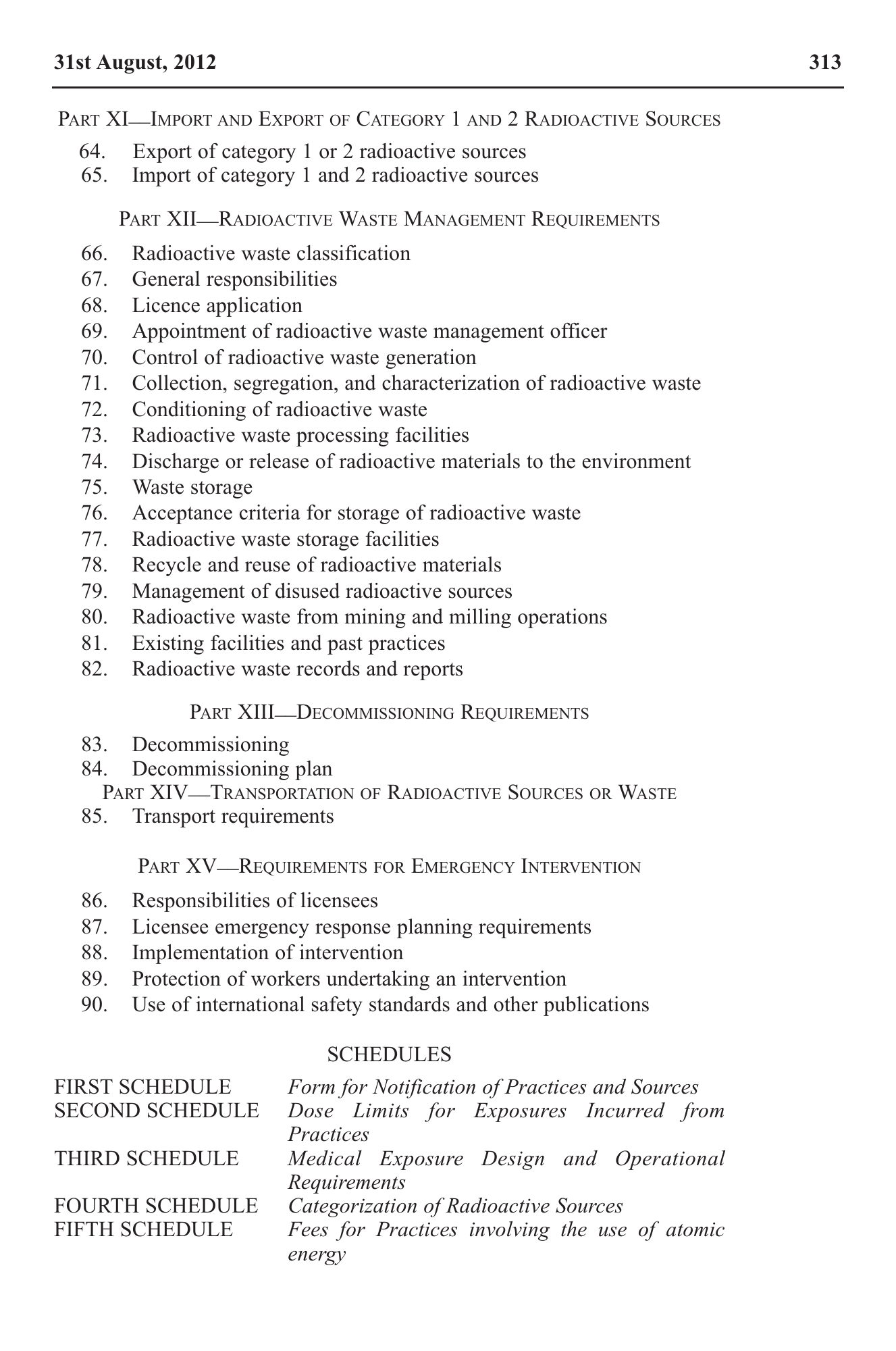
31st August, 2012 313
PART XI—IMPORT AND EXPORT OF CATEGORY 1 AND 2 RADIOACTIVE SOURCES
64. Export of category 1 or 2 radioactive sources
65. Import of category 1 and 2 radioactive sources
PART XII—RADIOACTIVE WASTE MANAGEMENT REQUIREMENTS
66. Radioactive waste classification
67. General responsibilities
68. Licence application
69. Appointment of radioactive waste management officer
70. Control of radioactive waste generation
71. Collection, segregation, and characterization of radioactive waste
72. Conditioning of radioactive waste
73. Radioactive waste processing facilities
74. Discharge or release of radioactive materials to the environment
75. Waste storage
76. Acceptance criteria for storage of radioactive waste
77. Radioactive waste storage facilities
78. Recycle and reuse of radioactive materials
79. Management of disused radioactive sources
80. Radioactive waste from mining and milling operations
81. Existing facilities and past practices
82. Radioactive waste records and reports
PART XIII—DECOMMISSIONING REQUIREMENTS
83. Decommissioning
84. Decommissioning plan
PART XIV—TRANSPORTATION OF RADIOACTIVE SOURCES OR WASTE
85. Transport requirements
PART XV—REQUIREMENTS FOR EMERGENCY INTERVENTION
86. Responsibilities of licensees
87. Licensee emergency response planning requirements
88. Implementation of intervention
89. Protection of workers undertaking an intervention
90. Use of international safety standards and other publications
SCHEDULES
FIRST SCHEDULE Form for Notification of Practices and Sources
SECOND SCHEDULE Dose Limits for Exposures Incurred from
Practices
THIRD SCHEDULE Medical Exposure Design and Operational
Requirements
FOURTH SCHEDULE Categorization of Radioactive Sources
FIFTH SCHEDULE Fees for Practices involving the use of atomic
energy
Government Notice 22 of 2012 — official PDF page 3; original table columns, symbols and diagram connections
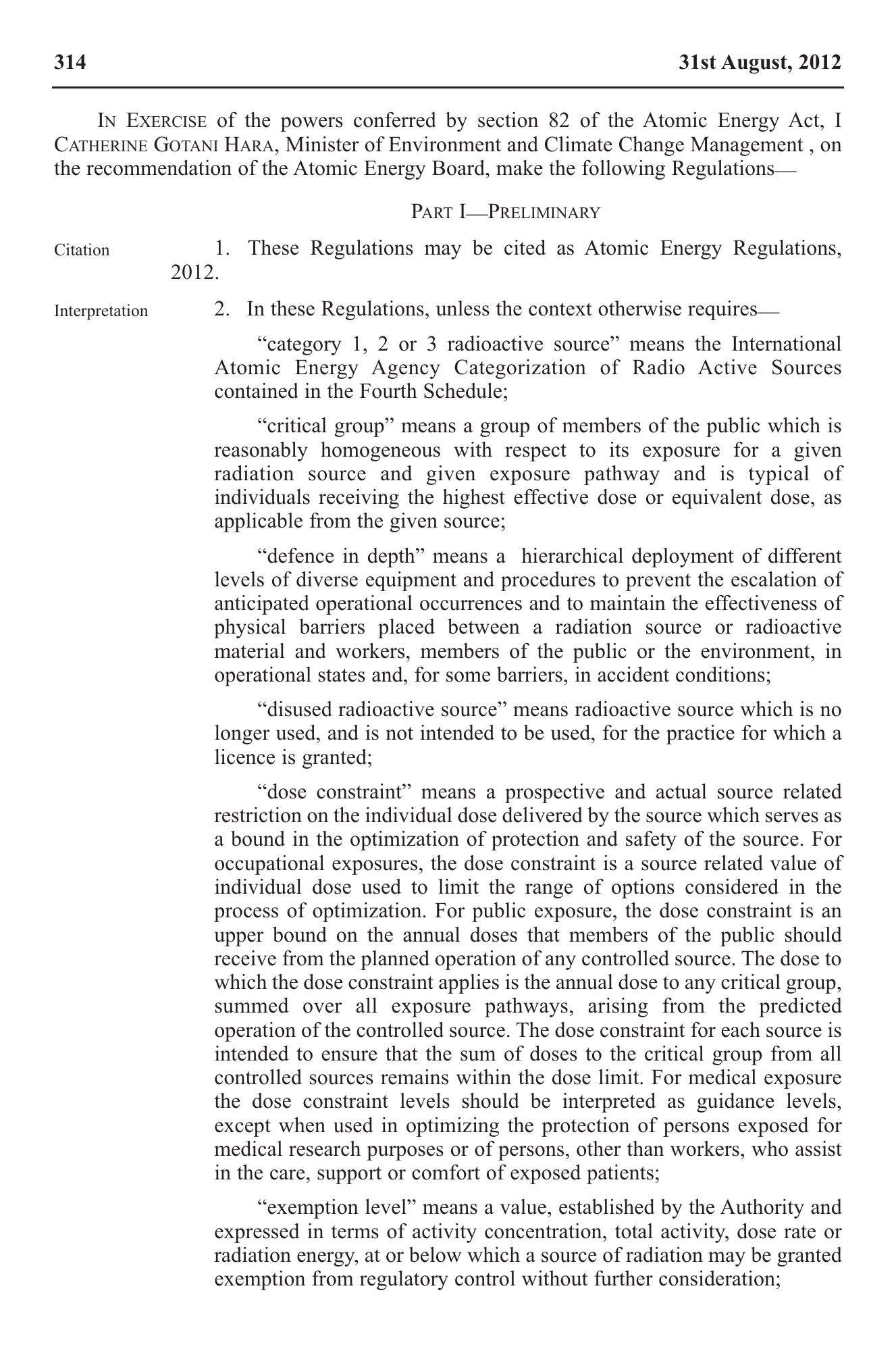
314 31st August, 2012
IN EXERCISE of the powers conferred by section 82 of the Atomic Energy Act, I
CATHERINE GOTANI HARA, Minister of Environment and Climate Change Management , on
the recommendation of the Atomic Energy Board, make the following Regulations—
PART I—PRELIMINARY
Citation
1. These Regulations may be cited as Atomic Energy Regulations,
2012.
Interpretation
2. In these Regulations, unless the context otherwise requires—
“category 1, 2 or 3 radioactive source” means the International
Atomic Energy Agency Categorization of Radio Active Sources
contained in the Fourth Schedule;
“critical group” means a group of members of the public which is
reasonably homogeneous with respect to its exposure for a given
radiation source and given exposure pathway and is typical of
individuals receiving the highest effective dose or equivalent dose, as
applicable from the given source;
“defence in depth” means a hierarchical deployment of different
levels of diverse equipment and procedures to prevent the escalation of
anticipated operational occurrences and to maintain the effectiveness of
physical barriers placed between a radiation source or radioactive
material and workers, members of the public or the environment, in
operational states and, for some barriers, in accident conditions;
“disused radioactive source” means radioactive source which is no
longer used, and is not intended to be used, for the practice for which a
licence is granted;
“dose constraint” means a prospective and actual source related
restriction on the individual dose delivered by the source which serves as
a bound in the optimization of protection and safety of the source. For
occupational exposures, the dose constraint is a source related value of
individual dose used to limit the range of options considered in the
process of optimization. For public exposure, the dose constraint is an
upper bound on the annual doses that members of the public should
receive from the planned operation of any controlled source. The dose to
which the dose constraint applies is the annual dose to any critical group,
summed over all exposure pathways, arising from the predicted
operation of the controlled source. The dose constraint for each source is
intended to ensure that the sum of doses to the critical group from all
controlled sources remains within the dose limit. For medical exposure
the dose constraint levels should be interpreted as guidance levels,
except when used in optimizing the protection of persons exposed for
medical research purposes or of persons, other than workers, who assist
in the care, support or comfort of exposed patients;
“exemption level” means a value, established by the Authority and
expressed in terms of activity concentration, total activity, dose rate or
radiation energy, at or below which a source of radiation may be granted
exemption from regulatory control without further consideration;
Government Notice 22 of 2012 — official PDF page 4; original table columns, symbols and diagram connections
31st August, 2012 315
“legal person” means any organization, corporation, partnership,
firm, association, trust, estate, public or private institution, group,
political or administrative entity or other persons designated in
accordance with national legislation, who or which has responsibility
and authority for any action having implications for protection and
safety;
“management” means the administrative and operational activities
that are involved in the manufacture, supply, receipt, possession, storage,
use, transfer, import, export, transport, maintenance, recycling or
disposal of radioactive sources;
“principal parties” mean the persons having the main
responsibilities for the application of these Regulations, including
registrants, licensees and employers;
“orphan radioactive source” means radioactive source which is not
under regulatory control because it has never been under regulatory
control, or because it has been abandoned, lost, misplaced, stolen, or
transferred without a proper licence;
“registration” means a form of licence for practices of low or
moderate risks whereby the legal person responsible for the practice has,
as appropriate, prepared and submitted a safety assessment of the facility
and equipment to the Authority. The practice or activity is licensed with
conditions or limitations, as appropriate;
“regulatory control” means any form of control or regulation
applied to facilities or activities by an Authority for reasons related to
radiation protection or to the safety of radiation sources;
“safety culture” means the assembly of characteristics and attitudes
in organizations and individuals which establishes that, as an overriding
priority, protection and safety issues receive the attention warranted by
their significance;
“spent radioactive source” means radioactive source that is no
longer suitable for its intended purpose as a result of radioactive decay;
“storage” means the holding of radioactive sources, spent fuel or
radioactive waste in a facility that provides for its containment, with the
intention of retrieval;
“vulnerable radioactive source” means radioactive source for which
control is inadequate to provide assurance of long term safety and
security, such that it could relatively be easily acquired by unlicensed
persons or could, relatively easily become orphaned.
PART II—GENERAL PROVISIONS
Purpose
3.—(1) These Regulations specify the basic requirements:
(a) for the protection of people against exposure to ionizing
radiation, for the safety of radiation sources, for the safety of radioactive
waste management, and for the protection of the environment,
(hereinafter referred to as “protection and safety”) and;
Government Notice 22 of 2012 — official PDF page 5; original table columns, symbols and diagram connections
316 31st August, 2012
(b) to prevent unlicensed access or damage to, and loss, theft or
unlicensed transfer of radioactive sources, so as to reduce the likelihood
of accidental harmful exposure to such sources.
(2) These Regulations shall not relieve a licensed legal person from the
duty to take any additional actions as may be appropriate and necessary to
protect the environment or the health and safety of people.
Scope
4. These Regulations shall apply to the adoption, introduction, conduct,
discontinuance, or cessation of a practice and to the design, manufacture,
construction or assembly, acquisition, import or export, distribution, selling,
loaning or hiring, locating, commissioning, processing, possession, use and
operation, maintenance or repair, transfer or decommissioning, disassembly,
transport, storage and recycling or disposal of a radiation source within a
practice unless exposure from the source is specifically excluded under
regulation 7 or is exempted under regulation 16.
Application
5.—(1) The sources within any practice to which the requirements for
practices of these Regulations shall apply include—
(a) radioactive materials and devices that contain radioactive
material, produce radiation or nuclear material, including consumer
products, sealed radioactive sources, unsealed sources, and radiation
generators;
(b) installations and facilities containing radioactive materials or
devices containing radioactive material or that produce radiation which
are used for industrial, medical, agricultural, research and education
purposes;
(c) radioactive waste resulting from applications and to radioactive
waste management facilities and activities including;
(i) effluent discharges;
(ii) waste that contains only naturally occurring materials,
whatever the origin of that waste;
(iii) disused radioactive sources; and
(iv) any other radiation source specified by the Atomic Energy
Regulatory Authority, including sources in the environment such as
radon.
(2) The specific radioactive waste provisions contained in regulations
74_78 shall apply only to waste arising from medical, agricultural, industrial,
research and education applications, mining and milling activities, including
associated radioactive waste management activities, such as collection,
segregation, characterization, classification, treatment, conditioning, and
storage.
(3) These Regulations shall apply to intervention by legal persons
licensed to possess radiation sources in the event of radiological emergencies
involving their sources.
Government Notice 22 of 2012 — official PDF page 6; original table columns, symbols and diagram connections
31st August, 2012 317
Exposures
6. The exposures to which the safety requirements of these
Regulations apply are any occupational exposure, medical exposure or public
exposure due to any relevant practice or radiation source within the practice,
including both normal exposures and potential exposures.
Exclusions
7. The following exposures are excluded from the application of these
Regulations—
(a) exposures from natural radioactivity in the body;
(b) cosmic radiation;
(c) unmodified concentrations of natural radionuclides in raw
materials; and
(d) any other radiation sources that is essentially unamenable to
control as may be determined by the Authority.
Responsible parties
8.—(1) The principal parties which have the main responsibilities for the
application of these Regulations shall be—
(a) legal persons responsible for notified or licensed practices or
sources within practices; and
(b) employers of workers who do not report directly to legal
persons.
(2) Other parties which shall have subsidiary responsibilities for the
application of these Regulations may include, as appropriate;
(a) suppliers;
(b) workers;
(c) radiation protection and waste safety officers;
(d) medical practitioners;
(e) health professionals;
(f) qualified experts;
(g) ethical review committees; and
(h) any other party to whom the principal party has delegated
specific tasks.
(3) the general responsibilities of the principal parties include—
(a) to establish radiation safety objectives, to protect people and the
environment from the harmful effects of ionizing radiation, in
conformity with the relevant requirements of these Regulations;
(b) to develop, implement and document a radiation safety
programme commensurate with the nature and extent of the risks
associated with the practices and interventions under their responsibility
and sufficient to ensure compliance with the requirements of these
Regulations and in particular, this programme shall include the following
actions—
(i) to determine and continually review the measures needed to
achieve the radiation safety objectives, to ensure that resources
needed for their implementation are provided and regularly to
verify that radiation safety objectives are being achieved;
Government Notice 22 of 2012 — official PDF page 7; original table columns, symbols and diagram connections
318 31st August, 2012
(ii) to identify and prevent, or promptly correct, any failures or
shortcomings in the radiation safety measures;
(iii) to facilitate consultation and co-operation among all
relevant parties with respect to radiation safety; and
(iv) to keep appropriate records regarding the discharge of
their responsibilities; and
(c) to ensure that—
(i) radioactive sources are managed in accordance with the
licence;
(ii) when radioactive sources are not in use, they are safely
stored;
(iii) any transfer of sources to another person is licensed and
documented and that the receiving person or entity is licensed in
accordance with the applicable regulatory requirements to receive
the transferred source;
(iv) arrangements are made for the safe management of
radioactive sources (minimum Category 1, 2 & 3 as referred to in
the Fourth Schedule), including financial provisions where
appropriate, once they have become disused;
(v) the import and export of Category 1 & 2 radioactive
sources is done in accordance with these Regulations;
(vi) sources are shipped and received in accordance with
regulatory requirements; and
(vii) assistance is provided to relevant authorities or law
enforcement authorities in recovering any lost or stolen source.
Access to premises and information
9.—(1) Legal persons responsible for notified or licensed practices or
sources within practices shall permit representatives of the Authority
immediate access to premises and facilities in which such practices are
conducted or sources located in order to obtain information about the status of
radiation safety and verify compliance with regulatory requirements.
(2) Each legal person engaged in a practice to which these Regulations
apply, shall make available to the Authority, information and records
regarding radiation safety and security of sources as required.
Non- compliance, incidents and accidents
10.—(1) In the event of a breach of any applicable requirement of these
Regulations, principal parties shall, as appropriate—
(a) investigate the breach and its causes, circumstances and
consequences;
(b) take appropriate action to remedy the circumstances and to
prevent a recurrence of similar situations;
(c) report to the Authority within twenty-four (24) hours, or as
required, on the causes of the breach, its circumstances and
consequences, and on the corrective or preventive actions taken or to be
taken; and
Government Notice 22 of 2012 — official PDF page 8; original table columns, symbols and diagram connections
31st August, 2012 319
(d) take whatever other actions are necessary as required by these
Regulations.
(2) Whenever a situation involving the loss of control through loss or
theft of a Category 1, 2 or 3 radioactive source has occurred or is occurring,
the Authority shall be informed as soon as it is discovered that there has been
a loss of control of the Category 1, 2 or 3 radioactive source.
(3) Failure to take corrective or preventive actions within a reasonable
time in accordance with these Regulations shall be grounds for enforcement
in accordance with regulation 11.
Enforcement
11.—(1) The Authority may revoke, suspend or modify a licence to use
a radiation source where the Authority finds that there is an undue threat to
health and safety or non-compliance with the Act or other applicable
regulatory requirements.
(2) Where the Authority finds that legal persons responsible for notified
or licensed practices or sources within practices have not complied with the
Act, applicable regulations and regulatory requirements commensurate with
the nature of the infraction, the Authority shall impose upon them the
prescribed fines.
(3) The Authority shall refer any wilful violations or attempted violations
of these Regulations or requirements to the Director of Public Prosecutions
for prosecution.
(4) Any person who contravenes any provision of these Regulations
commits an offence and shall, upon conviction, be liable to a fine of five
million Kwacha and to five (5) years imprisonment.
Applicability of other regulations and requirements,
12.—(1) The requirements of these Regulations are in addition to, and
not in place of, other applicable national and international laws and
regulations.
(2) Nothing in these Regulations shall be construed as—
(a) relieving employers from complying with applicable national
and international laws and regulations governing safety and security of
sources; or
(b) restricting any actions that may otherwise be necessary for
safety and security of sources.
(3) Where a conflict exists between requirements contained in these
regulations and other laws or regulations, the Authority shall be notified of the
conflict in order to initiate steps towards resolution.
Additional requirements
13.—(1) The Authority may prescribe other requirements by order, or
conditions of a licence, in addition to those established under these
Regulations, as considered necessary to—
(a) protect the public;
(b) protect the environment; or
(c) minimize risk from radiation hazards.
Government Notice 22 of 2012 — official PDF page 9; original table columns, symbols and diagram connections
320 31st August, 2012
(2) A licensed legal person shall comply with the additional requirements
referred to in subregulation (1).
(3) Except as specifically licensed, no official interpretation of these
Regulations binding on the Authority can be made by any officer or employee
of the Authority other than a written interpretation by the Executive Director
of the Authority.
PART III—ADMINISTRATIVE REQUIREMENT
General obligations
14.—(1) A person shall not engage in activities, which involve
radioactive waste, practices or radiation sources as specified in regulation 4,
unless the requirements of these Regulations, including requirements of
notification and licence, are fulfilled.
(2) An applicant and a licensee, as the case may be, shall pay the
applicable fees contained in the fifth schedule as prescribed by the Minister
from time to time.
(3) The Authority shall determine the formula to calculate the applicable
fees, and the authority may, from time to time, review the formula.
Requirements for notification
15.—(1) Unless exempt from notification as provided for in regulation
16 (1) or (3), any legal person—
(a) who, on the day these Regulations enter into force, is
responsible for a practice or in possession of a radioactive source
referred to in regulation 4, shall submit a notification to the Authority
within ninety (90) days from the effective date and shall provide the
information in the notification, specified in the First Schedule hereto;
and
(b) who intends to initiate a practice or to possess a radiation source
referred to in regulation 4, shall submit a prior notification to the
Authority of the intention.
(2) After notification, each legal person who is required to apply to the
Authority for a licence and who submits such an application in accordance
with regulation 17, may continue with the existing activities specified in the
notification, in conformity with the applicable requirements of these
Regulations, until the Authority revokes the permission or grants the licence.
Exemption of practices and sources
16.—(1) The Authority may exempt practices and sources within a
practice from the specific safety requirements specified under these
Regulations:
Provided that they comply with exemption levels defined by the
Authority.
(2) Exemptions shall not be granted for practices considered not to be
justified as specified in regulation 22 (2) and regulation 46 (4).
(3) the following practices and sources within a practice are
automatically exempt from the specific safety requirements of these
Regulations, including the requirements for notification, registration or
licensing—
Government Notice 22 of 2012 — official PDF page 10; original table columns, symbols and diagram connections
31st August, 2012 321
(a) the radioactive materials for which the total activity of a given
nuclide present on the premises at any one time or its activity
concentration contained in a mass of one thousand kilograms (1000 kg)
or less of material does not exceed the exemption levels; or
(b) the apparatus containing radioactive material exceeding the
quantities or concentrations specified above:
Provided that—
(i) it is of a type approved by the Authority; and
(ii) it is constructed in the form of a sealed radioactive source,
and it does not cause, in normal operating conditions, a dose rate
exceeding 1 µSv·h^-1 at a distance of 0.1 m from any accessible
surface of the apparatus nor a dose to any member of the public
exceeding 10 µSv in a year; or
(c) the operation of any electrical apparatus to which these
Regulations apply, other than that referred to in (d) below:
Provided that—
(i) it is of a type approved by the Authority; and
(i) it does not cause in normal operating conditions a dose rate
exceeding 1 µSv·h^-1 at a distance of 0.1 m from any accessible
surface of the apparatus; or
(d) the operation of any cathode ray tube intended for the display of
visual images or other electrical apparatus operating at a potential
difference not exceeding 30 kV:
Provided that it does not cause in normal operating conditions a dose rate
exceeding 1 µSv·h^-1 at a distance of 0.1 m from any accessible surface of the
apparatus.
Requirements for licence
17.—(1) Except as provided in regulations 15 and 16, a legal person who
wishes to engage in a practice or possess a radiation source referred to in
regulation 3, shall apply to the Authority for a licence and shall pay the fees
prescribed in the fifth schedule.
(2) In the case of existing practices or sources for which notification is
made in accordance with regulation 15 (1) (a), such application shall be
submitted within ninety (90) days.
(3) Where the application is in respect of—
(a) an industrial irradiation installation;
(b) an installation processing radioactive materials;
(c) a medical facility;
(d) industrial radiography facility; or
(e) is for any use of source that the Authority has not designated as
suitable for registration from the date these Regulations enter into force,
the application shall be in respect of a licence.
Government Notice 22 of 2012 — official PDF page 11; original table columns, symbols and diagram connections
322 31st August, 2012
(4) Any legal person applying for a licence, shall—
(a) submit to the Authority relevant information necessary to
support the application, including—
(i) an evaluation of the nature, magnitude and likelihood of the
exposures attributed to the practice and sources within the practice;
(ii) a safety assessment, in cases where this is prescribed by the
Authority, to be submitted as part of the application;
(iii) an emergency plan, if applicable;
(iv) a determination of the characteristics and activity of any
radioactive material to be discharged to the environment with an
assessment of the resulting doses to the critical group; and
(v) a final disposal solution for generated radioactive waste
and disused sealed sources according to the agreed national policy
and strategy;
(b) take all necessary steps for the protection and safety of—
(i) Workers;
(ii) Members of the public; and
(iii) Where applicable, patients; and
(c) ensure the availability of human and financial resources for
decommissioning of the facility and the management of radioactive
waste.
(3) Applications for licences involving Category 1, 2 or 3 radioactive
sources shall include a description of the arrangements for the safe
management of the source, including financial provisions where appropriate,
once they have become disused.
(4) The applicant shall clearly identify any information in the application
which needs to be kept confidential in accordance with regulation 28.
(5) Any legal person responsible for a source to be used for medical
exposure shall include in the application for a licence, the qualifications in
radiation protection of the medical practitioners, who shall be designated by
name or by qualification credentials, in the licence as the only individuals
permitted to prescribe medical exposure by means of the licensed source.
Responsibilities of licensees
18.—(1) A licensee shall bear the responsibility of establishing and
implementing the administrative and technical measures that are necessary for
ensuring protection and safety for both the practices and sources for which
they are licensed; and for compliance with all applicable requirements of
these Regulations.
(2) The licensee may appoint and shall specifically identify other persons
to carry out actions and tasks related to the responsibilities, referred to in
subregulation (1) but shall retain the responsibility for the actions and tasks
themselves.
Government Notice 22 of 2012 — official PDF page 12; original table columns, symbols and diagram connections
31st August, 2012 323
(3) The licensee shall notify the Authority of his intentions to introduce
modifications to any practice with a radiation source for which he is licensed
where the modifications may have significant implications for safety, and the
licensee shall not carry out any such modification unless specifically
authorized by the Authority.
(4) The licensee shall in an application to the Authority—
(a) designate by name or qualifications any person who has key
assignments related to safety; and
(b) specify other workers assigned tasks in the handling and
operation of radiation sources that may substantially affect protection
and safety.
(5) The licensee shall ensure that only workers referred to in
subregulation (4) are permitted to fulfill such required assignments and tasks
referred to in subregulation (4).
(6) The licensee shall ensure that such persons meet the requirements for
training specified in these Regulations.
(7) The licensee shall ensure that, as applicable and appropriate, the
location, design, construction and assembly, commissioning, operation and
maintenance, and decommissioning of sources as well as devices and
facilities are based on sound engineering practices that—
(a) take into account approved codes of practice, standards, and
technical and scientific developments;
(b) are supported by reliable managerial and organizational
features; and
(c) include adequate margins in the design, construction and
operation of sources.
(8) The licensee shall ensure that the appropriate safety and security
measures are in place and taken during the entire life cycle of radiation
sources, from the moment of their manufacturing up to their final disposal.
(9) For this purpose, the licensee shall ensure that a multilayer system of
provisions, defence in depth, for protection and safety commensurate with the
magnitude and likelihood of the potential exposures involved is applied to the
sources under his responsibility such that a failure at one layer is compensated
for or corrected by subsequent layers, for the purposes of—
(a) preventing accidents that may cause exposure;
(b) mitigating the consequences of any accident should it occur; and
(c) restoring sources to safe conditions after any accident.
(10) the licensee shall ensure that the safety of the facility or of the waste
shall not be jeopardized by any provision made for the purpose of complying
with national or international requirements concerning safeguards of the
material.
Government Notice 22 of 2012 — official PDF page 13; original table columns, symbols and diagram connections
324 31st August, 2012
Requirements for reporting to the Authority
19.—(1) A licensee shall—
(a) notify the Authority by telephone or facsimile as soon as
practicable, but in any case not later than twenty-four (24) hours after
discovery of any accident or incident which has the potential for, or has
resulted in, serious injury or death of a patient, or which involves more
than one patient in accordance with regulation 51;
(b) submit to the Authority, within seven (7) days after discovery of
the accident or incident, a written report which states the cause of the
accident or incident and includes information on the doses, corrective
measures and any other relevant information;
(c) report a summary of the public exposure monitoring results to
the Authority as prescribed and promptly inform the Authority of any
abnormal results which lead or could lead to an increase of public
exposure;
(d) report discharges of radioactive waste into the environment to
the Authority at intervals as may be specified in the licence and promptly
report any discharges exceeding the licensed limits; and
(e) report promptly, but in any case not later than twenty-four (24)
hours and within seven (7) days, submit a written report to the Authority
of any releases of radioactive material into the environment above the
clearance criteria established by the Authority.
(2) In addition to the radiation safety related reports above, the licensee
shall make the following reports to the Authority—
(a) radioactive source inventory data and subsequent changes to
those data, except for routine movements of the source allowed in the
licence—
(b) unusual events or incidents, such as—
(i) loss of control over a radioactive source;
(ii) unlicensed access to, or unlicensed use of, a source; or
(iii) discovery of any orphan sources;
(c) any intentions to introduce modifications to any practice with a
radioactive source whenever the modifications could have significant
implications for safety; and
(d) a copy of relevant parts of any contract or acceptance document
relating to the return of radioactive sources intending to be imported.
(3) The licensee shall report to the Authority any breach of these
Regulations within twenty four (24) hours, and shall include the information
required by Regulation 10.
(4) For radioactive sources in Category 1, 2 and 3, the licensee shall
inform the Director of Public Prosecution and the Authority immediately of—
(a) lost sources; and
(b) actual or attempted theft of sources.
Government Notice 22 of 2012 — official PDF page 14; original table columns, symbols and diagram connections
31st August, 2012 325
(5) Additional reports regarding radioactive waste shall be made in
accordance with regulation 82.
(6) Unless otherwise specified, all reports required under this regulation
shall be made in writing within seven (7) days.
Feedback of operating experience
20.—(1) A licensee shall ensure that information on normal operation
performance as well as abnormal conditions and events significant to
radiation safety is disseminated or made available, as appropriate, to the
Authority and other relevant parties, including other users, as specified by the
Authority.
(2) In addition, and where applicable, the licensee shall make suitable
arrangements with suppliers of sources to establish and maintain mechanisms
for transfer from the licensee to suppliers of any information on the use,
maintenance, disposal and malfunctioning that may be relevant for future
improvements in the design and fabrication of the sources they have supplied.
Clearance levels
21. Radiation sources, including substances, materials, radioactive
waste and objects within licensed practices may be released from further
compliance with the safety requirements of these Regulations where they
comply with clearance levels established by the Authority.
PART IV—RADIATION PROTECTION PERFORMANCE REQUIREMENTS
Justification of practices
22. —(1) The Authority shall not license any practice unless it is likely
to produce sufficient benefit to the exposed individuals or to society to offset
the radiation harm that it might cause, taking into account social, economic
and other relevant factors.
(2) At the request of the Authority, an applicant for a licence shall
provide sufficient information and evidence on the benefits and the potential
harm, to support the justification of the practice or source and the Authority
may refuse to grant a licence on the basis that it is not justified.
(3) The following practices are deemed not justifiable where they may
result in an increase, by deliberate addition of radioactive material or by
activation, in the activity of the associated commodities or products—
(a) except for justified practices involving medical exposures,
practices involving food, beverages, cosmetics or any other commodity
or product containing radioactive material and intended for ingestion,
inhalation or percutaneous intake by, or application to, a human being;
(b) practices involving use of radiation or radioactive materials in
commodities or products such as toys and personal jewellery or
adornments; and
(c) any other practices determined by the Authority as unjustified.
Dose limitation
23.—(1) The normal exposure of individuals shall be restricted so that
neither the total effective dose nor the total equivalent dose to relevant organs
or tissues, caused by the possible combination of exposures from licensed
Government Notice 22 of 2012 — official PDF page 15; original table columns, symbols and diagram connections
326 31st August, 2012
practices, exceeds any relevant dose limit specified in the Second Schedule
hereto, except in the special circumstances considered in regulation 46.
(2) Dose limits specified in the Second Schedule shall not apply to
medical exposures from licensed practices.
Optimization of protection and safety
24.—(1) In relation to exposures from any particular source within a
practice, a licensee shall optimize radiation safety in order that the magnitude
of individual doses, except for the volume of interest in cases of therapeutic
medical exposures, the number of people exposed and the likelihood of
incurring exposures are kept as low as reasonably achievable, economic and
social factors being taken into account, within the restriction that the dose to
individuals delivered by the source be subject to dose constraints, as it is
specified in Regulation 25.
(2) The licensee shall, to the extent practicable, use procedures and
engineering controls based upon sound radiation safety principles to achieve
this objective.
Dose constraints
25.—(1) Except for medical exposure, the optimization of the radiation
safety measures associated with a given practice shall satisfy the condition
that the resulting doses do not exceed dose constraints which are equal to the
dose limits specified in the Second Schedule or any lower values established
by the Authority.
(2) In case of any source that can release radioactive material to the
environment, the Authority shall establish dose constraints so that the
prospective annual doses to members of the public, including people distant
from the source and people of future generations, summed over all exposure
pathways, including contributions by other practices and sources, are unlikely
to exceed the dose limits specified in the Second Schedule or any lower
values.
Guidance levels for diagnostic medical exposure
26.—(1) Medical practitioners, in the conduct of diagnostic procedures
involving exposure to radiation as well as in the optimization of protection of
patients, shall use guidance levels for medical exposure and the guidance
level of activity for discharge from a hospital, respectively.
(2) The guidance levels shall be established by relevant professional
bodies or well known specialists, in consultation with the Authority, to
provide an indication on what doses are achievable with current good practice
for average sized patients.
(3) The guidance levels shall be applied with flexibility to allow higher
exposures if these are indicated by sound clinical judgements and shall be
revised as required by technological and scientific developments and
international standards.
PART V—MANAGEMENT REQUIREMENTS
Safety culture
27. A licensee shall establish a management system, commensurate with
the size and nature of the licensed activity and practice, which ensures that—
(a) policies and procedures are established that identify protection
and safety as the highest priority;
Government Notice 22 of 2012 — official PDF page 16; original table columns, symbols and diagram connections
31st August, 2012 327
(b) problems affecting protection and safety are promptly identified
and corrected in a manner commensurate with their importance;
(c) the responsibilities of each individual for protection and safety
are clearly identified and each individual is suitably trained and
qualified;
(d) clear lines of authority for decisions on protection safety are
defined; and
(e) organizational arrangements and lines of communications are
established that result in an appropriate flow of information on
protection and safety at and between the various levels in the entire
organization of the licensee.
Confidentiality of information
28. A licensee shall establish an information management system,
commensurate with the size and nature of the licensed activity, which
ensures—
(a) that the confidentiality of information that it receives in
confidence from another party is protected; and
(b) that information received in confidence from another party is
only provided to a third party with the consent of the person who
furnished the information.
Management system
29.—(1) A licensee shall establish management system programmes
based on standards acceptable to the Authority that provide, as appropriate—
(a) adequate assurance that the specific requirements relating to
radiation safety and radioactive waste are satisfied;
(b) adequate assurance that the specific requirements relating to
security of sources are satisfied;
(c) assurance that the components of the safety systems are of a
quality sufficient for their tasks; and
(d) quality control mechanisms and procedures for reviewing and
assessing the overall effectiveness of safety measures.
(2) Management system programmes shall include periodic exercises,
annually for Category 1, 2 and 3 radioactive sources, and evaluation of
emergency plans with subsequent revision as necessary.
(3) Management system programmes for radioactive waste management
shall be submitted to the Authority for approval as part of the licence
application.
Human factors
30.—(1) A licensee shall ensure that all personnel on whom protection
and safety depend, are—
(a) appropriately trained and qualified so that they understand their
responsibilities and can perform their duties with appropriate judgement
and according to defined procedures; and
(b) periodically retrained or re-qualified as may be appropriate.
Government Notice 22 of 2012 — official PDF page 17; original table columns, symbols and diagram connections
328 31st August, 2012
(2) All employees shall be informed, at least annually of the importance
of effective safety measures and be trained in their implementation, as
appropriate.
(3) The Authority shall routinely, evaluate and require the licensee to
update training programmes as necessary.
(4) The licensee, in co-operation with suppliers, as appropriate, shall
follow sound ergonomic principles in designing equipment and preparing
operating procedures, in order to facilitate the safe use of equipment and
minimize the contribution of human errors to accidents or incidents.
(5) The licensee shall provide appropriate equipment, safety systems and
procedures which—
(a) reduce, as far as practicable, the possibility of human errors
leading to unplanned exposure of any person;
(b) provide means to detect human errors and correct or compensate
for them; and,
(c) facilitate intervention in the event of an accident or incident.
Radiation protection officers and qualified experts in radiation safety
31.—(1) A licensee shall have on his staff qualified experts in radiation
safety who shall be available for providing advice on the observance of these
Regulations, where required by the Authority.
(2) The qualifications of experts in radiation safety shall include a level
of academic knowledge and of professional experience compatible with the
levels of risks associated with the licensed practices or sources within a
practice.
(3) A radiation protection officer shall be technically competent in
radiation protection matters relevant to a given type of practice and the
radiation protection officer shall oversee the application of the requirements
of these Regulations to that practice.
(4) The licensee may propose to use a radiation protection officer in
place of a qualified expert in radiation safety on the basis of the relatively low
risk of the practice.
(5) The licensee shall keep the Authority informed of the arrangements
made with respect to subregulations (1) and (2) above.
PART VI—VERIFICATION OF SAFETY
Safety assessment
32. Where the Authority requires, or to meet management system
requirements, a licensee shall prepare safety assessments for radiation sources
and for sources within practices, including radioactive waste management
activities, in order to—
(a) identify ways in which normal exposures and potential
exposures could be incurred, account being taken of the effect of events
external to the sources as well as events directly involving the sources
and their associated equipment;
(b) determine the expected magnitudes of normal exposures;
Government Notice 22 of 2012 — official PDF page 18; original table columns, symbols and diagram connections
31st August, 2012 329
(c) estimate the probabilities and the magnitudes of potential
exposures; and
(d) assess the quality and extent of the protection and safety
provisions.
Monitoring, testing and verification of compliance
33.—(1) A licensee shall conduct monitoring and measurements of the
parameters necessary for verification of compliance with the requirements of
these Regulations and a licence.
(2) For the purposes of monitoring and verification of compliance, the
licensee shall provide suitable equipment and introduce verification
procedures.
(3) The licensee shall ensure that equipment is properly maintained and
tested and calibrated at appropriate intervals with reference to standards
traceable to national or international standards.
Inventory and records
34.—(1) A licensee shall maintain records of the results of monitoring
and verification of compliance, including the inventory of radiation sources
and radioactive waste, the transfer of radiation sources, radiation monitoring,
testing of instruments and safety systems, calibrations and other checks
carried out in accordance with requirements of these Regulations.
(2) Individual radioactive source records shall include the—
(a) location of the source;
(b) radionuclide;
(c) radioactivity on a specified date;
(d) serial number or unique identifier;
(e) chemical and physical form;
(f) source use history, including recording all movements into and
out of the storage location;
(g) receipt, transfer or disposal of the source; and
(h) other information, as appropriate, to enable the source to be
identifiable and traceable.
PART VII—OCCUPATIONAL EXPOSURE PROTECTION
General responsibilities
Second Schedule
35.—(1) A licensee and an employer of workers who are engaged in
activities that involve or could involve occupational exposure shall be
responsible for the protection of the workers against any occupational
exposure which is not excluded from these Regulations.
(2) The licensee and employer shall ensure, for all workers engaged in
activities that involve or could involve occupational exposure, that—
(a) occupational exposures are limited to the doses specified in the
Second Schedule hereto;
(b) radiation safety is optimized in accordance with regulations 23
and 24;
Government Notice 22 of 2012 — official PDF page 19; original table columns, symbols and diagram connections
330 31st August, 2012
(c) policies, procedures and organizational arrangements for
occupational radiation safety are established to implement the relevant
requirements of these Regulations, and the resulting decisions on
measures to be adopted for this purpose are recorded and made available
to relevant parties, including workers, through their representatives
where appropriate;
(d) suitable and adequate devices and equipment for radiation safety
are provided, including personal protective devices and monitoring
equipment, and training arrangements are made for their proper use;
(e) radiation safety and health surveillance services are provided, as
required, through qualified experts;
(f) arrangements are made to facilitate consultation and cooperation
with workers, through their representatives where appropriate, about
measures which are needed to achieve adequate radiation safety by an
effective implementation of these Regulations;
(g) necessary conditions are provided and arrangements are made to
promote a safety culture in the work force and achieve adequate training
of workers on radiation safety matters;
(h) occupational exposures are limited to within the doses specified
in the Second Schedule hereto;
(3) If workers are to be engaged in work that involves or could involve
a radiation source which is not under the control of their employer, the
licensee responsible for the source shall—
(a) obtain from the employer, as a pre-condition for engagement of
such workers, information on their previous occupational exposure
history and other information as may be necessary to provide protection
and safety in compliance with these Regulations;
(b) provide such workers with adequate protective measures and
safety provisions; and
(c) make dosimetric and other appropriate information available to
the employer for the purpose of demonstrating that the level of protection
provided to such workers is compatible with the requirements of these
Regulations.
(4) The licensee and employer shall ensure that workers under their
responsibility who are exposed to radiation from sources other than natural
sources that are not directly related to or required by their work receive the
same level of protection as if they were members of the public.
(5) The licensee and employer shall ensure that workers are informed of
their obligations and responsibilities for their own protection and the
protection of others against radiation and for the safety of radiation sources
and in particular, the licensee and employers shall ensure that workers—
(a) follow any applicable rules and procedures for protection and
safety;
(b) properly use the monitoring devices and the protective
equipment and clothing provided;
Government Notice 22 of 2012 — official PDF page 20; original table columns, symbols and diagram connections
31st August, 2012 331
(c) abstain from any wilful action that could put themselves or
others in situations that contravene the requirements of these
Regulations; and
(d) promptly report to the licensee and employer any circumstances
that could adversely affect safety conditions or the requirements of these
Regulations.
(6) The licensee and employer shall record any report received from a
worker that identifies any circumstances that could affect safety conditions or
compliance with the requirements of these Regulations, and shall take
appropriate remedial actions.
Conditions of service
36.—(1) A licensee or an employer shall ensure that the conditions of
service of workers are independent of the existence or the possibility of
occupational exposure and shall not use special compensatory arrangements
or preferential treatment with respect to salary or special insurance coverage,
working hours, length of vacation, additional holidays or retirement benefits
as substitutes for the provision of proper protection and safety measures to
ensure compliance with the requirements of these Regulations.
(2) The licensee or employer shall advise female workers that they
should notify the employer if pregnant and where a female worker has
notified the employer that she is pregnant, the employer shall adapt the
working conditions with respect to occupational exposure to ensure that the
unborn baby is afforded the same broad level of protection which is required
for members of the public:
Provided that notification of pregnancy shall not be considered a reason
to exclude a female worker from work.
(3) The licensee shall not subject a person under the age of sixteen (16)
years to occupational exposure and the licensee shall not allow a person under
the age of eighteen (18) years to work in a controlled area unless supervised
and then only for the purpose of the training.
Classification of areas
37.—(1) A licensee shall designate as a controlled area, any area in
which specific protective measures or safety provisions are or could be
required for—
(a) controlling normal exposures or preventing the spread of
contamination during normal working conditions; and
(b) preventing or limiting the extent of potential exposures.
(2) The licensee shall—
(a) determine the boundaries of any controlled area on the basis of
the magnitude and likelihood of expected exposures and the nature and
extent of the required protection and safety provisions;
(b) delineate controlled areas by physical means or, where this is not
reasonably practicable, by some other suitable means;
(c) where a radiation source is brought into operation or energized
only intermittently or is moved from place to place, delineate controlled
Government Notice 22 of 2012 — official PDF page 21; original table columns, symbols and diagram connections
332 31st August, 2012
area by means that are appropriate under the prevailing circumstances
and specific exposure times;
(d) display a warning symbol, recommended by the International
Organization for Standardization (ISO), and appropriate instructions at
access points and other appropriate locations within controlled areas;
(e) establish occupational protection and safety measures, including
local rules and procedures that are appropriate for controlled areas;
(f) restrict access to controlled areas by means of administrative
procedures, such as the use of work permits, and by physical barriers,
which could include locks or interlocks; the degree of restriction being
commensurate with the magnitude and likelihood of the expected
exposures; and
(g) provide at entrances and exits of controlled areas appropriate
means for change of clothing, contamination monitoring and personal
decontamination.
(3) The licensee shall designate as a supervised area, any area not already
designated as a controlled area, but where occupational exposure conditions
need to be kept under review even though specific protection measures and
safety provisions are not normally needed.
(4) The licensee shall delineate and identify the supervised areas by
appropriate means, taking into account the nature and extent of radiation
hazards in those areas.
(5) The licensee shall periodically review conditions to determine the
possible need to revise the protection measures or safety provisions, including
the boundaries of controlled or supervised areas.
Local rules and supervision
38.—(1) A licensee and an employer shall, in consultation with workers,
through their representatives, where appropriate—
(a) establish in writing, in a language comprehensible to the
workers and others, such rules and procedures, as are necessary, to
ensure adequate levels of protection and safety for workers and other
persons;
(b) include in the local rules and procedures the values of any
relevant licensed level, investigation level or other reference level and
the procedure to be followed in the event that any such level is exceeded;
(c) ensure that any work involving occupational exposure is
adequately supervised and take all reasonable steps to ensure that the
rules, procedures, protective measures and safety provisions are
observed; and
(d) and when required by the Authority, designate a qualified expert
in radiation safety as radiation protection officer.
(2) The licensee and employer shall—
(a) provide to all workers adequate information on—
(i) the health risks due to their occupational exposure, whether
normal exposure or potential exposure;
Government Notice 22 of 2012 — official PDF page 22; original table columns, symbols and diagram connections
31st August, 2012 333
(ii) adequate instruction and training on protection and safety,
including information on general and local rules and procedures and
on available protection and safety provisions; and
(iii) the significance for protection and safety of their actions;
(b) make arrangements for an appropriate health surveillance
programme in accordance with regulation 42;
(c) provide to female workers who are liable to enter controlled
areas or supervised areas appropriate information on—
(i) the risk to the unborn baby due to exposure of a pregnant
woman;
(ii) the importance for a female worker of notifying her
employer as soon as she suspects that she is pregnant; and
(iii) the risk to an infant ingesting radioactive material by
breast feeding;
(d) provide to those workers who could be affected by an
emergency plan appropriate information, instruction and training; and
(e) keep records of the training provided to individual workers.
Personal protective equipment
39. A licensee and an employer shall—
(a) minimize the need for relying on administrative controls and
personal protective equipment for protection and safety during normal
operations by providing appropriate well engineered controls and
satisfactory working conditions;
(b) if necessary, ensure that workers are provided with suitable and
adequate personal protective equipment, including as appropriate—
(i) protective clothing;
(ii) protective respiratory equipment with information on its
protection characteristics and instructions on its proper use;
(iii) protective aprons and gloves and organ shields;
(c) arrange for regular testing and maintenance to be carried out on
all personal protective equipment, including, as required, special
equipment for use in the event of accidents and interventions;
(d) take into account the following factors when assigning personal
protective equipment for a given task—
(i) medical fitness to sustain possible extra physical effort
while using the protective equipment; and
(ii) additional work time or inconvenience or additional
non-radiological risks associated with the use of the protective
equipment.
Exposure assessment
40.—(1) A licensee and an employer shall arrange for the assessment of
the occupational exposure of workers and ensure that adequate arrangements
are made with appropriate dosimetry services under an adequate management
system programme.
Government Notice 22 of 2012 — official PDF page 23; original table columns, symbols and diagram connections
334 31st August, 2012
(2) The licensee or employer shall ensure that individual monitoring is
undertaken for any worker who is normally employed in a controlled area,
where this is feasible and in cases where individual monitoring is not feasible,
the occupational exposure of the workers shall be assessed on the basis of the
results of monitoring of the workplace and of information on the locations and
duration of exposure of the workers.
(3) The licensee and employer shall ensure that for any worker who is
normally employed in a supervised area or who enters a controlled area only
occasionally, his occupational exposure is assessed, but the assessment may
be on the basis of the results of monitoring of the workplace or of individual
monitoring.
(4) The nature, frequency and precision of individual monitoring shall be
determined taking into consideration the magnitude and possible fluctuations
of exposure levels and the likelihood and magnitude of potential exposures.
(5) The licensee and employer shall ensure that workers who may be
exposed to radioactive contamination, including workers who use protective
respiratory equipment, are identified and shall arrange for appropriate
monitoring to the extent necessary to demonstrate the effectiveness of the
protection provided and to assess the intake of radioactive material or the
committed doses, as appropriate.
Monitoring of workplace
41.—(1) A licensee, in cooperation with an employer, where appropriate,
shall establish, maintain and keep under review a programme for the
monitoring of the workplace commensurate with the nature of and the risks
associated with the radiation source.
(2) The nature and frequency of monitoring of workplaces shall—
(a) be sufficient to enable—
(i) evaluation of the radiological conditions in all workplaces;
(ii) assessment of the exposure of workers in controlled areas
and supervised areas; and
(iii) review of the classification of controlled and supervised
areas; and
(b) depend on the levels of ambient dose equivalent and airborne
and surface activity concentration, including their expected fluctuations
and the likelihood and magnitude of potential exposures.
(3) The programmes for monitoring of the workplace shall specify—
(a) the quantities to be measured;
(b) where and when the measurements are to be made and at what
frequency;
(c) the most appropriate measurement methods and procedures; and
(d) reference levels and the actions to be taken if they are exceeded.
(4) The licensee shall keep appropriate records of the findings of the
workplace monitoring programme, which shall be made available to workers,
where appropriate through their representatives.
Government Notice 22 of 2012 — official PDF page 24; original table columns, symbols and diagram connections
31st August, 2012 335
Health surveillance
42. A licensee and an employer, in accordance with the rules established
by the Authority, shall make arrangements for appropriate health surveillance
based on the general principles of occupational health and designed to assess
the initial and continuing fitness of workers for their intended tasks.
Records of worker exposure
43.—(1) A licensee and an employer shall maintain records of exposure
for each worker for whom assessment of occupational exposure is required
under regulation 41 and such worker exposure records shall include
information on—
(a) the general nature of the work resulting in exposure, the doses
and intakes at or above the relevant recording levels and the data upon
which the dose assessments are based;
(b) the periods of employment with different employers, if any, and
the corresponding doses and intakes in each period of employment; and
(c) the doses or intakes due to emergency interventions or accidents,
which shall be distinguished from doses and intakes received during
work in normal conditions.
(2) The licensee and employer shall—
(a) provide access by workers to information regarding their own
exposure records and, where appropriate, to workplace monitoring
records; and
(b) upon request of the Authority or other persons or organizations
with a demonstrated need for such records, including relevant employers
and supervisors of the health surveillance programme, provide access to
worker exposure records with due care and attention to the maintenance
of appropriate confidentiality.
(3) Exposure records for each worker shall be retained by the licensees
and employers, or by the Authority in case the licensees and employers cease
their activities.
(4) These records shall be preserved at least until the worker attains or
would have attained the age of seventy five (75) years, and for not less than
thirty (30) years after the termination of the work involving occupational
exposure.
Special circumstances
44.—(1) If a practice which is justified and for which radiation safety is
optimized, presents special circumstances which require a temporary change
in some dose limitation requirements of these Regulations, a licensee shall
not make any such temporary change without the approval of the Authority.
(2) An application submitted by the licensee to obtain the approval
referred to in subregulation (1), shall include evidence to demonstrate that—
(a) all reasonable efforts have been made to reduce exposures and
optimize radiation safety provisions in accordance with the requirements
of these Regulations; and
(b) the relevant employers and workers, through their
representatives where appropriate, have been consulted on the need for
Government Notice 22 of 2012 — official PDF page 25; original table columns, symbols and diagram connections
336 31st August, 2012
and the conditions of the temporary change in dose limitation
requirements.
(3) Any temporary change in a dose limitation requirement of these
Regulations shall be limited to specified work areas and shall be in
accordance with the time and dose limitations for special circumstances
specified in the Second Schedule.
PART VIII—MEDICAL EXPOSURE PROTECTION
General responsibilities
45.—(1) A licensee shall ensure that—
(a) no patient is administered a diagnostic or therapeutic medical
exposure unless the exposure is prescribed by a medical practitioner;
(b) medical practitioners are assigned the primary task and
obligation of ensuring overall patient protection and safety in the
prescription of and during the delivery of medical exposure;
(c) medical and paramedical personnel are available as needed, and
either are health professionals or have appropriate training to adequately
discharge assigned tasks in the conduct of the diagnostic or therapeutic
procedures that the medical practitioner prescribes;
(d) for therapeutic uses of radiation, including teletherapy and
brachytherapy, the calibration, dosimetry and management system
requirements of these Regulations are conducted by or under the
supervision of a qualified expert in radiotherapy physics;
(e) the exposure of individuals incurred knowingly while
voluntarily helping, other than in their occupation, in the care, support or
comfort of patients be constrained as specified in the Third Schedule;
and
(f) training of personnel is carried out according to criteria approved
by the Authority.
(2) The licensee shall to the extent practicable, ensure that for diagnostic
uses of radiation, the imaging and management system requirements of these
Regulations are fulfilled with the advice of a qualified expert in
radiodiagnostic physics, nuclear medicine physics and radiopharmacy in the
compounding of radiopharmaceuticals, as appropriate.
(3) A medical practitioner shall promptly inform the licensee of any
deficiencies or needs regarding compliance with these Regulations with
respect to protection and safety of patients and shall take such actions as may
be appropriate to ensure the protection and safety of patients.
Justification of medical exposure
46.—(1) Medical practitioners shall consider the justification of medical
exposures that they prescribe by weighing the diagnostic or therapeutic
benefits they produce against the radiation detriment they might cause, taking
into account the benefits and risks of available alternative techniques that do
not involve medical exposure.
(2) Any radiological examination for occupational, legal or health
insurance purposes undertaken without reference to clinical indications is
Government Notice 22 of 2012 — official PDF page 26; original table columns, symbols and diagram connections
31st August, 2012 337
deemed to be unjustifiable unless it is expected to provide useful information
on the health of the individual examined or unless the specific type of
examination is justified by those requesting it in consultation with competent
professional bodies.
(3) Mass screening of population groups involving medical exposure is
deemed to be unjustifiable unless the expected advantages for the individuals
examined or for the population as a whole are sufficient to compensate for the
economic and social costs, including the radiation detriment.
(4) The exposure of humans for medical research is deemed to be
unjustifiable, unless it is—
(a) in accordance with the provisions of the World Medical
Association Declaration of Helsinki, Ethical Principles for Medical
Research Involving Human Subjects and follows the guidelines for its
application prepared by the Council for International Organizations of
Medical Sciences (CIOMS) in collaboration with the World Health
Organization (WHO), International Ethical Guidelines for Biomedical
Research Involving Human Subjects; and
(b) subject to the advice of the licensee’s Ethical Review
Committee and to any other applicable laws and regulations.
Optimization of protection for medical exposures
47. In addition to satisfying the general requirements for optimization
of radiation safety specified in these Regulations, licensees, in cooperation
with suppliers, where appropriate, shall satisfy the prescriptive design and
operational requirements specified in Third Schedule hereto.
Calibration, clinical dosimetry and management system for medical exposures
48.—(1) A licensee shall ensure that—
(a) the calibration of radiation sources used for medical exposure is
traceable to a standards dosimetry laboratory in the country or abroad if
accepted by the Authority;
(b) each type of radiotherapy equipment is calibrated in terms of the
relevant dosimetric quantities and irradiation conditions;
(c) unsealed sources for nuclear medicine procedures are calibrated
in terms of activity of the radio-pharmaceuticals to be administered; and
(d) calibrations of equipment are carried out at the time of
commissioning of a source, after any maintenance procedure that may
affect the calibration, and at regular intervals established or approved by
the Authority.
(2) The licensee shall ensure that important values of clinical dosimetry
parameters are determined and documented.
(3) Management system programmes for medical exposures shall
include—
(a) measurements of the physical parameters of the radiation
generators, imaging devices and irradiation installations at the time of
commissioning and periodically thereafter;
Government Notice 22 of 2012 — official PDF page 27; original table columns, symbols and diagram connections
338 31st August, 2012
(b) verification of the appropriate physical and clinical factors used
in patient diagnosis or treatment;
(c) written records of relevant procedures and results;
(d) verification of the appropriate calibration and conditions of
operation of dosimetry and monitoring equipment; and
(e) as far as possible, regular and independent quality audit reviews
of the management system programme for radiotherapy procedures.
Dose constraints
49.—(1) The optimization of protection of persons exposed for medical
research purposes, if such medical exposure does not produce direct benefit to
the exposed individuals, shall be subjected to individual dose constraints
established on a case-by-case basis by the Authority or other institutional
body assigned a similar function.
(2) A licensee shall constrain any dose to individuals incurred while
voluntarily helping (other than in their occupation) in the care, support or
comfort of patients undergoing medical exposure, and to visitors to patients
who have received therapeutic amounts of radionuclides or who are being
treated with brachytherapy sources, to a level not exceeding that specified in
the Third Schedule.
Guidance levels
50. A licensee shall ensure that guidance levels for medical exposure,
determined as specified in regulation 26, are revised as technology improves
and are used as guidance by medical practitioners, in order that—
(a) corrective actions are taken as necessary if doses or activities
fall substantially below the guidance levels, and the exposures do not
provide useful diagnostic information and do not yield the expected
medical benefit to; and
(b) reviews are considered if doses or activities exceed the guidance
levels, as an input to ensuring optimized protection of patients and
maintaining appropriate levels of good practice.
Maximum activity for patients in therapy and discharge from hospital
51.—(1) In order to restrict the exposure of any members of the
household of a patient who has undergone a therapeutic procedure with sealed
or unsealed radionuclides and of members of the public, such a patient shall
not be discharged from hospital before the activity of radioactive material in
the body falls below the level specified by the Authority unless otherwise
justified, and the justification is documented.
(2) A licencee shall provide written instructions to the patient concerning
contact with other persons and relevant precautions for radiation protection
where necessary .
Investigation of accidental medical exposure
52.—(1) A licensee shall promptly investigate any of the following
situations—
(a) any therapeutic treatment delivered to either the wrong patient
or the wrong tissue, or using the wrong pharmaceutical, or with a dose or
dose fractionation differing substantially from the values prescribed by
the medical practitioner;
Government Notice 22 of 2012 — official PDF page 28; original table columns, symbols and diagram connections
31st August, 2012 339
(b) any diagnostic exposure substantially greater than intended or
resulting in doses repeatedly and substantially exceeding the established
guidance levels; and
(c) any repeated equipment failure, accident, error, mishap or other
unusual occurrence with the potential for causing a patient exposure
significantly different from that intended.
(2) The licensee shall, with respect to any investigation required above—
(a) calculate or estimate the doses received and their distribution
within the patient;
(b) indicate the corrective measures required to prevent recurrence
of such an accident or incident;
(c) implement all the corrective measures that are under his own
responsibility;
(d) notify the Authority by telephone or facsimile as soon as
practicable, but in any case not later than twenty-four (24) hours after
discovery, of any accident or incident which has the potential for, or has
resulted in, serious injury or death of a patient, or which involves more
than one patient;
(e) submit to the Authority, within seven (7) days after discovery of
the accident or incident, a written report which contains the cause of the
incident and includes information on the doses, corrective measures and
any other relevant information; and
(f) inform the patient and his doctor about the accident or incident.
Records related to medical exposures
53. A licensee shall keep and make available, as appropriate, records of
equipment calibration, clinical dosimetry and management system, as well as
any other necessary information to allow retrospective assessments of the
doses received by patients.
PART IX—PUBLIC EXPOSURE PROTECTION
General responsibilities
54.—(1) A licensee shall apply the requirements of these Regulations to
any public exposure delivered by a practice or source for which they are
responsible, unless the exposure is excluded from the application of these
Regulations or the practice or source delivering the exposure is exempt from
the requirements of these Regulations.
(2) The licensee shall be responsible, with respect to the sources under
his responsibility, for the establishment, implementation and maintenance
of—
(a) radiation safety policies, procedures and organizational
arrangements for control of public exposure;
(b) measures for ensuring—
(i) the optimization of the protection, subject to constraints as
may be appropriate, of members of the public whose exposure is
attributable to such sources; and,
Government Notice 22 of 2012 — official PDF page 29; original table columns, symbols and diagram connections
340 31st August, 2012
(ii) the limitation of the normal exposure of the relevant
critical group, which is attributable to such sources, in order that the
total exposure is not higher than the dose limits for members of the
public as specified in the Second Schedule;
(c) measures for ensuring the safety of such sources, in order that
the likelihood of public exposures is controlled in accordance with the
requirements of these Regulations;
(d) suitable and adequate facilities, equipment and services for the
protection of the public, the nature and extent of which are
commensurate with the magnitude and likelihood of the exposure;
(e) appropriate radiation safety training, and periodic retraining, to
the personnel having functions relevant to the protection of the public;
(f) appropriate monitoring equipment and surveillance programmes
to assess public exposure;
(g) informing the public, and particularly critical groups, about
radiation safety measures to be taken in case of an accident or incident
such as lost radioactive sources; and
(h) adequate records of the surveillance and monitoring.
Control of visitors
55. A licensee shall—
(a) ensure that visitors to any controlled area are accompanied by a
person knowledgeable about the radiation safety measures for that area;
(b) provide adequate information, instruction and protective means,
as necessary, to visitors before they enter a controlled area to ensure
appropriate protection of the visitors and workers who may be affected
by their actions; and
(c) ensure that adequate control over entry of visitors to a
supervised area is maintained and that appropriate signs are posted in
such areas.
Sources of external irradiation
56. A licensee shall ensure that, if a source of external irradiation can
cause exposure to the public—
(a) prior to commissioning, the floor plans and equipment
arrangement for all new installations and all significant modifications to
existing installations utilizing such sources of external irradiation are
subject to review and approval by the Authority;
(b) specific dose constraints for the operation of such a source are
established to the satisfaction of the Authority; and,
(c) shielding and other protective measures that are optimized, in
accordance with the requirements of these Regulations, are provided as
appropriate for restricting public exposure to the satisfaction of the
Authority.
Radioactive contamination in enclosed spaces
57. A licensee shall ensure that—
(a) for sources for which they are responsible, measures that are
optimized in accordance with the requirements of these Regulations are
Government Notice 22 of 2012 — official PDF page 30; original table columns, symbols and diagram connections
31st August, 2012 341
taken as appropriate for restricting public exposure in areas accessible to
the public; and
(b) specific containment provisions are established for the
construction and operation of those sources in order to avoid or minimize
spread of radioactive contamination in areas accessible to the public.
Monitoring of public exposure
58. A licensee shall, as appropriate—
(a) establish and carry out a monitoring programme, of magnitude
and complexity commensurate with the type of and risks associated with
the sources under his responsibility, which is sufficient to ensure that the
requirements of these Regulations are complied with and to assess the
exposure of members of the public from sources of external irradiation
or discharges of radioactive materials into the environment, as
appropriate;
(b) keep appropriate records of the results of the monitoring
programmes; and
(c) report a summary of the monitoring results to the Authority at
approved intervals and promptly inform the Authority of any abnormal
results which lead or could lead to an increase of public exposure.
Consumer products
59. —(1) A person shall not supply consumer products capable of
causing exposure to radiation to members of the public unless—
(a) such exposure is excluded from these Regulations under
regulation 7;
(b) such products meet the exemption requirements specified in
regulation 16 or have otherwise been exempted by the Authority; or
(c) such products are licensed by the Authority for use by members
of the public.
(2) A person who imports consumer products, as exempt products, for
subsequent sale and distribution shall include in the application to the
Authority for a licence to distribute, a copy of the exporter’s or other legal
persons’ licence issued by the Authority in the country of manufacture or
origin which authorizes distribution to members of the public in that country.
(3) A person who imports consumer products for sale and distribution, as
exempt products shall ensure that—
(a) legible labels are visibly and firmly affixed to each consumer
product and its package, stating, in English and the local language,
that—
(i) the product contains radioactive material; and
(ii) the sale of the product to the public has been licensed by
the relevant Authority; and
(b) basic information and instructions on the precaution of use and
disposal of the product, written in English and the local language, are
made available with the product.
Government Notice 22 of 2012 — official PDF page 31; original table columns, symbols and diagram connections
342 31st August, 2012
PART X—REQUIREMENTS FOR THE DESIGN, PROTECTION AND SUPPLY OF
RADIATION SOURCES
General responsibilities
60. A licensee shall ensure that, as applicable and appropriate, the
location, design, construction and assembly, commissioning, operation and
maintenance and decommissioning of sources are based on sound engineering
practice that—
(a) takes into account approved codes of practice, standards, and
technical and scientific developments;
(b) is supported by reliable managerial and organizational features;
and
(c) includes adequate safety margins in the design, construction and
operation of sources.
Design of radiation sources
61. A licensee, in specific cooperation with a supplier where
appropriate, shall—
(a) ensure, on procurement of new equipment containing radiation
generators or sources, that such equipment and sources conform to
applicable standards of the International Electrotechnical Commission
(IEC) and the International Standards Organization (ISO) except for IEC
and ISO standards, other standards applied in the country of origin of
such equipment and sources shall have the acceptance of the competent
authority in this matter;
(b) ensure that sources and equipment are tested to demonstrate
compliance with the appropriate specifications;
(c) conduct a safety assessment, either generic or specific, for the
sources for which they are responsible, according to the requirements of
regulation 32;
(d) ensure that performance specifications and operating and
maintenance instructions, including protection and safety instructions,
are provided in English and local languages and in compliance with the
relevant IEC and ISO standards with regard to accompanying
documents, and that this information is translated into the local language
when appropriate; and
(e) ensure that, where practicable, the operating terminology and
operating values are displayed on operating consoles or other control
systems in an appropriate language as specified in paragraph (d) above.
Supply and procurement of radioactive sources
62.—(1) A licensee who supplies and distributes radioactive sources
shall ensure that the persons to whom the sources are being supplied are
licensed to receive the sources.
(2) The licensee shall, before purchasing or otherwise acquiring a
radioactive source—
(a) make arrangements with respect to the safe management of the
source, including financial provisions, where appropriate, once the
source becomes disused; and
Government Notice 22 of 2012 — official PDF page 32; original table columns, symbols and diagram connections
31st August, 2012 343
(b) submit to the Authority details of the arrangements, including
copies of any contractual arrangements.
(3) The licensee supplying radioactive sources or devices incorporating
radioactive sources shall provide the recipient with all relevant technical
information to permit their safe management.
Domestic transfer of radiation sources
63. A licencee shall not transfer radiation sources to another party
unless—
(a) he is licensed to do so by the Authority;
(b) the recipient possesses a valid licence for the sources; and
(c) the recipient is provided with all relevant technical information
to permit the safe management of the sources.
PART XI—IMPORT AND EXPORT OF CATEGORY 1 OR 2 RADIOACTIVE SOURCES
Export category 1 or 2 radioactive sources
64.—(1) A licensee who intends to export Category 1 or 2 radioactive
source shall apply to the Authority for an export licence and shall pay the fees
prescribed in the fifth schedule.
(2) The application for licence to export a source shall include a copy of
the recipient licence to receive and possess the source to be exported that
includes at least the following information—
(a) name of the recipient;
(b) recipient location and legal address or principal place of
business;
(c) relevant radionuclides and radioactivity;
(d) uses of the source, if appropriate; and
(e) recipient licence expiration date, if any.
(3) Other information to be submitted as part of the application for
licence to export, may include, as applicable—
(a) copies of relevant parts of any contractual agreements to
re-import the source; and
(b) justification or explanation of any need to use the “exceptional
circumstances” provisions.
(4) After receiving a licence to export the source, the licensee shall
ensure that—
(a) the export of the source is conducted in compliance with all
applicable transport requirements of the International Atomic Energy
Agency Regulations for the Safe Transport of Radioactive Material;
(b) the competent authority of the importing country is notified in
advance, at least seven (7) days to the extent practicable, of each shipment
with the following information in writing—
(i) the estimated date of export;
(ii) exporting facility;
Government Notice 22 of 2012 — official PDF page 33; original table columns, symbols and diagram connections
344 31st August, 2012
(iii) recipient;
(iv) radionuclide(s) and radioactivity;
(v) aggregate activity level; and
(vi) the number of radioactive sources and, if available, their
unique identifiers; and
(c) for Category 1 sources only, the notification described above
shall be accompanied by a copy of the consent from the competent
authority of the importing country to import the sources.
Import of category 1 and 2 radioactive sources
65.—(1) A licensee who intends to import Category 1 or 2 radioactive
sources shall apply to the Authority for an import licence.
(2) The application for the licence to import a source shall include the
following information—
(a) name of the exporter,
(b) exporter location and legal address or principal place of
business,
(c) name of the recipient;
(d) recipient location and legal address or principal place of
business;
(e) relevant radionuclides and radioactivity;
(f) uses of the source, if appropriate;
(g) details of the arrangements for the safe management of the
source, including financial provisions where appropriate, once they have
become disused, including copies of any contractual agreements; and
(h) justification or explanation of any need to use the “exceptional
circumstances”provisions, if applicable.
(3) After receiving the licence to import the source, the licensee shall
ensure that the import of the source is in compliance with all applicable
transport requirements of the International Atomic Energy Agency
Regulations for the Safe Transport of Radioactive Material.
PART XII—RADIOACTIVE WASTE MANAGEMENT REQUIREMENTS
Radioactive waste classification
66. A licensee shall classify radioactive waste in accordance with
specific requirements provided by the Authority in accordance with the
International Atomic Energy Agency Safety Series No.111-G 1.1-
Classification of Radioactive Waste Safety Guide.
General responsibilities
67. A licensee shall be responsible for the safe management of the
radioactive waste generated by the practices or sources for which he is
licensed and shall take all necessary measures to ensure that—
(a) generation of the activity and volume of radioactive waste are
kept to the minimum practicable by suitable design, operation and
decommissioning of its facilities;
Government Notice 22 of 2012 — official PDF page 34; original table columns, symbols and diagram connections
31st August, 2012 345
(b) radioactive waste is managed by appropriate classification,
segregation, treatment, conditioning, storage and disposal, and
maintaining records of such activities;
(c) disposal of radioactive waste is not unnecessarily delayed; and,
(d) submission of the necessary reports to the Authority of required
information at intervals, as may be specified in the licence.
Licence application
68. A person or organization shall not generate, keep or manage
radioactive waste except in accordance with a licence issued by the Authority
under regulation 17.
Appointment of radioactive waste management officer
69.—(1) A licensee shall appoint, if necessary and where required by the
Authority, a technically competent person with the appropriate independence
and authority to be a radioactive waste management officer in order to assist
the licensee in the safe and efficient on-site management of radioactive waste.
(2) In discharging his duties, the radioactive waste management officer
shall—
(a) make and maintain contact with all relevant persons involved
with radioactive waste to provide an authoritative point of advice and
guidance;
(b) liaise as needed with the radiation protection officer and with
other radioactive waste management organizations;
(c) establish and maintain a detailed record-keeping system for all
stages of radioactive waste management, including the inventory of
radioactive waste;
(d) ensure proper radioactive waste conditioning;
(e) ensure that on-site transfer of radioactive waste is carried out in
accordance with written safety procedures;
(f) ensure that waste packages for off-site transportation are
prepared to be in compliance with transport regulations;
(g) obtain approval from the Authority for the transport of
radioactive waste;
(h) ensure appropriate shielding, labelling, physical security and
integrity of waste packages;
(i) ensure that any discharge of effluents is made below the limits
licensed by the Authority;
(j) ensure that solid waste disposed off in a municipal landfill is in
accordance with clearance levels established by the Authority;
(k) report on accidents and inappropriate waste management
practices to the licensees’ management; and
(l) maintain an up-to-date knowledge of the characteristics of
discharge and disposal options.
Government Notice 22 of 2012 — official PDF page 35; original table columns, symbols and diagram connections
346 31st August, 2012
Control of radioactive waste generation
70. A licensee shall ensure that appropriate measures are taken to keep
generation of radioactive waste and its environmental impact and cost to the
minimum practicable by—
(a) avoiding the use of unnecessarily hazardous or toxic materials;
(b) minimizing the activity of waste by using the minimum quantity
of radioactive material needed;
(c) using short lived radionuclides, where practicable and an
appropriate selection of materials for the construction of facilities;
(d) incorporating into the design of facilities features to facilitate
future decommissioning;
(e) minimizing the amount of waste by preventing unnecessary
contamination of materials;
(f) applying careful planning to the design, construction,
administration, operation and decommissioning of facilities so that the
generation of radioactive waste is kept to the minimum practicable; and
(g) maintaining consistency with the management strategy and
systems.
Collection, segregation, and characterization of radioactive waste
71.—(1) A licensee shall ensure that waste is collected, segregated, and
characterized, at the point of origin in accordance with the classification
system established by the Authority and the following criteria—
(a) non-radioactive and radioactive;
(b) short-lived, for instance half-lives less than one hundred (100)
days, suitable for decay storage;
(c) activity and radionuclide content;
(d) physical and chemical form—
(i) liquid—
(A) aqueous; and
(B) organic;
(ii) non-homogeneous, for instance containing sludges or
suspended solids;
(iii) solid—
(A) combustible or non-combustible, if applicable; and
(B) compactable or non-compactable, if applicable;
(e) spent sealed sources;
(f) non-radiological hazardous waste, for instance toxic, pathogenic,
infectious, genotoxic or biological; and
(g) mixed waste, that is radioactive and hazardous waste.
(2) After segregation, each waste stream shall be kept in separate
containers.
Government Notice 22 of 2012 — official PDF page 36; original table columns, symbols and diagram connections
31st August, 2012 347
(3) The licensee shall ensure that the waste containers are—
(a) labeled clearly and easily identified;
(b) bear a radiation trefoil when in use for radioactive waste;
(c) robust;
(d) compatible with the waste contents; and
(e) able to be filled and emptied safely.
(4) The following information shall be recorded for each waste
container—
(a) identification number;
(b) radionuclides;
(c) activity if measured or estimated or date of measurement;
(d) origin, room, laboratory, individual, etc., if applicable;
(e) potential or actual hazards, chemical, infectious, etc.;
(f) surface dose rate or date of measurement;
(g) quantity weight or volume; and
(h) responsible person.
Conditioning of radioactive waste
72.—(1) A licensee shall select waste packages that are compatible with
planned storage or disposal options and which meet waste acceptance criteria
as approved by the Authority for storage and disposal.
(2) In selecting a conditioning process, the licensee shall consider
whether safety will be improved from the use of a matrix material and shall
ensure compatibility of the radioactive waste with the selected materials and
processes.
(3) The licensee shall ensure that the waste packages are designed and
produced in such a way so that radionuclides are confined under both normal
conditions and under the accident conditions that may occur during handling,
storage, and disposal.
Radioactive waste processing facilities
73.—(1) A licensee shall ensure that facilities for the processing of
radioactive waste have sufficient capacity to process all such waste generated
and in particular, storage capacity is sufficient enough to account for
uncertainties in the availability of facilities for treatment, conditioning and
disposal.
(2) The licensee shall ensure that the design of a facility takes into
account the possible need to process waste arising from incidents or accidents.
Discharge or release of radioactive materials to the environment
74.—(1) A licensee shall ensure that radioactive materials from licensed
practices and sources are not discharged into the environment unless—
(a) such discharge is within the limits specified in the licence and is
carried out in a controlled manner using licensed methods; or
(b) the activity discharged is confirmed to be below clearance or
other disposal levels established by the Authority as specified in
regulation 16.
Government Notice 22 of 2012 — official PDF page 37; original table columns, symbols and diagram connections
348 31st August, 2012
(2) The licensee shall, during the operational stages of a source under his
responsibility—
(a) keep all radioactive discharges as far below the licensed limits
as is reasonably achievable;
(b) monitor and record the discharges of radionuclides with
sufficient detail and accuracy to demonstrate compliance with the
licensed discharge limits and to permit estimation of the exposure of the
critical group;
(c) report discharges to the Authority at intervals as may be
specified in the licence; and
(d) report promptly to the Authority any discharges exceeding the
licensed limits.
(3) Whether an activity is released within the clearance levels established
by the Authority or radioactive waste is discharged under licence, the licensee
shall consider the non-radiological hazards of the released waste and shall
comply with the requirements of any other regulations concerning those
hazards.
Waste storage
75. A licensee shall store radioactive waste in such a way as to protect
human health and the environment and in particular shall not store the
radioactive waste in the vicinity of corrosive, explosive or easily flammable
materials.
Acceptance criteria for storage of radioactive waste
76.—(1) A licensee shall define acceptance criteria for waste packages
and after consultation with the Authority, the licensee shall decide which type
of pre-treatment, treatment and conditioning is required.
(2) The licensee shall, in defining criteria for acceptance of waste
packages in a storage facility, take account of the known or likely
requirements for subsequent disposal of the radioactive waste.
(3) The licensee shall ensure that the integrity of waste packages in
storage is maintained until it is retrieved for further treatment, conditioning or
disposal.
(4) Where there may be a significant time lag before an acceptable
disposal route becomes available, the licensee shall ensure that the waste
package container provides integrity throughout the storage period and is
capable of being—
(a) retrieved at the end of the storage period;
(b) enclosed in an overpack, if necessary; and
(c) transported to and handled at a disposal facility.
Radioactive waste storage facilities
77.—(1) An applicant for a licence to operate a radioactive waste storage
facility shall—
(a) meet safety requirements for the protection of human health and
the environment by appropriate planning for the design, construction,
operation and maintenance of the respective facility, including
provisions for eventual retrieval of the waste;
Government Notice 22 of 2012 — official PDF page 38; original table columns, symbols and diagram connections
31st August, 2012 349
(b) design the facility—
(i) on the basis of assumed conditions for its normal operation
and assumed incidents or accidents;
(ii) for the likely period of storage, and taking into account the
potential for degradation;
(iii) in such a way that the waste can be retrieved whenever
required;
(iv) so that it is adequately ventilated to exhaust any gas
generated in normal conditions or under anticipated accident
conditions;
(v) so that measures to prevent, detect and control fires are
incorporated as required; and
(vi) so that radiological monitoring and visual inspection is
readily possible.
Recycle and reuse of radioactive materials
78. A licensee shall, in relation to recycling and re-use of radioactive
material—
(a) not disassemble any disused radioactive source unless
specifically allowed in the licence;
(b) before declaring the radioactive material as waste, consider
whether the licensee or any other organization can make use of the
material; and
(c) if appropriate, transfer radioactive material after being licensed
by the Authority.
Management of disused radioactive sources
79.—(1) A licensee shall review his radioactive source inventory at least
annually to identify any sources that are not in routine use and have become
disused.
(2) Unless the licence allows otherwise, the licensee shall make
arrangements for the prompt management of any disused radioactive source
in compliance with regulation 17 (4) (v).
Radioactive waste from mining and milling operations
80.—(1) A licensee shall ensure that the same established safety
requirements that apply to the disposal of radioactive waste also apply,
mutatis mutandis, to the waste from mining and milling operations.
(2) The licensee shall propose to the Authority which option has to be
followed for the siting, design, construction, operation, closure and
post-closure activity for a mining and milling waste disposal facility and the
Authority shall determine whether or not to approve the option.
Existing facilities and past practices
81. A legal owner of an existing facility and past practices containing
radioactive waste shall be responsible for its safe management,
decommissioning and disposal.
Radioactive waste records and reports
82.—(1) A licensee shall record, report to the Authority and update the
inventory of radioactive waste in his possession.
Government Notice 22 of 2012 — official PDF page 39; original table columns, symbols and diagram connections
350 31st August, 2012
(2) The licensee shall send before the 15th of January of each year to the
Authority a copy of his waste inventory and a report for the previous year,
giving types, quantities and destinations of—
(a) cleared materials released into the environment;
(b) waste discharged into the environment;
(c) disused radioactive sources returned to suppliers; and
(d) such other details as the Authority may require.
(3) The Authority has the right to inspect and review the kept radioactive
waste records at any time.
(4) If any radioactive waste has been lost, stolen or is missing, the
licensee shall immediately, but in any case not later than twenty-four (24)
hours, inform the Authority and within seven (7) days submit a written report
on the matter and the actions which have been taken.
PART XIII—DECOMMISIONING REQUIREMENTS
Decommissioning
83.—(1) A licensee shall establish and maintain a decommissioning plan
commensurate with the type and status of the facility.
(2) The licensee shall submit an application for permission to
decommission a facility to the Authority and the application shall contain the
final decommissioning plan and a justification of the proposed
decommissioning option.
(3) The licensee shall remain responsible for the safety of a facility
during the decommissioning operations.
(4) During all phases of decommissioning, the licensee shall ensure that
workers, the public and the environment are properly protected from hazards,
including radiological hazards resulting from decommissioning activities.
(5) An applicant for a licence shall ensure that the initial design and any
subsequent modifications of a facility include consideration of future
decommissioning requirements.
Decommissioning plan
84.—(1) An applicant for a licence for a facility shall develop a
decommissioning plan which demonstrates that decommissioning can be
accomplished safely and the initial decommissioning plan shall be prepared
and submitted by the applicant in support of the licence application for the
construction of the facility.
(2) A licensee shall periodically review the initial decommissioning plan
and update it as appropriate, taking into account the operating history of the
facility.
(3) When applying for a licence to decommission the facility, the
licensee shall submit a final decommissioning plan to the Authority.
Government Notice 22 of 2012 — official PDF page 40; original table columns, symbols and diagram connections
31st August, 2012 351
PART XIV—TRANSPORTATION OF RADIOACTIVE SOURCES OR WASTE
Transport requirements
85. A licensee transporting radioactive sources or radioactive waste,
either domestically or internationally, shall do so in compliance with all
applicable transport requirements of the International Atomic Energy Agency
Regulations for the Safe Transport of Radioactive Material.
PART XV—REQUIREMENTS FOR EMERGENCY INTERVENTION
Responsibilities of a licensee
86.—(1) If a licensed practice or source, including radioactive waste
within a practice, has a potential for accidents that may provoke unplanned
exposure of any person, a licensee shall ensure that an emergency plan
appropriate for the source and its associated risks is prepared and is kept
operational.
(2) The effectiveness of the emergency plan referred to in subregulation
(1) shall be verified to the satisfaction of the Authority by means of systematic
drills.
(3) If a licensed source is involved in an accident or incident, the licensee
shall be responsible for taking such protective actions as may be required for
the protection of occupationally exposed workers undertaking intervention
and for the protection of the public from exposure as set forth in the licence
application and emergency plans approved by the Authority, or as might
otherwise by required by the Authority to protect against, mitigate or
remediate a hazardous situation involving the licensed sources.
Licensee emergency response planning requirements
87. A licensee responsible for a source, including radioactive waste for
which prompt intervention may be required, shall ensure that the emergency
plan defines on-site responsibilities and takes account of off-site
responsibilities of other intervening organizations appropriate for
implementation of the emergency plan and the emergency, and the plans shall,
as appropriate—
(a) characterize the content, features and extent of a potential
emergency, taking into account the results of any accident analysis and
any lessons learned from operating experience and from accidents that
have occurred with sources of a similar type—
(i) identify the various operating and other conditions of the
source which could lead to the need for intervention;
(ii) describe the methods and instruments for assessing the
accident and its consequences on and off the site;
(iii) provide for protection and mitigation actions, and
assignment of responsibilities for initiating and discharging such
actions;
(iv) provide for rapid and continuous assessment of the
accident as it proceeds and determining the need for protective
actions;
(v) allocate responsibilities for notifying the relevant
authorities and for initiating intervention;
Government Notice 22 of 2012 — official PDF page 41; original table columns, symbols and diagram connections
352 31st August, 2012
(vi) provide procedures, including communication
arrangements for contacting any relevant intervening organization,
for instance civil or defence and for obtaining assistance from fire-
fighting, medical, police and other relevant organizations;
(vii) provide for training personnel involved in implementing
emergency plans and be rehearsed at suitable intervals based on
requirements defined in regulation 29 (2) in conjunction with
designated authorities; and
(viii) provide for periodic review and updating of the plan.
Implementation of intervention
88.—(1) A licensee shall ensure that the protective actions or remedial
actions aimed at reducing or averting accidental exposures are only
undertaken when they are justified, taking into account health, social and
economic factors.
(2) The form, scale and duration of any justified intervention shall be
optimized so as to produce the maximum net benefit under the prevailing
social and economic circumstances.
(3) The licensee shall promptly notify the Authority when an accidental
situation requiring intervention has arisen or is expected to arise and shall
keep the Authority informed of:
(a) the current situation and its expected evolution;
(b) the measures taken to terminate the accident and to protect
workers and members of the public; and
(c) the exposures that have been incurred and that are expected to
be incurred.
Protection of workers undertaking an intervention
89.—(1) A worker undertaking an intervention shall not be exposed in
excess of the maximum single year dose limit for occupational exposure
specified in the Second Schedule hereto except—
(a) for the purpose of saving life or preventing serious injury;
(b) if undertaking actions intended to avert a large collective dose;
or
(c) if undertaking actions to prevent the development of
catastrophic conditions.
(2) While undertaking intervention under these circumstances, the
licensee shall take reasonable efforts to keep doses to workers below twice the
maximum single year dose limit, except for life saving actions, in which case
every effort shall be made to keep doses below ten times the maximum single
year dose limit in order to avoid deterministic effects on health.
(3) In addition, the licensee shall ensure that workers undertaking actions
in which their doses may approach or exceed ten times the maximum single
year dose limit do so only when the benefits to others clearly outweigh their
own risk.
(4) The licensee shall only use those workers who volunteer to undertake
actions in which the dose may exceed the maximum single year dose limit and
Government Notice 22 of 2012 — official PDF page 42; original table columns, symbols and diagram connections
31st August, 2012 353
the licensee shall clearly and comprehensively inform the workers in advance
of the associated health risk, and to the extent feasible, the workers shall be
trained in the actions that may be required.
(5) The licensee shall ensure that once the emergency phase of an
intervention has ended, workers undertaking recovery operations, such as
repairs to equipment and buildings, waste disposal or decontamination are
subject to the full system of detailed requirements for occupational exposure
specified in these Regulations.
(6) The licensee shall take all reasonable steps to provide appropriate
protection during the emergency intervention and to assess and record the
doses received by workers involved in emergency intervention and when the
intervention has ended, the licensee shall inform workers involved about the
doses received and the consequent health risk.
(7) The licensee shall ensure that workers are not normally precluded
from incurring further occupational exposure because of doses received in an
emergency situation, but the licensee shall seek medical advice from a
qualified medical doctor before any exposure if a worker who has undergone
an emergency exposure receives a dose exceeding ten times the maximum
single year dose limit, or at the worker’s request.
Use of international safety standards and other publications
90.—(1) An applicant for a licence may propose to apply
recommendations regarding facilities and equipment, procedures,
qualifications and training of personnel, maintenance and management
system contained in safety and good practice publications issued by the
International Atomic Energy Agency, World Health Organization, Pan
American Health Organization or other international bodies as methods by
which performance requirements in these Regulations shall be met and in
such cases, the applicant shall—
(a) identify the document; and
(b) identify both the particular recommendation or part of the
document being adopted and the performance requirement in these
Regulations it is intended to implement.
(2) The Authority shall determine whether the proposal referred to in
subregulation (1) is acceptable.
(3) The applicant for a licence may adopt, by reference any of the
documents listed under References, to the extent that they are relevant to the
particular practice and the applicant may propose to use other relevant
documents that are not listed under References provided that the documents
are clearly identified and copies of the relevant parts of the documents are
included with the application.
(3) The Authority, on its own initiative or upon request, may revise and
update the list under References from time to time.
Government Notice 22 of 2012 — official PDF page 43; original table columns, symbols and diagram connections
354 31st August, 2012
FIRST SCHEDULE
FORM FOR NOTIFICATION OF PRACTICES AND SOURCES (reg. 15)
ATOMIC ENERGY REGULATIONS AUTHORITY
(Use one form for each source to be notified)
1. Name and address of the legal person: ......................................................................
...................................................................................................................................
...........................................................................................................................................
2. Name and address of the organization: ....................................................................
...................................................................................................................................
...........................................................................................................................................
3. Nature of the practice in which the source is used: ............................................................
..........................................................................................................................................
...........................................................................................................................................
4. Identification of each source: ............................................................................................
...........................................................................................................................................
...........................................................................................................................................
RADIONUCLIDE
Activity (Bq): ..........................................................................................................................
Chemical form: .......................................................................................................................
Sealed source: YES/NO If Yes = Manufacturer: ..............................................................
Model: .....................................................................................................................................
RADIATION GENERATING EQUIPMENT
Manufacturer: .........................................................................................................................
Model: .....................................................................................................................................
Operating potential:.................................................................................................................
Nature of the equipment in which the source is installed: .....................................................
.................................................................................................................................................
Model (if appropriate): ............................................................................................................
Date: ......................................................
.............................................
Signature for Legal Person
SECOND SCHEDULE
DOSE LIMITS FOR EXPOSURES INCURRED FROM PRACTICES
OCCUPATIONAL DOSE LIMITS (reg. 23)
The occupational exposure of any worker shall be so controlled that the following limits are
not exceeded:
(a) an effective dose of 20 mSv per year averaged over five consecutive years; 1
1 The start of the averaging period shall be coincident with the first day of the relevant annual period starting from
the date of entry into force of the Regulations, with no retroactive averaging.
Government Notice 22 of 2012 — official PDF page 44; original table columns, symbols and diagram connections
31st August, 2012 355
(b) an effective dose of 50 mSv in any single year;
(c) an equivalent dose to the lens of the eye of 150 mSv in a year; and
(d) an equivalent dose to the extremities (hands and feet) or the skin of 500 mSv in a
year.
For apprentices of 16 to 18 years of age who are training for employment involving
exposure to radiation and for students of age 16 to 18 years who are required to use sources
in the course of their studies, the occupational exposure shall be so controlled that the
following limits be not exceeded:
(a) an effective dose of 6 mSv in a year;
(b) an equivalent dose to the lens of the eye of 50 mSv in a year; and
(c) an equivalent dose to the extremities or the skin of 150 mSv in a year.
SPECIAL CIRCUMSTANCES
When, in special circumstances, a temporary change in the dose limitation requirements
is approved:
(a) the dose averaging period mentioned in paragraph (a) above may exceptionally be
up to 10 consecutive years as specified by the regulatory body, and the effective
dose for any worker shall not exceed 20 mSv per year averaged over this period
and shall not exceed 50 mSv in any single year, and the circumstances shall be
reviewed when the dose accumulated by any worker since the start of the extended
averaging period reaches 100 mSv; or
(b) the temporary change in dose limitation shall be as specified by the regulatory
body, but shall not exceed 50 mSv in any year and the period of the temporary
change shall not exceed 5 years.
DOSE LIMITS FOR THE PUBLIC
The estimated average doses to the relevant critical groups of members of the public that
are attributable to practices shall not exceed the following limits:
(a) an effective dose of 1 mSv in a year;
(b) in special circumstances, an effective dose of up to 5 mSv in a single year provided
that the average dose over five consecutive years does not exceed 1 mSv per year;
(c) an equivalent dose to the lens of the eye of 15 mSv in a year; and
(d) an equivalent dose to the skin of 50 mSv in a year.
INTERNAL EXPOSURE
Internal exposure caused by inhalation or ingestion of radioactive material shall be
estimated in accordance with the methodologies, parameters and values contained in the
International Basic Safety Standards for Protection against Ionizing Radiation and for the
Safety of Radiation Sources, International Atomic Energy Agency Safety Series No. 115
[3], Schedule II.
Government Notice 22 of 2012 — official PDF page 45; original table columns, symbols and diagram connections
356 31st August, 2012
DOSE LIMITATIONS FOR COMFORTERS AND VISITORS OF PATIENTS
The dose limits set out in this Part shall not apply to comforters or visitors of patients.
However the dose of any such comforter or visitor shall be constrained so that it is unlikely
that the dose will exceed 5 mSv during the period of the diagnostic examination or
treatment. The dose to children visiting patients who have ingested or have been injected
with radioactive material shall be similarly constrained to less than 1 mSv.
THIRD SCHEDULE
MEDICAL EXPOSURE DESIGN AND OPERATIONAL
REQUIREMENTS (reg. 45)
Design of sources and equipment
(1) The requirements related to the design and procurement of sources and the
accountability and security of sources of these Regulations shall apply to sources used
in medical exposure where relevant and, in particular, equipment used in medical
exposure shall be so designed that:
(a) failure of equipment or components can be promptly detected so that any unplanned
exposure of patients can be avoided or minimized; and
(b) the risk of delivering unplanned exposure to patients by human error is minimized.
(2) Licensees, in co-operation with suppliers where relevant or appropriate, shall:
(a) ensure that radiation generators, sources and accessories are designed and
manufactured so as to facilitate the keeping of medical exposures as low as
reasonably achievable consistent with obtaining adequate diagnostic information or
therapeutic results;
(b) ensure that equipment containing sources for medical exposure is conform to
applicable international (e.g. IEC, ISO) and national standards;
(c) ensure that performance specifications and operating and maintenance instructions,
including radiation safety aspects, are provided in a major world language
understandable to the users as well as in the local language;
(d) identify and take all reasonable measures to prevent failures and human errors that
could result in unplanned medical exposures, including the establishment of
adequate procedures for calibration, management system and operation of
diagnostic and therapeutic equipment as well as the selection, training and periodic
retraining of suitably qualified personnel;
(e) ensure that any radiation emitting equipment is provided with radiation beam
control mechanisms, including safety interlocks and clear and fail-safe ‘on-off’
indicators;
(f) ensure that devices are provided to limit the exposure to the area being examined or
treated and keep exposure rates outside this area, due to radiation leakage or
scattering, as low as reasonably achievable;
(g) ensure that, when appropriate, monitoring equipment is installed or is available to
give warning of an unusual situation or trend in the use of radiation emitting
equipment for diagnostic or therapeutic applications.
Government Notice 22 of 2012 — official PDF page 46; original table columns, symbols and diagram connections
31st August, 2012 357
Operational aspects
(1) Diagnostic exposure
A licensee shall make sure that—
(a) the medical practitioners who prescribe or conduct radiological diagnostic
examinations:
(i) ensure that the appropriate equipment is used;
(ii) ensure that the exposure of patients is the minimum necessary to achieve the
required diagnostic objective, taking into account norms of acceptable image
quality established by appropriate professional bodies and relevant guidance
levels for medical exposure;
(iii) take into account relevant information from previous examinations in order to
avoid unnecessary additional examinations;
(iv) avoid radiological examinations causing exposure of the abdomen or pelvis
of women who are pregnant or likely to be pregnant unless there are strong
clinical reasons for such examinations;
(v) plan any diagnostic examination of the abdomen or pelvis of women of
reproductive capacity, between the ages of 12_50 years, so as to deliver the
minimum dose to any embryo or foetus that might be present;
(vi) ensure that portable and mobile radiological equipment is used only for
examinations where it is impractical or not medically acceptable to transfer
patients to a stationary radiological installation and only after proper attention
has been given to the radiation protection measures required in its use; and
(vii) ensure that, whenever feasible, shielding of radiosensitive organs such as the
gonads, lens of the eye, breast and thyroid is provided as appropriate;
(b) the medical practitioner, the technologist or other imaging staff select the
following parameters, as relevant, such that their combination produce the
minimum patient exposure consistent with acceptable image quality and the
clinical purpose of the examination, paying particular attention to this selection for
paediatric radiology and interventional radiology:
(i) the area to be examined, the number and size of views per examination (e.g.
number of films or computed tomography slices) or the time per examination
(e.g. fluoroscopic time);
(ii) the type of image receptor (e.g. high versus low speed screens);
(iii) the use of antiscatter grids;
(iv) proper collimation of the primary X ray beam to minimize the volume of
patient tissue being irradiated and to improve image quality;
(v) appropriate values of operational parameters (e.g. tube generating potential,
current and time or their product);
(vi) appropriate image storage techniques in dynamic imaging (e.g. number of
images per second); and
Government Notice 22 of 2012 — official PDF page 47; original table columns, symbols and diagram connections
358 31st August, 2012
(vii) adequate image processing factors (e.g. developer temperature and image
reconstruction algorithms).
(2) Nuclear Medicine
A licensee shall make sure that:
(a) medical practitioners who prescribe or conduct diagnostic applications of
radionuclides:
(i) ensure that the exposure of patients is the minimum required to achieve the
intended diagnostic objective taking into account relevant guidance levels for
medical exposure;
(ii) take into account relevant information from previous examinations in order to
avoid unnecessary additional examinations;
(iii) avoid administration of radionuclides for diagnostic procedures to women
pregnant or likely to be pregnant unless there are strong clinical indications;
(iv) for mothers in lactation, recommend discontinuation of nursing until the
radiopharmaceutical is no longer secreted in an amount estimated to give an
unacceptable effective dose to the nursling; and
(v) ensure that administration of radionuclides to children for diagnostic
procedures is carried out only if there is a strong clinical indication, and the
activity of the radionuclides administered is reduced according to body
weight, body surface area or other appropriate criteria.
(b) the medical practitioner, the technologist or other imaging staff, as appropriate,
endeavour to achieve the minimum patient exposure consistent with acceptable
image quality by:
(i) appropriate selection of the best available radiopharmaceutical and its
activity, noting the special requirements for children and for patients with
impairment of organ function;
(ii) use of methods for blocking the uptake in organs not under study and for
accelerated excretion when applicable; and,
(iii) appropriate image acquisition and processing.
(3) Therapeutic exposure
A licencee shall make sure that the medical practitioners who prescribe or conduct
radiotherapy procedures with radiation sources or with radionuclides:
(a) ensure that the prescribed absorbed dose is delivered to the planning target volume
or organ;
(b) ensure that exposure of normal tissue during radiotherapy is kept as low as
reasonably achievable consistent with delivering the required dose to the planning
target volume, and organ shielding is used when feasible and appropriate;
(c) avoid radiotherapeutic procedures causing exposure of the abdomen or pelvis of
women who are pregnant or likely to be pregnant unless there are strong clinical
indications;
(d) avoid administration of radionuclides for therapeutic procedures to women who
are pregnant or likely to be pregnant or who are nursing, unless there are strong
clinical indications;
Government Notice 22 of 2012 — official PDF page 48; original table columns, symbols and diagram connections
31st August, 2012 359
(e) plan any therapeutic procedure for pregnant women so as to deliver the minimum
dose to any embryo or foetus; and,
(f) inform the patient of possible risks.
FOURTH SCHEDULE
CATEGORIZATION OF RADIOACTIVE SOURCES (reg. 2)
The International Atomic Energy Agency Categorization of Radioactive Sources
provides an internationally harmonized basis for risk informed decision making, and can be
used by national authorities in establishing the appropriate degree of regulatory control for
many activities relating to the safety and security of radioactive sources. The categorization
system is based on the concept of ‘dangerous sources’ - which are quantified in terms of
‘D-values’. The D-value is the radionuclide-specific activity of a source which, if not under
control, could cause severe deterministic effects for a range of scenarios that include both
external exposure from an unshielded source and inadvertent internal exposure following
dispersal (e.g.: by fire or explosion) of the source material. A full list of
radionuclide-specific D-values is given in IAEA-EPR-D-Values 2006 [30] and the D-values
for the radionuclides from Annex I of the Code of Conduct are given in Table IV-1 below—
Table IV-1. Activities corresponding to thresholds of categories (From Annex I of
Code)
Category 1 Category 2 Category 3
Radionuclide 1000 x D 10 x D D
(TBq) (Ci)[a] (TBq) (Ci)[a] (TBq) (Ci)[a]
Am-241 | 6.E+01 | 2.E+03 | 6.E-01 | 2.E+01 | 6.E-02 | 2.E+00
Am-241/Be | 6.E+01 | 2.E+03 | 6.E-01 | 2.E+01 | 6.E-02 | 2.E+00
Cf-252 | 2.E+01 | 5.E+02 | 2.E-01 | 5.E-00 | 2.E-02 | 5.E-01
Cm-244 | 5.E+01 | 1.E+03 | 5.E-01 | 1.E+01 | 5.E-02 | 1.E+00
Co-60 | 3.E+01 | 8.E+02 | 3.E-01 | 8.E+00 | 3.E-02 | 8.E-01
Cs-137 | 1.E+02 | 3.E+03 | 1.E+00 | 3.E+01 | 1.E-01 | 3.E+00
Gd-153 | 1.E+03 | 3.E+04 | 1.E+01 | 3.E+02 | 1.E+00 | 3.E+01
Ir-192 | 8.E+01 | 2.E+03 | 8.E-01 | 2.E+01 | 8.E-02 | 2.E+00
Pm-147 | 4.E+04 | 1.E+06 | 4.E+02 | 1.E+04 | 4.E+01 | 1.E+03
Pu-238 | 6.E+01 | 2.E+03 | 6.E-01 | 2.E+01 | 6.E-02 | 2.E+00
Pu-239[b]/Be | 6.E+01 | 2.E+03 | 6.E-01 | 2.E+01 | 6.E-02 | 2.E+00
Ra-226 | 4.E+01 | 1.E+03 | 4.E-01 | 1.E+01 | 4.E-02 | 1.E+00
Se-75 | 2.E+02 | 5.E+03 | 2.E+00 | 5.E+01 | 2.E-01 | 5.E+00
Sr-90 (Y-90) | 1.E+03 | 3.E+04 | 1.E+01 | 3.E+02 | 1.E+00 | 3.E+01
Tm-170 | 2.E+04 | 5.E+05 | 2.E+02 | 5.E+03 | 2.E+01 | 5.E+02
Yb-169 | 3.E+02 | 8.E+03 | 3.E+00 | 8.E+01 | 3.E-01 | 8.E+00
Au-198** | 2.E+02 | 5.E+03 | 2.E+00 | 5.E+01 | 2.E-01 | 5.E+00
Cd-109* | 2.E+04 | 5.E+05 | 2.E+02 | 5.E+03 | 2.E+01 | 5.E+02
Co-57* | 7.E+02 | 2.E+04 | 7.E+00 | 2.E+02 | 7.E-01 | 2.E+01
Fe-55* | 8.E+05 | 2.E+07 | 8.E+03 | 2.E+05 | 8.E+02 | 2.E+04
a The primary values to be used are given in TBq. Curie values are provided for practical usefulness and are
rounded after conversion.
b Criticality and safeguards issues will need to be considered for multiples of D
Government Notice 22 of 2012 — official PDF page 49; original table columns, symbols and diagram connections
360 31st August, 2012
Category 1 Category 2 Category 3
Radionuclide 1000 x D 10 x D D
(TBq) (Ci)[a] (TBq) (Ci)[a] (TBq) (Ci)[a]
Ge-68* | 7.E+02 | 2.E+04 | 7.E+00 | 2.E+02 | 7.E-01 | 2.E+01
Ni-63* | 6.E+04 | 2.E+06 | 6.E+02 | 2.E+04 | 6.E+01 | 2.E+03
Pd-103* | 9.E+04 | 2.E+06 | 9.E+02 | 2.E+04 | 9.E+01 | 2.E+03
Po-210* | 6.E+01 | 2.E+03 | 6.E-01 | 2.E+01 | 6.E-02 | 2.E+00
Ru-106 (Rh-106)* | 3.E+02 | 8.E+03 | 3.E+00 | 8.E+01 | 3.E-01 | 8.E+00
Tl-204* | 2.E+04 | 5.E+05 | 2.E+02 | 5.E+03 | 2.E+01 | 5.E+02
The category of a source can be determined by dividing the activity of the source (‘A’ in
TBq) by the D-value for the relevant radionuclide, and comparing the A/D value with those
given in column 2 of table IV-2.
In some situations it may be appropriate to categorize a source on the basis of A/D alone
for example, when the practice for which the source may be used is unknown or not
confirmed, as may happen at the time of import or export of the source. However, when the
circumstances of use of the source are known, the regulatory body may make a judgement
to modify this initial categorization using other information about the source or its use. In
some circumstances it may, therefore, be convenient to assign a category on the basis of the
practice in which the source is used, as shown in column 3 in table IV-2).
Note: The categorization system set is composed of five categories, as shown in Table
IV-2 below. This number of categories is considered sufficient to enable the practical
application of the scheme, without unwarranted precision. Within this categorization
system, sources in Category 1 are considered to be the most ‘dangerous’ because they can
pose a very high risk to human health if not managed safely and securely. An exposure of
only a few minutes to an unshielded Category 1 source may be fatal. At the lower end of
the categorization system, sources in Category 5 are the least dangerous; however, even
these sources could give rise to doses in excess of the dose limits if not properly controlled,
and therefore need to be kept under appropriate regulatory control. Categories should not
be subdivided as this would imply a degree of precision that is not warranted and would
lead to a loss of international harmonization.
* These radionuclides are very unlikely to be used in individual radioactive sources with activity levels that
would place them within Categories 1, 2 or 3 and would, therefore, not be subject to those paragraphs of the
Code relating to national registries or to import and export controls.
Government Notice 22 of 2012 — official PDF page 50; original table columns, symbols and diagram connections
31st August, 2012 361
Table IV–2. Categories for radioactive sources and some typical sources and
practices with those categories
Activity ratio
Category (A/D)[a] Source[b] and practice
1 | A/D ≥ 1000 | Radioisotope thermoelectric generators (RTGs) Irradiators Teletherapy sources Fixed, multi-beam teletherapy (gamma knife) sources
2 | 1000 > A/D ≥ 10 | Industrial gamma radiography sources High/medium dose-rate brachytherapy sources
3 | 10 > A/D ≥ 1 | Fixed industrial gauges that incorporate high activity sources[c] Well logging gauges
4 | 1 > A/D ≥ 0.01 | Low dose-rate brachytherapy sources (except eye plaques and permanent implants) Industrial gauges that do not incorporate high activity sources Bone densitometers Static eliminators
5 | 0.01 > A/D and A > Exempt[d] | Low dose-rate brachytherapy eye plaques and permanent implant sources X ray fluorescence devices Electron capture devices Mossbauer spectrometry sources Positron Emission Tomography (PET) check sources
UNLISTED PRACTICES
For radioactive sources used in practices not listed in Table 3, the regulatory body may
assign a category to the source based on the A/D ratio.
SHORT HALF-LIFE RADIONUCLIDES AND UNSEALED SOURCES
In some practices, such as nuclear medicine, radionuclides with a short half-life are used
in a source form that is unsealed. Examples of such applications include 99mTc in
radiodiagnosis and 131I in radiotherapy. In such situations, the principles of the
categorization system may be applied to determine a category for the source, but a
judgement should be made in choosing the activity on the basis of which to calculate the
ratio A/D. These situations should be considered case by case.
a Some D-values are given in Ref. [21,29].
b Factors other than A/D alone have been taken into consideration in assigning the sources to a category as
indicated in Annex I of Ref. [22].
Government Notice 22 of 2012 — official PDF page 51; original table columns, symbols and diagram connections
362 31st August, 2012
AGGREGATION OF SOURCES
For an aggregation of sources of a single radionuclide in a single storage or use location
where sources are in close proximity, such as in storage facilities or manufacturing
processes, the total activity shall be treated as one source for the purposes of assigning a
category. If sources with several radionuclides are aggregated, then the sum of the A/D
ratios shall be used to determine the category in accordance with the formula:
Aggregate A/D = Σ_n ((Σ_i A_i,n) / D_n)
Where:
Ai,n = activity of each individual source i of radionuclide n.
Dn = D value for radionuclide n.
FIFTH SCHEDULE
Fees (regs 14, 17, 64,)
A person who intends to engage in any activity or practice involving a radiation source,
nuclear material or any other radioactive material must ensure that such activity or practice
is licensed in accordance with Section 23 of the Atomic Energy Act.
Fees to engage in any activity or practice K t
1. Application Fee
(Non-Refundable) 20,000 00
2. Renewal Fee
(Non-Refundable) 20,000 00
3. Annual Licence to Possess and
Use a radiation source
(Number of radiation sources in the
same location to be dealt with under one license)
For less than 3 radiation sources
Category 1 500,000 00
Category 2 450,000 00
Category 3 400,000 00
Category 4 350,000 00
Category 5 300,000 00
For more than 3 radiation sources
but less than 6
Category 1 1,200,000 00
Category 2 950,000 00
Category 3 850,000 00
Category 4 750,000 00
Category 5 600,000 00
Government Notice 22 of 2012 — official PDF page 52; original table columns, symbols and diagram connections
31st August, 2012 363
For more than 6 radiation sources
Category 1 2,400,000 00
Category 2 1,900,000 00
Category 3 1,700,000 00
Category 4 1,500,000 00
Category 5 1,200,000 00
4. License to mine and/or process radioactive minerals
1 year 3,000,000 00
2 years 5,500,000 00
5. Licence to transport radioactive material
or radioactive minerals
(Per consignment) 400,000 00
6. Licence to import category 1 and category 2
radioactive source
(per import for one source) 400,000 00
7. Licence to export category 1 and category 2
radioactive source
(per import for one source) 400,000 00
8. Licence to generate, keep or manage radioactive waste
(Annual) 2,000,000 00
9. Licence to operate Radioactive waste storage facility 2,000,000 00
(Annual)
10. Licence to decommission a mining facility 8,000,000 00
NOTE:—The categorization system set is composed of five categories, as shown in Table
IV-2 below. This number of categories is considered sufficient to enable the practical
application of the scheme, without unwarranted precision. Within this categorization
system, sources in Category 1 are considered to be the most ‘dangerous’ because they can
pose a very high risk to human health if not managed safely and securely. An exposure of
only a few minutes to an unshielded Category 1 source may be fatal. At the lower end of
the categorization system, sources in Category 5 are the least dangerous; however, even
these sources could give rise to doses in excess of the dose limits if not properly controlled,
and therefore need to be kept under appropriate regulatory control. Categories should not
be subdivided as this would imply a degree of precision that is not warranted and would
lead to a loss of international harmonization.
Government Notice 22 of 2012 — official PDF page 53; original table columns, symbols and diagram connections
364 31st August, 2012
Table IV-2. Categories for radioactive sources and some typical sources and
practices with those categories
Category Activity ratio Source[b] and practice
(A/D)[a]
1 | A/D ≥ 1000 | Radioisotope thermoelectric generators (RTGs) Irradiators Teletherapy sources Fixed, multi-beam teletherapy (gamma knife) sources
2 | 1000 > A/D ≥ 10 | Industrial gamma radiography sources High/medium dose-rate brachytherapy sources
3 | 10 > A/D ≥ 1 | Fixed industrial gauges that incorporate high activity sources[c] Well logging gauges
4 | 1>A/D ≥ 0.01 | Low dose-rate brachytherapy sources (except eye plaques and permanent implants) Industrial gauges that do not incorporate high activity sources Bone densitometers Static eliminators
5 | 0.01>A/D anD and and A>Exempt[d] | Low dose-rate brachytherapy eye plaques and permanent implant sources X ray fluorescence devices Electron capture devices Mossbauer spectrometry sources Positron Emission Tomography (PET) check sources
a Some D-values are given in Ref. [21,29]
Made this 31st day of July, 2012.
CATHERINE GOTANI HARA
Minister of Environment and Climate
Change Management
FILE NO. EAD/99/05/52
Printed by THE GOVERNMENT PRINTER Lilongwe, Malawi—02820—(Price–K500)
Government Notice 22 of 2012 — official PDF page 54; original table columns, symbols and diagram connections