Currentness under review. Whether this instrument remains applicable is under review. Consult the later instruments and source context below before relying on it.
Link directly to a passage with its anchor — for example #pdf-page-1 — to open it highlighted. This reference version is generated from the authority’s publication and does not replace it. Language: English.
Contents
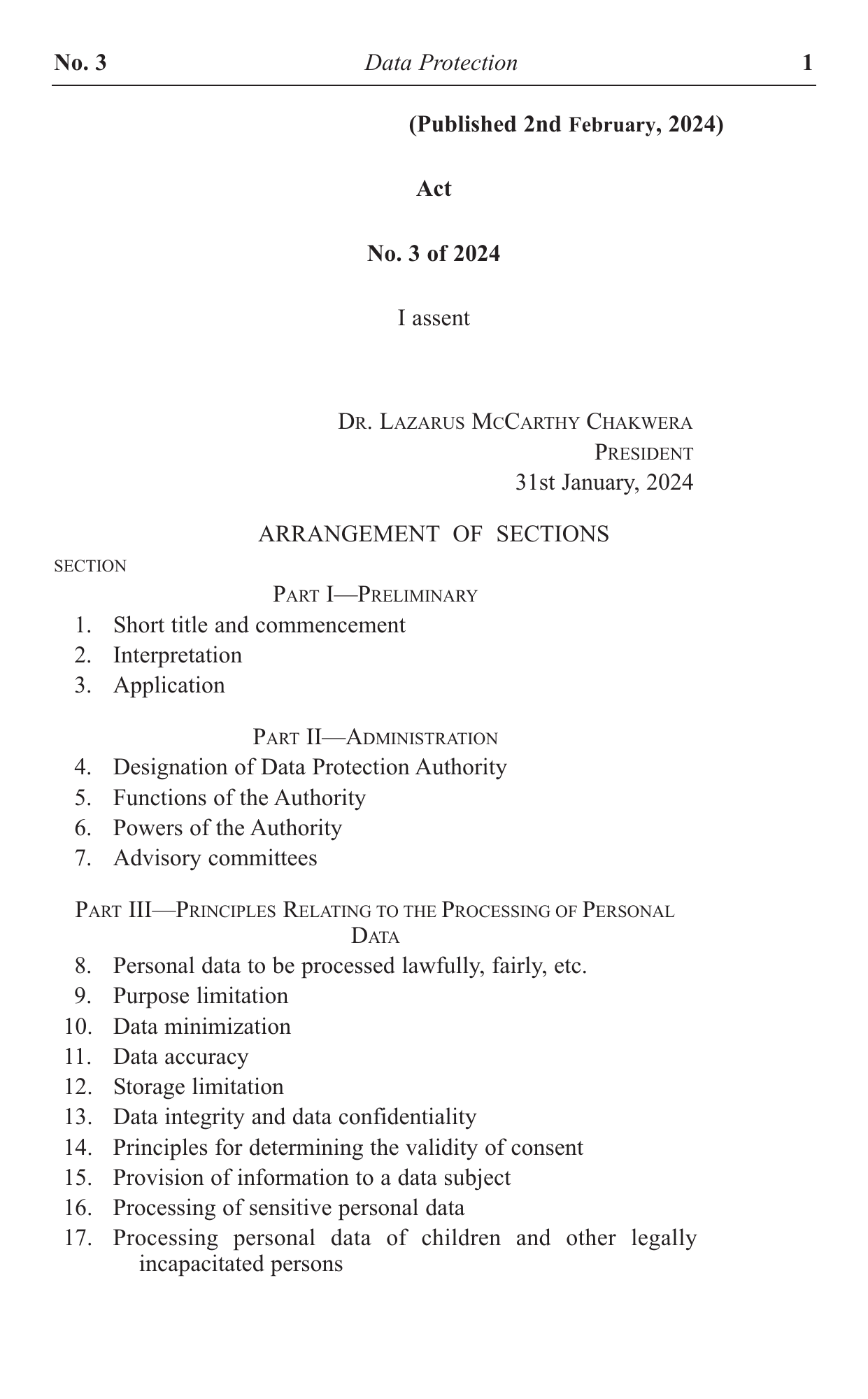
No. 3 Data Protection 1
(Published 2nd February, 2024)
Act
No. 3 of 2024
I assent
DR. LAZARUS MCCARTHY CHAKWERA
PRESIDENT
31st January, 2024
ARRANGEMENT OF SECTIONS
SECTION
PART I—PRELIMINARY
1. Short title and commencement
2. Interpretation
3. Application
PART II—ADMINISTRATION
4. Designation of Data Protection Authority
5. Functions of the Authority
6. Powers of the Authority
7. Advisory committees
PART III—PRINCIPLES RELATING TO THE PROCESSING OF PERSONAL
DATA
8. Personal data to be processed lawfully, fairly, etc.
9. Purpose limitation
10. Data minimization
11. Data accuracy
12. Storage limitation
13. Data integrity and data confidentiality
14. Principles for determining the validity of consent
15. Provision of information to a data subject
16. Processing of sensitive personal data
17. Processing personal data of children and other legally
incapacitated persons
Act No. 3 of 2024 — official PDF page 1; original table columns, symbols and diagram connections
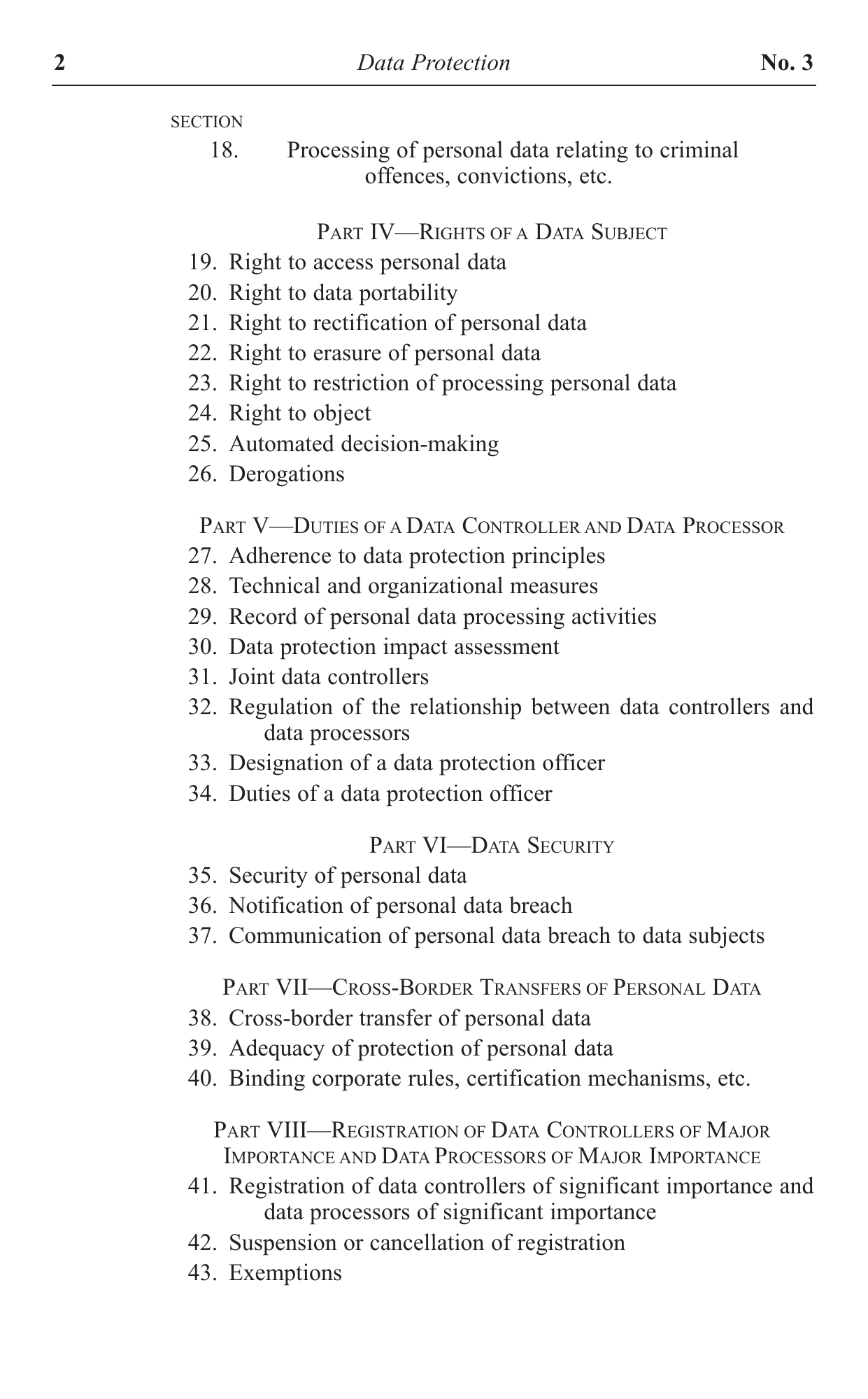
2 Data Protection No. 3
SECTION
18. Processing of personal data relating to criminal
offences, convictions, etc.
PART IV—RIGHTS OF A DATA SUBJECT
19. Right to access personal data
20. Right to data portability
21. Right to rectification of personal data
22. Right to erasure of personal data
23. Right to restriction of processing personal data
24. Right to object
25. Automated decision-making
26. Derogations
PART V—DUTIES OF A DATA CONTROLLER AND DATA PROCESSOR
27. Adherence to data protection principles
28. Technical and organizational measures
29. Record of personal data processing activities
30. Data protection impact assessment
31. Joint data controllers
32. Regulation of the relationship between data controllers and
data processors
33. Designation of a data protection officer
34. Duties of a data protection officer
PART VI—DATA SECURITY
35. Security of personal data
36. Notification of personal data breach
37. Communication of personal data breach to data subjects
PART VII—CROSS-BORDER TRANSFERS OF PERSONAL DATA
38. Cross-border transfer of personal data
39. Adequacy of protection of personal data
40. Binding corporate rules, certification mechanisms, etc.
PART VIII—REGISTRATION OF DATA CONTROLLERS OF MAJOR
IMPORTANCE AND DATA PROCESSORS OF MAJOR IMPORTANCE
41. Registration of data controllers of significant importance and
data processors of significant importance
42. Suspension or cancellation of registration
43. Exemptions
Act No. 3 of 2024 — official PDF page 2; original table columns, symbols and diagram connections
No. 3
Data Protection
3
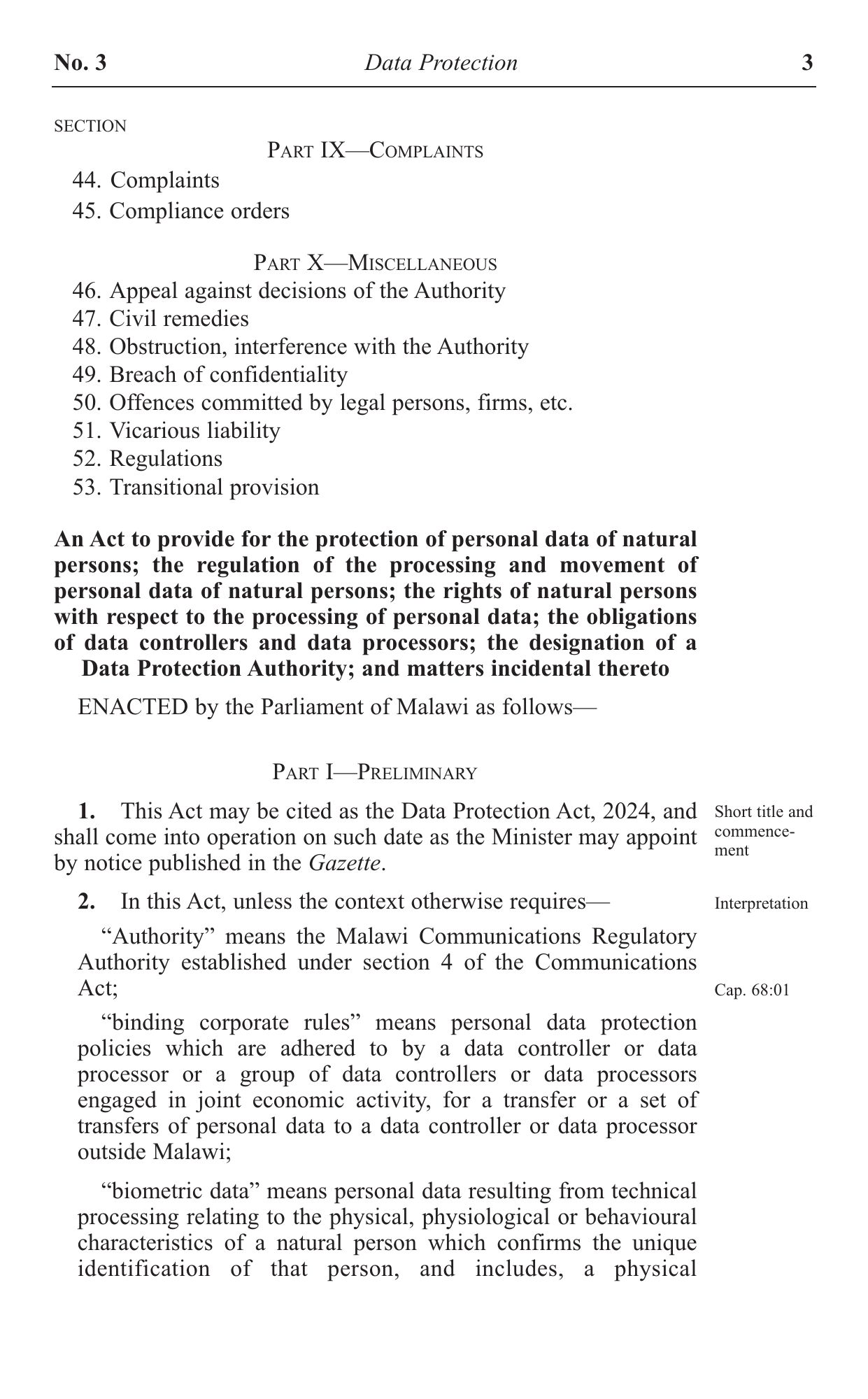
SECTION
PART IX—COMPLAINTS
44. Complaints
45. Compliance orders
PART X—MISCELLANEOUS
46. Appeal against decisions of the Authority
47. Civil remedies
48. Obstruction, interference with the Authority
49. Breach of confidentiality
50. Offences committed by legal persons, firms, etc.
51. Vicarious liability
52. Regulations
53. Transitional provision
An Act to provide for the protection of personal data of natural
persons; the regulation of the processing and movement of
personal data of natural persons; the rights of natural persons
with respect to the processing of personal data; the obligations
of data controllers and data processors; the designation of a
Data Protection Authority; and matters incidental thereto
ENACTED by the Parliament of Malawi as follows—
PART I—PRELIMINARY
Short title and commencement
1. This Act may be cited as the Data Protection Act, 2024, and
shall come into operation on such date as the Minister may appoint
by notice published in the Gazette.
Interpretation
2. In this Act, unless the context otherwise requires—
“Authority” means the Malawi Communications Regulatory
Authority established under section 4 of the Communications
Act;
Cap. 68:01
“binding corporate rules” means personal data protection
policies which are adhered to by a data controller or data
processor or a group of data controllers or data processors
engaged in joint economic activity, for a transfer or a set of
transfers of personal data to a data controller or data processor
outside Malawi;
“biometric data” means personal data resulting from technical
processing relating to the physical, physiological or behavioural
characteristics of a natural person which confirms the unique
identification of that person, and includes, a physical
Act No. 3 of 2024 — official PDF page 3; original table columns, symbols and diagram connections
4
Data Protection
No. 3
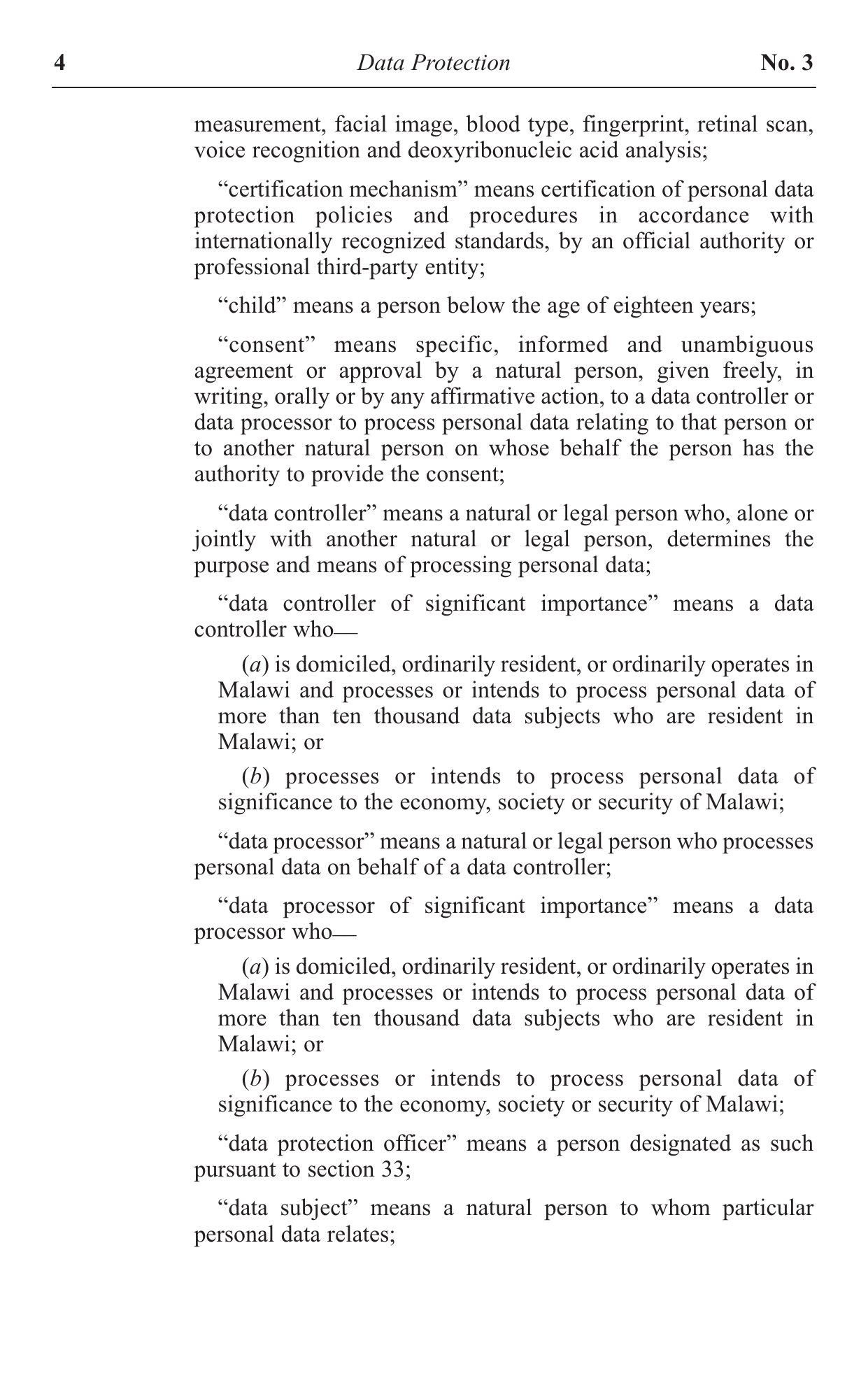
measurement, facial image, blood type, fingerprint, retinal scan,
voice recognition and deoxyribonucleic acid analysis;
“certification mechanism” means certification of personal data
protection policies and procedures in accordance with
internationally recognized standards, by an official authority or
professional third-party entity;
“child” means a person below the age of eighteen years;
“consent” means specific, informed and unambiguous
agreement or approval by a natural person, given freely, in
writing, orally or by any affirmative action, to a data controller or
data processor to process personal data relating to that person or
to another natural person on whose behalf the person has the
authority to provide the consent;
“data controller” means a natural or legal person who, alone or
jointly with another natural or legal person, determines the
purpose and means of processing personal data;
“data controller of significant importance” means a data
controller who—
(a) is domiciled, ordinarily resident, or ordinarily operates in
Malawi and processes or intends to process personal data of
more than ten thousand data subjects who are resident in
Malawi; or
(b) processes or intends to process personal data of
significance to the economy, society or security of Malawi;
“data processor” means a natural or legal person who processes
personal data on behalf of a data controller;
“data processor of significant importance” means a data
processor who—
(a) is domiciled, ordinarily resident, or ordinarily operates in
Malawi and processes or intends to process personal data of
more than ten thousand data subjects who are resident in
Malawi; or
(b) processes or intends to process personal data of
significance to the economy, society or security of Malawi;
“data protection officer” means a person designated as such
pursuant to section 33;
“data subject” means a natural person to whom particular
personal data relates;
Act No. 3 of 2024 — official PDF page 4; original table columns, symbols and diagram connections
No. 3
Data Protection
5
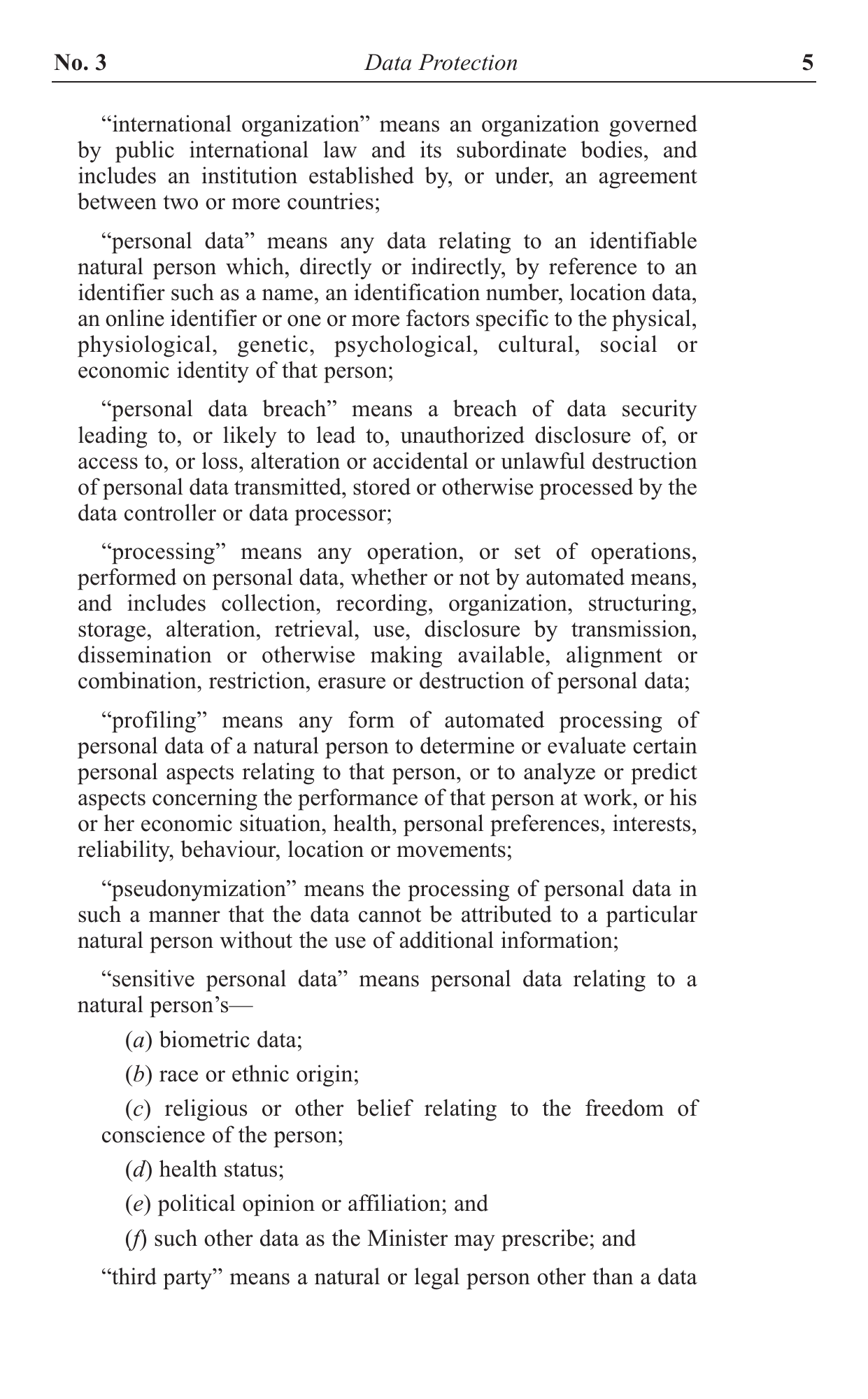
“international organization” means an organization governed
by public international law and its subordinate bodies, and
includes an institution established by, or under, an agreement
between two or more countries;
“personal data” means any data relating to an identifiable
natural person which, directly or indirectly, by reference to an
identifier such as a name, an identification number, location data,
an online identifier or one or more factors specific to the physical,
physiological, genetic, psychological, cultural, social or
economic identity of that person;
“personal data breach” means a breach of data security
leading to, or likely to lead to, unauthorized disclosure of, or
access to, or loss, alteration or accidental or unlawful destruction
of personal data transmitted, stored or otherwise processed by the
data controller or data processor;
“processing” means any operation, or set of operations,
performed on personal data, whether or not by automated means,
and includes collection, recording, organization, structuring,
storage, alteration, retrieval, use, disclosure by transmission,
dissemination or otherwise making available, alignment or
combination, restriction, erasure or destruction of personal data;
“profiling” means any form of automated processing of
personal data of a natural person to determine or evaluate certain
personal aspects relating to that person, or to analyze or predict
aspects concerning the performance of that person at work, or his
or her economic situation, health, personal preferences, interests,
reliability, behaviour, location or movements;
“pseudonymization” means the processing of personal data in
such a manner that the data cannot be attributed to a particular
natural person without the use of additional information;
“sensitive personal data” means personal data relating to a
natural person’s—
(a) biometric data;
(b) race or ethnic origin;
(c) religious or other belief relating to the freedom of
conscience of the person;
(d) health status;
(e) political opinion or affiliation; and
(f) such other data as the Minister may prescribe; and
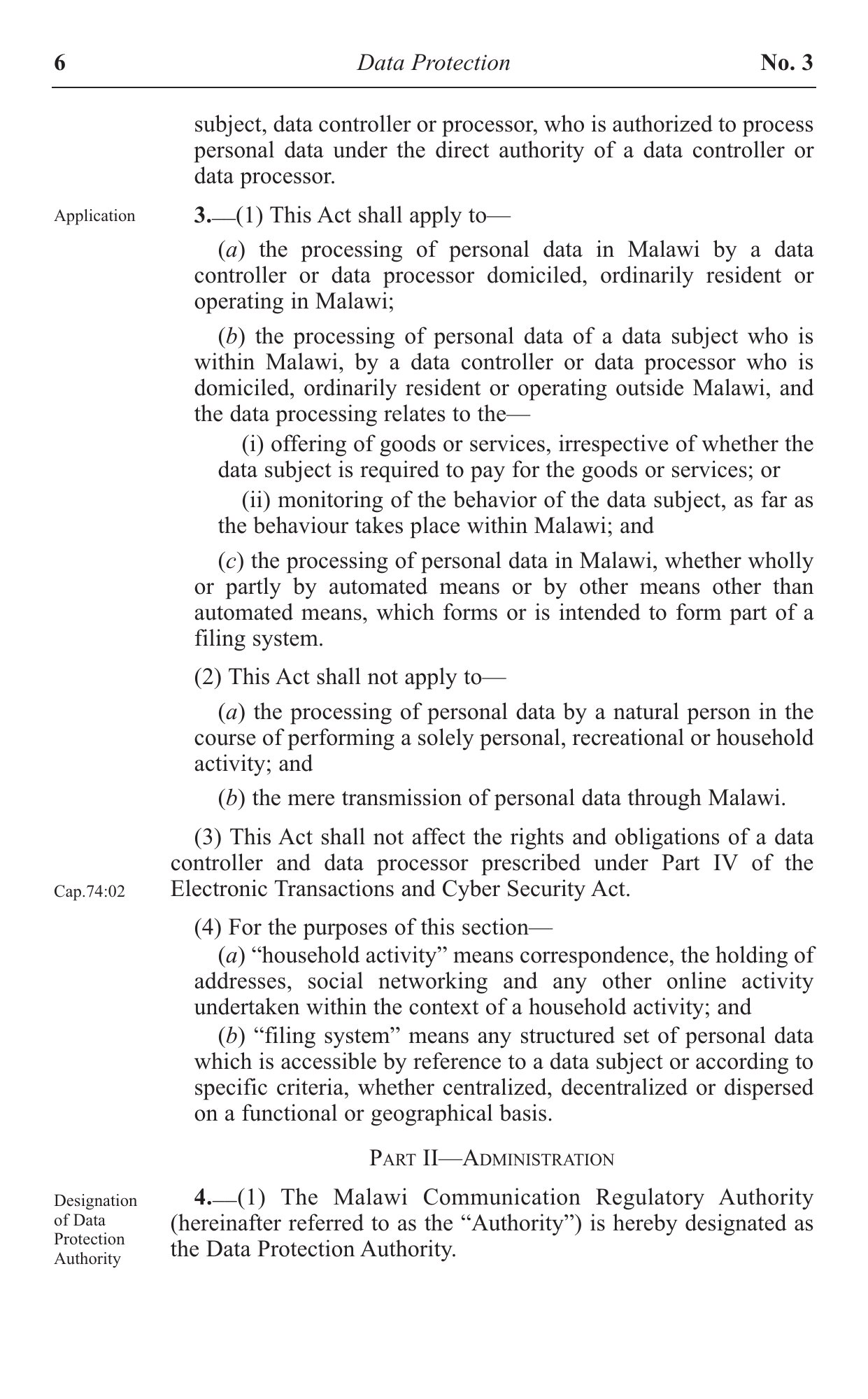
“third party” means a natural or legal person other than a data
Act No. 3 of 2024 — official PDF page 5; original table columns, symbols and diagram connections
6
Data Protection
No. 3
subject, data controller or processor, who is authorized to process
personal data under the direct authority of a data controller or
data processor.
Application
3.—(1) This Act shall apply to—
(a) the processing of personal data in Malawi by a data
controller or data processor domiciled, ordinarily resident or
operating in Malawi;
(b) the processing of personal data of a data subject who is
within Malawi, by a data controller or data processor who is
domiciled, ordinarily resident or operating outside Malawi, and
the data processing relates to the—
(i) offering of goods or services, irrespective of whether the
data subject is required to pay for the goods or services; or
(ii) monitoring of the behavior of the data subject, as far as
the behaviour takes place within Malawi; and
(c) the processing of personal data in Malawi, whether wholly
or partly by automated means or by other means other than
automated means, which forms or is intended to form part of a
filing system.
(2) This Act shall not apply to—
(a) the processing of personal data by a natural person in the
course of performing a solely personal, recreational or household
activity; and
(b) the mere transmission of personal data through Malawi.
(3) This Act shall not affect the rights and obligations of a data
controller and data processor prescribed under Part IV of the
Electronic Transactions and Cyber Security Act.
Cap.74:02
(4) For the purposes of this section—
(a) “household activity” means correspondence, the holding of
addresses, social networking and any other online activity
undertaken within the context of a household activity; and
(b) “filing system” means any structured set of personal data
which is accessible by reference to a data subject or according to
specific criteria, whether centralized, decentralized or dispersed
on a functional or geographical basis.
PART II—ADMINISTRATION
Designation of Data Protection Authority
4.—(1) The Malawi Communication Regulatory Authority
(hereinafter referred to as the “Authority”) is hereby designated as
the Data Protection Authority.
Act No. 3 of 2024 — official PDF page 6; original table columns, symbols and diagram connections
No. 3
Data Protection
7
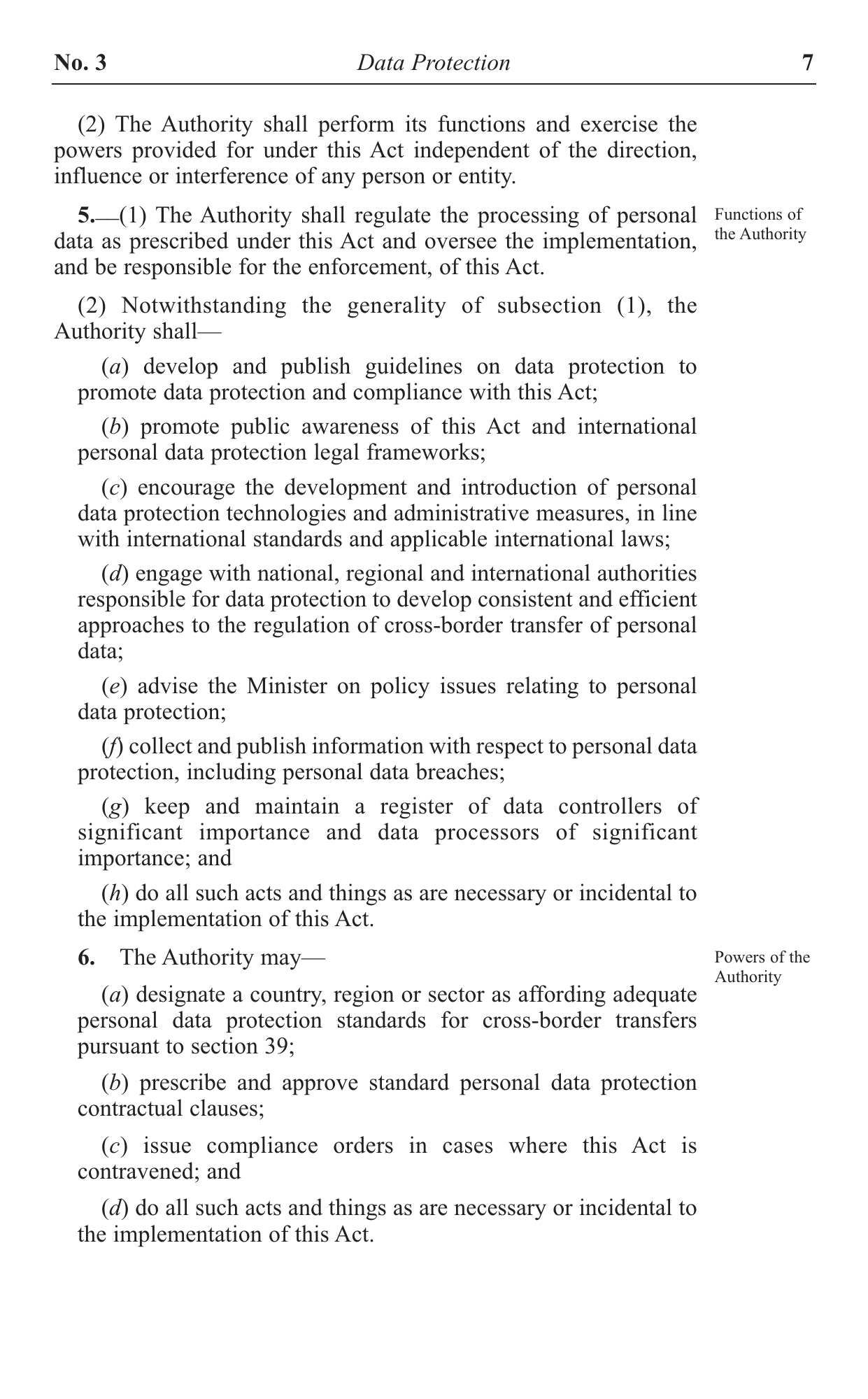
(2) The Authority shall perform its functions and exercise the
powers provided for under this Act independent of the direction,
influence or interference of any person or entity.
Functions of the Authority
5.—(1) The Authority shall regulate the processing of personal
data as prescribed under this Act and oversee the implementation,
and be responsible for the enforcement, of this Act.
(2) Notwithstanding the generality of subsection (1), the
Authority shall—
(a) develop and publish guidelines on data protection to
promote data protection and compliance with this Act;
(b) promote public awareness of this Act and international
personal data protection legal frameworks;
(c) encourage the development and introduction of personal
data protection technologies and administrative measures, in line
with international standards and applicable international laws;
(d) engage with national, regional and international authorities
responsible for data protection to develop consistent and efficient
approaches to the regulation of cross-border transfer of personal
data;
(e) advise the Minister on policy issues relating to personal
data protection;
(f) collect and publish information with respect to personal data
protection, including personal data breaches;
(g) keep and maintain a register of data controllers of
significant importance and data processors of significant
importance; and
(h) do all such acts and things as are necessary or incidental to
the implementation of this Act.
Powers of the Authority
6. The Authority may—
(a) designate a country, region or sector as affording adequate
personal data protection standards for cross-border transfers
pursuant to section 39;
(b) prescribe and approve standard personal data protection
contractual clauses;
(c) issue compliance orders in cases where this Act is
contravened; and
(d) do all such acts and things as are necessary or incidental to
the implementation of this Act.
Act No. 3 of 2024 — official PDF page 7; original table columns, symbols and diagram connections
8
Data Protection
No. 3
Advisory committees
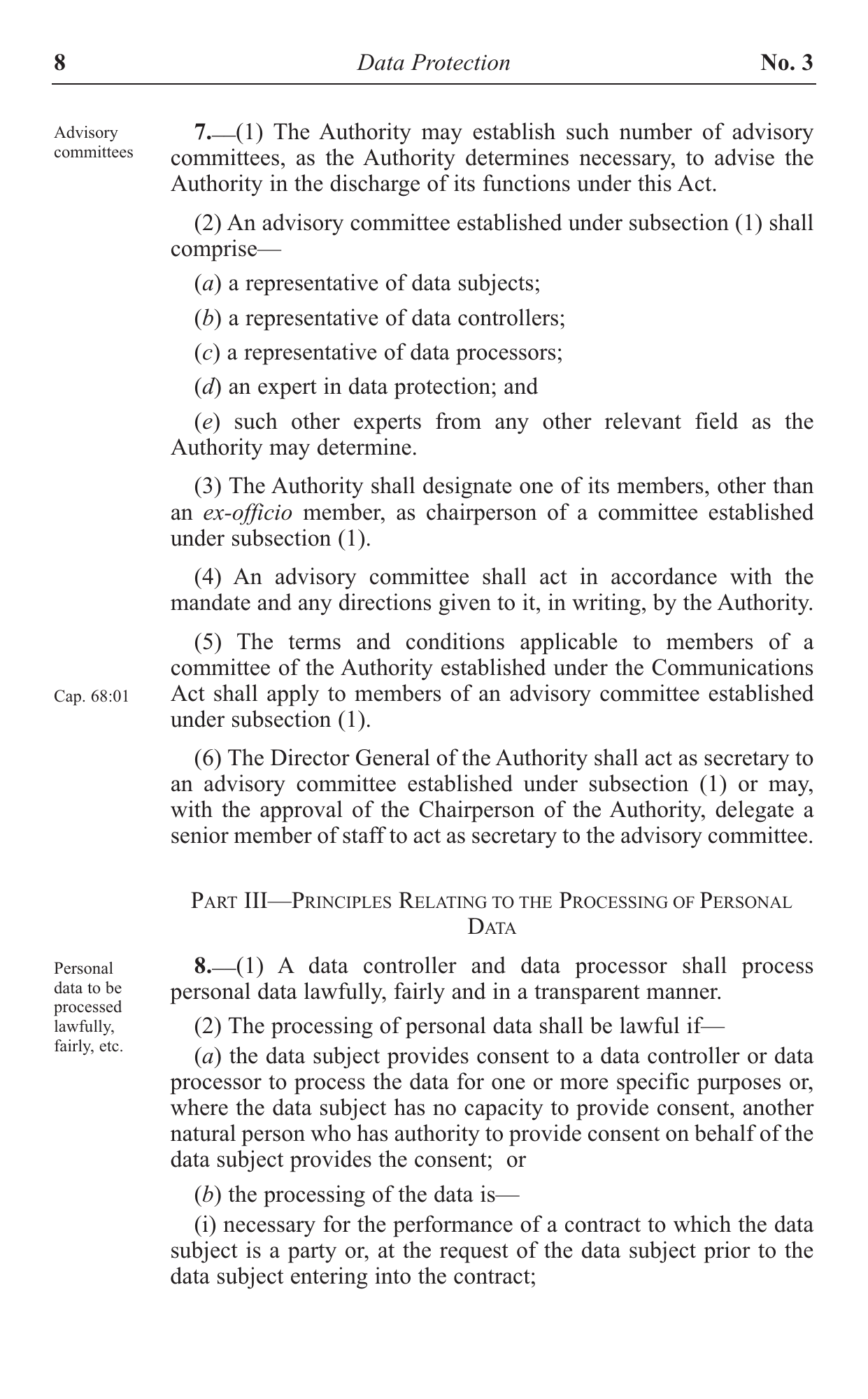
7.—(1) The Authority may establish such number of advisory
committees, as the Authority determines necessary, to advise the
Authority in the discharge of its functions under this Act.
(2) An advisory committee established under subsection (1) shall
comprise—
(a) a representative of data subjects;
(b) a representative of data controllers;
(c) a representative of data processors;
(d) an expert in data protection; and
(e) such other experts from any other relevant field as the
Authority may determine.
(3) The Authority shall designate one of its members, other than
an ex-officio member, as chairperson of a committee established
under subsection (1).
(4) An advisory committee shall act in accordance with the
mandate and any directions given to it, in writing, by the Authority.
Cap. 68:01
(5) The terms and conditions applicable to members of a
committee of the Authority established under the Communications
Act shall apply to members of an advisory committee established
under subsection (1).
(6) The Director General of the Authority shall act as secretary to
an advisory committee established under subsection (1) or may,
with the approval of the Chairperson of the Authority, delegate a
senior member of staff to act as secretary to the advisory committee.
PART III—PRINCIPLES RELATING TO THE PROCESSING OF PERSONAL
DATA
Personal data to be processed lawfully, fairly, etc.
8.—(1) A data controller and data processor shall process
personal data lawfully, fairly and in a transparent manner.
(2) The processing of personal data shall be lawful if—
(a) the data subject provides consent to a data controller or data
processor to process the data for one or more specific purposes or,
where the data subject has no capacity to provide consent, another
natural person who has authority to provide consent on behalf of the
data subject provides the consent; or
(b) the processing of the data is—
(i) necessary for the performance of a contract to which the data
subject is a party or, at the request of the data subject prior to the
data subject entering into the contract;
Act No. 3 of 2024 — official PDF page 8; original table columns, symbols and diagram connections
No. 3
Data Protection
9
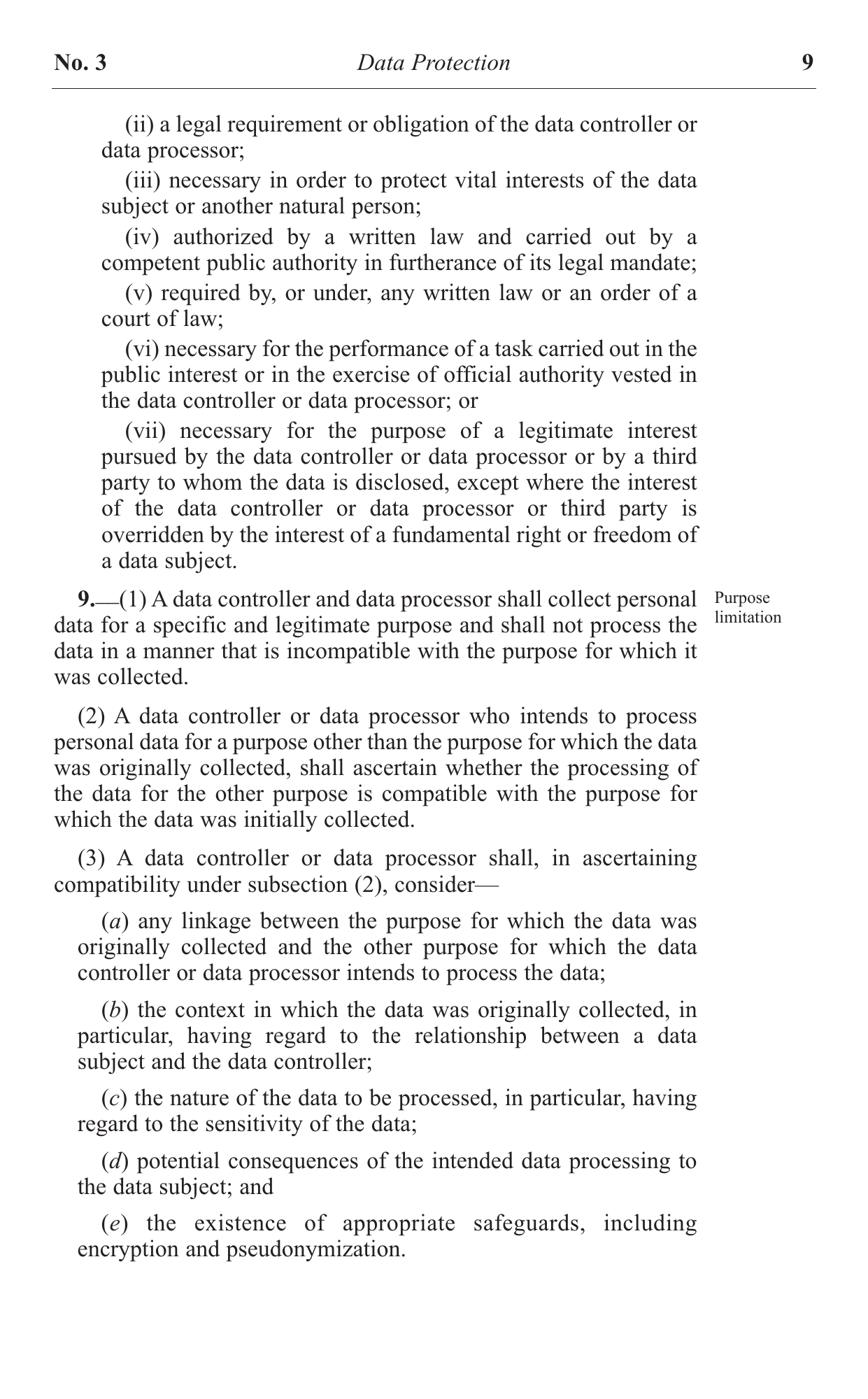
(ii) a legal requirement or obligation of the data controller or
data processor;
(iii) necessary in order to protect vital interests of the data
subject or another natural person;
(iv) authorized by a written law and carried out by a
competent public authority in furtherance of its legal mandate;
(v) required by, or under, any written law or an order of a
court of law;
(vi) necessary for the performance of a task carried out in the
public interest or in the exercise of official authority vested in
the data controller or data processor; or
(vii) necessary for the purpose of a legitimate interest
pursued by the data controller or data processor or by a third
party to whom the data is disclosed, except where the interest
of the data controller or data processor or third party is
overridden by the interest of a fundamental right or freedom of
a data subject.
Purpose limitation
9.—(1) A data controller and data processor shall collect personal
data for a specific and legitimate purpose and shall not process the
data in a manner that is incompatible with the purpose for which it
was collected.
(2) A data controller or data processor who intends to process
personal data for a purpose other than the purpose for which the data
was originally collected, shall ascertain whether the processing of
the data for the other purpose is compatible with the purpose for
which the data was initially collected.
(3) A data controller or data processor shall, in ascertaining
compatibility under subsection (2), consider—
(a) any linkage between the purpose for which the data was
originally collected and the other purpose for which the data
controller or data processor intends to process the data;
(b) the context in which the data was originally collected, in
particular, having regard to the relationship between a data
subject and the data controller;
(c) the nature of the data to be processed, in particular, having
regard to the sensitivity of the data;
(d) potential consequences of the intended data processing to
the data subject; and
(e) the existence of appropriate safeguards, including
encryption and pseudonymization.
Act No. 3 of 2024 — official PDF page 9; original table columns, symbols and diagram connections
10
Data Protection
No. 3
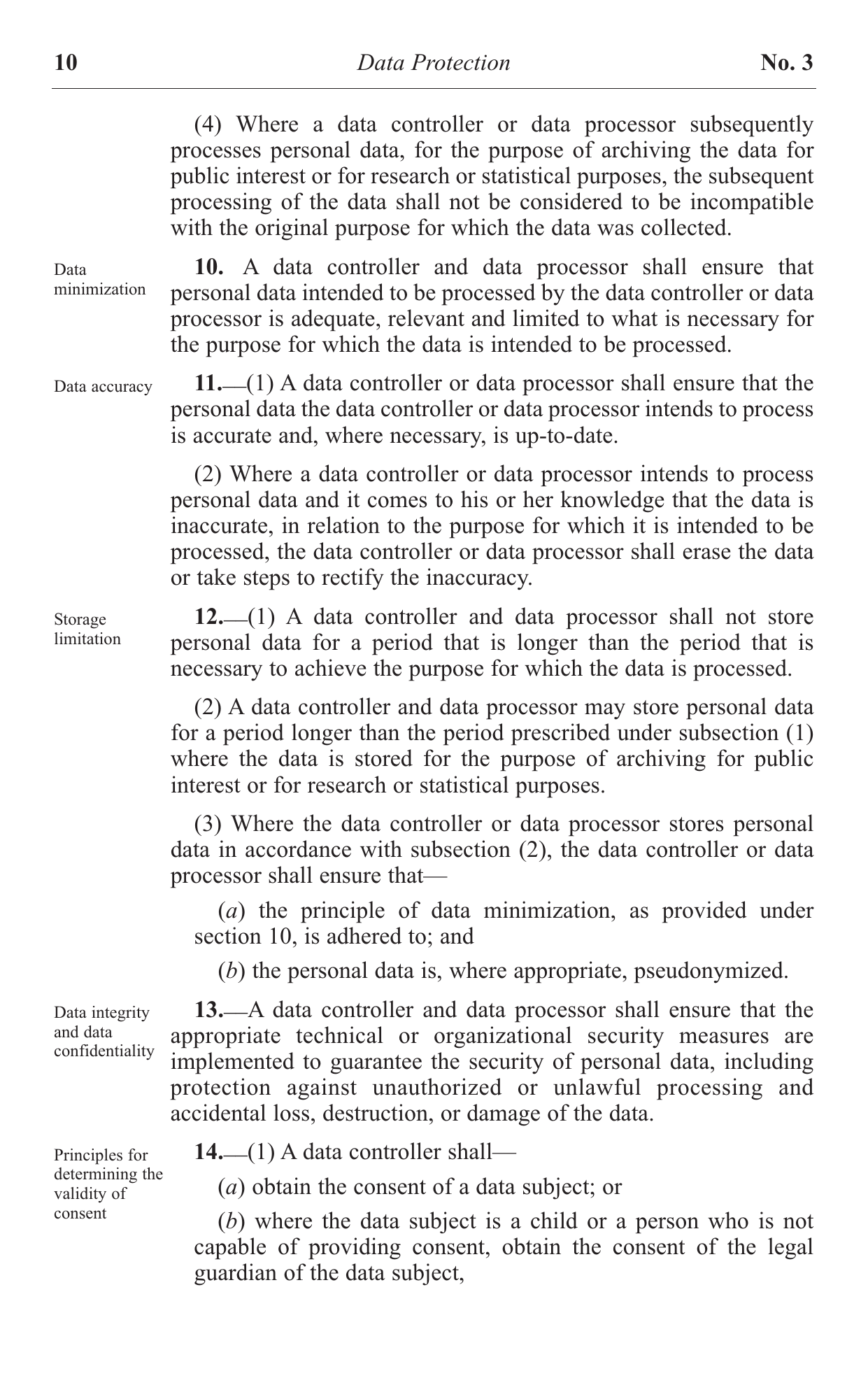
(4) Where a data controller or data processor subsequently
processes personal data, for the purpose of archiving the data for
public interest or for research or statistical purposes, the subsequent
processing of the data shall not be considered to be incompatible
with the original purpose for which the data was collected.
Data minimization
10. A data controller and data processor shall ensure that
personal data intended to be processed by the data controller or data
processor is adequate, relevant and limited to what is necessary for
the purpose for which the data is intended to be processed.
Data accuracy
11.—(1) A data controller or data processor shall ensure that the
personal data the data controller or data processor intends to process
is accurate and, where necessary, is up-to-date.
(2) Where a data controller or data processor intends to process
personal data and it comes to his or her knowledge that the data is
inaccurate, in relation to the purpose for which it is intended to be
processed, the data controller or data processor shall erase the data
or take steps to rectify the inaccuracy.
Storage limitation
12.—(1) A data controller and data processor shall not store
personal data for a period that is longer than the period that is
necessary to achieve the purpose for which the data is processed.
(2) A data controller and data processor may store personal data
for a period longer than the period prescribed under subsection (1)
where the data is stored for the purpose of archiving for public
interest or for research or statistical purposes.
(3) Where the data controller or data processor stores personal
data in accordance with subsection (2), the data controller or data
processor shall ensure that—
(a) the principle of data minimization, as provided under
section 10, is adhered to; and
(b) the personal data is, where appropriate, pseudonymized.
Data integrity and data confidentiality
13.—A data controller and data processor shall ensure that the
appropriate technical or organizational security measures are
implemented to guarantee the security of personal data, including
protection against unauthorized or unlawful processing and
accidental loss, destruction, or damage of the data.
Principles for determining the validity of consent
14.—(1) A data controller shall—
(a) obtain the consent of a data subject; or
(b) where the data subject is a child or a person who is not
capable of providing consent, obtain the consent of the legal
guardian of the data subject,
Act No. 3 of 2024 — official PDF page 10; original table columns, symbols and diagram connections
No. 3
Data Protection
11
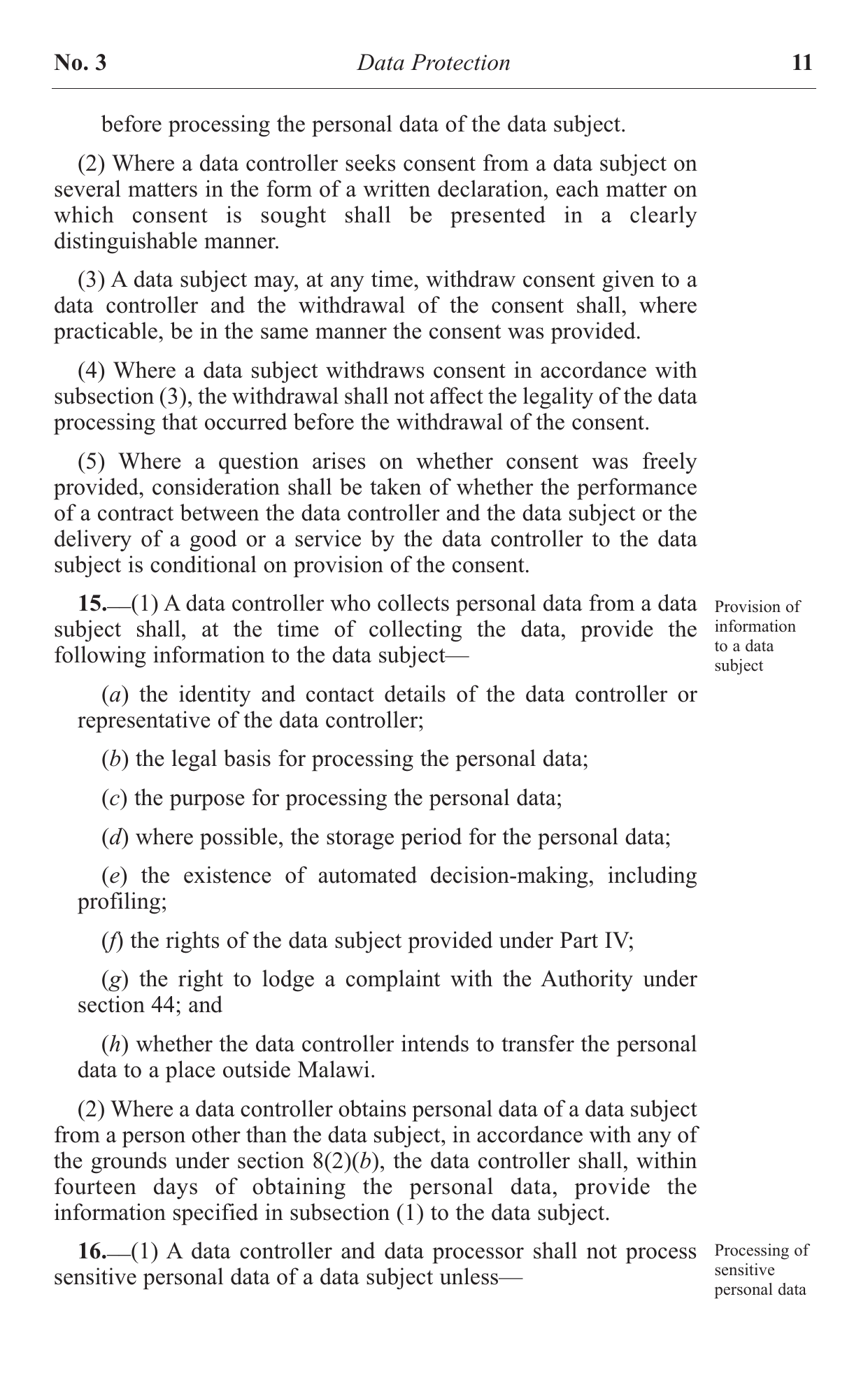
before processing the personal data of the data subject.
(2) Where a data controller seeks consent from a data subject on
several matters in the form of a written declaration, each matter on
which consent is sought shall be presented in a clearly
distinguishable manner.
(3) A data subject may, at any time, withdraw consent given to a
data controller and the withdrawal of the consent shall, where
practicable, be in the same manner the consent was provided.
(4) Where a data subject withdraws consent in accordance with
subsection (3), the withdrawal shall not affect the legality of the data
processing that occurred before the withdrawal of the consent.
(5) Where a question arises on whether consent was freely
provided, consideration shall be taken of whether the performance
of a contract between the data controller and the data subject or the
delivery of a good or a service by the data controller to the data
subject is conditional on provision of the consent.
Provision of information to a data subject
15.—(1) A data controller who collects personal data from a data
subject shall, at the time of collecting the data, provide the
following information to the data subject—
(a) the identity and contact details of the data controller or
representative of the data controller;
(b) the legal basis for processing the personal data;
(c) the purpose for processing the personal data;
(d) where possible, the storage period for the personal data;
(e) the existence of automated decision-making, including
profiling;
(f) the rights of the data subject provided under Part IV;
(g) the right to lodge a complaint with the Authority under
section 44; and
(h) whether the data controller intends to transfer the personal
data to a place outside Malawi.
(2) Where a data controller obtains personal data of a data subject
from a person other than the data subject, in accordance with any of
the grounds under section 8(2)(b), the data controller shall, within
fourteen days of obtaining the personal data, provide the
information specified in subsection (1) to the data subject.
Processing of sensitive personal data
16.—(1) A data controller and data processor shall not process
sensitive personal data of a data subject unless—
Act No. 3 of 2024 — official PDF page 11; original table columns, symbols and diagram connections
12
Data Protection
No. 3
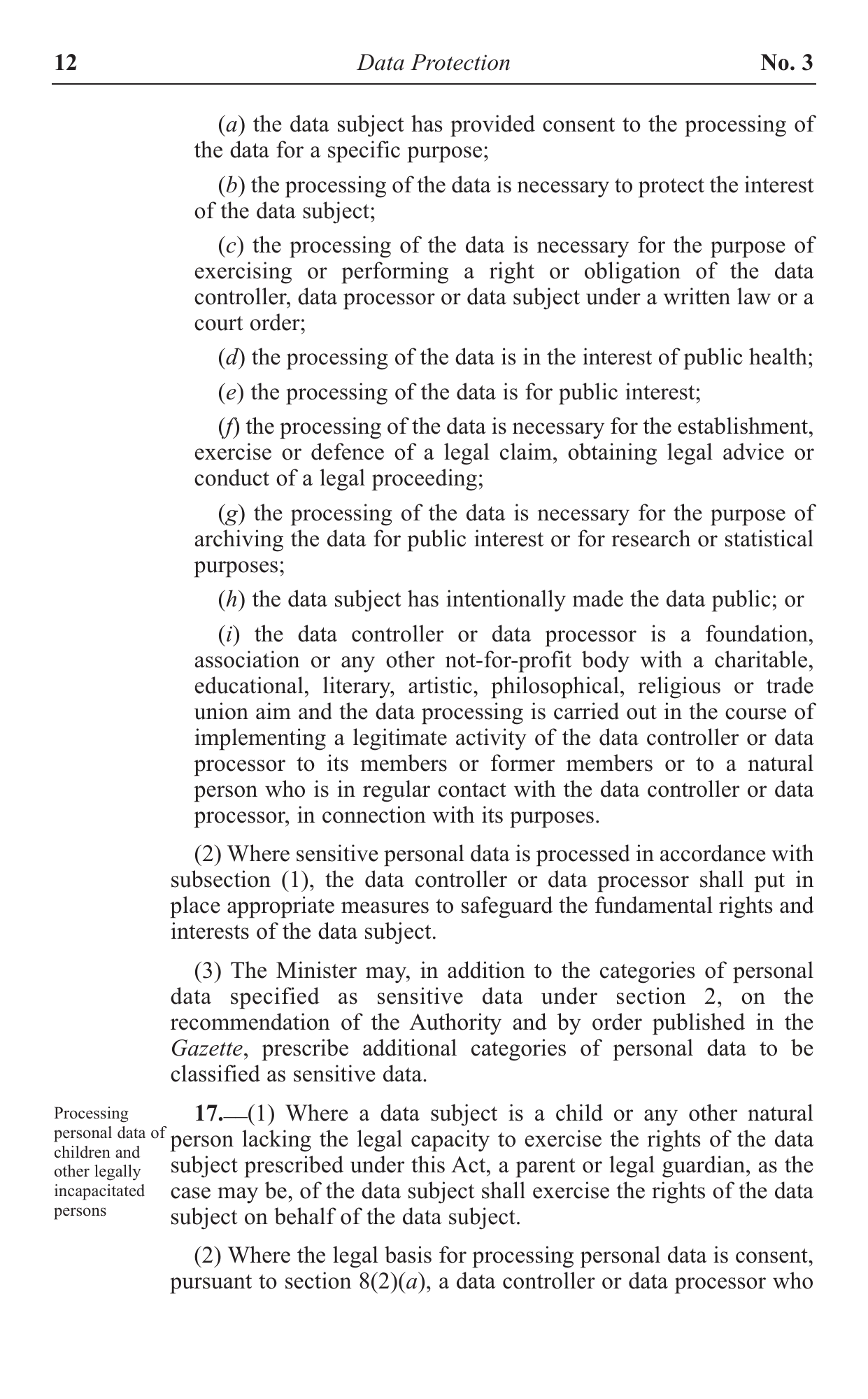
(a) the data subject has provided consent to the processing of
the data for a specific purpose;
(b) the processing of the data is necessary to protect the interest
of the data subject;
(c) the processing of the data is necessary for the purpose of
exercising or performing a right or obligation of the data
controller, data processor or data subject under a written law or a
court order;
(d) the processing of the data is in the interest of public health;
(e) the processing of the data is for public interest;
(f) the processing of the data is necessary for the establishment,
exercise or defence of a legal claim, obtaining legal advice or
conduct of a legal proceeding;
(g) the processing of the data is necessary for the purpose of
archiving the data for public interest or for research or statistical
purposes;
(h) the data subject has intentionally made the data public; or
(i) the data controller or data processor is a foundation,
association or any other not-for-profit body with a charitable,
educational, literary, artistic, philosophical, religious or trade
union aim and the data processing is carried out in the course of
implementing a legitimate activity of the data controller or data
processor to its members or former members or to a natural
person who is in regular contact with the data controller or data
processor, in connection with its purposes.
(2) Where sensitive personal data is processed in accordance with
subsection (1), the data controller or data processor shall put in
place appropriate measures to safeguard the fundamental rights and
interests of the data subject.
(3) The Minister may, in addition to the categories of personal
data specified as sensitive data under section 2, on the
recommendation of the Authority and by order published in the
Gazette, prescribe additional categories of personal data to be
classified as sensitive data.
Processing personal data of children and other legally incapacitated persons
17.—(1) Where a data subject is a child or any other natural
person lacking the legal capacity to exercise the rights of the data
subject prescribed under this Act, a parent or legal guardian, as the
case may be, of the data subject shall exercise the rights of the data
subject on behalf of the data subject.
(2) Where the legal basis for processing personal data is consent,
pursuant to section 8(2)(a), a data controller or data processor who
Act No. 3 of 2024 — official PDF page 12; original table columns, symbols and diagram connections
No. 3
Data Protection
13
intends to process personal data of a data subject who is a child or
any other natural person lacking legal capacity to provide consent
shall obtain the consent from a parent or legal guardian, as the case
may be, of the data subject.
(3) A data controller or data processor who obtains consent in
accordance with subsection (2) shall put in place appropriate
mechanisms to verify the age of the child or the mental capacity of
the other natural person, as the case may be, and the identity of the
parent or legal guardian providing the consent.
Processing of personal data relating to criminal offences, convictions, etc.
18.—(1) Without prejudice to section 8(2), a data controller or
data processor shall not process personal data of a data subject
relating to a criminal offence, conviction, or security measure
imposed on the data subject unless—
(a) the processing is authorized by a written law and the law
provides for the necessary safeguards for the rights and freedoms
of the data subject; or
(b) the processing is carried out under the control of an organ
of Government or other official authority.
(2) For purposes of this section “organ of Government” means
the three branches of Government, a local authority and a body or a
committee established or instituted by, or under, any written law.
PART IV—RIGHTS OF A DATA SUBJECT
Right to access personal data
19.—(1) A data subject has the right to obtain from a data
controller or data processor, confirmation of whether personal data
concerning the data subject is being processed by the data controller
or data processor, and where that is the case, the right to access the
personal data being processed.
(2) Where the data controller or data processor confirms the
processing of the personal data of the data subject, the data
controller or data processor shall provide the data subject with—
(a) on demand, a copy of the personal data being processed—
(i) in a commonly used electronic format;
(ii) within thirty days of receipt of the request; and
(iii) where practicable, at no expense to the data subject; and
(b) information specified in section 15(1).
Right to data portability
20.—(1) A data subject has the right to receive personal data
concerning the data subject from a data controller in a structured,
commonly used and machine-readable format where the processing
of the personal data is—
Act No. 3 of 2024 — official PDF page 13; original table columns, symbols and diagram connections
14
Data Protection
No. 3
(a) based on consent pursuant to sections 8(2)(a) or 16(1)(a) or
fulfilment of a contractual obligation pursuant to section 8(2)(b);
or
(b) carried out by automated means.
(2) A data controller shall, on request by a data subject—
(a) provide to the data subject personal data of the data subject
in a commonly used and machine-readable format; or
(b) transmit personal data of the data subject directly to another
data controller specified in the request,
within thirty days of receipt of the request.
Right to rectification of personal data
21.—(1) A data subject has the right to rectify any error in
personal data of the data subject collected by or being processed by
a data controller or data processor.
(2) A data subject has the right to have his or her incomplete
personal data completed.
(3) A data controller or data processor who receives—
(a) a request from a data subject to rectify an error in the
personal data of the data subject; or
(b) supplementary data from a data subject aimed at
completing personal data of the data subject that is incomplete,
shall rectify the error in the personal data or add the
supplementary data to the personal data of the data subject, within
fourteen days of receipt of the request or the supplementary data.
Right to erasure of personal data
22.—(1) A data subject has the right to erasure of personal data
concerning the data subject, without undue delay, where—
(a) the personal data is no longer necessary in relation to the
purpose for which the data was processed;
(b) the data subject withdraws the consent on which the
processing of the personal data is based and there is no other
legal ground for processing the data;
(c) the data subject objects to the processing of the personal
data pursuant to section 24 and that there is no overriding
legitimate ground for processing the data;
(d) the personal data has been unlawfully processed; or
(e) there is a legal obligation under a written law to erase the
personal data.
(2) A data controller or data processor who receives a request
from a data subject to erase personal data of the data subject in
Act No. 3 of 2024 — official PDF page 14; original table columns, symbols and diagram connections
No. 3
Data Protection
15
accordance with subsection (1), shall take reasonable steps to
inform other data controllers and data processors who, to his or her
knowledge, are processing the data to adhere to the request of the
data subject.
Right to restriction of processing personal data
23.—(1) A data subject has the right to restrict the processing of
personal data of the data subject where—
(a) the accuracy of the data is contested by the data subject; or
(b) the data controller or data processor no longer needs the
data for the intended purpose of processing.
(2) A data controller or data processor who receives a request
from a data subject to restrict processing of personal data of the data
subject, in accordance with subsection (1), shall adhere to the
request, unless the data controller or data processor shows cause, in
writing, why the request cannot be adhered to.
Right to object
24.—(1) A data subject has the right to object to the processing of
personal data of the data subject at any time, where the processing
of the data is pursuant to section 8(2)(b) (vi) or (vii)—
(a) the processing is causing, or is likely to cause, substantial
damage or substantial distress to the data subject; and
(b) the damage or distress referred to in paragraph (a) is, or
would be, unwarranted.
(2) A data controller or data processor shall, upon receipt of an
objection from a data subject under subsection (1), cease to process
the personal data, unless the data controller or data processor, as the
case may be, demonstrates that—
(a) there is a compelling legitimate ground for the processing
which overrides the interest or right of the data subject; or
(b) the processing is necessary for the establishment, exercise
or defence of a legal claim.
(3) A data subject may, where the personal data of the data subject
is processed for a direct marketing purpose, object to the processing
of the data for that purpose.
Automated decision-making
25.—(1) A data subject has the right not to be subject to a
decision based solely on automated processing of personal data,
including profiling, which produces a legal or similarly significant
effect concerning the data subject.
(2) Subsection (1) shall not apply where the decision is—
(a) necessary for entering into, or performance of, a contract
between the data subject and a data controller;
Act No. 3 of 2024 — official PDF page 15; original table columns, symbols and diagram connections
16
Data Protection
No. 3
(b) authorized by a written law which has suitable measures to
safeguard the rights and interests of the data subject; or
(c) based on the consent of the data subject.
(3) Where an exception under subsection (2) applies, a data
controller shall implement the appropriate measures to safeguard
the rights and interests of the data subject.
Derogations
26.—The rights of a data subject provided under this Part may be
restricted where the processing of the personal data of the data
subject is for the purpose of—
(a) national security, including safeguarding against and the
prevention of a threat to national security;
(b) the prevention, investigation, detection or prosecution of a
criminal offence or the execution of a criminal penalty;
(c) pursuing a national economic or financial interest,
including a monetary, budgetary and taxation matter;
(d) public health;
(e) social security;
(f) judicial proceedings;
(g) the prevention, investigation, detection and prosecution of
a breach of ethics for a regulated profession;
(h) monitoring, inspection or exercise of a regulatory function
by a public authority;
(i) protecting the data subject or the rights and freedoms of
another natural person; or
(j) the enforcement of a civil law claim.
PART V—DUTIES OF A DATA CONTROLLER AND DATA PROCESSOR
Adherence to data protection principles
27. A data controller and data processor shall adhere to the
principles relating to processing of personal data prescribed under
Part III.
Technical and organizational measures
28. A data controller and data processor shall develop and
implement appropriate technical and organizational measures to
ensure that the processing of personal data complies with the
provisions of this Act.
Record of personal data processing activities
29.—(1) A data controller and data processor shall maintain, in
writing, a record of each personal data processing activity.
(2) The record referred to in subsection (1) shall contain—
Act No. 3 of 2024 — official PDF page 16; original table columns, symbols and diagram connections
No. 3
Data Protection
17
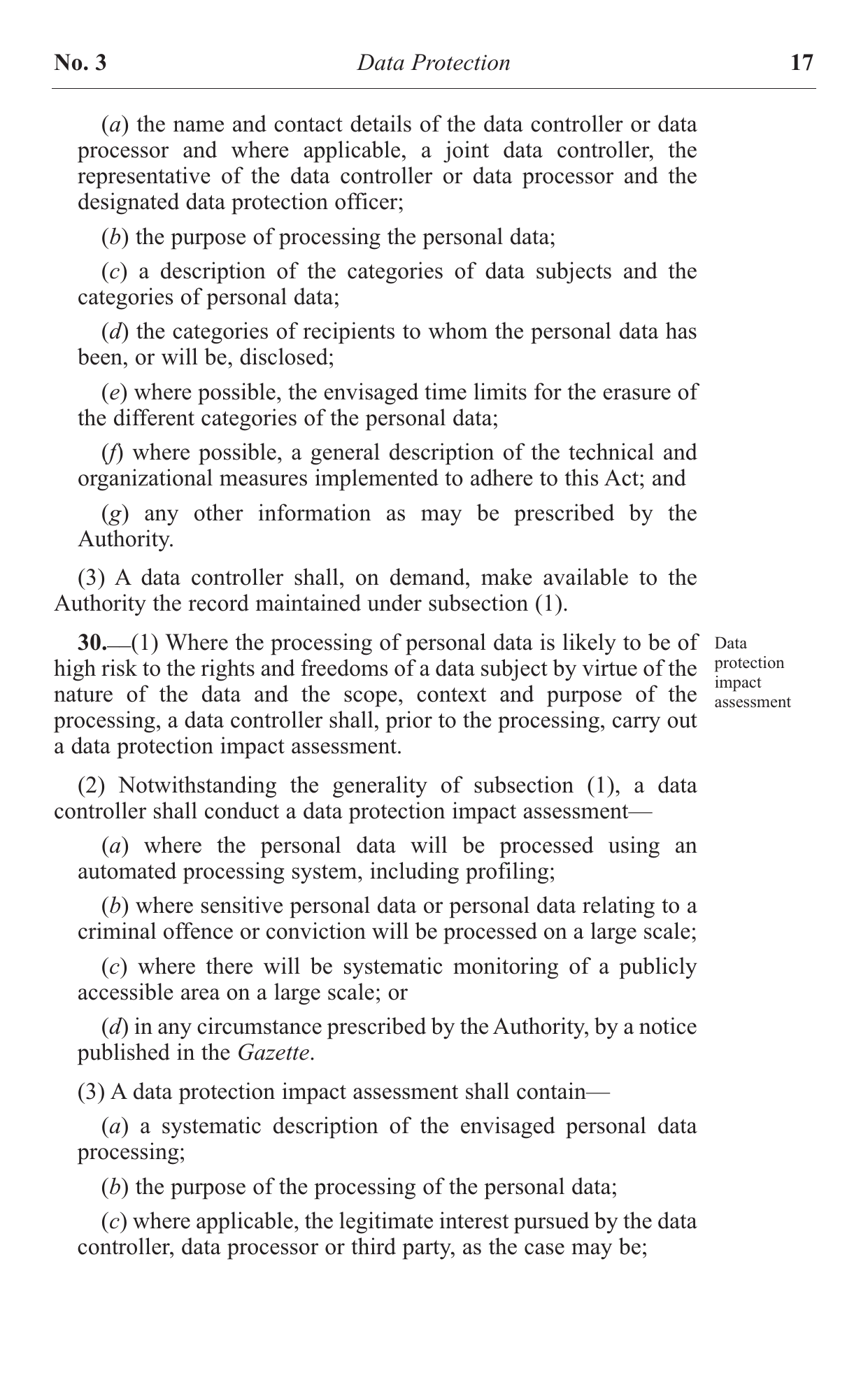
(a) the name and contact details of the data controller or data
processor and where applicable, a joint data controller, the
representative of the data controller or data processor and the
designated data protection officer;
(b) the purpose of processing the personal data;
(c) a description of the categories of data subjects and the
categories of personal data;
(d) the categories of recipients to whom the personal data has
been, or will be, disclosed;
(e) where possible, the envisaged time limits for the erasure of
the different categories of the personal data;
(f) where possible, a general description of the technical and
organizational measures implemented to adhere to this Act; and
(g) any other information as may be prescribed by the
Authority.
(3) A data controller shall, on demand, make available to the
Authority the record maintained under subsection (1).
Data protection impact assessment
30.—(1) Where the processing of personal data is likely to be of
high risk to the rights and freedoms of a data subject by virtue of the
nature of the data and the scope, context and purpose of the
processing, a data controller shall, prior to the processing, carry out
a data protection impact assessment.
(2) Notwithstanding the generality of subsection (1), a data
controller shall conduct a data protection impact assessment—
(a) where the personal data will be processed using an
automated processing system, including profiling;
(b) where sensitive personal data or personal data relating to a
criminal offence or conviction will be processed on a large scale;
(c) where there will be systematic monitoring of a publicly
accessible area on a large scale; or
(d) in any circumstance prescribed by the Authority, by a notice
published in the Gazette.
(3) A data protection impact assessment shall contain—
(a) a systematic description of the envisaged personal data
processing;
(b) the purpose of the processing of the personal data;
(c) where applicable, the legitimate interest pursued by the data
controller, data processor or third party, as the case may be;
Act No. 3 of 2024 — official PDF page 17; original table columns, symbols and diagram connections
18
Data Protection
No. 3
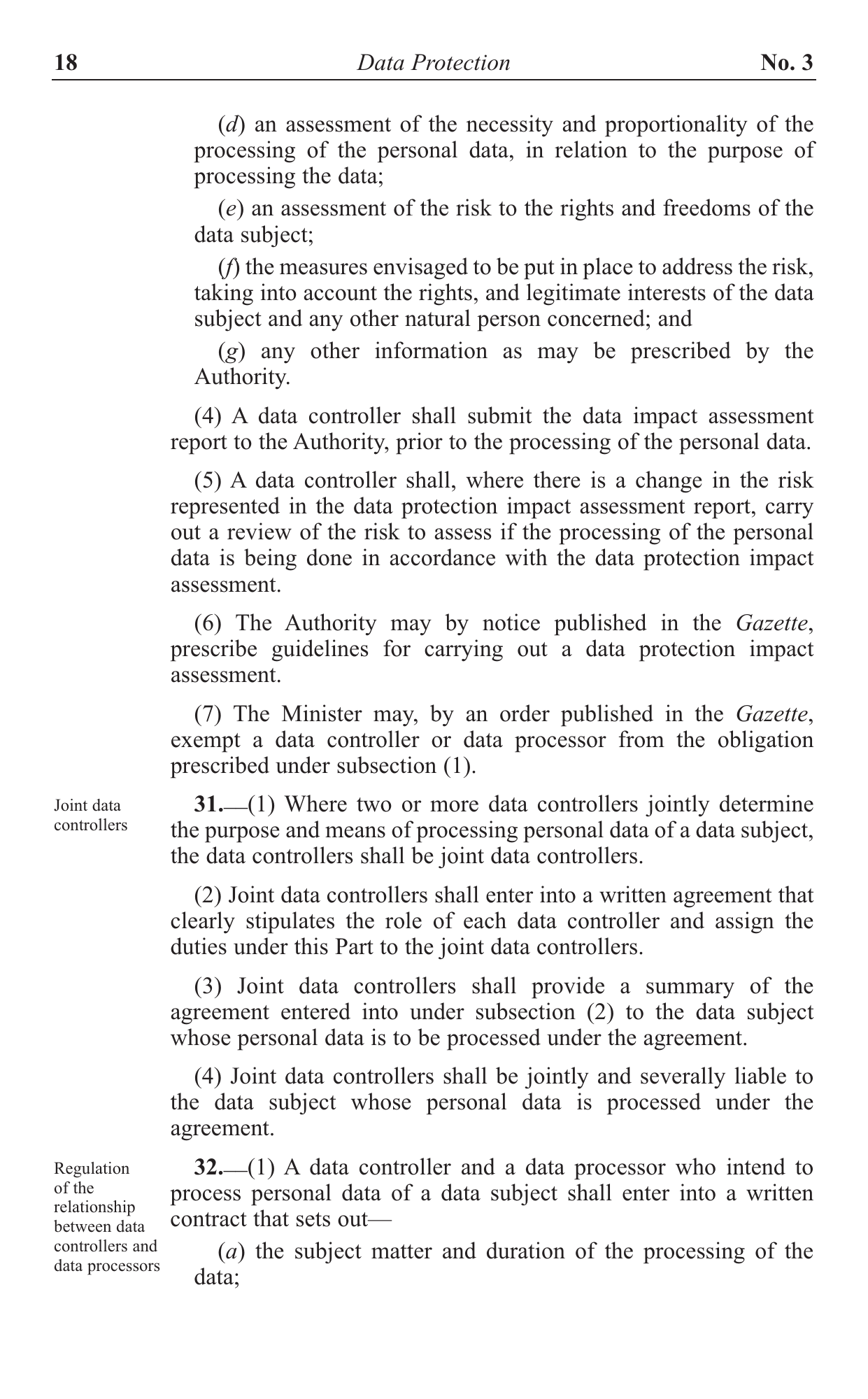
(d) an assessment of the necessity and proportionality of the
processing of the personal data, in relation to the purpose of
processing the data;
(e) an assessment of the risk to the rights and freedoms of the
data subject;
(f) the measures envisaged to be put in place to address the risk,
taking into account the rights, and legitimate interests of the data
subject and any other natural person concerned; and
(g) any other information as may be prescribed by the
Authority.
(4) A data controller shall submit the data impact assessment
report to the Authority, prior to the processing of the personal data.
(5) A data controller shall, where there is a change in the risk
represented in the data protection impact assessment report, carry
out a review of the risk to assess if the processing of the personal
data is being done in accordance with the data protection impact
assessment.
(6) The Authority may by notice published in the Gazette,
prescribe guidelines for carrying out a data protection impact
assessment.
(7) The Minister may, by an order published in the Gazette,
exempt a data controller or data processor from the obligation
prescribed under subsection (1).
Joint data controllers
31.—(1) Where two or more data controllers jointly determine
the purpose and means of processing personal data of a data subject,
the data controllers shall be joint data controllers.
(2) Joint data controllers shall enter into a written agreement that
clearly stipulates the role of each data controller and assign the
duties under this Part to the joint data controllers.
(3) Joint data controllers shall provide a summary of the
agreement entered into under subsection (2) to the data subject
whose personal data is to be processed under the agreement.
(4) Joint data controllers shall be jointly and severally liable to
the data subject whose personal data is processed under the
agreement.
Regulation of the relationship between data controllers and data processors
32.—(1) A data controller and a data processor who intend to
process personal data of a data subject shall enter into a written
contract that sets out—
(a) the subject matter and duration of the processing of the
data;
Act No. 3 of 2024 — official PDF page 18; original table columns, symbols and diagram connections
No. 3
Data Protection
19
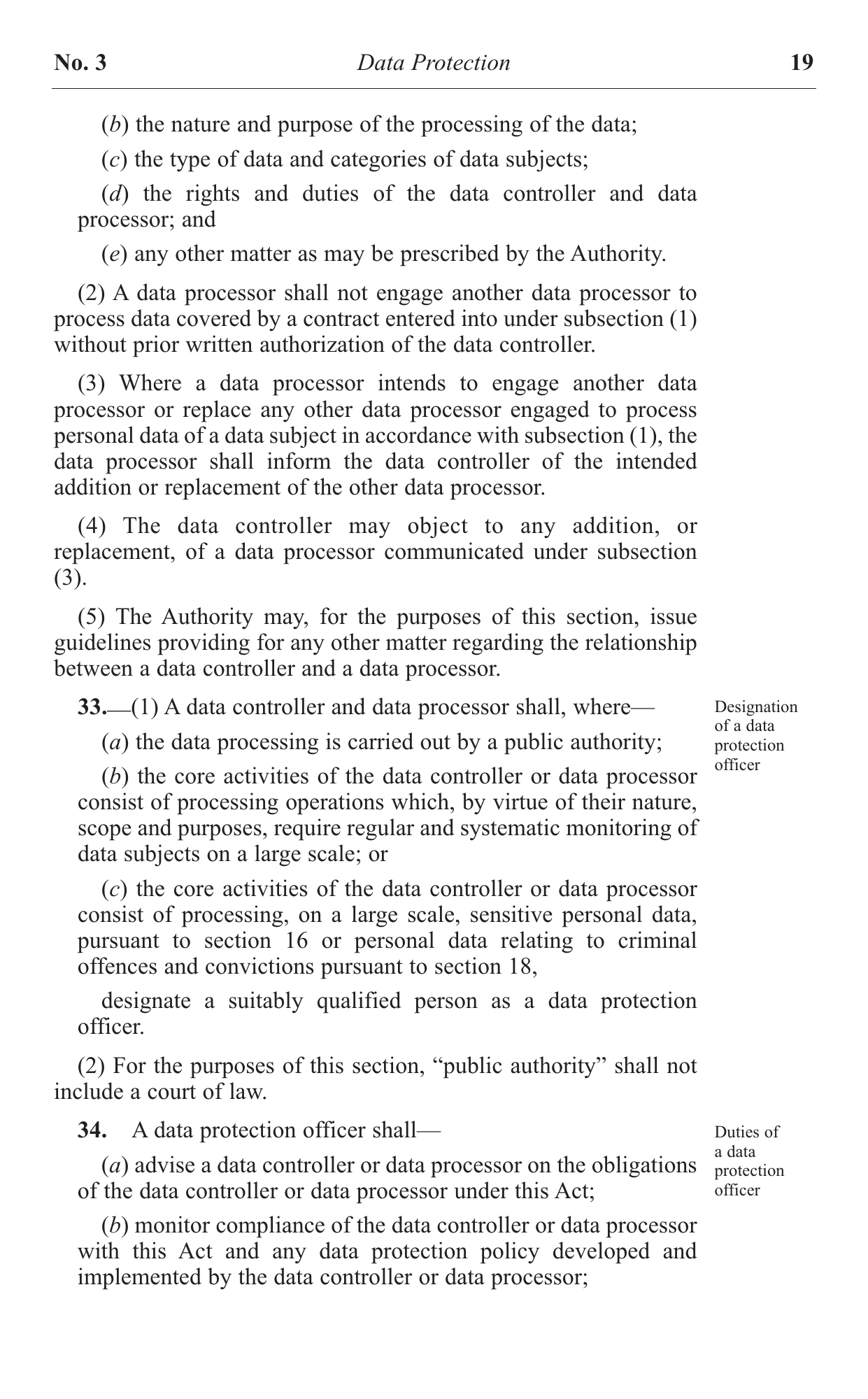
(b) the nature and purpose of the processing of the data;
(c) the type of data and categories of data subjects;
(d) the rights and duties of the data controller and data
processor; and
(e) any other matter as may be prescribed by the Authority.
(2) A data processor shall not engage another data processor to
process data covered by a contract entered into under subsection (1)
without prior written authorization of the data controller.
(3) Where a data processor intends to engage another data
processor or replace any other data processor engaged to process
personal data of a data subject in accordance with subsection (1), the
data processor shall inform the data controller of the intended
addition or replacement of the other data processor.
(4) The data controller may object to any addition, or
replacement, of a data processor communicated under subsection
(3).
(5) The Authority may, for the purposes of this section, issue
guidelines providing for any other matter regarding the relationship
between a data controller and a data processor.
Designation of a data protection officer
33.—(1) A data controller and data processor shall, where—
(a) the data processing is carried out by a public authority;
(b) the core activities of the data controller or data processor
consist of processing operations which, by virtue of their nature,
scope and purposes, require regular and systematic monitoring of
data subjects on a large scale; or
(c) the core activities of the data controller or data processor
consist of processing, on a large scale, sensitive personal data,
pursuant to section 16 or personal data relating to criminal
offences and convictions pursuant to section 18,
designate a suitably qualified person as a data protection
officer.
(2) For the purposes of this section, “public authority” shall not
include a court of law.
Duties of a data protection officer
34. A data protection officer shall—
(a) advise a data controller or data processor on the obligations
of the data controller or data processor under this Act;
(b) monitor compliance of the data controller or data processor
with this Act and any data protection policy developed and
implemented by the data controller or data processor;
Act No. 3 of 2024 — official PDF page 19; original table columns, symbols and diagram connections
20
Data Protection
No. 3
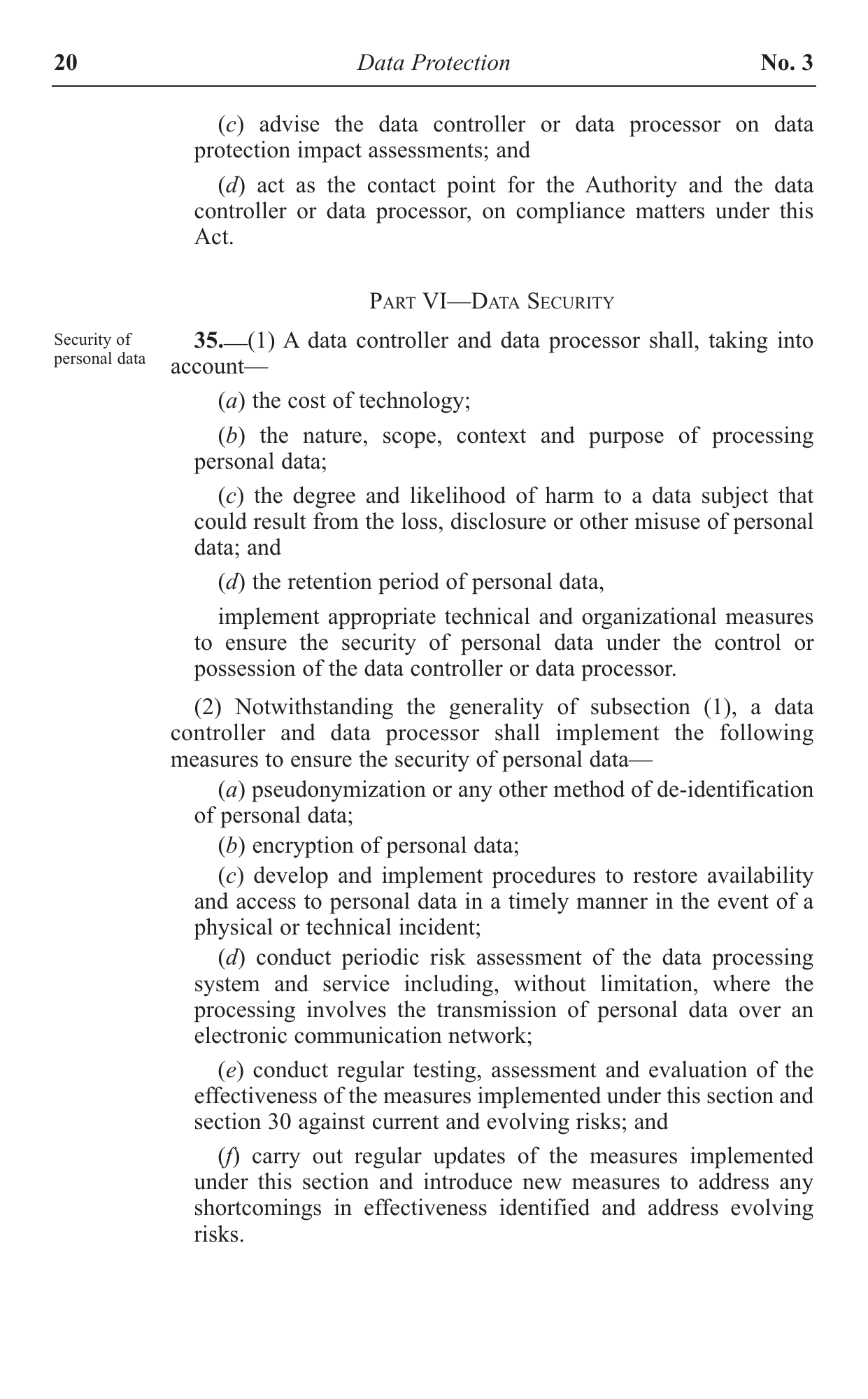
(c) advise the data controller or data processor on data
protection impact assessments; and
(d) act as the contact point for the Authority and the data
controller or data processor, on compliance matters under this
Act.
PART VI—DATA SECURITY
Security of personal data
35.—(1) A data controller and data processor shall, taking into
account—
(a) the cost of technology;
(b) the nature, scope, context and purpose of processing
personal data;
(c) the degree and likelihood of harm to a data subject that
could result from the loss, disclosure or other misuse of personal
data; and
(d) the retention period of personal data,
implement appropriate technical and organizational measures
to ensure the security of personal data under the control or
possession of the data controller or data processor.
(2) Notwithstanding the generality of subsection (1), a data
controller and data processor shall implement the following
measures to ensure the security of personal data—
(a) pseudonymization or any other method of de-identification
of personal data;
(b) encryption of personal data;
(c) develop and implement procedures to restore availability
and access to personal data in a timely manner in the event of a
physical or technical incident;
(d) conduct periodic risk assessment of the data processing
system and service including, without limitation, where the
processing involves the transmission of personal data over an
electronic communication network;
(e) conduct regular testing, assessment and evaluation of the
effectiveness of the measures implemented under this section and
section 30 against current and evolving risks; and
(f) carry out regular updates of the measures implemented
under this section and introduce new measures to address any
shortcomings in effectiveness identified and address evolving
risks.
Act No. 3 of 2024 — official PDF page 20; original table columns, symbols and diagram connections
No. 3
Data Protection
21
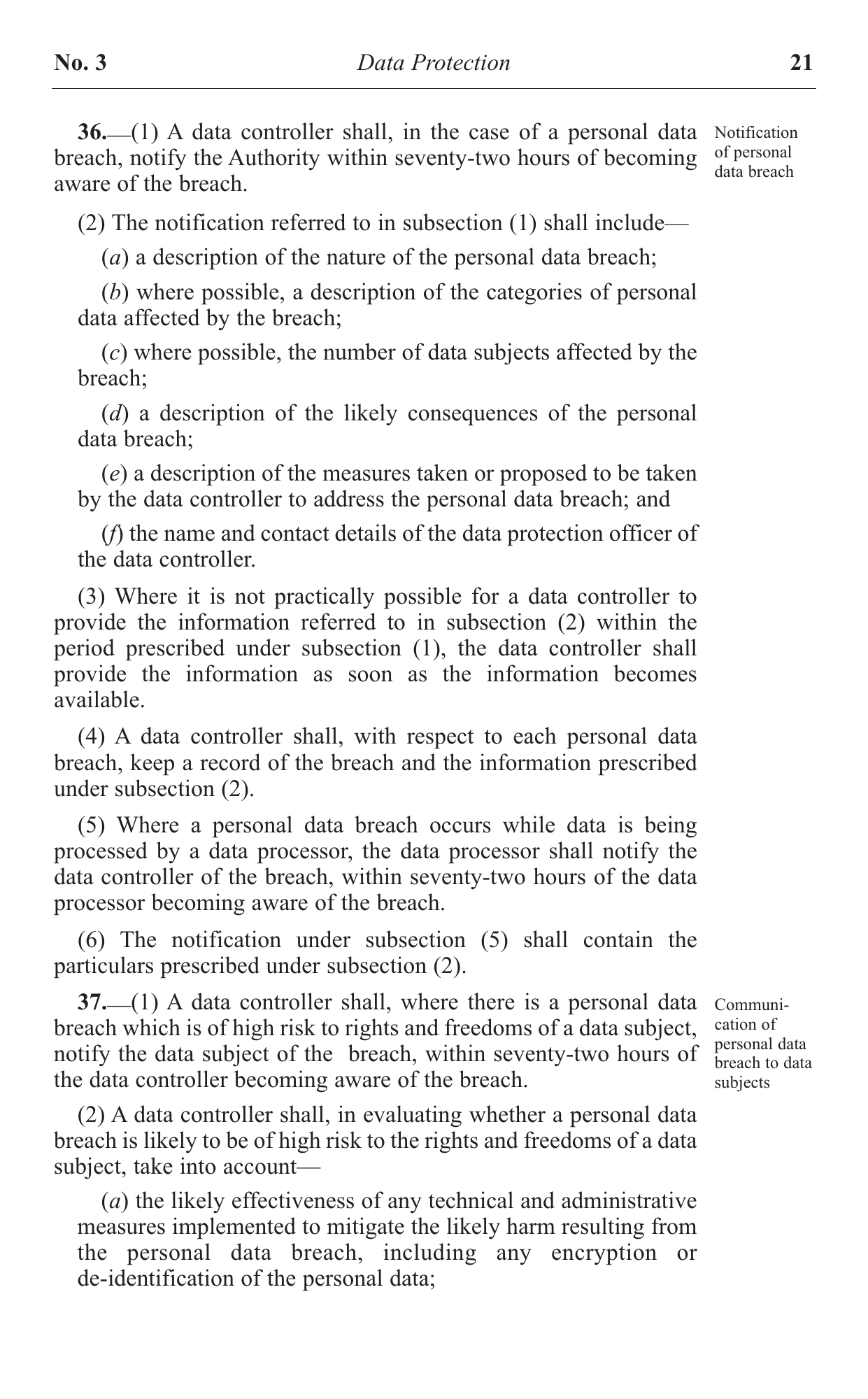
Notification of personal data breach
36.—(1) A data controller shall, in the case of a personal data
breach, notify the Authority within seventy-two hours of becoming
aware of the breach.
(2) The notification referred to in subsection (1) shall include—
(a) a description of the nature of the personal data breach;
(b) where possible, a description of the categories of personal
data affected by the breach;
(c) where possible, the number of data subjects affected by the
breach;
(d) a description of the likely consequences of the personal
data breach;
(e) a description of the measures taken or proposed to be taken
by the data controller to address the personal data breach; and
(f) the name and contact details of the data protection officer of
the data controller.
(3) Where it is not practically possible for a data controller to
provide the information referred to in subsection (2) within the
period prescribed under subsection (1), the data controller shall
provide the information as soon as the information becomes
available.
(4) A data controller shall, with respect to each personal data
breach, keep a record of the breach and the information prescribed
under subsection (2).
(5) Where a personal data breach occurs while data is being
processed by a data processor, the data processor shall notify the
data controller of the breach, within seventy-two hours of the data
processor becoming aware of the breach.
(6) The notification under subsection (5) shall contain the
particulars prescribed under subsection (2).
Communication of personal data breach to data subjects
37.—(1) A data controller shall, where there is a personal data
breach which is of high risk to rights and freedoms of a data subject,
notify the data subject of the breach, within seventy-two hours of
the data controller becoming aware of the breach.
(2) A data controller shall, in evaluating whether a personal data
breach is likely to be of high risk to the rights and freedoms of a data
subject, take into account—
(a) the likely effectiveness of any technical and administrative
measures implemented to mitigate the likely harm resulting from
the personal data breach, including any encryption or
de-identification of the personal data;
Act No. 3 of 2024 — official PDF page 21; original table columns, symbols and diagram connections
22
Data Protection
No. 3
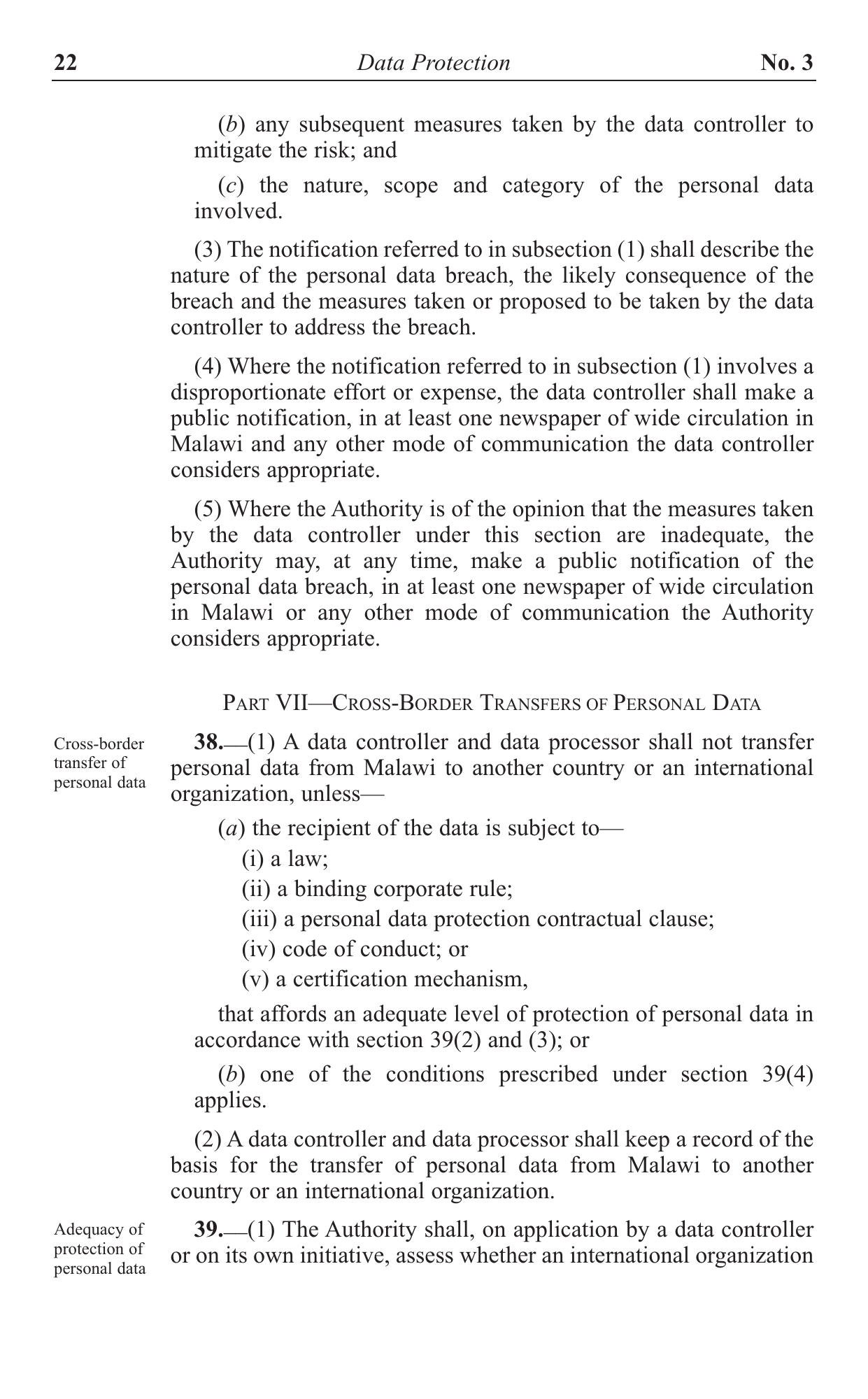
(b) any subsequent measures taken by the data controller to
mitigate the risk; and
(c) the nature, scope and category of the personal data
involved.
(3) The notification referred to in subsection (1) shall describe the
nature of the personal data breach, the likely consequence of the
breach and the measures taken or proposed to be taken by the data
controller to address the breach.
(4) Where the notification referred to in subsection (1) involves a
disproportionate effort or expense, the data controller shall make a
public notification, in at least one newspaper of wide circulation in
Malawi and any other mode of communication the data controller
considers appropriate.
(5) Where the Authority is of the opinion that the measures taken
by the data controller under this section are inadequate, the
Authority may, at any time, make a public notification of the
personal data breach, in at least one newspaper of wide circulation
in Malawi or any other mode of communication the Authority
considers appropriate.
PART VII—CROSS-BORDER TRANSFERS OF PERSONAL DATA
Cross-border transfer of personal data
38.—(1) A data controller and data processor shall not transfer
personal data from Malawi to another country or an international
organization, unless—
(a) the recipient of the data is subject to—
(i) a law;
(ii) a binding corporate rule;
(iii) a personal data protection contractual clause;
(iv) code of conduct; or
(v) a certification mechanism,
that affords an adequate level of protection of personal data in
accordance with section 39(2) and (3); or
(b) one of the conditions prescribed under section 39(4)
applies.
(2) A data controller and data processor shall keep a record of the
basis for the transfer of personal data from Malawi to another
country or an international organization.
Adequacy of protection of personal data
39.—(1) The Authority shall, on application by a data controller
or on its own initiative, assess whether an international organization
Act No. 3 of 2024 — official PDF page 22; original table columns, symbols and diagram connections
No. 3
Data Protection
23
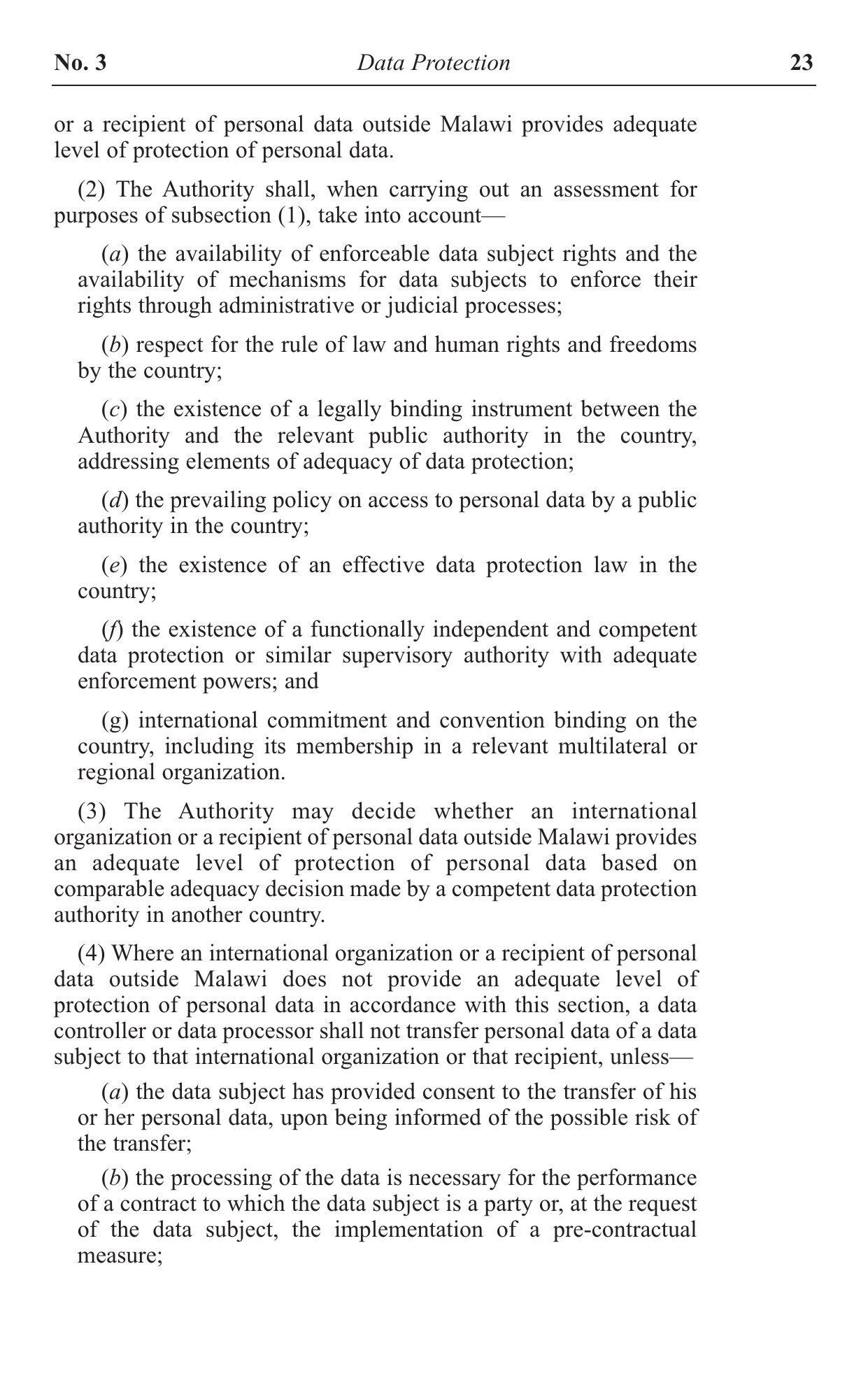
or a recipient of personal data outside Malawi provides adequate
level of protection of personal data.
(2) The Authority shall, when carrying out an assessment for
purposes of subsection (1), take into account—
(a) the availability of enforceable data subject rights and the
availability of mechanisms for data subjects to enforce their
rights through administrative or judicial processes;
(b) respect for the rule of law and human rights and freedoms
by the country;
(c) the existence of a legally binding instrument between the
Authority and the relevant public authority in the country,
addressing elements of adequacy of data protection;
(d) the prevailing policy on access to personal data by a public
authority in the country;
(e) the existence of an effective data protection law in the
country;
(f) the existence of a functionally independent and competent
data protection or similar supervisory authority with adequate
enforcement powers; and
(g) international commitment and convention binding on the
country, including its membership in a relevant multilateral or
regional organization.
(3) The Authority may decide whether an international
organization or a recipient of personal data outside Malawi provides
an adequate level of protection of personal data based on
comparable adequacy decision made by a competent data protection
authority in another country.
(4) Where an international organization or a recipient of personal
data outside Malawi does not provide an adequate level of
protection of personal data in accordance with this section, a data
controller or data processor shall not transfer personal data of a data
subject to that international organization or that recipient, unless—
(a) the data subject has provided consent to the transfer of his
or her personal data, upon being informed of the possible risk of
the transfer;
(b) the processing of the data is necessary for the performance
of a contract to which the data subject is a party or, at the request
of the data subject, the implementation of a pre-contractual
measure;
Act No. 3 of 2024 — official PDF page 23; original table columns, symbols and diagram connections
24
Data Protection
No. 3
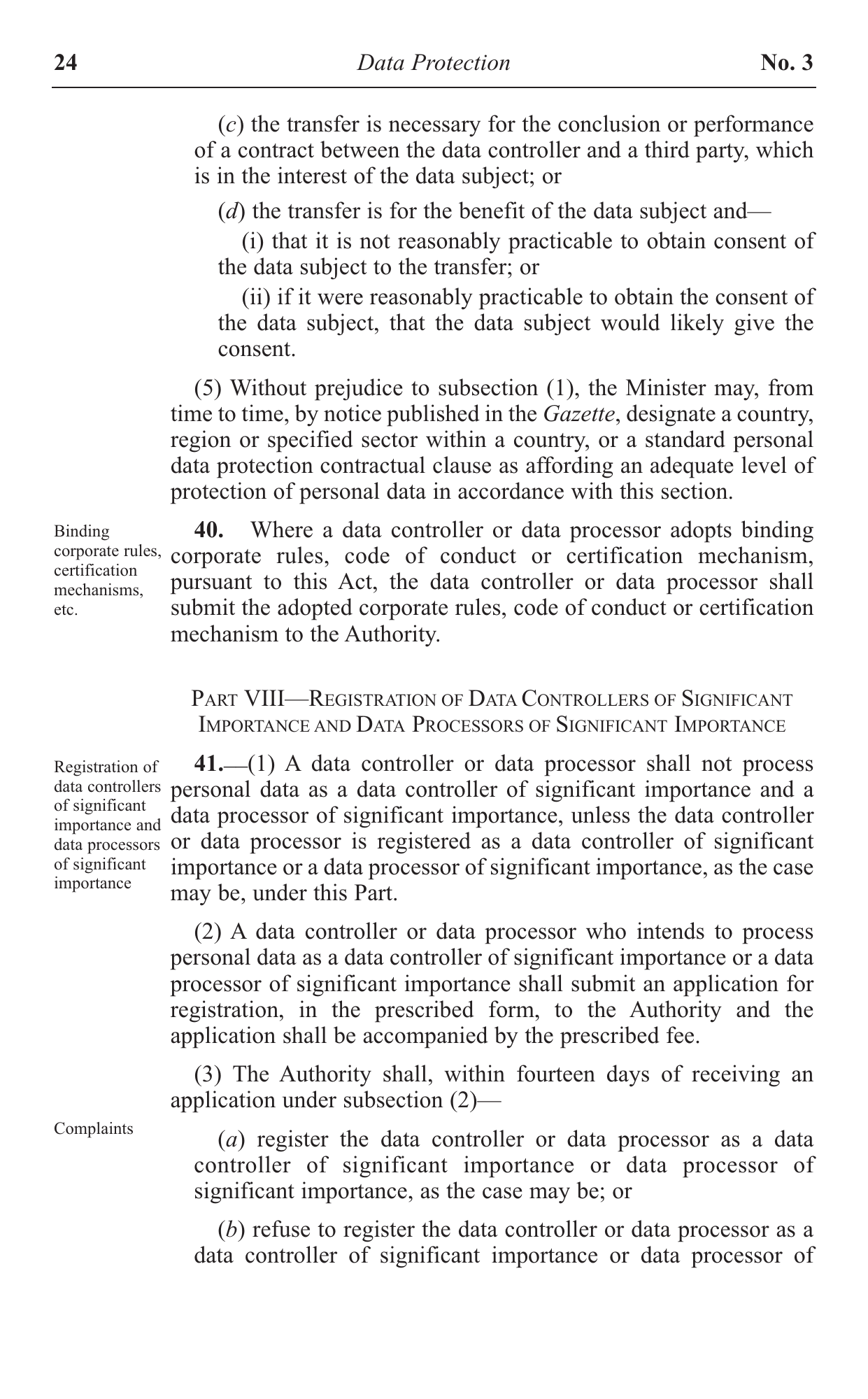
(c) the transfer is necessary for the conclusion or performance
of a contract between the data controller and a third party, which
is in the interest of the data subject; or
(d) the transfer is for the benefit of the data subject and—
(i) that it is not reasonably practicable to obtain consent of
the data subject to the transfer; or
(ii) if it were reasonably practicable to obtain the consent of
the data subject, that the data subject would likely give the
consent.
(5) Without prejudice to subsection (1), the Minister may, from
time to time, by notice published in the Gazette, designate a country,
region or specified sector within a country, or a standard personal
data protection contractual clause as affording an adequate level of
protection of personal data in accordance with this section.
Binding corporate rules, certification mechanisms, etc.
40. Where a data controller or data processor adopts binding
corporate rules, code of conduct or certification mechanism,
pursuant to this Act, the data controller or data processor shall
submit the adopted corporate rules, code of conduct or certification
mechanism to the Authority.
PART VIII—REGISTRATION OF DATA CONTROLLERS OF SIGNIFICANT
IMPORTANCE AND DATA PROCESSORS OF SIGNIFICANT IMPORTANCE
Registration of data controllers of significant importance and data processors of significant importance
41.—(1) A data controller or data processor shall not process
personal data as a data controller of significant importance and a
data processor of significant importance, unless the data controller
or data processor is registered as a data controller of significant
importance or a data processor of significant importance, as the case
may be, under this Part.
(2) A data controller or data processor who intends to process
personal data as a data controller of significant importance or a data
processor of significant importance shall submit an application for
registration, in the prescribed form, to the Authority and the
application shall be accompanied by the prescribed fee.
(3) The Authority shall, within fourteen days of receiving an
application under subsection (2)—
(a) register the data controller or data processor as a data
controller of significant importance or data processor of
significant importance, as the case may be; or
(b) refuse to register the data controller or data processor as a
data controller of significant importance or data processor of
Complaints
Act No. 3 of 2024 — official PDF page 24; original table columns, symbols and diagram connections
No. 3
Data Protection
25
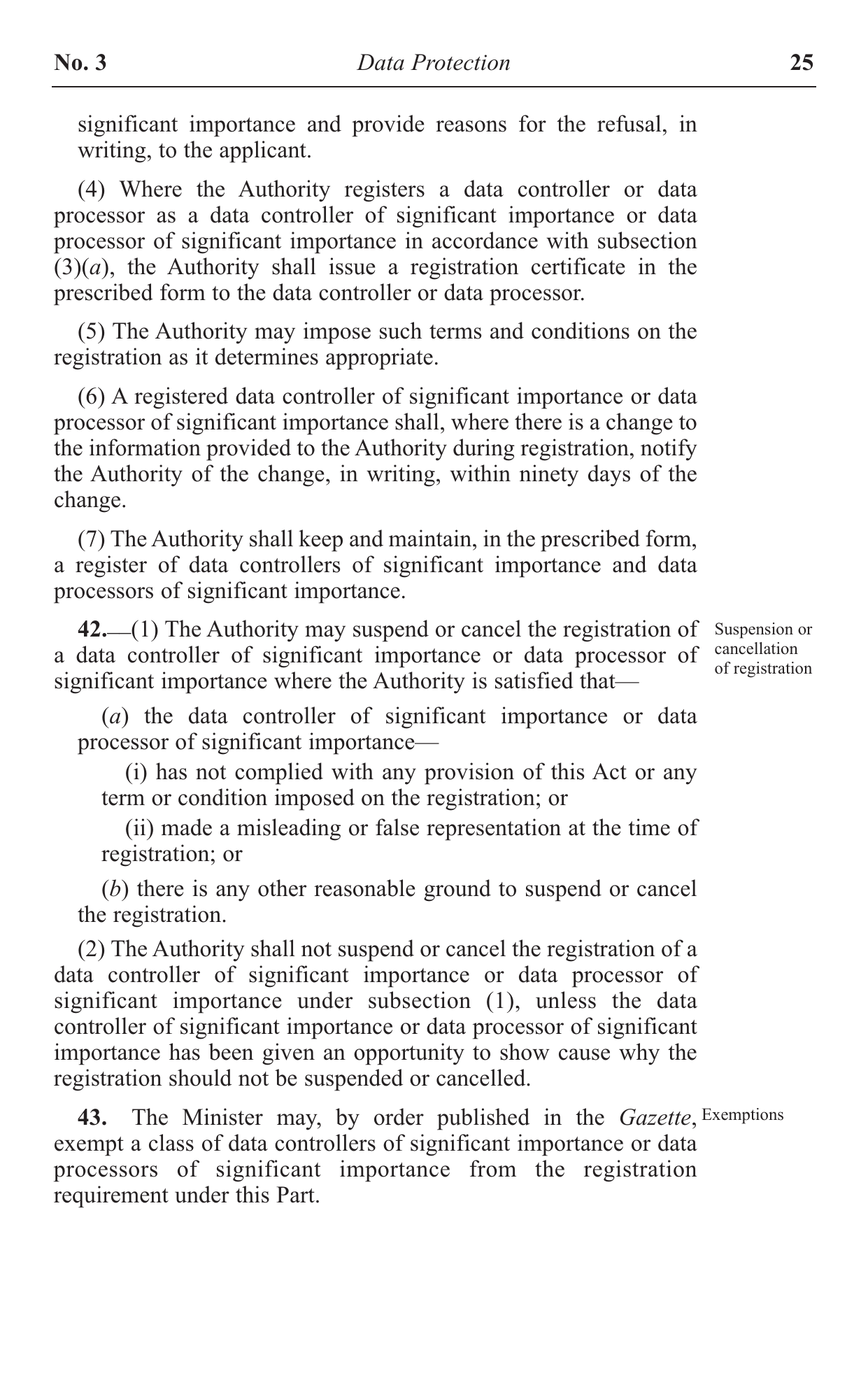
significant importance and provide reasons for the refusal, in
writing, to the applicant.
(4) Where the Authority registers a data controller or data
processor as a data controller of significant importance or data
processor of significant importance in accordance with subsection
(3)(a), the Authority shall issue a registration certificate in the
prescribed form to the data controller or data processor.
(5) The Authority may impose such terms and conditions on the
registration as it determines appropriate.
(6) A registered data controller of significant importance or data
processor of significant importance shall, where there is a change to
the information provided to the Authority during registration, notify
the Authority of the change, in writing, within ninety days of the
change.
(7) The Authority shall keep and maintain, in the prescribed form,
a register of data controllers of significant importance and data
processors of significant importance.
Suspension or cancellation of registration
42.—(1) The Authority may suspend or cancel the registration of
a data controller of significant importance or data processor of
significant importance where the Authority is satisfied that—
(a) the data controller of significant importance or data
processor of significant importance—
(i) has not complied with any provision of this Act or any
term or condition imposed on the registration; or
(ii) made a misleading or false representation at the time of
registration; or
(b) there is any other reasonable ground to suspend or cancel
the registration.
(2) The Authority shall not suspend or cancel the registration of a
data controller of significant importance or data processor of
significant importance under subsection (1), unless the data
controller of significant importance or data processor of significant
importance has been given an opportunity to show cause why the
registration should not be suspended or cancelled.
Exemptions
43. The Minister may, by order published in the Gazette,
exempt a class of data controllers of significant importance or data
processors of significant importance from the registration
requirement under this Part.
Act No. 3 of 2024 — official PDF page 25; original table columns, symbols and diagram connections
26
Data Protection
No. 3
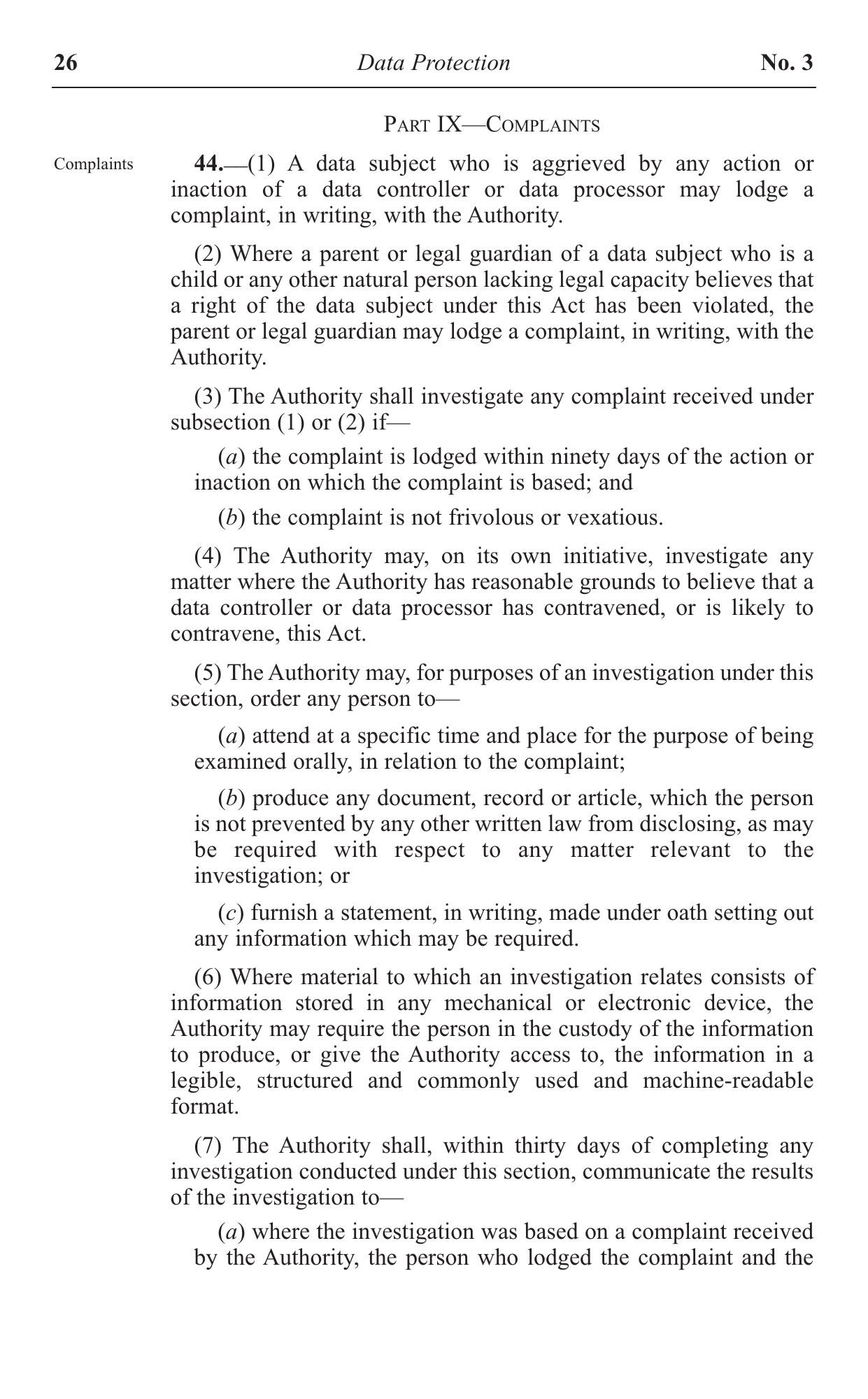
PART IX—COMPLAINTS
Complaints
44.—(1) A data subject who is aggrieved by any action or
inaction of a data controller or data processor may lodge a
complaint, in writing, with the Authority.
(2) Where a parent or legal guardian of a data subject who is a
child or any other natural person lacking legal capacity believes that
a right of the data subject under this Act has been violated, the
parent or legal guardian may lodge a complaint, in writing, with the
Authority.
(3) The Authority shall investigate any complaint received under
subsection (1) or (2) if—
(a) the complaint is lodged within ninety days of the action or
inaction on which the complaint is based; and
(b) the complaint is not frivolous or vexatious.
(4) The Authority may, on its own initiative, investigate any
matter where the Authority has reasonable grounds to believe that a
data controller or data processor has contravened, or is likely to
contravene, this Act.
(5) The Authority may, for purposes of an investigation under this
section, order any person to—
(a) attend at a specific time and place for the purpose of being
examined orally, in relation to the complaint;
(b) produce any document, record or article, which the person
is not prevented by any other written law from disclosing, as may
be required with respect to any matter relevant to the
investigation; or
(c) furnish a statement, in writing, made under oath setting out
any information which may be required.
(6) Where material to which an investigation relates consists of
information stored in any mechanical or electronic device, the
Authority may require the person in the custody of the information
to produce, or give the Authority access to, the information in a
legible, structured and commonly used and machine-readable
format.
(7) The Authority shall, within thirty days of completing any
investigation conducted under this section, communicate the results
of the investigation to—
(a) where the investigation was based on a complaint received
by the Authority, the person who lodged the complaint and the
Act No. 3 of 2024 — official PDF page 26; original table columns, symbols and diagram connections
No. 3
Data Protection
27
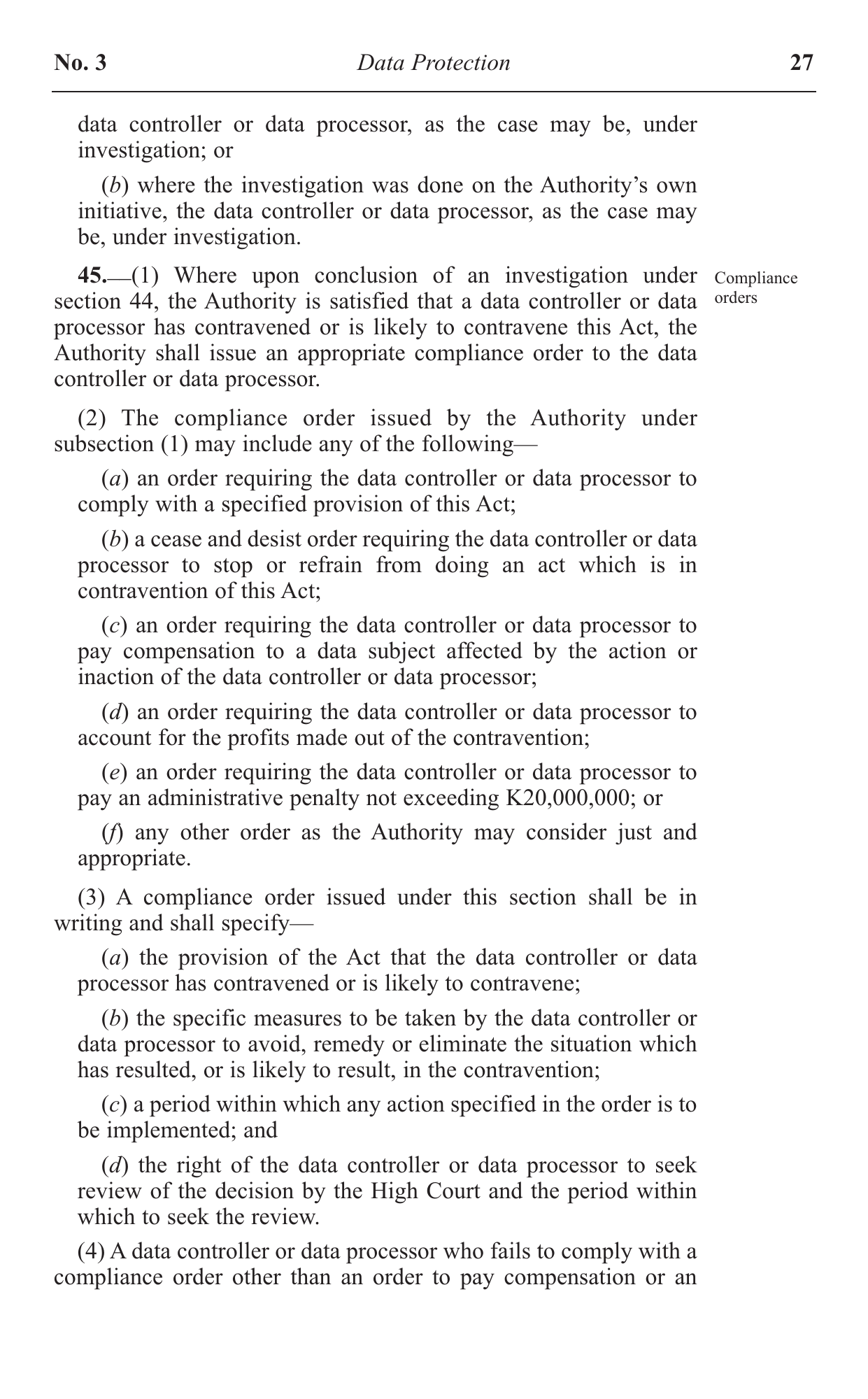
data controller or data processor, as the case may be, under
investigation; or
(b) where the investigation was done on the Authority’s own
initiative, the data controller or data processor, as the case may
be, under investigation.
Compliance orders
45.—(1) Where upon conclusion of an investigation under
section 44, the Authority is satisfied that a data controller or data
processor has contravened or is likely to contravene this Act, the
Authority shall issue an appropriate compliance order to the data
controller or data processor.
(2) The compliance order issued by the Authority under
subsection (1) may include any of the following—
(a) an order requiring the data controller or data processor to
comply with a specified provision of this Act;
(b) a cease and desist order requiring the data controller or data
processor to stop or refrain from doing an act which is in
contravention of this Act;
(c) an order requiring the data controller or data processor to
pay compensation to a data subject affected by the action or
inaction of the data controller or data processor;
(d) an order requiring the data controller or data processor to
account for the profits made out of the contravention;
(e) an order requiring the data controller or data processor to
pay an administrative penalty not exceeding K20,000,000; or
(f) any other order as the Authority may consider just and
appropriate.
(3) A compliance order issued under this section shall be in
writing and shall specify—
(a) the provision of the Act that the data controller or data
processor has contravened or is likely to contravene;
(b) the specific measures to be taken by the data controller or
data processor to avoid, remedy or eliminate the situation which
has resulted, or is likely to result, in the contravention;
(c) a period within which any action specified in the order is to
be implemented; and
(d) the right of the data controller or data processor to seek
review of the decision by the High Court and the period within
which to seek the review.
(4) A data controller or data processor who fails to comply with a
compliance order other than an order to pay compensation or an
Act No. 3 of 2024 — official PDF page 27; original table columns, symbols and diagram connections
28
Data Protection
No. 3
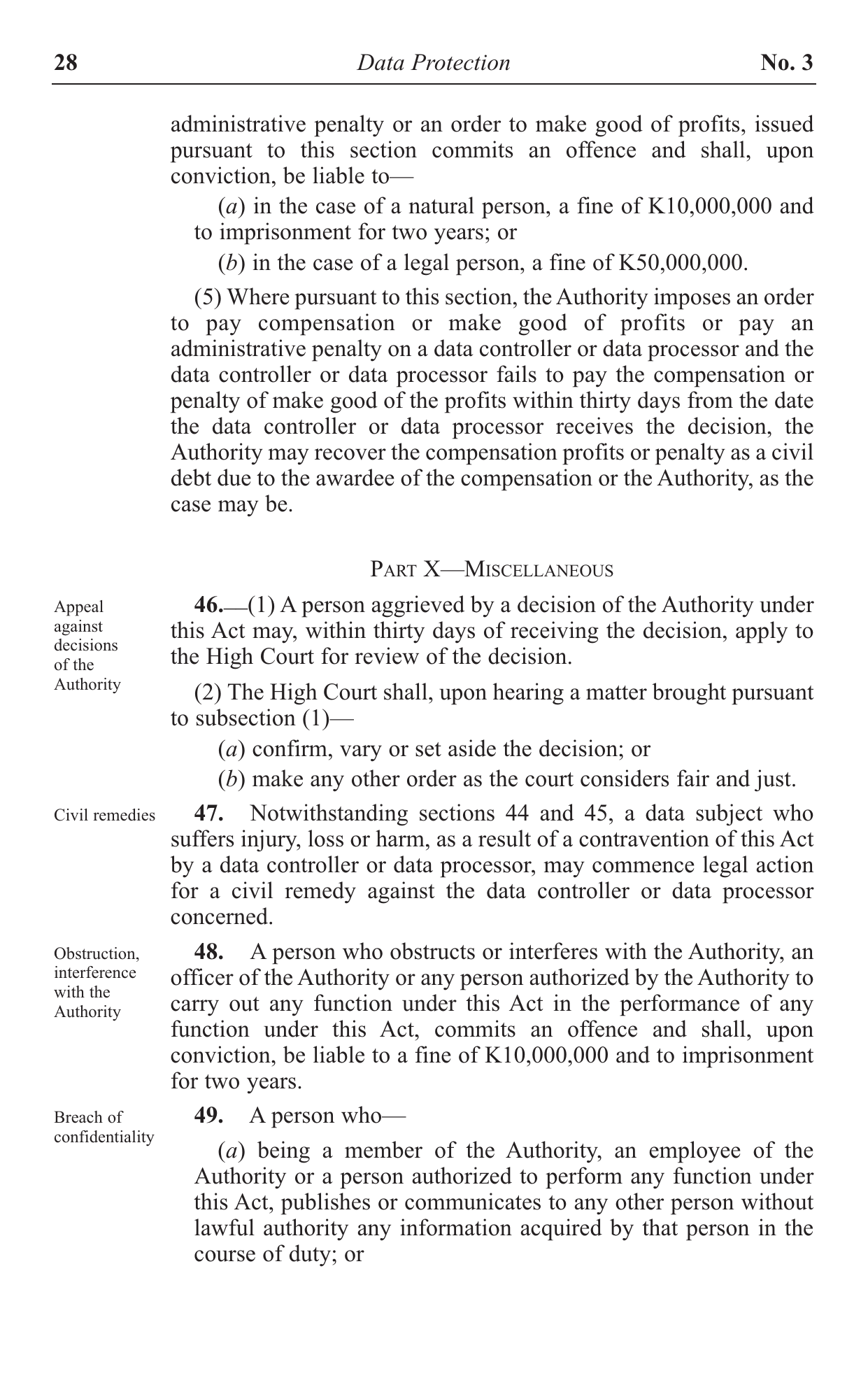
administrative penalty or an order to make good of profits, issued
pursuant to this section commits an offence and shall, upon
conviction, be liable to—
(a) in the case of a natural person, a fine of K10,000,000 and
to imprisonment for two years; or
(b) in the case of a legal person, a fine of K50,000,000.
(5) Where pursuant to this section, the Authority imposes an order
to pay compensation or make good of profits or pay an
administrative penalty on a data controller or data processor and the
data controller or data processor fails to pay the compensation or
penalty of make good of the profits within thirty days from the date
the data controller or data processor receives the decision, the
Authority may recover the compensation profits or penalty as a civil
debt due to the awardee of the compensation or the Authority, as the
case may be.
PART X—MISCELLANEOUS
Appeal against decisions of the Authority
46.—(1) A person aggrieved by a decision of the Authority under
this Act may, within thirty days of receiving the decision, apply to
the High Court for review of the decision.
(2) The High Court shall, upon hearing a matter brought pursuant
to subsection (1)—
(a) confirm, vary or set aside the decision; or
(b) make any other order as the court considers fair and just.
Civil remedies
47. Notwithstanding sections 44 and 45, a data subject who
suffers injury, loss or harm, as a result of a contravention of this Act
by a data controller or data processor, may commence legal action
for a civil remedy against the data controller or data processor
concerned.
Obstruction, interference with the Authority
48. A person who obstructs or interferes with the Authority, an
officer of the Authority or any person authorized by the Authority to
carry out any function under this Act in the performance of any
function under this Act, commits an offence and shall, upon
conviction, be liable to a fine of K10,000,000 and to imprisonment
for two years.
Breach of confidentiality
49. A person who—
(a) being a member of the Authority, an employee of the
Authority or a person authorized to perform any function under
this Act, publishes or communicates to any other person without
lawful authority any information acquired by that person in the
course of duty; or
Act No. 3 of 2024 — official PDF page 28; original table columns, symbols and diagram connections
No. 3
Data Protection
29
(b) is in possession of any information which to the knowledge
of the person was obtained in contravention of this Act, publishes
or communicates that information without lawful authority to any
other person,
commits an offence and shall, upon conviction, be liable to a
fine of K20,000,000 and to imprisonment for five years.
Offences committed by legal persons, firms, etc.
50.—(1) Where a legal person is convicted of an offence under
this Act, every natural person who—
(a) is a director of, or is otherwise concerned with the
management of, the legal person; and
(b) knowingly authorized or permitted the act or omission
constituting the offence,
commits the same offence which the legal person is guilty of,
and may be proceeded against and be sentenced in the same
manner as any other natural person.
(2) A natural person who is a partner in a firm shall be jointly and
severally liable for any act or omission of the other partner in the
firm in so far as the act or omission relates to the firm.
(3) Where a data controller or data processor charged with an
offence under this Act is a legal person, any person who, at the time
the offence was committed was a chief executive officer, manager
or officer of such legal person, may be charged jointly in the same
proceeding with the legal person, if the person was party to the
offence committed.
Vicarious liability
51. A data controller and data processor shall be vicariously
liable for any act or omission of an agent, employee or other person
authorized by the data controller or data processor to perform any
function regulated under this Act, in so far as the act or omission
relates to an operation of the data controller or data processor.
Regulations
52.—(1) The Minister may, on the recommendation of the
Authority, make regulations for the better carrying out of the
purposes of this Act.
(2) Without prejudice to the generality of subsection (1), the
regulations may make provision for—
(a) forms, certificates and registers required under this Act;
(b) fees payable under this Act;
(c) the procedure for receiving and handling
complaints;
(d) the criteria for classifying data controllers of
Act No. 3 of 2024 — official PDF page 29; original table columns, symbols and diagram connections
30 Data Protection No. 3
significant importance and data processors of significant
importance;
(e) the form of binding corporate rules, codes of conduct or
certification mechanisms; and
(f) any matter required to be prescribed under this Act.
Cap. 1:01
(3) Notwithstanding the provisions of section 21(e) of the
General Interpretation Act, the regulations made under subsection
(1), may provide for offences the contravention of which may attract
a penalty of a fine of K5,000,000 and imprisonment for twelve
months.
Transitional provision
53. A data controller or a data processor who is domiciled,
ordinarily resident, or ordinarily operates in Malawi and—
(a) is not a data controller of significant importance or data
processor of significant importance shall be exempt from
compliance with this Act, for a period of twenty-four months
from the date the Act comes into operation; or
(b) is a data controller of significant importance or data
processor of significant importance shall, within six months from
the date the Act comes into operation, comply with the
requirements prescribed under this Act.
Passed in Parliament this seventh day of December, two thousand and
twenty-three.
FIONA KALEMBA
Clerk of Parliament
Act No. 3 of 2024 — official PDF page 30; original table columns, symbols and diagram connections