Government Notice 88 of 1998 — Pharmacy, Medicines and Poisons Regulations, 1998
Currentness under review. Whether this instrument remains applicable is under review. Consult the later instruments and source context below before relying on it.
Link directly to a passage with its anchor — for example #pdf-page-1 — to open it highlighted. This reference version is generated from the authority’s publication and does not replace it. Language: English.
Contents
4th December, 1998 375
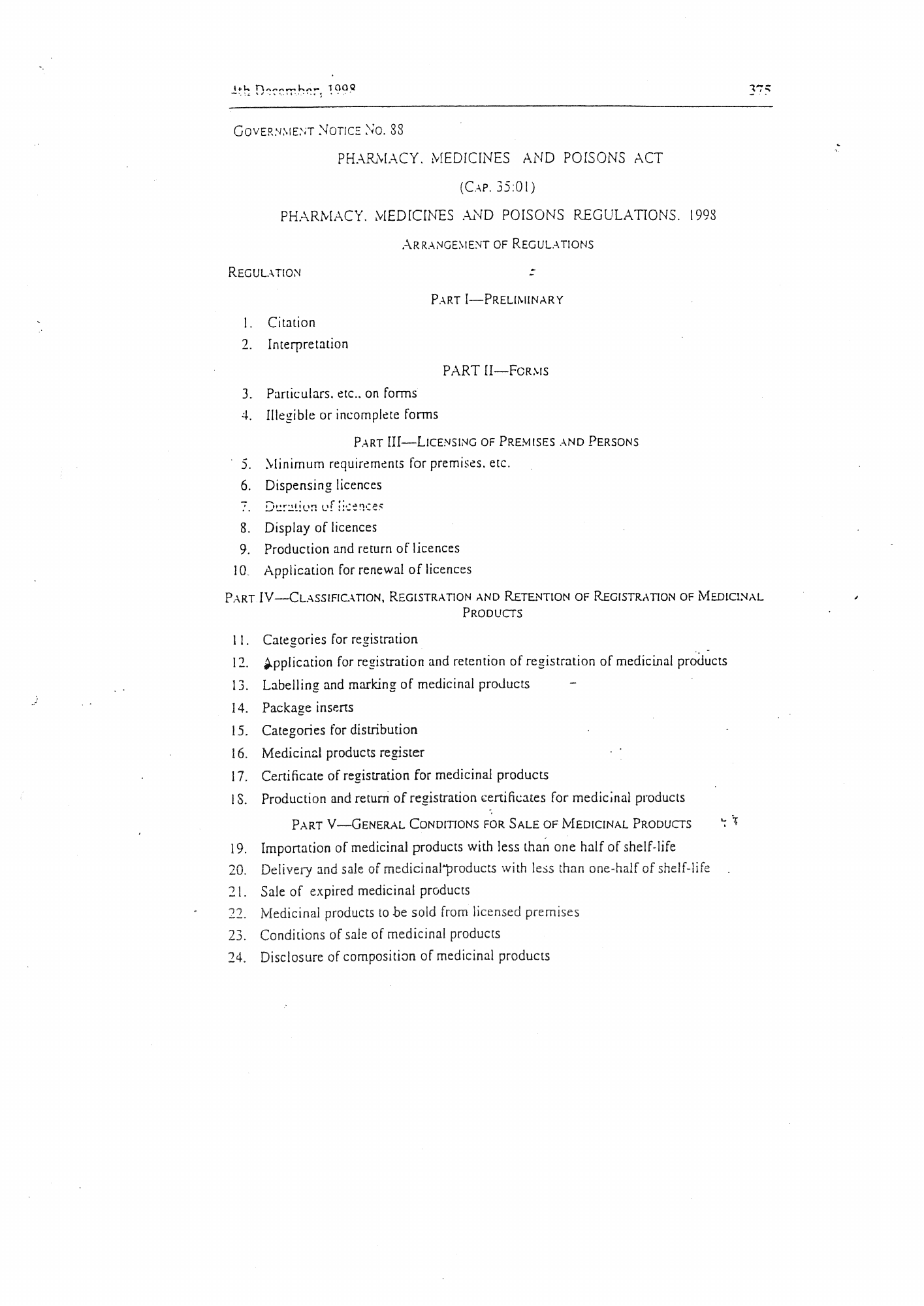
GOVERNMENT NOTICE NO. 88
PHARMACY, MEDICINES AND POISONS ACT
(CAP. 35:01)
PHARMACY, MEDICINES AND POISONS REGULATIONS, 1998
ARRANGEMENT OF REGULATIONS
REGULATION
PART I—PRELIMINARY
1. Citation
2. Interpretation
PART II—FORMS
3. Particulars, etc., on forms
4. Illegible or incomplete forms
PART III—LICENSING OF PREMISES AND PERSONS
5. Minimum requirements for premises, etc.
6. Dispensing licences
7. Duration of licences
8. Display of licences
9. Production and return of licences
10. Application for renewal of licences
PART IV—CLASSIFICATION, REGISTRATION AND RETENTION OF REGISTRATION OF MEDICINAL PRODUCTS
11. Categories for registration
12. Application for registration and retention of registration of medicinal products
13. Labelling and marking of medicinal products
14. Package inserts
15. Categories for distribution
16. Medicinal products register
17. Certificate of registration for medicinal products
18. Production and return of registration certificates for medicinal products
PART V—GENERAL CONDITIONS FOR SALE OF MEDICINAL PRODUCTS
19. Importation of medicinal products with less than one half of shelf-life
20. Delivery and sale of medicinal products with less than one-half of shelf-life
21. Sale of expired medicinal products
22. Medicinal products to be sold from licensed premises
23. Conditions of sale of medicinal products
24. Disclosure of composition of medicinal products
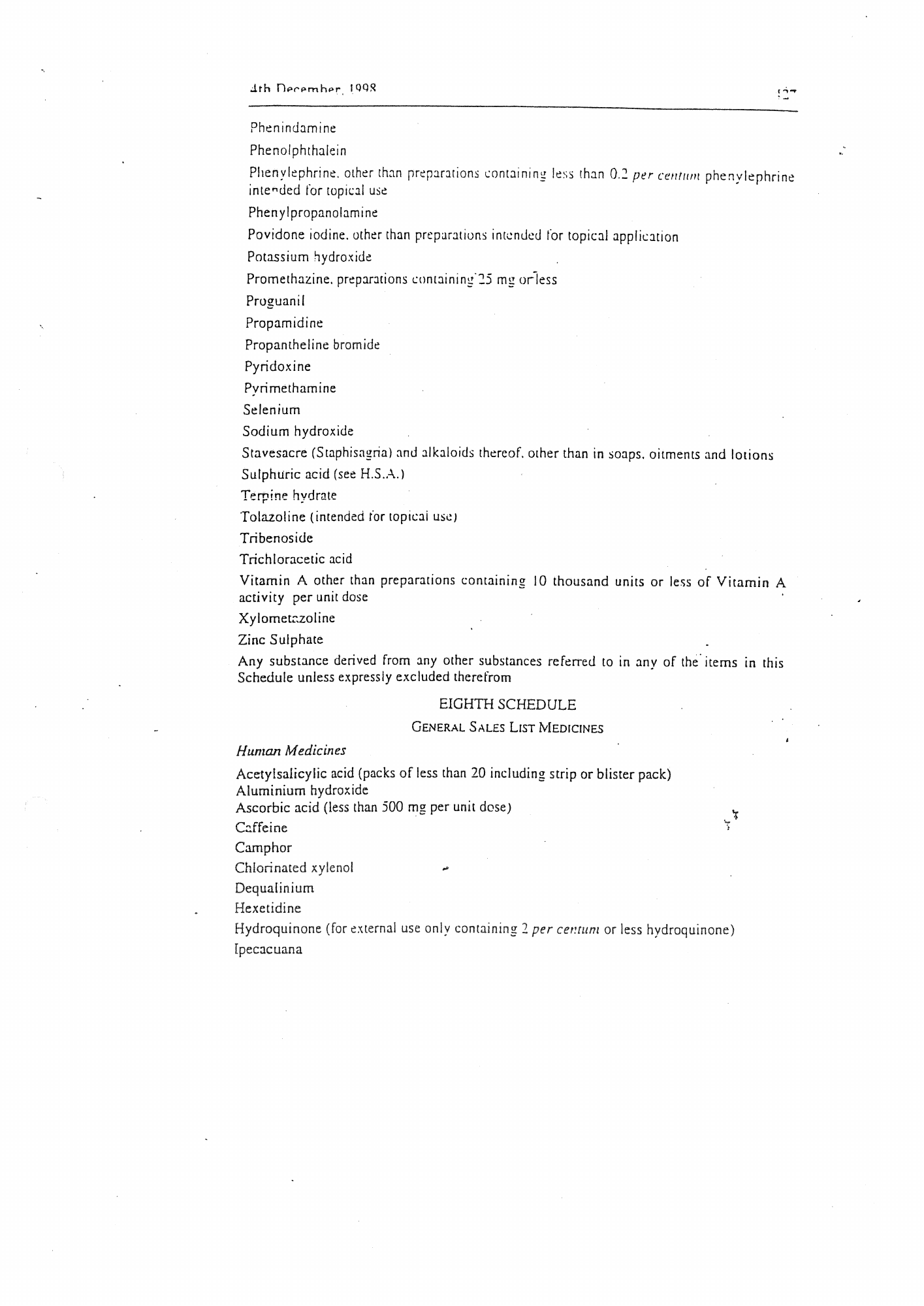
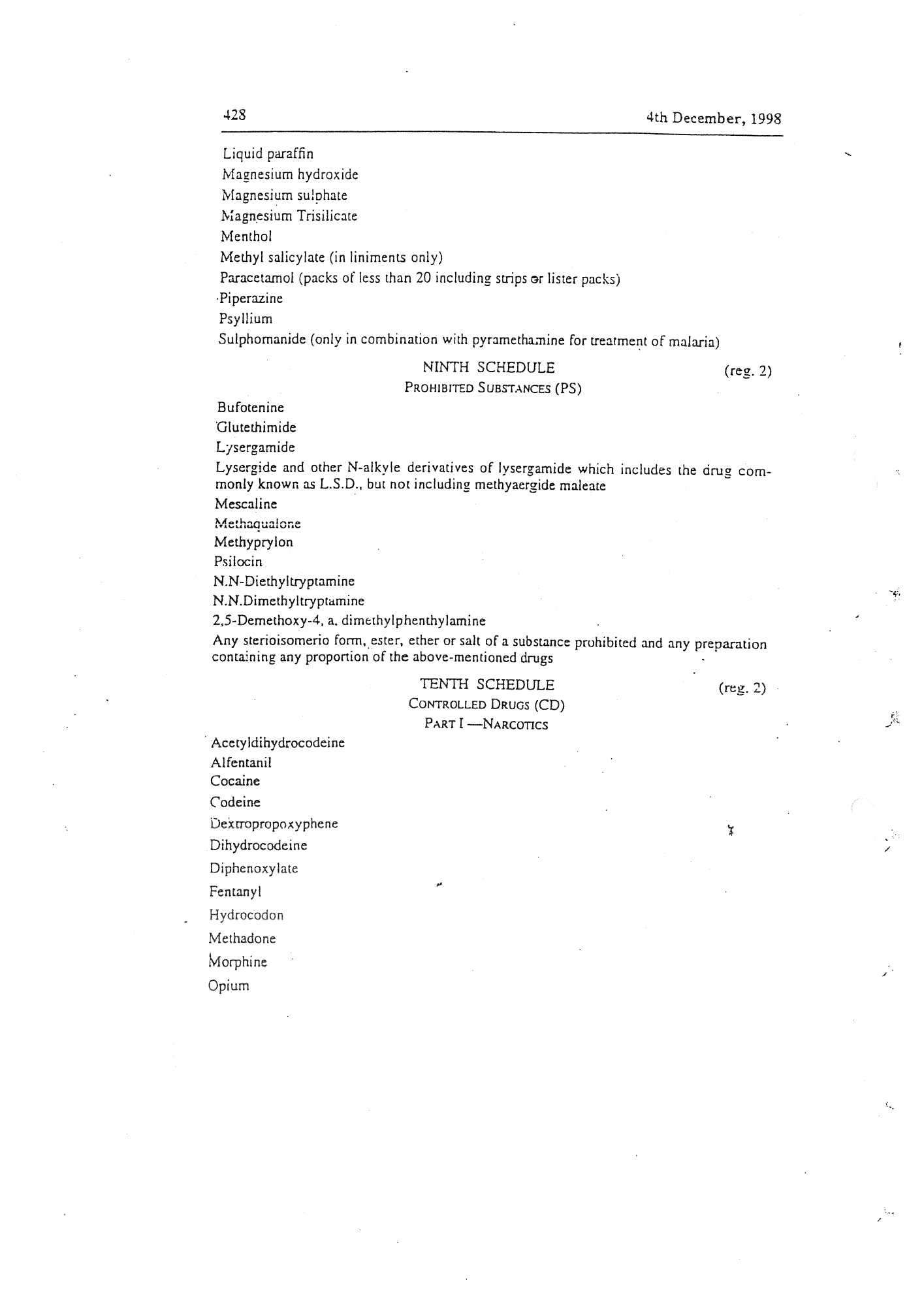
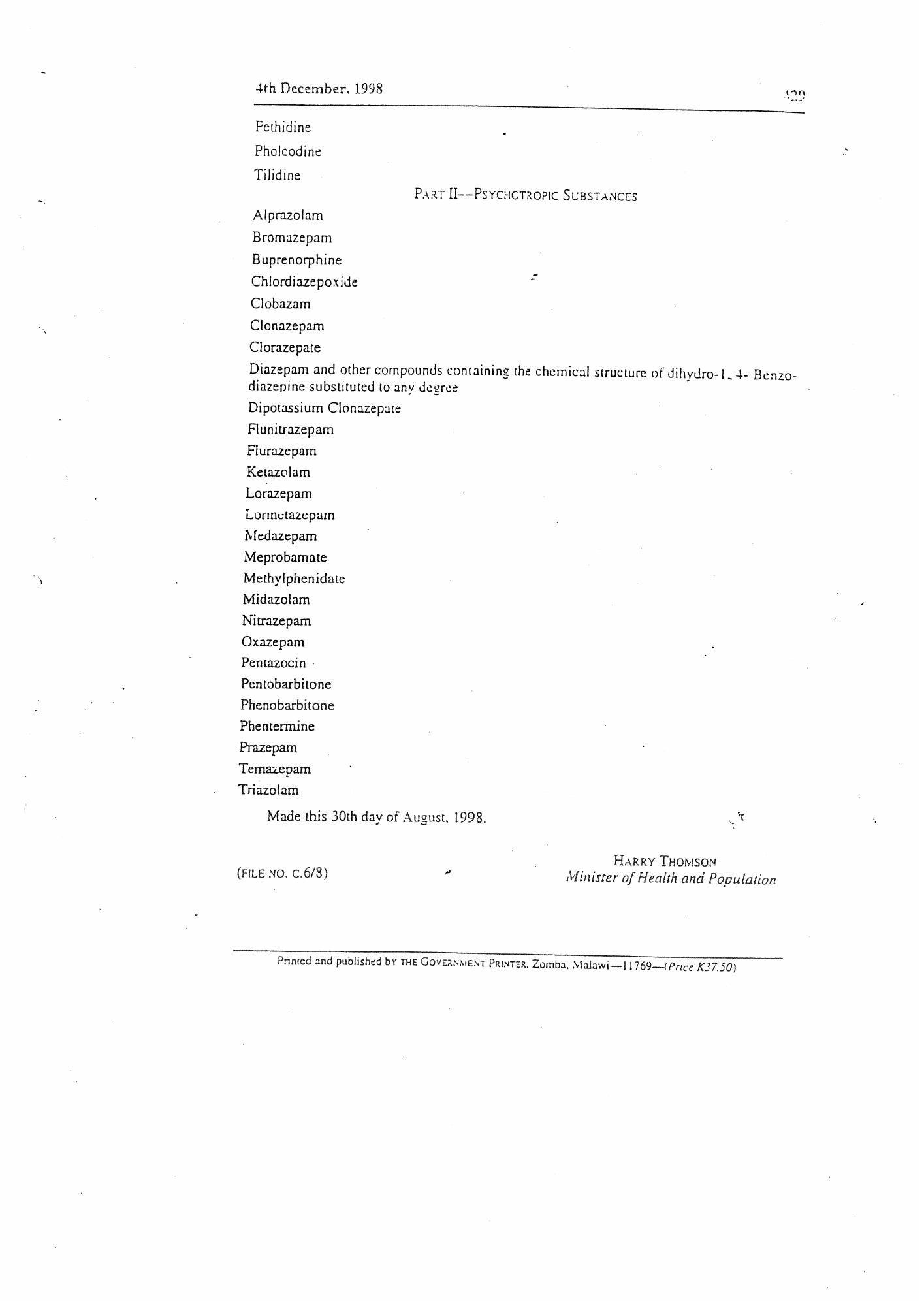
Government Notice 88 of 1998 — official PDF page 1; original table columns, symbols and diagram connections
376 4th December, 1998
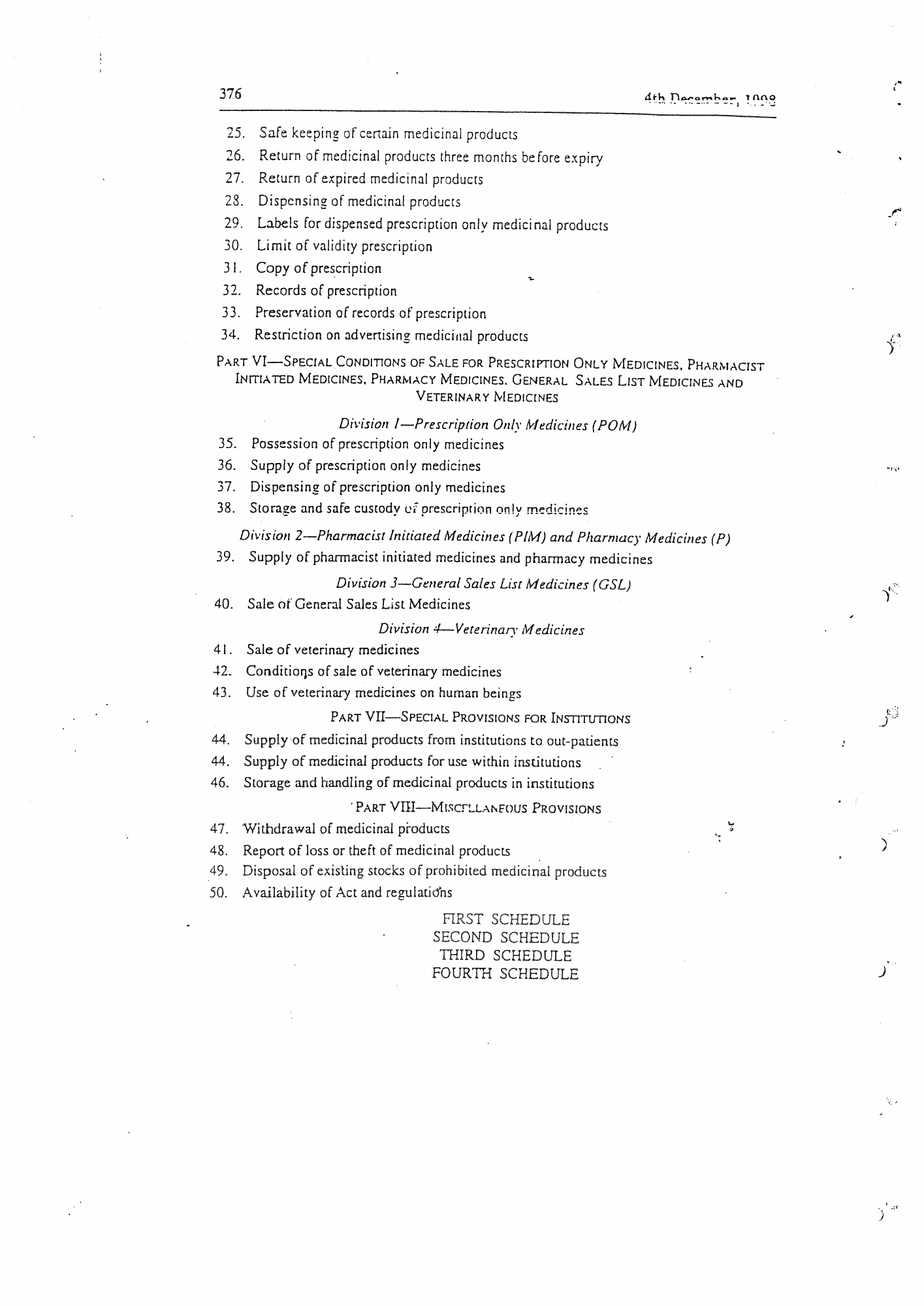
25. Safe keeping of certain medicinal products
26. Return of medicinal products three months before expiry
27. Return of expired medicinal products
28. Dispensing of medicinal products
29. Labels for dispensed prescription only medicinal products
30. Limit of validity prescription
31. Copy of prescription
32. Records of prescription
33. Preservation of records of prescription
34. Restriction on advertising medicinal products
PART VI—SPECIAL CONDITIONS OF SALE FOR PRESCRIPTION ONLY MEDICINES, PHARMACIST INITIATED MEDICINES, PHARMACY MEDICINES, GENERAL SALES LIST MEDICINES AND VETERINARY MEDICINES
Division 1—Prescription Only Medicines (POM)
35. Possession of prescription only medicines
36. Supply of prescription only medicines
37. Dispensing of prescription only medicines
38. Storage and safe custody of prescription only medicines
Division 2—Pharmacist Initiated Medicines (PIM) and Pharmacy Medicines (P)
39. Supply of pharmacist initiated medicines and pharmacy medicines
Division 3—General Sales List Medicines (GSL)
40. Sale of General Sales List Medicines
Division 4—Veterinary Medicines
41. Sale of veterinary medicines
42. Conditions of sale of veterinary medicines
43. Use of veterinary medicines on human beings
PART VII—SPECIAL PROVISIONS FOR INSTITUTIONS
44. Supply of medicinal products from institutions to out-patients
44. Supply of medicinal products for use within institutions
46. Storage and handling of medicinal products in institutions
PART VIII—MISCELLANEOUS PROVISIONS
47. Withdrawal of medicinal products
48. Report of loss or theft of medicinal products
49. Disposal of existing stocks of prohibited medicinal products
50. Availability of Act and regulations
FIRST SCHEDULE
SECOND SCHEDULE
THIRD SCHEDULE
FOURTH SCHEDULE
Government Notice 88 of 1998 — official PDF page 2; original table columns, symbols and diagram connections
4th December, 1998 377
FIFTH SCHEDULE
SIXTH SCHEDULE
SEVENTH SCHEDULE
EIGTH SCHEDULE
NINTH SCHEDULE
TENTH SCHEDULE
IN EXERCISE of the powers conferred by section 66 of the Pharmacy, Medicines and Poisons Act, I, HARRY THOMSON, Minister of Health and Population, on the advice of the Pharmacy, Medicines and Poisons Board, make the following Regulations—
PART I—PRELIMINARY
Citation
1. These Regulations may be cited as the Pharmacy, Medicines and Poisons Regulations, 1998.
Interpretation
2. In these Regulations, unless the context otherwise requires—
“batch number” means the number or other cipher allocated to medicinal product by a manufacturer, by which the origin of raw materials and the complete process of manufacture of the medicinal product can be determined;
“business address” in relation to a business, means the full address of the premises where that business is carried on or any abbreviated address approved by the Board;
“country of origin” in relation to a medicinal product, means the country where the manufacture of that medicinal product was undertaken;
“dangerous drug” or “Controlled Drugs” or “(CD)” means a drug—
(a) controlled in terms of the Dangerous Drugs Act;
(b) listed in the Tenth Schedule; or
(c) registered as such by the Board;
“expiry date”, in relation to any batch of a medicinal product, means the date on which the shelf-life of such medicinal product will expire;
“general sales list medicine” or “GSL” means a medicinal product to which Division 3 of Part VI applies or a medicinal product registered as such by the Board;
“logo” means the mark, device, design, letter, word, name or numeral or any combination thereof which is used in, or proposed to be used, in relation to, any medicinal product for the purpose of indicating a connexion with the principal manufacturer of the medicinal product and the medicinal product itself;
“institution” means a hospital, dispensary, clinic, nursing home or other institution at which human ailments are treated;
“label”, in relation to a package of a medicinal product, means any written, pictorial or other matter marked on or affixed to the package;
Government Notice 88 of 1998 — official PDF page 3; original table columns, symbols and diagram connections
378 4th December, 1998
“package insert” means a pamphlet on which is printed the particulars prescribed in regulation 15;
“patent” means a patent registered in terms of the Patents Act and which is of full force and effect;
“pharmacist initiated medicine” or “PIM” means a medicinal product listed in the Sixth Schedule or registered as such by the Board;
“pharmacy medicine” or “(P)” means a medicinal product listed in the Seventh Schedule or registered as such by the Board;
“prescriber” means a medical practitioner, a dentist, or a veterinary surgeon or any other person who is lawfully authorized to prescribe any medicinal product;
“prescription” means an order, in writing or orally by a prescriber for the supply of a medicinal product or combination of medicinal products, for the treatment of a person or animal specified therein;
“prescription only medicines” or “POM” means a medicinal product listed in the Fifth Schedule, or registered as such by the Board;
“shelf-life”, in relation to any batch or a medicinal product, means the period up to which a medicinal product in that batch will retain the potency and properties stated on the label as fixed by the manufacturer.
PART II—FORMS
Particulars, etc., on forms
3.—(1) Every person who is required to make an application under the Act shall complete the prescribed form and pay the prescribed fees, and shall furnish to the Registrar with such further information or particulars as may be prescribed.
(2) All forms shall be completed in English.
Illegible or incomplete forms
4. The Registrar may reject any form if any part of the form is illegible or not properly completed.
PART III—LICENSING OF PREMISES AND PERSONS
Minimum requirements for premises, etc.
5. Any person who applies for registration under the Act shall ensure that the premises comply with—
(a) in the case of manufacturing pharmacy business, the minimum requirements set out in Part I of the First Schedule;
(b) in the case of wholesale pharmacy business, the minimum requirements set out in Part II of the First Schedule;
(c) in the case of retail pharmacy business, the minimum requirements set out in Part III of the First Schedule;
(d) in the case of an institution, the minimum requirements set out in Part III of the First Schedule;
(e) in the case of a registered dispensing practitioner, the minimum requirements set out in Part IV of the First Schedule; and
(f) in the case of a medicine store, the minimum requirements set out the Part V of the First Schedule.
Government Notice 88 of 1998 — official PDF page 4; original table columns, symbols and diagram connections
4th December, 1998 379
Dispensing licences
6. An application for a dispensing licence to dispense medicinal products from any premises in accordance with section 35 (4) of the Act shall not be granted where such premises are situated within five kilometres of a pharmacy:
Provided that the Board may waive this requirement where the Board considers it in the public interest so to do.
Duration of licences
7. Every licence which is issued in respect of premises or to any person pursuant to the Act shall be valid for a period of one year from the date of issue, and may be renewed annually thereafter.
Display of licences
8.—(1) Subject to subregulation (2), every licensee shall ensure that his licence is prominently displayed at all times upon the licensed premises to which it relates.
(2) Subregulation (1) shall not apply in respect of any period during which the licence is necessarily removed from the licensed premises for the purposes of doing anything in terms of the Act or for any other lawful purpose the proof thereof, in any proceedings against any person for contravention of subsection (1), shall lie upon that person.
Production and return of licences
9.—(1) Whenever the Board—
(a) cancels any licence;
(b) varies or amends the conditions of any licence; or
(c) imposes any new condition in respect of or on the renewal of any licence,
the Registrar shall request the holder of the licence to produce such licence within such period as the Registrar may specify, and the holder thereof shall produce such licence within the specified period.
(2) Any person who fails to comply with a request made in accordance with subregulation (1) shall be guilty of an offence.
(3) Whenever the Board varies, amends or imposes any new condition in respect of a licence, the Board shall return such licence duly endorsed to the holder thereof within a reasonable time.
Application for renewal of licences
10.—(1) Every application for the renewal of a licence shall be—
(a) in the prescribed form;
(b) lodged with the Registrar at least two months before the expiry of the licence; and
(c) accompanied by the appropriate fee in respect of the licence.
(2) If an application for the renewal of a licence is lodged with the Registrar after the time limit as specified in subregulation (1) there shall be paid in addition to the renewal fee an appropriate penalty fee in respect of the licence as determined by the Board.
PART IV—CLASSIFICATION, REGISTRATION AND RETENTION OF REGISTRATION OF MEDICINAL PRODUCTS
Categories for registration
11. For the purpose of registration, the Board shall divide medicinal products into the categories specified in the Second Schedule.
Government Notice 88 of 1998 — official PDF page 5; original table columns, symbols and diagram connections
380 4th December, 1998
Application for registration and retention of registration of medicinal products
12.—(1) An application for the registration of a medicinal product may be made by—
(a) the person who owns the medicinal product; or
(b) any other person registered by the Board.
(2) Every application for the registration of a medicinal product shall be submitted to the Registrar in the prescribed form and shall be accompanied by—
(a) a sample of the medicinal product in the smallest of each of the package forms available for distribution to the public, including the identification marks on such product where appropriate, or if the package forms are not yet available, a sample in a package in which the applicant intends to make the medicinal product available for distribution to the public;
(b) detailed information of all advertising material and package inserts which the applicant intends to use;
(c) such samples of the medicinal product or the raw materials thereof as the Board may request for analysis;
(d) a copy of any literature in support of the application:
Provided that the Board may require additional copies of such literature;
(e) twenty additional package inserts and twenty labels or copies of the package;
(f) at least three copies of all records and batch data relating to a particular batch, which shall include raw material analytical reports, master sheets relating to manufacture and packaging in process control records, final product analytical records and authorized for release, and any other relevant records; and
(g) the prescribed fee, together with such additional fees as the Board may require for the purpose of analysing the medicinal product.
(3) Every applicant shall, without delay, inform the Board either before or after the registration of a medicinal product—
(a) of any alteration of the information or particulars furnished by him in applying for registration in terms of subsection (2); and
(b) whether the medicinal product is to be imported as a finished product into, or relabelled or repackaged or dealt with in any other manner, in Malawi.
(4) For the purposes of paragraph (b) of subsection (3), “finished product”, in relation to a medicinal product, means a medicinal product which is wholly manufactured outside Malawi and is imported into Malawi ready for sale without having to be relabelled or repackaged.
(5) An application for the retention of the registration of a registered medicinal product shall be submitted to the Registrar, in prescribed form at least two months before the expiry of the licence and shall be accompanied by the prescribed fee.
Government Notice 88 of 1998 — official PDF page 6; original table columns, symbols and diagram connections
4th December, 1998 381
Labelling and marking of medicinal products
13.—(1) Subject to regulation 29, every medicinal product shall, unless otherwise directed by the Board, bear or incorporate a label on the package in which the medicinal product is sold, on which is printed in clear and indelible letters in the English language and any other language as may be directed or approved by the Board the following particulars which relate to that medicinal product—
(a) the name and address of the person who owns the medicinal product;
(b) the name and address of the manufacturer;
(c) the approved name of the medicinal product and the proprietary name or trade mark, if any, of the medicinal product;
(d) the logo, if any, of the person who owns the medicinal product or manufacturer of the medicinal product;
(e) the name and percentage of any bacteriostatic or bactericidal agent which is added to the medicinal product as a preservative;
(f) the date of manufacture and the expiry date of the medicinal product;
(g) the batch number of the medicinal product;
(h) the quantity of the medicinal product, in the package;
(i) the strength of the medicinal product;
(j) the required storage conditions or other necessary precautions for the preservation of the medicinal product;
(k) the category of distribution of the medicinal product which may be represented by words or symbols as set out in the Third Schedule;
(l) the dosage of the medicinal product and the directions for use;
(m) any warning notices which shall be in a colour or print other than the colour or print of the particulars referred to in subparagraph (a) to (l); and
(n) any other particulars as may be directed by the Board:
Provided that in the case of a small package containing a medicinal product, it shall be adequate to record the information required by paragraphs (c), (f), (g), (h), and on the outer label.
(2) Every medicinal product shall where possible be marked with the logo of the owner of the medicinal product or manufacturer of the medicinal product, as the case may be, and such other distinguishing mark for the purpose of identifying such medicinal product.
Package inserts
14. Every package of a medicinal product shall, unless otherwise directed by the Board, contain a package insert on which is printed in clear and indelible letters in the English language and any other language as may be directed or approved by the Board the following particulars which relate to medicinal product—
(a) the name and address of the owner of the medicinal product;
(b) the name and address of the manufacturer of the medicinal product;
Government Notice 88 of 1998 — official PDF page 7; original table columns, symbols and diagram connections
382 4th December, 1998
(c) the approved name of the active ingredient of the medicinal product and the proprietary name or trade mark, if any, of the medicinal product;
(d) the logo, if any, of the owner of the medicinal product or manufacturer of the medicinal product;
(e) the name and percentage of any bacteriostatic or bactericidal agent which is added to the medicinal product as a preservative;
(f) the strength of the medicinal product, where applicable;
(g) the required storage conditions or other necessary precautions for the preservation of the medicinal product;
(h) the category of distribution of the medicinal product which may be represented by words or symbols as set out in Third Schedule;
(i) the pharmacological classification of the medicinal product determined in accordance with regulation 11;
(j) the dosage of the medicinal product and the directions for use;
(k) the description of the pharmacological action of the medicinal product;
(l) indications of the medicinal product;
(m) contra-indications of the medicinal product;
(n) warnings relating to the use of the medicinal product;
(o) the side-effects and special precautions of the medicinal product;
(p) known symptoms of over-dosage and particulars of its treatment;
(q) the identification of the medicinal product;
(r) the form in which the medicinal product is presented, whether tablet, capsule or liquid and the colour thereof,
(s) the date of publication of the package insert;
(t) any necessary warning concerning the administration or use of the medicinal product by children, old people, pregnant women or patients suffering from certain diseases, or the use of the medicinal product in conjunction with the consumption of alcohol or any particular food or any other medicinal product;
(u) a summary of relevant information concerning the purpose and the beneficial, detrimental, injurious or other effects of the medicinal product, and the possible dangers that may arise from the prolonged use of the medicinal product;
(v) relevant information, including particulars in regard to a specific medicinal product as an antidote (if known), concerning the treatment of a patient in cases where an overdose of the medicinal product has been administered or where a patient reacts adversely to the medicinal product; and
(w) any other particulars or warning notices as may be directed by the Board.
Government Notice 88 of 1998 — official PDF page 8; original table columns, symbols and diagram connections
4th December, 1998 383
Categories for distribution
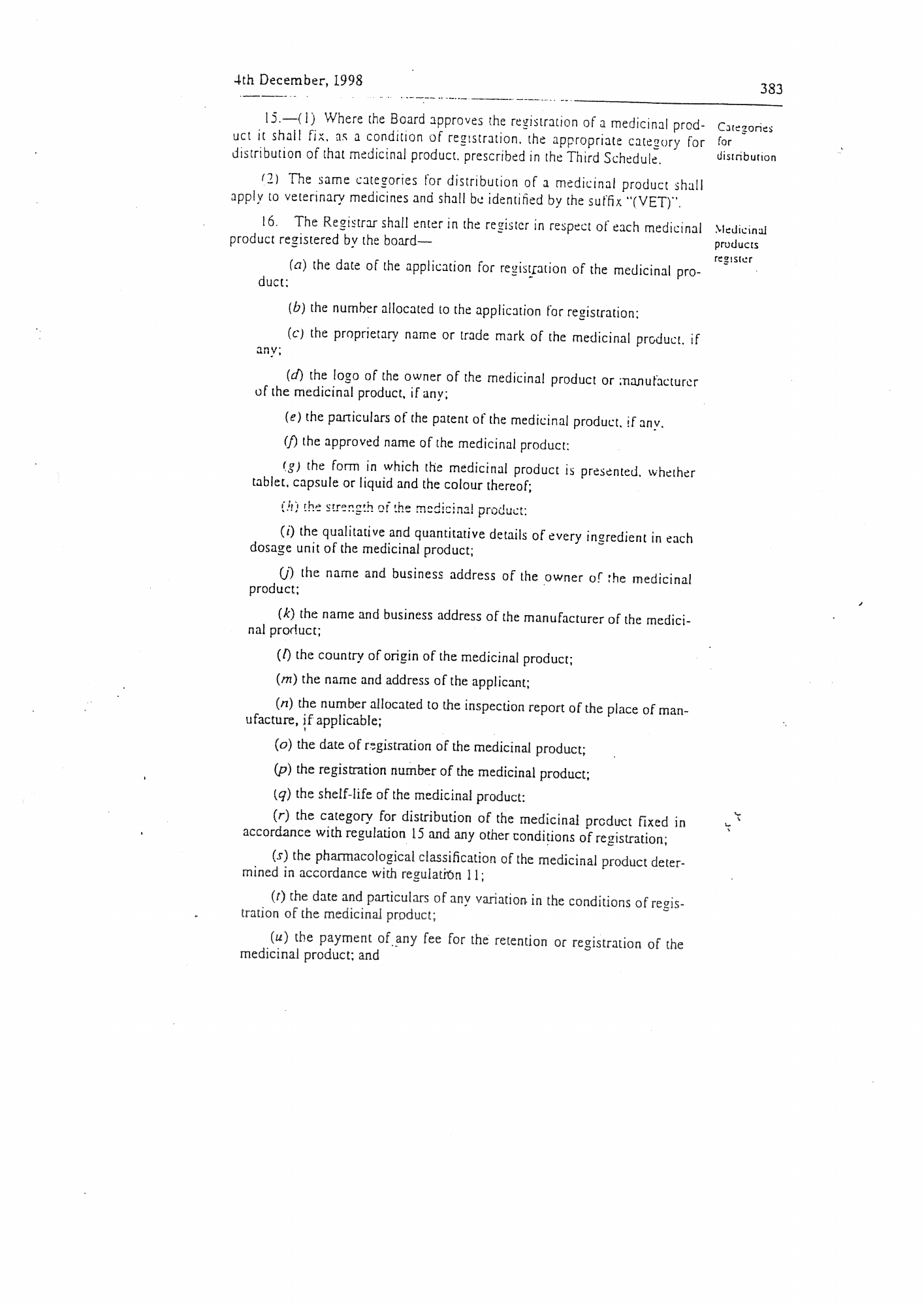
15.—(1) Where the Board approves the registration of a medicinal product it shall fix, as a condition of registration, the appropriate category for distribution of that medicinal product, prescribed in the Third Schedule.
(2) The same categories for distribution of a medicinal product shall apply to veterinary medicines and shall be identified by the suffix “(VET)”.
Medicinal products register
16. The Registrar shall enter in the register in respect of each medicinal product registered by the board—
(a) the date of the application for registration of the medicinal product;
(b) the number allocated to the application for registration;
(c) the proprietary name or trade mark of the medicinal product, if any;
(d) the logo of the owner of the medicinal product or manufacturer of the medicinal product, if any;
(e) the particulars of the patent of the medicinal product, if any;
(f) the approved name of the medicinal product;
(g) the form in which the medicinal product is presented, whether tablet, capsule or liquid and the colour thereof;
(h) the strength of the medicinal product;
(i) the qualitative and quantitative details of every ingredient in each dosage unit of the medicinal product;
(j) the name and business address of the owner of the medicinal product;
(k) the name and business address of the manufacturer of the medicinal product;
(l) the country of origin of the medicinal product;
(m) the name and address of the applicant;
(n) the number allocated to the inspection report of the place of manufacture, if applicable;
(o) the date of registration of the medicinal product;
(p) the registration number of the medicinal product;
(q) the shelf-life of the medicinal product;
(r) the category for distribution of the medicinal product fixed in accordance with regulation 15 and any other conditions of registration;
(s) the pharmacological classification of the medicinal product determined in accordance with regulation 11;
(t) the date and particulars of any variation in the conditions of registration of the medicinal product;
(u) the payment of any fee for the retention or registration of the medicinal product; and
Government Notice 88 of 1998 — official PDF page 9; original table columns, symbols and diagram connections
384 4th December, 1998
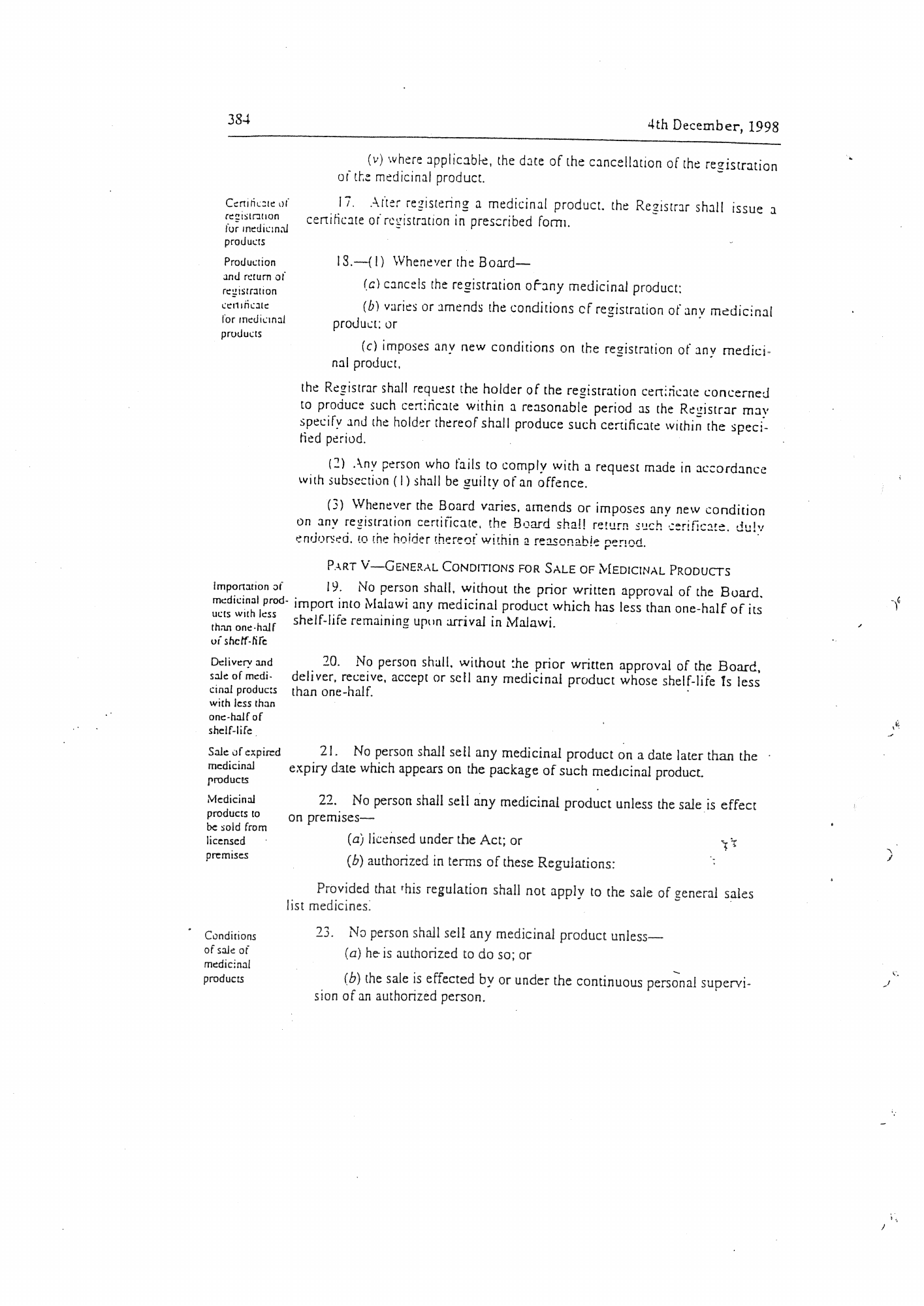
(v) where applicable, the date of the cancellation of the registration of the medicinal product.
Certificate of registration for medicinal products
17. After registering a medicinal product, the Registrar shall issue a certificate of registration in prescribed form.
Production and return of registration certificate for medicinal products
18.—(1) Whenever the Board—
(a) cancels the registration of any medicinal product;
(b) varies or amends the conditions of registration of any medicinal product; or
(c) imposes any new conditions on the registration of any medicinal product,
the Registrar shall request the holder of the registration certificate concerned to produce such certificate within a reasonable period as the Registrar may specify and the holder thereof shall produce such certificate within the specified period.
(2) Any person who fails to comply with a request made in accordance with subsection (1) shall be guilty of an offence.
(3) Whenever the Board varies, amends or imposes any new condition on any registration certificate, the Board shall return such certificate, duly endorsed, to the holder thereof within a reasonable period.
PART V—GENERAL CONDITIONS FOR SALE OF MEDICINAL PRODUCTS
Importation of medicinal products with less than one-half of shelf-life
19. No person shall, without the prior written approval of the Board, import into Malawi any medicinal product which has less than one-half of its shelf-life remaining upon arrival in Malawi.
Delivery and sale of medicinal products with less than one-half of shelf-life
20. No person shall, without the prior written approval of the Board, deliver, receive, accept or sell any medicinal product whose shelf-life is less than one-half.
Sale of expired medicinal products
21. No person shall sell any medicinal product on a date later than the expiry date which appears on the package of such medicinal product.
Medicinal products to be sold from licensed premises
22. No person shall sell any medicinal product unless the sale is effect on premises—
(a) licensed under the Act; or
(b) authorized in terms of these Regulations:
Provided that this regulation shall not apply to the sale of general sales list medicines.
Conditions of sale of medicinal products
23. No person shall sell any medicinal product unless—
(a) he is authorized to do so; or
(b) the sale is effected by or under the continuous personal supervision of an authorized person.
Government Notice 88 of 1998 — official PDF page 10; original table columns, symbols and diagram connections
4th December, 1998 385
Disclosure of composition of medicinal product
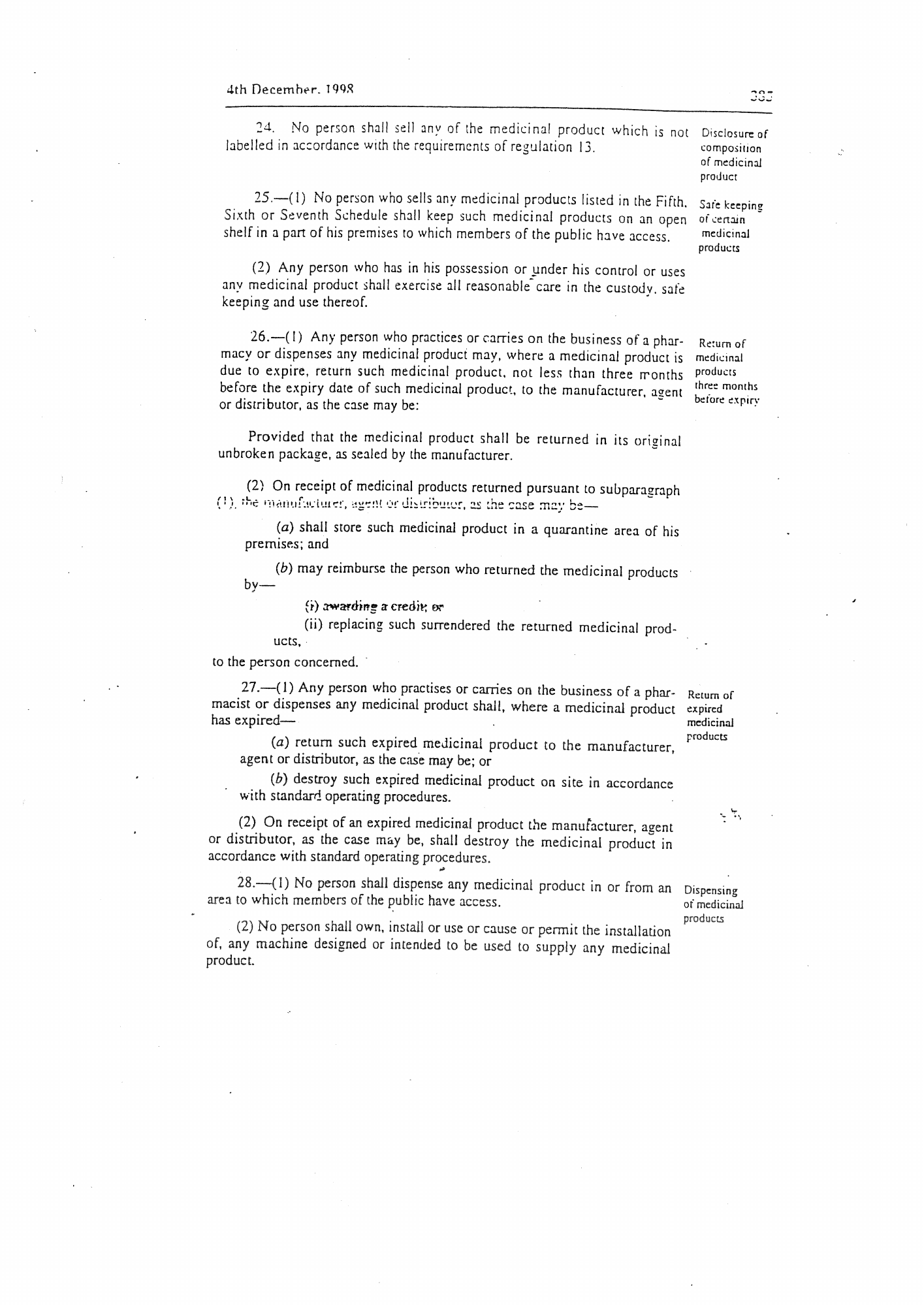
24. No person shall sell any of the medicinal product which is not labelled in accordance with the requirements of regulation 13.
Safe keeping of certain medicinal products
25.—(1) No person who sells any medicinal products listed in the Fifth, Sixth or Seventh Schedule shall keep such medicinal products on an open shelf in a part of his premises to which members of the public have access.
(2) Any person who has in his possession or under his control or uses any medicinal product shall exercise all reasonable care in the custody, safe keeping and use thereof.
Return of medicinal products three months before expiry
26.—(1) Any person who practices or carries on the business of a pharmacy or dispenses any medicinal product may, where a medicinal product is due to expire, return such medicinal product, not less than three months before the expiry date of such medicinal product, to the manufacturer, agent or distributor, as the case may be:
Provided that the medicinal product shall be returned in its original unbroken package, as sealed by the manufacturer.
(2) On receipt of medicinal products returned pursuant to subparagraph (1), the manufacturer, agent or distributor, as the case may be—
(a) shall store such medicinal product in a quarantine area of his premises; and
(b) may reimburse the person who returned the medicinal products by—
(i) awarding a credit; or
(ii) replacing such surrendered the returned medicinal products,
to the person concerned.
Return of expired medicinal products
27.—(1) Any person who practises or carries on the business of a pharmacist or dispenses any medicinal product shall, where a medicinal product has expired—
(a) return such expired medicinal product to the manufacturer, agent or distributor, as the case may be; or
(b) destroy such expired medicinal product on site in accordance with standard operating procedures.
(2) On receipt of an expired medicinal product the manufacturer, agent or distributor, as the case may be, shall destroy the medicinal product in accordance with standard operating procedures.
Dispensing of medicinal products
28.—(1) No person shall dispense any medicinal product in or from an area to which members of the public have access.
(2) No person shall own, install or use or cause or permit the installation of, any machine designed or intended to be used to supply any medicinal product.
Government Notice 88 of 1998 — official PDF page 11; original table columns, symbols and diagram connections
386 4th December, 1998
Labels for dispensed prescription only medicinal products
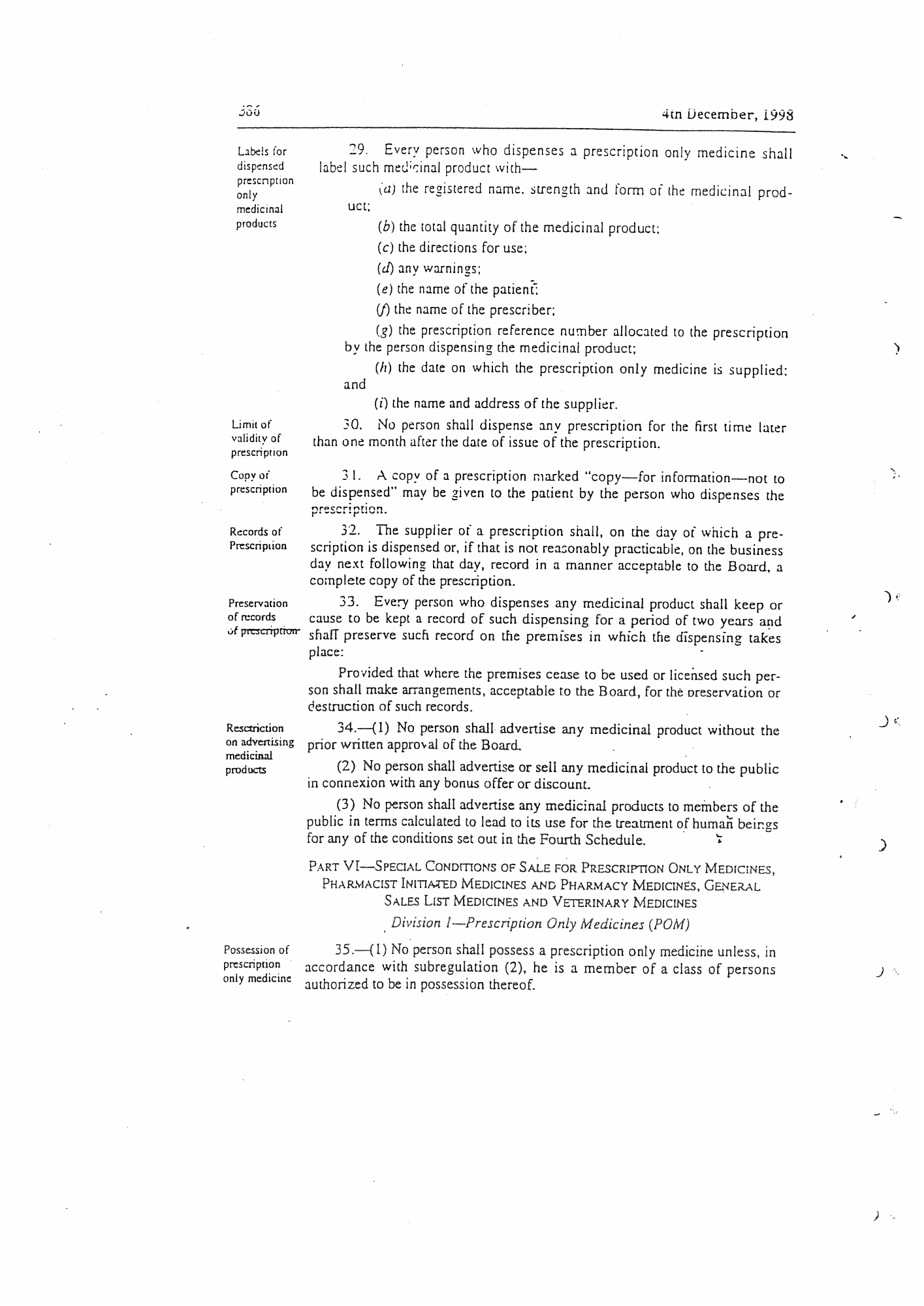
29. Every person who dispenses a prescription only medicine shall label such medicinal product with—
(a) the registered name, strength and form of the medicinal product;
(b) the total quantity of the medicinal product;
(c) the directions for use;
(d) any warnings;
(e) the name of the patient;
(f) the name of the prescriber;
(g) the prescription reference number allocated to the prescription by the person dispensing the medicinal product;
(h) the date on which the prescription only medicine is supplied; and
(i) the name and address of the supplier.
Limit of validity of prescription
30. No person shall dispense any prescription for the first time later than one month after the date of issue of the prescription.
Copy of prescription
31. A copy of a prescription marked “copy—for information—not to be dispensed” may be given to the patient by the person who dispenses the prescription.
Records of Prescription
32. The supplier of a prescription shall, on the day of which a prescription is dispensed or, if that is not reasonably practicable, on the business day next following that day, record in a manner acceptable to the Board, a complete copy of the prescription.
Preservation of records of prescription
33. Every person who dispenses any medicinal product shall keep or cause to be kept a record of such dispensing for a period of two years and shall preserve such record on the premises in which the dispensing takes place:
Provided that where the premises cease to be used or licensed such person shall make arrangements, acceptable to the Board, for the preservation or destruction of such records.
Restriction on advertising medicinal products
34.—(1) No person shall advertise any medicinal product without the prior written approval of the Board.
(2) No person shall advertise or sell any medicinal product to the public in connexion with any bonus offer or discount.
(3) No person shall advertise any medicinal products to members of the public in terms calculated to lead to its use for the treatment of human beings for any of the conditions set out in the Fourth Schedule.
PART VI—SPECIAL CONDITIONS OF SALE FOR PRESCRIPTION ONLY MEDICINES, PHARMACIST INITIATED MEDICINES AND PHARMACY MEDICINES, GENERAL SALES LIST MEDICINES AND VETERINARY MEDICINES
Division 1—Prescription Only Medicines (POM)
Possession of prescription only medicine
35.—(1) No person shall possess a prescription only medicine unless, in accordance with subregulation (2), he is a member of a class of persons authorized to be in possession thereof.
Government Notice 88 of 1998 — official PDF page 12; original table columns, symbols and diagram connections
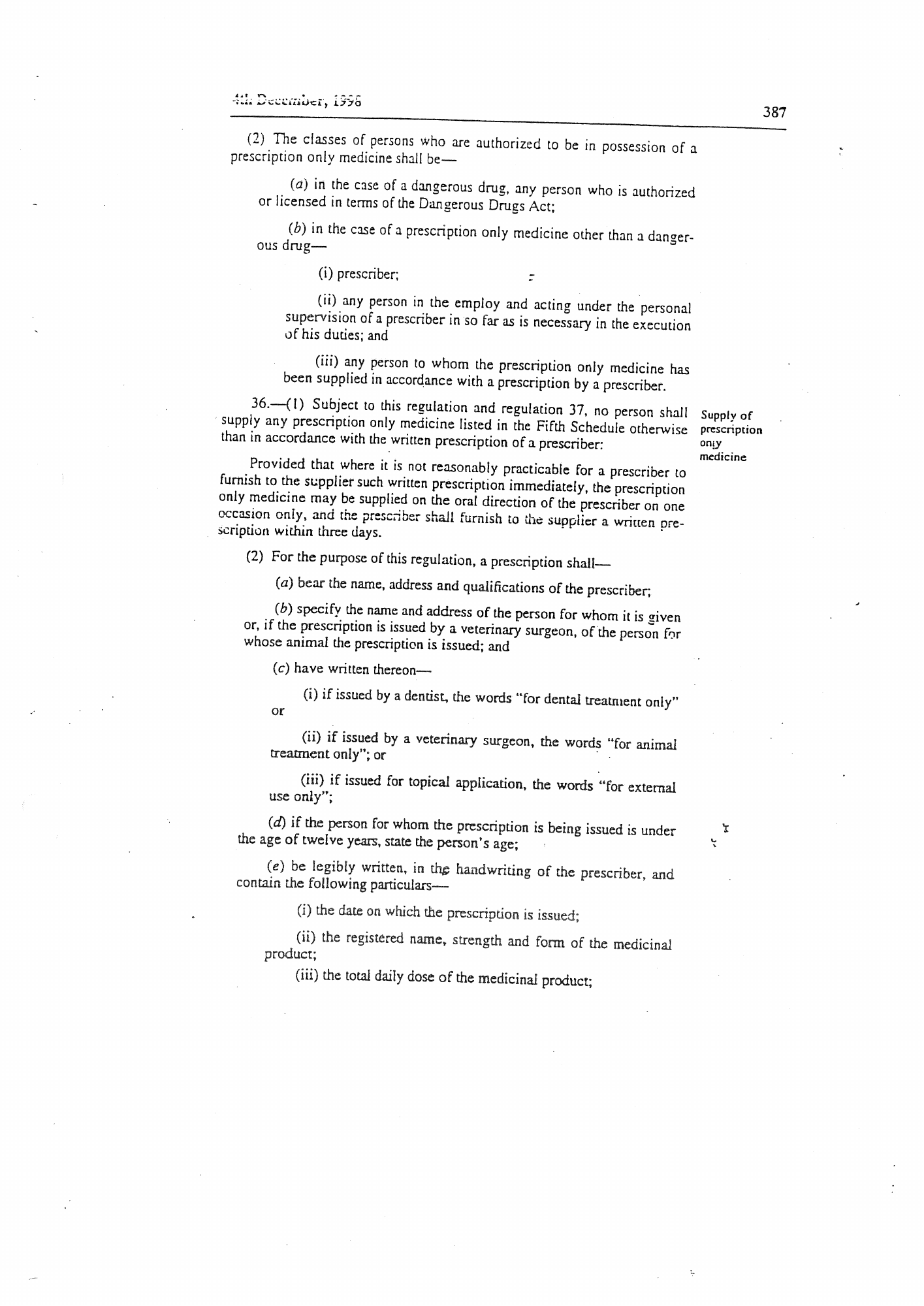
4th December, 1998 387
(2) The classes of persons who are authorized to be in possession of a prescription only medicine shall be—
(a) in the case of a dangerous drug, any person who is authorized or licensed in terms of the Dangerous Drugs Act;
(b) in the case of a prescription only medicine other than a dangerous drug—
(i) prescriber;
(ii) any person in the employ and acting under the personal supervision of a prescriber in so far as is necessary in the execution of his duties; and
(iii) any person to whom the prescription only medicine has been supplied in accordance with a prescription by a prescriber.
Supply of prescription only medicine
36.—(1) Subject to this regulation and regulation 37, no person shall supply any prescription only medicine listed in the Fifth Schedule otherwise than in accordance with the written prescription of a prescriber:
Provided that where it is not reasonably practicable for a prescriber to furnish to the supplier such written prescription immediately, the prescription only medicine may be supplied on the oral direction of the prescriber on one occasion only, and the prescriber shall furnish to the supplier a written prescription within three days.
(2) For the purpose of this regulation, a prescription shall—
(a) bear the name, address and qualifications of the prescriber;
(b) specify the name and address of the person for whom it is given or, if the prescription is issued by a veterinary surgeon, of the person for whose animal the prescription is issued; and
(c) have written thereon—
(i) if issued by a dentist, the words “for dental treatment only” or
(ii) if issued by a veterinary surgeon, the words “for animal treatment only”; or
(iii) if issued for topical application, the words “for external use only”;
(d) if the person for whom the prescription is being issued is under the age of twelve years, state the person’s age;
(e) be legibly written, in the handwriting of the prescriber, and contain the following particulars—
(i) the date on which the prescription is issued;
(ii) the registered name, strength and form of the medicinal product;
(iii) the total daily dose of the medicinal product;
Government Notice 88 of 1998 — official PDF page 13; original table columns, symbols and diagram connections
388 4th December, 1998
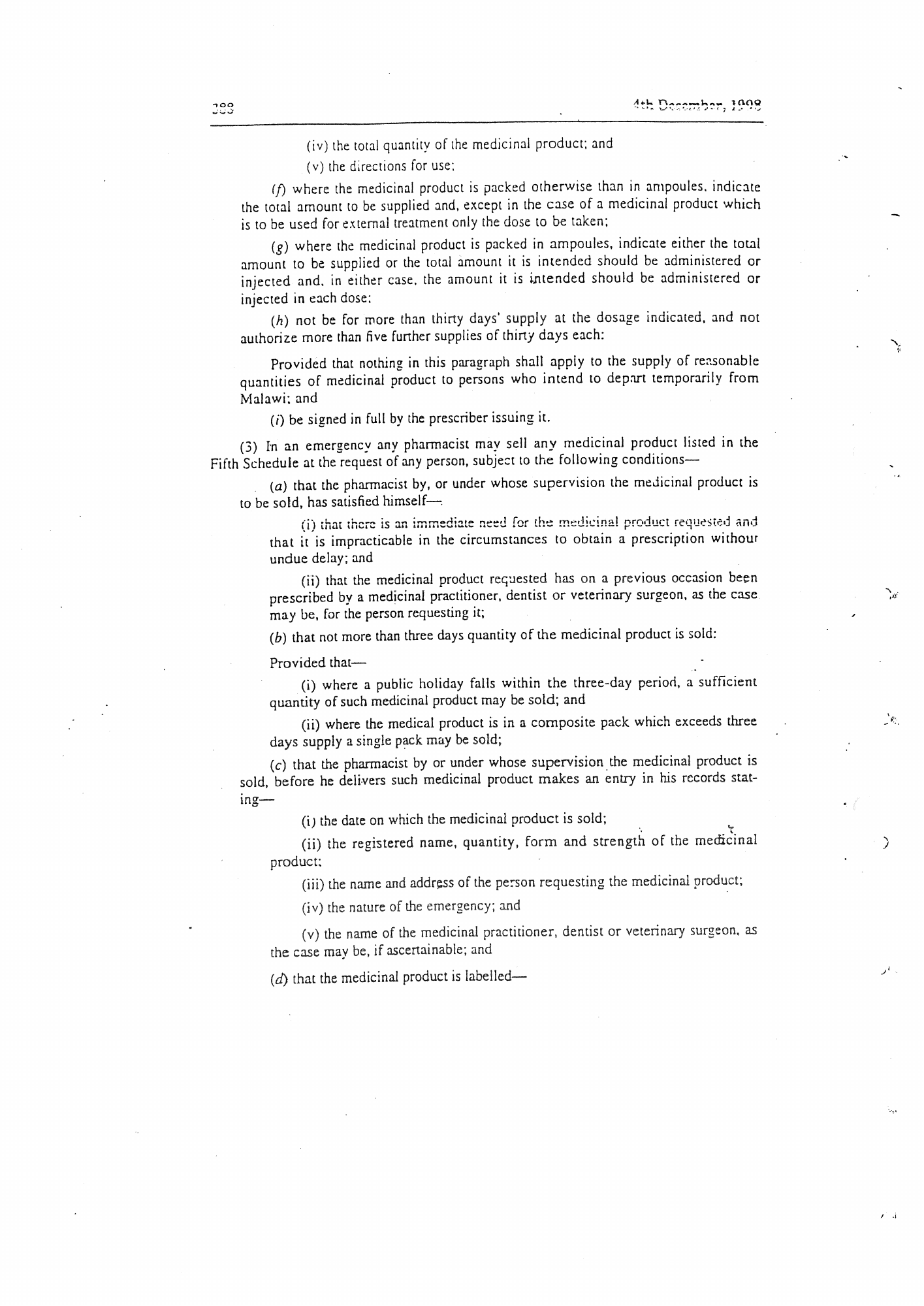
(iv) the total quantity of the medicinal product; and
(v) the directions for use;
(f) where the medicinal product is packed otherwise than in ampoules, indicate the total amount to be supplied and, except in the case of a medicinal product which is to be used for external treatment only the dose to be taken;
(g) where the medicinal product is packed in ampoules, indicate either the total amount to be supplied or the total amount it is intended should be administered or injected and, in either case, the amount it is intended should be administered or injected in each dose;
(h) not be for more than thirty days’ supply at the dosage indicated, and not authorize more than five further supplies of thirty days each:
Provided that nothing in this paragraph shall apply to the supply of reasonable quantities of medicinal product to persons who intend to depart temporarily from Malawi: and
(i) be signed in full by the prescriber issuing it.
(3) In an emergency any pharmacist may sell any medicinal product listed in the Fifth Schedule at the request of any person, subject to the following conditions—
(a) that the pharmacist by, or under whose supervision the medicinal product is to be sold, has satisfied himself—
(i) that there is an immediate need for the medicinal product requested and that it is impracticable in the circumstances to obtain a prescription without undue delay; and
(ii) that the medicinal product requested has on a previous occasion been prescribed by a medicinal practitioner, dentist or veterinary surgeon, as the case may be, for the person requesting it;
(b) that not more than three days quantity of the medicinal product is sold:
Provided that—
(i) where a public holiday falls within the three-day period, a sufficient quantity of such medicinal product may be sold; and
(ii) where the medical product is in a composite pack which exceeds three days supply a single pack may be sold;
(c) that the pharmacist by or under whose supervision the medicinal product is sold, before he delivers such medicinal product makes an entry in his records stating—
(i) the date on which the medicinal product is sold;
(ii) the registered name, quantity, form and strength of the medicinal product;
(iii) the name and address of the person requesting the medicinal product;
(iv) the nature of the emergency; and
(v) the name of the medicinal practitioner, dentist or veterinary surgeon, as the case may be, if ascertainable; and
(d) that the medicinal product is labelled—
Government Notice 88 of 1998 — official PDF page 14; original table columns, symbols and diagram connections
4th December, 1998 389
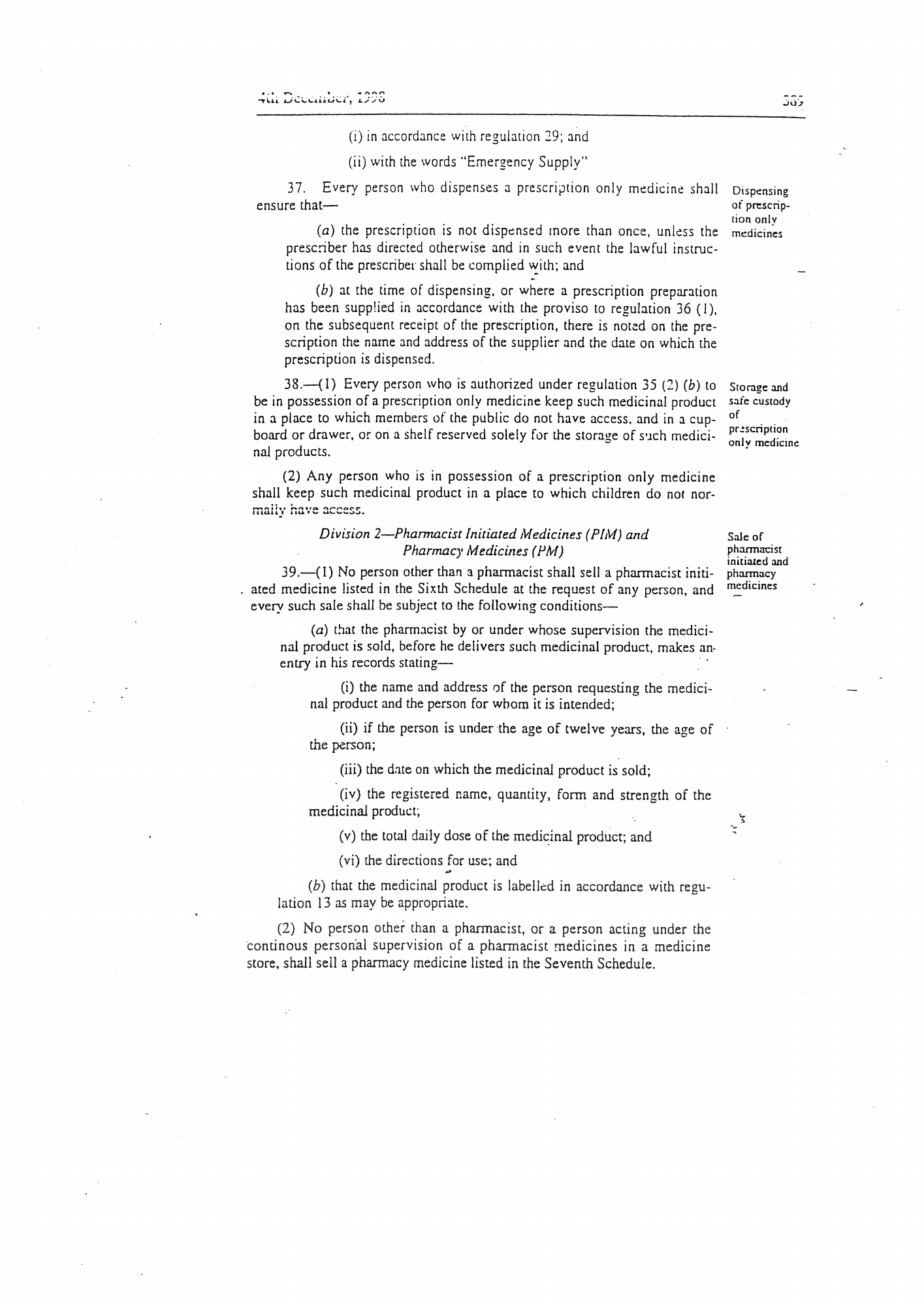
(i) in accordance with regulation 29; and
(ii) with the words “Emergency Supply”
Dispensing of prescription only medicines
37. Every person who dispenses a prescription only medicine shall ensure that—
(a) the prescription is not dispensed more than once, unless the prescriber has directed otherwise and in such event the lawful instructions of the prescriber shall be complied with; and
(b) at the time of dispensing, or where a prescription preparation has been supplied in accordance with the proviso to regulation 36 (1), on the subsequent receipt of the prescription, there is noted on the prescription the name and address of the supplier and the date on which the prescription is dispensed.
Storage and safe custody of prescription only medicine
38.—(1) Every person who is authorized under regulation 35 (2) (b) to be in possession of a prescription only medicine keep such medicinal product in a place to which members of the public do not have access, and in a cupboard or drawer, or on a shelf reserved solely for the storage of such medicinal products.
(2) Any person who is in possession of a prescription only medicine shall keep such medicinal product in a place to which children do not normally have access.
Division 2—Pharmacist Initiated Medicines (PIM) and Pharmacy Medicines (PM)
Sale of pharmacist initiated and pharmacy medicines
39.—(1) No person other than a pharmacist shall sell a pharmacist initiated medicine listed in the Sixth Schedule at the request of any person, and every such sale shall be subject to the following conditions—
(a) that the pharmacist by or under whose supervision the medicinal product is sold, before he delivers such medicinal product, makes an entry in his records stating—
(i) the name and address of the person requesting the medicinal product and the person for whom it is intended;
(ii) if the person is under the age of twelve years, the age of the person;
(iii) the date on which the medicinal product is sold;
(iv) the registered name, quantity, form and strength of the medicinal product;
(v) the total daily dose of the medicinal product; and
(vi) the directions for use; and
(b) that the medicinal product is labelled in accordance with regulation 13 as may be appropriate.
(2) No person other than a pharmacist, or a person acting under the continous personal supervision of a pharmacist medicines in a medicine store, shall sell a pharmacy medicine listed in the Seventh Schedule.
Government Notice 88 of 1998 — official PDF page 15; original table columns, symbols and diagram connections
390 4th December, 1998
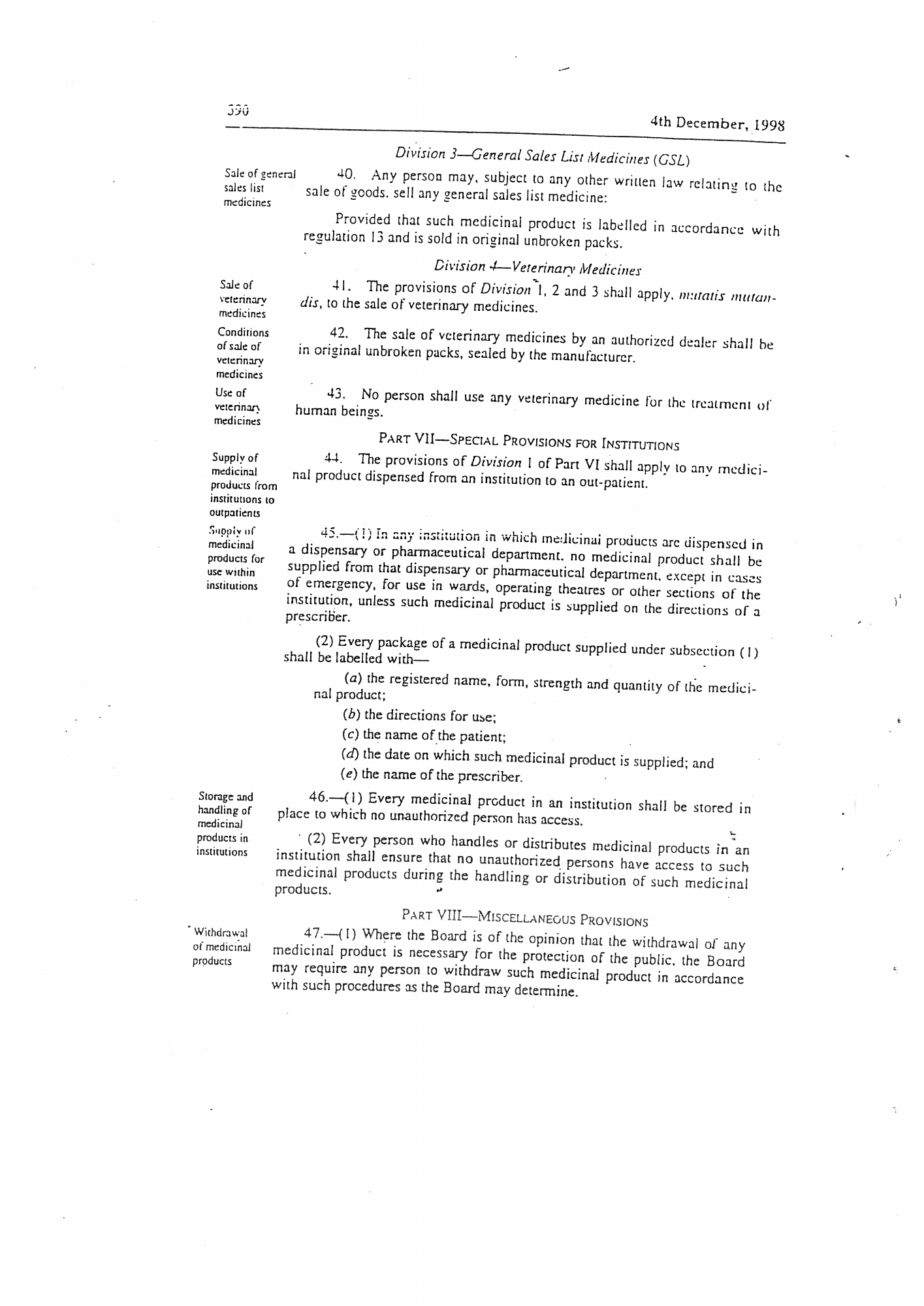
Division 3—General Sales List Medicines (GSL)
Sale of general sales list medicines
40. Any person may, subject to any other written law relating to the sale of goods, sell any general sales list medicine:
Provided that such medicinal product is labelled in accordance with regulation 13 and is sold in original unbroken packs.
Division 4—Veterinary Medicines
Sale of veterinary medicines
41. The provisions of Division 1, 2 and 3 shall apply, mutatis mutandis, to the sale of veterinary medicines.
Conditions of sale of veterinary medicines
42. The sale of veterinary medicines by an authorized dealer shall be in original unbroken packs, sealed by the manufacturer.
Use of veterinary medicines
43. No person shall use any veterinary medicine for the treatment of human beings.
PART VII—SPECIAL PROVISIONS FOR INSTITUTIONS
Supply of medicinal products from institutions to outpatients
44. The provisions of Division 1 of Part VI shall apply to any medicinal product dispensed from an institution to an out-patient.
Supply of medicinal products for use within institutions
45.—(1) In any institution in which medicinal products are dispensed in a dispensary or pharmaceutical department, no medicinal product shall be supplied from that dispensary or pharmaceutical department, except in cases of emergency, for use in wards, operating theatres or other sections of the institution, unless such medicinal product is supplied on the directions of a prescriber.
(2) Every package of a medicinal product supplied under subsection (1) shall be labelled with—
(a) the registered name, form, strength and quantity of the medicinal product;
(b) the directions for use;
(c) the name of the patient;
(d) the date on which such medicinal product is supplied; and
(e) the name of the prescriber.
Storage and handling of medicinal products in institutions
46.—(1) Every medicinal product in an institution shall be stored in place to which no unauthorized person has access.
(2) Every person who handles or distributes medicinal products in an institution shall ensure that no unauthorized persons have access to such medicinal products during the handling or distribution of such medicinal products.
PART VIII—MISCELLANEOUS PROVISIONS
Withdrawal of medicinal products
47.—(1) Where the Board is of the opinion that the withdrawal of any medicinal product is necessary for the protection of the public, the Board may require any person to withdraw such medicinal product in accordance with such procedures as the Board may determine.
Government Notice 88 of 1998 — official PDF page 16; original table columns, symbols and diagram connections
4th December, 1998 391
(2) Every person who is in possession of a medicinal product required to be withdrawn under subregulation (1) shall comply with the procedure for the withdrawal of such medicinal product as determined by the Board.
Report of loss or theft of medicinal products
48. Any person, other than a person to whom a prescription preparation is lawfully dispensed, who is in possession of any medicinal product and who misplaces or loses such medicinal product or from whom such medicinal product is stolen, shall report such loss or theft, as the case may be, to a police officer and to the Registrar as soon as is reasonably practicable, and in any case within twenty-four hours of the occurrence of the loss or theft.
Disposal of existing stocks of prohibited medicinal products
49. If at any time any medicinal product becomes prohibited any person other than a person to whom a medicinal product is lawfully dispensed who is in possession of such medicinal product at the time shall inform the Board of his possession, and shall dispose of such medicinal product in such manner as the Board may direct.
Availability of Act and regulations
50. A copy of the Act and these Regulations shall be available at all premises licensed under the Act.
FIRST SCHEDULE
PART I—MINIMUM REQUIREMENTS FOR PREMISES USED FOR MANUFACTURING PHARMACY BUSINESS
1. Premises
1.1 Premises should be sited to avoid contamination from the external environment or from other nearby activities and in existing premises, effective measures should be taken to avoid such contamination.
1.2 Animal houses should be well isolated from manufacturing areas.
1.3 Premises should be constructed and maintained so as to be protected against weather, ground seepage and the entrance and harbouring of vermin, birds and pests.
1.4 Premises should be designed and laid-out in such a way that the risk of mix-up or contamination of one product or material by another is minimized. This especially applies to premises for the handling of highly toxic or sensitizing materials such as hormones, cytotoxic agents and antibiotics.
1.5 Protection from the weather should be provided for receiving and despatch areas and for materials and products in transit.
1.6 Premises should be maintained in a good state of repair. The condition of buildings should be reviewed regularly and repairs effected where necessary. Special care should be exercised to ensure that buildings and repair or maintenance operations do not hazard products.
1.7 Premises should have sufficient space to suit the operations to be carried out, allow an efficient flow of work, and permit effective communication and supervision.
1.8 The processing of materials for non-medicinal use should be separated from the processing of medicinal products.
Government Notice 88 of 1998 — official PDF page 17; original table columns, symbols and diagram connections
392 4th December, 1998
1.9 Cloakrooms should be separate form, or partitioned from processing areas. Toilets should be well ventilated and should not open directly to manufacturing areas.
1.10 Premises in which medicinal products are manufactured or stored should be made secure, with access restricted to authorized personnel.
1.11 Floors in processing areas should be made of impervious materials, laid on an even surface, free from cracks and open joints, and should allow prompt and efficient removal of any spillages. Walls should be sound and finished with a smooth, impervious and washable surface. Ceilings should be so constructed and finished that they can be maintained in a clean condition.
1.12 Pipework, light fittings, ventilation points and other services in manufacturing areas should be sited to avoid the creation of uncleanable recesses; and should be sealed into any walls and partitions through, which they pass service should preferably be run outside the processing areas.
1.13 Drains should be of adequate size, and should have trapped gullies and proper ventilation. Open channels should be avoided where possible, but if they are necessary, they should be shallow to facilitate cleaning and disinfection.
1.14 Buildings should be effectively lit and properly ventilated, with air control facilities including temperature, humidity and filtration facilities appropriate both to the operations undertaken within them and to the external environment.
1.15 Air intakes and exhausts, and associate pipework and trucking should be sited to avoid product contamination hazards.
1.16 Manufacturing areas should not be used as a general right of way for personnel or except of materials used in the manufacturing process, for storage of materials.
1.17 All premises, including processing areas, laboratories, stores, passage ways, external surroundings should be maintained in a clean and tidy condition.
1.18 Waste material should not be allowed to accumulate but should be collected in suitable receptacles for removal to collection points outside the building, and disposed of at regular and frequent intervals. Special care is necessary over the disposal of waste containing dangerous, highly toxic or sensitizing materials such as hormones, cytotoxic agents, sensitizing antibiotics. Disposal of raw materials, printed packing materials and rejected products should be carefully controlled and documented.
1.19 There should be made available written cleaning procedures and schedules for manufacturing and storage areas.
1.20 Adequate space, preferably separated from processing areas, should be provided for cleaning and storing equipment, and the storage of cleaning materials.
2. Storage areas
2.1 Storage areas should be designed, laid-out and be of sufficient capacity to permit effective and orderly segregation of the various categories of material stored and allow rotation of stock.
2.2 Segregated storage should be provided for rejected, recalled, expired or returned goods. Where the maintenance quarantine status depends upon storage in separate areas, such areas should be provided with restricted access.
Government Notice 88 of 1998 — official PDF page 18; original table columns, symbols and diagram connections
4th December, 1998 393
2.3 Labels and other printed packaging materials, including labels for starting materials and for bulk and intermediate products, should be stored in a secure manner that will permit issue only to authorized person in accordance with formal documented procedures. Storage arrangements should permit separation of different labels and other printed materials and avoidance of mix-up.
2.4 Goods should be stored off the floor. Provision should be made for shelving, racking and pelleting and in a manner that will permit easy cleaning and the use of pest control agents by trained personnel without risk of contamination.
2.5 All goods should be stored under cover.
2.6 All materials containers should be clean before they are admitted to stores and checked again for cleanliness before issued to manufacturing areas.
2.7 Where special storage conditions such as temperature, humidity and security are required, these should be provided, checked and monitored.
3. Equipment
3.1 Equipment should be designed and located to suit the process and products for which it is to be used. Equipment should be maintained so as to be fit to perform contemplated functions and present no hazard to the product and personnel.
3.2 Manufacturing equipment should be easily and conveniently cleanable, both inside and outside. There should be available written instructions for cleaning of equipment and suitable cleaning facilities should be provided.
3.3 Equipment should not be a hazard to products through leaking joints, lubricant drips, or through inappropriate modifications or adaptations.
3.4 Equipment used for weighing, measuring, testing and recording should be subject to regular recorded checks for accuracy and working order, in accordance with a written planned maintenance schedule.
4. Qualifications of personnel
4.1 The key personnel are the person responsible for production and the person responsible for quality control, who should be different persons, neither of whom should be responsible to the other, but who should both have a responsibility for achieving the requisite quality.
4.2 Manufacturing operations shall be carried out under the supervision of a registered pharmacist with adequate relevant post graduate training with the support of suitably qualified personnel such as a pharmacy technologist or pharmacy assistant.
4.3 All quality control operations shall be carried out under the supervision of an appropriately trained pharmacist or chemist with relevant post graduate training with the support of suitably qualified personnel such as pharmacy technologist, laboratory technologist or chemist.
4.4 All manufacturing and quality control processes should be done in accordance with Good Manufacturing Practices (GMP) as approved by Board.
Government Notice 88 of 1998 — official PDF page 19; original table columns, symbols and diagram connections
394 4th December, 1998
PART II—MINIMUM REQUIREMENTS FOR PREMISES FOR WHOLESALE PHARMACY BUSINESS
(reg. 5)
1. Premises and equipment
1.1 Premises should be sited to avoid contamination from the external environment or from the nearby activities and in existing premises, effective measures should be taken to avoid such contamination.
1.2 Premises should be constructed and maintained so as to be protected against weather, ground seepage and the entrance and harbouring of vermin, birds, pests and pets.
1.3 Protection from the weather should be provided for receiving and despatching areas and for materials and products in transit.
1.4 Premises should be maintained in good state of repair. The condition of buildings should be reviewed regularly, and repairs effected where necessary. Special care should be exercised to ensure that buildings, repair and maintenance operations do not hazard products.
1.5 Premises should provide sufficient space to suit the operations to be carried out, allow an efficient flow of work, and permit effective communication and supervision.
1.6 Cloakrooms should be separate from or partitioned from processing areas. Toilets should be well ventilated and should not open directly to storage areas.
1.7 Premises in which medicinal products are stored should be secure, with access restricted to authorized personnel.
1.8 Floors in processing areas should be made of impervious materials, laid on an even surface, free from cracks and open joints and should allow prompt and efficient removal of any spillages. Walls should be sound and finished with a smooth, impervious and washable surface. Ceilings should be so constructed and finished that they can be maintained in a clean condition.
1.9 Buildings should be effectively lit and properly ventilated, with air control facilities including temperature and humidity appropriate both to operations undertaken within them and to the external environment.
1.10 All premises, including processing areas, stores, passage ways and external surroundings, should be maintained in a clean and tidy condition.
1.11 Waste material should not be allowed to accumulate, but it should be collected in suitable receptacles for removal to collection points outside the building and disposed of at regular and frequent intervals. Special care is necessary over the disposal of waste containing dangerous, highly toxic or sensitizing materials such as hormones, cytotoxic agents, sensitizing antibiotics.
1.12 Segregated storage should be provided for rejected, expired or returned goods.
1.13 Goods should be stored off the floor. Provision should be made for shelving, racking and pelleting, and in a manner that will permit easy cleaning and the use of pest control agents by trained personnel without risk of contamination.
Government Notice 88 of 1998 — official PDF page 20; original table columns, symbols and diagram connections
4th December, 1998 395
1.14 Where special storage conditions such as temperature, humidity and security are required; these should be provided, and checked and monitored regularly. In particular, controlled temperature environments should be equipped with temperature recorders.
1.15 Van selling should be restricted to items on the general sales list.
2. Qualifications of personnel
2.1 Wholesale operations shall be carried out under the direct full time supervision of a registered pharmacist, with the support of a suitably qualified personnel such as a pharmacy assistant or pharmacy technologist, who shall be responsible for the funding, procurement, clearing, receipting, storage, distribution and documentation relating to medicinal products.
2.2 The services of a locum may be used.
3. Records
3.1 Adequate records shall be maintained for—
(a) receipts source, quantity, expiry dates and batch number of medicinal products;
(b) sales (source, quantity, expiry dates and batch number of medicinal products) despatches shall be countersigned by a pharmacist. Orders shall be signed by authorized persons known to the wholesaling unit;
(c) stock (balances) of each batch and consignment;
(d) disposal of rejected or/expired products and records shall be kept for a minimum period of 2 years. All expired products must be notified to the Board when destroyed plus method of destruction used.
PART III—MINIMUM REQUIRMENTS FOR PREMISES USED FOR RETAIL PHARMACY BUSINESS
(reg. 5)
1. Premises
1.1 Premises shall be constructed and maintained so as to be protected against weather, ground seepage and the entrance and harbouring of vermin, pest and pets.
1.2 Premises should be maintained in a good state of repair. The condition of buildings should be reviewed regularly, and repairs effected where necessary. Special care should be exercised to ensure that buildings, and repair or maintenance operations do not hazard products.
1.3 Premises should provide sufficient space to suit the operations to be carried out, allow an efficient flow of work, and permit effective communication and supervision.
1.4 Toilets should be well ventilated and should not open directly to storage areas.
1.5 Floors should be made of impervious materials, laid to an even surface, and should be free from cracks and open joints. If not carpeted floors should have tiles to facilitate easy cleaning. Walls should be sound and finished with a smooth, impervious and washable surface. Ceilings should be so constructed and finished that they can be maintained in a clean condition.
Government Notice 88 of 1998 — official PDF page 21; original table columns, symbols and diagram connections
396 4th December, 1998
1.6 Buildings should be effectively lit and properly ventilated with air control facilities.
1.7 All premises, including stores, passage ways and external surroundings, should be maintained in a clean and tidy condition.
1.8 Premises in which midicinal products are stored should be made secure, with access restricted to authorized personnel.
1.9 Waste material should not be allowed to accumulate, but it should be collected in suitable receptacles for removal to collection points outside the building and disposed of at regular and frequent intervals.
1.10 The dispensary should be separate and independent from other operations, and should be locked when the pharmacist is not present. The dispensary should have running water (cold and warm) and adequate working and cleaning benches with formica tops and adequate shelving.
1.11 The dispensary and consulting room should be elevated overlooking pharmacy and medicine counter.
2. Equipment and reference books
2.1 A Pharmacy shall, where relevant, have measuring cylinders, a stirring rod, counting trays, balance, fridge, a fixed lockable DDA cupboard, current edition of Martingale and other books such as British National Formulary (BNF),United States Pharmacopoela (USP) and Malawi National Formulary (MNF).
3. Records
3.1 Patient profile cards should be kept where possible.
3.2 Prescriptions should be kept for a minimum period of two years and should be numbered and filed chronologically.
3.3 Record of receipts with expiry dates and Lot. No. should be kept for a minimum of two years.
4. Labelling
4.1 Labelling of dispensed medicine products should include—
(a) name of patient;
(b) name of medicine, its strength and quantity dispensed;
(c) directions for use;
(d) date of dispensing; and
(e) name of pharmacy or dispensing unit.
The Pharmacist shall communicate to the patient any other pertinent information.
5. Prescription
5.1 A presciption should have—
(a) name of patient;
(b) name of medicine, its strength and quantity dispensed;
(c) directions for use; and
(d) signature, date and address of the prescriber.
Government Notice 88 of 1998 — official PDF page 22; original table columns, symbols and diagram connections
4th December, 1998 397
5.2 A prescription should be checked and endorsed after dispensing.
6. Personnel
6.1 A retail pharmacy should be under the direct supervision of a full-time registered pharmacist assisted by appropriately trained personnel approved by the Board.
PART IV—MINIMUM REQUIREMENTS FOR REGISTERED DESIPENSING PRACTITIONER
(reg. 5)
1. Dispensary layout
1.1 Dispensary shall be separated from the clinical areas.
1.2 Dispensary should be maintained in good state of repair. The general condition of the building should be reviewed regularly and repairs effected where necessary.
1.3 Dispensary should be clean and tidy at all times.
1.4 Floors and walls should be free from cracks and made of impervious material for easy cleaning.
1.5 Dispensary should be effectively lit and properly ventilated.
1.6 Dispensary should be made adequately secure with no access to unauthorized persons.
1.7 Dispensary should have running water (cold and warm), adequate shelving for medicines and other supplies, adequate patient waiting area with seats.
1.8 A toilet for staff with running water, must be provided but should not open directly to the dispensing area.
2. Storage room (if separated from dispensary)
2.1 The main storeroom for medicines should have adequate lighting and ventilation.
2.2 Medicines and other supplies should be arranged on shelves in an orderly manner.
2.3 Medicines should be protected from direct sunlight and excess heat and kept well out reach of patients.
2.4 Storeroom should be provided with adequate security measures including adequate locking system, burglar bars and there shall be restricted entry into storeroom.
3. Dispensing requirements
3.1 Labelling of dispensed medicinal products must be legible and should include—
Name of patient;
Name of medicine, its strength and quantity dispensed;
Directions for use of medicine;
Date of dispensing;
Name of surgery or clinic or dispensing unit.
Government Notice 88 of 1998 — official PDF page 23; original table columns, symbols and diagram connections
398 4th December, 1998
4. Equipment and reference books
4.1 Measuring cylinders for dispensing reconstituted powders must be made available.
4.2 Refrigerator in good working condition must be provided.
4.3 Medicine counting trays for tablets and capsules must be provided.
4.4 Dispensing packs or containers must be available.
4.5 A fixed lockable cupboard for controlled medicines, including narcotics must be provided.
4.6 Current editions of the following publications must be made available—
Current edition martindale;
Pharmacy, Medicines and Poisons Board Act and Regulations;
Pharmacy, Medicines and Poisons Board schedules of registered medicines;
Malawi National Formulary;
Malawi Standard Treatment Guidelines.
5. Records
5.1 Patient profile cards should be maintained.
5.2 Dispensed prescriptions should be kept or a minimum of 2 years and should be filed orderly.
5.3 Records of sources of medicinal products, receipt of goods, stock movement should be available and kept for a minimum of 2 years.
6. Human Resources
6.1 A dispensary should be managed and supervised by a full time registered health professional in the medical, nursing or pharmacy field.
6.2 Other suitably qualified staff may also be employed to assist the supervisor.
PART V—MINIMUM REQUIREMENT FOR OPERATION OF A MEDICINE STORE
1. Premises
1.1 Premises should be constructed and maintained so as to be protected against weather, ground seepage and the entrance and harbouring of vermin and pests.
1.2 Premises should be maintained in a good state of repair. The condition of the buildings should be reviewed regularly, and repairs effected where necessary. Special care should be exercised to ensure that building, repair or maintenance operations do not hazard the products.
1.3 Premises should provide sufficient space to suit the operations to be carried out, allow an efficient flow of work and permit effective communication and supervision.
1.4 Toilets should be well ventilated and should not open directly to the medicine store.
1.5 Floors should be made of impervious material and should be free from cracks and open joints. Walls should be sound and finished with a smooth, impervious and washable surface. Ceilings should be so constructed and finished that they can be maintained in a clean condition.
1.6 The building should be effectively lit and properly ventilated.
Government Notice 88 of 1998 — official PDF page 24; original table columns, symbols and diagram connections
4th December, 1998 399
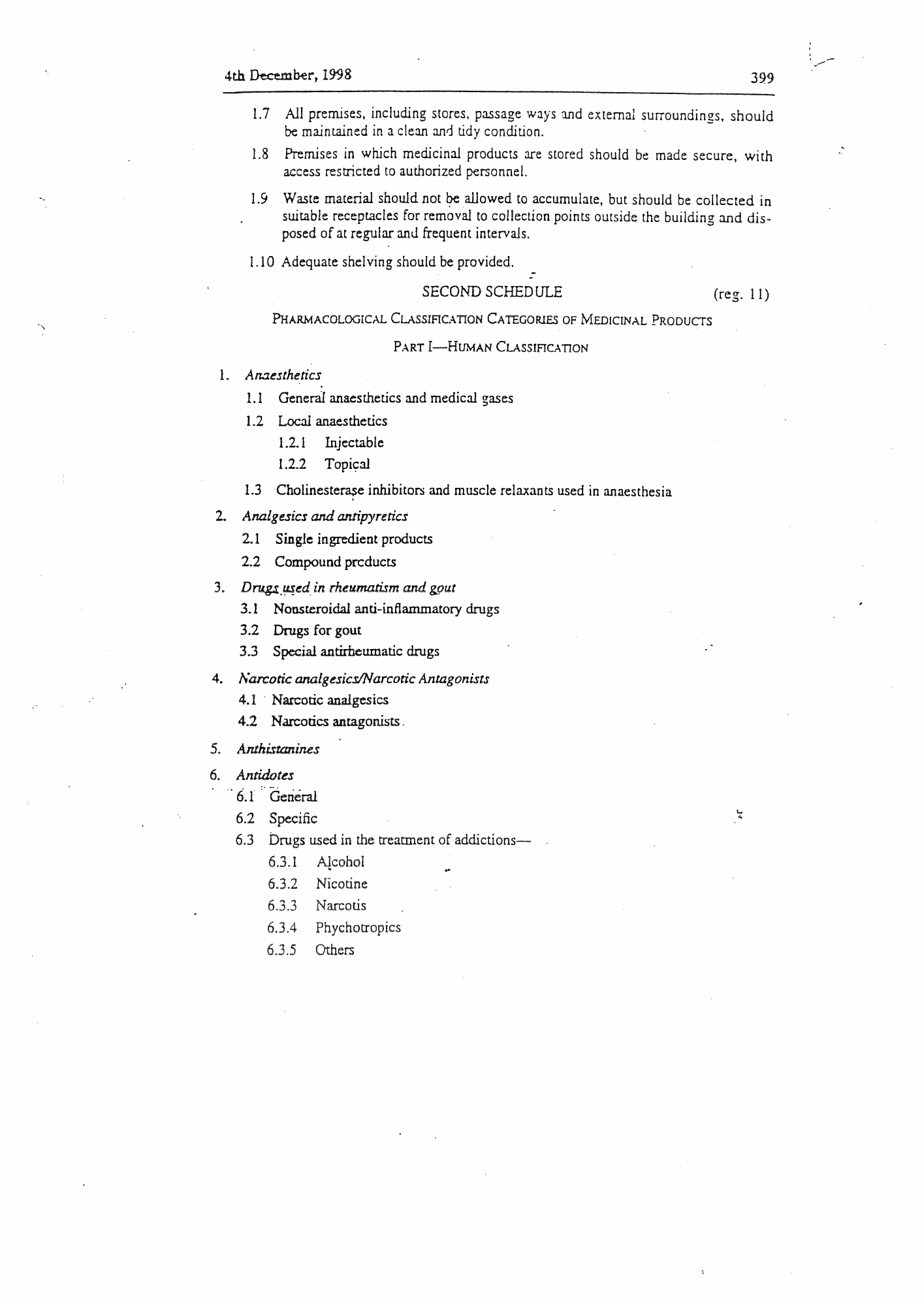
1.7 All premises, including stores, passage ways and external surroundings, should be maintained in a clean and tidy condition.
1.8 Premises in which medicinal products are stored should be made secure, with access restricted to authorized personnel.
1.9 Waste material should not be allowed to accumulate, but should be collected in suitable receptacles for removal to collection points outside the building and disposed of at regular and frequent intervals.
1.10 Adequate shelving should be provided.
SECOND SCHEDULE
(reg. 11)
PHARMACOLOGICAL CLASSIFICATION CATEGORIES OF MEDICINAL PRODUCTS
PART I—HUMAN CLASSIFICATION
1. Anaesthetics
1.1 General anaesthetics and medical gases
1.2 Local anaesthetics
1.2.1 Injectable
1.2.2 Topical
1.3 Cholinesterase inhibitors and muscle relaxants used in anaesthesia
2. Analgesics and antipyretics
2.1 Single ingredient products
2.2 Compound products
3. Drugs used in rheumatism and gout
3.1 Nonsteroidal anti-inflammatory drugs
3.2 Drugs for gout
3.3 Special antirheumatic drugs
4. Narcotic analgesics/Narcotic Antagonists
4.1 Narcotic analgesics
4.2 Narcotics antagonists
5. Antihistamines
6. Antidotes
6.1 General
6.2 Specific
6.3 Drugs used in the treatment of addictions—
6.3.1 Alcohol
6.3.2 Nicotine
6.3.3 Narcotis
6.3.4 Phychotropics
6.3.5 Others
Government Notice 88 of 1998 — official PDF page 25; original table columns, symbols and diagram connections
Government Notice 88 of 1998 — official PDF page 31; original table columns, symbols and diagram connections
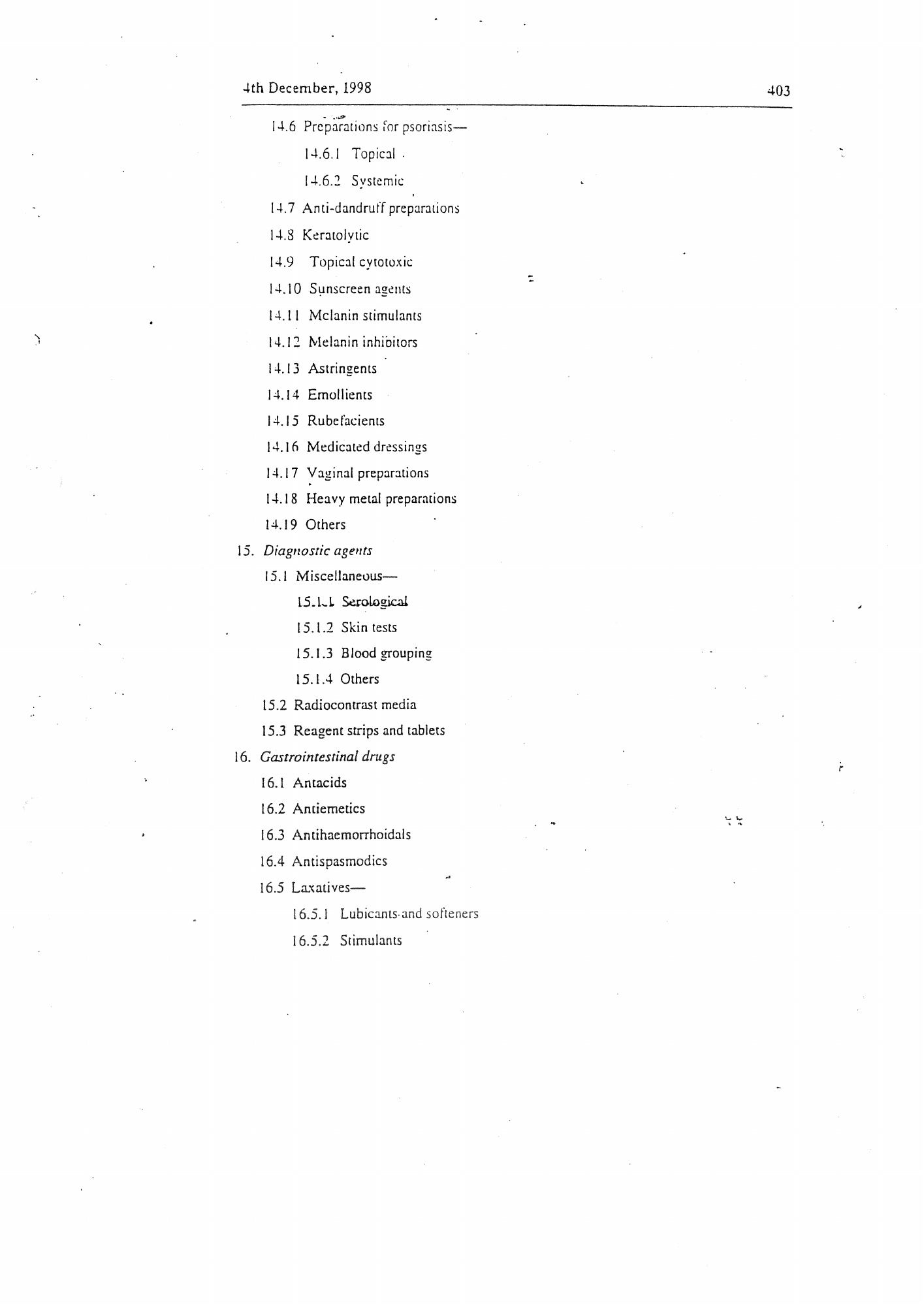
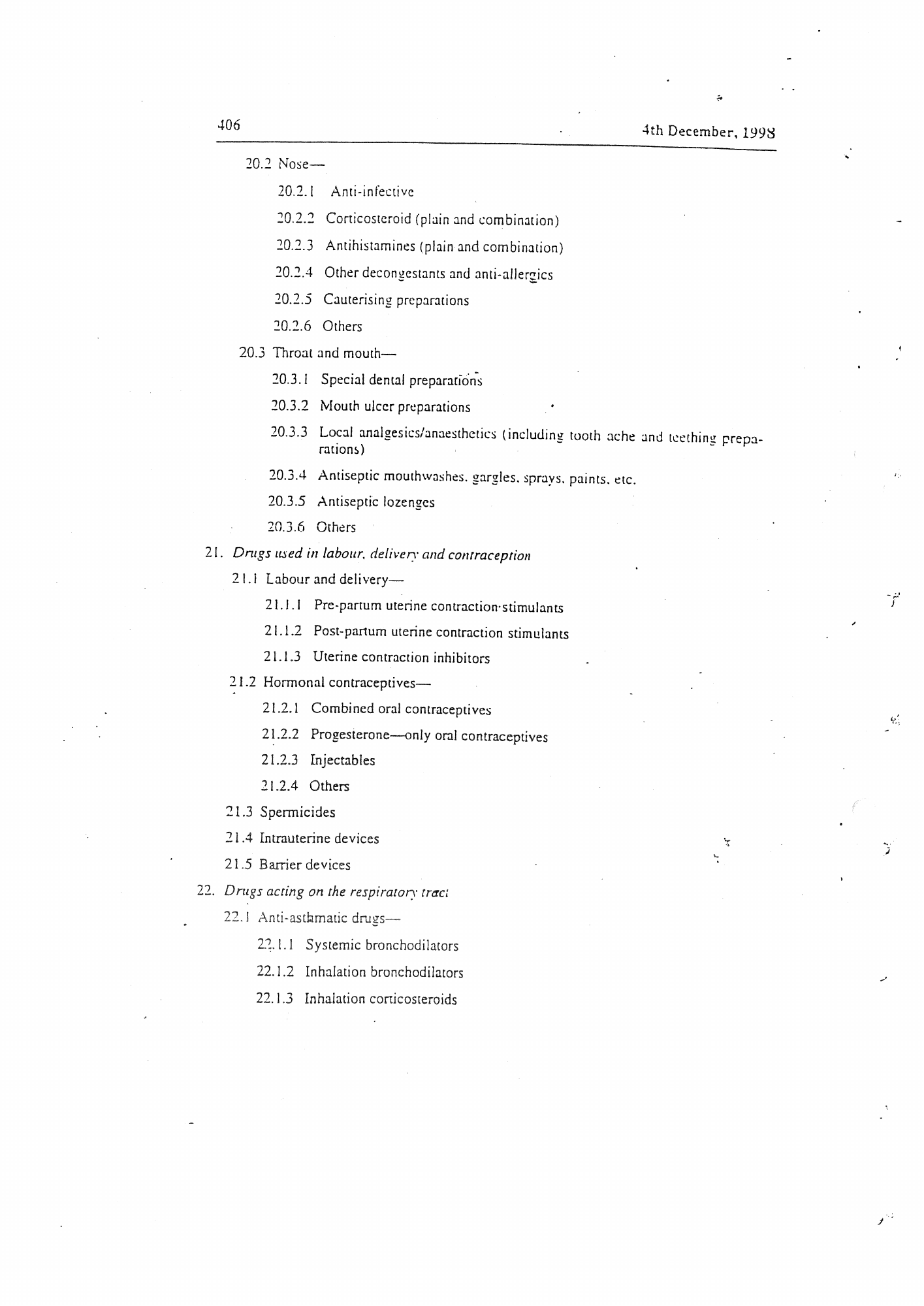
406 4th December, 1998
20.2 Nose—
20.2.1 Anti-infective
20.2.2 Corticosteroid (plain and combination)
20.2.3 Antihistamines (plain and combination)
20.2.4 Other decongestants and anti-allergics
20.2.5 Cauterising preparations
20.2.6 Others
20.3 Throat and mouth—
20.3.1 Special dental preparations
20.3.2 Mouth ulcer preparations
20.3.3 Local analgesics/anaesthetics (including tooth ache and teething preparations)
20.3.4 Antiseptic mouthwashes, gargles, sprays, paints, etc.
20.3.5 Antiseptic lozenges
20.3.6 Others
21. Drugs used in labour, delivery and contraception
21.1 Labour and delivery—
21.1.1 Pre-partum uterine contraction stimulants
21.1.2 Post-partum uterine contraction stimulants
21.1.3 Uterine contraction inhibitors
21.2 Hormonal contraceptives—
21.2.1 Combined oral contraceptives
21.2.2 Progesterone—only oral contraceptives
21.2.3 Injectables
21.2.4 Others
21.3 Spermicides
21.4 Intrauterine devices
21.5 Barrier devices
22. Drugs acting on the respiratory tract
22.1 Anti-asthmatic drugs—
22.1.1 Systemic bronchodilators
22.1.2 Inhalation bronchodilators
22.1.3 Inhalation corticosteroids
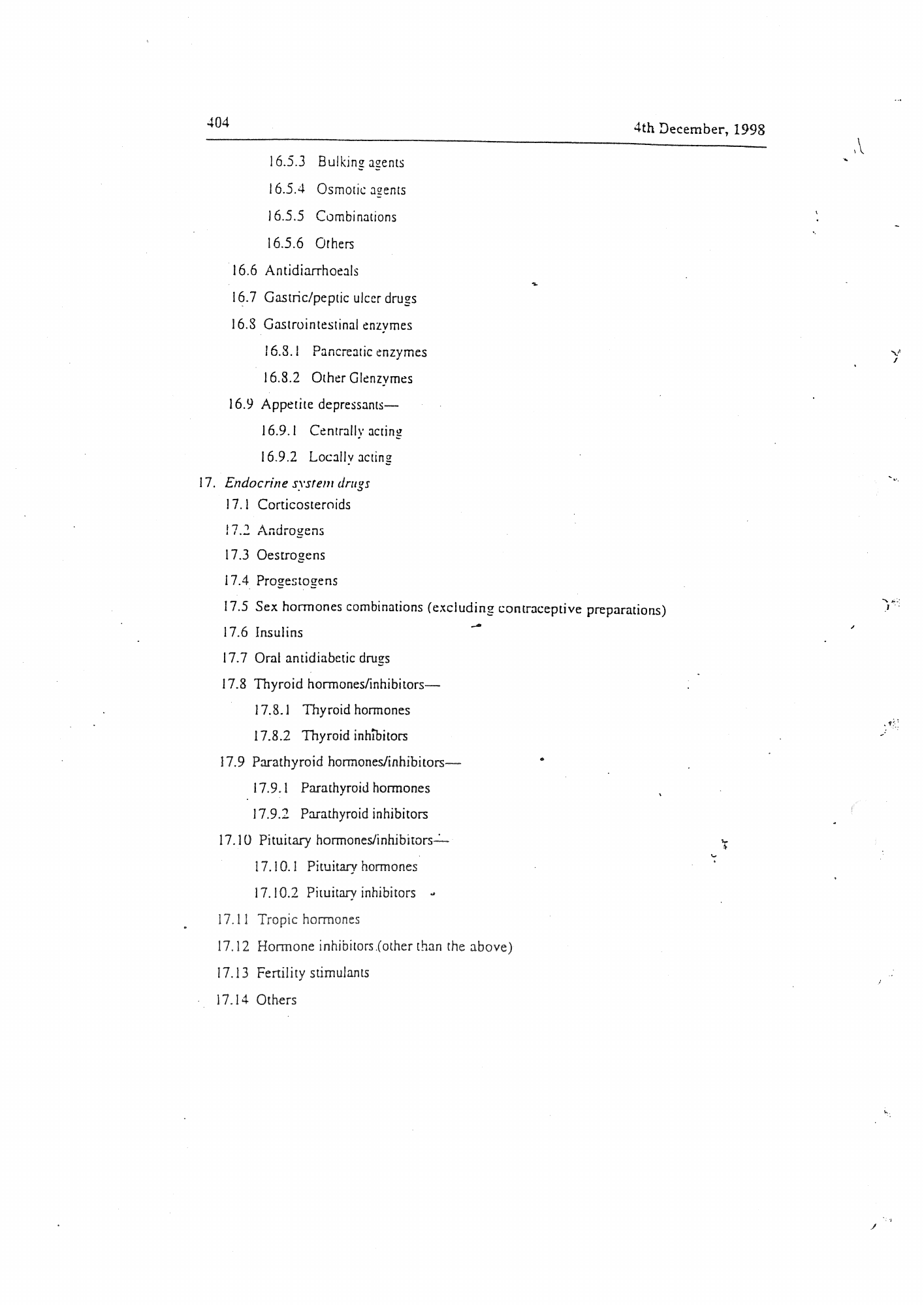
Government Notice 88 of 1998 — official PDF page 32; original table columns, symbols and diagram connections
4th December, 1998 407
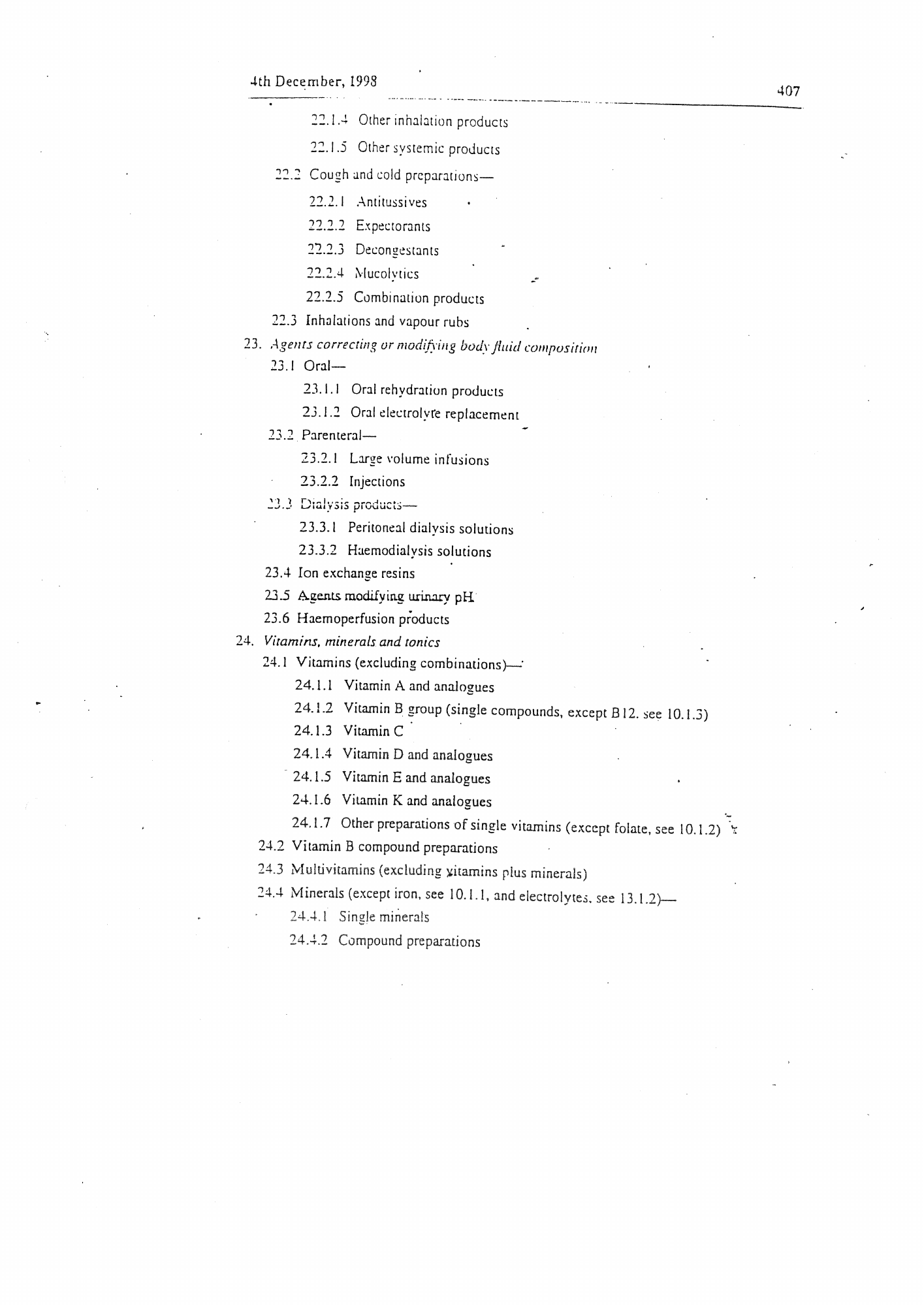
22.1.4 Other inhalation products
22.1.5 Other systemic products
22.2 Cough and cold preparations—
22.2.1 Antitussives
22.2.2 Expectorants
22.2.3 Decongestants
22.2.4 Mucolytics
22.2.5 Combination products
22.3 Inhalations and vapour rubs
23. Agents correcting or modifying body fluid composition
23.1 Oral—
23.1.1 Oral rehydration products
23.1.2 Oral electrolyte replacement
23.2 Parenteral—
23.2.1 Large volume infusions
23.2.2 Injections
23.3 Dialysis products—
23.3.1 Peritoneal dialysis solutions
23.3.2 Haemodialysis solutions
23.4 Ion exchange resins
23.5 Agents modifying urinary pH
23.6 Haemoperfusion products
24. Vitamins, minerals and tonics
24.1 Vitamins (excluding combinations)—
24.1.1 Vitamin A and analogues
24.1.2 Vitamin B group (single compounds, except B12, see 10.1.3)
24.1.3 Vitamin C
24.1.4 Vitamin D and analogues
24.1.5 Vitamin E and analogues
24.1.6 Vitamin K and analogues
24.1.7 Other preparations of single vitamins (except folate, see 10.1.2)
24.2 Vitamin B compound preparations
24.3 Multivitamins (excluding vitamins plus minerals)
24.4 Minerals (except iron, see 10.1.1, and electrolytes, see 13.1.2)—
24.4.1 Single minerals
24.4.2 Compound preparations
Government Notice 88 of 1998 — official PDF page 33; original table columns, symbols and diagram connections
408 4th December, 1998
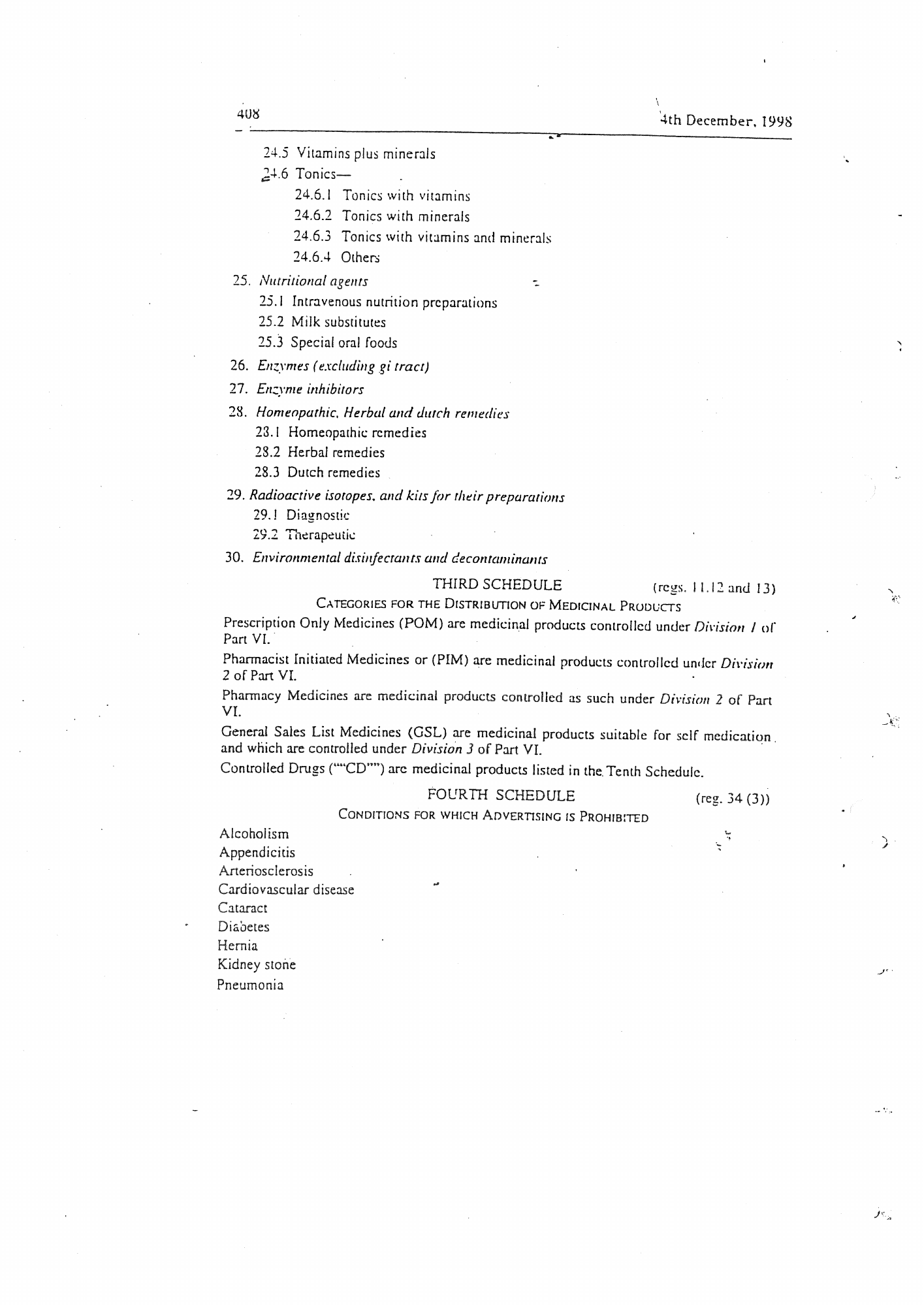
24.5 Vitamins plus minerals
24.6 Tonics—
24.6.1 Tonics with vitamins
24.6.2 Tonics with minerals
24.6.3 Tonics with vitamins and minerals
24.6.4 Others
25. Nutritional agents
25.1 Intravenous nutrition preparations
25.2 Milk substitutes
25.3 Special oral foods
26. Enzymes (excluding gi tract)
27. Enzyme inhibitors
28. Homeopathic, Herbal and dutch remedies
23.1 Homeopathic remedies
28.2 Herbal remedies
28.3 Dutch remedies
29. Radioactive isotopes, and kits for their preparations
29.1 Diagnostic
29.2 Therapeutic
30. Environmental disinfectants and decontaminants
THIRD SCHEDULE
(regs. 11,12 and 13)
CATEGORIES FOR THE DISTRIBUTION OF MEDICINAL PRODUCTS
Prescription Only Medicines (POM) are medicinal products controlled under Division 1 of Part VI.
Pharmacist Initiated Medicines or (PIM) are medicinal products controlled under Division 2 of Part VI.
Pharmacy Medicines are medicinal products controlled as such under Division 2 of Part VI.
General Sales List Medicines (GSL) are medicinal products suitable for self medication and which are controlled under Division 3 of Part VI.
Controlled Drugs (““CD””) are medicinal products listed in the Tenth Schedule.
FOURTH SCHEDULE
(reg. 34 (3))
CONDITIONS FOR WHICH ADVERTISING IS PROHIBITED
Alcoholism
Appendicitis
Arteriosclerosis
Cardiovascular disease
Cataract
Diabetes
Hernia
Kidney stone
Pneumonia
Government Notice 88 of 1998 — official PDF page 34; original table columns, symbols and diagram connections
4th December, 1998 409
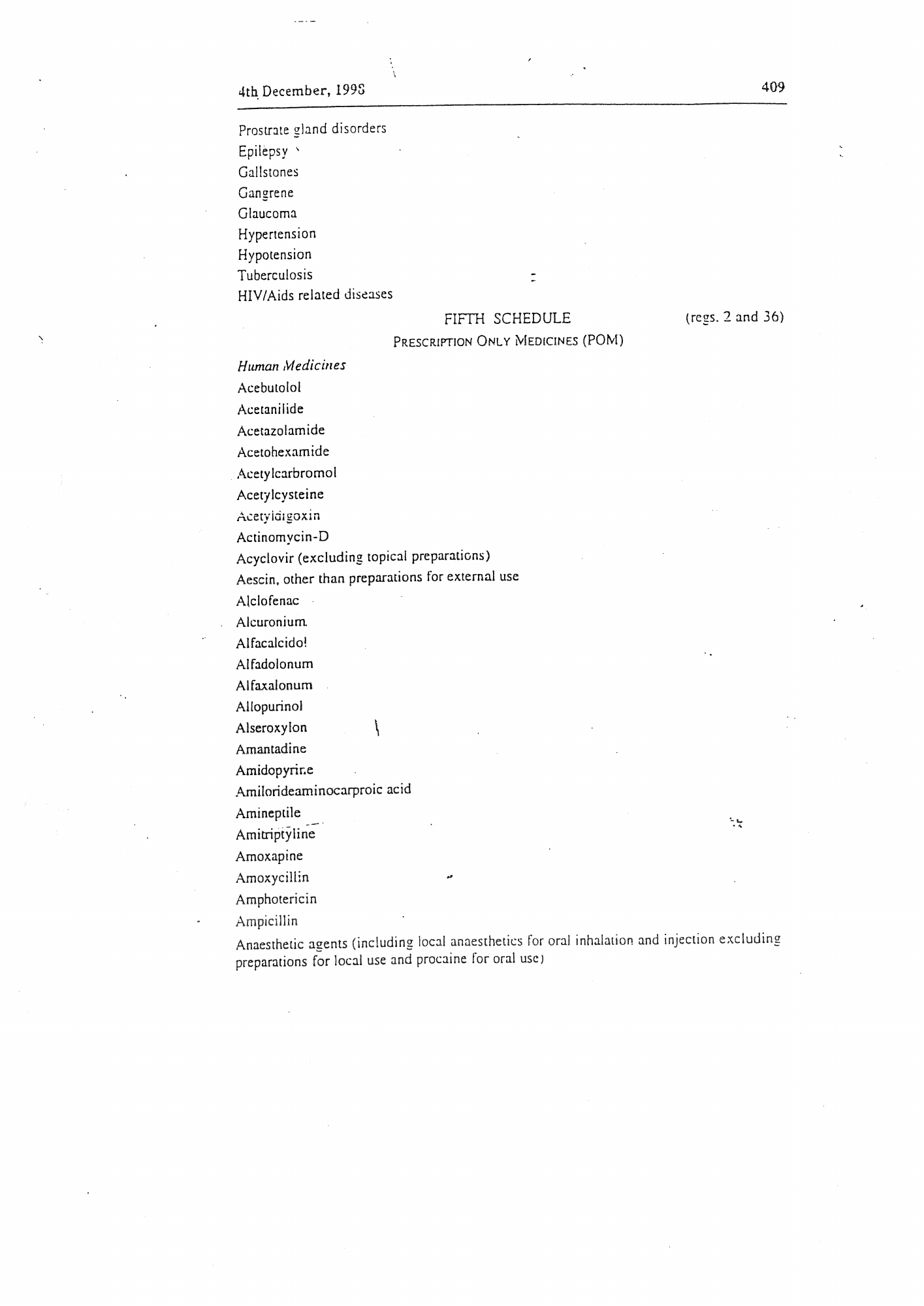
Prostrate gland disorders
Epilepsy
Gallstones
Gangrene
Glaucoma
Hypertension
Hypotension
Tuberculosis
HIV/Aids related diseases
FIFTH SCHEDULE
(regs. 2 and 36)
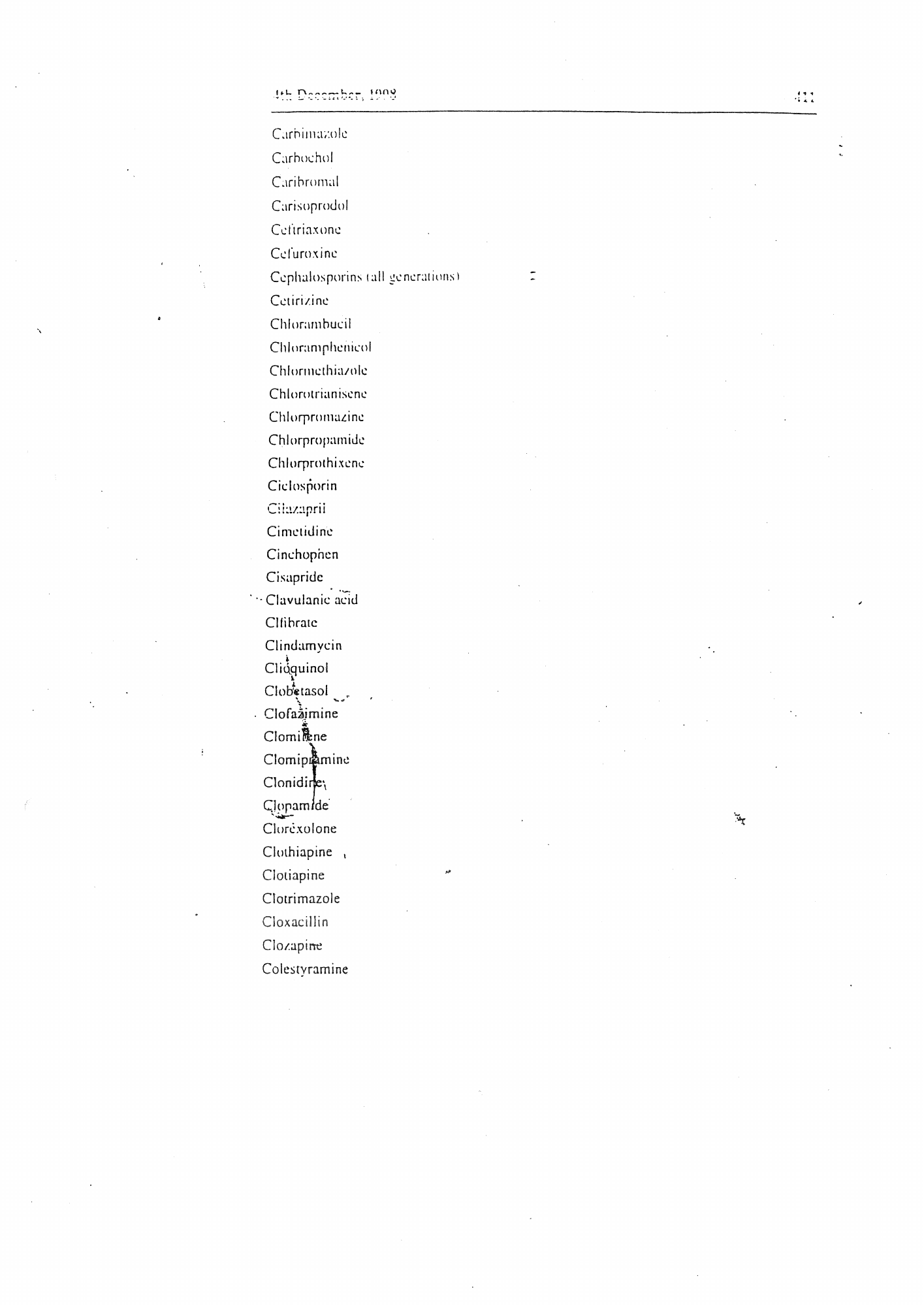
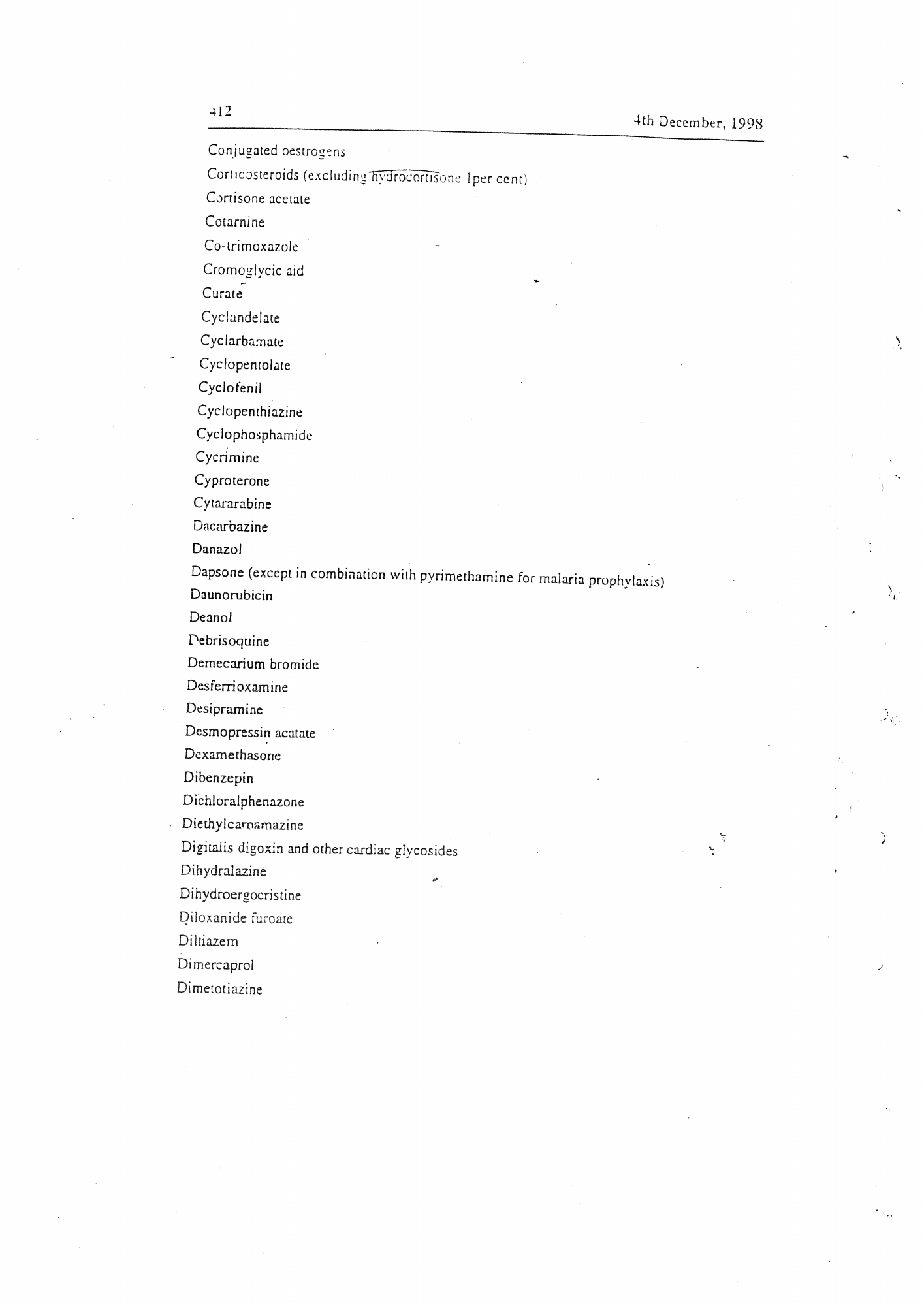
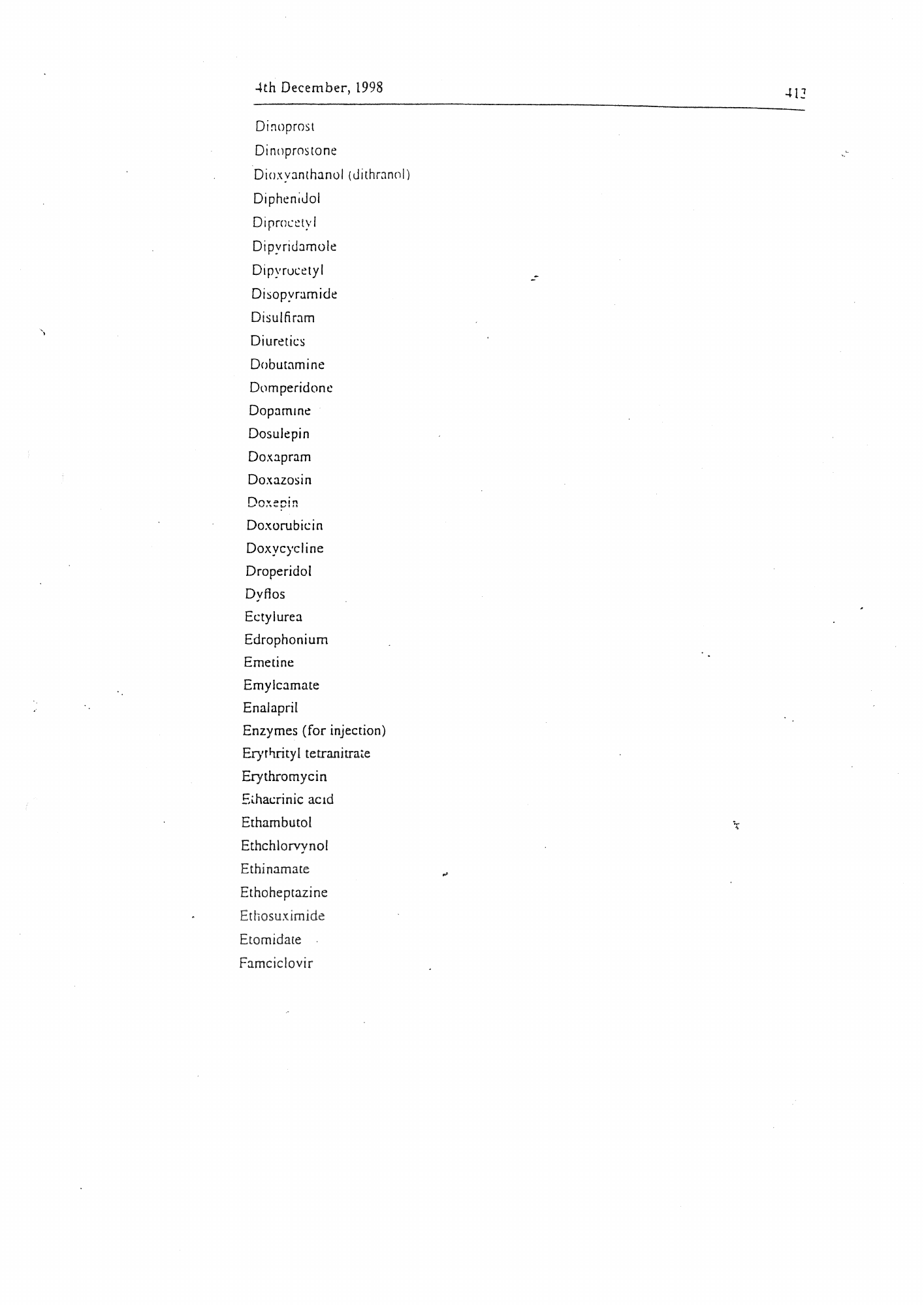
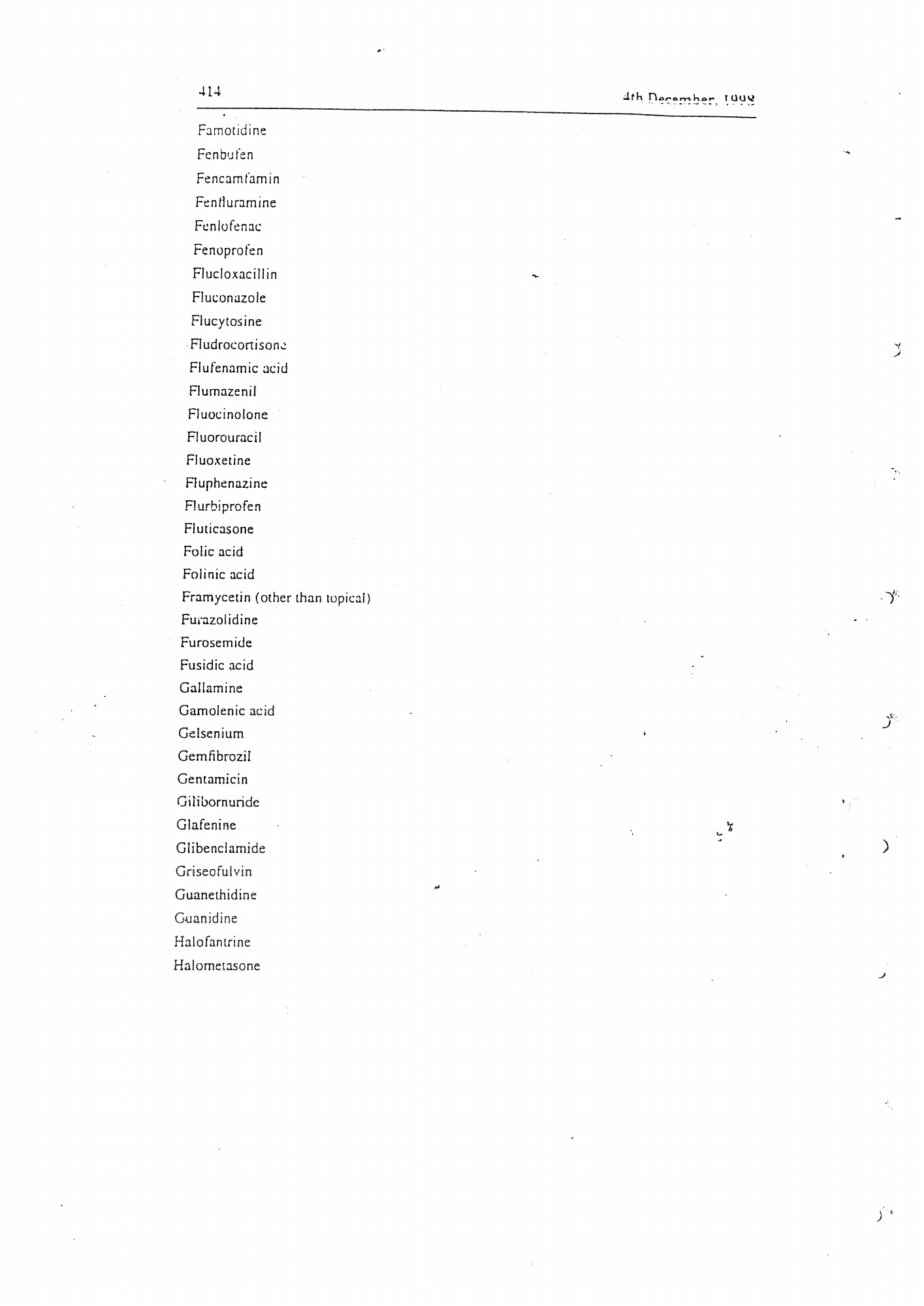
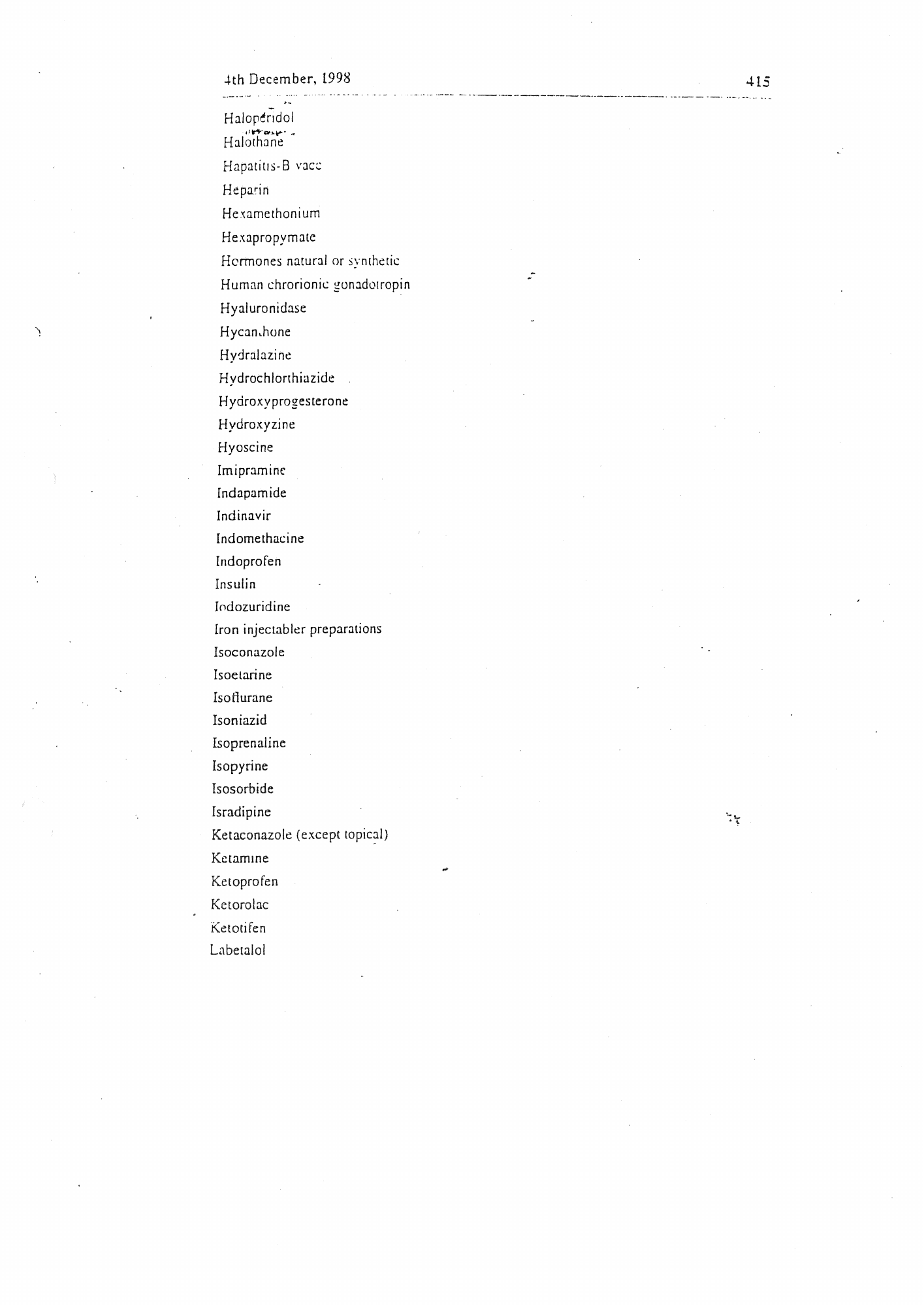
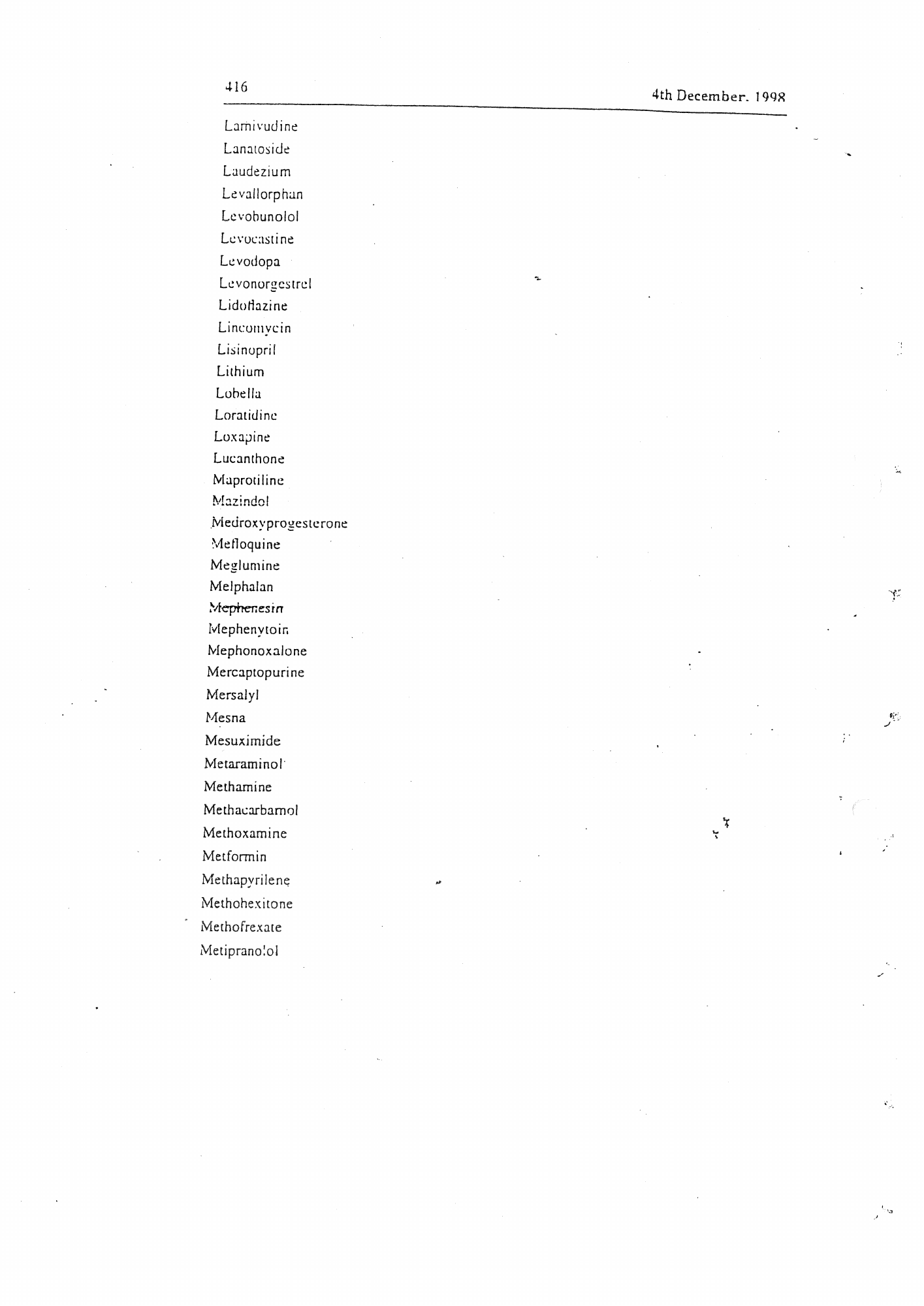
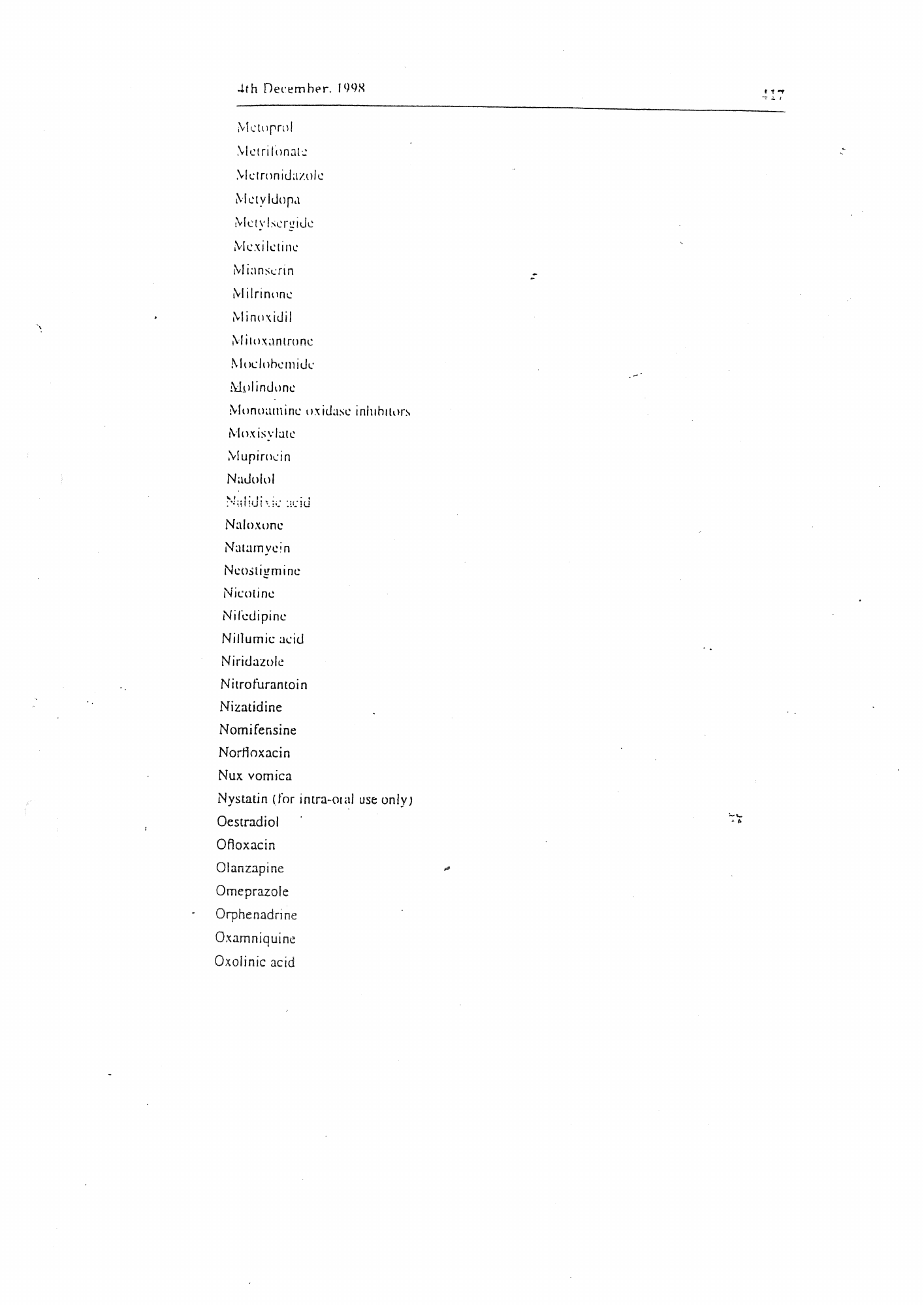
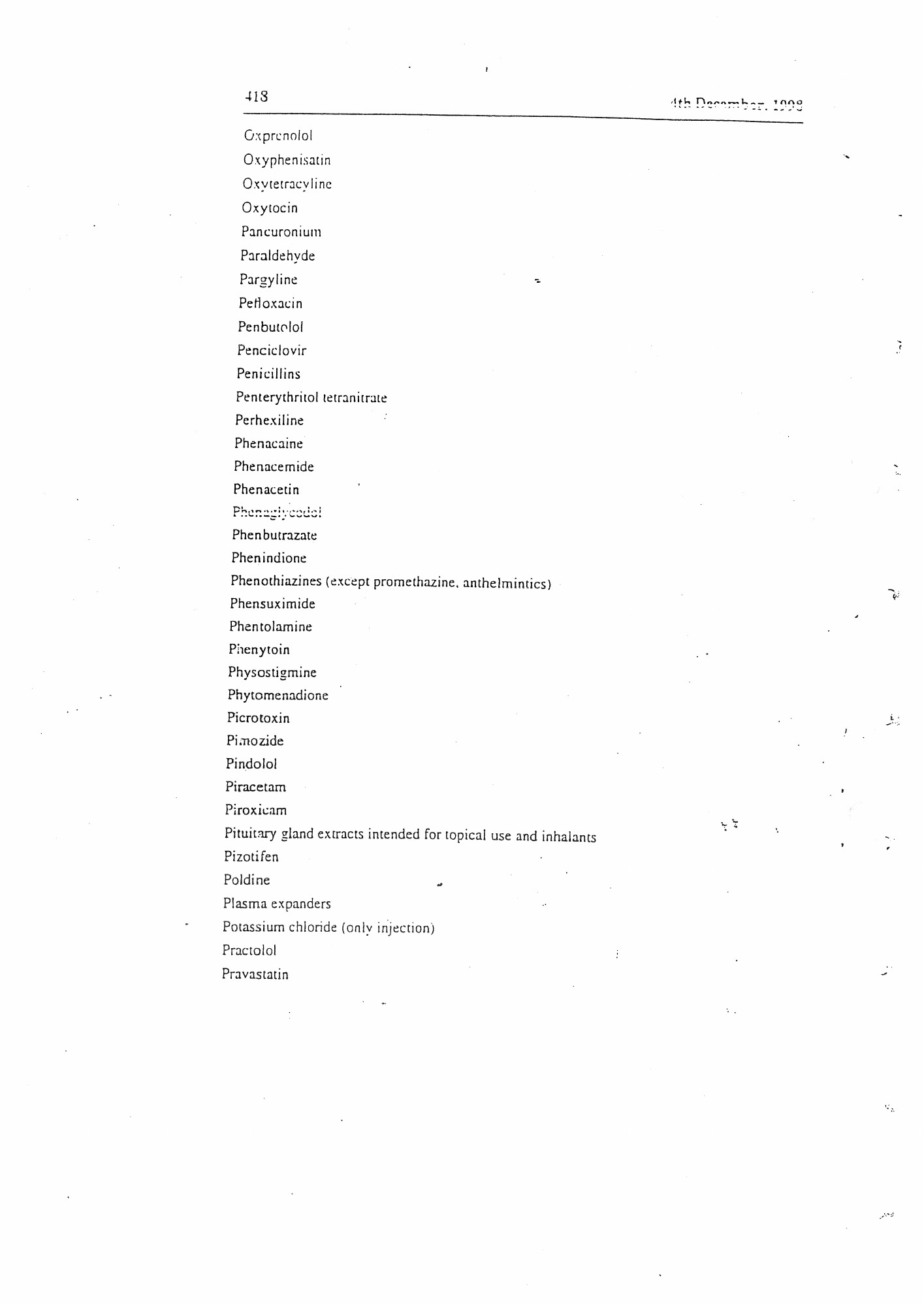
PRESCRIPTION ONLY MEDICINES (POM)
Human Medicines
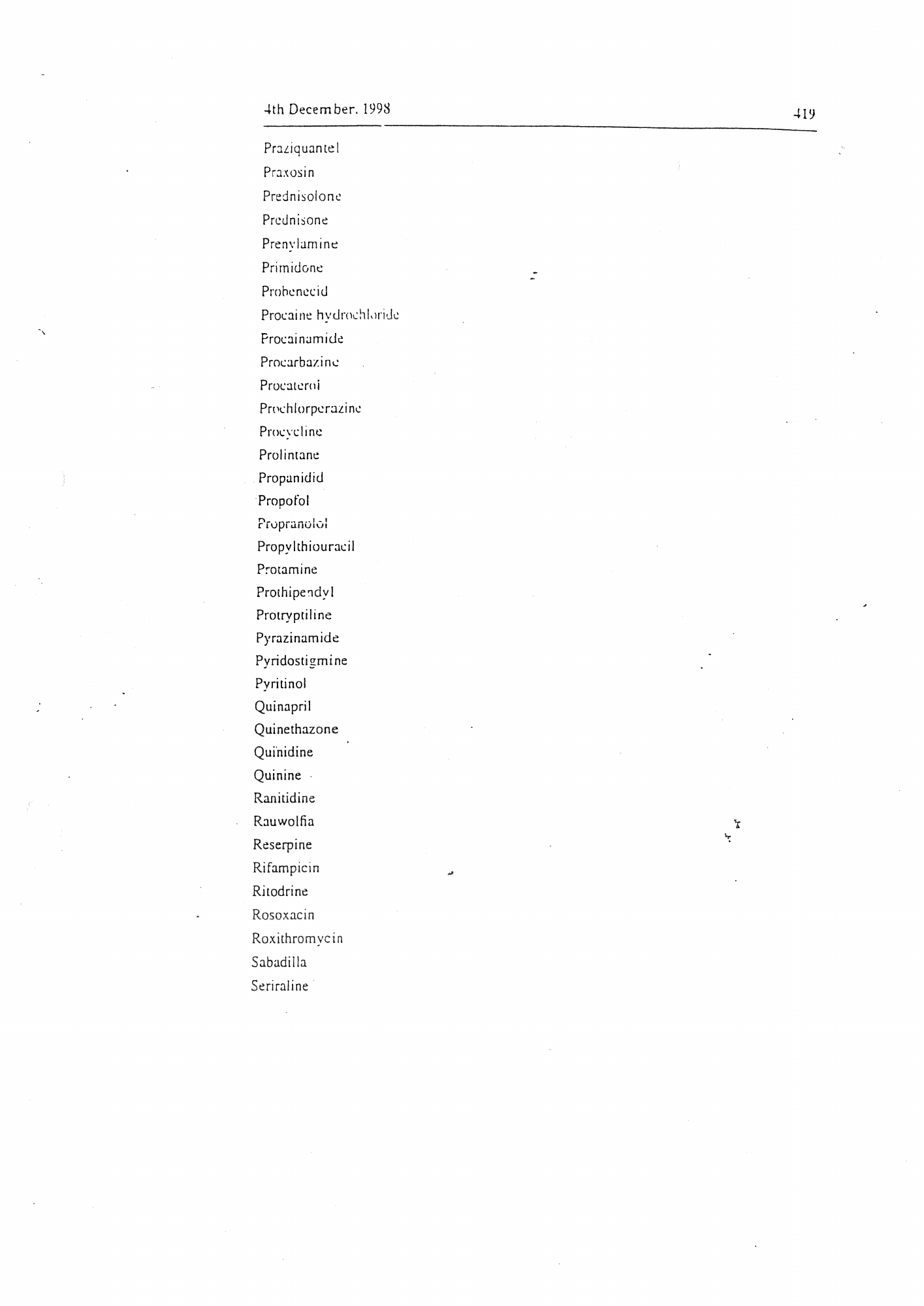
Acebutolol
Acetanilide
Acetazolamide
Acetohexamide
Acetylcarbromol
Acetylcysteine
Acetyldigoxin
Actinomycin-D
Acyclovir (excluding topical preparations)
Aescin, other than preparations for external use
Alclofenac
Alcuronium
Alfacalcidol
Alfadolonum
Alfaxalonum
Allopurinol
Alseroxylon
Amantadine
Amidopyrine
Amilorideaminocarproic acid
Amineptile
Amitriptyline
Amoxapine
Amoxycillin
Amphotericin
Ampicillin
Anaesthetic agents (including local anaesthetics for oral inhalation and injection excluding preparations for local use and procaine for oral use)
Government Notice 88 of 1998 — official PDF page 35; original table columns, symbols and diagram connections
410 4th December, 1998
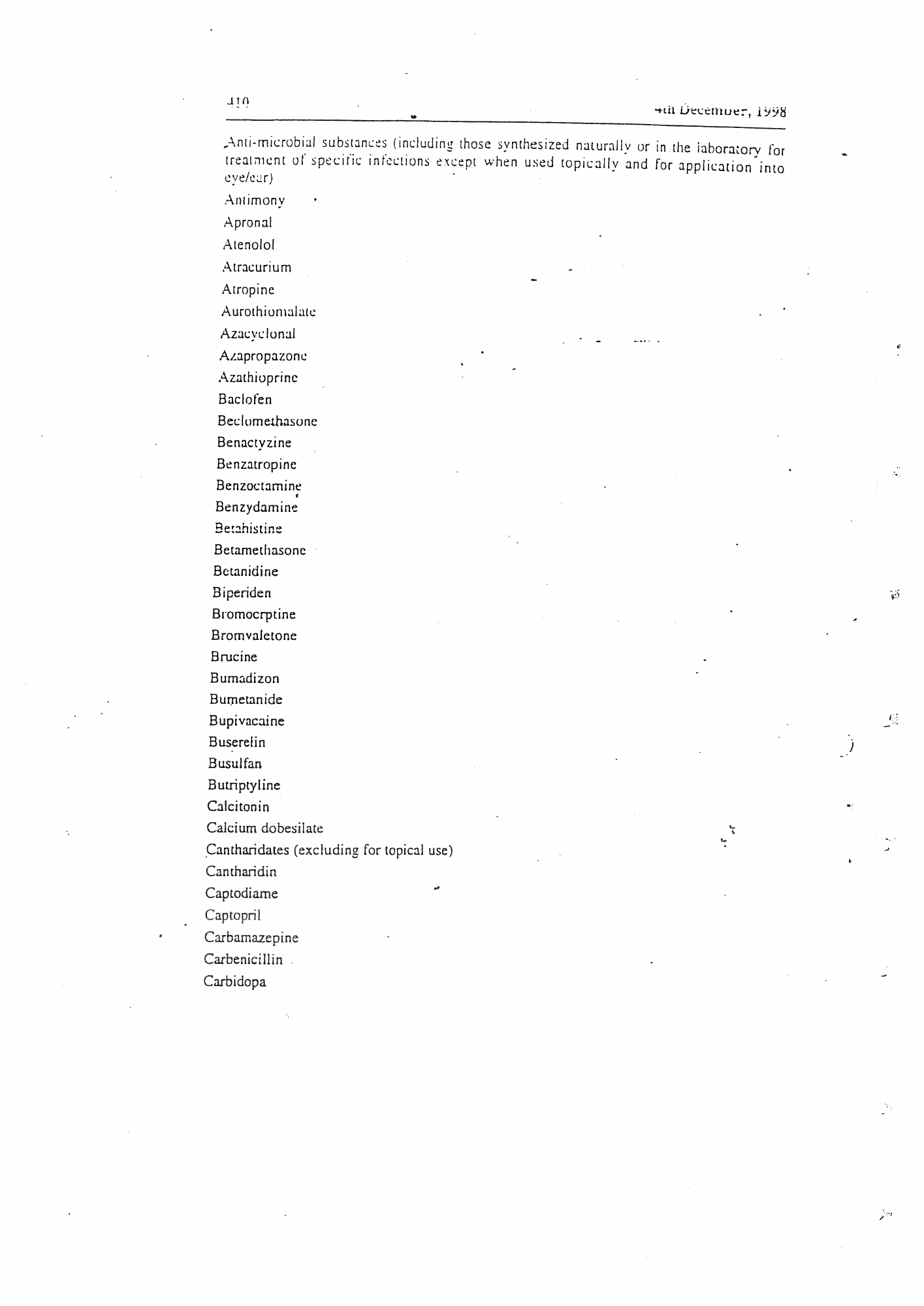
Anti-microbial substances (including those synthesized naturally or in the laboratory for treatment of specific infections except when used topically and for application into eye/ear)
Antimony
Apronal
Atenolol
Atracurium
Atropine
Aurothiomalate
Azacyclonal
Azapropazone
Azathioprine
Baclofen
Beclomethasone
Benactyzine
Benzatropine
Benzoctamine
Benzydamine
Betahistine
Betamethasone
Betanidine
Biperiden
Bromocriptine
Bromvaletone
Brucine
Bumadizon
Bumetanide
Bupivacaine
Buserelin
Busulfan
Butriptyline
Calcitonin
Calcium dobesilate
Cantharidates (excluding for topical use)
Cantharidin
Captodiame
Captopril
Carbamazepine
Carbenicillin
Carbidopa
Government Notice 88 of 1998 — official PDF page 36; original table columns, symbols and diagram connections
Government Notice 88 of 1998 — official PDF page 45; original table columns, symbols and diagram connections
420 4th December, 1998
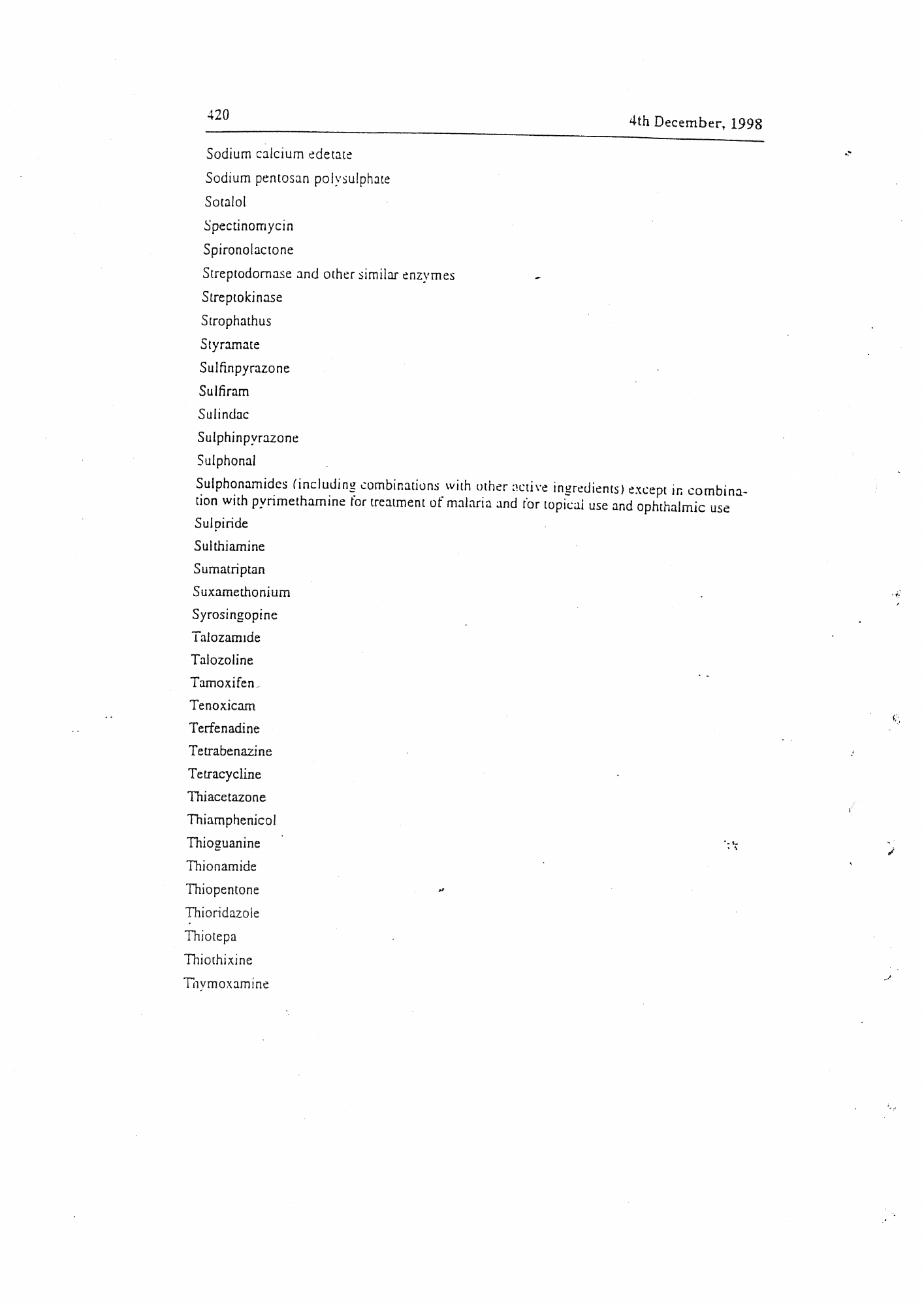
Sodium calcium edetate
Sodium pentosan polysulphate
Sotalol
Spectinomycin
Spironolactone
Streptodornase and other similar enzymes
Streptokinase
Strophathus
Styramate
Sulfinpyrazone
Sulfiram
Sulindac
Sulphinpyrazone
Sulphonal
Sulphonamides (including combinations with other active ingredients) except in combination with pyrimethamine for treatment of malaria and for topical use and ophthalmic use
Sulpiride
Sulthiamine
Sumatriptan
Suxamethonium
Syrosingopine
Talozamide
Talozoline
Tamoxifen
Tenoxicam
Terfenadine
Tetrabenazine
Tetracycline
Thiacetazone
Thiamphenicol
Thioguanine
Thionamide
Thiopentone
Thioridazole
Thiotepa
Thiothixine
Thymoxamine
Government Notice 88 of 1998 — official PDF page 46; original table columns, symbols and diagram connections
Government Notice 88 of 1998 — official PDF page 47; original table columns, symbols and diagram connections
422 4th December, 1998
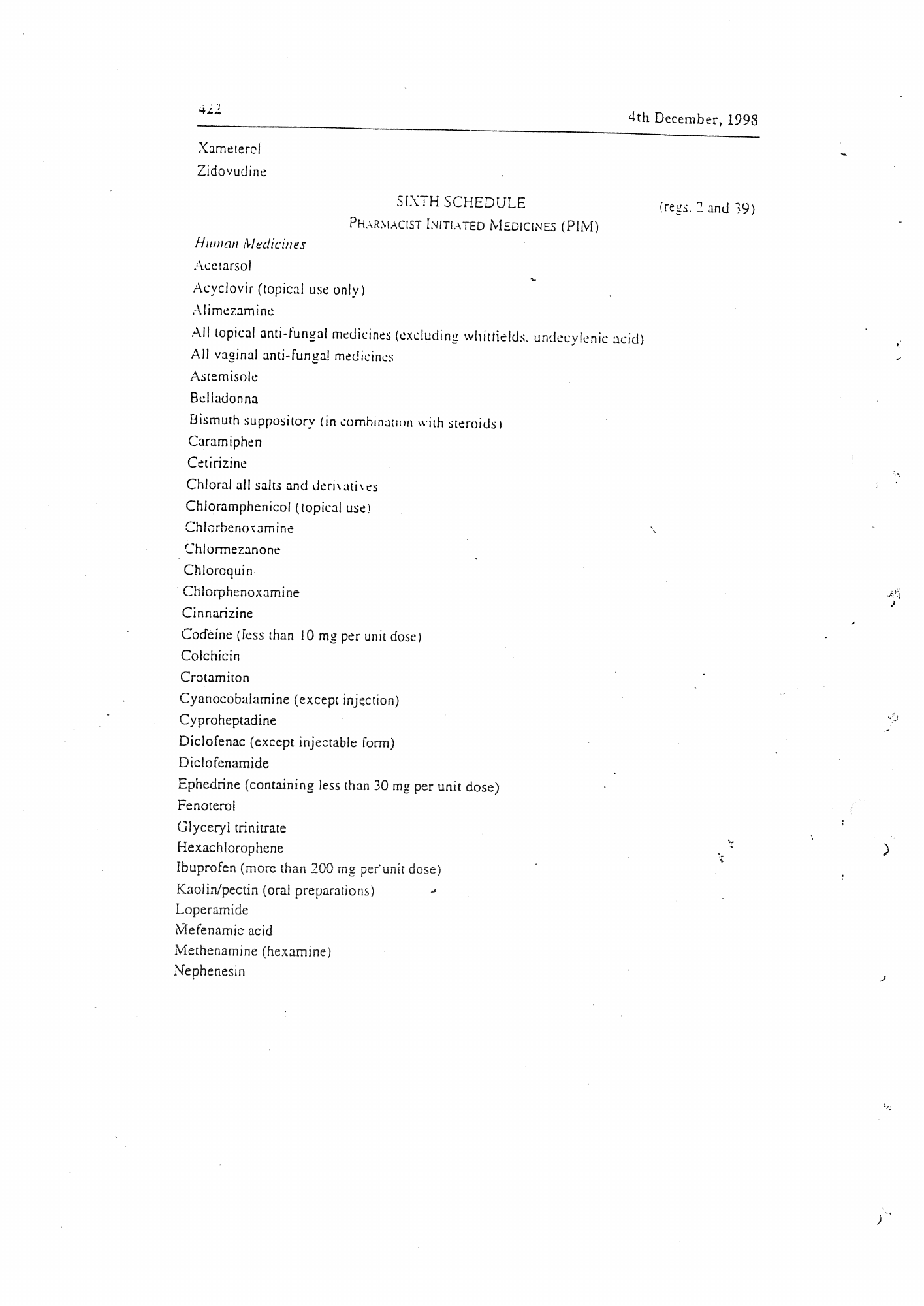
Xameterol
Zidovudine
SIXTH SCHEDULE
(regs. 2 and 39)
PHARMACIST INITIATED MEDICINES (PIM)
Human Medicines
Acetarsol
Acyclovir (topical use only)
Alimezamine
All topical anti-fungal medicines (excluding whittields. undecylenic acid)
All vaginal anti-fungal medicines
Astemisole
Belladonna
Bismuth suppository (in combination with steroids)
Caramiphen
Cetirizine
Chloral all salts and derivatives
Chloramphenicol (topical use)
Chlorbenoxamine
Chlormezanone
Chloroquin
Chlorphenoxamine
Cinnarizine
Codeine (less than 10 mg per unit dose)
Colchicin
Crotamiton
Cyanocobalamine (except injection)
Cyproheptadine
Diclofenac (except injectable form)
Diclofenamide
Ephedrine (containing less than 30 mg per unit dose)
Fenoterol
Glyceryl trinitrate
Hexachlorophene
Ibuprofen (more than 200 mg per unit dose)
Kaolin/pectin (oral preparations)
Loperamide
Mefenamic acid
Methenamine (hexamine)
Nephenesin
Government Notice 88 of 1998 — official PDF page 48; original table columns, symbols and diagram connections
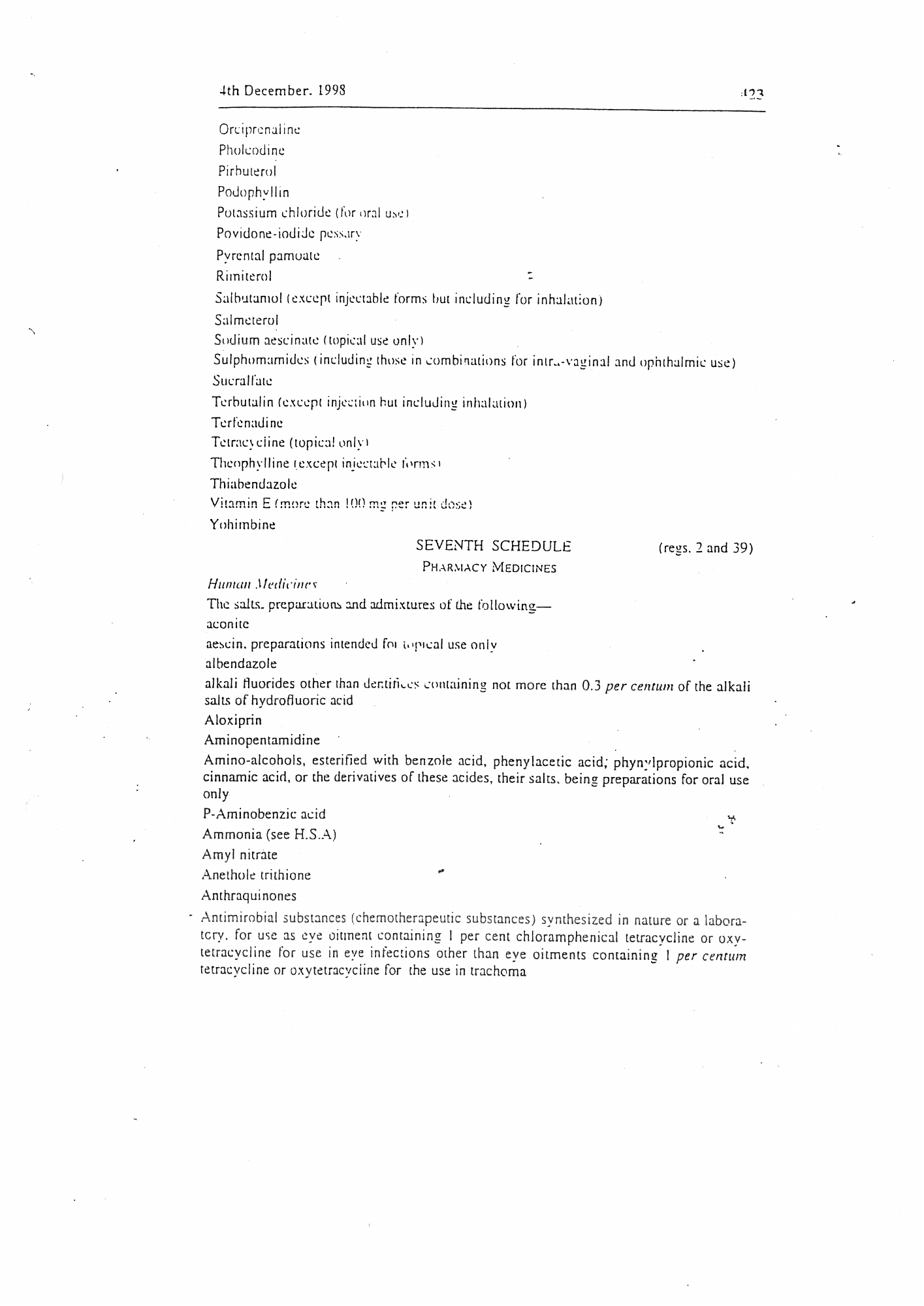
423 4th December, 1998
Orciprenaline
Pholcodine
Pirbuterol
Podophyllin
Potassium chloride (for oral use)
Povidone-iodide pessary
Pyrental pamoate
Rimiterol
Salbutamol (except injectable forms but including for inhalation)
Salmeterol
Sodium aescinate (topical use only)
Sulphonamides (including those in combinations for intra-vaginal and ophthalmic use)
Sucralfate
Terbutalin (except injection but including inhalation)
Terfenadine
Tetracycline (topical only)
Theophylline (except injectable forms)
Thiabendazole
Vitamin E (more than 100 mg per unit dose)
Yohimbine
SEVENTH SCHEDULE
(regs. 2 and 39)
PHARMACY MEDICINES
Human Medicines
The salts, preparations and admixtures of the following—
aconite
aescin, preparations intended for topical use only
albendazole
alkali fluorides other than dentifrices containing not more than 0.3 per centum of the alkali salts of hydrofluoric acid
Aloxiprin
Aminopentamidine
Amino-alcohols, esterified with benzole acid, phenylacetic acid; phenylpropionic acid, cinnamic acid, or the derivatives of these acids, their salts, being preparations for oral use only
P-Aminobenzic acid
Ammonia (see H.S.A)
Amyl nitrate
Anethole trithione
Anthraquinones
Antimirobial substances (chemotherapeutic substances) synthesized in nature or a laboratory, for use as eye ointment containing 1 per cent chloramphenical tetracycline or oxytetracycline for use in eye infections other than eye ointments containing 1 per centum tetracycline or oxytetracycline for the use in trachoma
Government Notice 88 of 1998 — official PDF page 49; original table columns, symbols and diagram connections
424 4th December, 1998
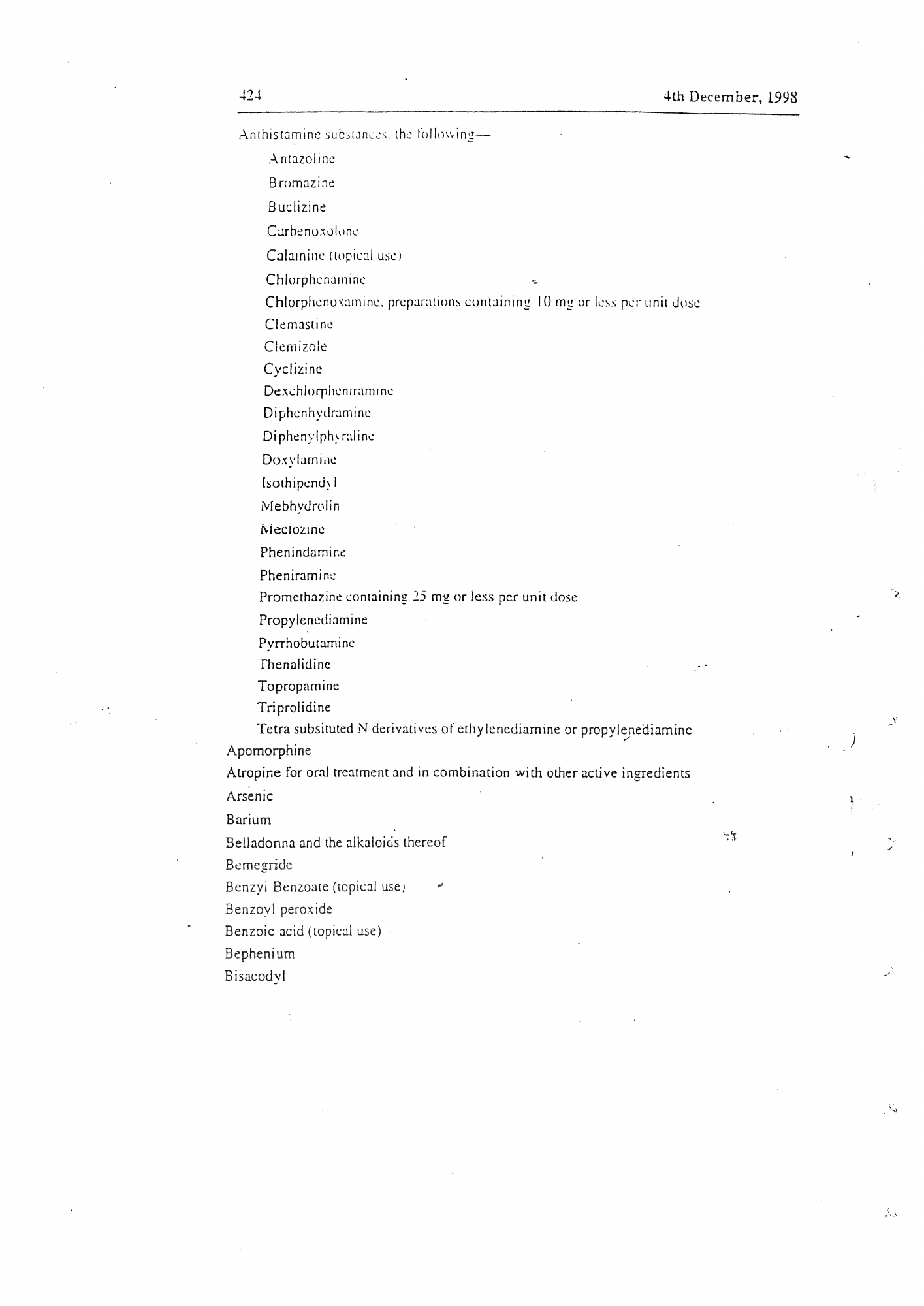
Anthistamine substances, the following—
Antazoline
Bromazine
Buclizine
Carbenoxolone
Calamine (topical use)
Chlorphenamine
Chlorphenoxamine, preparations containing 10 mg or less per unit dose
Clemastine
Clemizole
Cyclizine
Dexchlorpheniramine
Diphenhydramine
Diphenylpyraline
Doxylamine
Isothipendyl
Mebhydrolin
Meclozine
Phenindamine
Pheniramine
Promethazine containing 25 mg or less per unit dose
Propylenediamine
Pyrrhobutamine
Thenalidine
Topropamine
Triprolidine
Tetra subsituted N derivatives of ethylenediamine or propylenediamine
Apomorphine
Atropine for oral treatment and in combination with other active ingredients
Arsenic
Barium
Belladonna and the alkaloids thereof
Bemegride
Benzyl Benzoate (topical use)
Benzoyl peroxide
Benzoic acid (topical use)
Bephenium
Bisacodyl
Government Notice 88 of 1998 — official PDF page 50; original table columns, symbols and diagram connections
425 4th December, 1998
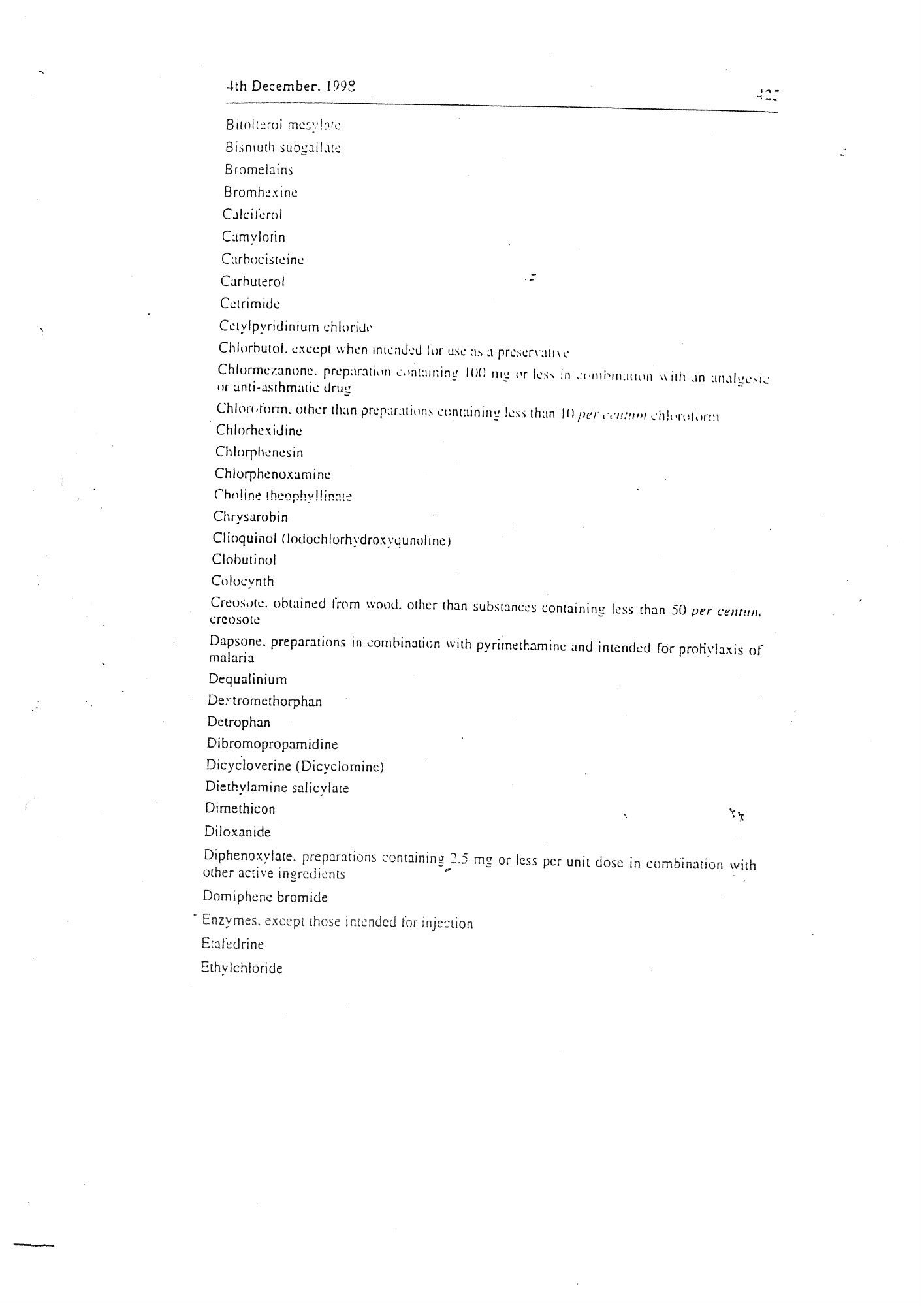
Bitolterol mesylate
Bismuth subgallate
Bromelains
Bromhexine
Calciferol
Camylotin
Carbocisteine
Carbuterol
Cetrimide
Cetylpyridinium chloride
Chlorbutol, except when intended for use as a preservative
Chlormezanone, preparation containing 100 mg or less in combination with an analgesic or anti-asthmatic drug
Chloroform, other than preparations containing less than 10 per centum chloroform
Chlorhexidine
Chlorphenesin
Chlorphenoxamine
Choline theophyllinate
Chrysarobin
Clioquinol (Iodochlorhydroxyqunoline)
Clobutinol
Colocynth
Creosote, obtained from wood, other than substances containing less than 50 per centum creosote
Dapsone, preparations in combination with pyrimethamine and intended for prophylaxis of malaria
Dequalinium
Dextromethorphan
Detrophan
Dibromopropamidine
Dicycloverine (Dicyclomine)
Diethylamine salicylate
Dimethicon
Diloxanide
Diphenoxylate, preparations containing 2.5 mg or less per unit dose in combination with other active ingredients
Domiphene bromide
Enzymes, except those intended for injection
Etafedrine
Ethylchloride
Government Notice 88 of 1998 — official PDF page 51; original table columns, symbols and diagram connections
426 4th December, 1998
Fedrilate
Ferric and ferrous salts, and combinations
Floctafenine
Fluoride sodium, excluding dental pastes and gels
Folic acid
Formaldehyde, other than when used as a preservative
Gamma benzene hexachloride
Glucuronic acid
Halquinol (Chlorhydroxyquinoline) (Di-iodohydroxyquinoline)
Hexachlorophene, preparations containing less than 1 per centum hexachlorophene
Hexetidine
Hexoprenaline
Hydrochloric acid, as diluted solution for achlorhydria
Hydrotalcite
Iodine, iodides
Isoaminile
Jalap
Lead, salts, other than preparations for hair containing less than 0.5 per centum of lead
Mebendazole
Mefenamic acid
Mepyramine maleate
Methxyphenamine
Myrtecaine
Naphazoline
Niclosamide
Nicotinic acid
Nitric acid (see H.S.A.)
Noscapine
Oxalic acid
Oxetacaine
Oxyphencyclimine
Oxymetazoline
Pancreatin
Pantothenic acid
Pentifyllin
Pentoxyverine
Phenazone
Government Notice 88 of 1998 — official PDF page 52; original table columns, symbols and diagram connections
427 4th December, 1998
Phenindamine
Phenolphthalein
Phenylephrine, other than preparations containing less than 0.2 per centum phenylephrine intended for topical use
Phenylpropanolamine
Povidone iodine, other than preparations intended for topical application
Potassium hydroxide
Promethazine, preparations containing 25 mg or less
Proguanil
Propamidine
Propantheline bromide
Pyridoxine
Pyrimethamine
Selenium
Sodium hydroxide
Stavesacre (Staphisagria) and alkaloids thereof, other than in soaps, ointments and lotions
Sulphuric acid (see H.S.A.)
Terpine hydrate
Tolazoline (intended for topical use)
Tribenoside
Trichloracetic acid
Vitamin A other than preparations containing 10 thousand units or less of Vitamin A activity per unit dose
Xylometazoline
Zinc Sulphate
Any substance derived from any other substances referred to in any of the items in this Schedule unless expressly excluded therefrom
EIGHTH SCHEDULE
GENERAL SALES LIST MEDICINES
Human Medicines
Acetylsalicylic acid (packs of less than 20 including strip or blister pack)
Aluminium hydroxide
Ascorbic acid (less than 500 mg per unit dose)
Caffeine
Camphor
Chlorinated xylenol
Dequalinium
Hexetidine
Hydroquinone (for external use only containing 2 per centum or less hydroquinone)
Ipecacuana
Government Notice 88 of 1998 — official PDF page 53; original table columns, symbols and diagram connections
428 4th December, 1998
Liquid paraffin
Magnesium hydroxide
Magnesium sulphate
Magnesium Trisilicate
Menthol
Methyl salicylate (in liniments only)
Paracetamol (packs of less than 20 including strips or lister packs)
Piperazine
Psyllium
Sulphonamide (only in combination with pyramethamine for treatment of malaria)
NINTH SCHEDULE
(reg. 2)
PROHIBITED SUBSTANCES (PS)
Bufotenine
Glutethimide
Lysergamide
Lysergide and other N-alkyle derivatives of lysergamide which includes the drug commonly known as L.S.D., but not including methyaergide maleate
Mescaline
Methaqualone
Methyprylon
Psilocin
N.N-Diethyltryptamine
N.N.Dimethyltryptamine
2,5-Demethoxy-4, a, dimethylphenthylamine
Any sterioisomerio form, ester, ether or salt of a substance prohibited and any preparation containing any proportion of the above-mentioned drugs
TENTH SCHEDULE
(reg. 2)
CONTROLLED DRUGS (CD)
PART I—NARCOTICS
Acetyldihydrocodeine
Alfentanil
Cocaine
Codeine
Dextropropoxyphene
Dihydrocodeine
Diphenoxylate
Fentanyl
Hydrocodon
Methadone
Morphine
Opium
Government Notice 88 of 1998 — official PDF page 54; original table columns, symbols and diagram connections
4th December, 1998 429
Pethidine
Pholcodine
Tilidine
PART II—PSYCHOTROPIC SUBSTANCES
Alprazolam
Bromazepam
Buprenorphine
Chlordiazepoxide
Clobazam
Clonazepam
Clorazepate
Diazepam and other compounds containing the chemical structure of dihydro-1, 4- Benzo-diazepine substituted to any degree
Dipotassium Clonazepate
Flunitrazepam
Flurazepam
Ketazolam
Lorazepam
Lormetazepam
Medazepam
Meprobamate
Methylphenidate
Midazolam
Nitrazepam
Oxazepam
Pentazocin
Pentobarbitone
Phenobarbitone
Phentermine
Prazepam
Temazepam
Triazolam
Made this 30th day of August, 1998.
(FILE NO. C.6/8)
HARRY THOMSON
Minister of Health and Population
Printed and published by THE GOVERNMENT PRINTER, Zomba, Malawi—11769—(Price K37.50)
Government Notice 88 of 1998 — official PDF page 55; original table columns, symbols and diagram connections