Searchable PDF text layer
MDA/GD/0026 May 2026 7th Edition MEDICAL DEVICE GUIDANCE DOCUMENT REQUIREMENTS FOR LABELLING OF MEDICAL DEVICES
Currentness under review. Whether this instrument remains applicable is under review. Consult the later instruments and source context below before relying on it.
Original page images are authoritative. Searchable text is the PDF text layer and may omit image text or contain extraction artifacts. Quote and verify against the page images.
Link directly to a passage with its anchor — for example #pdf-page-1 — to open it highlighted. This reference version is generated from the authority’s publication and does not replace it. Language: English.
MDA/GD/0026 May 2026 7th Edition MEDICAL DEVICE GUIDANCE DOCUMENT REQUIREMENTS FOR LABELLING OF MEDICAL DEVICES
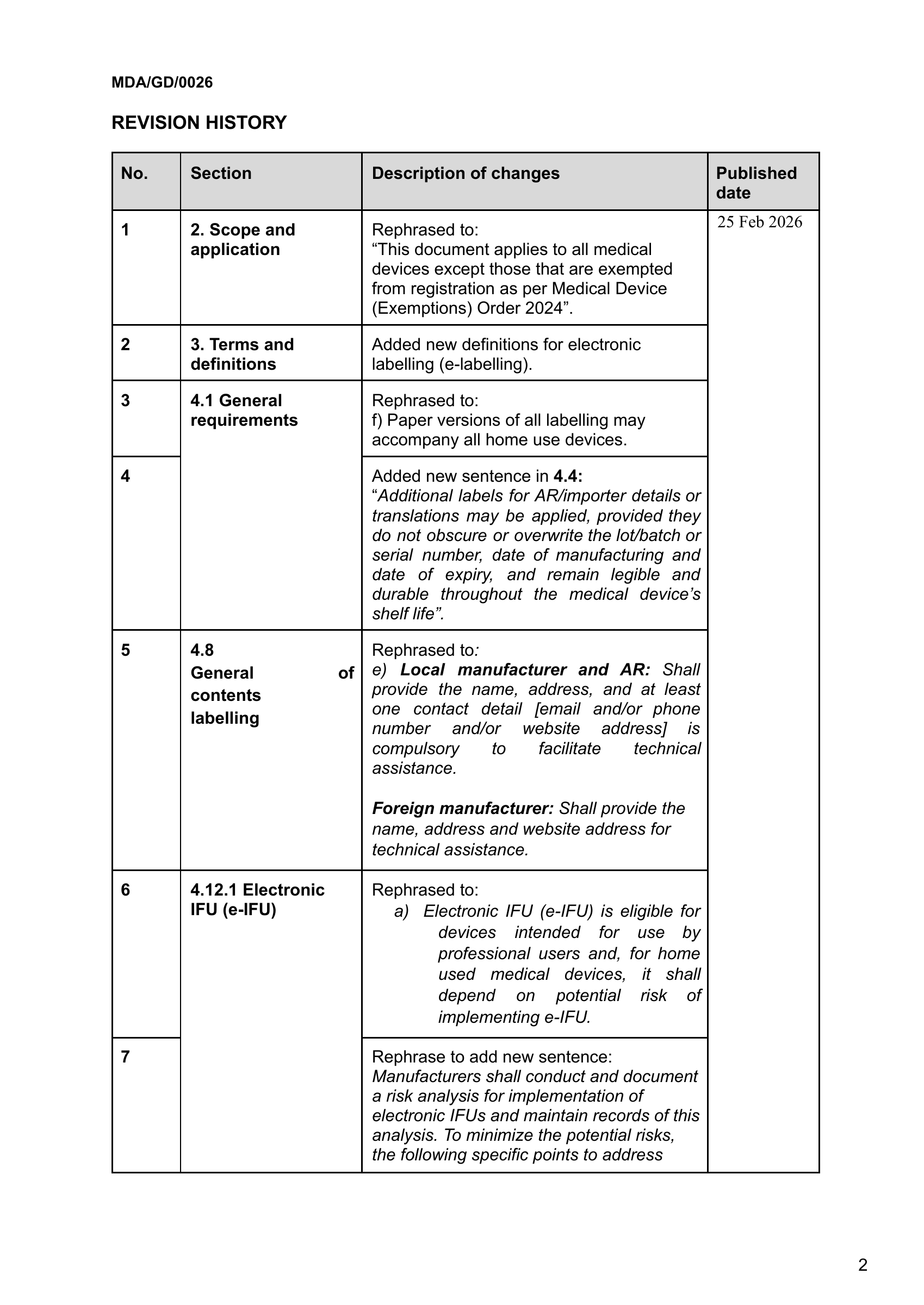
MDA/GD/0026 REVISION HISTORY No. Section Description of changes Published date 1 2. Scope and Rephrased to: 25 Feb 2026 application “This document applies to all medical devices except those that are exempted from registration as per Medical Device (Exemptions) Order 2024”. 2 3. Terms and Added new definitions for electronic definitions labelling (e-labelling). 3 4.1 General Rephrased to: requirements f) Paper versions of all labelling may accompany all home use devices. 4 Added new sentence in 4.4: “Additional labels for AR/importer details or translations may be applied, provided they do not obscure or overwrite the lot/batch or serial number, date of manufacturing and date of expiry, and remain legible and durable throughout the medical device’s shelf life”. 5 4.8 Rephrased to: General of e) Local manufacturer and AR: Shall contents provide the name, address, and at least one contact detail [email and/or phone labelling number and/or website address] is compulsory to facilitate technical assistance. Foreign manufacturer: Shall provide the name, address and website address for technical assistance. 6 4.12.1 Electronic Rephrased to: IFU (e-IFU) a) Electronic IFU (e-IFU) is eligible for devices intended for use by professional users and, for home used medical devices, it shall depend on potential risk of implementing e-IFU. 7 Rephrase to add new sentence: Manufacturers shall conduct and document a risk analysis for implementation of electronic IFUs and maintain records of this analysis. To minimize the potential risks, the following specific points to address 2
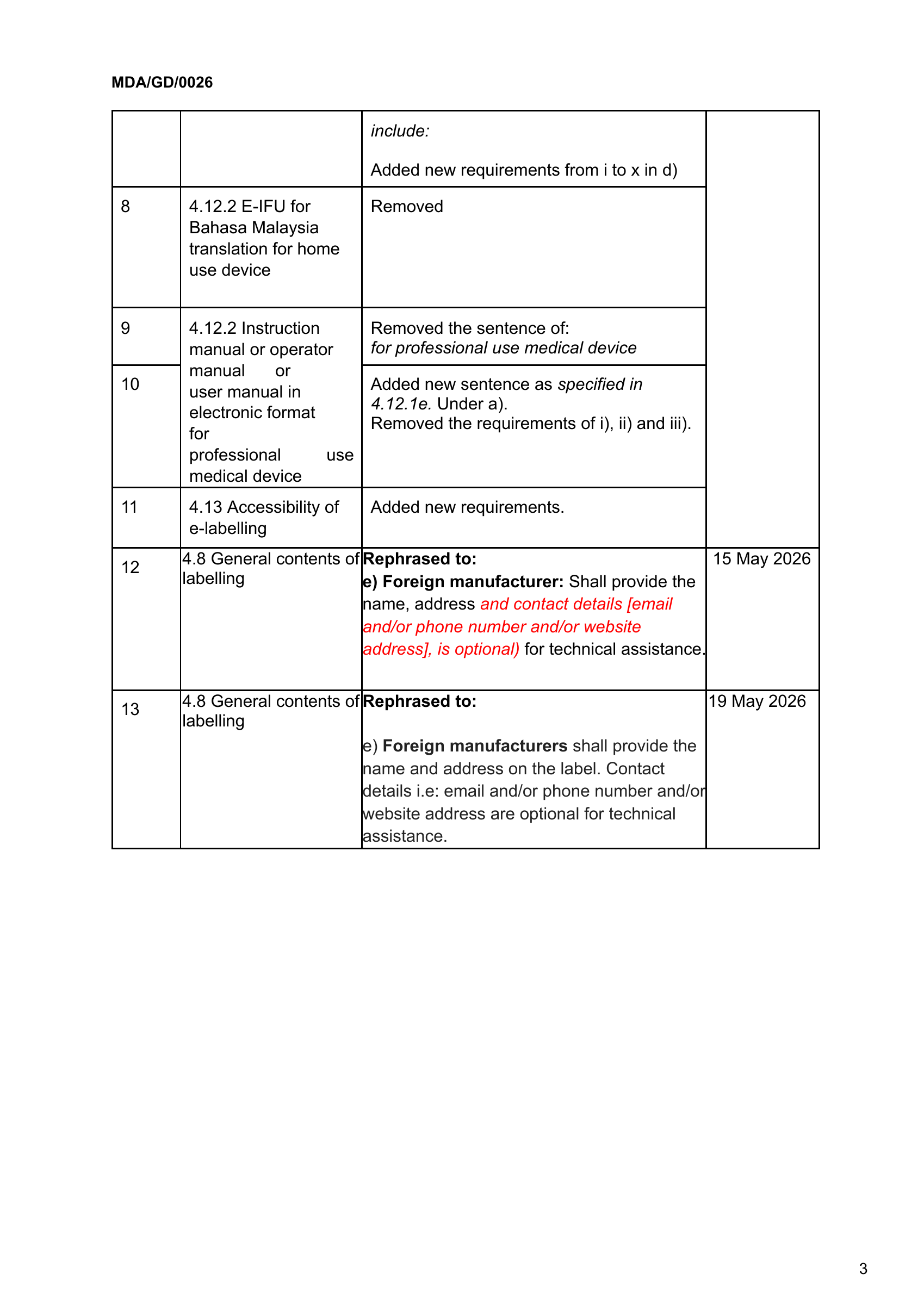
MDA/GD/0026 include: Added new requirements from i to x in d) 8 4.12.2 E-IFU for Removed Bahasa Malaysia translation for home use device 9 4.12.2 Instruction Removed the sentence of: manual or operator for professional use medical device manual or 10 user manual in Added new sentence as specified in 4.12.1e. Under a). electronic format Removed the requirements of i), ii) and iii). for professional use medical device 11 4.13 Accessibility of Added new requirements. e-labelling 12 4.8 General contents of Rephrased to: 15 May 2026 labelling e) Foreign manufacturer: Shall provide the name, address and contact details [email and/or phone number and/or website address], is optional) for technical assistance. 13 4.8 General contents of Rephrased to: 19 May 2026 labelling e) Foreign manufacturers shall provide the name and address on the label. Contact details i.e: email and/or phone number and/or website address are optional for technical assistance. 3
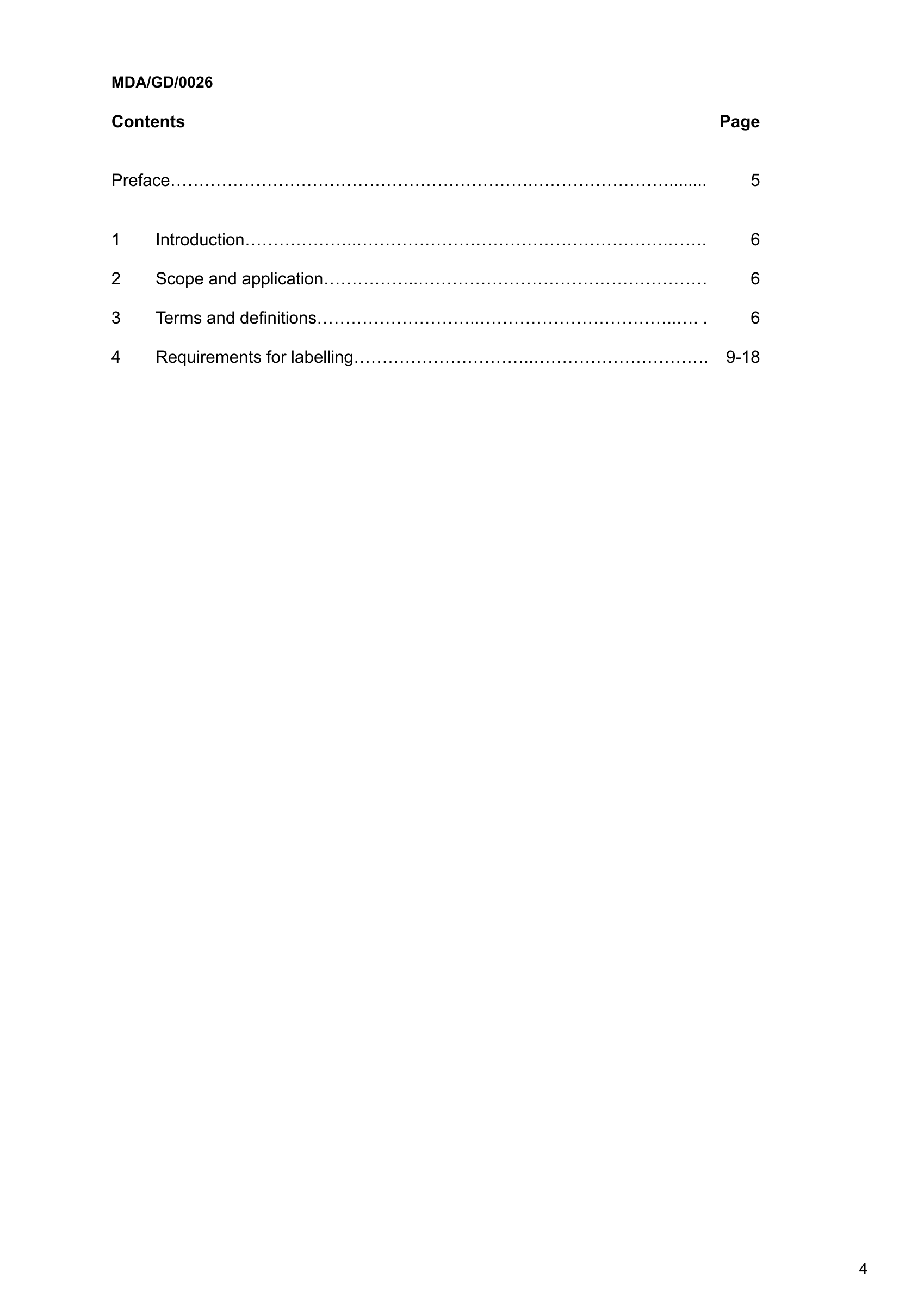
MDA/GD/0026 Contents Page Preface……………………………………………………….……………………........ 5 1 Introduction………………..……………………………………………….……. 6 2 Scope and application……………..…………………………………………… 6 3 Terms and definitions………………………..……………………………..…. . 6 4 Requirements for labelling…………………………..…………………………. 9-18 4
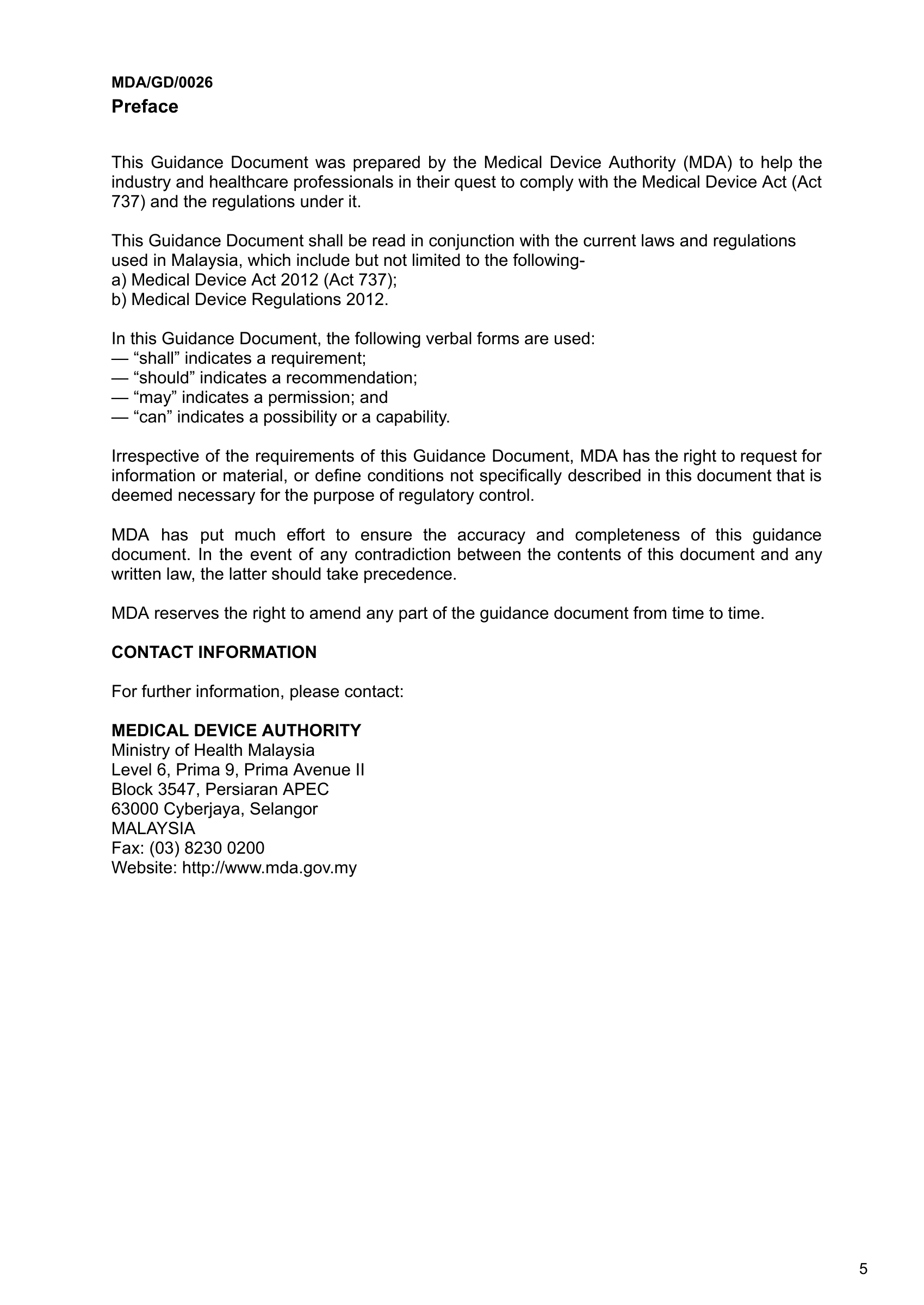
MDA/GD/0026 Preface This Guidance Document was prepared by the Medical Device Authority (MDA) to help the industry and healthcare professionals in their quest to comply with the Medical Device Act (Act 737) and the regulations under it. This Guidance Document shall be read in conjunction with the current laws and regulations used in Malaysia, which include but not limited to the following- a)Medical Device Act 2012 (Act 737); b)Medical Device Regulations 2012. In this Guidance Document, the following verbal forms are used: —“shall” indicates a requirement; —“should” indicates a recommendation; —“may” indicates a permission; and —“can” indicates a possibility or a capability. Irrespective of the requirements of this Guidance Document, MDA has the right to request for information or material, or define conditions not specifically described in this document that is deemed necessary for the purpose of regulatory control. MDA has put much effort to ensure the accuracy and completeness of this guidance document. In the event of any contradiction between the contents of this document and any written law, the latter should take precedence. MDA reserves the right to amend any part of the guidance document from time to time. CONTACT INFORMATION For further information, please contact: MEDICAL DEVICE AUTHORITY Ministry of Health Malaysia Level 6, Prima 9, Prima Avenue II Block 3547, Persiaran APEC 63000 Cyberjaya, Selangor MALAYSIA Fax: (03) 8230 0200 Website: http://www.mda.gov.my 5
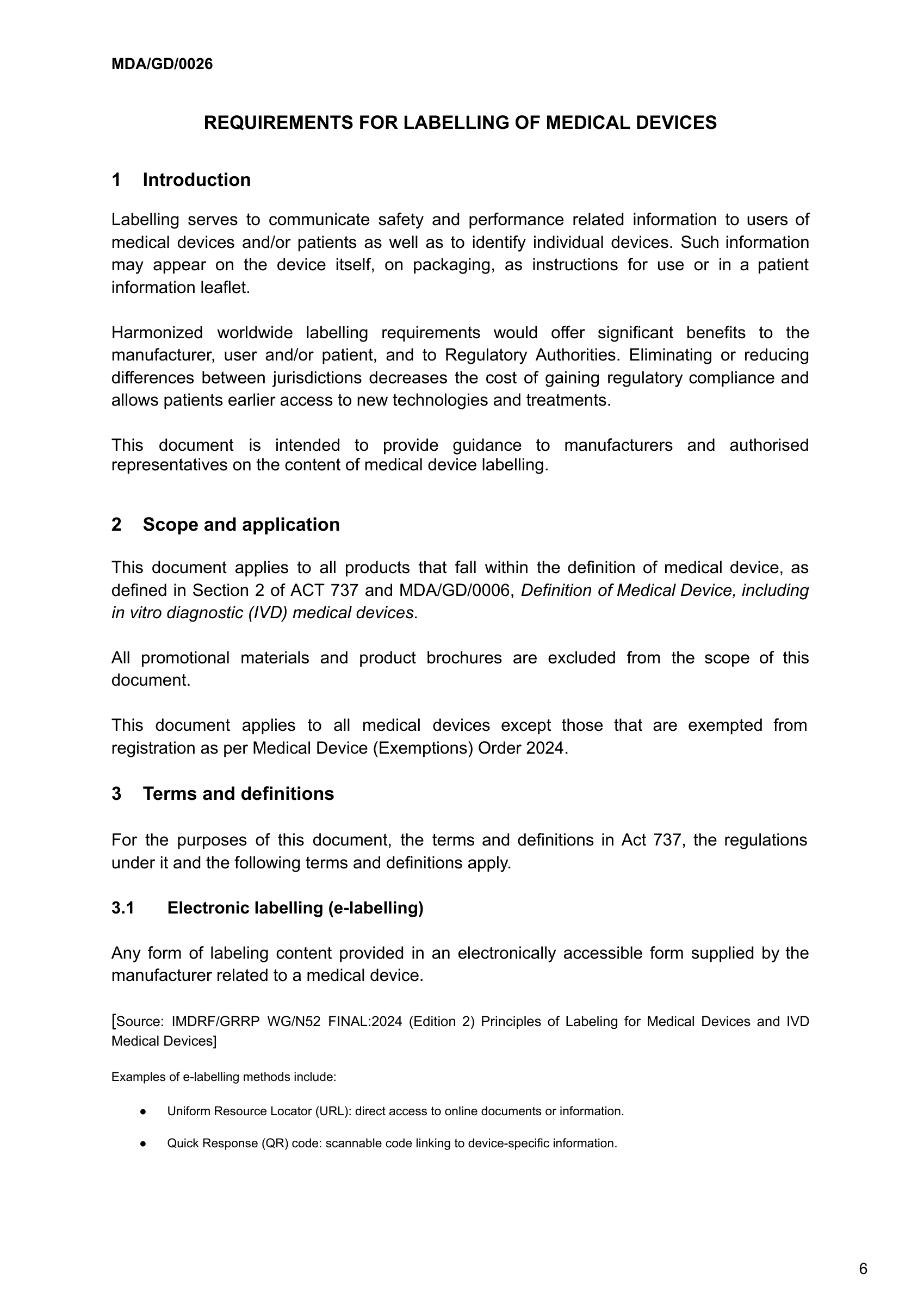
MDA/GD/0026 REQUIREMENTS FOR LABELLING OF MEDICAL DEVICES 1 Introduction Labelling serves to communicate safety and performance related information to users of medical devices and/or patients as well as to identify individual devices. Such information may appear on the device itself, on packaging, as instructions for use or in a patient information leaflet. Harmonized worldwide labelling requirements would offer significant benefits to the manufacturer, user and/or patient, and to Regulatory Authorities. Eliminating or reducing differences between jurisdictions decreases the cost of gaining regulatory compliance and allows patients earlier access to new technologies and treatments. This document is intended to provide guidance to manufacturers and authorised representatives on the content of medical device labelling. 2 Scope and application This document applies to all products that fall within the definition of medical device, as defined in Section 2 of ACT 737 and MDA/GD/0006, Definition of Medical Device, including in vitro diagnostic (IVD) medical devices. All promotional materials and product brochures are excluded from the scope of this document. This document applies to all medical devices except those that are exempted from registration as per Medical Device (Exemptions) Order 2024. 3 Terms and definitions For the purposes of this document, the terms and definitions in Act 737, the regulations under it and the following terms and definitions apply. 3.1 Electronic labelling (e-labelling) Any form of labeling content provided in an electronically accessible form supplied by the manufacturer related to a medical device. [Source: IMDRF/GRRP WG/N52 FINAL:2024 (Edition 2) Principles of Labeling for Medical Devices and IVD Medical Devices] Examples of e-labelling methods include: ● Uniform Resource Locator (URL): direct access to online documents or information. ● Quick Response (QR) code: scannable code linking to device-specific information. 6
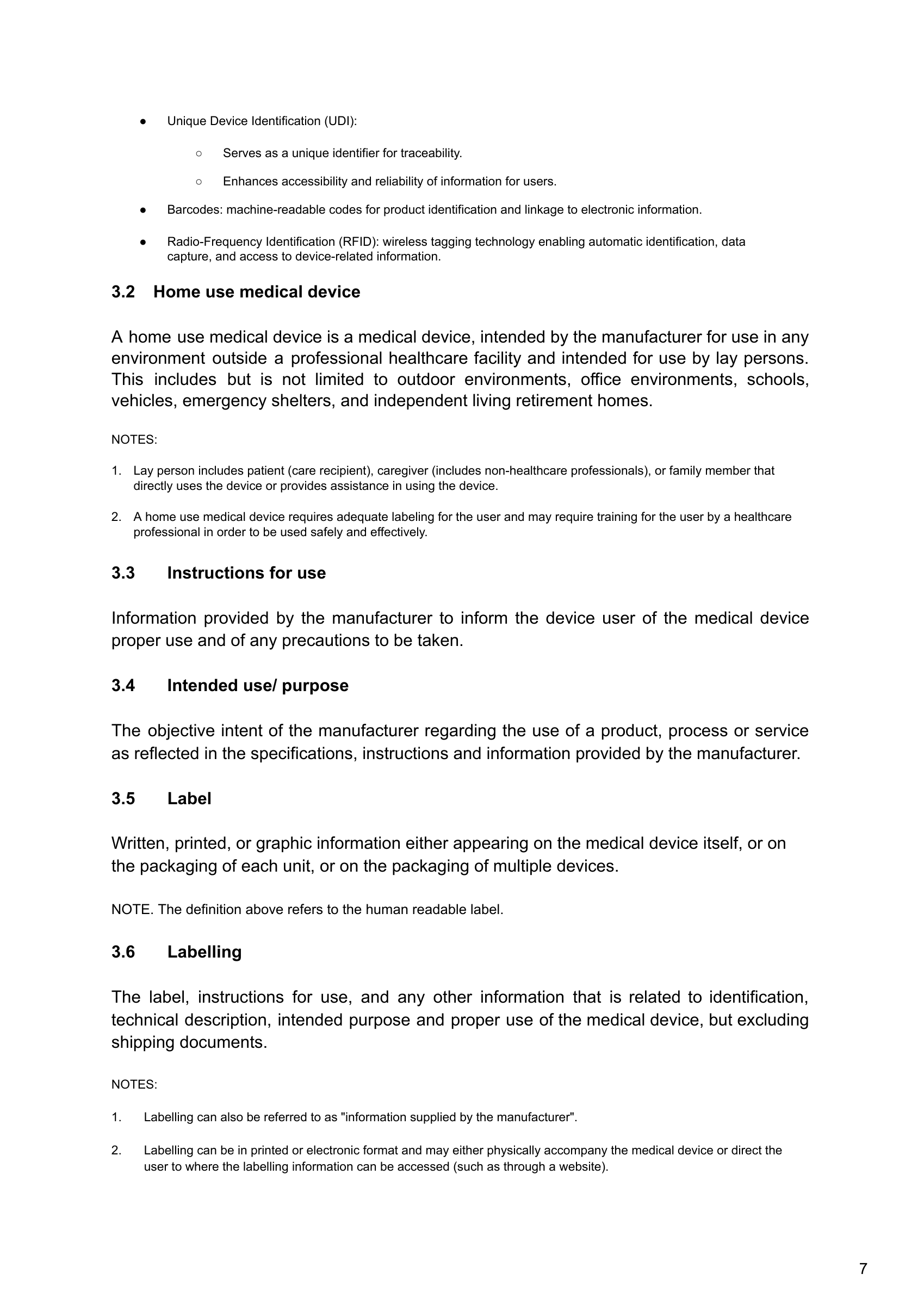
● Unique Device Identification (UDI): ○ Serves as a unique identifier for traceability. ○ Enhances accessibility and reliability of information for users. ● Barcodes: machine-readable codes for product identification and linkage to electronic information. ● Radio-Frequency Identification (RFID): wireless tagging technology enabling automatic identification, data capture, and access to device-related information. 3.2 Home use medical device A home use medical device is a medical device, intended by the manufacturer for use in any environment outside a professional healthcare facility and intended for use by lay persons. This includes but is not limited to outdoor environments, office environments, schools, vehicles, emergency shelters, and independent living retirement homes. NOTES: 1. Lay person includes patient (care recipient), caregiver (includes non-healthcare professionals), or family member that directly uses the device or provides assistance in using the device. 2. A home use medical device requires adequate labeling for the user and may require training for the user by a healthcare professional in order to be used safely and effectively. 3.3 Instructions for use Information provided by the manufacturer to inform the device user of the medical device proper use and of any precautions to be taken. 3.4 Intended use/ purpose The objective intent of the manufacturer regarding the use of a product, process or service as reflected in the specifications, instructions and information provided by the manufacturer. 3.5 Label Written, printed, or graphic information either appearing on the medical device itself, or on the packaging of each unit, or on the packaging of multiple devices. NOTE. The definition above refers to the human readable label. 3.6 Labelling The label, instructions for use, and any other information that is related to identification, technical description, intended purpose and proper use of the medical device, but excluding shipping documents. NOTES: 1. Labelling can also be referred to as "information supplied by the manufacturer". 2. Labelling can be in printed or electronic format and may either physically accompany the medical device or direct the user to where the labelling information can be accessed (such as through a website). 7
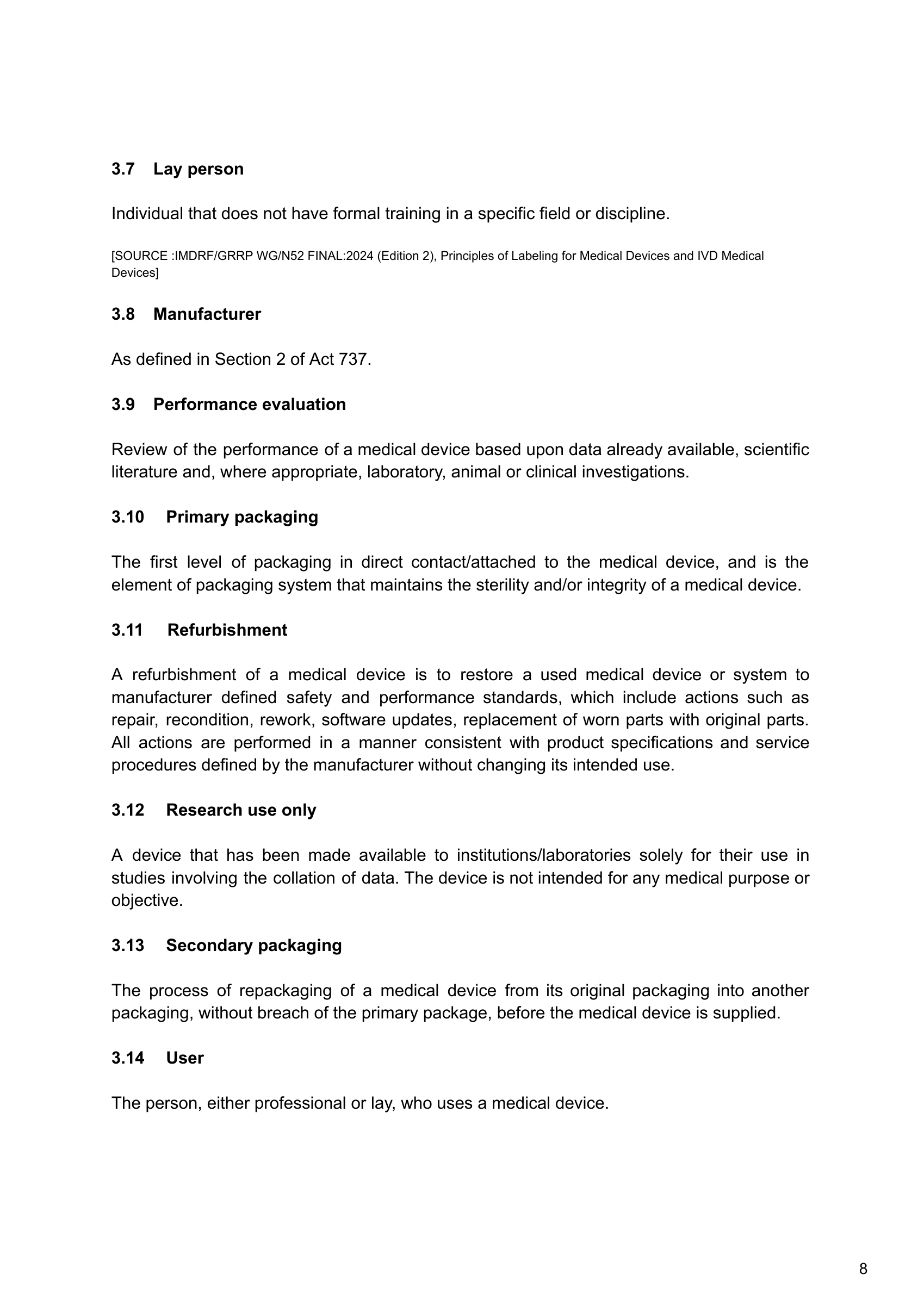
3.7 Lay person Individual that does not have formal training in a specific field or discipline. [SOURCE :IMDRF/GRRP WG/N52 FINAL:2024 (Edition 2), Principles of Labeling for Medical Devices and IVD Medical Devices] 3.8 Manufacturer As defined in Section 2 of Act 737. 3.9 Performance evaluation Review of the performance of a medical device based upon data already available, scientific literature and, where appropriate, laboratory, animal or clinical investigations. 3.10 Primary packaging The first level of packaging in direct contact/attached to the medical device, and is the element of packaging system that maintains the sterility and/or integrity of a medical device. 3.11 Refurbishment A refurbishment of a medical device is to restore a used medical device or system to manufacturer defined safety and performance standards, which include actions such as repair, recondition, rework, software updates, replacement of worn parts with original parts. All actions are performed in a manner consistent with product specifications and service procedures defined by the manufacturer without changing its intended use. 3.12 Research use only A device that has been made available to institutions/laboratories solely for their use in studies involving the collation of data. The device is not intended for any medical purpose or objective. 3.13 Secondary packaging The process of repackaging of a medical device from its original packaging into another packaging, without breach of the primary package, before the medical device is supplied. 3.14 User The person, either professional or lay, who uses a medical device. 8
4 Requirements for labelling 4.1 General requirements The labelling for all medical devices shall adhere to these general requirements: a) No person shall: i) place any medical device in the market unless it has been appropriately labelled; ii) use or operate any medical device to another person unless the label has been provided with the medical device when it is used on the other person; iii) use or operate any medical device to another person unless the label has been provided with the medical device when it is used to any other person in any investigational testing. b) A registered medical device shall be labelled with Malaysian medical device registration number and this shall be carried out within 6 months from the date of registration of the medical device. The use of QR code available from medical device registration certificate to indicate medical device registration number is encouraged. c) The label shall not contain any statement to the effect, whether directly or indirectly, that the placement in the market, or usage or operation of the medical device is being promoted or endorsed by the Authority or the Ministry of Health or any of its organizational bodies. d) The label of a medical device shall be legible, permanent and prominent. e) The medium, format, content, readability and location of labelling should be appropriate to the particular device, its intended purpose and the technical knowledge, experience, education or training of the intended user(s). In particular, instructions for use should be written in terms readily understood by the intended user and, where appropriate, supplemented with drawings and diagrams. Some devices may require separate information for the healthcare professional and the lay user. f) Paper versions of all labelling may accompany all home use devices. g) Any residual risk identified in the risk analysis should be reflected as contraindications or warnings within the labelling. 4.2 Instructions for use (IFU) may not be needed or may be abbreviated for medical devices of low or moderate risk if they can be used safely and as intended by the manufacturer without any such instructions. 9
4.3 Labelling may be provided to the user in various media and by several means, such as printed documents, through a display screen incorporated into the device and the manufacturer’s website. Whatever the media or the means, information should be targeted to the anticipated user population. 4.4 Labelling activities to meet the Medical Device Act and regulations, may be conducted post importation or manufacturing, but prior to placing in the market. Contents of labelling shall be as per submitted to the authority during medical device registration. There shall be no over labeling on the lot/batch or serial number, date of manufacturing and date of expiry. Additional labels for AR/importer details or translations may be applied, provided they do not obscure or overwrite the lot/batch or serial number, date of manufacturing and date of expiry, and remain legible and durable throughout the medical device’s shelf life. 4.5 Location of labelling The label shall be appropriately located depending on a particular medical device and its intended use, in accordance with these following manners: a) As far as it is practical and appropriate, the information needed to identify and use the medical device safely shall be provided on the medical device itself, and/or on the packaging for each unit (primary level of packaging), and/or the packaging of multiple medical devices (secondary level of packaging). If this is not practicable or appropriate, the information may be set out in the accompanying leaflet, manual, packaging insert, etc. b) The medical device registration number, and manufacturer/ authorised representative details and QR code (if available) shall be located where the information can be accessed at the point of sale by the customers/users. c) in the case of medical devices that are packaged together because individual packaging of the medical devices is not practical, the label shall be provided as leaflet, packaging insert, document or other media supplied with a single or multiple medical device; and d) if multiple medical devices are supplied to a single user and/or location or packaged together as one package, it may be appropriate to provide only a single copy of the label but more copies shall be supplied upon request. e) For information that is provided on the label, Bahasa Malaysia translation shall be provided on the label itself. 4.6 Format a) The format of labelling shall be in accordance with the international standards for medical device labelling where applicable. b) The use of internationally recognised symbols is encouraged provided that medical device safety is not compromised by a lack of understanding on the part of the patient 10
or user. Where the meaning of the symbol is not obvious to the medical device user, e.g. for a home-used medical device or for a newly introduced symbol, an explanation shall be provided. 4.7 Language a) The use of Bahasa Malaysia shall be required for home use medical devices. b) English language shall be used on the labelling for other types of medical devices. c) Other languages may be used as necessary. 4.8 General contents of labelling 4.8.1 The label of a medical device shall contain the following information: a) Details of medical device to enable user to identify it, which include name and model of the medical device; b) An indication of either the batch code/lot number (e.g. on single-use disposable medical devices or reagents) or the serial number (e.g. on electrically-powered medical devices), where relevant, to allow appropriate actions to trace and recall the medical devices. c) An unambiguous indication of the date until when the medical device may be used safely, expressed at least as the year and month (e.g. on medical devices supplied with sterile, single-use disposable medical devices or reagents), where this is relevant. For medical devices other than those covered by b) and c), and as appropriate to the type of medical device, an indication of the date of manufacture. This indication may be included in the batch code/lot number or serial number; d) Where relevant, the storage conditions and shelf life following the first opening of the primary container, together with the storage conditions and stability of working solutions. e) Local manufacturer and AR: Shall provide the name, address, and at least one contact detail [email and/or phone number and/or website address] is compulsory to facilitate technical assistance. Foreign manufacturers shall provide the name and address on the label. Contact details i.e: email and/or phone number and/or website address are optional for technical assistance. f) Technical details concerning the medical device, e.g: device specification/ formulation, colour, size, compatibility, and etc.; g) The details strictly necessary for a user to identify the device, the contents of the packaging and, where it is not obvious for the user, the intended purpose of the device; 11
h) Instructions for use of the medical device; i) Any undesirable side-effects, limitations, warnings and/or precautions on the safe use of the medical device; j) Any necessary post-market servicing needs for the medical device; and k) Any decommissioning or disposal information, if applicable and based on risk assessment (for example: infection or microbial hazards, environmental hazards; physical hazards). 4.8.2 The information in 4.8.1 f), g), h), i), j) and k) and other necessary information may be provided, in the form of insert or other types of labelling, after applying risk management as according to ISO 14971. 4.8.3 For all labeling information, requirements on MDA/GD/0032, Code of Advertisement (COA) shall be observed. 4.9 Specific contents of labelling a) For some medical devices, the following specific contents shall be included in the labelling: i) An indication on the external packaging of any special storage and/ or handling conditions that applies; ii) Verification that a medical device has been properly installed and can operate correctly and safely, the nature and frequency of preventative and regular maintenance, replacement of consumable components, and calibration needed to ensure optimal and safe operation of a medical device; iii) Treatment or handling, such as sterilisation, calibration, etc., that is needed before a medical device can be used. This includes information on the sterilisation method; iv) Identification for a sterile medical device, its indication for sterility and precautions and instructions if the sterile packaging is damaged, and where appropriate, description of re-sterilisation methods; v) Identification for a single-use medical device; vi) Identification for a reusable medical device, information and instruction for cleaning, disinfecting, packaging and, where appropriate, the method of re-sterilisation, and identification on when the medical device or its accessory can no longer be reused (e.g., signs of material degradation or the maximum number of allowable reuses). 12
vii) If the device is intended for research use only, it must be labelled as “research use only”; viii) The medical device labelling for the purpose of: 1. demonstrations, please refer to the guidance document MDA/GD/0018, Import and/or Supply of Unregistered Medical Devices for the Purpose of Demonstration for Marketing or Education; and 2. clinical research, please refer to the guidance document MDA/GD/0016, Notification of Exemption from Registration of Medical Devices for The Purpose of Clinical Research or Performance Evaluation. ix) Sufficient details to obtain a safe combination for a medical device that is to be installed with or connected to other medical devices or equipment or with dedicated software, in order to operate as required for its intended purpose; x) Particular risks in connection with implantation of an implantable medical device; xi) The risks of reciprocal interference posed by a reasonably foreseeable presence of a medical device during specific investigation or treatment; xii) The details of the nature, type, intensity and distribution of the radiation emitted by radiation emitting medical device; xiii) Indication that the medical device is a refurbished medical device. The refurbishment date shall also be indicated. b) The Authority may require any other additional information to be included as medical device labelling. 4.10 Instructions for use (IFU) In addition to 4.8, the IFU shall contain the following details on contra-indications, warnings, and precautions to be taken, where appropriate: a) Warnings, precautions or measures to be taken in the event of malfunction of the medical device or changes in its performance that may affect safety; b) Warnings, precautions or measures to be taken in regards to the exposure to reasonably foreseeable external influences or environmental conditions, such as magnetic fields, external electrical and electromagnetic effects, electrostatic discharge, radiation associated with diagnostic or therapeutic procedures, pressure, humidity, or temperature; c) Warnings, precautions or measures to be taken in regards to the risks of interference posed by the reasonably foreseeable presence of the medical device during specific 13
diagnostic investigations, evaluations, therapeutic treatment or use (e.g., electromagnetic interference emitted by the medical device affecting other equipment); d) Precautions related to materials incorporated into the medical device that are endocrine disrupting, carcinogenic, mutagenic or toxic to reproduction or could result in sensitisation or allergic reaction of the patient or user; e) Warnings or precautions related to potentially infectious material present in the medical device; f) Warnings or precautions for a medical device administering medicinal or biological products, including information that indicates any limitations or incompatibility in the type of substances to be delivered; g) Warnings, precautions or measures to be taken in regards to calibration and maintenance requirements that could result in inaccurate measurements, diagnostic results or therapeutic treatment or use; and h) Warnings or precautions on hazardous or potentially hazardous radiation, including: i. the nature of the emitted radiation; ii. the means of protecting the users, bystanders, and patients; iii. including ways of avoiding misuse; and iv. including ways of appropriately reducing the risks inherent during transport, storage and installation, where applicable. i) For medical device with measuring function, the degree of accuracy claimed by the manufacturer; j) Requirements for special facilities, special training or particular qualifications for the medical device user; k) A specification of the clinical benefit to be expected; l) A summary of safety and clinical performance information relevant to the user or patient; m) For medical device software, user instructions may be supplied in electronic data storage devices (e.g. compact disc, digital video disc, USB flash drive). The IFU should include the date of issue or latest revision of the instructions for use and, where appropriate, an identification number. Where relevant, for devices intended for home users, the IFU should contain a statement clearly directing the user not to make any decision of medical relevance without first consulting his or her health care provider. 14
4.11 Additional information for in vitro diagnostic medical devices 4.11.1 For in vitro diagnostic medical devices, the following additional information shall be included in its label: a) Intended use/ purpose (e.g. monitoring, screening or diagnostic) including an indication that it is for in vitro diagnostic use and these following information: i) type of analyte or measurement of the assay; ii) whether the test is qualitative or quantitative; iii) role of the test in the clinical use e.g. screening, diagnostic or detection, aid to diagnostic, monitoring; iv) disease or condition that the test is intended for; v) type of specimen to be used e.g. serum, plasma etc.; vi) the intended users (e.g. self-testing by lay person, near patient by trained personnel or professionals). vii) assay type (e.g. immunoassay, chemistry, cytochemistry, image analysis, immunohistochemistry, etc.); and viii) the specific name of the instrument required for the assay, if any. For instruments, the intended use should also include the modes of operation for instruments e.g., random access, batch, stat, open tube, closed tube, automatic, manual. b) test principle; c) specimen type, collection, handling and preparation; d) reagent description and any limitation (e.g. use with a dedicated instrument only); e) assay procedure including calculations and interpretation of results; f) information on interfering substances that may affect the performance of the assay; g) analytical performance characteristics, such as sensitivity, specificity, accuracy (trueness and precision); h) reference intervals; and i) use of drawings and diagrams. 15
4.11.2 The additional information for IVD should also include the following: a) the metrological traceability of values assigned to calibrators and trueness-control materials, including identification of applicable reference materials and/ or reference measurement procedures of higher order. b) study design (population studies, N, type of sample, matrix, dilution, target, concentrations, etc.). 4.12 Electronic labelling 4.12.1 Electronic IFU (e-IFU) The implementation of electronic Instructions for Use (e-IFU) shall ensure that device users have continuous access to up-to-date information, equivalent in content and accuracy to that provided in paper form. The manufacturer shall maintain appropriate risk controls and documentation to ensure accessibility, security, and version consistency. a) Electronic IFU (e-IFU) is eligible for devices intended for use by professional users and, for home used medical devices, it shall depend on potential risk of implementing e-IFU. b) Users shall always have the choice to obtain the content of the e-IFU in paper form on request, without undue delay or within the time period specified in the risk assessment, and at no additional cost. c) For information downloadable from the internet, the internet web address shall be clearly printed on the physical label of the device and displayed in such a manner that highlights to the user its purpose. The manufacturer /AR shall ensure that the information in the electronic label is identical with the printed IFU approved in the product registration. d) Manufacturers shall conduct and document a risk analysis for implementation of electronic IFUs and maintain records of this analysis. To minimize the potential risks, the following specific points to address include: i) knowledge and experience of the intended users in particular regarding the use of the device and user needs including to display the instructions for use in electronic form; ii) characteristics of the environment in which the device will be used; iii) access of the user to the electronic resources needed at the time of use; iv) performance of safeguards to ensure that the electronic data and content are protected from tampering; v) safety and back-up mechanisms in the event of a hardware or software fault, particularly if the instructions for use in electronic form are integrated within the device; 16
vi) foreseeable medical emergency situations requiring the provision of information in paper form/ Expected medical emergencies where paper information is needed; vii)impact caused by the temporary unavailability of the specific website or of the internet in general, or of their access in the healthcare institution as well as the safety measures available to cope with such a situation; viii)evaluation of the period within which the instructions for use shall be provided in paper form at the user’s request; ix) assessment of the website’s compatibility displaying the electronic instructions for use with different devices which could be used to display those instructions; x) management of different versions of the instructions for use. e) Manufacturers shall have defined procedures and processes for the establishment and revisions to electronic documents. f) Any changes to the electronic label shall comply with the specified requirements in Guidance on Change Notification for Registered Medical Devices (MDA/GD/0020). g) The corresponding paper IFU shall be revised accordingly within a defined timeframe to maintain version alignment and ensure that both formats contain consistent information. 4.12.2 Instruction manual or operator manual or user manual in electronic format; All types of manual are recommended to be in printed form. However, electronic form is allowed to be provided subject to the following conditions: a) Manufacturers shall conduct and document a risk analysis for implementation of electronic manuals and maintain records of this analysis as specified in 4.12.1d. b) Manufacturers shall have defined procedures and processes for the establishment and revisions to electronic documents. 4.13Accessibility of e-IFU a) E-IFU shall be made available in commonly accessible digital formats with legible font, sufficient contrast, and adjustable text size to accommodate users with visual or cognitive impairments, such as persons with disabilities, elderly etc., Where applicable, use of dynamic instructional content (i.e. the ability to shift from written to video/ audible material). b) A direct access mechanism (e.g., QR code, barcode, or URL) shall be provided on the device or its packaging to enable retrieval of the e-IFU. c) The manufacturer shall ensure that the eIFU can be downloaded or viewed offline. For software-based or app-based devices that rely on network connectivity, the IFU integrated in the software shall be easily accessible through a clearly labelled section 17
(e.g., ‘User Guide’, ‘Instructions’, or ‘Help’) and shall remain available during normal use of the device. d) Each e-IFU shall clearly display its version number, date of issue, or revision history. e) Manufacturers shall provide a customer support channel (e.g., helpline, chatbot, or website portal) to assist users who experience difficulties in accessing e-IFU. f) E-IFU systems shall be designed with appropriate measures to prevent unauthorised modification, ensuring data integrity and regulatory compliance at all times. 4.14Use of specific statements Statements such as “Medical Device Authority (MDA)” and/or “Ministry of Health Malaysia” (unless it is required by Ministry of Health Malaysia) is prohibited in all labelling as it is considered as an endorsement from the Authority. Note: These statements may be included if requested in tender documents. 4.15Use of MDA Logo Any logo of the Medical Device Authority (MDA) is prohibited to be placed in the medical device labelling. 18
MEDICAL DEVICE AUTHORITY MINISTRY OF HEALTH, MALAYSIA Contact Information: Medical Device Authority Ministry of Health Malaysia Level 6, Prima 9, Prima Avenue II Block 3547, Persiaran APEC 63000 Cyberjaya, Selangor MALAYSIA T: (03) 8230 0300 F: (03) 8230 0200 Website: http://www.mda.gov.my 19