Searchable PDF text layer
MDA/GD/0072 May 2026 First Edition MEDICAL DEVICE GUIDANCE DOCUMENT CHANGE MANAGEMENT FOR REGISTERED MEDICAL DEVICES
Currentness under review. Whether this instrument remains applicable is under review. Consult the later instruments and source context below before relying on it.
Original page images are authoritative. Searchable text is the PDF text layer and may omit image text or contain extraction artifacts. Quote and verify against the page images.
Link directly to a passage with its anchor — for example #pdf-page-1 — to open it highlighted. This reference version is generated from the authority’s publication and does not replace it. Language: English.
MDA/GD/0072 May 2026 First Edition MEDICAL DEVICE GUIDANCE DOCUMENT CHANGE MANAGEMENT FOR REGISTERED MEDICAL DEVICES
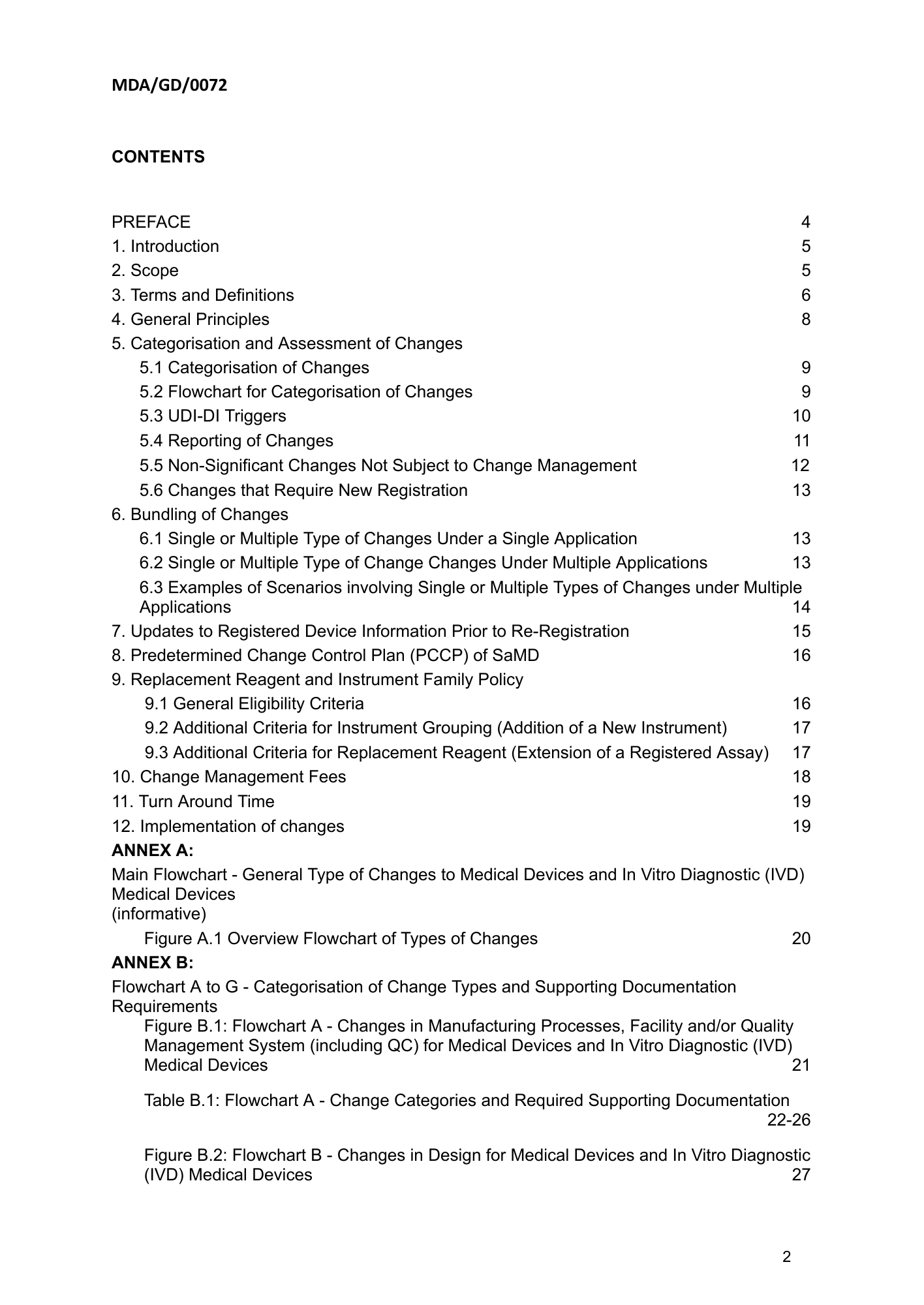
MDA/GD/0072 CONTENTS PREFACE 4 1. Introduction 5 2. Scope 5 3. Terms and Definitions 6 4. General Principles 8 5. Categorisation and Assessment of Changes 5.1 Categorisation of Changes 9 5.2 Flowchart for Categorisation of Changes 9 5.3 UDI-DI Triggers 10 5.4 Reporting of Changes 11 5.5 Non-Significant Changes Not Subject to Change Management 12 5.6 Changes that Require New Registration 13 6. Bundling of Changes 6.1 Single or Multiple Type of Changes Under a Single Application 13 6.2 Single or Multiple Type of Change Changes Under Multiple Applications 13 6.3 Examples of Scenarios involving Single or Multiple Types of Changes under Multiple Applications 14 7. Updates to Registered Device Information Prior to Re-Registration 15 8. Predetermined Change Control Plan (PCCP) of SaMD 16 9. Replacement Reagent and Instrument Family Policy 9.1 General Eligibility Criteria 16 9.2 Additional Criteria for Instrument Grouping (Addition of a New Instrument) 17 9.3 Additional Criteria for Replacement Reagent (Extension of a Registered Assay) 17 10. Change Management Fees 18 11. Turn Around Time 19 12. Implementation of changes 19 ANNEX A: Main Flowchart - General Type of Changes to Medical Devices and In Vitro Diagnostic (IVD) Medical Devices (informative) Figure A.1 Overview Flowchart of Types of Changes 20 ANNEX B: Flowchart A to G - Categorisation of Change Types and Supporting Documentation Requirements Figure B.1: Flowchart A - Changes in Manufacturing Processes, Facility and/or Quality Management System (including QC) for Medical Devices and In Vitro Diagnostic (IVD) Medical Devices 21 Table B.1: Flowchart A - Change Categories and Required Supporting Documentation 22-26 Figure B.2: Flowchart B - Changes in Design for Medical Devices and In Vitro Diagnostic (IVD) Medical Devices 27 2
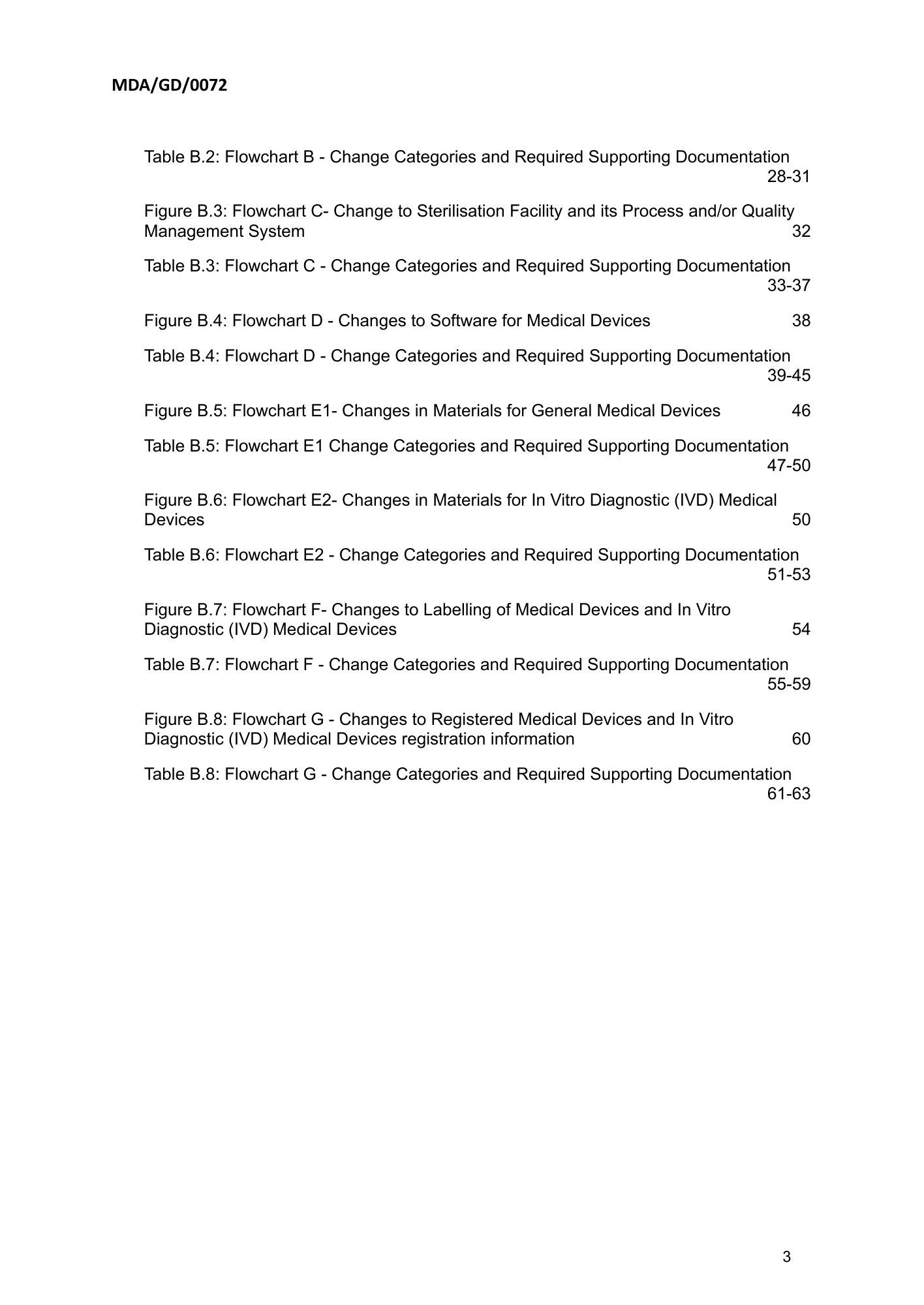
MDA/GD/0072 Table B.2: Flowchart B - Change Categories and Required Supporting Documentation 28-31 Figure B.3: Flowchart C- Change to Sterilisation Facility and its Process and/or Quality Management System 32 Table B.3: Flowchart C - Change Categories and Required Supporting Documentation 33-37 Figure B.4: Flowchart D - Changes to Software for Medical Devices 38 Table B.4: Flowchart D - Change Categories and Required Supporting Documentation 39-45 Figure B.5: Flowchart E1- Changes in Materials for General Medical Devices 46 Table B.5: Flowchart E1 Change Categories and Required Supporting Documentation 47-50 Figure B.6: Flowchart E2- Changes in Materials for In Vitro Diagnostic (IVD) Medical Devices 50 Table B.6: Flowchart E2 - Change Categories and Required Supporting Documentation 51-53 Figure B.7: Flowchart F- Changes to Labelling of Medical Devices and In Vitro Diagnostic (IVD) Medical Devices 54 Table B.7: Flowchart F - Change Categories and Required Supporting Documentation 55-59 Figure B.8: Flowchart G - Changes to Registered Medical Devices and In Vitro Diagnostic (IVD) Medical Devices registration information 60 Table B.8: Flowchart G - Change Categories and Required Supporting Documentation 61-63 3
MDA/GD/0072 PREFACE This Guidance Document was prepared by the Medical Device Authority (MDA) to help the industry and healthcare professionals in their quest to comply with the Medical Device Act 2012 (Act 737) and the regulations under it. This Guidance Document shall be read in conjunction with the current laws and regulations used in Malaysia, which include but not limited to the following- a) Medical Device Act 2012 (Act 737); and b) Medical Device Regulations 2012. In this Guidance Document, the following verbal forms are used: —“shall” indicates a requirement; —“should” indicates a recommendation; —“may” indicates a permission; and —“can” indicates a possibility or a capability. Irrespective of the requirements of this Guidance Document, MDA has the right to request for information or material, or define conditions not specifically described in this document that is deemed necessary for the purpose of regulatory control. MDA has put much effort into ensuring the accuracy and completeness of this guidance document. In the event of any contradiction between the contents of this document and any written law, the latter should take precedence. MDA reserves the right to amend any part of the guidance document from time to time. CONTACT INFORMATION For further information, please contact: MEDICAL DEVICE AUTHORITY Ministry of Health Malaysia Level 6, Prima 9, Prima Avenue II Blok 3547, Persiaran APEC 63000 Cyberjaya, Selangor MALAYSIA Tel: +603-8230 0300 Fax: +603-8230 0200 Email: https://femes.mda.gov.my/ Website: http://www.mda.gov.my 4
MDA/GD/0072 CHANGE MANAGEMENT FOR REGISTERED MEDICAL DEVICES 1. Introduction During its lifecycle, a medical device may undergo various changes. Any modifications or changes made to a registered medical device must align with the essential principles of safety and/or performance, enabling a risk-based regulatory system to effectively control the associated market risks. A manufacturer is obligated to assess the impact of any modification to a medical device on the patient, practitioner, and/or user. This assessment determines whether the change is anticipated to affect the device's safety, performance, or effectiveness, or the arrangements established to maintain quality system compliance with relevant standards (e.g., design verification, design validation, human factors, organizational structure, facility additions, deletions, or relocations), and/or applicable regulatory requirements. This is crucial for ensuring the continued safety, performance, and effectiveness of the medical device. This document outlines general principles, categorization, reporting, and alternative pathways for managing changes. It employs a risk-based approach with illustrative examples. 2. Scope This document applies to all registered medical devices under the Act 737 and outlines key considerations for manufacturers when a device undergoes any changes or modifications. It is also applicable when a registered medical device requires changes, or proposed changes, due to a mandatory reportable problem (MPR) or field corrective action (FCA) in accordance with Section 40 or Section 41 of Act 737. Apart from Change Management (CM) submissions made in accordance with the applicable categories of change, the manufacturer may also update the information and supporting documents of a registered medical device prior to re-registration. Such updates shall be carried out through the Change Management module while the registration certificate remains valid. In summary, the Change Management process applies to: 1. Any changes to a registered medical device; or 2. Updates arising from post-market issues, including reportable incidents and field corrective actions; or 3. Updates to information or documents required in preparation for re-registration. 5
MDA/GD/0072 3. Terms and Definitions For the purposes of this document, the terms and definitions provided in Act 737, its subsidiary regulations, and the following definitions shall apply. 3.1 Critical Supplier A supplier delivering materials, components, or services, that may influence the safety and performance of the product. Note 1: In the context of QMS, a critical supplier is one whose product or service, if it fails to meet specified manufacturer’s requirements, could result in an unreasonable risk to the patient, clinician, or others, or cause significant degradation in performance. This definition also encompasses suppliers of services essential for complying with Quality Management System (QMS) or regulatory requirements. Note 2: The following is a non-exhaustive list of examples of critical suppliers: ● suppliers of certain types of raw materials, including; medicinal substances, active ingredients, and material of animal, microbial or recombinant origin. ● suppliers of sterilisation services. ● suppliers of design and development activities for manufacturers holding, or applying for, a full quality assurance Conformity Assessment certificate. ● suppliers that carry out all stages of production and supply on behalf of the manufacturer. [Source: GHTF/SG4/N84 Guidelines for Regulatory Auditing of Quality Management Systems of Medical Device Manufacturers, Additional section 4. (Critical supplier details), Therapeutic Goods Administration, Department of Health, Disability and Ageing, Australian Government] 3.1 Editorial changes Simple clarifications that do not alter the substantive meaning of the information. Editorial changes may include punctuation changes, grammar corrections, typographical correction, reordering existing material, rephrasing sentences that do not alter the content and adding headers for ease of use. 3.2 Intended use The objective intent of the manufacturer regarding the use of a product, process or service as reflected in the specifications, instructions and information provided by the manufacturer. [Source: Medical Device Regulations 2012] 3.3 In Vitro Diagnostic (IVD) Medical Devices In vitro diagnostic tests are used for in vitro examination of specimens derived from the human body to provide information for screening, diagnosis, or treatment monitoring purposes. Includes any reagent, reagent product, calibrator, control material, kit, instrument, apparatus, equipment or system, whether used alone or in combination with any other reagent, reagent product, calibrator, control material, kit, instrument, apparatus, equipment or system, that is intended by its manufacturer to be used in vitro for the examination of any specimen, including any blood or tissue donation, derived from the human body, solely 6
MDA/GD/0072 or principally for the purpose of providing information: a) concerning a physiological or pathological state or a congenital abnormality b) to determine the safety and compatibility of any blood or tissue donation with a potential recipient thereof; or c) to monitor therapeutic measures; and includes a specimen receptacle. [SOURCE: Guidance Document MDA/GD/0001 In-Vitro Diagnostic (IVD) Medical Device Classification System] 3.4 Labelling The label, instructions for use, and any other information that is related to identification, technical description, intended purpose and proper use of the medical device, but excluding shipping documents. 3.5 Manufacturer As defined in Section 2 of the Act 737. 3.6 MeDC@St A web-based, centralized online application system administered by the MDA, used for submission and management of establishment licences, medical device registrations, change management applications, and related regulatory filings. 3.7 Medical device As defined in Section 2 of Act 737 and MDA/GD/0006: Guidance on the Definition of Medical Device. 3.8 Multiple application A consolidated Change Management submission that encompasses two or more Medical Device Registration Certificate numbers. This submission is applicable when the same type of change affects multiple registered medical devices. 3.9 Non-significant change Any change that has little or no potential to affect the safety and/or performance/effectiveness of the medical device. [SOURCE: Guidance Document GHWP/WG2-WG1-WG3/F001:2024 Change management to registered Medical Devices] 3.10 Quality Control (QC) It is part of quality management focused on fulfilling quality requirements. [SOURCE: (ISO 9000 Quality management)] 7
MDA/GD/0072 3.11 Risk management A systematic application of management policies, procedures and practices to the tasks of analysing, evaluating, controlling and monitoring risk. [SOURCE: ISO 14971:2019 Medical devices - Application of risk management to medical devices] 3.12 Single application A Change Management submission involving only one Medical Device Registration Certificate number. 3.13 Significant change Any change that could reasonably be expected to affect the safety and/or performance/effectiveness of a medical device or its conformity with the essential principles. [SOURCE: Guidance Document GHWP/WG2-WG1-WG3/F001:2024 Change management to registered Medical Devices] 3.14 Software as a medical device (SaMD) Software as intended to be used for one or more medical purposes that perform these purposes without being part of a hardware medical device. Notes: a) SaMD is a medical device and includes in-vitro diagnostic (IVD) medical devices; b) SaMD is capable of running on general purpose (non-medical purpose) computing platforms; c) “without being part of” means software not necessary for a hardware medical device to achieve its intended medical purpose; d) Software does not meet the definition of SaMD if its intended purpose is to drive a hardware medical device; e) SaMD may be used in combination (e.g., as a module) with other products including medical devices; f) SaMD may be interfaced with other medical devices, including hardware medical devices and other SaMD software, as well as general purpose software; g) Mobile apps that meet the definition above are considered SaMD. [SOURCE: Guidance Document IMDRF, Software as a Medical Device (SaMD): Key Definitions] 4. General Principles For any change made to a registered medical device, the manufacturer shall evaluate: ● the device concerned; ● the potential impact of the change on patients, practitioners, and/or users; ● the implications of the change on the intended use or indications for use, risk classification, and device specifications. Following this evaluation, the manufacturer shall determine whether the change may reasonably be expected to influence the safety, performance, or effectiveness of the device, 8
MDA/GD/0072 or its continued conformity with the Essential Principles and its overall risk–benefit profile throughout the device’s lifecycle. 5. Categorisation and Assessment of Changes 5.1 Categorisation of Changes Changes to a registered medical device may be categorised as significant or non-significant, depending on the extent to which the changes impact the safety and/or performance of the device. A significant change typically may: i. introduce risks to the patient and / or user that were not previously identified in the risk management file; ii. increase the probability of occurrence of existing hazards; or iii. modify the presentation of existing or new risks to the user, including those arising from labelling changes or new indications for use. Significant changes may include, but are not limited to, changes to: i. the manufacturing process, facility, or equipment; ii. the manufacturing quality control procedures, including methods, tests, reference standards, or procedures used to control the quality, purity, and sterility of the device or the materials used in its manufacture; iii. the design of the device, including its performance characteristics, principles of operation, and specifications of materials, energy source, software, or accessories. Note: Refer to Annex A for the complete list of significant changes. A non-significant change is any change that has little or no potential to affect the safety and/or performance of the medical device. 5.2 Flowchart for Categorisation of Changes The following section provides flowcharts to assist manufacturers in assessing a change to determine whether the change constitutes a significant change that needs to be reported to the MDA. Certain changes classified as non-significant may also require reporting, depending on their nature and impact. The main flowchart in Annex A outlines the general categories of changes and offers practical guidance to support manufacturers in assessing whether a change may affect the safety and/or performance of a medical device. Flowcharts A to G in Annex B present specific questions and decision pathways to further assist in determining whether a change should be categorised as significant or non-significant. These flowcharts, together with their accompanying explanations, are intended to clarify the decision-making process for change categorisation. 9
MDA/GD/0072 The summary of the flowcharts is provided in Table 1. Table 1. Summary of Flowchart Categorization based on Type of Changes Flowchart Changes Main Flowchart General Type of Changes to Medical Devices and In Vitro Diagnostic (IVD) Medical Devices Flowchart A Changes in Manufacturing Processes, Facility and/or Quality Management System (including QC) for Medical Devices and In Vitro Diagnostic (IVD) Medical Devices Flowchart B Changes in Design for Medical Devices and In Vitro Diagnostic (IVD) Medical Devices Flowchart C Changes to Sterilisation Facility and its Process Flowchart D Changes to Software for Medical Devices Flowchart E1 Changes in Materials for Medical Devices Flowchart E2 Changes in Materials for In Vitro Diagnostic (IVD) Medical Devices Flowchart F Changes to Labelling of Medical Devices and In Vitro Diagnostic (IVD) Medical Devices Flowchart G Changes to Registered Medical Devices and In Vitro Diagnostic (IVD) Medical Devices registration information 5.3 UDI-DI Triggers UDI-DI (Unique Device Identifier – Device Identifier) triggers are specific changes or events in a medical device’s characteristics, labelling, or packaging that necessitate the assignment of a new UDI-DI. These triggers ensure that each distinct version or model of a device is uniquely identifiable, avoiding misidentification and maintaining traceability throughout the device’s life cycle. If the same Device Identifier (DI) continues to be used for newer versions of a medical device after changes have been made, it may lead to misidentification of the device and/or ambiguity in its traceability. A new UDI-DI should be assigned when changes are made to any of the following UDI-DI related device data elements: ● Brand name ● Device version or model ● Clinical size (including volume, length, gauge, diameter) ● Labelled as single-use ● Packaged as sterile ● Requirement for sterilisation before use ● Quantity of devices contained within a package ● Critical warnings or contraindications (e.g., contains latex or Bis(2-ethylhexyl) phthalate (DEHP)) ● New or revised packaging configurations 10
MDA/GD/0072 When a change to a registered medical device necessitates a new UDI-DI, the manufacturer shall assess the change based on the flowchart Categorisation to determine the appropriate categories of change and apply for the applicable Change Management or a new pre-market submission, in accordance with the regulatory requirements. 5.4 Reporting of changes A manufacturer or Authorised Representative (AR) shall manage and assess all changes to a registered medical device according to their potential impact on safety and performance to determine the categorisation of change. Changes categorized as Significant Change shall be reported to MDA as explained in the Categorisation of Change Flowchart. The change will be subjected to evaluation and approval by MDA. For such changes, the affected medical device may only be placed on the market upon receipt of the MDA’s approval. Generally, non-significant changes do not require reporting to the MDA before implementation. However, referring to the Categorisation of Change Flowchart, for certain non-significant changes, notification to the MDA is required. This notification must be submitted with the necessary supporting documentation. For non-significant changes that do not require notification to the MDA, the manufacturer or AR must maintain a documented assessment and supporting evidence within their Quality Management System (QMS) and/or technical documentation. This documentation is necessary to demonstrate the continued safety and intended performance of the device. To assist manufacturers in determining the correct reporting pathway, Table 2 provides a recommended approach for reporting various types of changes. Table 2. Recommended Approach for Reporting Changes Type of Changes Reporting Pathway Significant Change Changes that require evaluation and approval by the MDA prior to implementation and before the device is placed on the market. Non-Significant Change – Changes that may be implemented immediately upon Notification Required submission of complete documentation through MeDC@St. Non-Significant Change – Changes that do not require submission; however, the Notification Optional manufacturer may submit a notification voluntarily. Non-Significant Change Changes that do not require submission but must be fully documented within the manufacturer’s QMS and/or technical documentation. Note: QMS requirement: Manufacturer shall assess the changes, perform risk benefit of the product, document the changes and if applicable update the technical documentation. All Change Management applications shall be submitted through MeDC@St. Manufacturers or AR are required to provide complete supporting documentation as specified in Annex B. 11
MDA/GD/0072 Manufacturers or AR are reminded that the determination of required documentation for a change management shall be based on all changes submitted, and not solely on an individual category of change. All Change Management applications shall be supported with complete documents. Where any supporting document is unavailable, a clear and valid justification shall be provided. 5.5 Non-Significant Changes Not Subject to Change Management The following types of changes are considered non-significant and are not subject to formal change management procedures: ● Changes to raw material suppliers (excluding medicinal substances and biological material suppliers) provided that the change does not affect the specifications of the registered medical device. ● Editorial changes to the labelling that do not affect the device’s intended use, safety, or performance. ● Rephrasing or rearrangement of information in the labelling without altering the meaning of the information remains unchanged. ● Labelling changes involving the addition and/or removal of languages that are not required by the MDA. ● Labelling changes involving the addition, removal, or modification of references to regulatory clearances or authorisations, provided that such changes do not affect the device’s registration. ● Labelling changes involving the addition, removal, or modification of barcodes, provided that such changes do not alter the registered device’s List of Configuration (LoC) information. ● Labelling changes that involve only layout, colour, font size, or design adjustments, provided there is no change to the prominence or content of the labelling. ● Labelling changes that update distributor information, including EU Authorised Representatives (AR), provided these changes do not affect the registered medical device information. ● Labelling changes to update Authorised Representative (AR) information, such as changes to the AR name, address, or ownership, provided that the amendment has been approved in the Establishment Licence (EL) Module by the MDA. NOTE: This above list is non-exhaustive and may be subject to change by the Authority These changes must still be documented within the manufacturer’s Quality Management System (QMS) to demonstrate that the device continues to comply with regulatory and safety requirements. 12
MDA/GD/0072 5.6 Changes that Require New Registration The following types of changes may require the manufacturers or AR to apply for new registration and subject to the regulatory assessment: a) Fundamental changes to a registered medical device that result in the device being considered as a new medical device, such as a complete change to its intended use or intended purpose previously approved; b) Change to the risk classification of a registered medical device; c) Addition of devices not considered a permissible variant according to the rules of grouping in Second Schedule of MDR 2012 and MDA/GD/0005, Product Grouping; d) Addition of variant(s) for Cluster (Class A and B) according to the rules of grouping in Second Schedule of MDR2012 and MDA/GD/0054 Product Grouping for In-Vitro Diagnostic (IVD) Medical Devices; e) Addition of medical devices with device proprietary names different from the registered devices, into a device listing. Unless the devices with different proprietary names qualify to be listed together under one listing based on MDA guidance documents on grouping criteria for medical devices registration. 6. Bundling of Changes Significant and non-significant changes that require notification submission in MeDC@St may be bundled for regulatory submission purposes, provided the changes meet the requirements outlined in this guidance. Bundling allows multiple related changes to be submitted together in a single application or across multiple applications, depending on the nature and scope of the changes. There are two types of bundling changes: 6.1 Single or Multiple Type of Changes Under a Single Application When changes involve one or multiple types of changes applied to a single registration certificate, such changes may be bundled and submitted under one Change Management application. 6.2 Single or Multiple Type of Change Changes Under Multiple Applications Bundling of one or multiple types of changes across multiple applications is only permitted for the following type of changes: ● Change in Manufacturer Name and/or Address. ● Change in Manufacturing Site Name and/or Address. ● Change in Sterilisation Site Name and/or Address. ● Change in Quality Management System (QMS) Information. 13
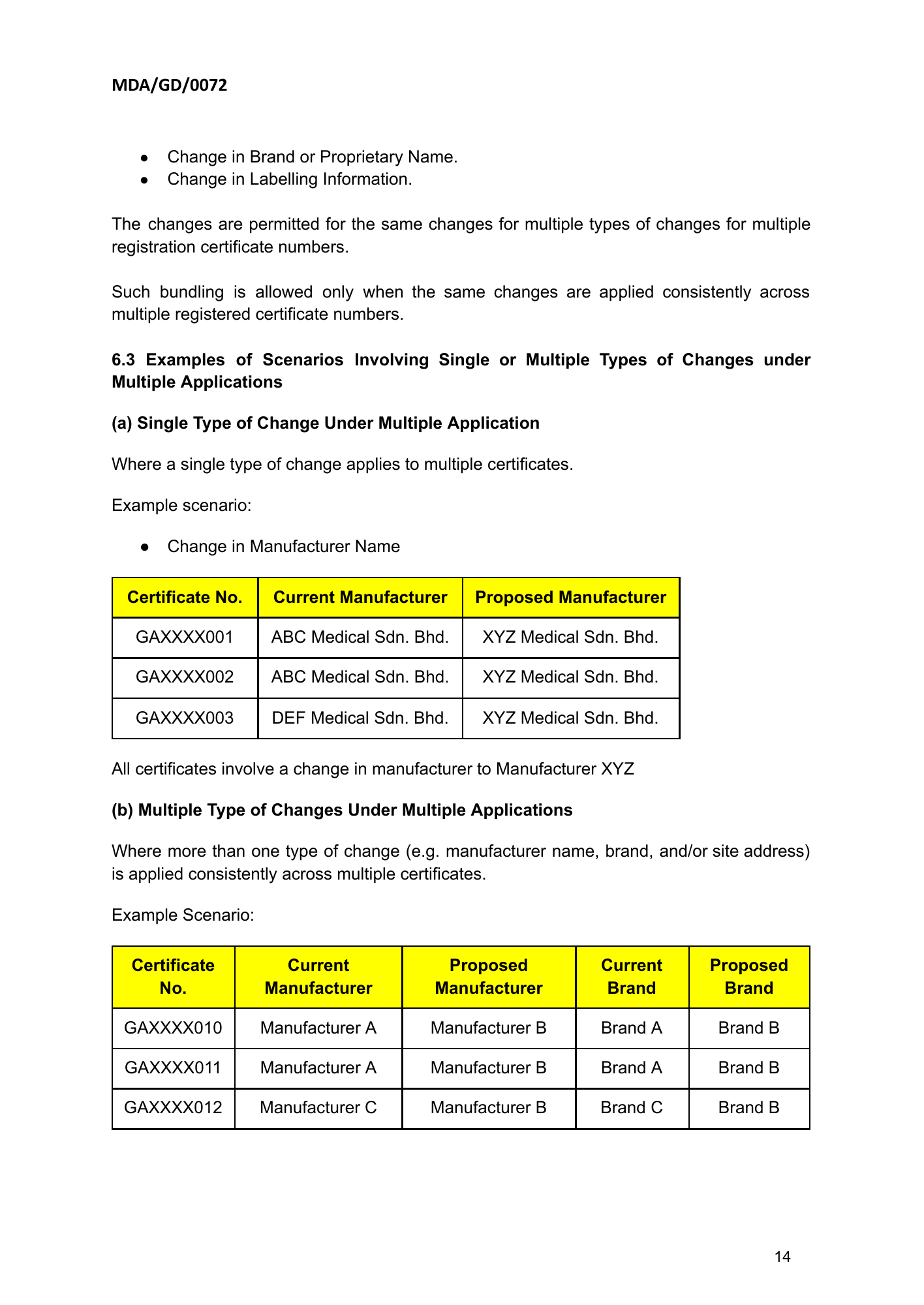
MDA/GD/0072 ● Change in Brand or Proprietary Name. ● Change in Labelling Information. The changes are permitted for the same changes for multiple types of changes for multiple registration certificate numbers. Such bundling is allowed only when the same changes are applied consistently across multiple registered certificate numbers. 6.3 Examples of Scenarios Involving Single or Multiple Types of Changes under Multiple Applications (a) Single Type of Change Under Multiple Application Where a single type of change applies to multiple certificates. Example scenario: ● Change in Manufacturer Name Certificate No. Current Manufacturer Proposed Manufacturer GAXXXX001 ABC Medical Sdn. Bhd. XYZ Medical Sdn. Bhd. GAXXXX002 ABC Medical Sdn. Bhd. XYZ Medical Sdn. Bhd. GAXXXX003 DEF Medical Sdn. Bhd. XYZ Medical Sdn. Bhd. All certificates involve a change in manufacturer to Manufacturer XYZ (b) Multiple Type of Changes Under Multiple Applications Where more than one type of change (e.g. manufacturer name, brand, and/or site address) is applied consistently across multiple certificates. Example Scenario: Certificate Current Proposed Current Proposed No. Manufacturer Manufacturer Brand Brand GAXXXX010 Manufacturer A Manufacturer B Brand A Brand B GAXXXX011 Manufacturer A Manufacturer B Brand A Brand B GAXXXX012 Manufacturer C Manufacturer B Brand C Brand B 14
MDA/GD/0072 In this case: ● All certificates involve a change in manufacturer to Manufacturer B; and ● All certificates involve a change in brand to Brand B. Even though the existing manufacturers or brands differ among certificates, the proposed change outcome is the same across all applications. Therefore, the changes may be bundled under a single Change Management submission. 7. Updates to Registered Device Information Prior to Re-Registration Apart from Change Management submissions made in accordance with the applicable categories of change, manufacturers may also update the information and supporting documents of a registered medical device prior to re-registration. Such updates shall be carried out through the Change Management module while the registration certificate remains valid. This change is classified as a non-significant change and must be notified to the MDA. Only medical devices with fully updated and current information may proceed with re-registration. Manufacturers are responsible for ensuring that all required information and documents are updated at any time within the five-year validity period of the certificate, and that these updates are completed before submission of the re-registration application. Re-registration cannot proceed if any required information or document has not been updated. For the purpose of re-registration, the following information and documents shall be updated according to device class: ● Class A Medical Devices o Declaration of Conformity (DoC) o Quality Management System (QMS) information o Post-Market Surveillance (PMS) information ● Class B, C, and D Medical Devices o Declaration of Conformity (DoC) o Quality Management System (QMS) information o Post-Market Surveillance (PMS) information o Clinical Evaluation Report (CER) or Clinical Performance Report (CPR) o Risk Management Report o CAB Report and Certificate Manufacturers must ensure that all updates are completed and approved, where required, prior to initiating the re-registration process. However, the MDA reserves the right to request additional information or documents if deemed necessary to support the evaluation and approval of the re-registration application. 15
MDA/GD/0072 8. Predetermined Change Control Plan (PCCP) of SaMD Any changes to an approved Predetermined Change Control Plan (PCCP) that was submitted during the initial premarket review (new medical device registration application) shall be managed through a formal change management application. A PCCP outlines the pre-specified elements of Software as a Medical Device (SaMD) that may be modified post-market, along with the associated methodology, data requirements, and verification/validation processes that ensure ongoing compliance with safety and performance principles. Once the PCCP has been reviewed and approved as part of the premarket submission, it forms part of the regulatory decision for the device. Therefore, any subsequent change to the approved PCCP within the allowable change boundaries must be submitted to the MDA through a change management application to ensure that the revised PCCP remains appropriate, scientifically justified, and consistent with the device’s intended use and risk classification. The change management process allows the MDA to assess whether: ● The proposed modification to the PCCP continues to support the safe and effective performance of the device; ● The change remains within the originally approved regulatory framework; and ● Any new information, risks, or methodologies introduced are adequately controlled and documented. This approach maintains regulatory oversight while enabling innovation and continuous improvement under a controlled and transparent mechanism. NOTE: The comprehensive requirements for PCCP will be specified in a separate guidance document on Software as a Medical Device (SaMD). 9. Replacement Reagent and Instrument Grouping Approaches The Replacement Reagent and Instrument Grouping expedites the availability of low to medium-risk assays on instruments within the same family. The Reagent Replacement Grouping is a risk-based approach that relies on the manufacturer’s Quality Management System (QMS), including risk-based assessments, and criteria, testing, and internal documentation for each reagent application, to allow low or medium risk reagents to be added to a registered instrument. Aligned with the principles outlined in the Instrument Grouping, a new instrument may be added to a registered instrument family. 9.1 General Eligibility Criteria To qualify for this criteria: ● The IVD test kit/assay and instrument shall be registered with MDA; and ● The changes do not significantly affect the safety, performance, or intended use of the test system; and 16
MDA/GD/0072 ● The manufacturer has an established Quality Management System (QMS) to support risk assessment, verification/validation, and documentation; and ● The change involves class A and B IVDs only; and ● Verification and validation confirm equivalent performance to the registered medical device. 9.2 Additional Criteria for Instrument Grouping (Addition of a New Instrument) A new instrument may be added to an existing instrument grouping when it complies to the additional criteria below: ● It shares the same general architecture, design, detection method, and intended use as the approved master instrument. ● Differences such as throughput, user interface, or data storage do not affect assay performance. ● The new instrument’s performance is verified and validated against acceptance criteria used for the master instrument. ● Comparative documentation (e.g., architecture, software, reaction conditions) demonstrates equivalence. 9.3 Additional Criteria for Replacement Reagent (Extension of a Registered Assay) Registered assay/test kit may be applied to another registered instrument or instrument grouping when: ● The intended use and detection principle are the same. ● The assay’s key components, formulation, and performance characteristics are the same. ● The instrument is already approved or part of an approved grouping. ● The new combination has been verified and validated by the manufacturer to confirm comparable analytical and clinical performance. If the device meets all the eligibility criteria outlined under the Replacement Reagent and Instrument Family, the changes can be proceeded through the Change Management process in accordance with MDA’s regulatory requirements, supported by comparative documentation, risk assessment, and performance validation data. Note:This approach does not apply if:- ● The assay or instrument is new and not previously approved. ● There is a change in measurement principle, detection method, or intended use. ● The device involves high-risk IVDs, blood banking, self-testing, or point-of-care use. ● There are significant reagent formulation changes or new sample types introduced. ● The instruments are classified as class A, whereas reagents and kits have different classification higher than Class A. 17
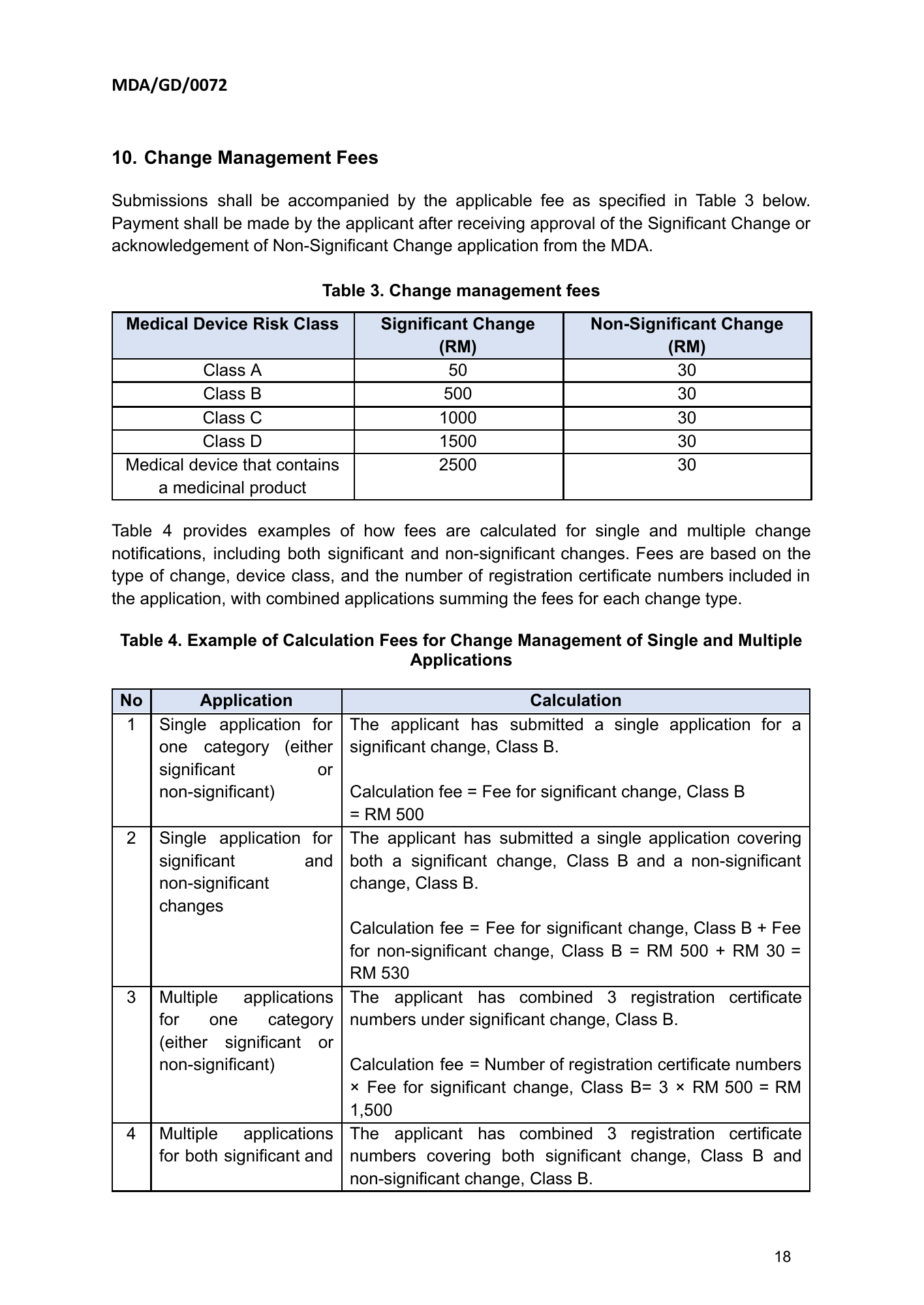
MDA/GD/0072 10.Change Management Fees Submissions shall be accompanied by the applicable fee as specified in Table 3 below. Payment shall be made by the applicant after receiving approval of the Significant Change or acknowledgement of Non-Significant Change application from the MDA. Table 3. Change management fees Medical Device Risk Class Significant Change Non-Significant Change (RM) (RM) Class A 50 30 Class B 500 30 Class C 1000 30 Class D 1500 30 Medical device that contains 2500 30 a medicinal product Table 4 provides examples of how fees are calculated for single and multiple change notifications, including both significant and non-significant changes. Fees are based on the type of change, device class, and the number of registration certificate numbers included in the application, with combined applications summing the fees for each change type. Table 4. Example of Calculation Fees for Change Management of Single and Multiple Applications No Application Calculation 1 Single application for The applicant has submitted a single application for a one category (either significant change, Class B. significant or non-significant) Calculation fee = Fee for significant change, Class B = RM 500 2 Single application for The applicant has submitted a single application covering significant and both a significant change, Class B and a non-significant non-significant change, Class B. changes Calculation fee = Fee for significant change, Class B + Fee for non-significant change, Class B = RM 500 + RM 30 = RM 530 3 Multiple applications The applicant has combined 3 registration certificate for one category numbers under significant change, Class B. (either significant or non-significant) Calculation fee = Number of registration certificate numbers × Fee for significant change, Class B= 3 × RM 500 = RM 1,500 4 Multiple applications The applicant has combined 3 registration certificate for both significant and numbers covering both significant change, Class B and non-significant change, Class B. 18
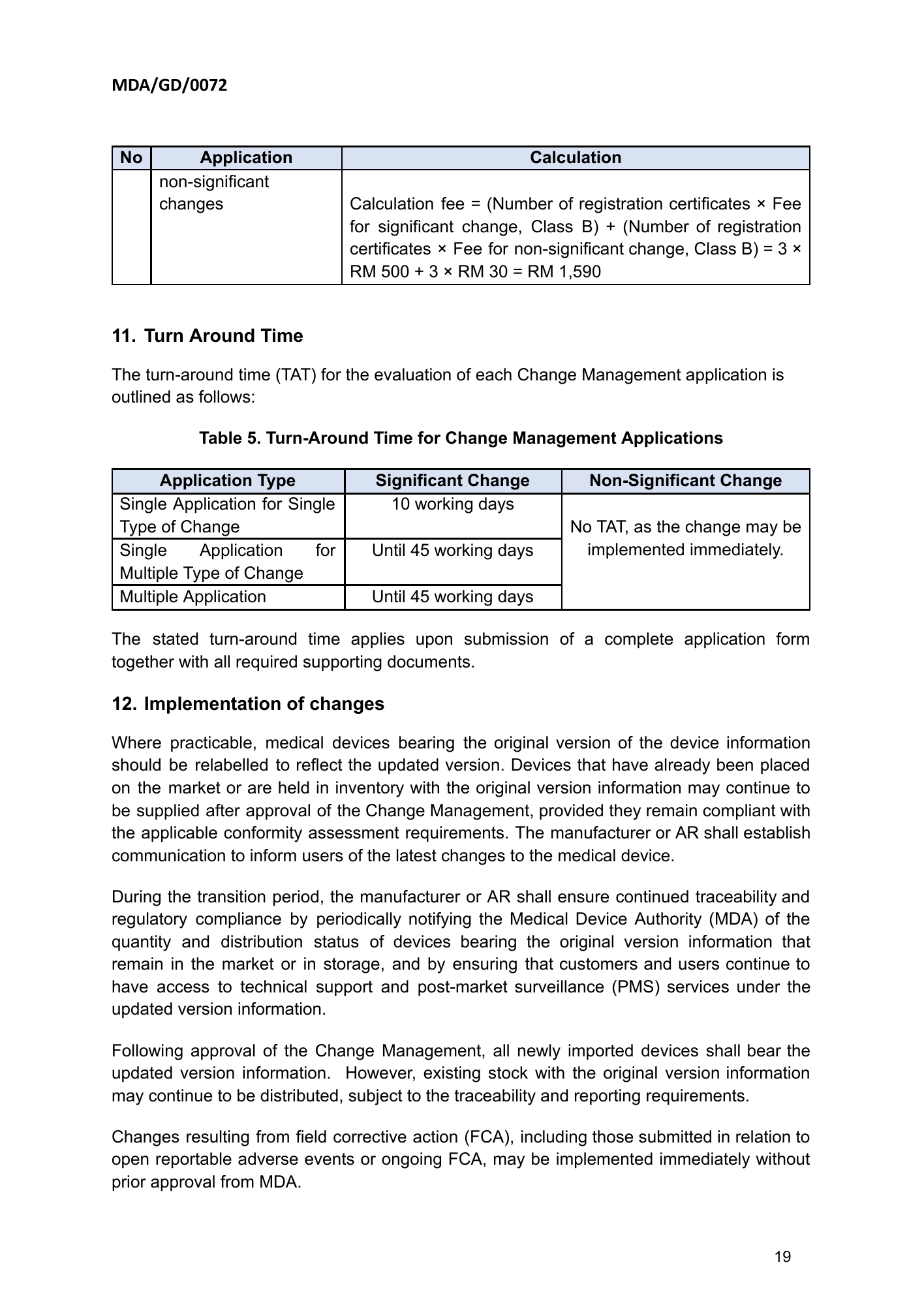
MDA/GD/0072 No Application Calculation non-significant changes Calculation fee = (Number of registration certificates × Fee for significant change, Class B) + (Number of registration certificates × Fee for non-significant change, Class B) = 3 × RM 500 + 3 × RM 30 = RM 1,590 11. Turn Around Time The turn-around time (TAT) for the evaluation of each Change Management application is outlined as follows: Table 5. Turn-Around Time for Change Management Applications Application Type Significant Change Non-Significant Change Single Application for Single 10 working days Type of Change No TAT, as the change may be Single Application for Until 45 working days implemented immediately. Multiple Type of Change Multiple Application Until 45 working days The stated turn-around time applies upon submission of a complete application form together with all required supporting documents. 12.Implementation of changes Where practicable, medical devices bearing the original version of the device information should be relabelled to reflect the updated version. Devices that have already been placed on the market or are held in inventory with the original version information may continue to be supplied after approval of the Change Management, provided they remain compliant with the applicable conformity assessment requirements. The manufacturer or AR shall establish communication to inform users of the latest changes to the medical device. During the transition period, the manufacturer or AR shall ensure continued traceability and regulatory compliance by periodically notifying the Medical Device Authority (MDA) of the quantity and distribution status of devices bearing the original version information that remain in the market or in storage, and by ensuring that customers and users continue to have access to technical support and post-market surveillance (PMS) services under the updated version information. Following approval of the Change Management, all newly imported devices shall bear the updated version information. However, existing stock with the original version information may continue to be distributed, subject to the traceability and reporting requirements. Changes resulting from field corrective action (FCA), including those submitted in relation to open reportable adverse events or ongoing FCA, may be implemented immediately without prior approval from MDA. 19
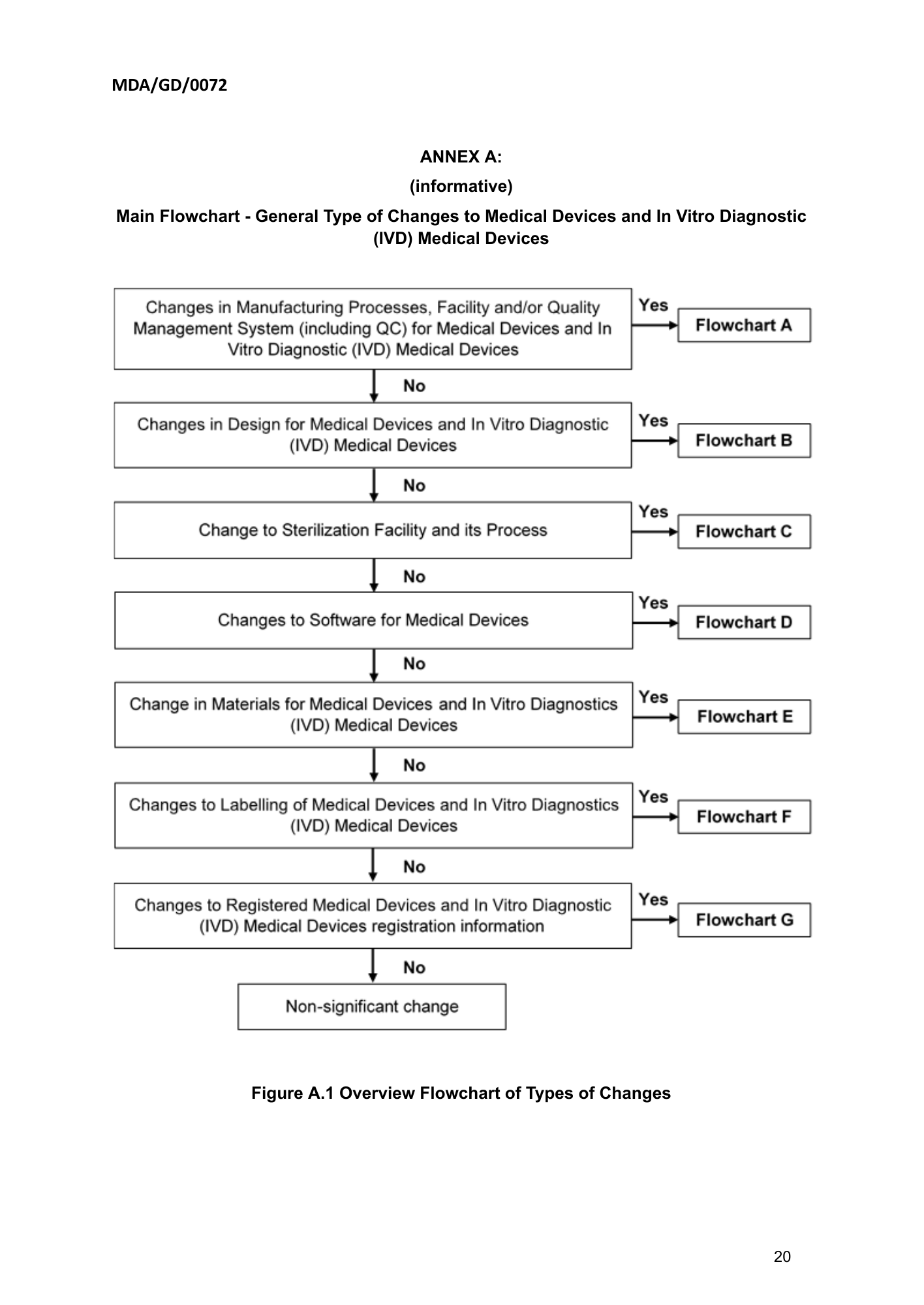
MDA/GD/0072 ANNEX A: (informative) Main Flowchart - General Type of Changes to Medical Devices and In Vitro Diagnostic (IVD) Medical Devices Figure A.1 Overview Flowchart of Types of Changes 20
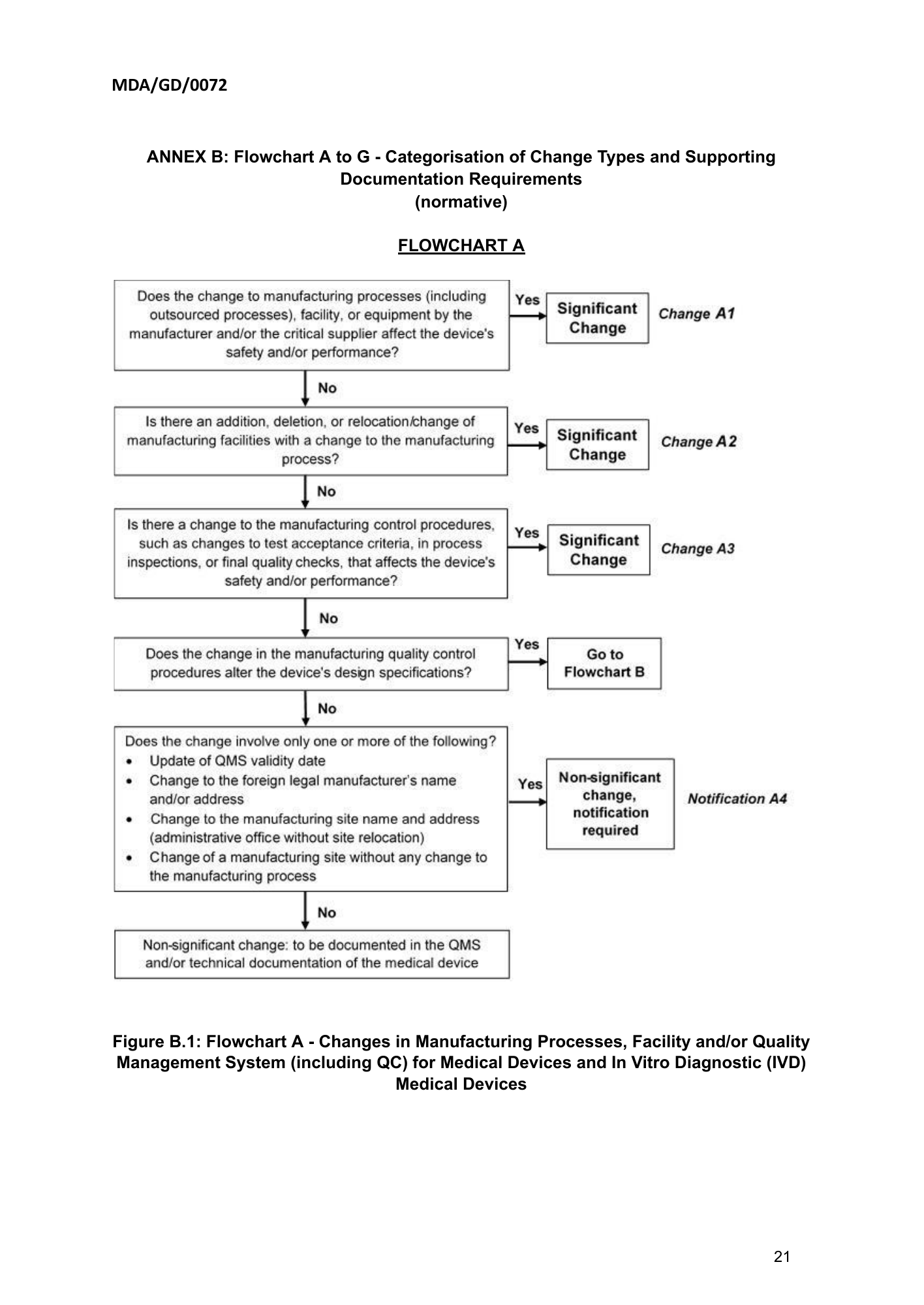
MDA/GD/0072 ANNEX B: Flowchart A to G - Categorisation of Change Types and Supporting Documentation Requirements (normative) FLOWCHART A Figure B.1: Flowchart A - Changes in Manufacturing Processes, Facility and/or Quality Management System (including QC) for Medical Devices and In Vitro Diagnostic (IVD) Medical Devices 21
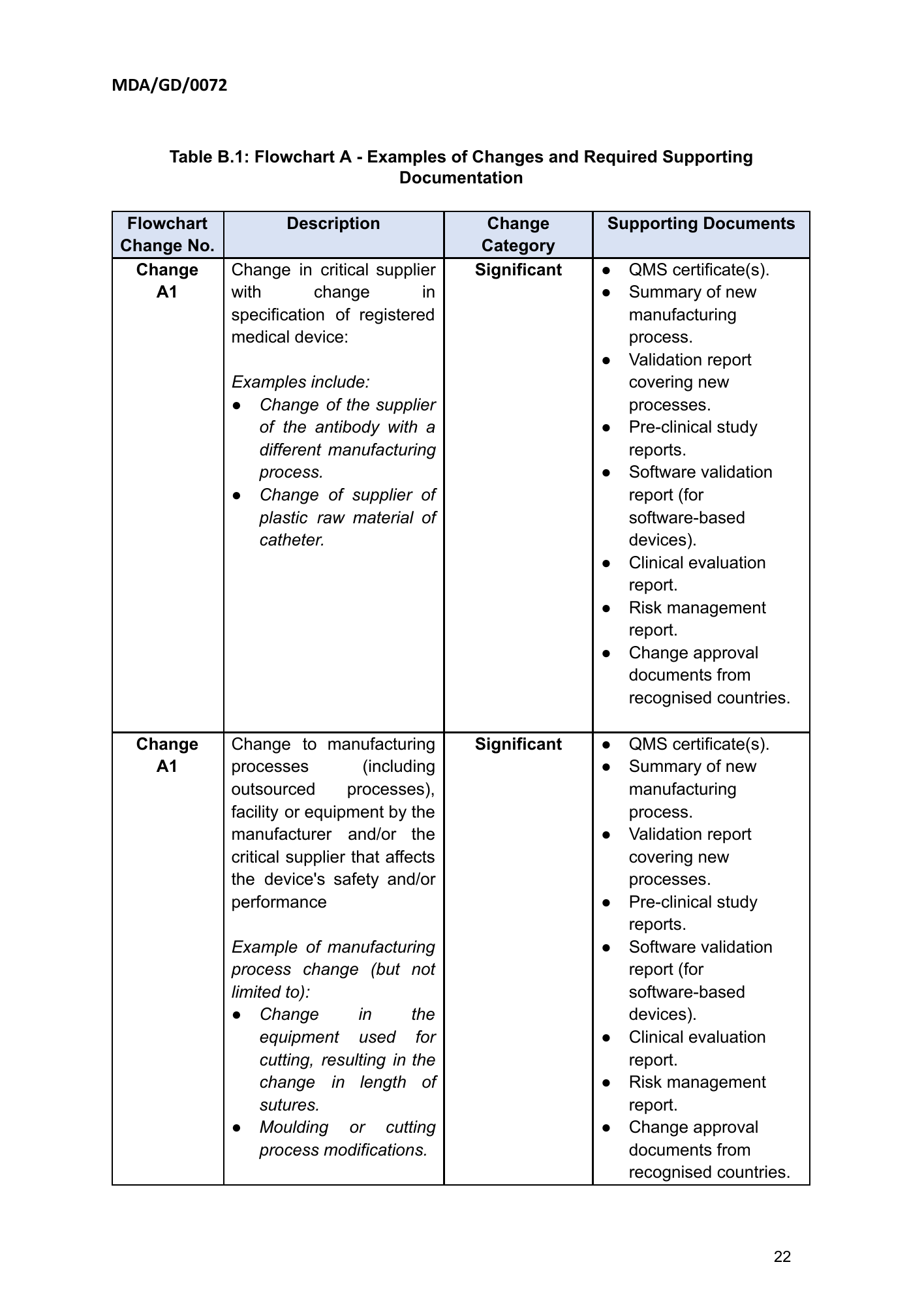
MDA/GD/0072 Table B.1: Flowchart A - Examples of Changes and Required Supporting Documentation Flowchart Description Change Supporting Documents Change No. Category Change Change in critical supplier Significant ● QMS certificate(s). A1 with change in ● Summary of new specification of registered manufacturing medical device: process. ● Validation report Examples include: covering new ● Change of the supplier processes. of the antibody with a ● Pre-clinical study different manufacturing reports. process. ● Software validation ● Change of supplier of report (for plastic raw material of software-based catheter. devices). ● Clinical evaluation report. ● Risk management report. ● Change approval documents from recognised countries. Change Change to manufacturing Significant ● QMS certificate(s). A1 processes (including ● Summary of new outsourced processes), manufacturing facility or equipment by the process. manufacturer and/or the ● Validation report critical supplier that affects covering new the device's safety and/or processes. performance ● Pre-clinical study reports. Example of manufacturing ● Software validation process change (but not report (for limited to): software-based ● Change in the devices). equipment used for ● Clinical evaluation cutting, resulting in the report. change in length of ● Risk management sutures. report. ● Moulding or cutting ● Change approval process modifications. documents from recognised countries. 22
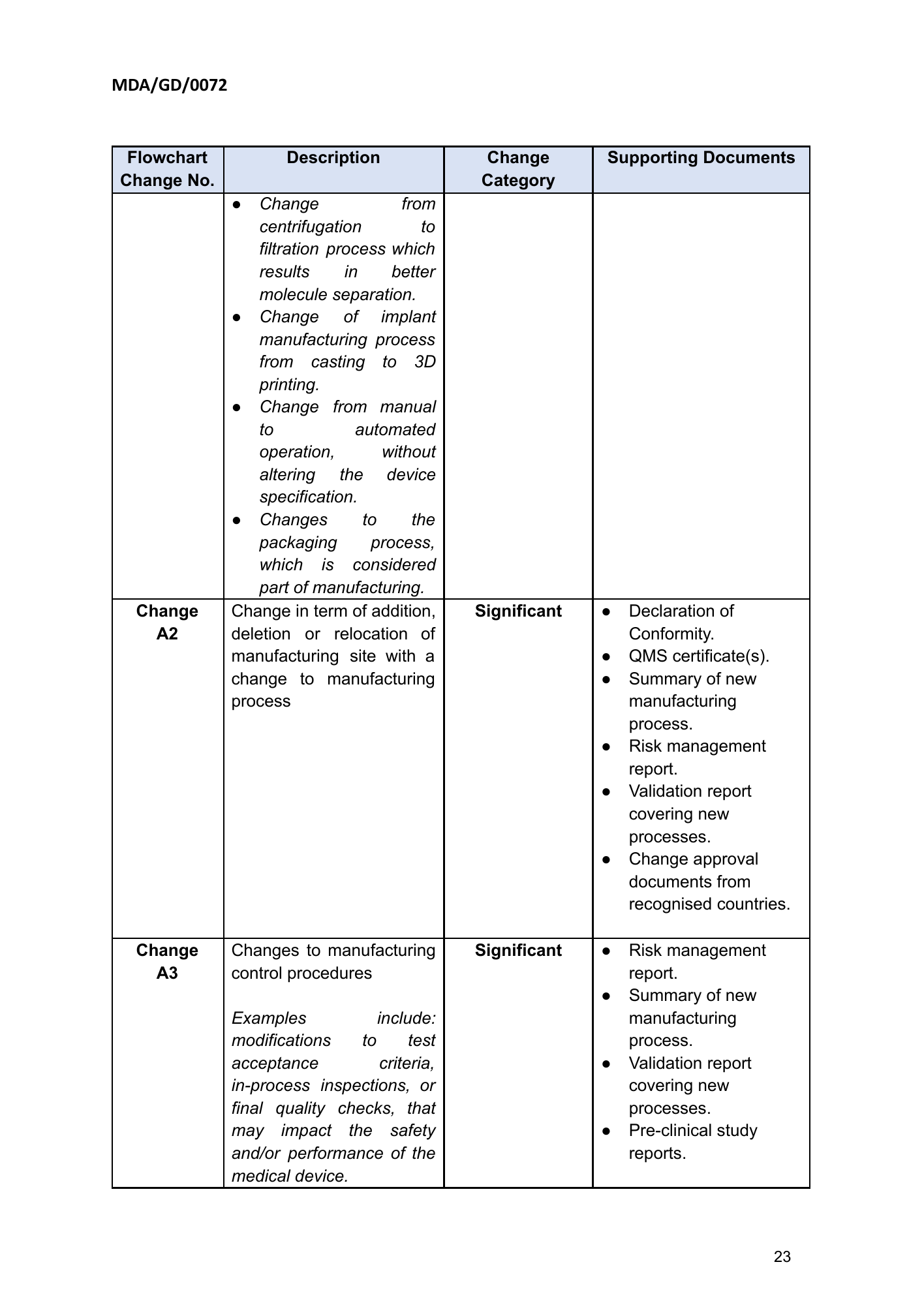
MDA/GD/0072 Flowchart Description Change Supporting Documents Change No. Category ● Change from centrifugation to filtration process which results in better molecule separation. ● Change of implant manufacturing process from casting to 3D printing. ● Change from manual to automated operation, without altering the device specification. ● Changes to the packaging process, which is considered part of manufacturing. Change Change in term of addition, Significant ● Declaration of A2 deletion or relocation of Conformity. manufacturing site with a ● QMS certificate(s). change to manufacturing ● Summary of new process manufacturing process. ● Risk management report. ● Validation report covering new processes. ● Change approval documents from recognised countries. Change Changes to manufacturing Significant ● Risk management A3 control procedures report. ● Summary of new Examples include: manufacturing modifications to test process. acceptance criteria, ● Validation report in-process inspections, or covering new final quality checks, that processes. may impact the safety ● Pre-clinical study and/or performance of the reports. medical device. 23
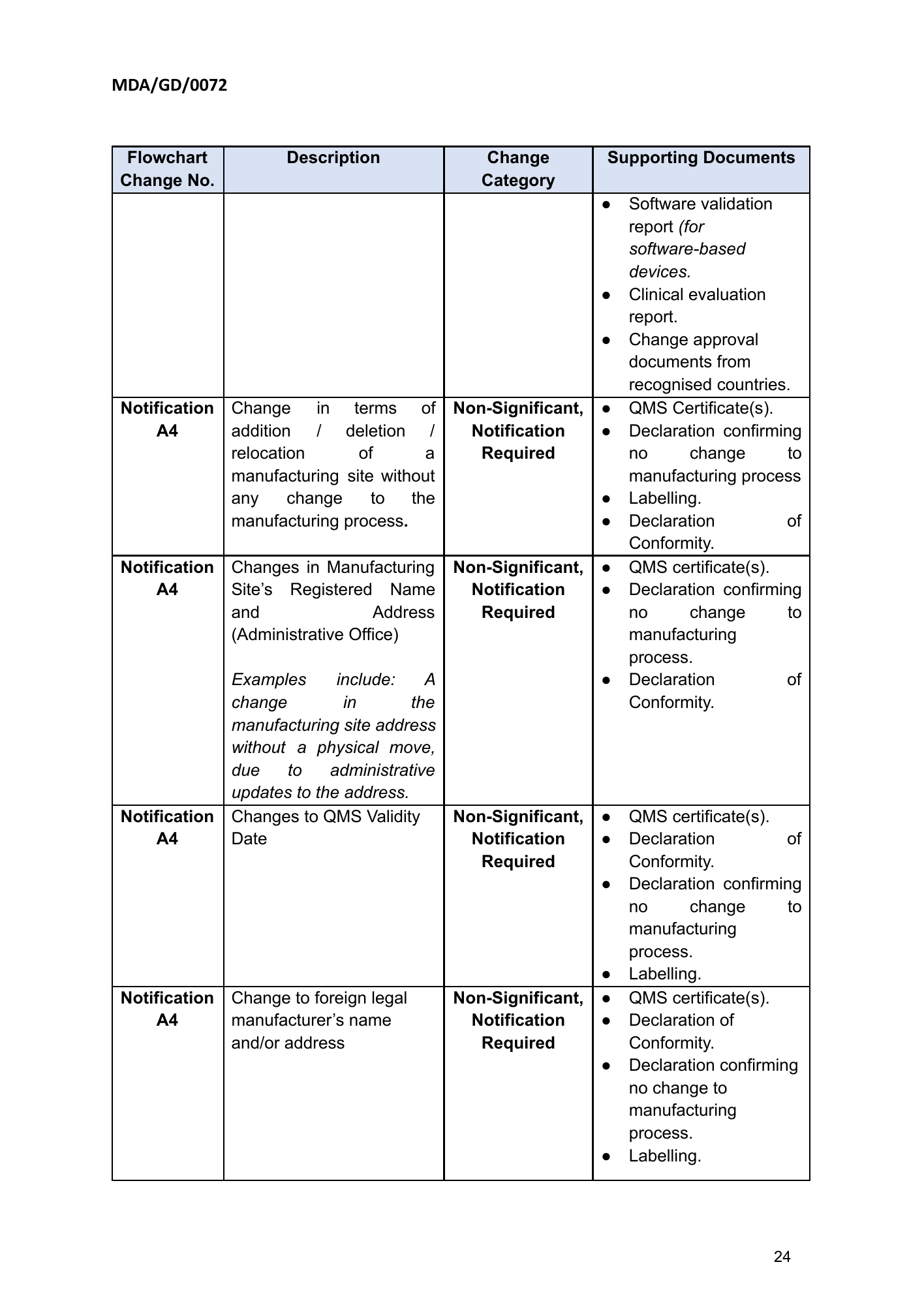
MDA/GD/0072 Flowchart Description Change Supporting Documents Change No. Category ● Software validation report (for software-based devices. ● Clinical evaluation report. ● Change approval documents from recognised countries. Notification Change in terms of Non-Significant, ● QMS Certificate(s). A4 addition / deletion / Notification ● Declaration confirming relocation of a Required no change to manufacturing site without manufacturing process any change to the ● Labelling. manufacturing process. ● Declaration of Conformity. Notification Changes in Manufacturing Non-Significant, ● QMS certificate(s). A4 Site’s Registered Name Notification ● Declaration confirming and Address Required no change to (Administrative Office) manufacturing process. Examples include: A ● Declaration of change in the Conformity. manufacturing site address without a physical move, due to administrative updates to the address. Notification Changes to QMS Validity Non-Significant, ● QMS certificate(s). A4 Date Notification ● Declaration of Required Conformity. ● Declaration confirming no change to manufacturing process. ● Labelling. Notification Change to foreign legal Non-Significant, ● QMS certificate(s). A4 manufacturer’s name Notification ● Declaration of and/or address Required Conformity. ● Declaration confirming no change to manufacturing process. ● Labelling. 24
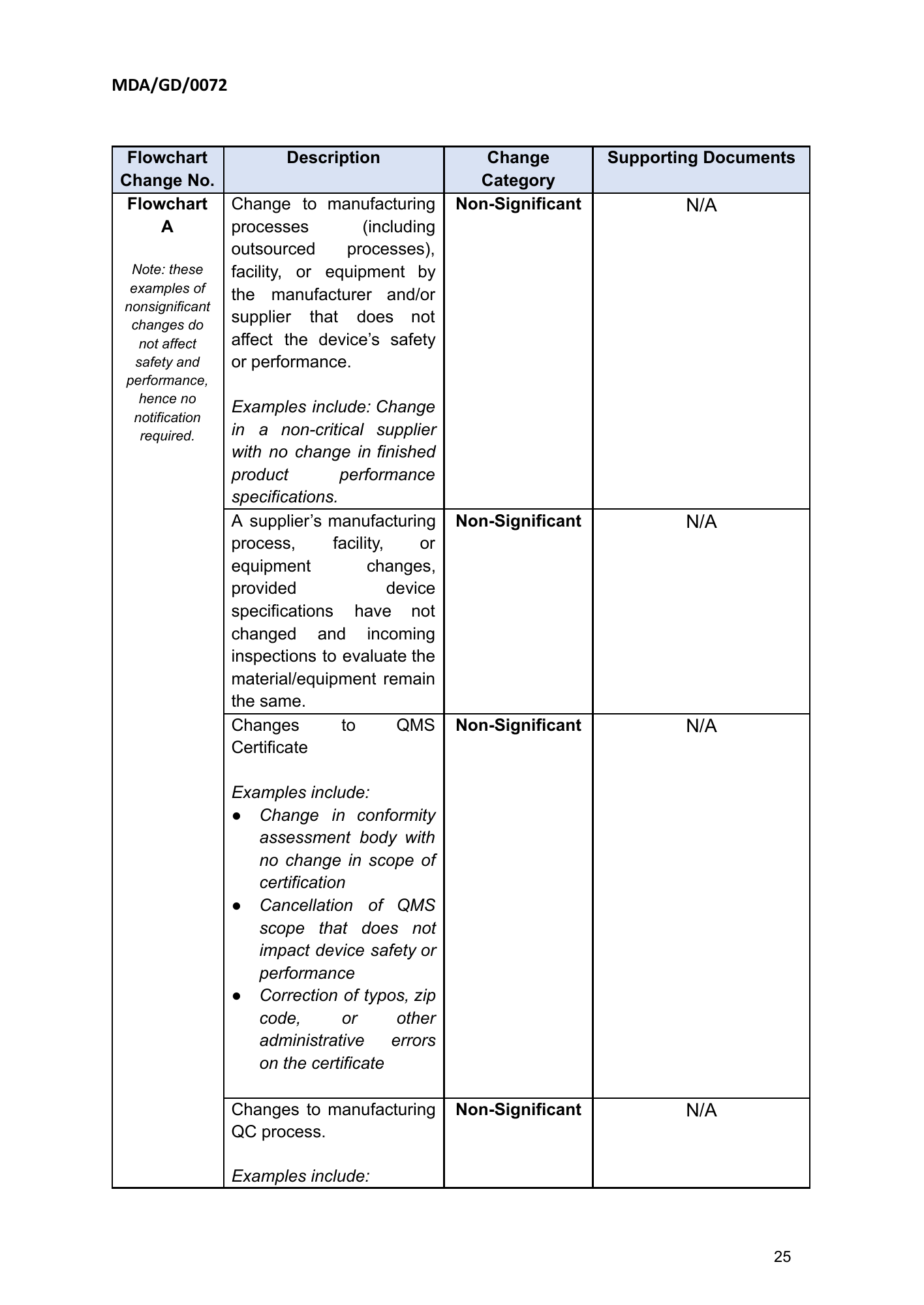
MDA/GD/0072 Flowchart Description Change Supporting Documents Change No. Category Flowchart Change to manufacturing Non-Significant N/A A processes (including outsourced processes), Note: these facility, or equipment by examples of the manufacturer and/or nonsignificant changes do supplier that does not not affect affect the device’s safety safety and or performance. performance, hence no Examples include: Change notification required. in a non-critical supplier with no change in finished product performance specifications. A supplier’s manufacturing Non-Significant N/A process, facility, or equipment changes, provided device specifications have not changed and incoming inspections to evaluate the material/equipment remain the same. Changes to QMS Non-Significant N/A Certificate Examples include: ● Change in conformity assessment body with no change in scope of certification ● Cancellation of QMS scope that does not impact device safety or performance ● Correction of typos, zip code, or other administrative errors on the certificate Changes to manufacturing Non-Significant N/A QC process. Examples include: 25
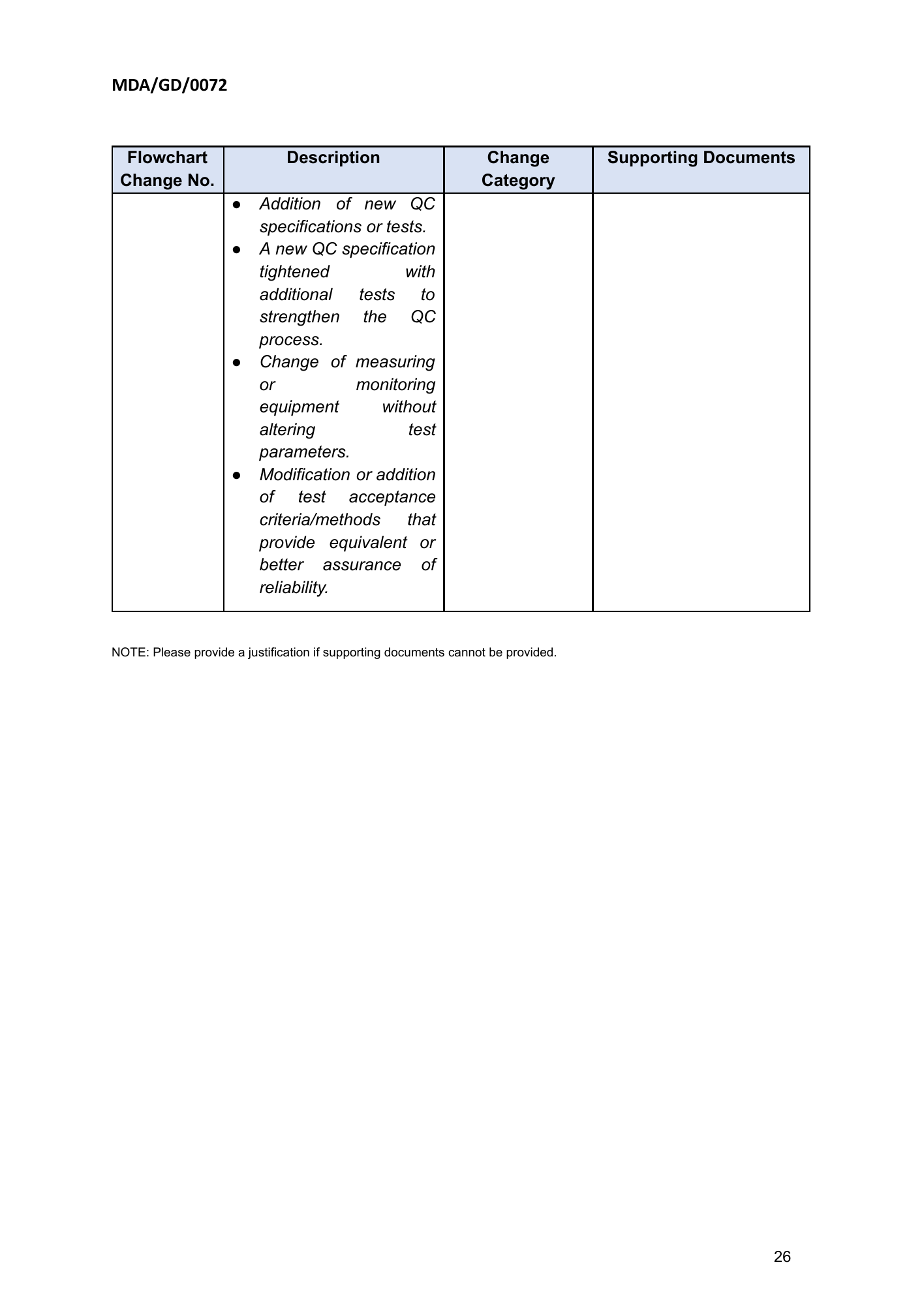
MDA/GD/0072 Flowchart Description Change Supporting Documents Change No. Category ● Addition of new QC specifications or tests. ● A new QC specification tightened with additional tests to strengthen the QC process. ● Change of measuring or monitoring equipment without altering test parameters. ● Modification or addition of test acceptance criteria/methods that provide equivalent or better assurance of reliability. NOTE: Please provide a justification if supporting documents cannot be provided. 26
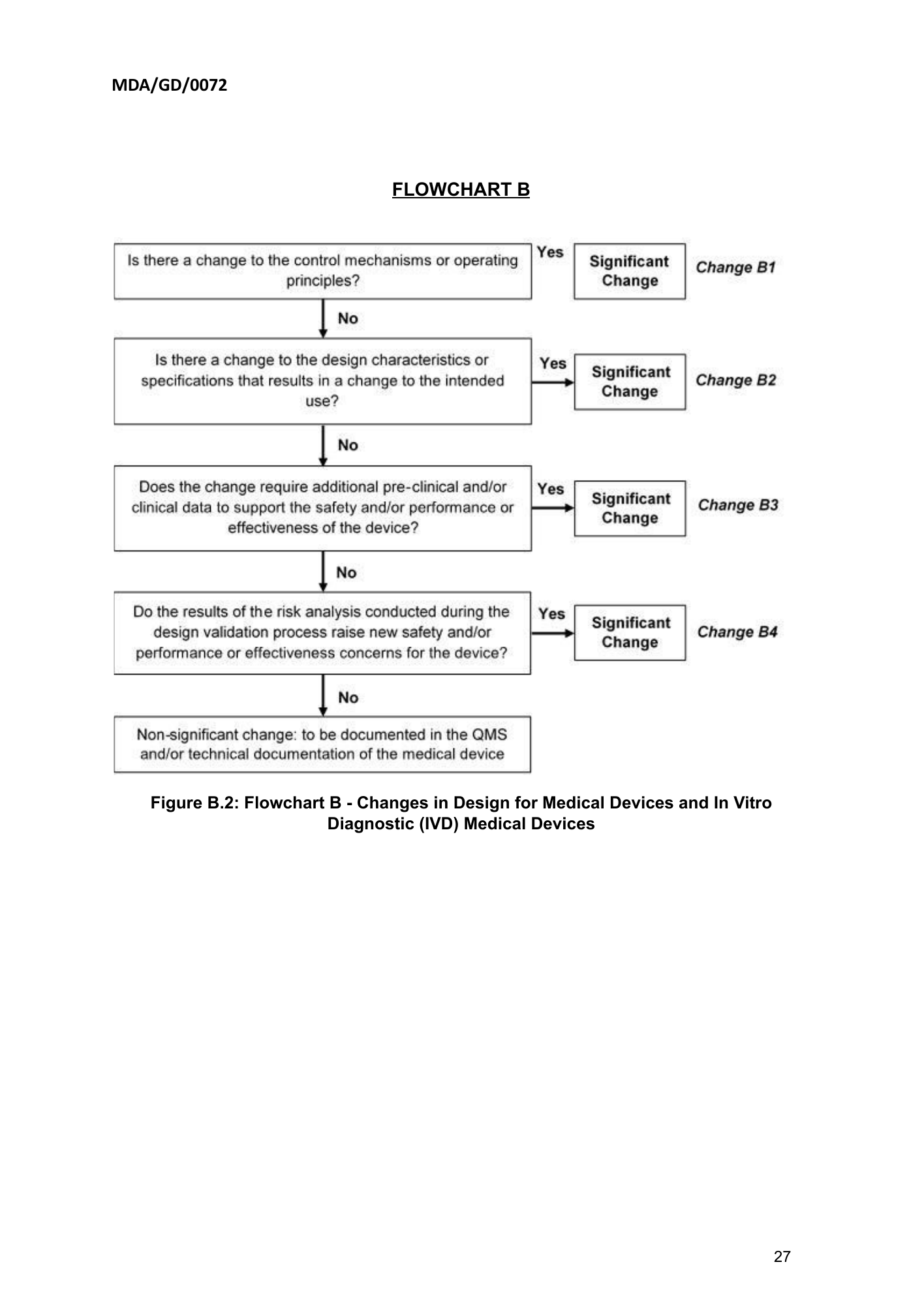
MDA/GD/0072 FLOWCHART B Figure B.2: Flowchart B - Changes in Design for Medical Devices and In Vitro Diagnostic (IVD) Medical Devices 27
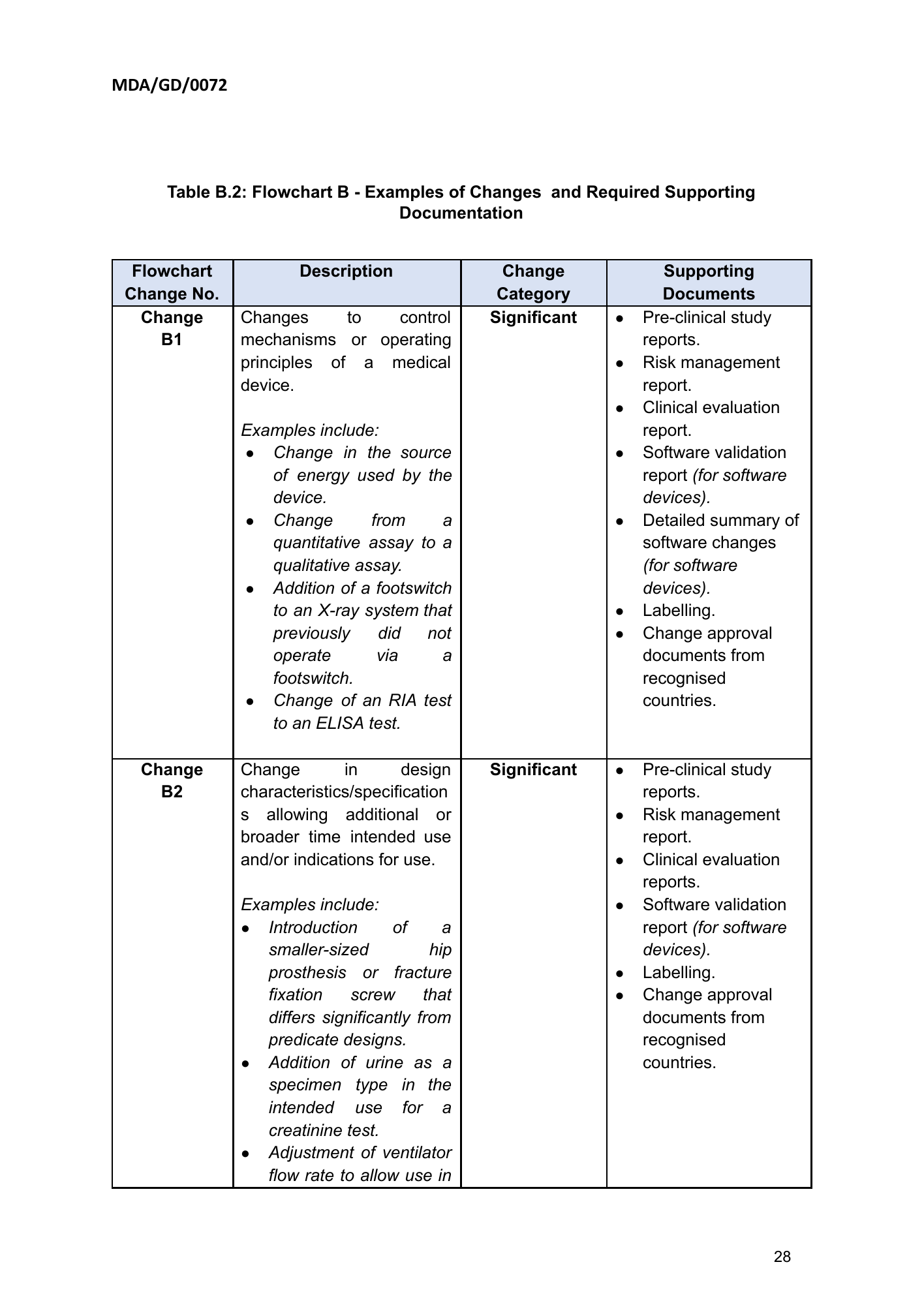
MDA/GD/0072 Table B.2: Flowchart B - Examples of Changes and Required Supporting Documentation Flowchart Description Change Supporting Change No. Category Documents Change Changes to control Significant ● Pre-clinical study B1 mechanisms or operating reports. principles of a medical ● Risk management device. report. ● Clinical evaluation Examples include: report. ● Change in the source ● Software validation of energy used by the report (for software device. devices). ● Change from a ● Detailed summary of quantitative assay to a software changes qualitative assay. (for software ● Addition of a footswitch devices). to an X-ray system that ● Labelling. previously did not ● Change approval operate via a documents from footswitch. recognised ● Change of an RIA test countries. to an ELISA test. Change Change in design Significant ● Pre-clinical study B2 characteristics/specification reports. s allowing additional or ● Risk management broader time intended use report. and/or indications for use. ● Clinical evaluation reports. Examples include: ● Software validation ● Introduction of a report (for software smaller-sized hip devices). prosthesis or fracture ● Labelling. fixation screw that ● Change approval differs significantly from documents from predicate designs. recognised ● Addition of urine as a countries. specimen type in the intended use for a creatinine test. ● Adjustment of ventilator flow rate to allow use in 28
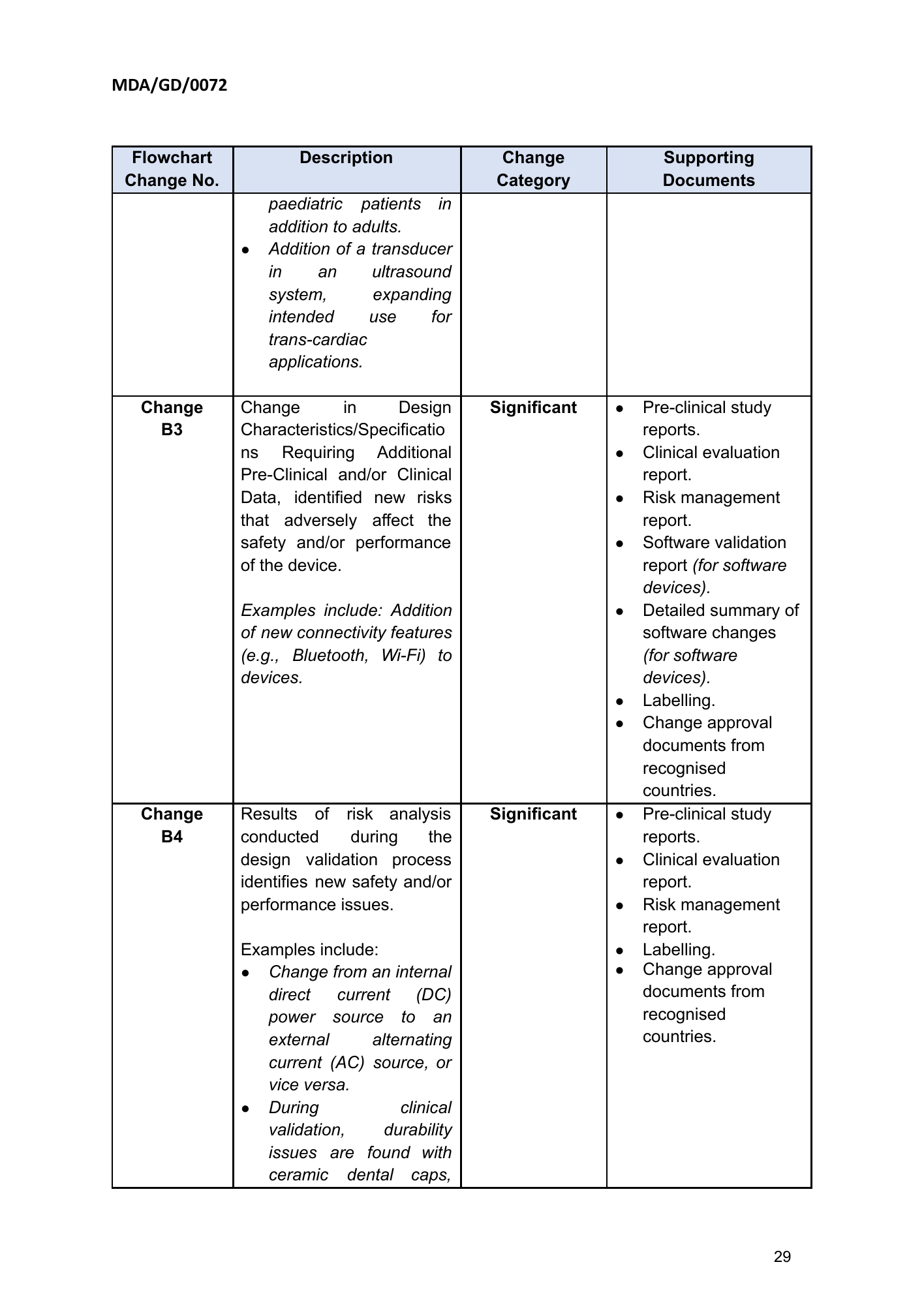
MDA/GD/0072 Flowchart Description Change Supporting Change No. Category Documents paediatric patients in addition to adults. ● Addition of a transducer in an ultrasound system, expanding intended use for trans-cardiac applications. Change Change in Design Significant ● Pre-clinical study B3 Characteristics/Specificatio reports. ns Requiring Additional ● Clinical evaluation Pre-Clinical and/or Clinical report. Data, identified new risks ● Risk management that adversely affect the report. safety and/or performance ● Software validation of the device. report (for software devices). Examples include: Addition ● Detailed summary of of new connectivity features software changes (e.g., Bluetooth, Wi-Fi) to (for software devices. devices). ● Labelling. ● Change approval documents from recognised countries. Change Results of risk analysis Significant ● Pre-clinical study B4 conducted during the reports. design validation process ● Clinical evaluation identifies new safety and/or report. performance issues. ● Risk management report. Examples include: ● Labelling. ● Change from an internal ● Change approval direct current (DC) documents from power source to an recognised external alternating countries. current (AC) source, or vice versa. ● During clinical validation, durability issues are found with ceramic dental caps, 29
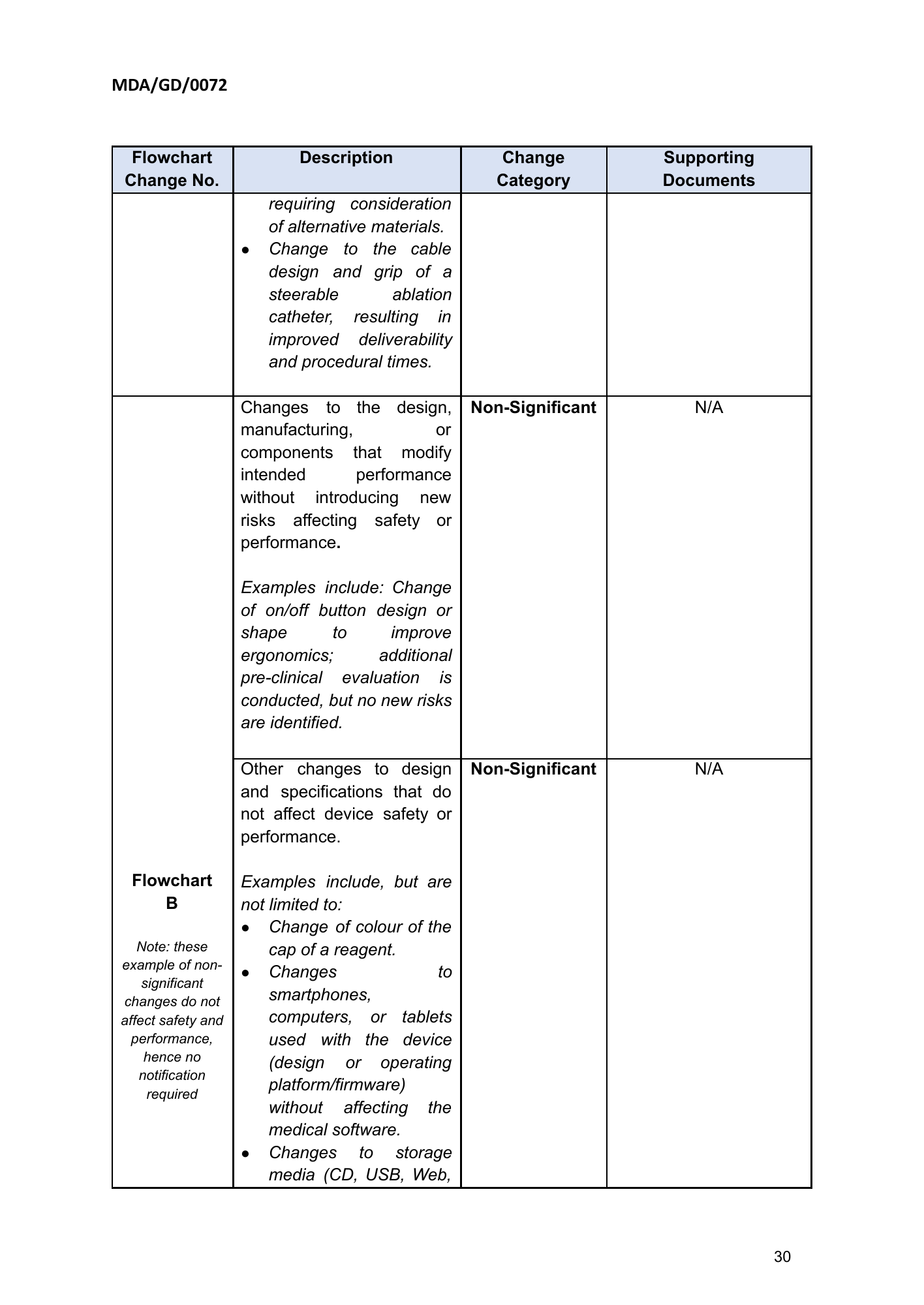
MDA/GD/0072 Flowchart Description Change Supporting Change No. Category Documents requiring consideration of alternative materials. ● Change to the cable design and grip of a steerable ablation catheter, resulting in improved deliverability and procedural times. Changes to the design, Non-Significant N/A manufacturing, or components that modify intended performance without introducing new risks affecting safety or performance. Examples include: Change of on/off button design or shape to improve ergonomics; additional pre-clinical evaluation is conducted, but no new risks are identified. Other changes to design Non-Significant N/A and specifications that do not affect device safety or performance. Flowchart Examples include, but are B not limited to: ● Change of colour of the Note: these cap of a reagent. example of non- ● Changes to significant changes do not smartphones, affect safety and computers, or tablets performance, used with the device hence no (design or operating notification required platform/firmware) without affecting the medical software. ● Changes to storage media (CD, USB, Web, 30
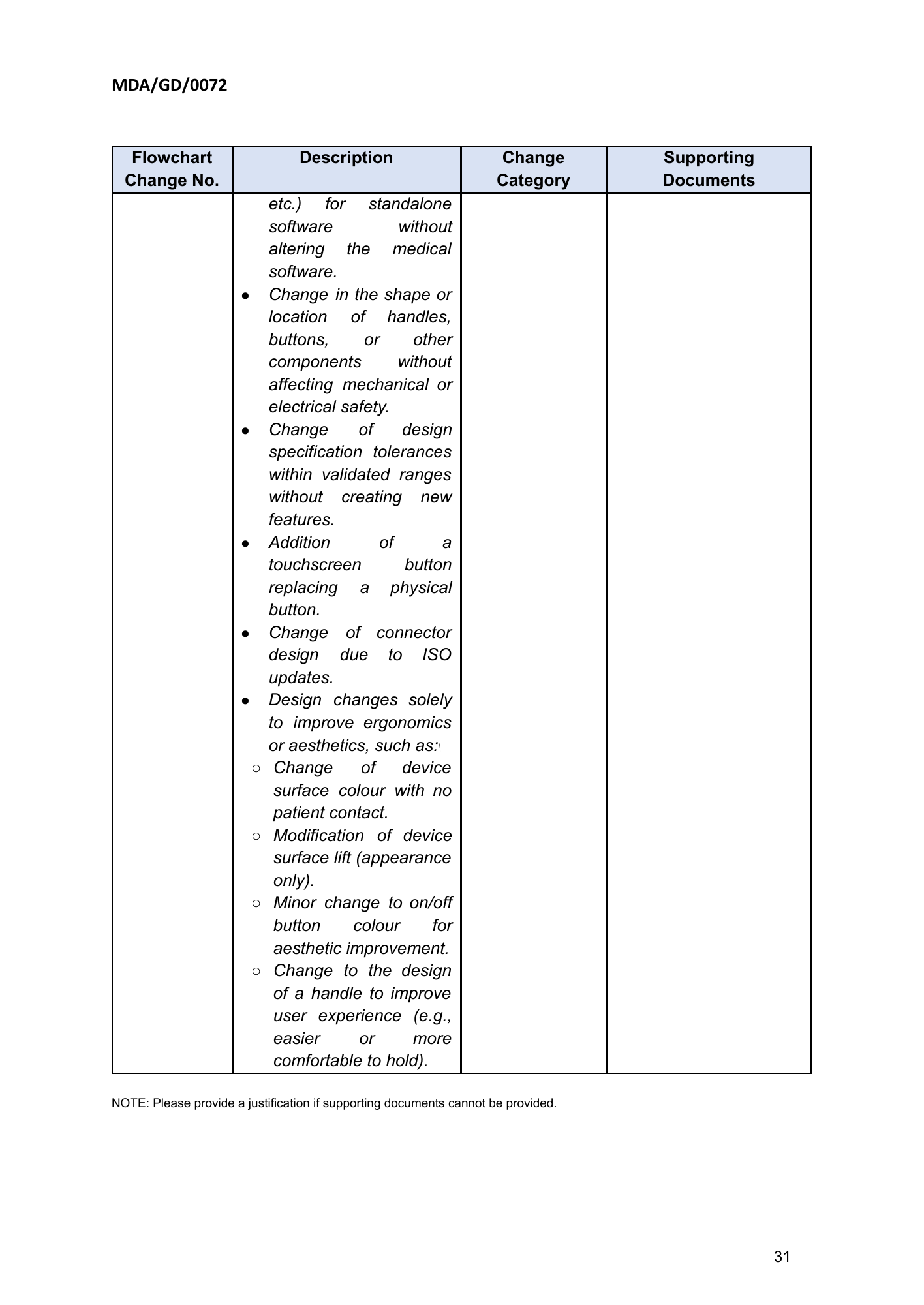
MDA/GD/0072 Flowchart Description Change Supporting Change No. Category Documents etc.) for standalone software without altering the medical software. ● Change in the shape or location of handles, buttons, or other components without affecting mechanical or electrical safety. ● Change of design specification tolerances within validated ranges without creating new features. ● Addition of a touchscreen button replacing a physical button. ● Change of connector design due to ISO updates. ● Design changes solely to improve ergonomics or aesthetics, such as:\ ○ Change of device surface colour with no patient contact. ○ Modification of device surface lift (appearance only). ○ Minor change to on/off button colour for aesthetic improvement. ○ Change to the design of a handle to improve user experience (e.g., easier or more comfortable to hold). NOTE: Please provide a justification if supporting documents cannot be provided. 31
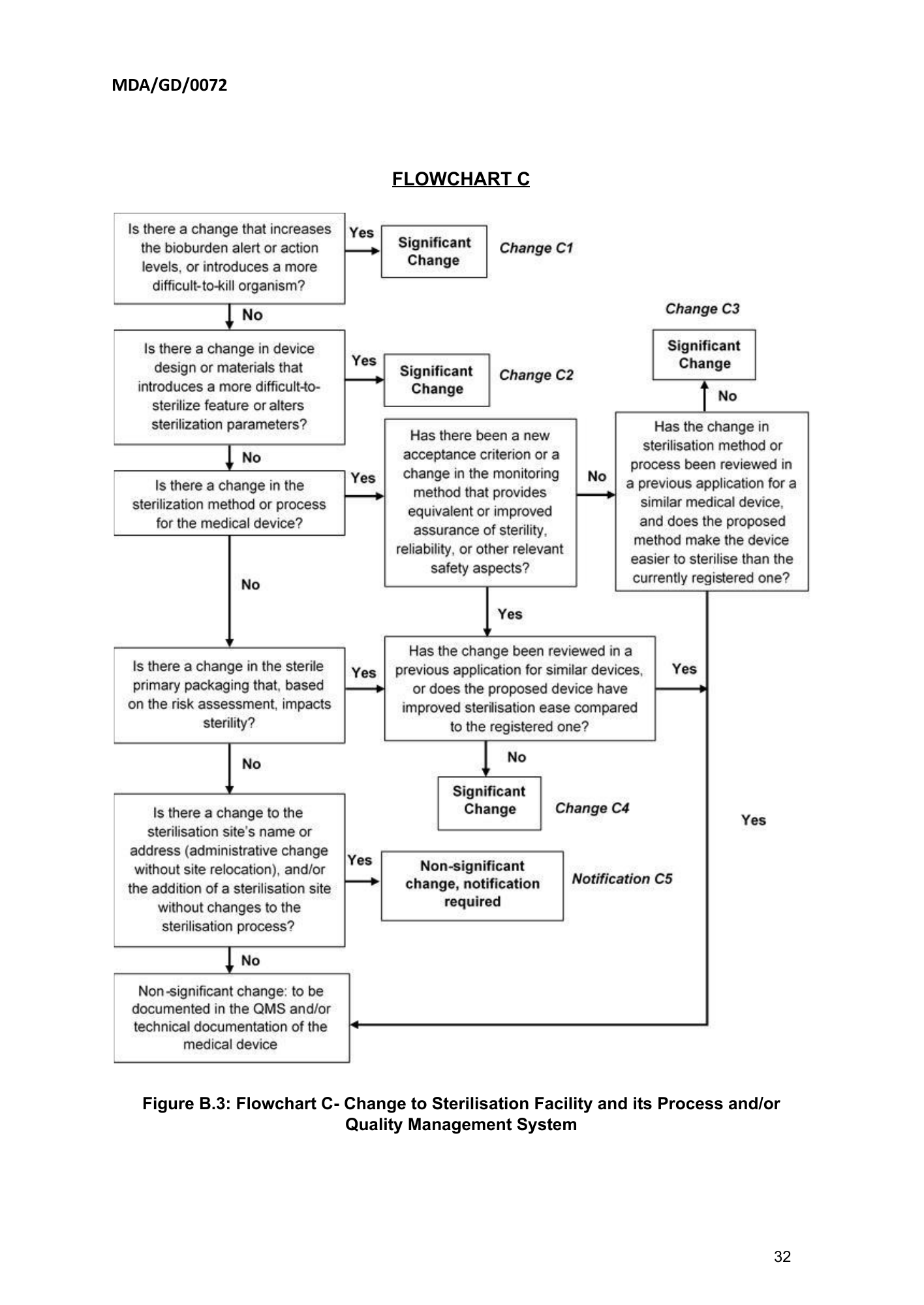
MDA/GD/0072 FLOWCHART C Figure B.3: Flowchart C- Change to Sterilisation Facility and its Process and/or Quality Management System 32
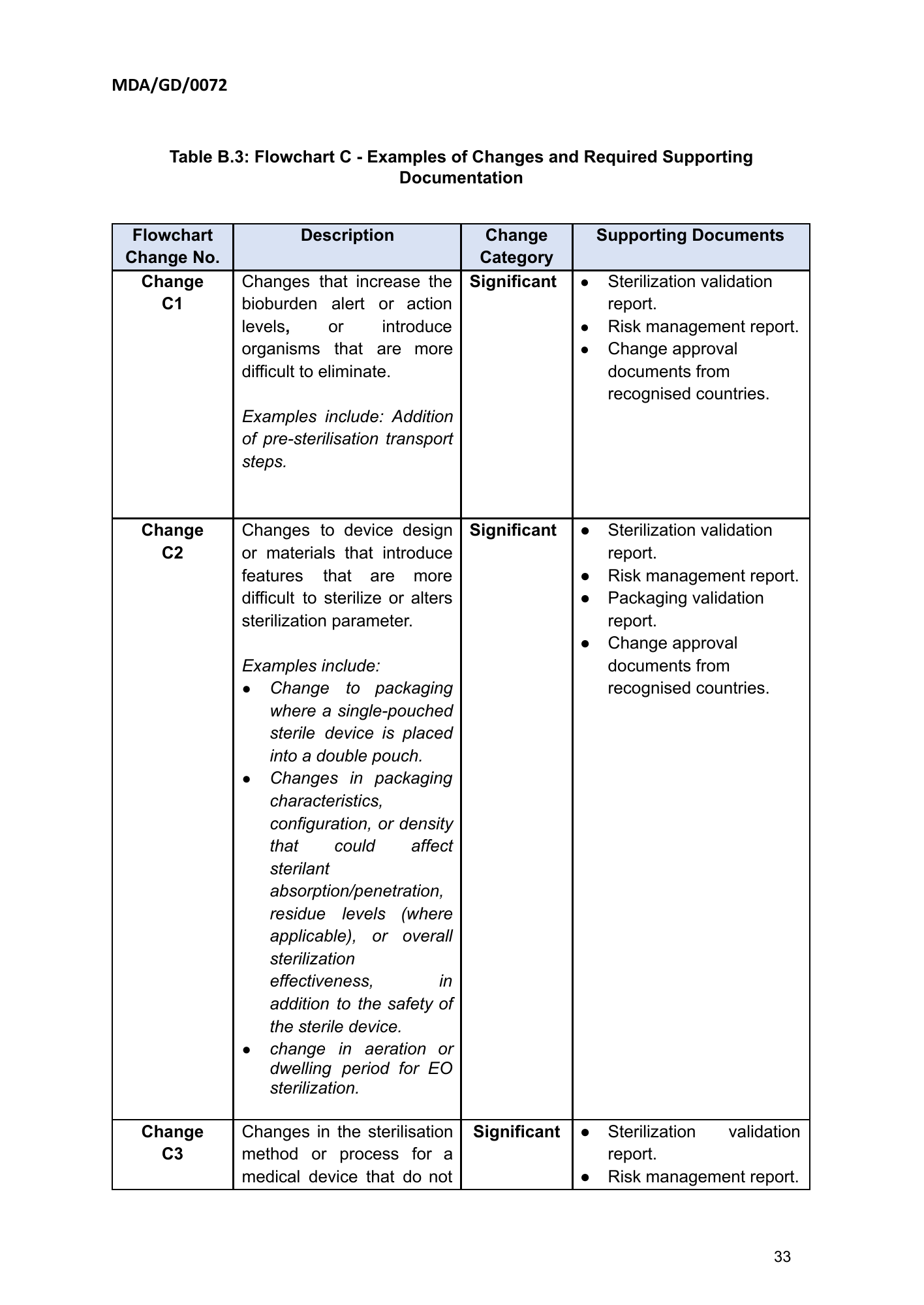
MDA/GD/0072 Table B.3: Flowchart C - Examples of Changes and Required Supporting Documentation Flowchart Description Change Supporting Documents Change No. Category Change Changes that increase the Significant ● Sterilization validation C1 bioburden alert or action report. levels, or introduce ● Risk management report. organisms that are more ● Change approval difficult to eliminate. documents from recognised countries. Examples include: Addition of pre-sterilisation transport steps. Change Changes to device design Significant ● Sterilization validation C2 or materials that introduce report. features that are more ● Risk management report. difficult to sterilize or alters ● Packaging validation sterilization parameter. report. ● Change approval Examples include: documents from ● Change to packaging recognised countries. where a single-pouched sterile device is placed into a double pouch. ● Changes in packaging characteristics, configuration, or density that could affect sterilant absorption/penetration, residue levels (where applicable), or overall sterilization effectiveness, in addition to the safety of the sterile device. ● change in aeration or dwelling period for EO sterilization. Change Changes in the sterilisation Significant ● Sterilization validation C3 method or process for a report. medical device that do not ● Risk management report. 33
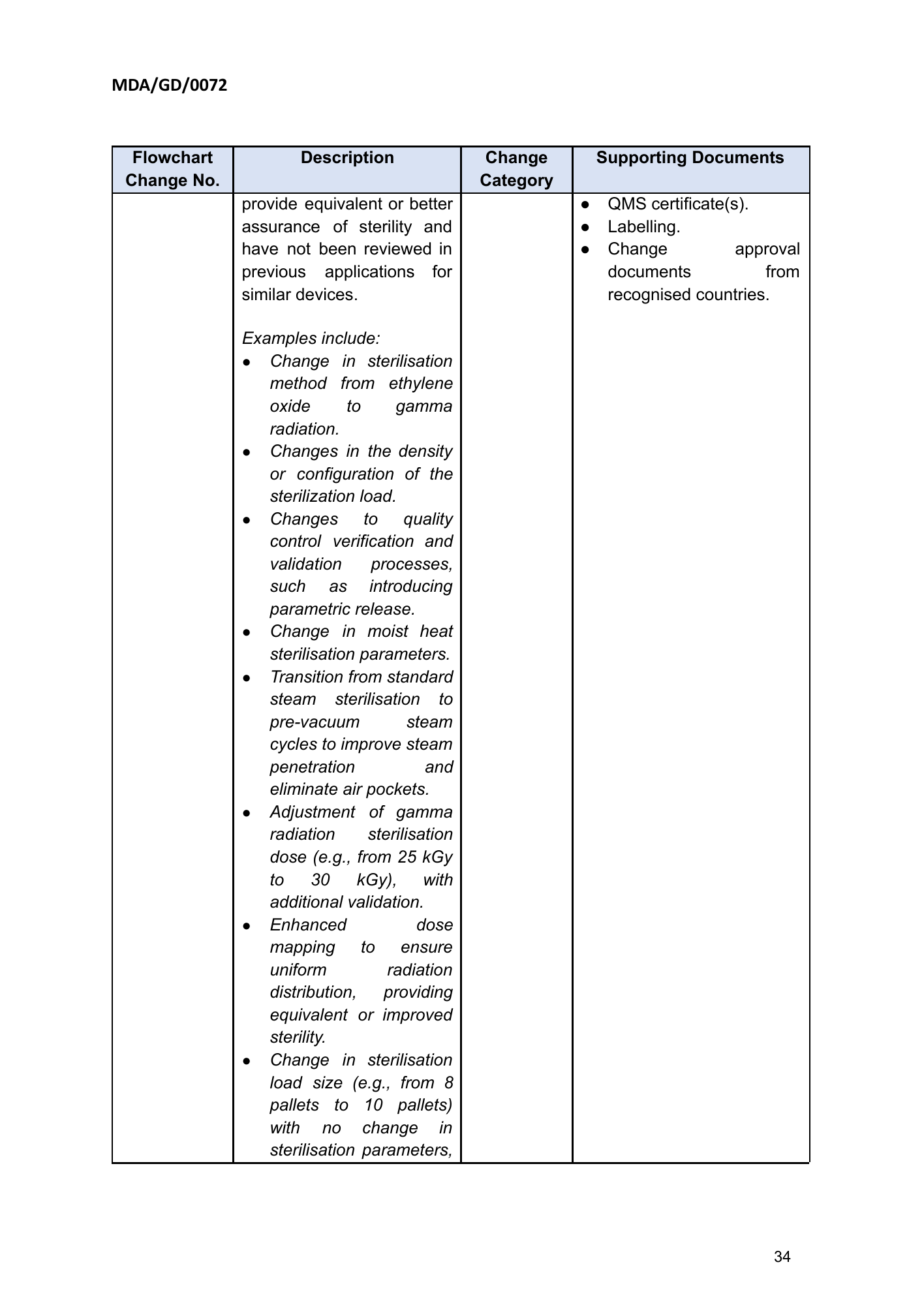
MDA/GD/0072 Flowchart Description Change Supporting Documents Change No. Category provide equivalent or better ● QMS certificate(s). assurance of sterility and ● Labelling. have not been reviewed in ● Change approval previous applications for documents from similar devices. recognised countries. Examples include: ● Change in sterilisation method from ethylene oxide to gamma radiation. ● Changes in the density or configuration of the sterilization load. ● Changes to quality control verification and validation processes, such as introducing parametric release. ● Change in moist heat sterilisation parameters. ● Transition from standard steam sterilisation to pre-vacuum steam cycles to improve steam penetration and eliminate air pockets. ● Adjustment of gamma radiation sterilisation dose (e.g., from 25 kGy to 30 kGy), with additional validation. ● Enhanced dose mapping to ensure uniform radiation distribution, providing equivalent or improved sterility. ● Change in sterilisation load size (e.g., from 8 pallets to 10 pallets) with no change in sterilisation parameters, 34
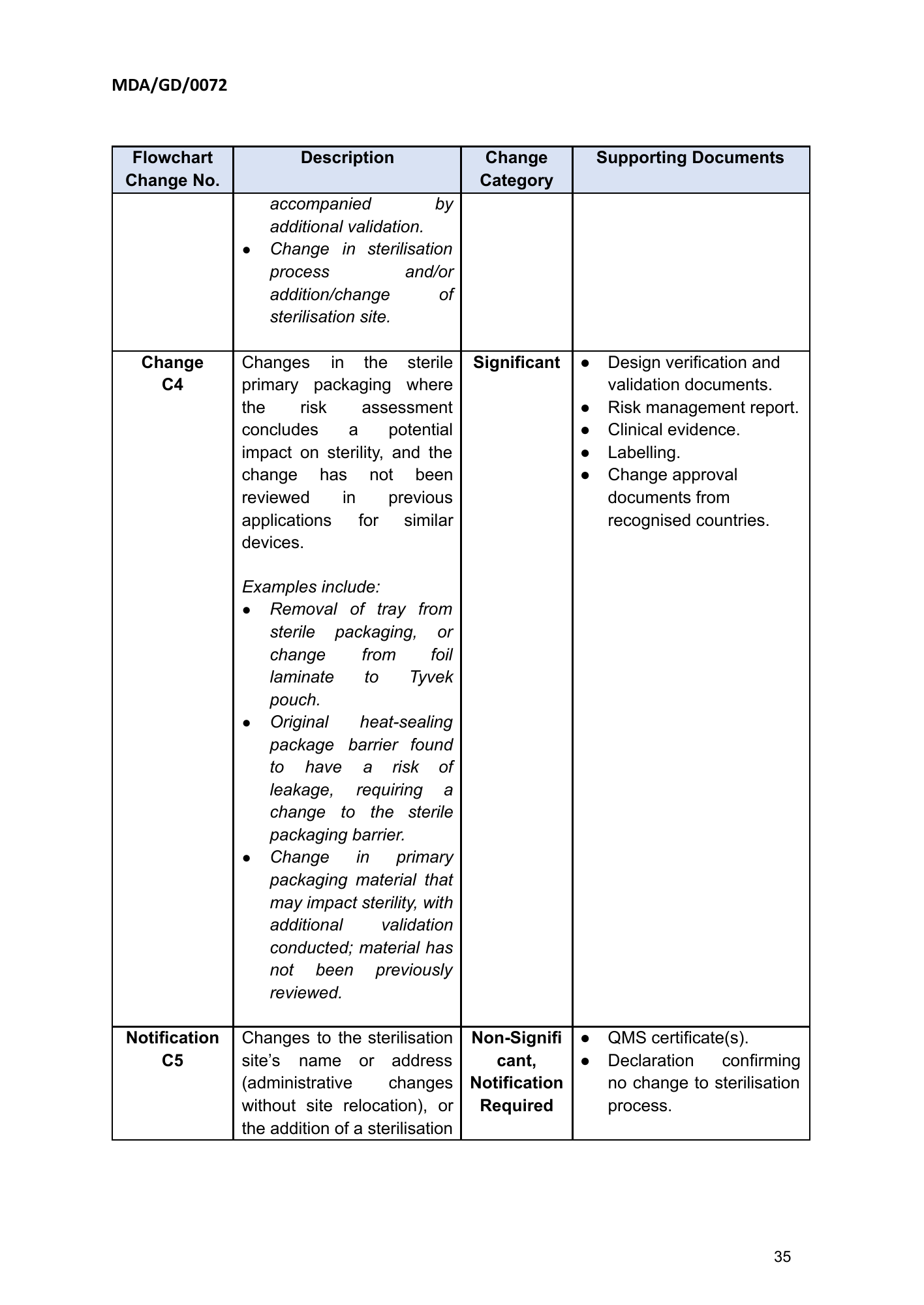
MDA/GD/0072 Flowchart Description Change Supporting Documents Change No. Category accompanied by additional validation. ● Change in sterilisation process and/or addition/change of sterilisation site. Change Changes in the sterile Significant ● Design verification and C4 primary packaging where validation documents. the risk assessment ● Risk management report. concludes a potential ● Clinical evidence. impact on sterility, and the ● Labelling. change has not been ● Change approval reviewed in previous documents from applications for similar recognised countries. devices. Examples include: ● Removal of tray from sterile packaging, or change from foil laminate to Tyvek pouch. ● Original heat-sealing package barrier found to have a risk of leakage, requiring a change to the sterile packaging barrier. ● Change in primary packaging material that may impact sterility, with additional validation conducted; material has not been previously reviewed. Notification Changes to the sterilisation Non-Signifi ● QMS certificate(s). C5 site’s name or address cant, ● Declaration confirming (administrative changes Notification no change to sterilisation without site relocation), or Required process. the addition of a sterilisation 35
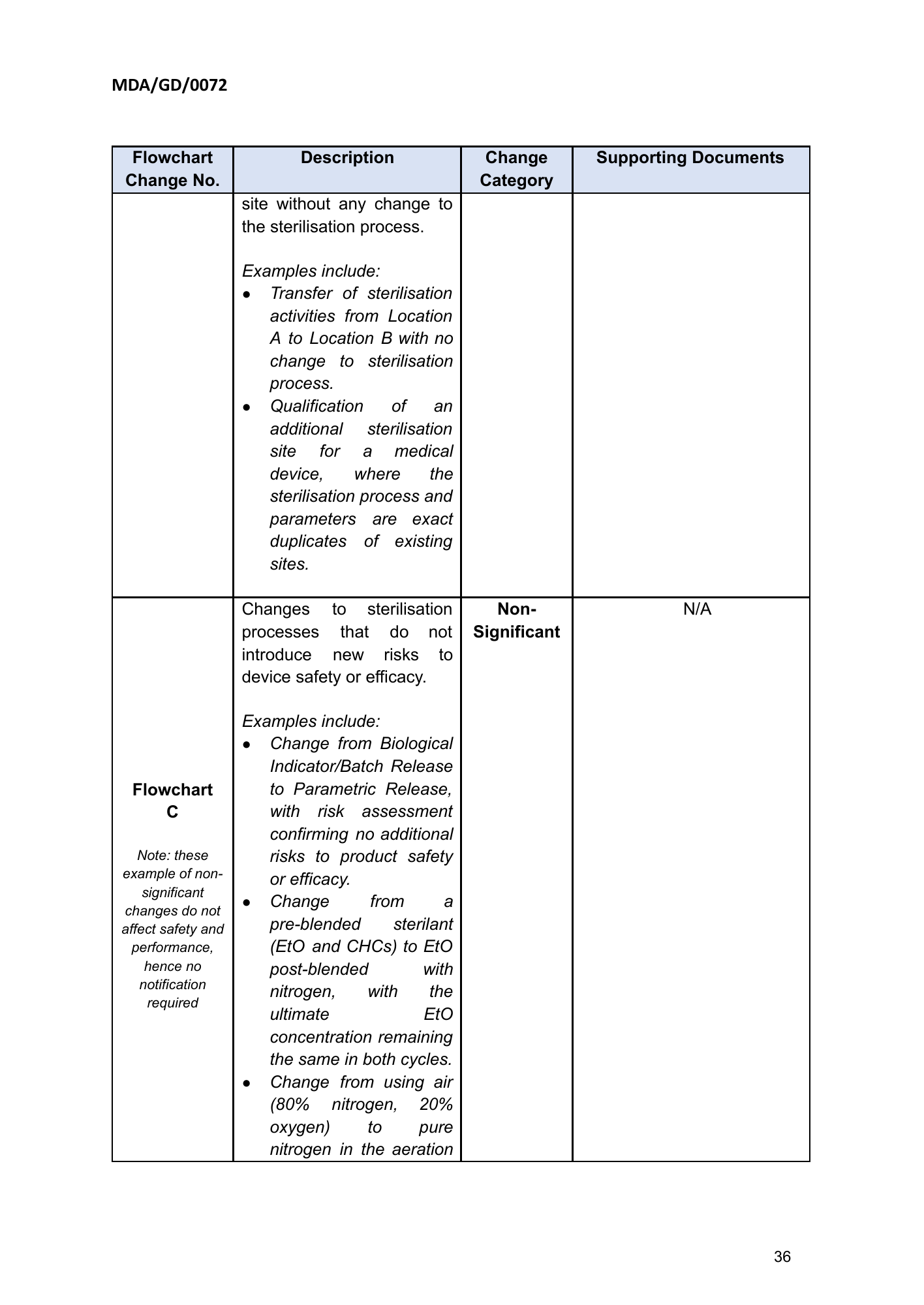
MDA/GD/0072 Flowchart Description Change Supporting Documents Change No. Category site without any change to the sterilisation process. Examples include: ● Transfer of sterilisation activities from Location A to Location B with no change to sterilisation process. ● Qualification of an additional sterilisation site for a medical device, where the sterilisation process and parameters are exact duplicates of existing sites. Changes to sterilisation Non- N/A processes that do not Significant introduce new risks to device safety or efficacy. Examples include: ● Change from Biological Indicator/Batch Release Flowchart to Parametric Release, C with risk assessment confirming no additional Note: these risks to product safety example of non- or efficacy. significant ● Change from a changes do not affect safety and pre-blended sterilant performance, (EtO and CHCs) to EtO hence no post-blended with notification nitrogen, with the required ultimate EtO concentration remaining the same in both cycles. ● Change from using air (80% nitrogen, 20% oxygen) to pure nitrogen in the aeration 36
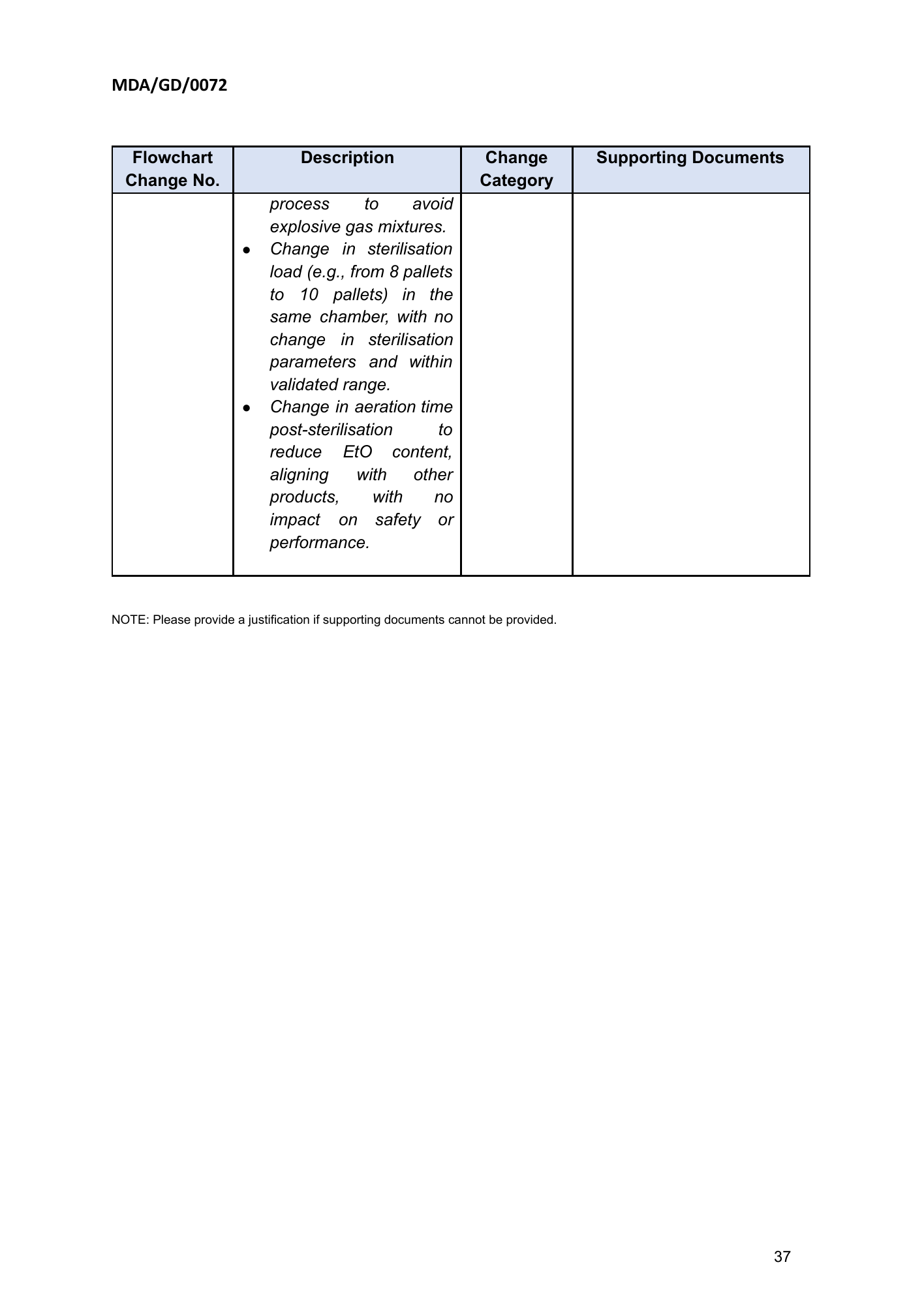
MDA/GD/0072 Flowchart Description Change Supporting Documents Change No. Category process to avoid explosive gas mixtures. ● Change in sterilisation load (e.g., from 8 pallets to 10 pallets) in the same chamber, with no change in sterilisation parameters and within validated range. ● Change in aeration time post-sterilisation to reduce EtO content, aligning with other products, with no impact on safety or performance. NOTE: Please provide a justification if supporting documents cannot be provided. 37
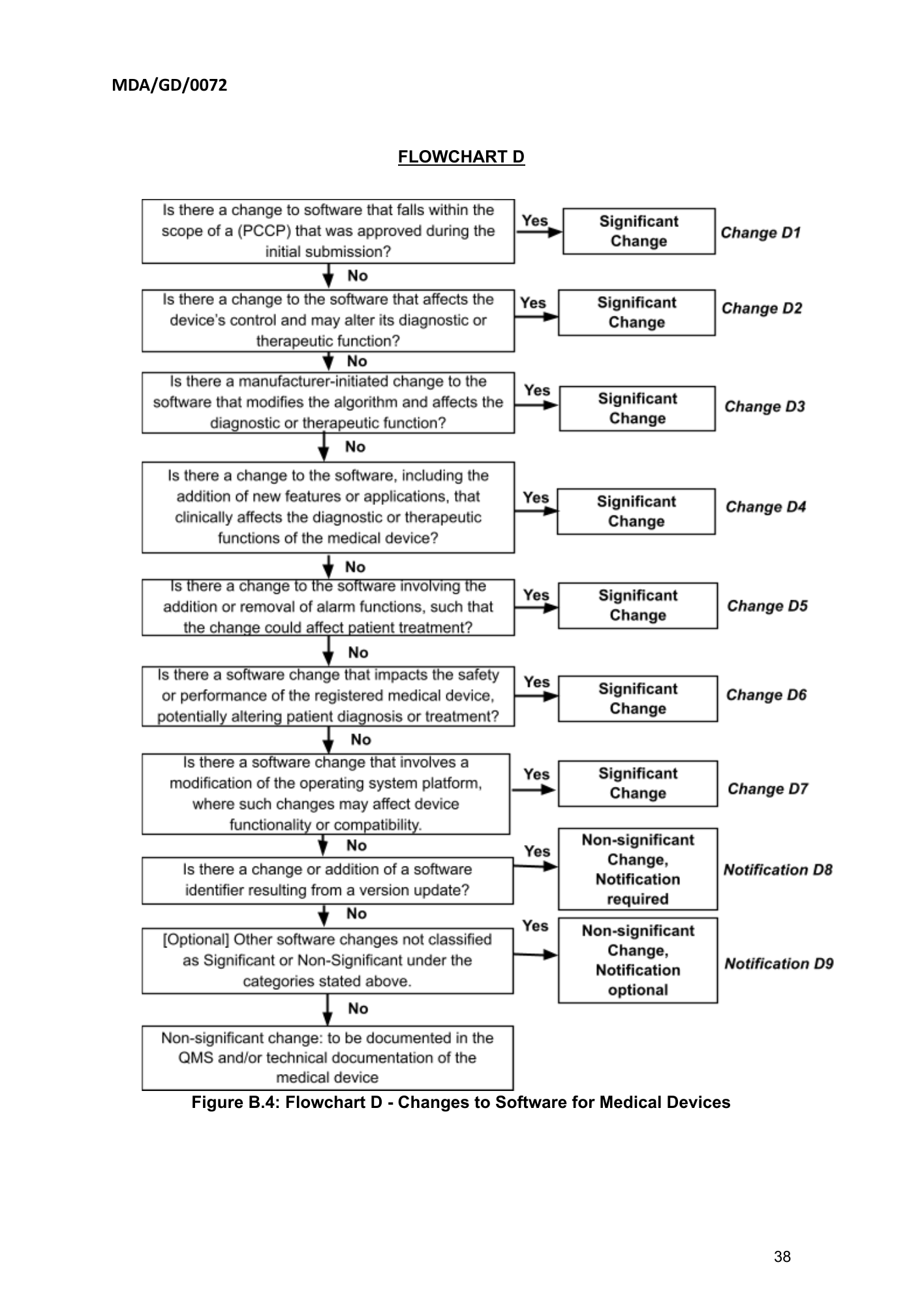
MDA/GD/0072 FLOWCHART D Figure B.4: Flowchart D - Changes to Software for Medical Devices 38
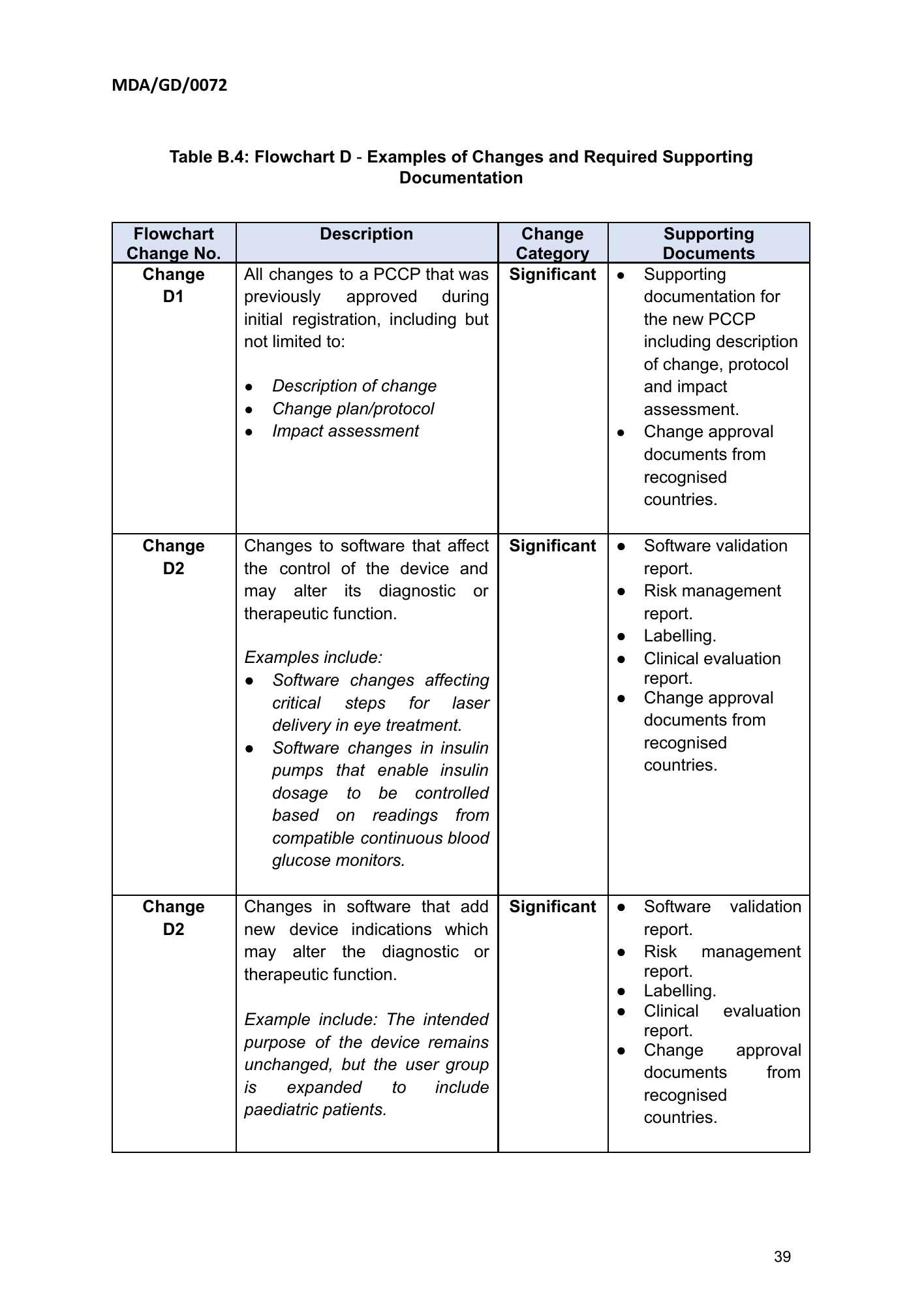
MDA/GD/0072 Table B.4: Flowchart D - Examples of Changes and Required Supporting Documentation Flowchart Description Change Supporting Change No. Category Documents Change All changes to a PCCP that was Significant ● Supporting D1 previously approved during documentation for initial registration, including but the new PCCP not limited to: including description of change, protocol ● Description of change and impact ● Change plan/protocol assessment. ● Impact assessment ● Change approval documents from recognised countries. Change Changes to software that affect Significant ● Software validation D2 the control of the device and report. may alter its diagnostic or ● Risk management therapeutic function. report. ● Labelling. Examples include: ● Clinical evaluation ● Software changes affecting report. critical steps for laser ● Change approval delivery in eye treatment. documents from ● Software changes in insulin recognised pumps that enable insulin countries. dosage to be controlled based on readings from compatible continuous blood glucose monitors. Change Changes in software that add Significant ● Software validation D2 new device indications which report. may alter the diagnostic or ● Risk management therapeutic function. report. ● Labelling. ● Clinical evaluation Example include: The intended report. purpose of the device remains ● Change approval unchanged, but the user group documents from is expanded to include recognised paediatric patients. countries. 39
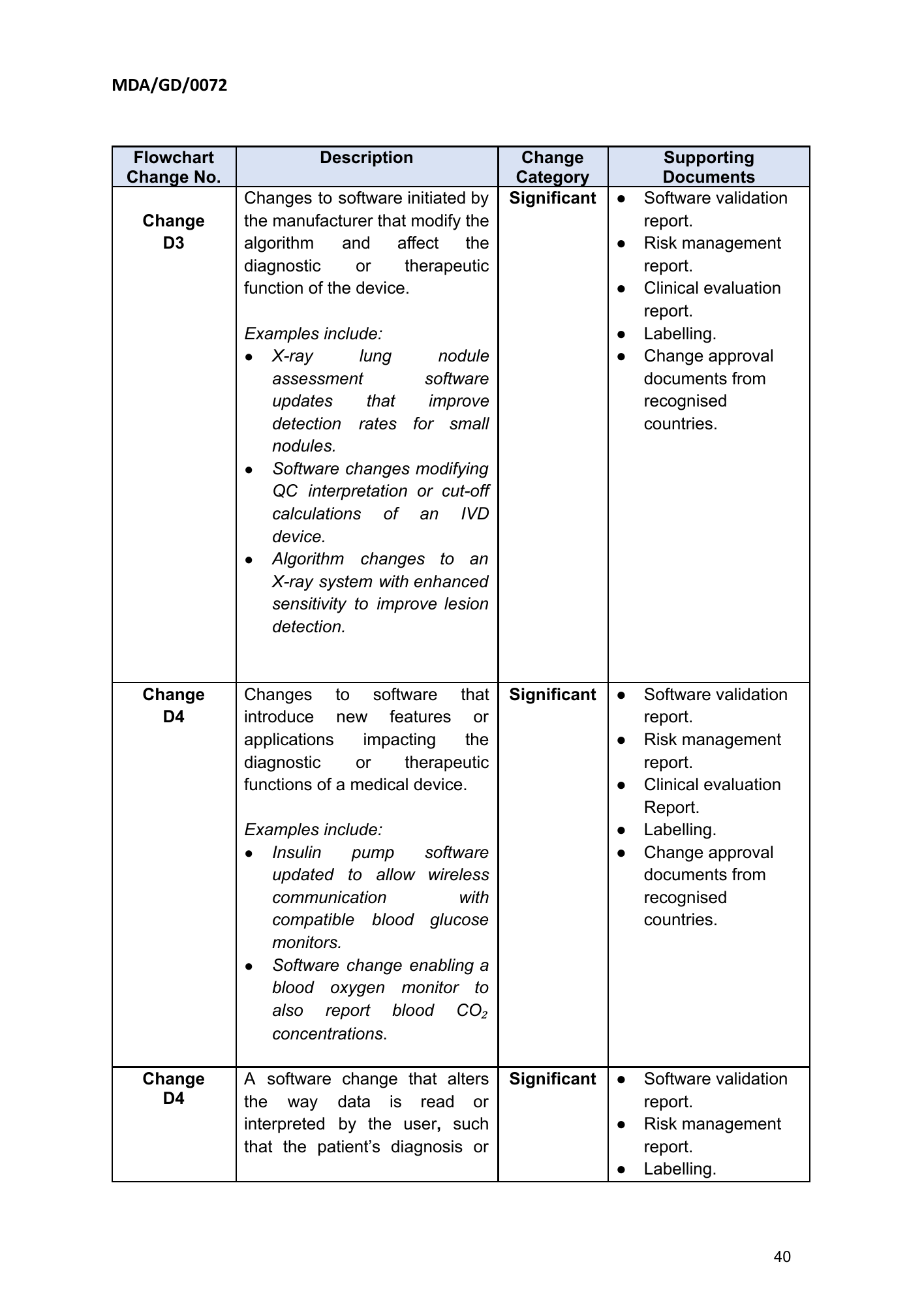
MDA/GD/0072 Flowchart Description Change Supporting Change No. Category Documents Changes to software initiated by Significant ● Software validation Change the manufacturer that modify the report. D3 algorithm and affect the ● Risk management diagnostic or therapeutic report. function of the device. ● Clinical evaluation report. Examples include: ● Labelling. ● X-ray lung nodule ● Change approval assessment software documents from updates that improve recognised detection rates for small countries. nodules. ● Software changes modifying QC interpretation or cut-off calculations of an IVD device. ● Algorithm changes to an X-ray system with enhanced sensitivity to improve lesion detection. Change Changes to software that Significant ● Software validation D4 introduce new features or report. applications impacting the ● Risk management diagnostic or therapeutic report. functions of a medical device. ● Clinical evaluation Report. Examples include: ● Labelling. ● Insulin pump software ● Change approval updated to allow wireless documents from communication with recognised compatible blood glucose countries. monitors. ● Software change enabling a blood oxygen monitor to also report blood CO₂ concentrations. Change A software change that alters Significant ● Software validation D4 the way data is read or report. interpreted by the user, such ● Risk management that the patient’s diagnosis or report. ● Labelling. 40
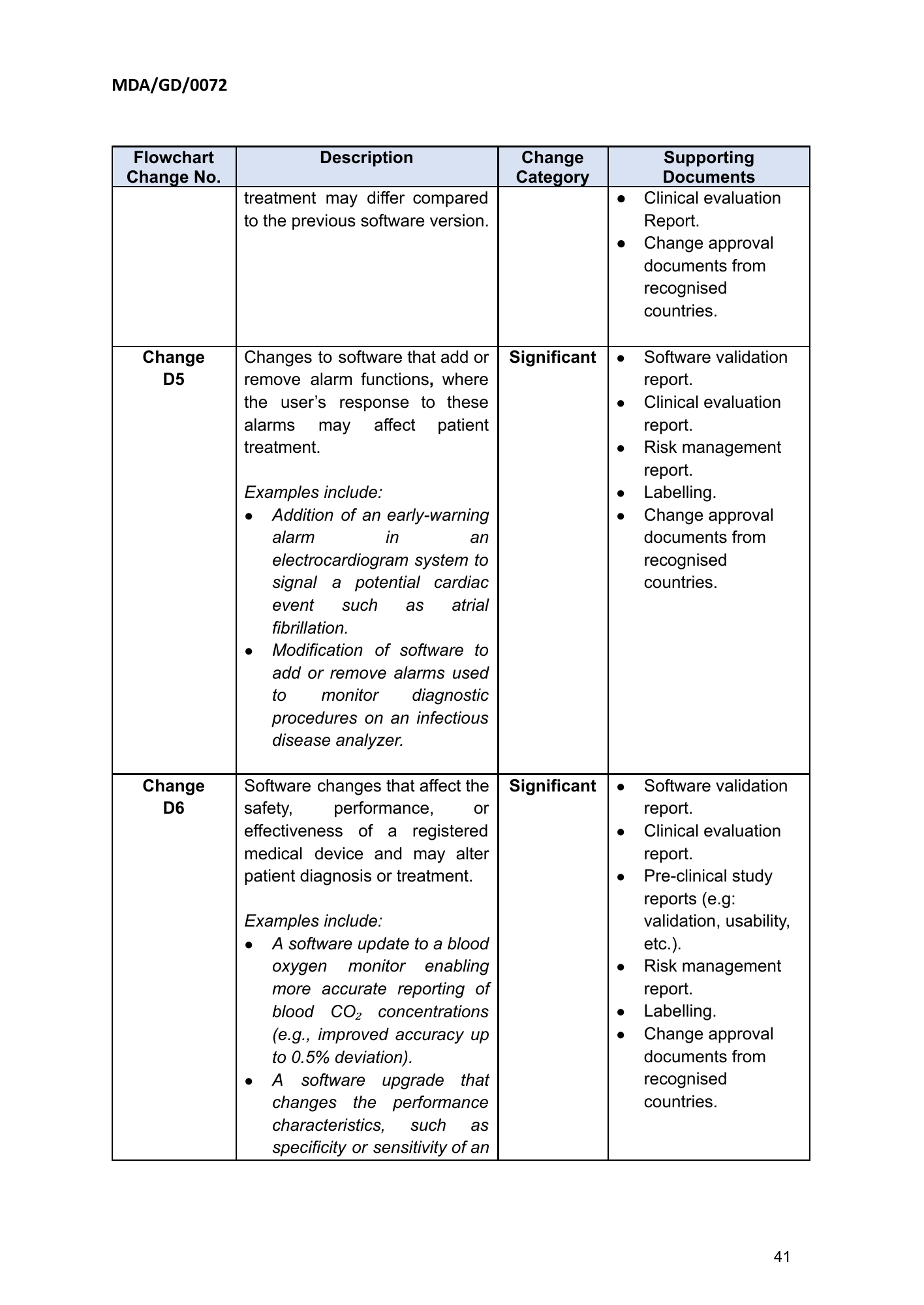
MDA/GD/0072 Flowchart Description Change Supporting Change No. Category Documents treatment may differ compared ● Clinical evaluation to the previous software version. Report. ● Change approval documents from recognised countries. Change Changes to software that add or Significant ● Software validation D5 remove alarm functions, where report. the user’s response to these ● Clinical evaluation alarms may affect patient report. treatment. ● Risk management report. Examples include: ● Labelling. ● Addition of an early-warning ● Change approval alarm in an documents from electrocardiogram system to recognised signal a potential cardiac countries. event such as atrial fibrillation. ● Modification of software to add or remove alarms used to monitor diagnostic procedures on an infectious disease analyzer. Change Software changes that affect the Significant ● Software validation D6 safety, performance, or report. effectiveness of a registered ● Clinical evaluation medical device and may alter report. patient diagnosis or treatment. ● Pre-clinical study reports (e.g: Examples include: validation, usability, ● A software update to a blood etc.). oxygen monitor enabling ● Risk management more accurate reporting of report. blood CO₂ concentrations ● Labelling. (e.g., improved accuracy up ● Change approval to 0.5% deviation). documents from ● A software upgrade that recognised changes the performance countries. characteristics, such as specificity or sensitivity of an 41
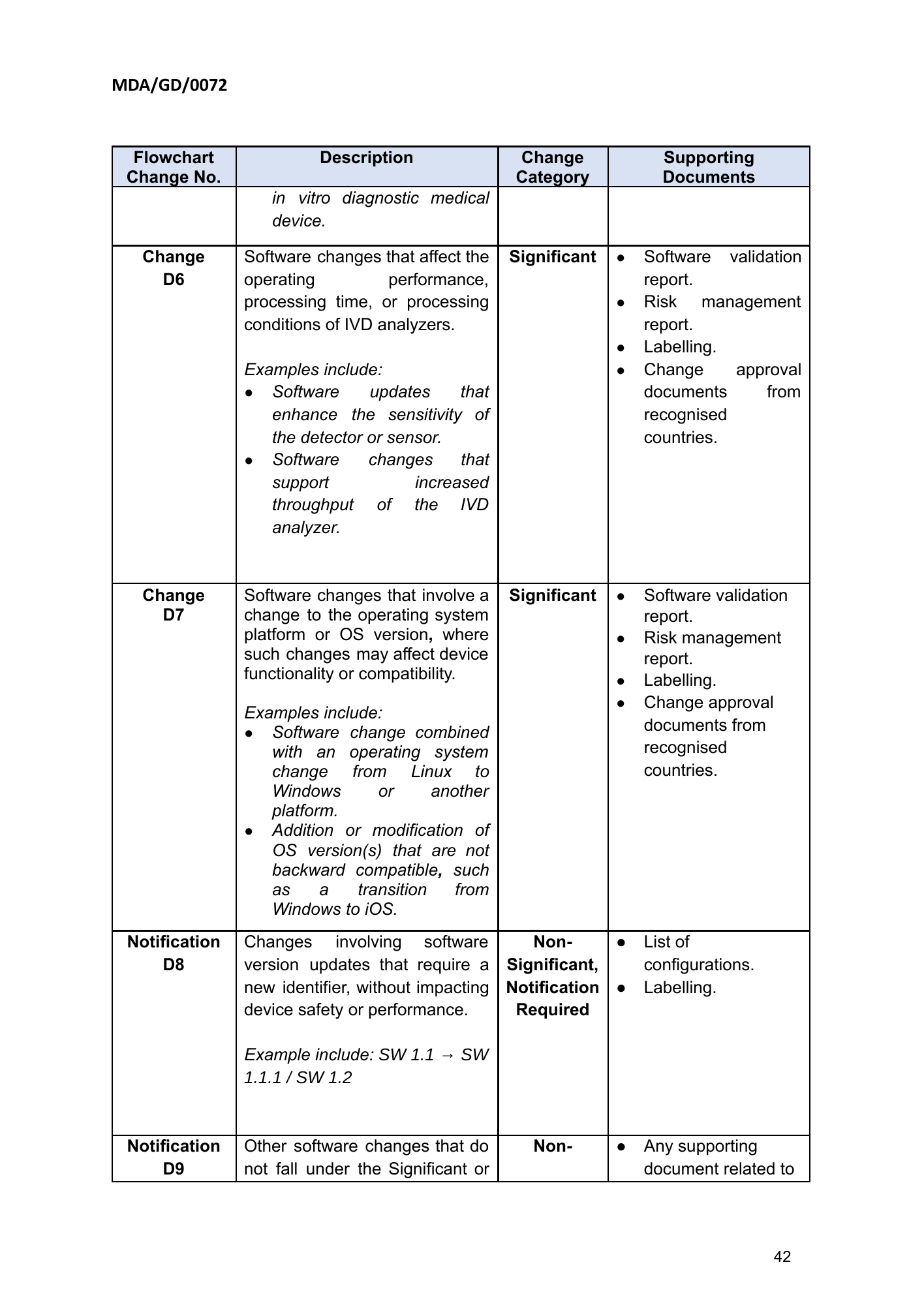
MDA/GD/0072 Flowchart Description Change Supporting Change No. Category Documents in vitro diagnostic medical device. Change Software changes that affect the Significant ● Software validation D6 operating performance, report. processing time, or processing ● Risk management conditions of IVD analyzers. report. ● Labelling. Examples include: ● Change approval ● Software updates that documents from enhance the sensitivity of recognised the detector or sensor. countries. ● Software changes that support increased throughput of the IVD analyzer. Change Software changes that involve a Significant ● Software validation D7 change to the operating system report. platform or OS version, where ● Risk management such changes may affect device report. functionality or compatibility. ● Labelling. ● Change approval Examples include: ● Software change combined documents from with an operating system recognised change from Linux to countries. Windows or another platform. ● Addition or modification of OS version(s) that are not backward compatible, such as a transition from Windows to iOS. Notification Changes involving software Non- ● List of D8 version updates that require a Significant, configurations. new identifier, without impacting Notification ● Labelling. device safety or performance. Required Example include: SW 1.1 → SW 1.1.1 / SW 1.2 Notification Other software changes that do Non- ● Any supporting D9 not fall under the Significant or document related to 42
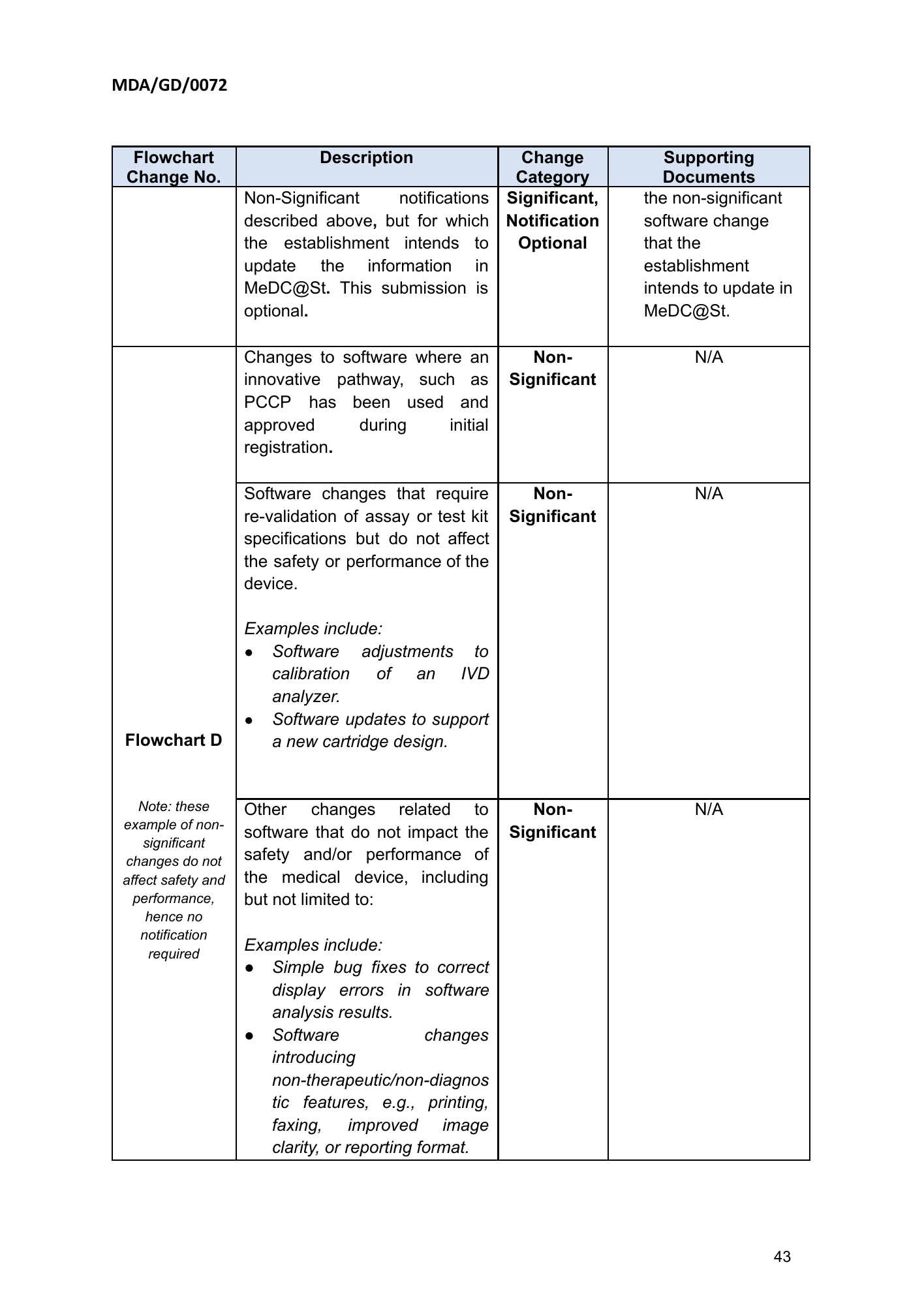
MDA/GD/0072 Flowchart Description Change Supporting Change No. Category Documents Non-Significant notifications Significant, the non-significant described above, but for which Notification software change the establishment intends to Optional that the update the information in establishment MeDC@St. This submission is intends to update in optional. MeDC@St. Changes to software where an Non- N/A innovative pathway, such as Significant PCCP has been used and approved during initial registration. Software changes that require Non- N/A re-validation of assay or test kit Significant specifications but do not affect the safety or performance of the device. Examples include: ● Software adjustments to calibration of an IVD analyzer. ● Software updates to support Flowchart D a new cartridge design. Note: these Other changes related to Non- N/A example of non- software that do not impact the Significant significant changes do not safety and/or performance of affect safety and the medical device, including performance, but not limited to: hence no notification required Examples include: ● Simple bug fixes to correct display errors in software analysis results. ● Software changes introducing non-therapeutic/non-diagnos tic features, e.g., printing, faxing, improved image clarity, or reporting format. 43
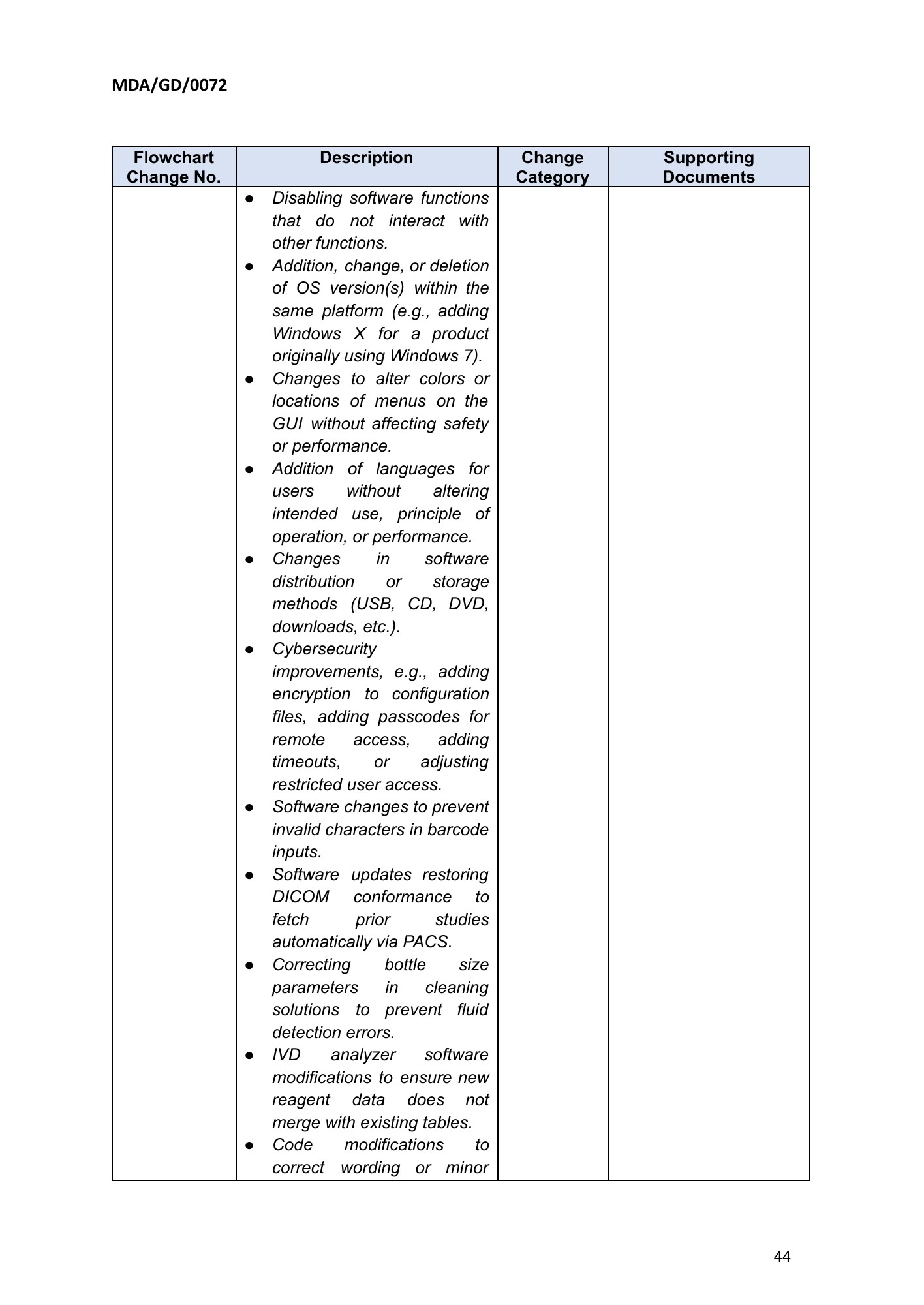
MDA/GD/0072 Flowchart Description Change Supporting Change No. Category Documents ● Disabling software functions that do not interact with other functions. ● Addition, change, or deletion of OS version(s) within the same platform (e.g., adding Windows X for a product originally using Windows 7). ● Changes to alter colors or locations of menus on the GUI without affecting safety or performance. ● Addition of languages for users without altering intended use, principle of operation, or performance. ● Changes in software distribution or storage methods (USB, CD, DVD, downloads, etc.). ● Cybersecurity improvements, e.g., adding encryption to configuration files, adding passcodes for remote access, adding timeouts, or adjusting restricted user access. ● Software changes to prevent invalid characters in barcode inputs. ● Software updates restoring DICOM conformance to fetch prior studies automatically via PACS. ● Correcting bottle size parameters in cleaning solutions to prevent fluid detection errors. ● IVD analyzer software modifications to ensure new reagent data does not merge with existing tables. ● Code modifications to correct wording or minor 44
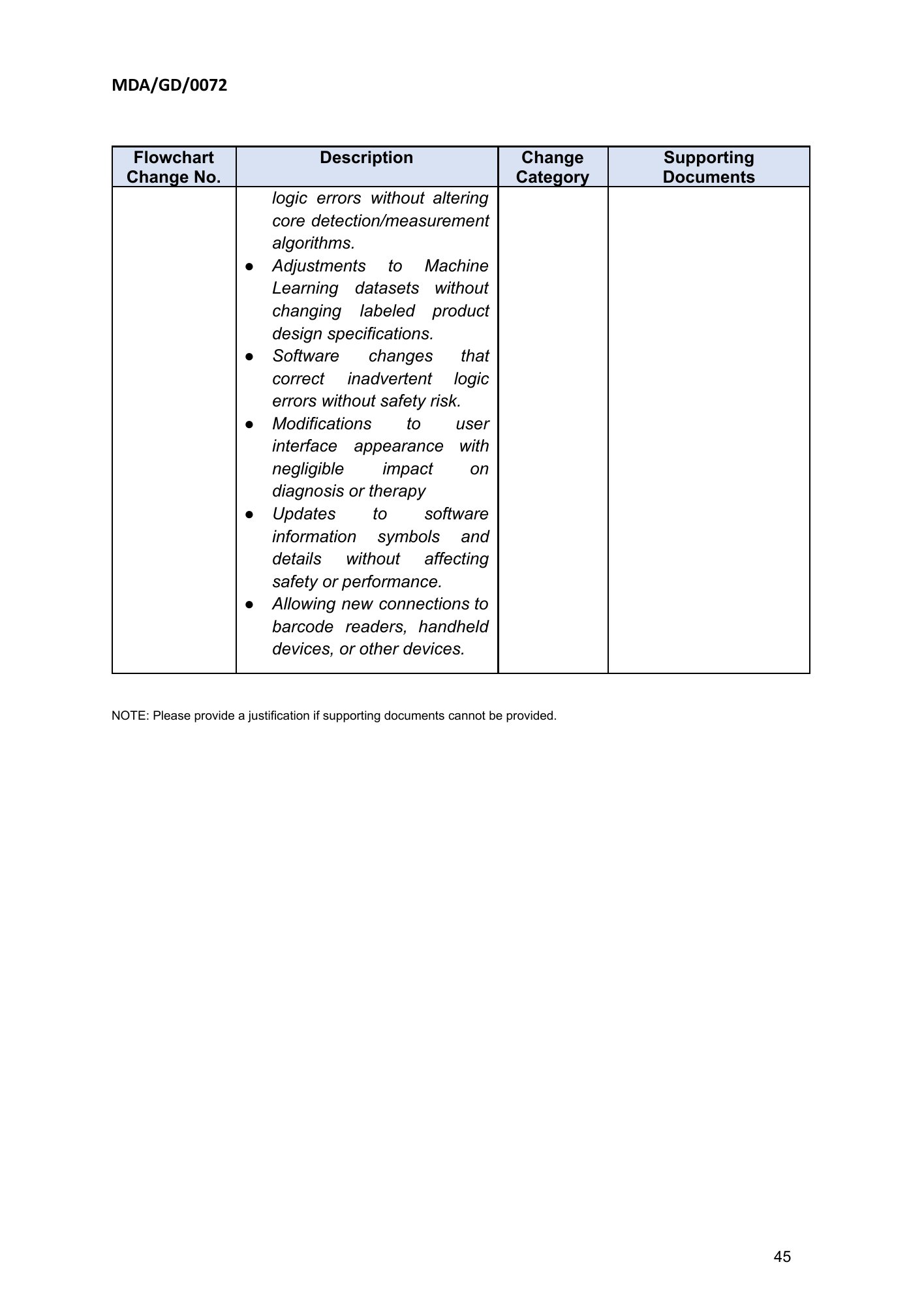
MDA/GD/0072 Flowchart Description Change Supporting Change No. Category Documents logic errors without altering core detection/measurement algorithms. ● Adjustments to Machine Learning datasets without changing labeled product design specifications. ● Software changes that correct inadvertent logic errors without safety risk. ● Modifications to user interface appearance with negligible impact on diagnosis or therapy ● Updates to software information symbols and details without affecting safety or performance. ● Allowing new connections to barcode readers, handheld devices, or other devices. NOTE: Please provide a justification if supporting documents cannot be provided. 45
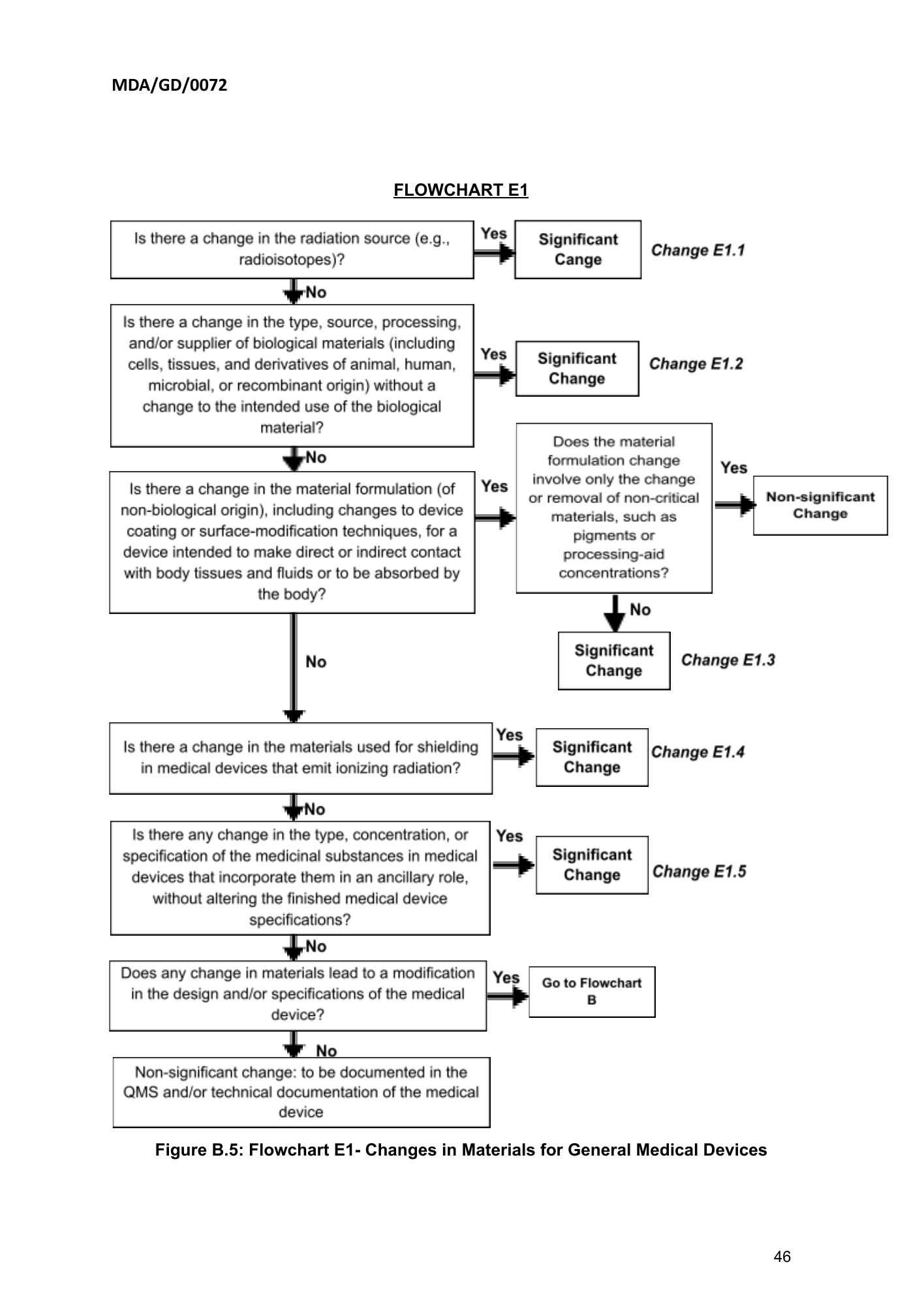
MDA/GD/0072 FLOWCHART E1 Figure B.5: Flowchart E1- Changes in Materials for General Medical Devices 46
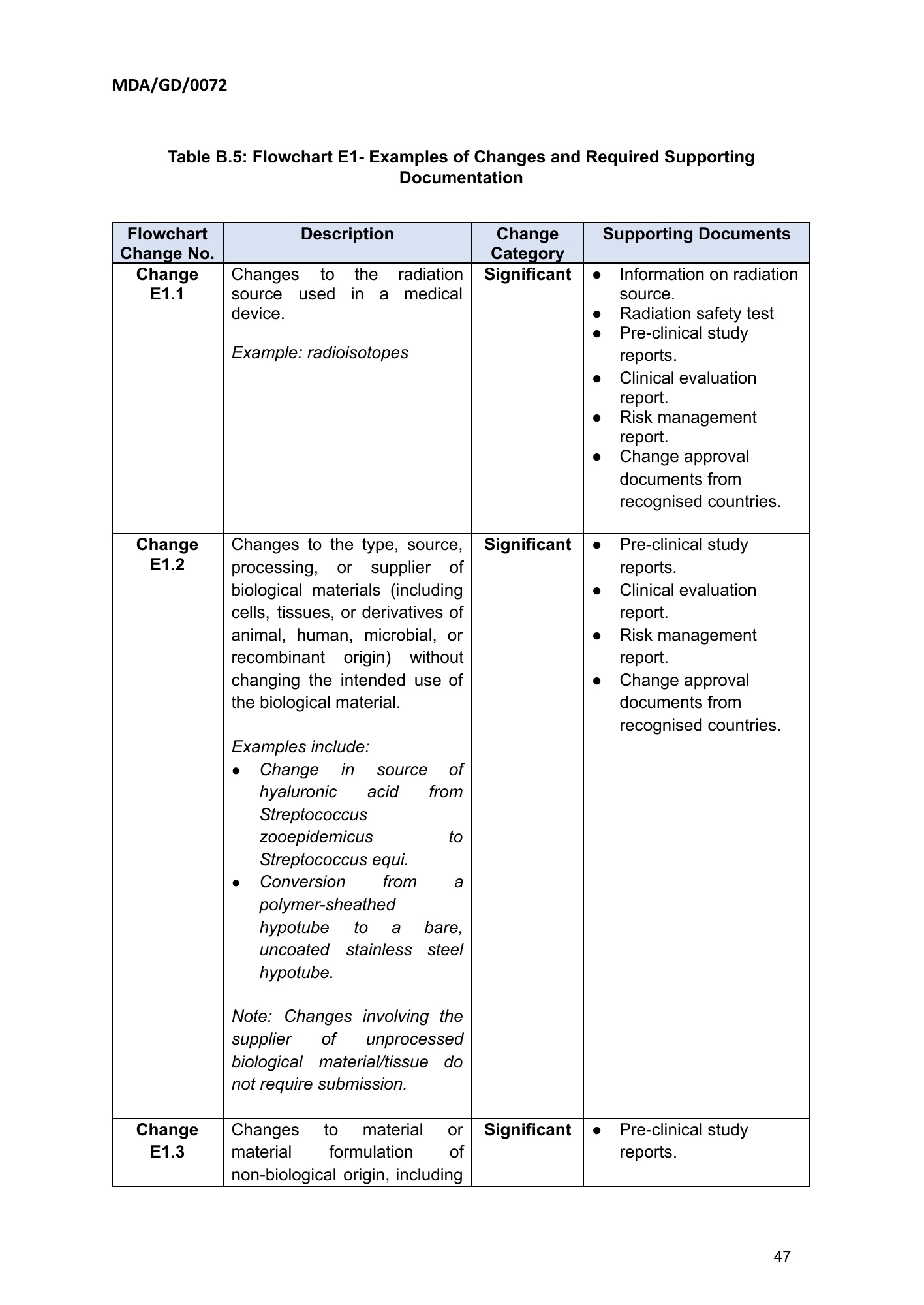
MDA/GD/0072 Table B.5: Flowchart E1- Examples of Changes and Required Supporting Documentation Flowchart Description Change Supporting Documents Change No. Category Change Changes to the radiation Significant ● Information on radiation E1.1 source used in a medical source. device. ● Radiation safety test ● Pre-clinical study Example: radioisotopes reports. ● Clinical evaluation report. ● Risk management report. ● Change approval documents from recognised countries. Change Changes to the type, source, Significant ● Pre-clinical study E1.2 processing, or supplier of reports. biological materials (including ● Clinical evaluation cells, tissues, or derivatives of report. animal, human, microbial, or ● Risk management recombinant origin) without report. changing the intended use of ● Change approval the biological material. documents from recognised countries. Examples include: ● Change in source of hyaluronic acid from Streptococcus zooepidemicus to Streptococcus equi. ● Conversion from a polymer-sheathed hypotube to a bare, uncoated stainless steel hypotube. Note: Changes involving the supplier of unprocessed biological material/tissue do not require submission. Change Changes to material or Significant ● Pre-clinical study E1.3 material formulation of reports. non-biological origin, including 47
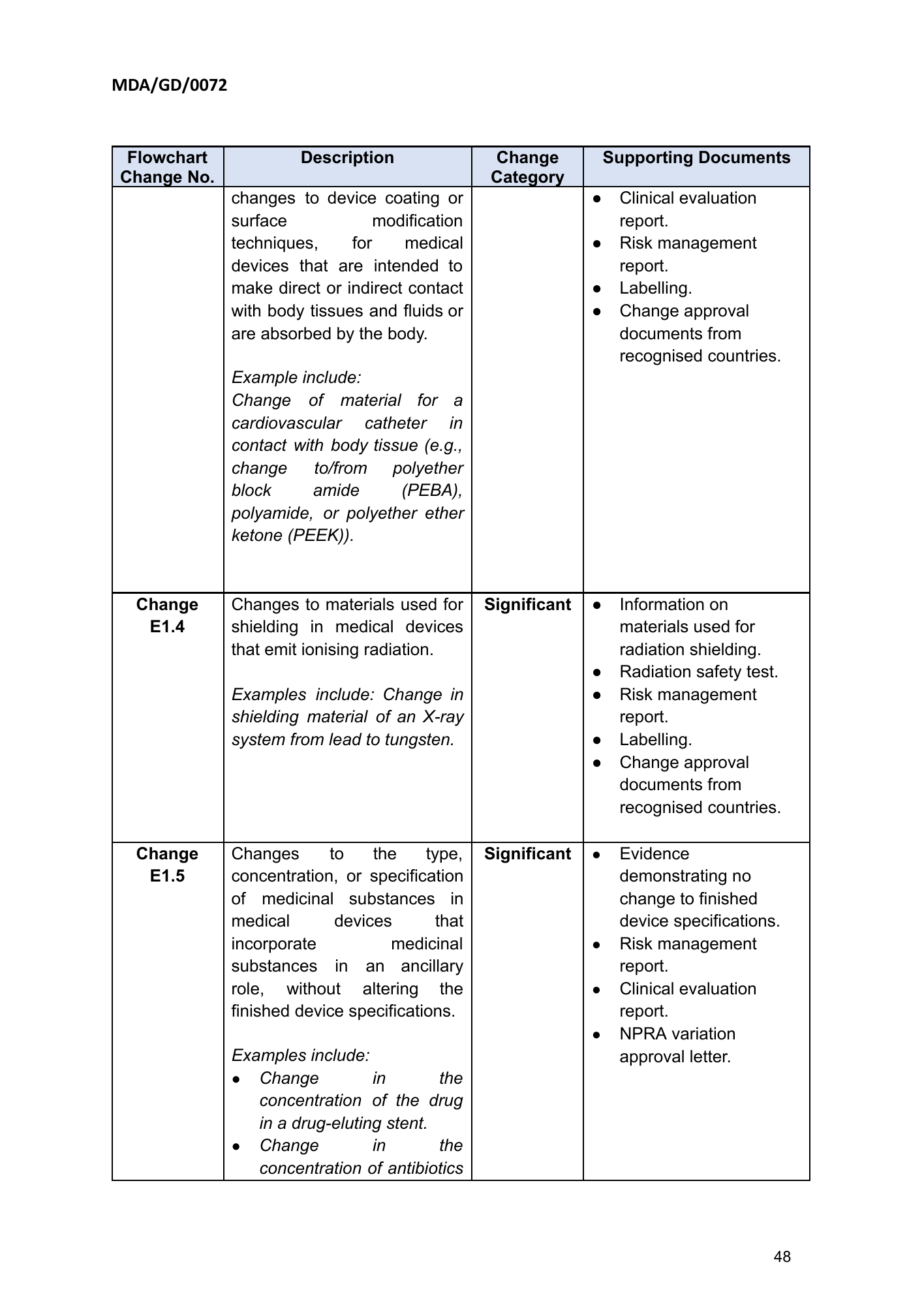
MDA/GD/0072 Flowchart Description Change Supporting Documents Change No. Category changes to device coating or ● Clinical evaluation surface modification report. techniques, for medical ● Risk management devices that are intended to report. make direct or indirect contact ● Labelling. with body tissues and fluids or ● Change approval are absorbed by the body. documents from recognised countries. Example include: Change of material for a cardiovascular catheter in contact with body tissue (e.g., change to/from polyether block amide (PEBA), polyamide, or polyether ether ketone (PEEK)). Change Changes to materials used for Significant ● Information on E1.4 shielding in medical devices materials used for that emit ionising radiation. radiation shielding. ● Radiation safety test. Examples include: Change in ● Risk management shielding material of an X-ray report. system from lead to tungsten. ● Labelling. ● Change approval documents from recognised countries. Change Changes to the type, Significant ● Evidence E1.5 concentration, or specification demonstrating no of medicinal substances in change to finished medical devices that device specifications. incorporate medicinal ● Risk management substances in an ancillary report. role, without altering the ● Clinical evaluation finished device specifications. report. ● NPRA variation Examples include: approval letter. ● Change in the concentration of the drug in a drug-eluting stent. ● Change in the concentration of antibiotics 48
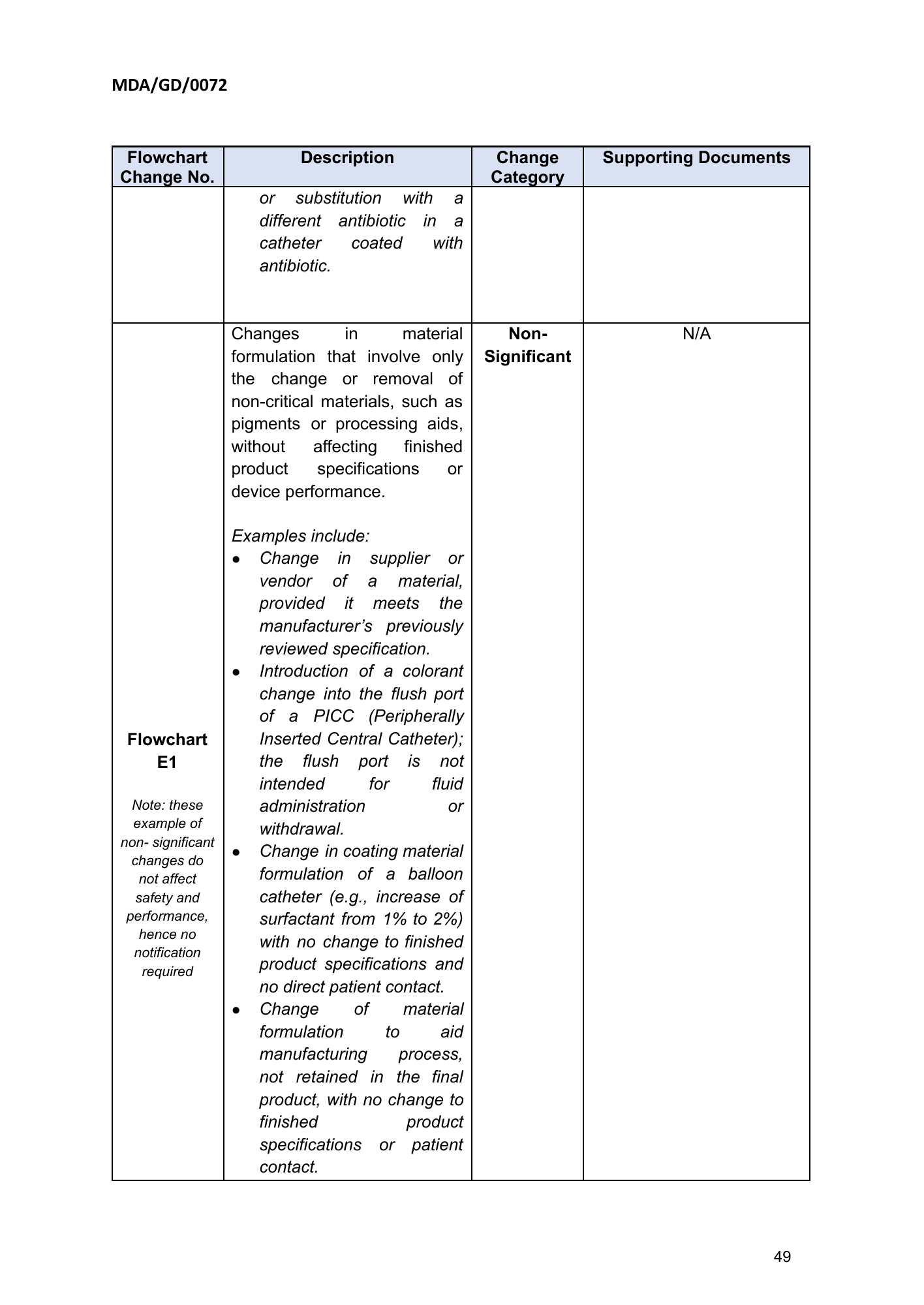
MDA/GD/0072 Flowchart Description Change Supporting Documents Change No. Category or substitution with a different antibiotic in a catheter coated with antibiotic. Changes in material Non- N/A formulation that involve only Significant the change or removal of non-critical materials, such as pigments or processing aids, without affecting finished product specifications or device performance. Examples include: ● Change in supplier or vendor of a material, provided it meets the manufacturer’s previously reviewed specification. ● Introduction of a colorant change into the flush port of a PICC (Peripherally Flowchart Inserted Central Catheter); E1 the flush port is not intended for fluid Note: these administration or example of withdrawal. non- significant ● Change in coating material changes do not affect formulation of a balloon safety and catheter (e.g., increase of performance, surfactant from 1% to 2%) hence no with no change to finished notification required product specifications and no direct patient contact. ● Change of material formulation to aid manufacturing process, not retained in the final product, with no change to finished product specifications or patient contact. 49
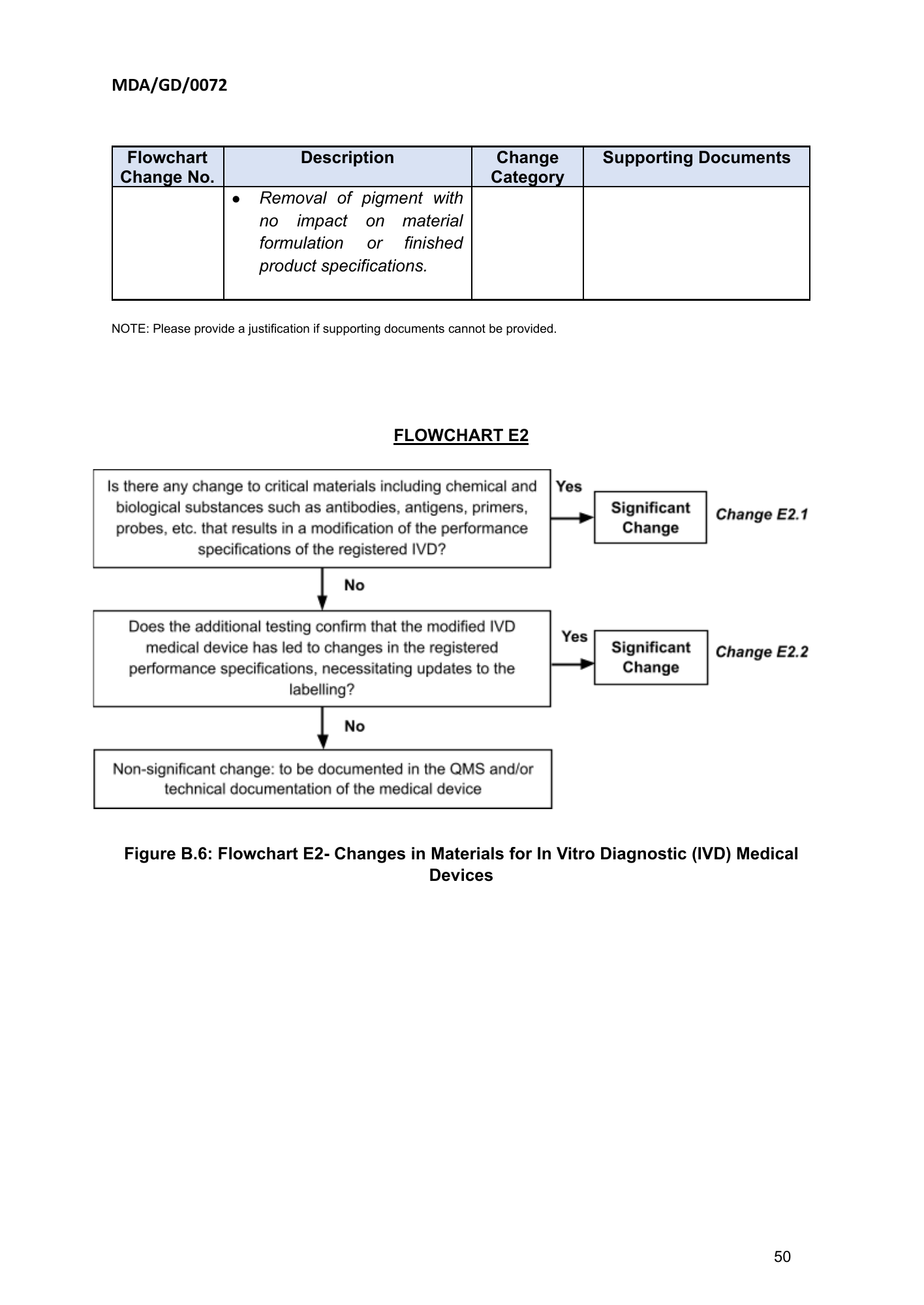
MDA/GD/0072 Flowchart Description Change Supporting Documents Change No. Category ● Removal of pigment with no impact on material formulation or finished product specifications. NOTE: Please provide a justification if supporting documents cannot be provided. FLOWCHART E2 Figure B.6: Flowchart E2- Changes in Materials for In Vitro Diagnostic (IVD) Medical Devices 50
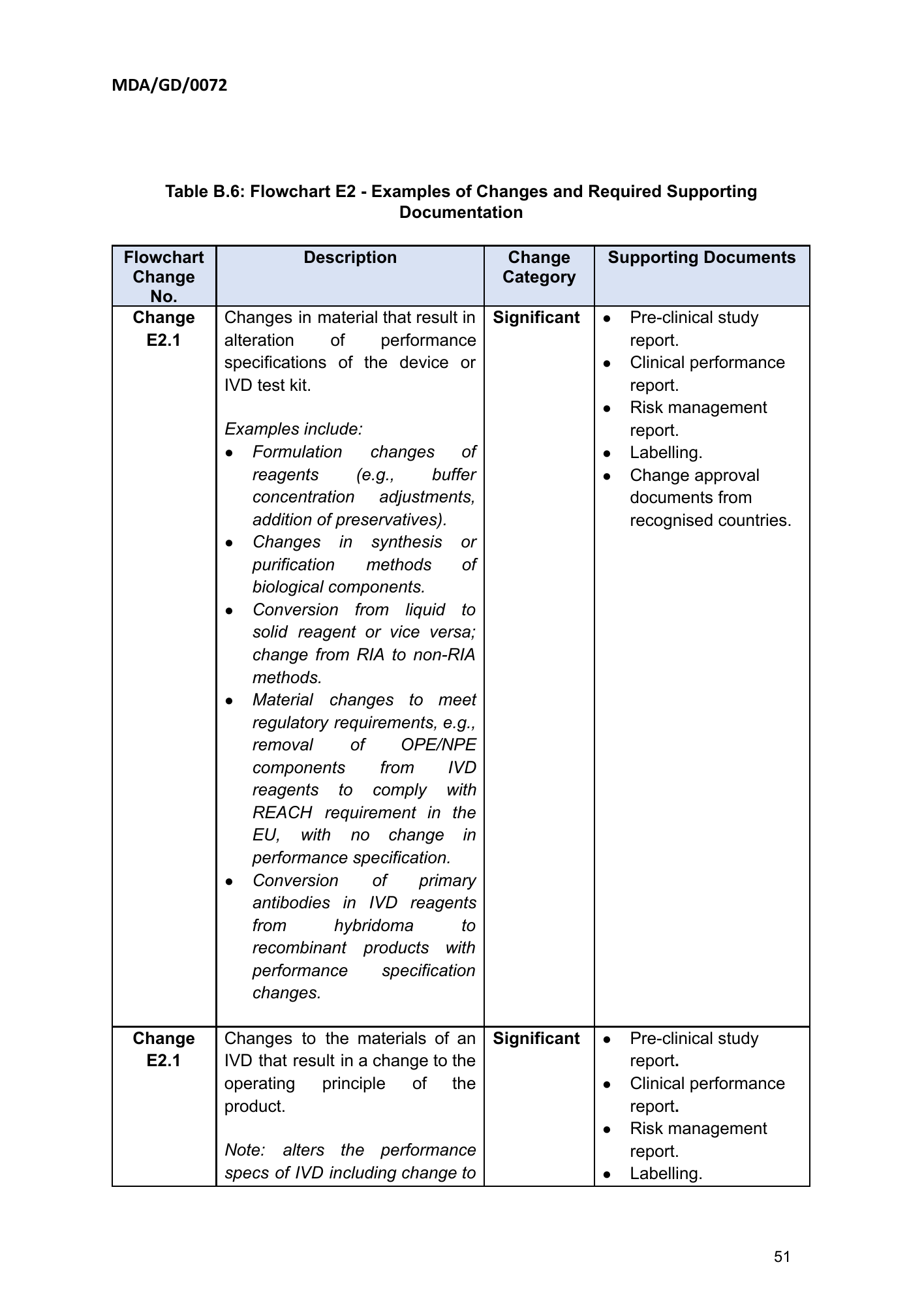
MDA/GD/0072 Table B.6: Flowchart E2 - Examples of Changes and Required Supporting Documentation Flowchart Description Change Supporting Documents Change Category No. Change Changes in material that result in Significant ● Pre-clinical study E2.1 alteration of performance report. specifications of the device or ● Clinical performance IVD test kit. report. ● Risk management Examples include: report. ● Formulation changes of ● Labelling. reagents (e.g., buffer ● Change approval concentration adjustments, documents from addition of preservatives). recognised countries. ● Changes in synthesis or purification methods of biological components. ● Conversion from liquid to solid reagent or vice versa; change from RIA to non-RIA methods. ● Material changes to meet regulatory requirements, e.g., removal of OPE/NPE components from IVD reagents to comply with REACH requirement in the EU, with no change in performance specification. ● Conversion of primary antibodies in IVD reagents from hybridoma to recombinant products with performance specification changes. Change Changes to the materials of an Significant ● Pre-clinical study E2.1 IVD that result in a change to the report. operating principle of the ● Clinical performance product. report. ● Risk management Note: alters the performance report. specs of IVD including change to ● Labelling. 51
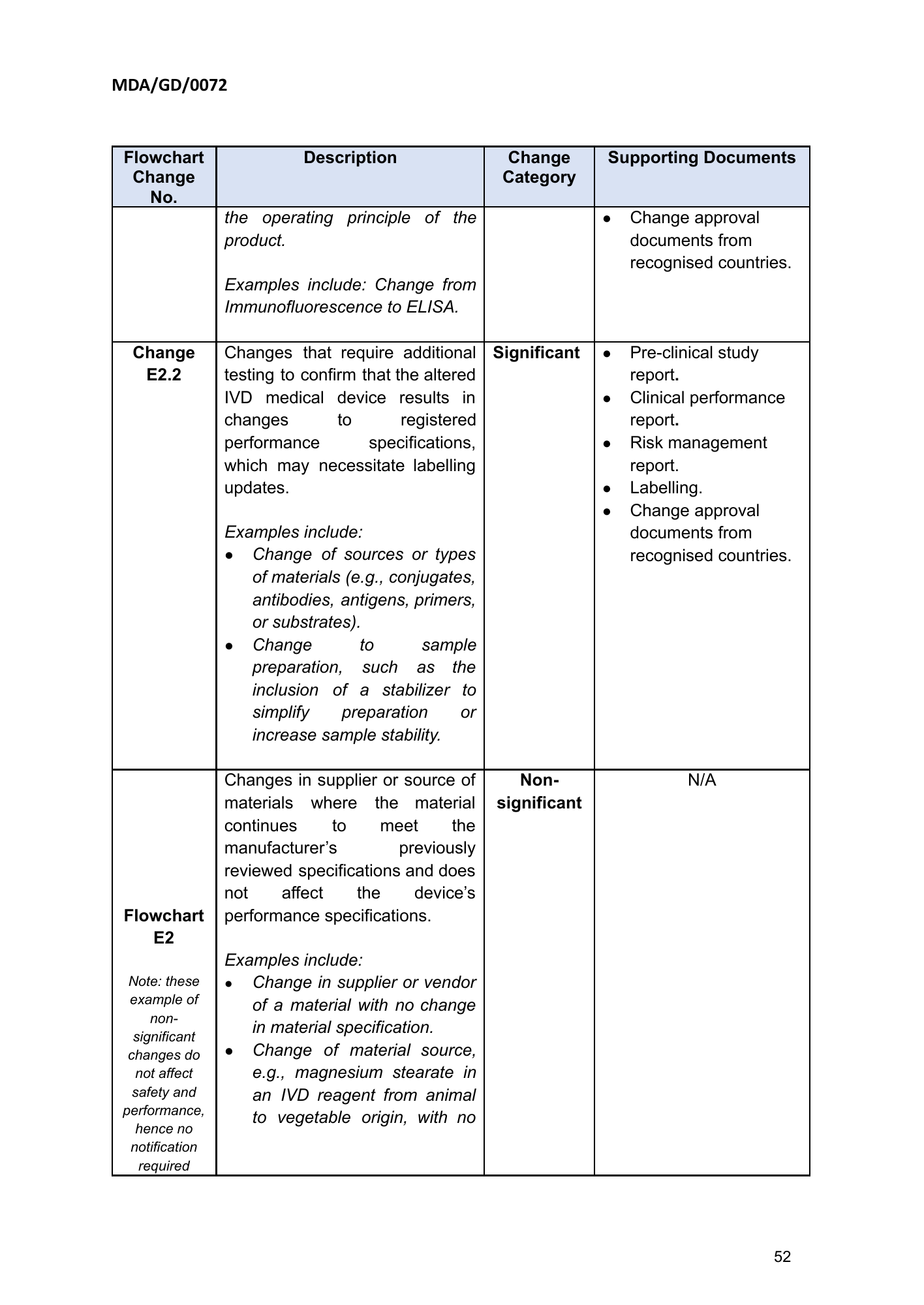
MDA/GD/0072 Flowchart Description Change Supporting Documents Change Category No. the operating principle of the ● Change approval product. documents from recognised countries. Examples include: Change from Immunofluorescence to ELISA. Change Changes that require additional Significant ● Pre-clinical study E2.2 testing to confirm that the altered report. IVD medical device results in ● Clinical performance changes to registered report. performance specifications, ● Risk management which may necessitate labelling report. updates. ● Labelling. ● Change approval Examples include: documents from ● Change of sources or types recognised countries. of materials (e.g., conjugates, antibodies, antigens, primers, or substrates). ● Change to sample preparation, such as the inclusion of a stabilizer to simplify preparation or increase sample stability. Changes in supplier or source of Non- N/A materials where the material significant continues to meet the manufacturer’s previously reviewed specifications and does not affect the device’s Flowchart performance specifications. E2 Examples include: Note: these ● Change in supplier or vendor example of of a material with no change non- significant in material specification. changes do ● Change of material source, not affect e.g., magnesium stearate in safety and an IVD reagent from animal performance, to vegetable origin, with no hence no notification required 52
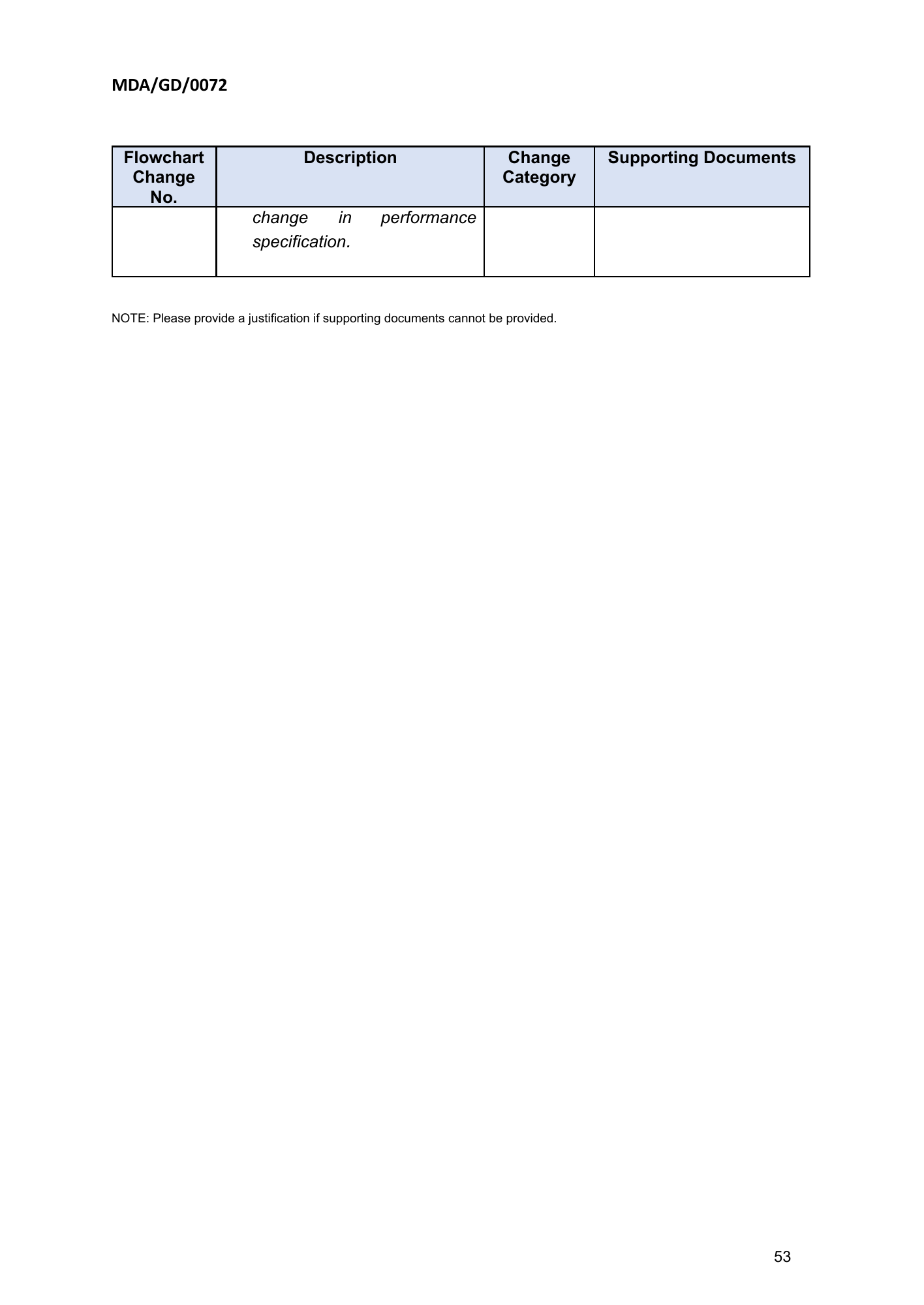
MDA/GD/0072 Flowchart Description Change Supporting Documents Change Category No. change in performance specification. NOTE: Please provide a justification if supporting documents cannot be provided. 53
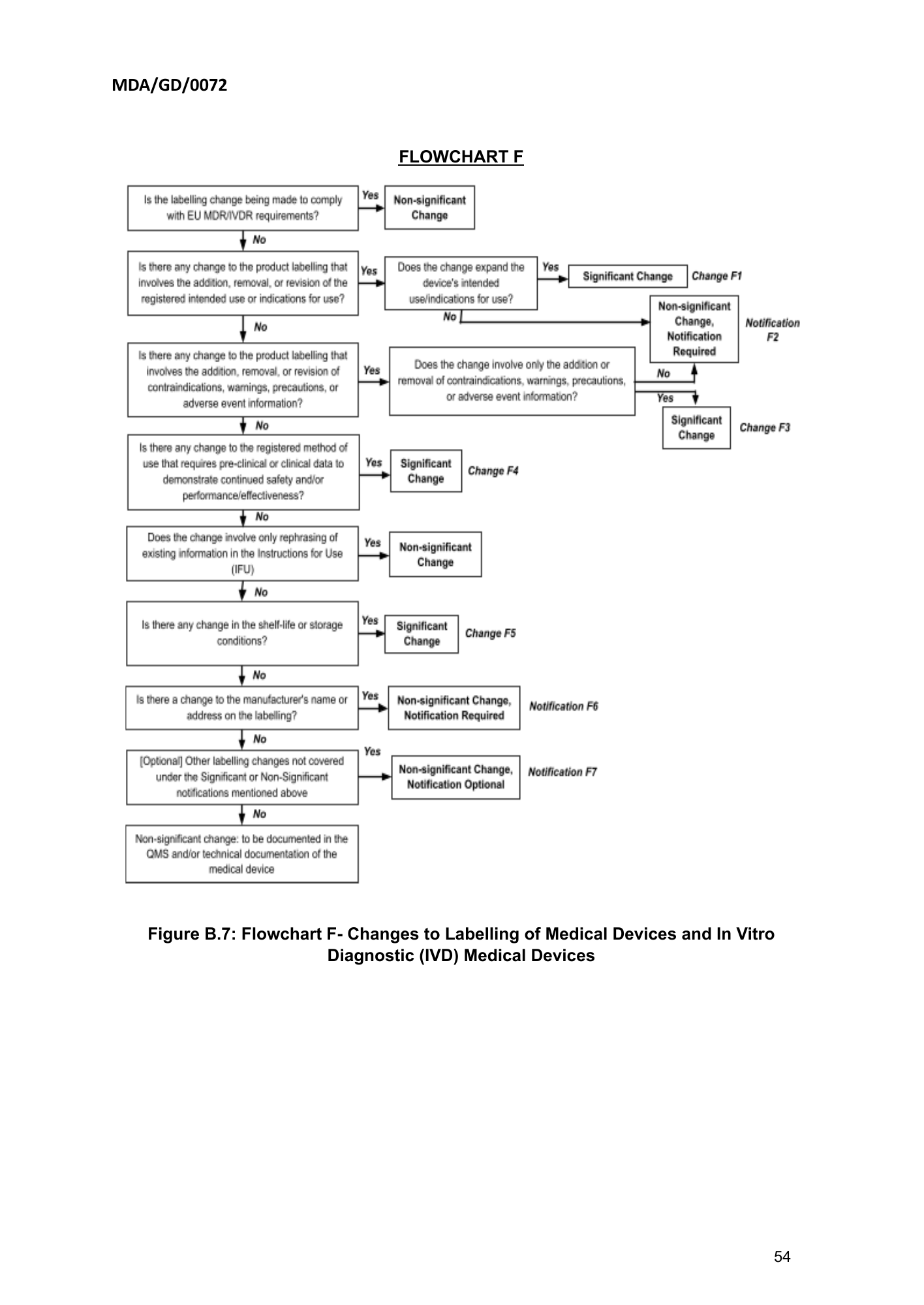
MDA/GD/0072 FLOWCHART F Figure B.7: Flowchart F- Changes to Labelling of Medical Devices and In Vitro Diagnostic (IVD) Medical Devices 54
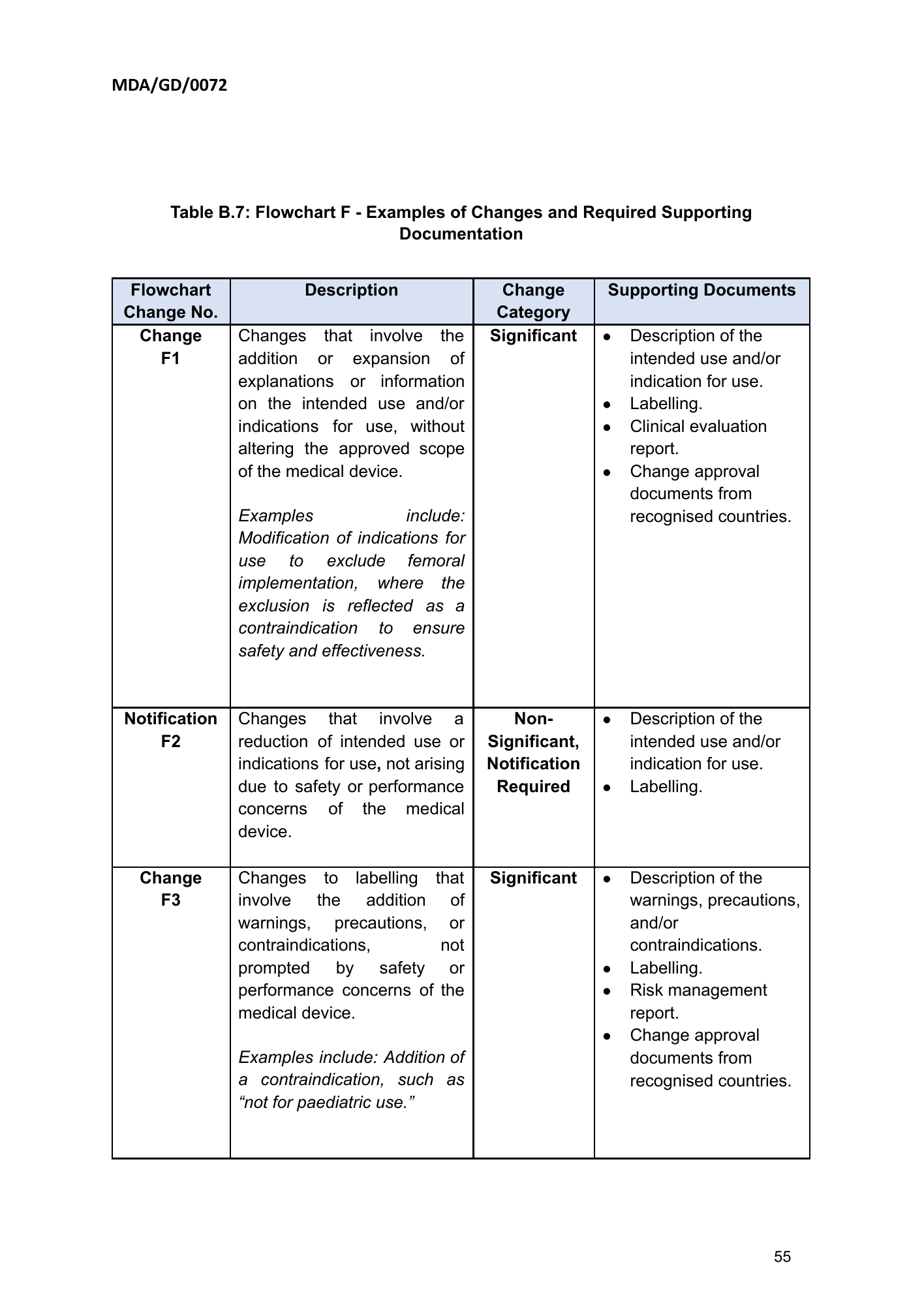
MDA/GD/0072 Table B.7: Flowchart F - Examples of Changes and Required Supporting Documentation Flowchart Description Change Supporting Documents Change No. Category Change Changes that involve the Significant ● Description of the F1 addition or expansion of intended use and/or explanations or information indication for use. on the intended use and/or ● Labelling. indications for use, without ● Clinical evaluation altering the approved scope report. of the medical device. ● Change approval documents from Examples include: recognised countries. Modification of indications for use to exclude femoral implementation, where the exclusion is reflected as a contraindication to ensure safety and effectiveness. Notification Changes that involve a Non- ● Description of the F2 reduction of intended use or Significant, intended use and/or indications for use, not arising Notification indication for use. due to safety or performance Required ● Labelling. concerns of the medical device. Change Changes to labelling that Significant ● Description of the F3 involve the addition of warnings, precautions, warnings, precautions, or and/or contraindications, not contraindications. prompted by safety or ● Labelling. performance concerns of the ● Risk management medical device. report. ● Change approval Examples include: Addition of documents from a contraindication, such as recognised countries. “not for paediatric use.” 55
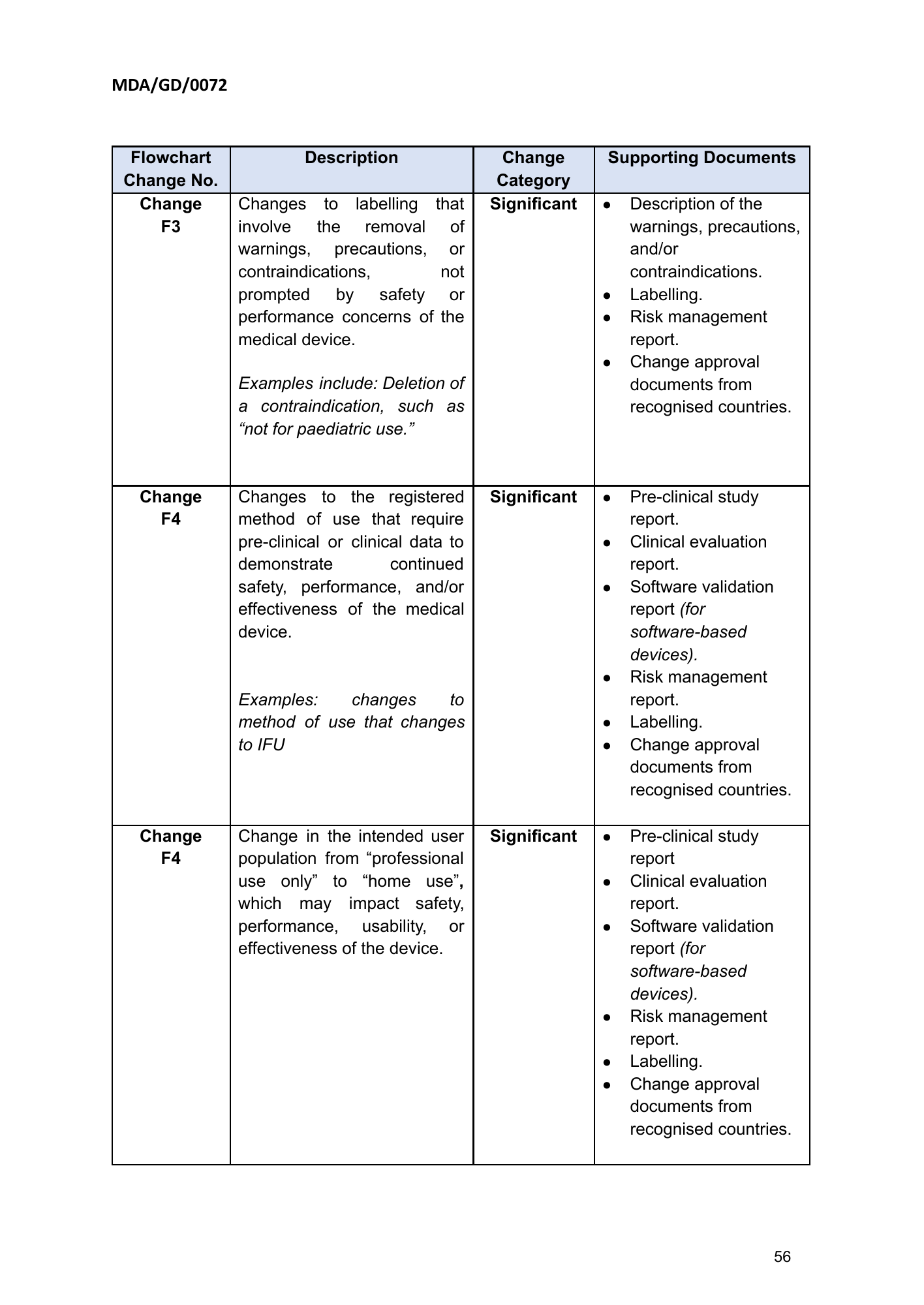
MDA/GD/0072 Flowchart Description Change Supporting Documents Change No. Category Change Changes to labelling that Significant ● Description of the F3 involve the removal of warnings, precautions, warnings, precautions, or and/or contraindications, not contraindications. prompted by safety or ● Labelling. performance concerns of the ● Risk management medical device. report. ● Change approval Examples include: Deletion of documents from a contraindication, such as recognised countries. “not for paediatric use.” Change Changes to the registered Significant ● Pre-clinical study F4 method of use that require report. pre-clinical or clinical data to ● Clinical evaluation demonstrate continued report. safety, performance, and/or ● Software validation effectiveness of the medical report (for device. software-based devices). ● Risk management Examples: changes to report. method of use that changes ● Labelling. to IFU ● Change approval documents from recognised countries. Change Change in the intended user Significant ● Pre-clinical study F4 population from “professional report use only” to “home use”, ● Clinical evaluation which may impact safety, report. performance, usability, or ● Software validation effectiveness of the device. report (for software-based devices). ● Risk management report. ● Labelling. ● Change approval documents from recognised countries. 56
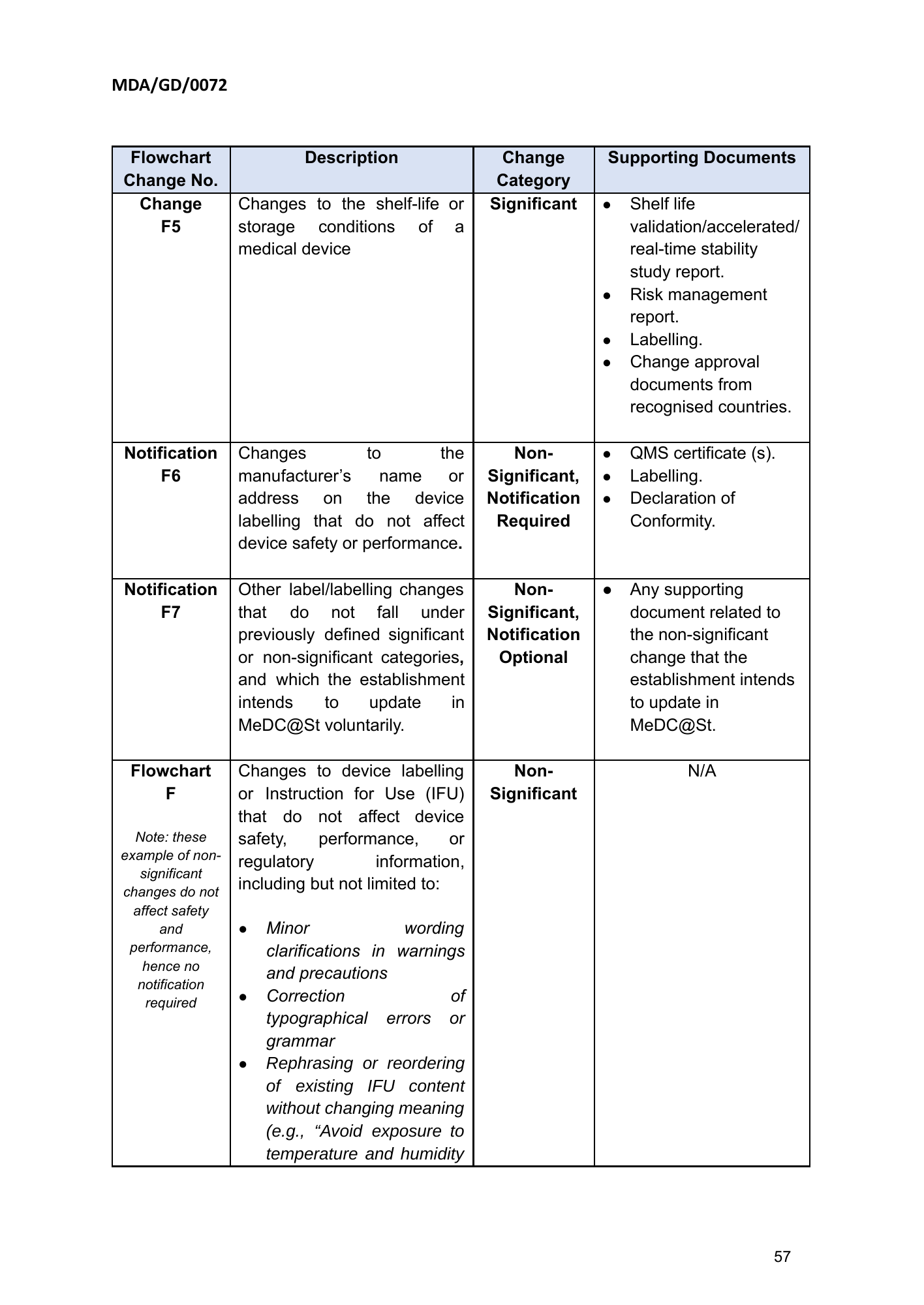
MDA/GD/0072 Flowchart Description Change Supporting Documents Change No. Category Change Changes to the shelf-life or Significant ● Shelf life F5 storage conditions of a validation/accelerated/ medical device real-time stability study report. ● Risk management report. ● Labelling. ● Change approval documents from recognised countries. Notification Changes to the Non- ● QMS certificate (s). F6 manufacturer’s name or Significant, ● Labelling. address on the device Notification ● Declaration of labelling that do not affect Required Conformity. device safety or performance. Notification Other label/labelling changes Non- ● Any supporting F7 that do not fall under Significant, document related to previously defined significant Notification the non-significant or non-significant categories, Optional change that the and which the establishment establishment intends intends to update in to update in MeDC@St voluntarily. MeDC@St. Flowchart Changes to device labelling Non- N/A F or Instruction for Use (IFU) Significant that do not affect device Note: these safety, performance, or example of non- regulatory information, significant changes do not including but not limited to: affect safety and ● Minor wording performance, clarifications in warnings hence no and precautions notification required ● Correction of typographical errors or grammar ● Rephrasing or reordering of existing IFU content without changing meaning (e.g., “Avoid exposure to temperature and humidity 57
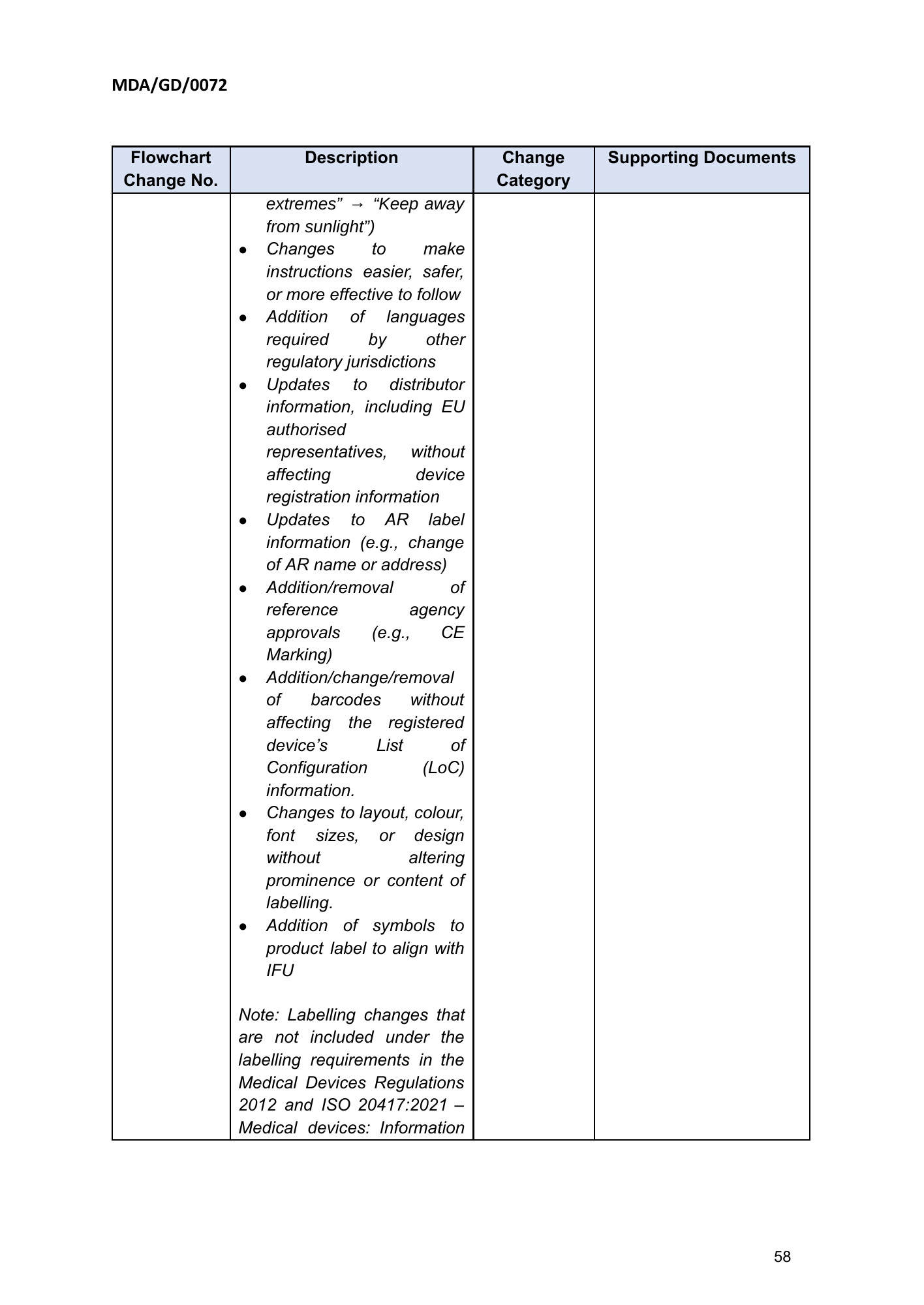
MDA/GD/0072 Flowchart Description Change Supporting Documents Change No. Category extremes” → “Keep away from sunlight”) ● Changes to make instructions easier, safer, or more effective to follow ● Addition of languages required by other regulatory jurisdictions ● Updates to distributor information, including EU authorised representatives, without affecting device registration information ● Updates to AR label information (e.g., change of AR name or address) ● Addition/removal of reference agency approvals (e.g., CE Marking) ● Addition/change/removal of barcodes without affecting the registered device’s List of Configuration (LoC) information. ● Changes to layout, colour, font sizes, or design without altering prominence or content of labelling. ● Addition of symbols to product label to align with IFU Note: Labelling changes that are not included under the labelling requirements in the Medical Devices Regulations 2012 and ISO 20417:2021 – Medical devices: Information 58
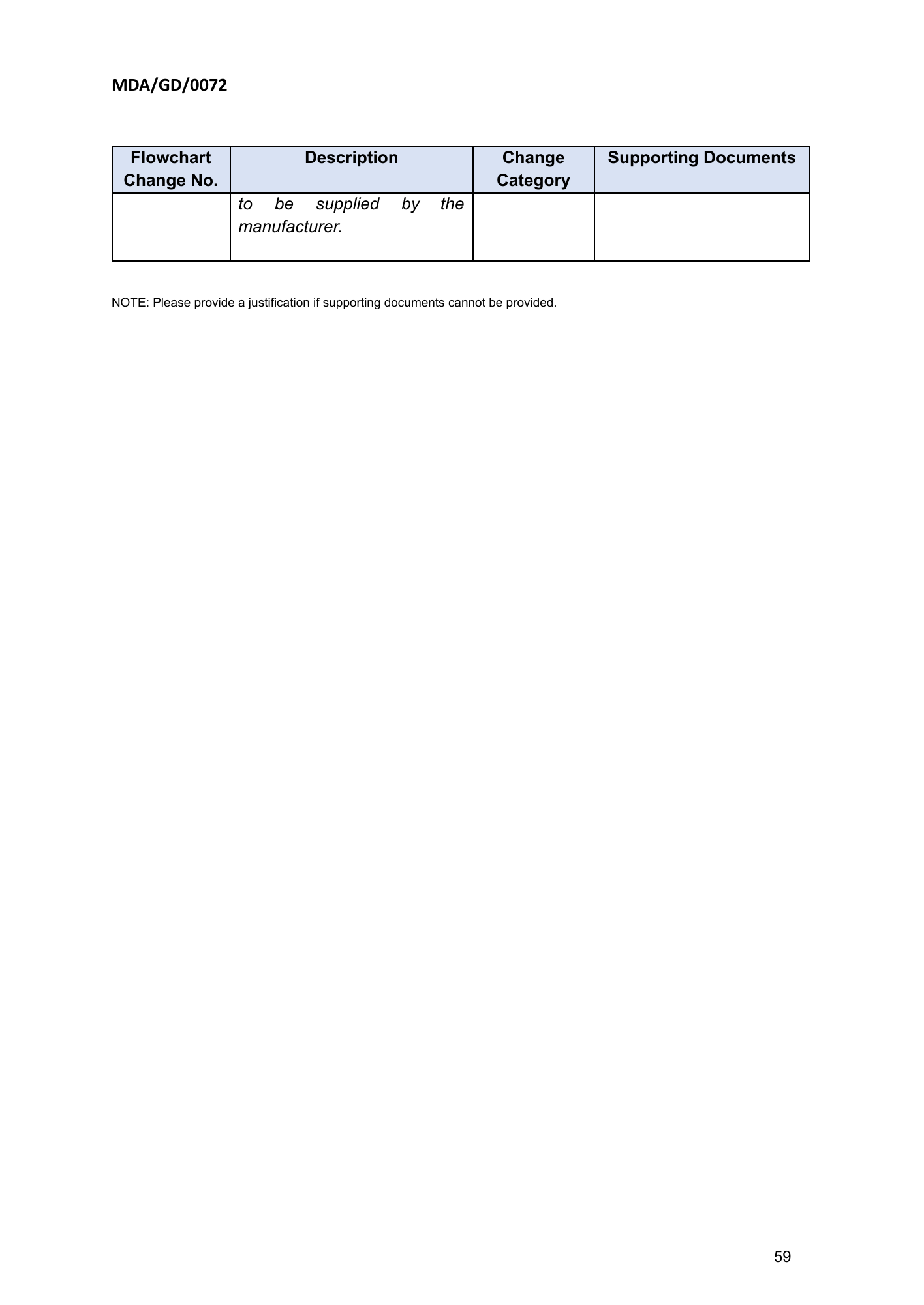
MDA/GD/0072 Flowchart Description Change Supporting Documents Change No. Category to be supplied by the manufacturer. NOTE: Please provide a justification if supporting documents cannot be provided. 59
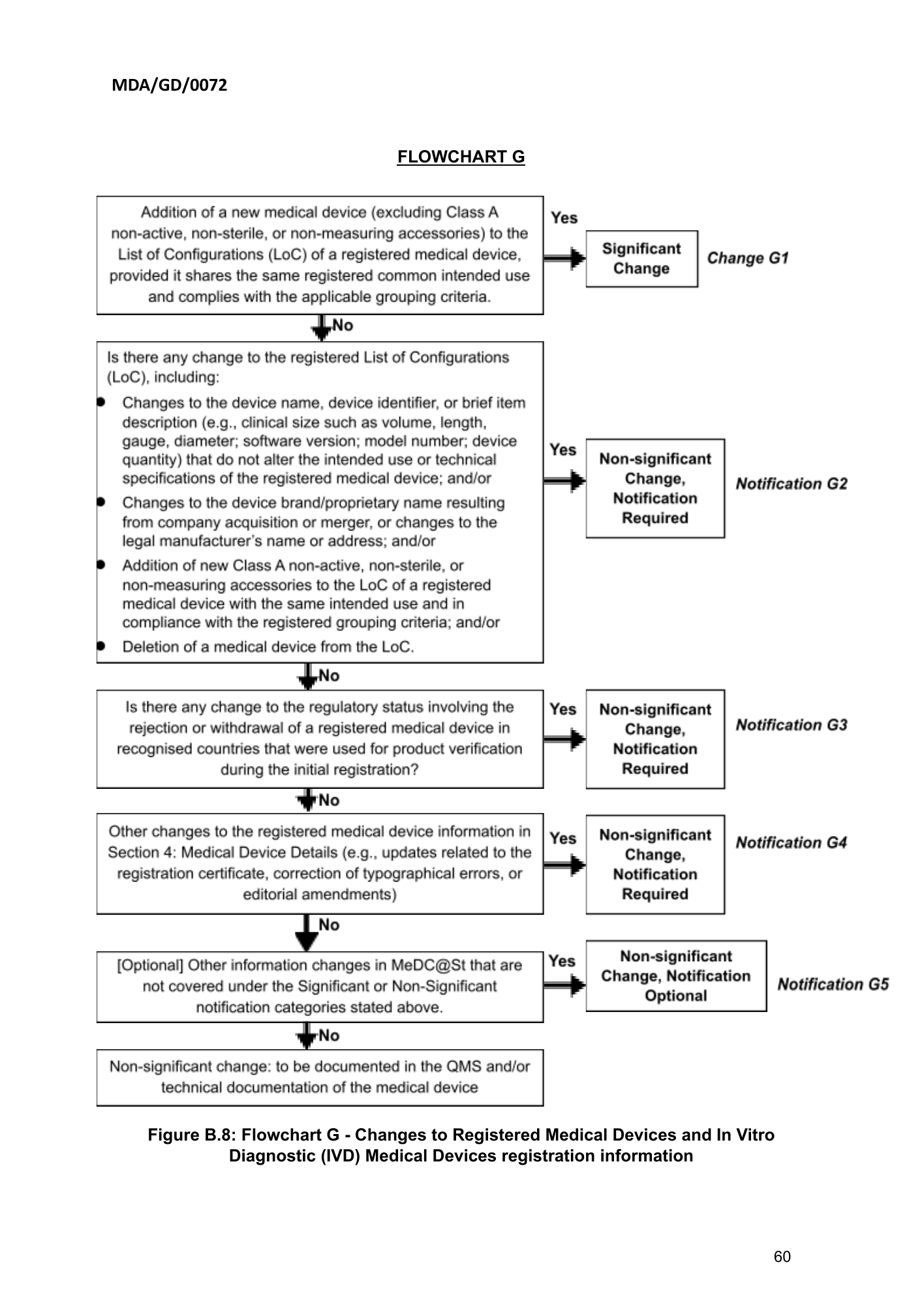
MDA/GD/0072 FLOWCHART G Figure B.8: Flowchart G - Changes to Registered Medical Devices and In Vitro Diagnostic (IVD) Medical Devices registration information 60
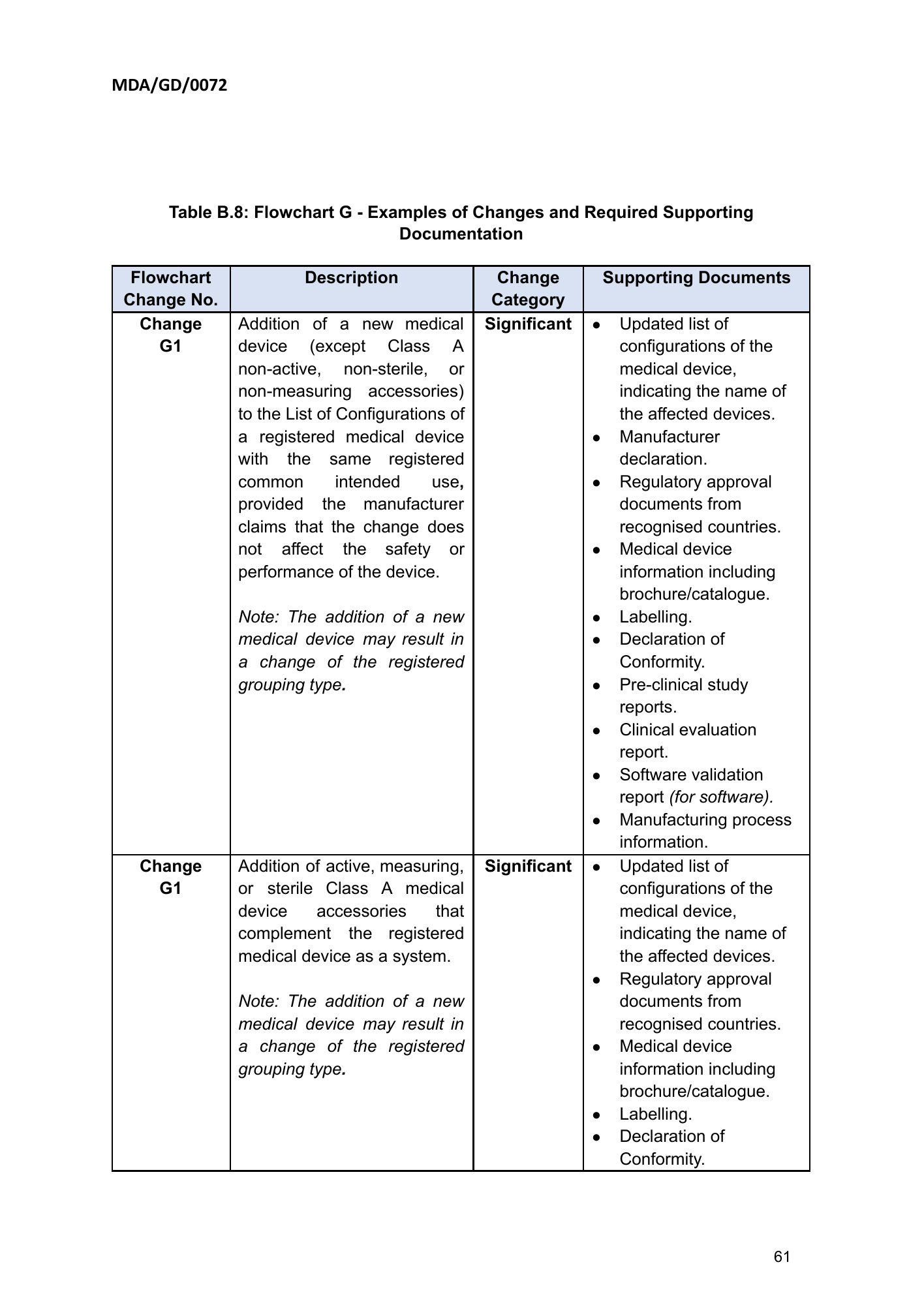
MDA/GD/0072 Table B.8: Flowchart G - Examples of Changes and Required Supporting Documentation Flowchart Description Change Supporting Documents Change No. Category Change Addition of a new medical Significant ● Updated list of G1 device (except Class A configurations of the non-active, non-sterile, or medical device, non-measuring accessories) indicating the name of to the List of Configurations of the affected devices. a registered medical device ● Manufacturer with the same registered declaration. common intended use, ● Regulatory approval provided the manufacturer documents from claims that the change does recognised countries. not affect the safety or ● Medical device performance of the device. information including brochure/catalogue. Note: The addition of a new ● Labelling. medical device may result in ● Declaration of a change of the registered Conformity. grouping type. ● Pre-clinical study reports. ● Clinical evaluation report. ● Software validation report (for software). ● Manufacturing process information. Change Addition of active, measuring, Significant ● Updated list of G1 or sterile Class A medical configurations of the device accessories that medical device, complement the registered indicating the name of medical device as a system. the affected devices. ● Regulatory approval Note: The addition of a new documents from medical device may result in recognised countries. a change of the registered ● Medical device grouping type. information including brochure/catalogue. ● Labelling. ● Declaration of Conformity. 61
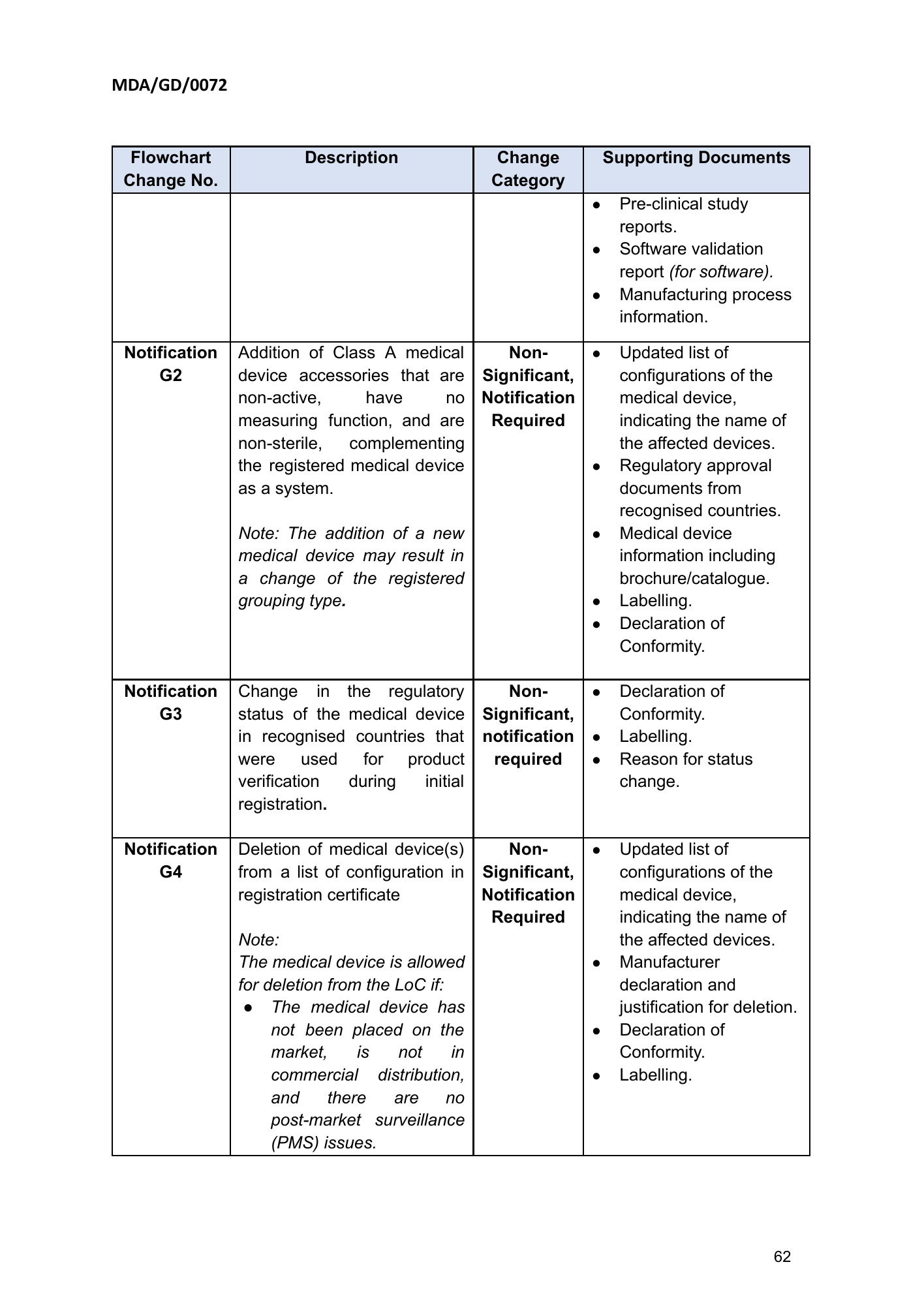
MDA/GD/0072 Flowchart Description Change Supporting Documents Change No. Category ● Pre-clinical study reports. ● Software validation report (for software). ● Manufacturing process information. Notification Addition of Class A medical Non- ● Updated list of G2 device accessories that are Significant, configurations of the non-active, have no Notification medical device, measuring function, and are Required indicating the name of non-sterile, complementing the affected devices. the registered medical device ● Regulatory approval as a system. documents from recognised countries. Note: The addition of a new ● Medical device medical device may result in information including a change of the registered brochure/catalogue. grouping type. ● Labelling. ● Declaration of Conformity. Notification Change in the regulatory Non- ● Declaration of G3 status of the medical device Significant, Conformity. in recognised countries that notification ● Labelling. were used for product required ● Reason for status verification during initial change. registration. Notification Deletion of medical device(s) Non- ● Updated list of G4 from a list of configuration in Significant, configurations of the registration certificate Notification medical device, Required indicating the name of Note: the affected devices. The medical device is allowed ● Manufacturer for deletion from the LoC if: declaration and ● The medical device has justification for deletion. not been placed on the ● Declaration of market, is not in Conformity. commercial distribution, ● Labelling. and there are no post-market surveillance (PMS) issues. 62
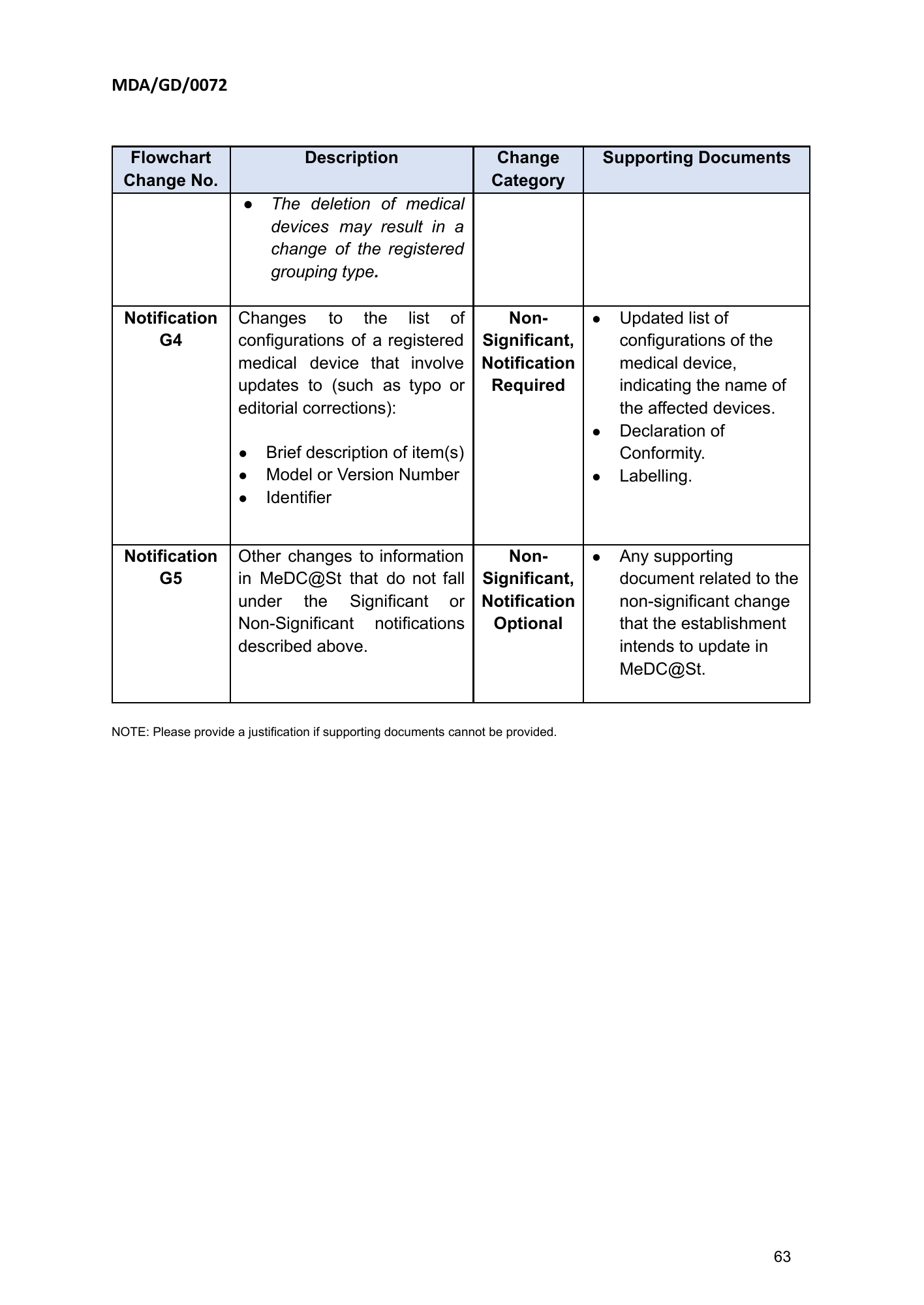
MDA/GD/0072 Flowchart Description Change Supporting Documents Change No. Category ● The deletion of medical devices may result in a change of the registered grouping type. Notification Changes to the list of Non- ● Updated list of G4 configurations of a registered Significant, configurations of the medical device that involve Notification medical device, updates to (such as typo or Required indicating the name of editorial corrections): the affected devices. ● Declaration of ● Brief description of item(s) Conformity. ● Model or Version Number ● Labelling. ● Identifier Notification Other changes to information Non- ● Any supporting G5 in MeDC@St that do not fall Significant, document related to the under the Significant or Notification non-significant change Non-Significant notifications Optional that the establishment described above. intends to update in MeDC@St. NOTE: Please provide a justification if supporting documents cannot be provided. 63
MDA/GD/0072 MEDICAL DEVICE AUTHORITY MINISTRY OF HEALTH, MALAYSIA Contact Information: MEDICAL DEVICE AUTHORITY Ministry of Health Malaysia Level 6, Prima 9, Prima Avenue II Block 3547, Persiaran APEC 63000 Cyberjaya, Selangor MALAYSIA T: (03) 8230 0300 F: (03) 8230 0200 Website: http://www.mda.gov.my 64