الهيئة العامة للغذاء والدواء Saudi Food & Drug Authority MDS – G012 الدليل الإرشادي للإذن بالتسويق للأجهزة والمستلزمات الطبية – التغييرات الجوهرية وغير الجوهرية رقم الإصدار: 1.0 تاريخ الإصدار: 2023/9/26 صفحة 1 من 18 MDS-G-012-V1/230926
Currentness under review. Whether this instrument remains applicable is under review. Consult the later instruments and source context below before relying on it.
Link directly to a passage with its anchor — for example #pdf-page-1 — to open it highlighted. This reference version is generated from the authority’s publication and does not replace it. Language: Arabic.
الهيئة العامة للغذاء والدواء Saudi Food & Drug Authority MDS – G012 الدليل الإرشادي للإذن بالتسويق للأجهزة والمستلزمات الطبية – التغييرات الجوهرية وغير الجوهرية رقم الإصدار: 1.0 تاريخ الإصدار: 2023/9/26 صفحة 1 من 18 MDS-G-012-V1/230926
المحتويات مقدمة 3 الغرض 3 نطاق التطبيق 3 معلومات أساسية 3 المتطلبات 4 مخطط سير الإجراءات 5 الأمثلة 6 الملاحق 15 ملحق (1): نموذج نموذج تغيير الأجهزة والمستلزمات الطبية 16 ملحق (2): تعاريف واختصارات 18 صفحة 2 من 18 MDS-G-012-V1/230926
مقدمة الغرض الغرض من هذه الوثيقة توضيح متطلبات (مع أمثلة) إبلاغ أو إخطار الهيئة بالتغييرات الجوهرية وغير الجوهرية للأجهزة والمستلزمات الطبية الحاصلة على الإذن بالتسويق (MDMA) والمشار إليها في: − المادة (10/8) من "اللائحة التنفيذية لنظام الأجهزة والمستلزمات الطبية" − الفقرة (5) من "متطلبات الإذن بتسويق الأجهزة والمستلزمات الطبية (MDS-REQ1)" نطاق التطبيق تنطبق هذه الوثيقة على التغييرات التي تم إجراؤها على الأجهزة والمستلزمات الطبية (وتشمل الكواشف المخبرية) الحاصلة على الإذن بالتسويق (MDMA). معلومات أساسية أصدرت الهيئة هذه الوثيقة استناداً إلى المادة (8/10) من "اللائحة التنفيذية لنظام الأجهزة والمستلزمات الطبية" الصادرة بقرار مجلس إدارة الهيئة العامة للغذاء والدواء رقم (1443-29-3) وتاريخ 19/2/1443 هـ. صفحة 3 من 18 MDS-G-012-V1/230926
المتطلبات عام | 1 يجب على المصنع تقييم أي تغيير والتأكد منه والتحقق منه صحته وفقاً للإجراء المتبع في نظام إدارة جودة المصنع، ويجب أن يغطي الإجراء ما يلي: − مراقبة التغييرات − تصنيف التغييرات على أنها جوهرية أو غير جوهرية − إبلاغ أو إخطار الهيئة بالتغييرات. الإجراء والإطار الزمني | 2 يجب على المصنع ما يلي: أ) التغييرات الجوهرية: إبلاغ الهيئة (يتطلب موافقة الهيئة) خلال (10) أيام من حدوث التغيير، ولإبلاغ الهيئة، يجب تحديث طلب/طلبات الإذن بالتسويق في نظام "غد"، مع تقديم "نموذج تغيير الأجهزة والمستلزمات الطبية" في الملحق (1) والمستندات ذات العلاقة. ب) التغييرات غير الجوهرية: إخطار الهيئة (لا يتطلب موافقة الهيئة) خلال (30) يوم من حدوث التغيير، ولإخطار الهيئة، يجب إرسال بريد إلكتروني (عنوانه رقم شهادة الإذن بالتسويق) إلى <MDMA.IT@sfda.gov.sa>، مع تقديم أحد الآتي: 1. "نموذج تغيير الأجهزة والمستلزمات الطبية" في الملحق (1) والمستندات ذات العلاقة، ثم لاحقاً (عند تحديث أو تجديد شهادة الإذن بالتسويق) تحديث طلب/طلبات الإذن بالتسويق في نظام "غد". 2. وصف موجز للتغيير مشتمل على اسم الجهاز/المستلزم وطرازه/موديله ورقم شهادة الإذن بالتسويق ورقم القيد الوطني للجهاز/المستلزم الطبي (Medical Device National Listing Number)، ثم لاحقاً (خلال تسعون يوم من حدوث التغيير) إستكمال المشار إليه في (ب/1) أعلاه ملاحظة: قد تطلب الهيئة تحديث طلب الإذن بالتسويق ذو العلاقة في نظام "غد". التداول | 3 يجب أن يحصل المصنع على موافقة الهيئة عند تحديث طلب الإذن بالتسويق في نظام "غد"، قبل تداول الجهاز/المستلزم الطبي ذو العلاقة بالتغييرات الجوهرية. صفحة 4 من 18 MDS-G-012-V1/230926
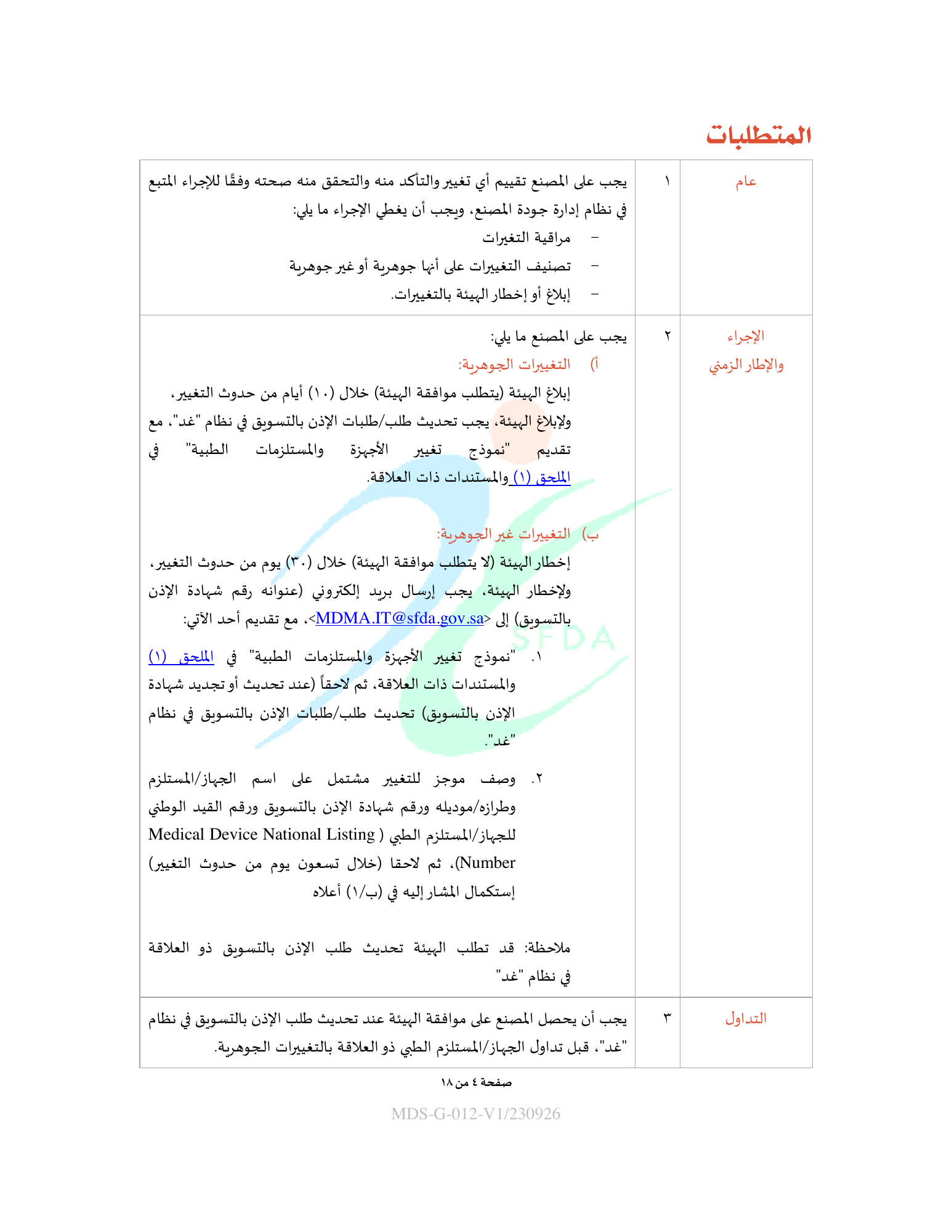
مخطط سير الإجراءات البداية يجب على المصنع تقييم أي تغيير والتأكد منه والتحقق منه صحته وفقاً للإجراء المتبع في نظام إدارة جودة المصنع، ويجب أن يغطي الإجراء مراقبة التغييرات، وتصنيف التغييرات على أنها جوهرية أو غير جوهرية، وإبلاغ أو إخطار الهيئة بالتغييرات. التغييرات الجوهرية إبلاغ الهيئة خلال (10) أيام من حدوث التغيير تحديث طلب/طلبات الإذن بالتسويق في نظام "غد" مع تقديم "نموذج تغيير الأجهزة والمستلزمات الطبية (الملحق 1) والمستندات ذات العلاقة يجب أن يحصل المصنع على موافقة الهيئة عند تحديث طلب الإذن بالتسويق في نظام "غد"، قبل تداول الجهاز/المستلزم الطبي ذو العلاقة بالتغييرات الجوهرية. التغييرات غير الجوهرية إخطار الهيئة خلال (30) يوم من حدوث التغيير اختر أحد المسارين إرسال بريد إلكتروني إلى <MDMA.IT@sfda.gov.sa>، مع تقديم نموذج تغيير الأجهزة والمستلزمات الطبية (الملحق 1) والمستندات ذات العلاقة لاحقاً عند تحديث أو تجديد شهادة الإذن بالتسويق في نظام "غد" إرسال بريد إلكتروني إلى <MDMA.IT@sfda.gov.sa>، مع تقديم وصف موجز للتغيير بما في ذلك اسم الجهاز/المستلزم وطرازه/موديله ورقم شهادة الإذن بالتسويق ورقم قيده الوطني اختر أحد المسارين خلال (90) يوم من حدوث التغيير تحديث طلب/طلبات الإذن بالتسويق في نظام "غد" مع تقديم "نموذج تغيير الأجهزة والمستلزمات الطبية (الملحق 1) والمستندات ذات العلاقة النهاية صفحة 5 من 18 MDS-G-012-V1/230926
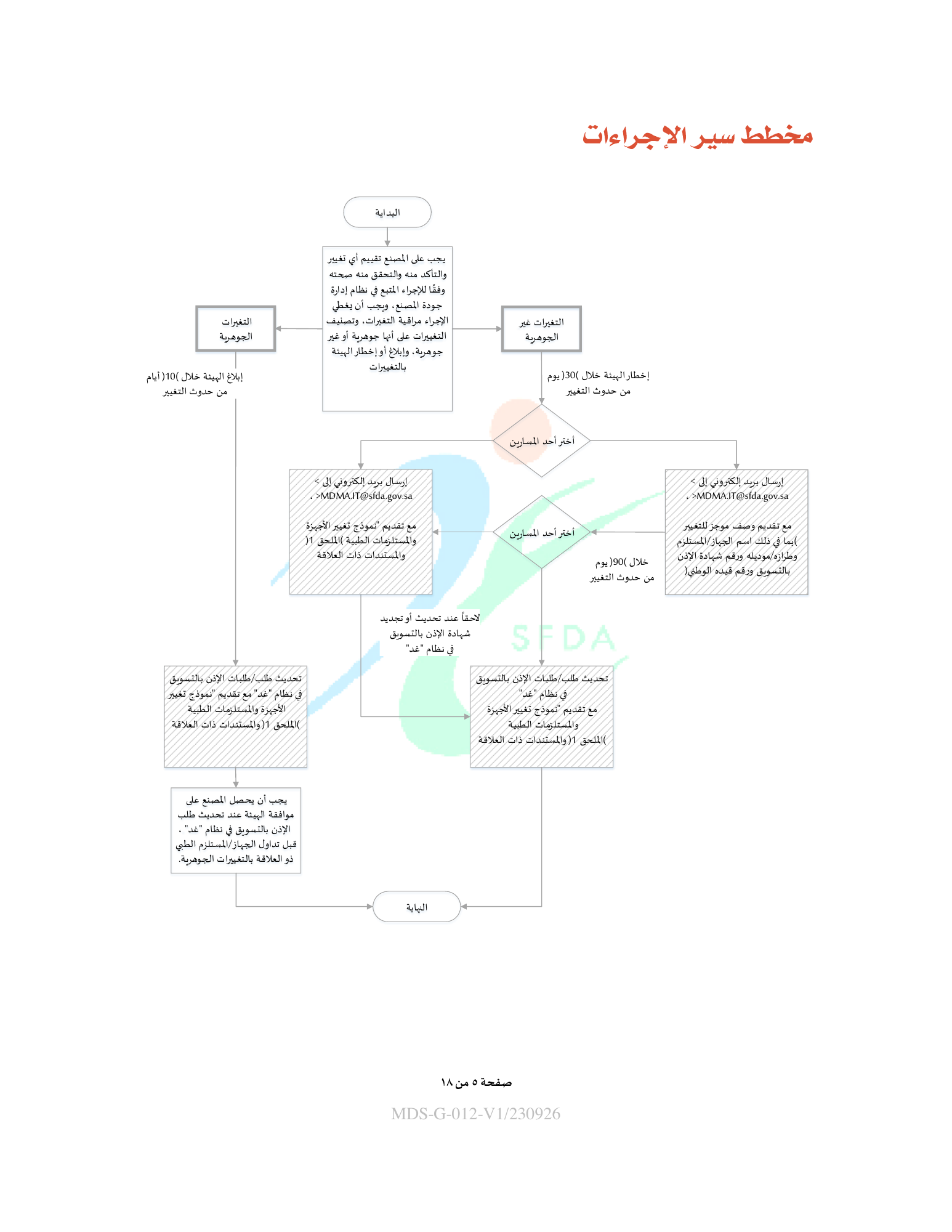
الأمثلة :فيما يلي أمثلة للتغييرات الـجوهرية وغير الـجوهرية I. Changes to Intended Use and Labelling A. The following are considered significant changes: 1) Changes to information on the label or IFU considered an important part of the risk mitigation measures for using the device, for example to add a contraindication, warning, or other important information about safe use of the device. 2) Changes to the intended purpose, such as broadening the clinical indications, therapeutic use, patient groups or users 3) Changes to sterilization status/method 4) Changes to the labelling from single use to re-usable 5) Adding a new procedure for a use or purpose 6) Changes to the MRI compatibility status of a device 7) Changes to the storage conditions for a device whose performance may be impacted by these conditions 8) Changes to the name or model of the device 9) Changes to name and/or address of the manufacturer. B. The following is considered non-significant change: 1) Changes to the artwork, color, font, or layout of the packaging and labelling of a device. 18 من6 صفحة MDS-G-012-V1/230926
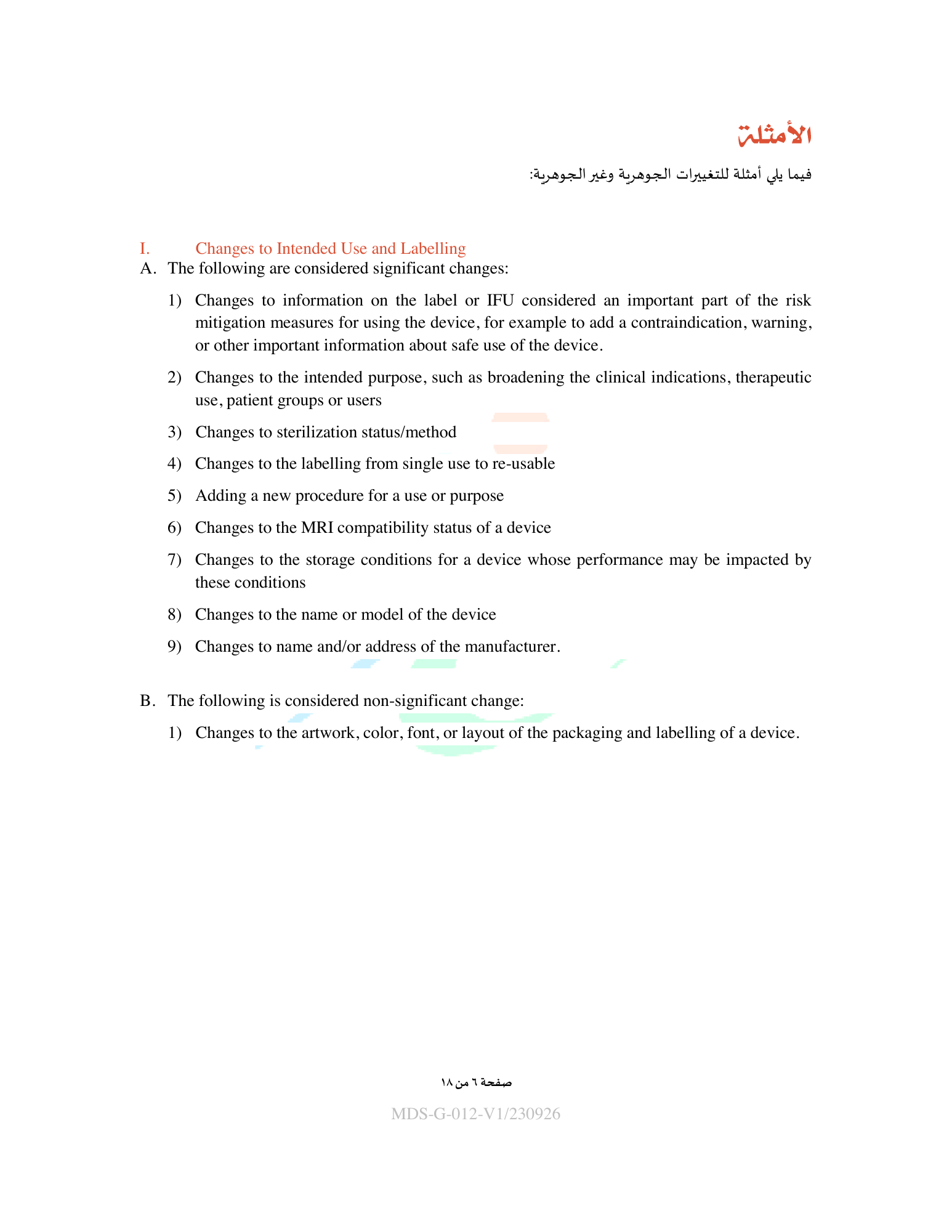
II. Changes to Critical Subcontractors/Supplier A. The following are considered significant changes: 1) Changes to the subcontractor's or supplier's manufacturing processes or facilities that could affect the safety, performance, or effectiveness of the device 2) Changes in type, source, processing and/or supplier of biological materials (including cells, tissues and/or derivatives of animal, human, microbial or recombinant origin) 3) Changes to the device design include changes to the supplier, addition or removal of a critical component or feature that could affect the device's safety or effectiveness. 4) Changes to an inactive reagent included in the formulation of an IVD as a result of a change in supplier. 5) Changes to specification of device due to change in critical supplier, such as: − changes the supplier of the Antibody with different manufacturing process − changes the supplier of plastic raw material of catheter B. The following are considered non-significant changes: 1) Changes to non-critical parts or suppliers that can be demonstrated to still meet the acceptance criteria established by the manufacturer. 2) Changes to the supplier's manufacturing process, facility, software or equipment if those changes do not affect the device's safety, effectiveness, functionality or performance specifications. III. Changes to the QMS A. The following is considered significant changes: 1) Changes to QMS processes, for example, changes to critical validated processes, in particular changes to a process where the validation is critical to mitigating risks related to that process. This is particularly important where the risks, if unmitigated, may have adverse effects on patients or users. Some examples are a change to: Sterilization method (EO to gamma, gamma to e-beam, etc.). The critical parameters of the sterilization process (e.g. biological indicator monitoring to parametric release for EO sterilization, change in aeration or dwelling period for EO sterilization). A manufacturing process that might impact on pre-sterilization bioburden The location for a step in manufacturing (e.g. to a different manufacturing site or critical supplier). A drug coating process. A viral inactivation process. 2) Changes to the device design (refer to section VII). 18 من7 صفحة MDS-G-012-V1/230926
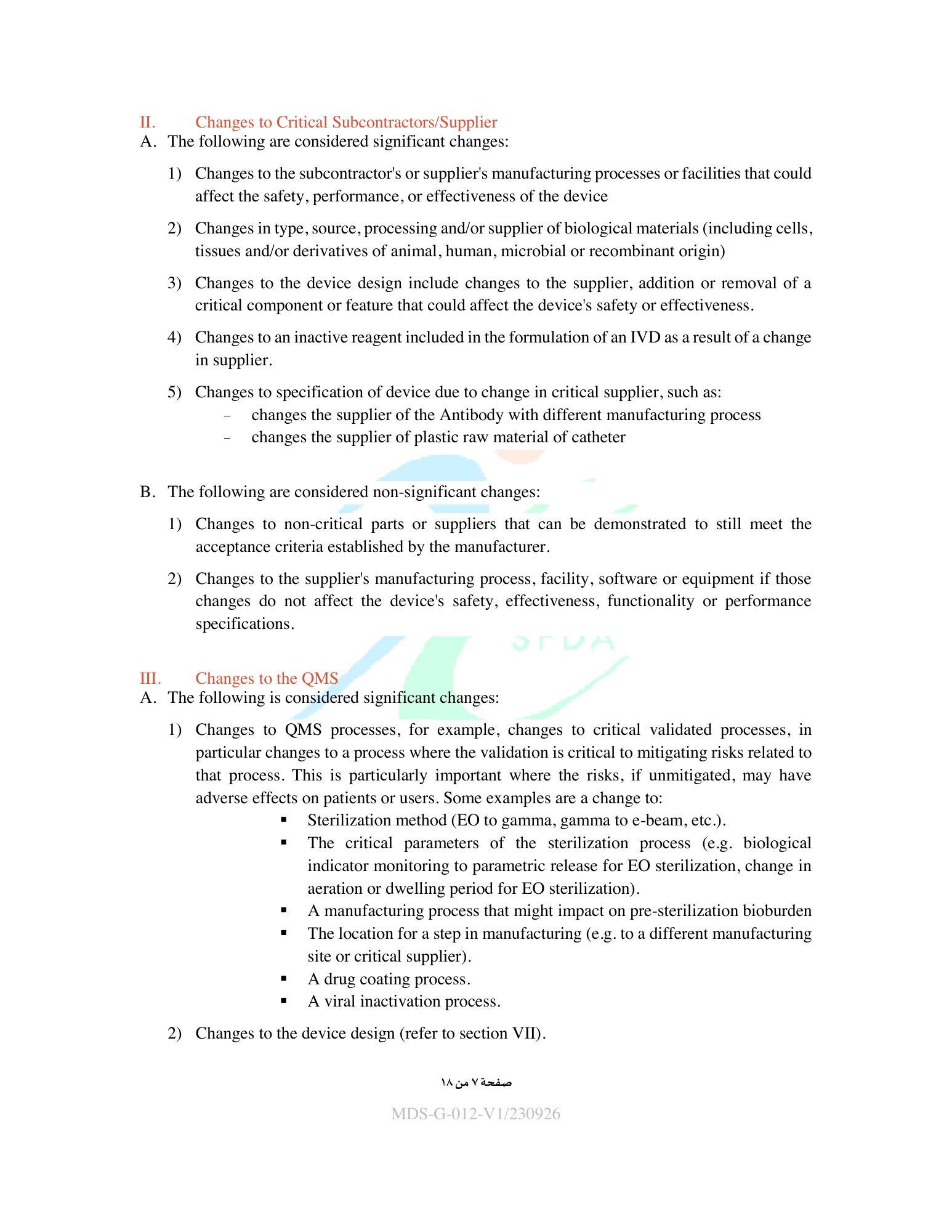
IV. Changes to Manufacturing Processes, Facility or Equipment A. The following are considered significant changes: 1) Changes to manufacturing processes, facility or equipment (including changes made to outsourced processes) that may affect the safety and/or performance of the device, such as: − Changes in the equipment used for cutting, resulting in the change in length of sutures − Changes to molding or cutting manufacturing process − Changes of centrifugation to filtration process which results in better molecule separation − Changes of implant manufacturing process from casting to 3D printing − Changes from manual operation to automatic operation, without changing the product specification − Changes to the packaging process 2) Changes in specification of device due to change in critical subcontractors/suppliers (refer to section II) 3) Changes to manufacturing quality control process or procedures, such as: − Removal of test acceptance criteria, in-process inspections, or final inspections without replacement of these activities − Removal of two test parameter and extend acceptance criteria − Changing the methods, tests or procedures used to control the quality, purity and sterility of the materials or the device − Changes to the manufacturer's requirements for material acceptance criteria if it alters the design specifications of the device B. The following are considered non-significant changes: 1) Changes or adding a new test acceptance criteria or test method to provide equivalent or better assurances of reliability. 2) changes in packaging from one variant of polyethylene to another that does not affect the sterile barrier integrity of a device, or its performance after storage, shelf life, or changing to the storage requirements. Validation and stability testing shall show the intergrity has not been compromised. 18 من8 صفحة MDS-G-012-V1/230926
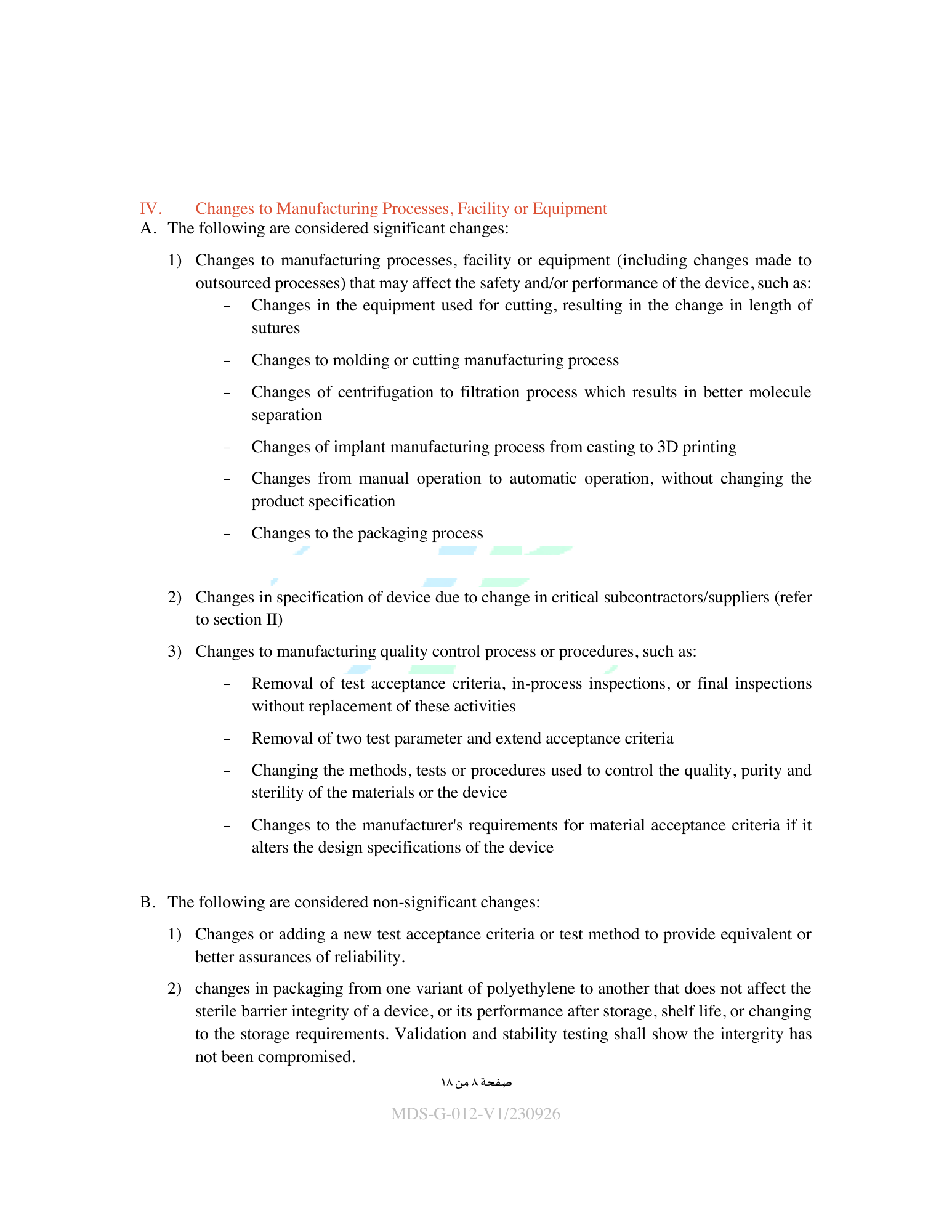
V. Changes to Software This section applies to software whether it is embedded software or standalone software. A. The following are considered significant changes: 1) Changes to software which impacts the control of the device that may be alter diagnostic or therapeutic function, such as software change causing the change of critical steps for laser delivery on eye treatment 2) Changes to software initiated by manufacturer that modifies the algorithm that affects the diagnostic or therapeutic function, such as an X-ray Lung Nodule Assessment Software is used along with a Digital Radiography System to support physicians in the visualization, identification, evaluation and reporting of pulmonary lesions/nodules in chest images. An algorithm change improves the detection rate for small nodules. 3) Changes to software with addition of new features or software applications that affect any diagnostic or therapeutic functions of a device, such as software changes of insulin pump that allow for wireless communication with compatible (continuous) blood glucose monitors. 4) Changes to software that includes addition or removal of alarm function, such that a response to this change affect the treatment of patient, such as electrocardiogram Addition to software of an early warning alarm to signal a potential cardiac event such as atrial fibrillation. 5) Changes to software that alter treatment or diagnostic of the patient, such as: − software change of blood oxygen monitor that allows the monitor to report blood CO2 concentrations with higher accuracy up to 0.5% deviation. − upgrade of software version changes the performance characteristics like specificity or sensitivity of the IVD device. 6) Change to software incorporating a change to the operation system platform, such as a change in the software together with operating system change from Linux to another operating system platform. 7) Change to software that affect the usability of the user interface significantly, such as a software change that impacts the way data is read or interpreted by the user. B. The following are considered non-significant changes: 1) A simple bug fix to correct the display error on the data table from the software analysis result. 2) Changes in software to disable certain functions that does not interact with other functions that does not affect the performance of the device. 3) Changes in software which only modifies the appearance of the user interface with negligible risk of impacting the device performance. 18 من9 صفحة MDS-G-012-V1/230926
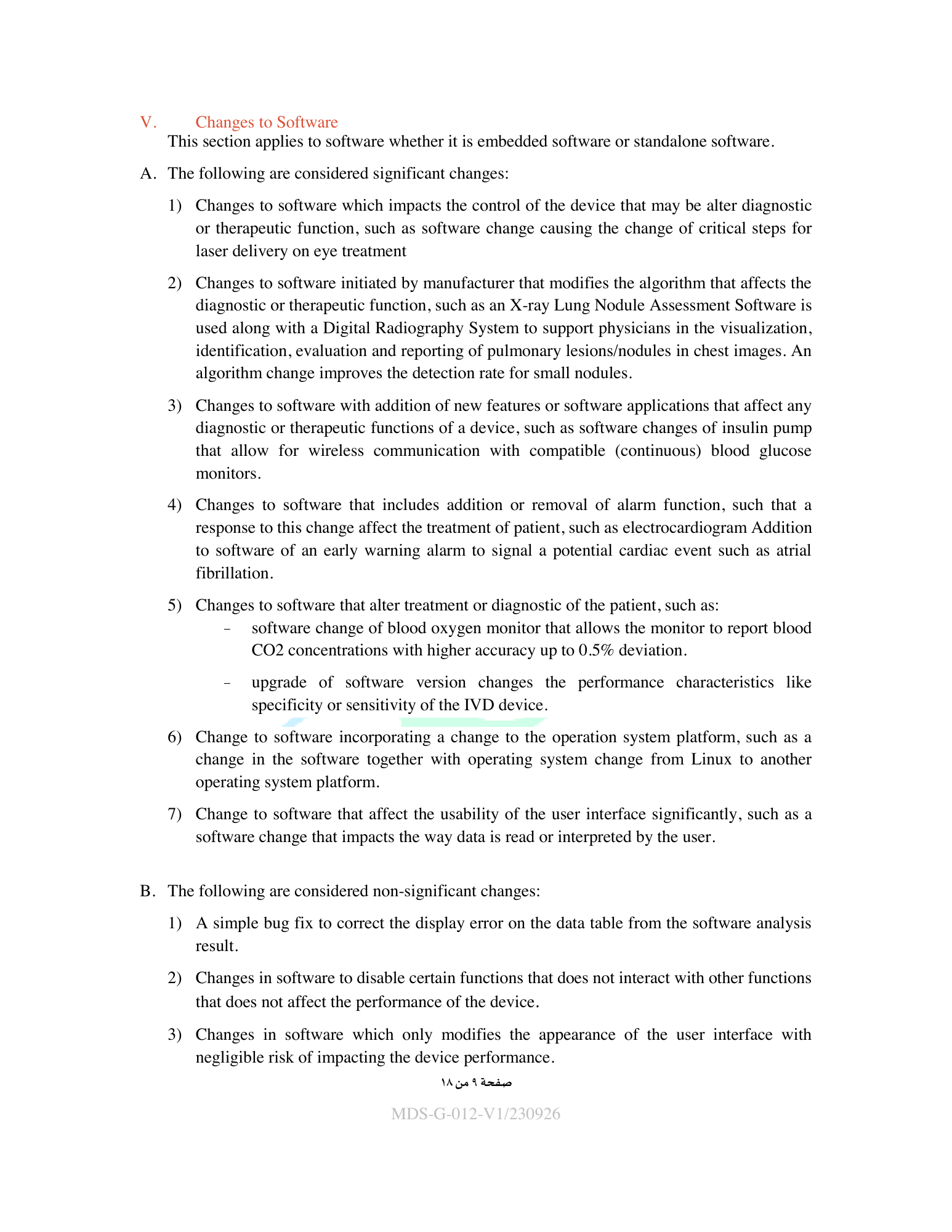
VI. Changes to Sterilization A. The following are considered significant changes: 1) Changes to the sterilization process or equipment or cycle parameters, such as: − Change from EO to gamma radiation sterilization − Change from biological indicator to parametric release or change from batch release to parametric release − Change in moist heat sterilization parameters 2) Changes that increase the bioburden alert or action levels or that introduces a more difficult to kill organism, such as change that introduces additional pre-sterilization transport steps. 3) Device design or material change that introduces a more difficult to sterilize feature, such as: − Changes in packaging characteristics of a sterile device − Change to the packaging where a single pouched sterile device is put into a double pouch 4) Changes in the density or configuration of the sterilization load 5) Changes to the quality control verification and validation process such as introducing parametric release B. The following are considered non-significant changes: 1) Adding a new test acceptance criteria or test method, over and above the existing process, to provide equivalent or better assurance of sterility, reliability or similar safety aspects is considered to be a non-significant change. However, if a proposed change is made from a non-parametric release to a parametric release, this is considered a significant change. 2) A change from a pre-blended sterilant (EO and CHCs) to EO post-blended with nitrogen. The ultimate concentration of EO in the sterilizer is the same in both cycles. 3) A change from using Air (mixture of 80% Nitrogen and 20% Oxygen) to pure Nitrogen in the aeration process to avoid explosive gas mixtures. 4) changes in air-flow or HVAC system to the manufacturing environment, where the sterilization facility is physically and environmentally segregated from the manufacturing line 18 من10 صفحة MDS-G-012-V1/230926
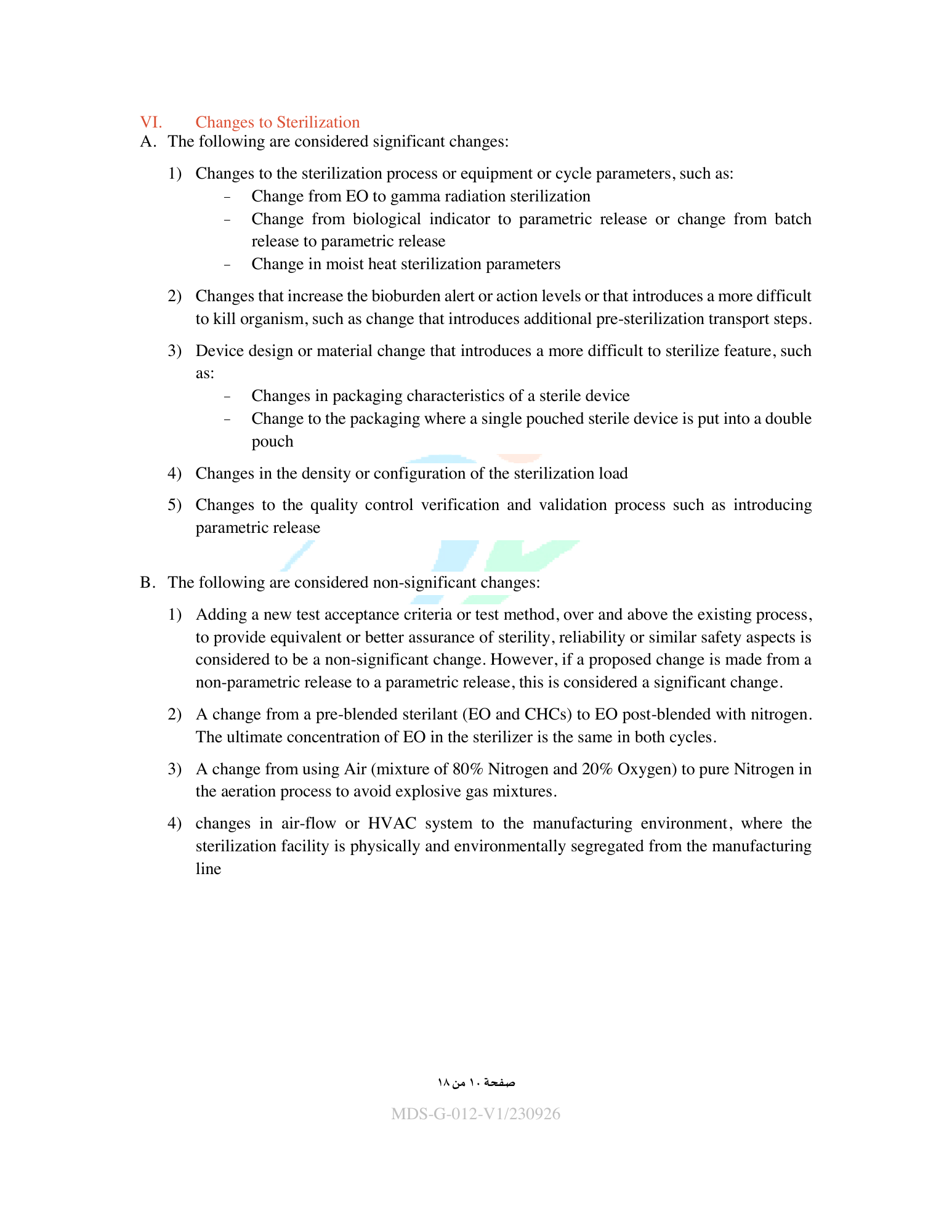
VII. Changes to Design A. The following are considered significant changes: 1) Changes in the intended use/intended users: Typically expanding the device’s intended use to include medical claims not assessed by the SFDA is considered s significant change. Similarly, changing the intended users to include a new type of users (e.g. layperson, children, or general practitioners instead of surgeons) is considered a significant change. In the risk-based assessment, manufacturers should consider whether the design change increases the likelihood that a broader or different group of users who have less training regarding safe and effective use of the device will use the device. 2) Changes affect the product’s risk management file: Any change that introduces a new hazard is considered a significant change. This includes changes that adversely affect the probability, severity, or detectability of harm, or consequences that were not previously documented by the manufacturer in the risk management file. 3) Changes of the materials: Changes to material, chemical composition, or formulations affect the biological safety or the mechanical performance of the device. It also includes a change of origin or source of animal or microbial origin materials, or quantity or type of the incorporated medicine in the product. The manufacturer shall analyze the materials in case of supplier change. 4) Changes in the device packaging or storage: Any change affects the sterile barrier integrity of a product, or its performance after storage, shelf life, or changing to the storage requirements. It includes changes to the packing material or method. 5) Changes in the sterilization: It includes a change of sterilization method, the subcontractor change, or the change of sterilization facility. It also includes the change of supplying the nonsterile devices to be in a sterile condition. 6) Changes in the control mechanism: Almost all changes in the control mechanism for a device could significantly affect safety and effectiveness. An example of a control mechanism change would be a change from analog to digital control of a device. 7) Changes in operating principle: Changing the operating principle could significantly affect the safety and performance of a device. An example of a new operating principle for a device would be changing the image reconstruction algorithm used in a computed tomography x-ray system from simple back-projection to a new, more radiation-efficient method. For IVD, changing the material may result in a change to the operating principle. For example, change from radioimmunoassay to ELISA. 8) Changes of energy type: Changing the device’s energy input and/or output is considered a significant change. Change the emitted energy from microwave to radiofrequency is a type 18 من11 صفحة MDS-G-012-V1/230926
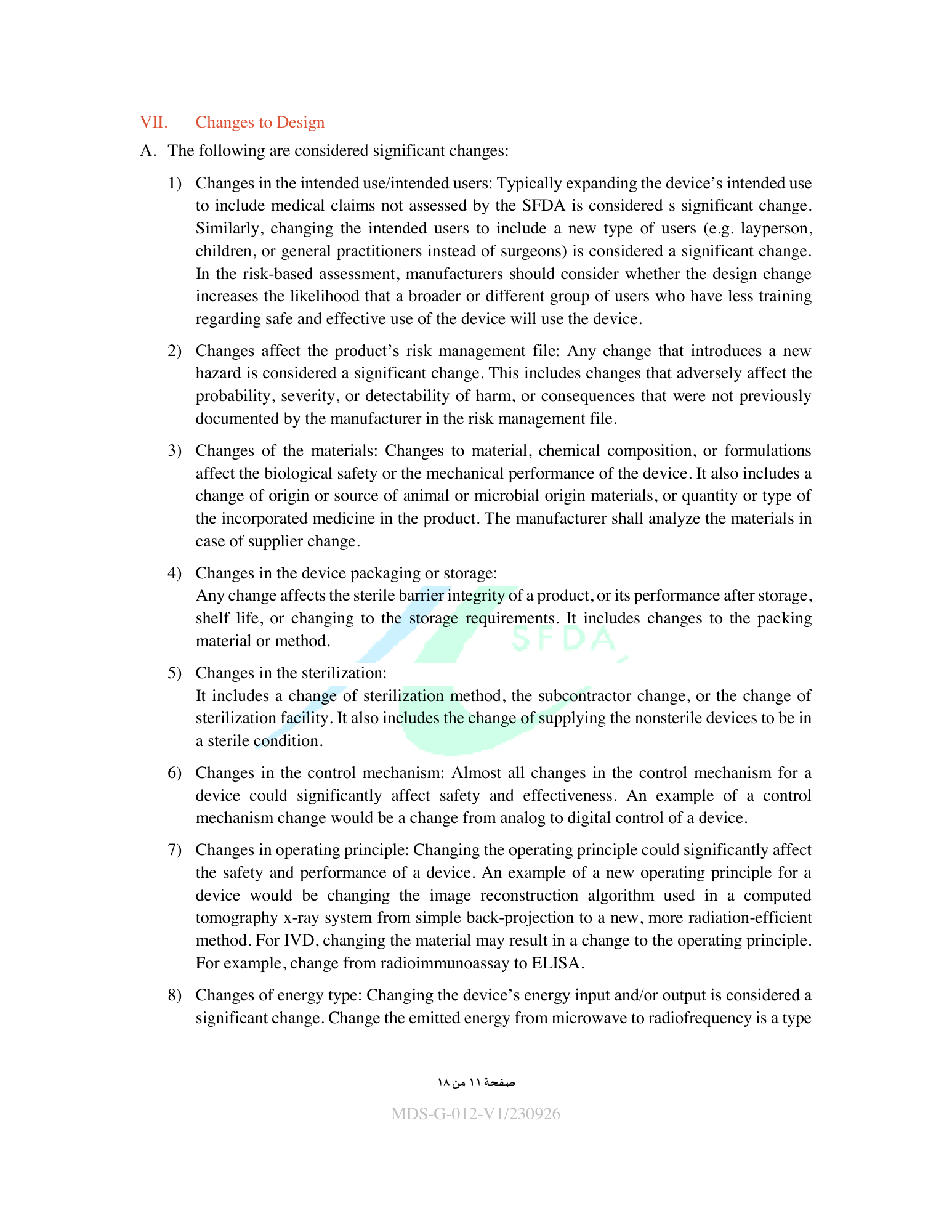
of output energy change. An example for change the input energy is changing the device power from AC to using a battery. 9) Changes in design specifications: Changes to the design specification, physical description, dimensions, communication type (by wire or wireless), software or firmware are likely considered as a significant change. The manufacturer shall evaluate the changes and their effects on the device’s intended use, device safety and performance, and the device’s risk management file by introducing new hazards. 10) Changes in the human factors of the patient or user interface: A device user interface includes all points of interaction between the product and the user, including elements such as displays, controls, and packaging. User interface changes refer to changes in the way in which a patient or user interacts with a device. The manufacturer shall evaluate changes to a user interface and whether they significantly affect safety or performance. 11) Changes in the operation environment: The Manufacturer shall consider whether the design change increases the likelihood that the device will be used in a new environment, and whether the new environment affects the risk profile of the device. If the change facilitates use in a completely different environment (e.g., from hospital to home use, or from hospital to ambulance transport), this typically will introduce new or significant modified existing risks and will likely considered as significant change. The manufacturer should consider differences in environmental specifications such as: − Temperatures and humidity that might affect device operation; − Noises that might drown out the sound of auditory alarms; − Exposure to water, soils, or light that might affect device operation; − Presence of other devices or equipment that may cause electromagnetic interference; − Possible use in MRI. 12) Changes requires new clinical data: Whenever the manufacturer recognizes that clinical data are needed because bench testing or simulations are not sufficient to assess the impact of the change on safety or performance to validate the design change. 13) Changes in technology, engineering, performance, or materials of an IVD can include changes made to reagents or changes to a test method or protocol, among other things. 14) Changes to components or accessories could, in some cases, significantly affect the safety or effectiveness of an IVD as a whole. The manufacturers should consider in their initial risk-based assessment whether changes to the IVD or any of its components or accessories affect the use of other components or accessories, or if changes to a component or accessory could lead an IVD to be used in a new way. The manufacturer should also consider whether changes to the IVD or any of its components or accessories could disrupt compatibility between the device, its components, and/or its accessories, or whether these changes could significantly affect performance or the device’s risk profile. 18 من12 صفحة MDS-G-012-V1/230926
15) A Change to an IVD device for self-testing that may increase the risk of error in the use of the device, handling of the sample or interpretation of results, or that may increase the complexity of use of the device for the user. B. The following is considered non-significant change: 1) Changes that do not have an impact on the design or the intended purpose of the device VIII. Changes to Materials The manufacturer making changes to the materials from which the device is manufactured, should also consider the other types of changes. A material change might also lead to a change in the labeling of the device, or a change in the design. Thus, these collateral changes should be considered an evaluated in additional to the materials change. The manufacturer shall have procedures documenting the materials change, including the change in material type, formulation, or chemical composition. The biocompatibility and physical properties of a finished device depend on the materials, materials processing, manufacturing methods, sterilization process, and manufacturing residuals that may be present on the finished device. Changes of any process or methods including material supplier changes (changes made by material supplier or change from a supplier to another) should be evaluated for their impact on safety and effectiveness. The manufacturer should consider whether they have used the same material, in its final, finished state, in another one of its own legally marketed devices that has been approved by the SFDA. If the manufacturer has used the same material in a similar approved device by SFDA and there is no postmarket evidence of biocompatibility issues, that may provide evidence that the material will be biocompatible in its new application in the changed device as well. The material in question should have the same formulation or chemical composition and be subjected to the same processing, including sterilization (i.e., the comparison should be between materials as they are applied in the final finished device, not between raw materials). Note that the size and geometry of the changed device or component could affect the material properties. Any change in chemical composition, manufacturing process, physical configuration (e.g., size, geometry, surface properties) or intended use of the device should be evaluated with respect to possible changes in biocompatibility and the need for additional biocompatibility assessment. If the modified device is intended to have a riskier category of contact (e.g., mucosal membrane contact is riskier than contact with intact skin, and blood contact is riskier than tissue/bone contact) or a longer duration of contact, then the manufacturer should answer no to this question. Contact may be either direct or indirect. Manufacturers should not compare their changed material to materials in other manufacturers’ legally 18 من13 صفحة MDS-G-012-V1/230926
marketed devices, unless the exact formulation and processing of the device, which may affect the safety and effectiveness of the final finished product, can be verified. If the manufacturer has used the same material in a similar legally marketed device, it should be considered whether the material change could affect the performance of the device by affecting its mechanical properties, such as strength, hardness, etc. Manufacturers should also consider whether the new material could be affected by any labeled cleaning, disinfection, and/or sterilization process. IX. Changes to Safety and/or Performance Characteristics: A. The following is considered significant change: 1) Clinical and analytical data that is obtained through new studies could prompt a significant change to the safety and/or performance of the device. For example, changes to diagnostic sensitivity or the inclusion of new interfering substances in the instructions for use. إ إ 18 من14 صفحة MDS-G-012-V1/230926
الملاحق صفحة 15 من 18 MDS-G-012-V1/230926
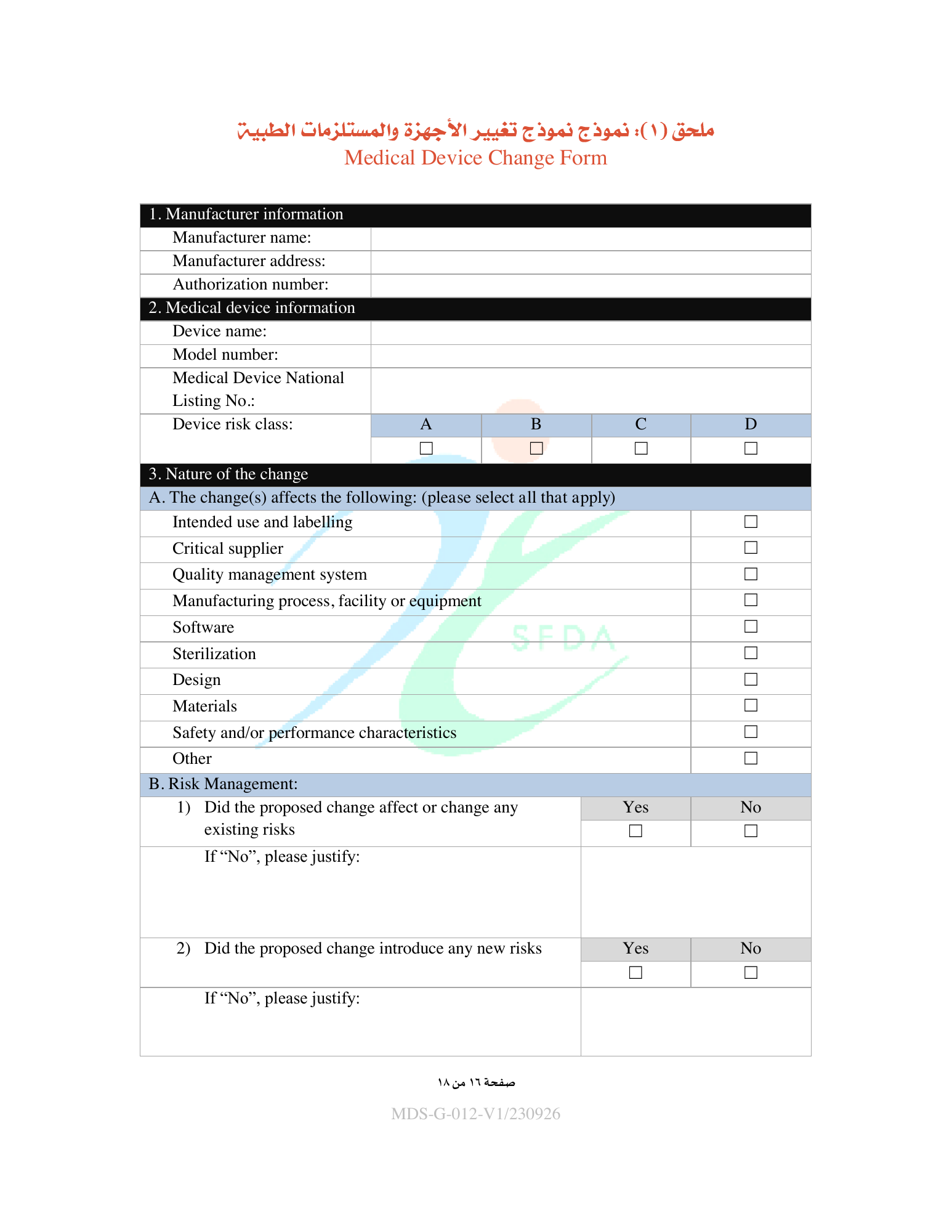
ملحق (1): نموذج نموذج تغيير الأجهزة والمستلزمات الطبية Medical Device Change Form 1. Manufacturer information Manufacturer name: Manufacturer address: Authorization number: 2. Medical device information Device name: Model number: Medical Device National Listing No.: Device risk class: A B C D ☐ ☐ ☐ ☐ 3. Nature of the change A. The change(s) affects the following: (please select all that apply) Intended use and labelling ☐ Critical supplier ☐ Quality management system ☐ Manufacturing process, facility or equipment ☐ Software ☐ Sterilization ☐ Design ☐ Materials ☐ Safety and/or performance characteristics ☐ Other ☐ B. Risk Management: 1) Did the proposed change affect or change any Yes No existing risks ☐ ☐ If “No”, please justify: 2) Did the proposed change introduce any new risks Yes No ☐ ☐ If “No”, please justify: 18 من16 صفحة MDS-G-012-V1/230926
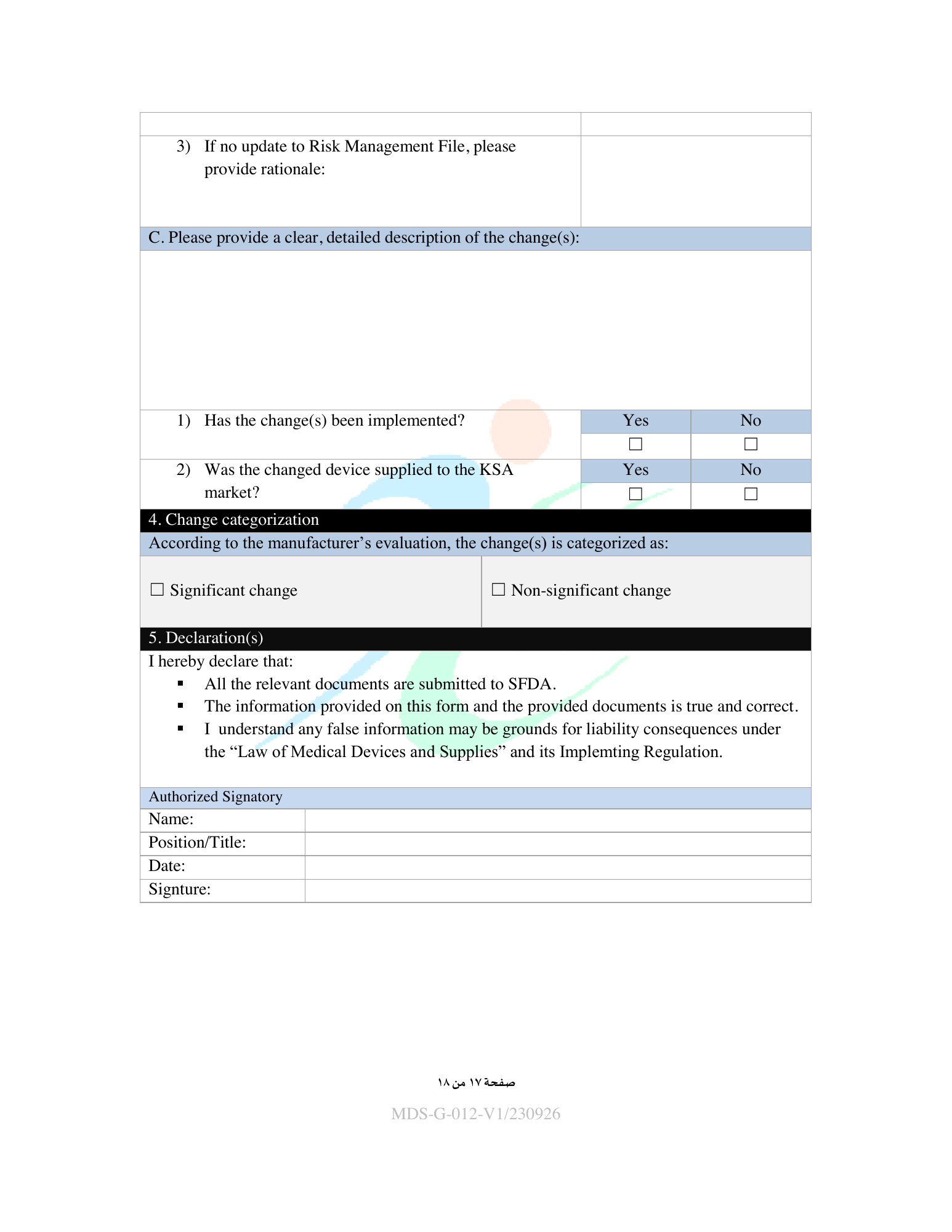
3) If no update to Risk Management File, please provide rationale: C. Please provide a clear, detailed description of the change(s): 1) Has the change(s) been implemented? Yes No ☐ ☐ 2) Was the changed device supplied to the KSA Yes No market? ☐ ☐ 4. Change categorization According to the manufacturer’s evaluation, the change(s) is categorized as: ☐ Significant change ☐ Non-significant change 5. Declaration(s) I hereby declare that: All the relevant documents are submitted to SFDA. The information provided on this form and the provided documents is true and correct. I understand any false information may be grounds for liability consequences under the “Law of Medical Devices and Supplies” and its Implemting Regulation. Authorized Signatory Name: Position/Title: Date: Signture: 18 من17 صفحة MDS-G-012-V1/230926
ملحق (2): تعاريف واختصارات المملكة | المملكة العربية السعودية الهيئة | الهيئة العامة للغذاء والدواء اللائحة | اللائحة التنفيذية لنظام الأجهزة والمستلزمات الطبية المصنع | أي منشأة وطنية أو أجنبية يكون من أغراضها تصميم الأجهزة أو المستلزمات الطبية أو تصنيعها لطرحها للاستخدام باسمها، سواء كانت داخل المملكة أو خارجها. ويشمل التصنيع: تجديدها، وتجميعها، وتعبئتها، وتغليفها، ووضع المعلومات التعريفية عليها. تداول الأجهزة والمستلزمات الطبية | توفيرها مجاناً أو بمقابل سواء كان للتوزيع أو للاستخدام. الترخيص: وثيقة تصدرها الهيئة لمزاولة أي من الأنشطة الخاضعة للنظام. الإذن بالتسويق | وثيقة تصدرها الهيئة لأي جهاز أو مستلزم طبي تسمح بتداوله في الأسواق. شهادة حرية البيع: وثيقة تصدرها الهيئة للمصنع تفيد بأن المصنع مسجل في المملكة وأن الأجهزة والمستلزمات الطبية المراد تصديرها حاصلة على الإذن بالتسويق. التغير الجوهري | تغيير يُتوقع –منطقياً– أن يؤثر على سلامة و/أو أداء الجهاز/المستلزم الطبي. التغير الجوهري عادة: − ينتج عنه مخاطر على المريض غير معروفة من قبل − يزيد احتمالية حدوث المخاطر الحالية − يغير طريقة عرض المخاطر الحالية أو الجديدة للمستخدم (ويشمل ذلك المعلومات التعريفية للتغييرات أو تعليمات جديدة للاستخدام) التغير غير الجوهري | تغيير لا يؤثر على على سلامة و/أو أداء الجهاز/المستلزم الطبي. MRI | Magnetic Resonance Imaging IVD | In Vitro Diagnostics EO | Ethylene Oxide HVAC | Heating, Ventilation, and Air Conditioning CHCs | Chlorinated hydrocarbons ELISA | Enzyme-linked immunosorbent assay CO2 | Carbon Dioxide Critical Supplier | A supplier delivering materials, components, or services, that may influence the safety and performance of the product. Note: The term supplier may refer to a “contractor” or “subcontractor”. For the purposes of the document the terms are regarded as synonymous. صفحة 18 من 18 MDS-G-012-V1/230926