3D-Printed — Regulatory Guidelines for 3D-Printed Medical Devices
Link directly to a passage with its anchor — for example #sec-1 — to open it highlighted. This reference version is generated from the authority’s publication and does not replace it. Language: English.
Objective TheHealthSciencesAuthority(HSA)isissuingthisguidelinetoprovide clarityonthree-dimensional(3 D)-printedmedicaldevices,aswellasthe regulatoryapproachandregulatoryrequirementsforthesemedicaldevices. ThisguidelinereflectsHSA’scurrentthinking,existingpoliciesandpractices. Thisshouldnotbemisconstruedasnewregulatorycontrolsforthesemedical devices. •3D printing, or Additive Manufacturing (AM) is a process of building an object layer by layer, based on a digital model. It is the opposite of conventional subtractive manufacturing. •Types of medical devices commonly manufactured using 3D printing: -Non-invasive prosthetics (such as prosthetic limbs) -Dental devices -Surgical tools and guides -Implantable devices (such as orthopedic implants) Background •Commonly used AM technologies in medical devices are: – Powder bed fusion: uses energy source (laser or electron beam) to melt a layer of powder – Stereolithography: uses a vat of liquid material that is selectively cured – Fused filament fabrication: melts a solid filament at point of deposition – Liquid-based extrusion: eject a liquid, which then solidifies through light exposure or chemical process •With 3D printing, designs can be altered rapidly without the need for re-tooling and complex devices can be created and built as a single piece. Background •Medicaldevicesmanufacturedusing3D printingtechnologyaresubjectto thecurrentregulatoryframeworkandrequirementsasthosemanufactured usingtraditionalmanufacturingtechniques,basedonriskclassificationof thedevice. •3D-printedmedicaldevicesmustcomplywiththeEssentialPrinciplesof SafetyandPerformanceasdescribedin GN-16: GuidanceonEssential PrinciplesforSafetyandPerformanceofMedicalDevices. •Regulatorycontrolsarebasedonintendeduse/indicationsforuseand technologicalcharacteristicswithintheexistingrisk-basedframeworkfor medicaldevices,regardlessofthemanufacturingprocess. Background Scope This document is applicable to all medical devices manufactured by Additive Manufacturing (3D printing), excluding in-vitrodiagnostic medical devices (IVD MDs).
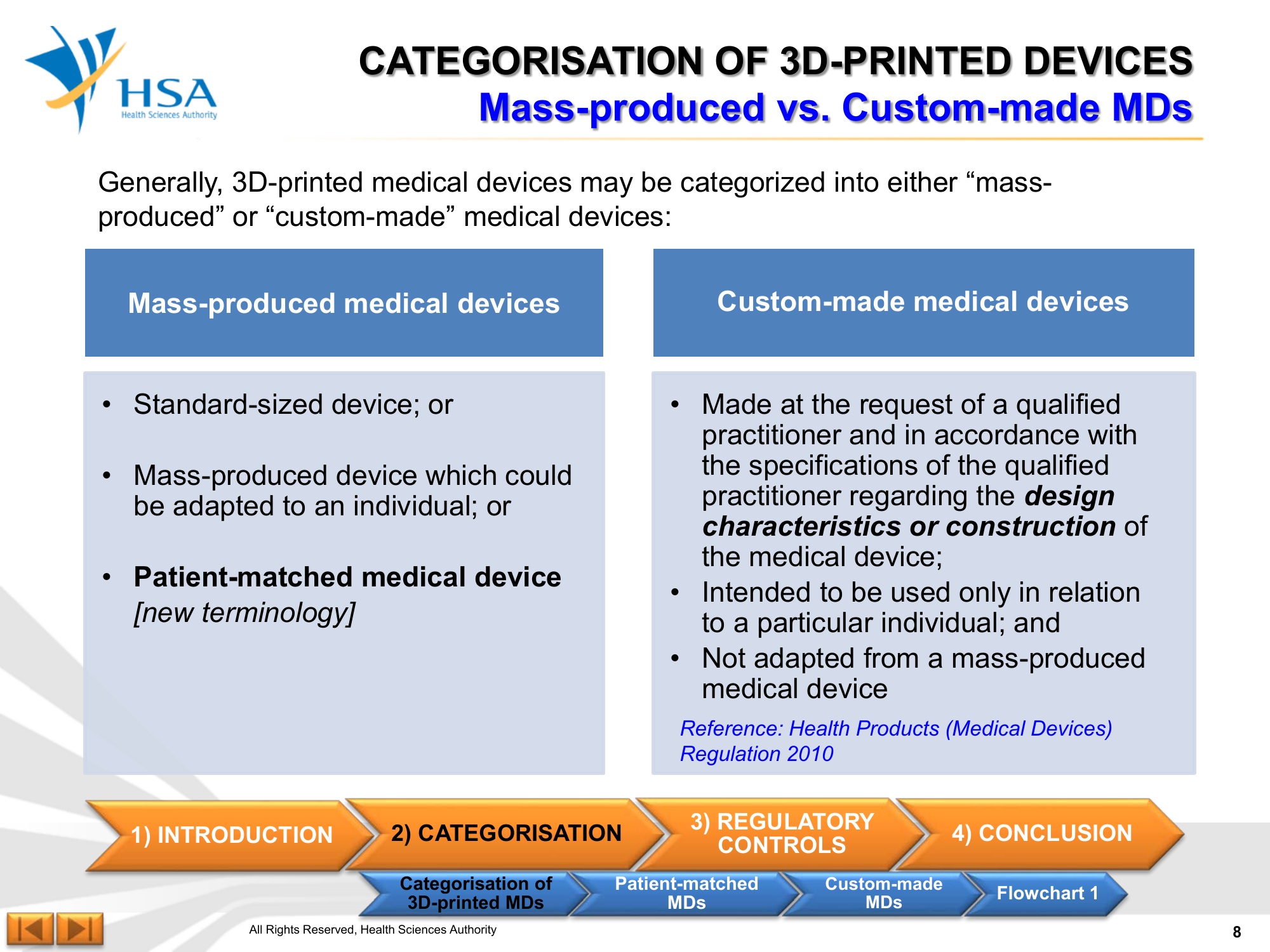
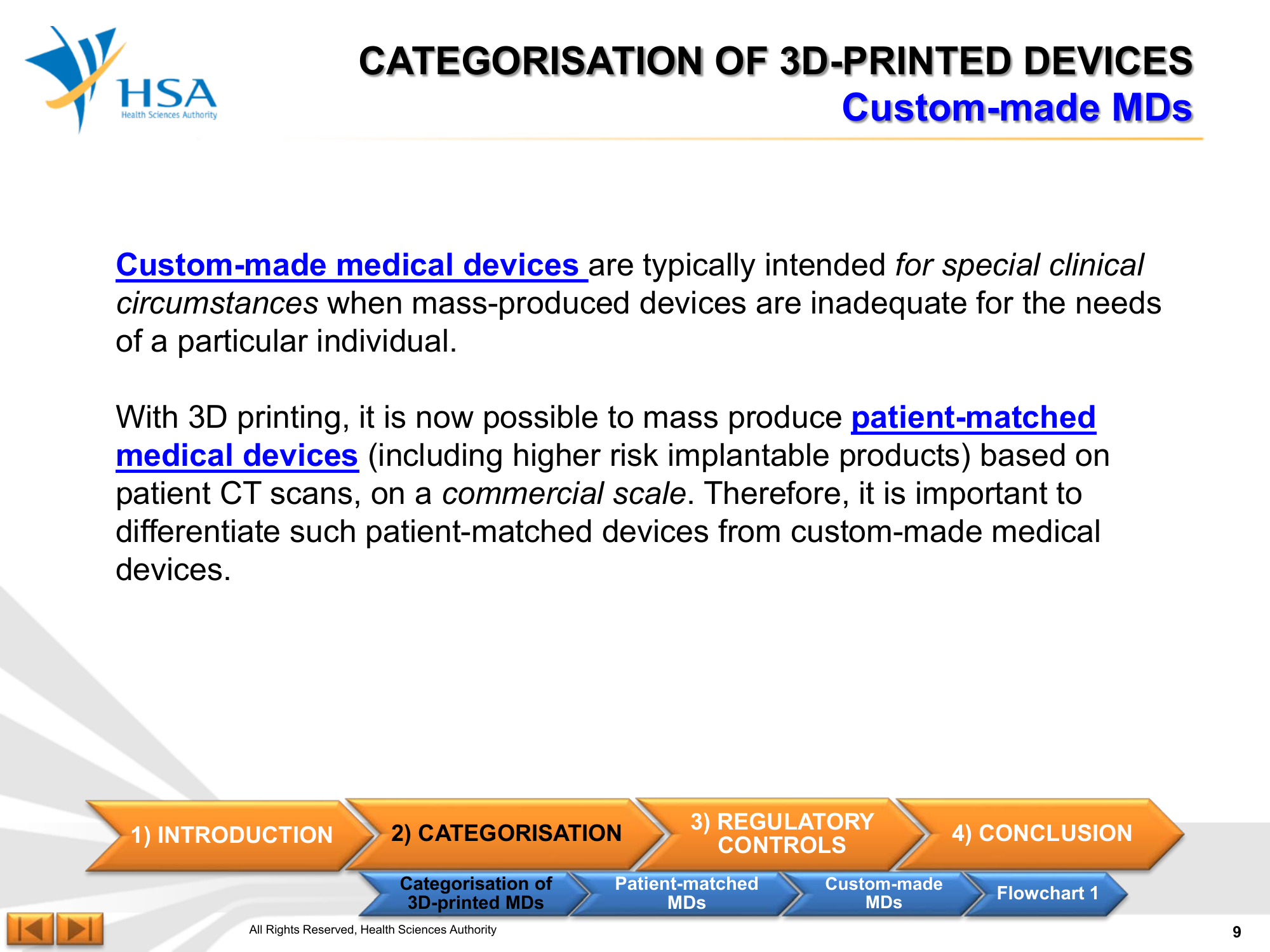
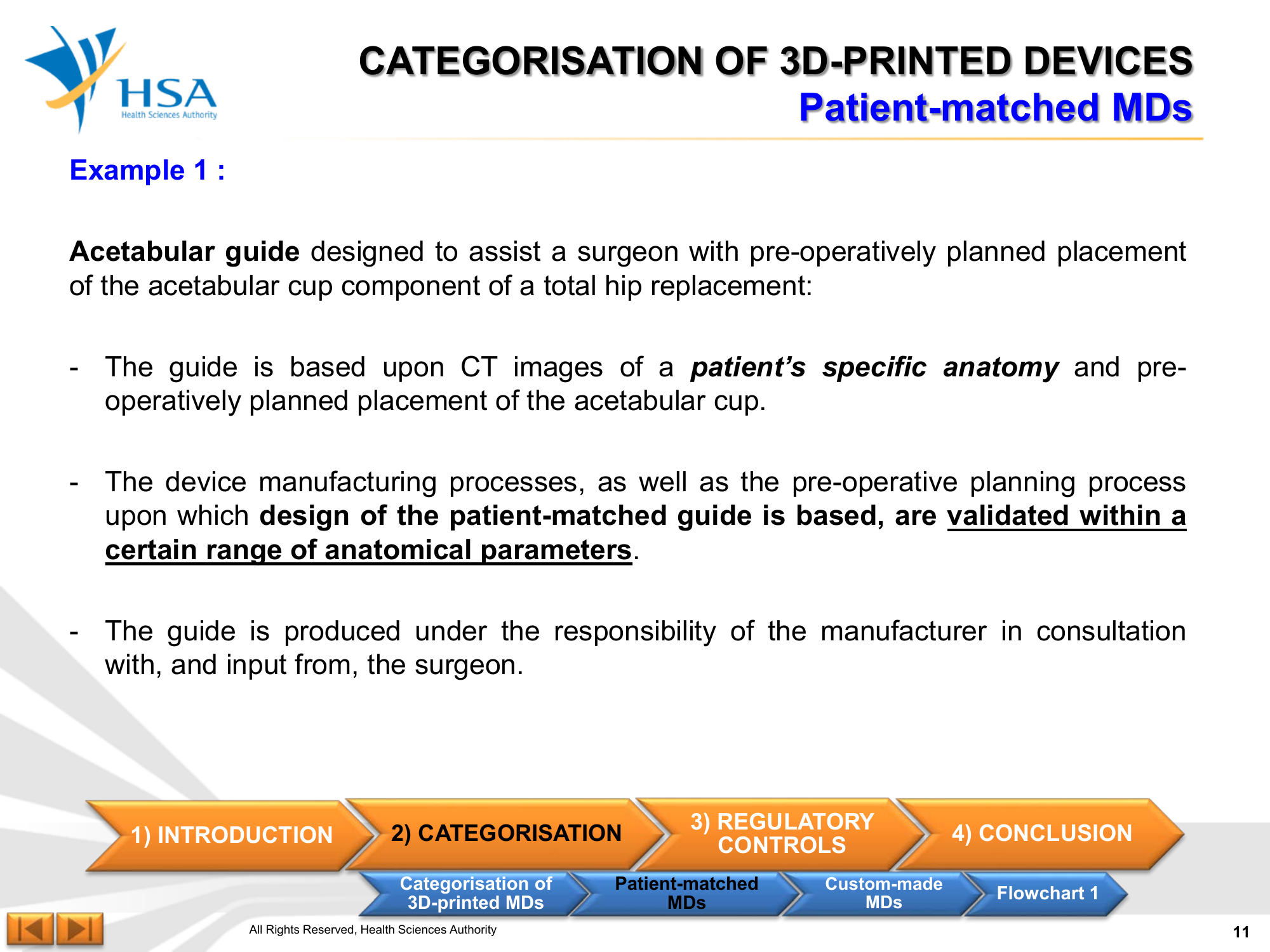
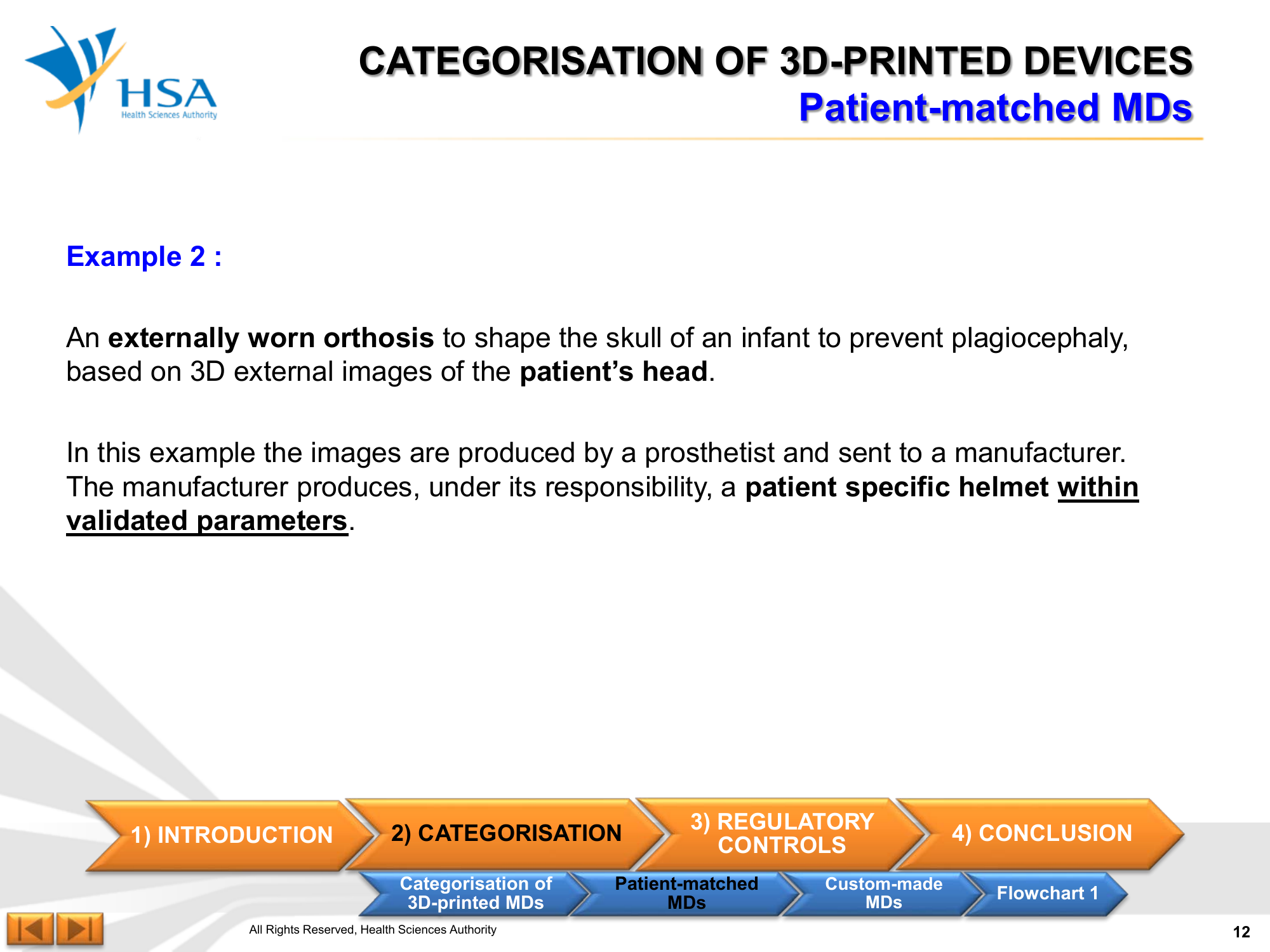
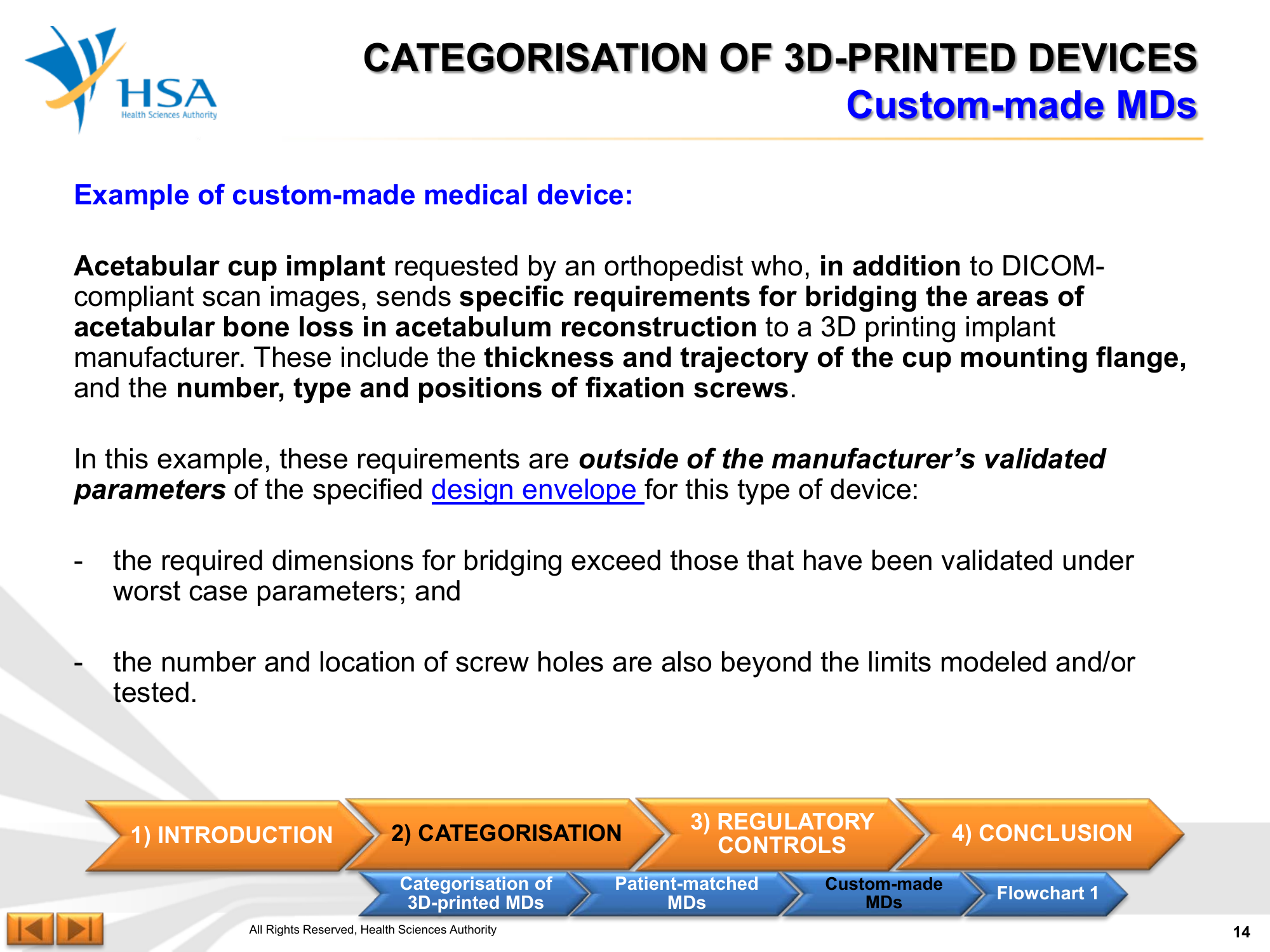
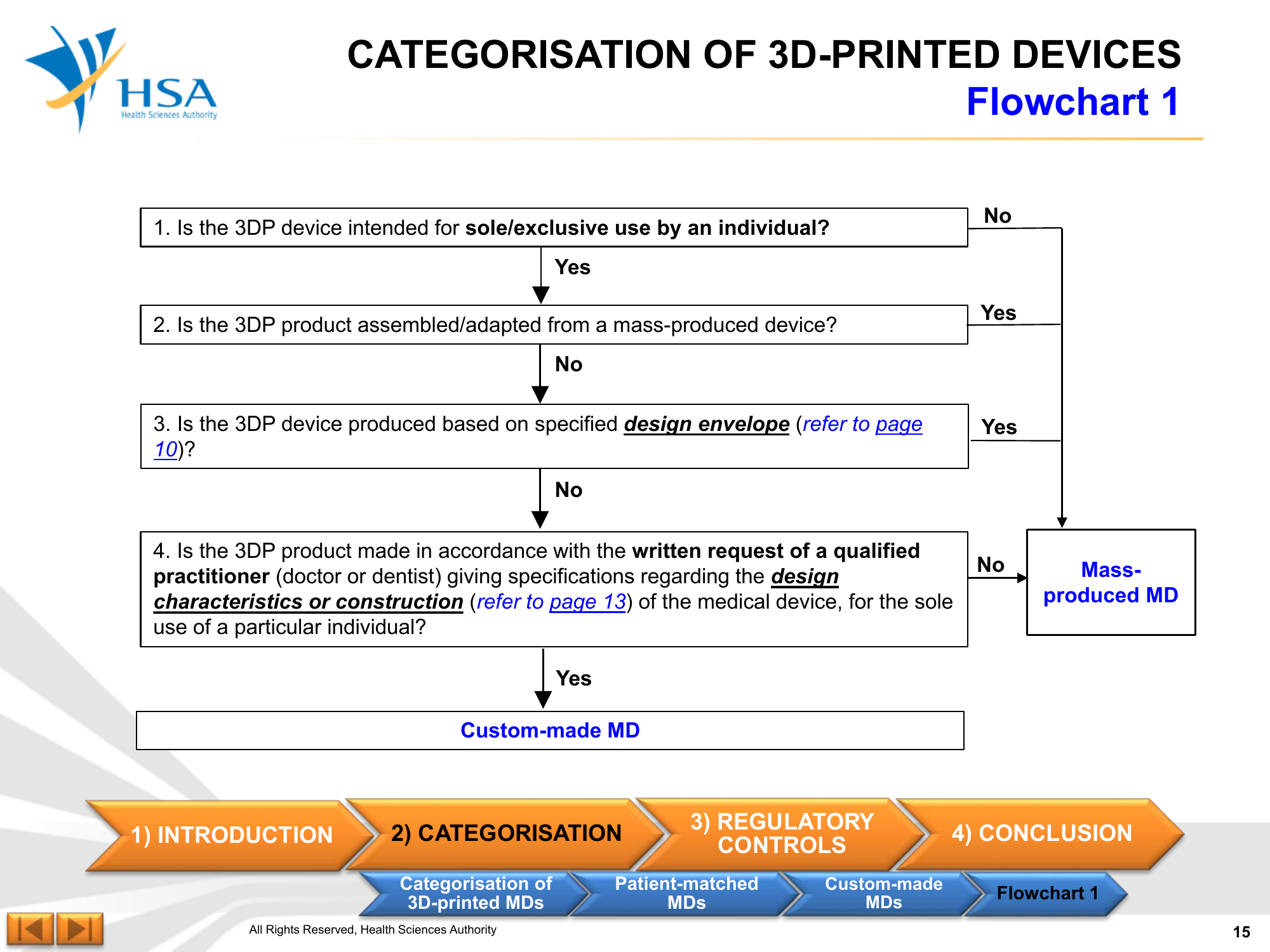
Mass-produced vs. Custom-made MDs Generally, 3D-printed medical devices may be categorized into either “mass- produced” or “custom-made” medical devices: Mass-produced medical devices •Standard-sized device; or •Mass-produced device which could be adapted to an individual; or •Patient-matched medical device [new terminology] Custom-made medical devices •Made at the request of a qualified practitioner and in accordance with the specifications of the qualified practitioner regarding the design characteristics or construction of the medical device; •Intended to be used only in relation to a particular individual; and •Not adapted from a mass-produced medical device Reference: Health Products (Medical Devices) Regulation 2010 Custom-made MDs Custom-made medical devices are typically intended for special clinical circumstanceswhen mass-produced devices are inadequate for the needs of a particular individual. With3D printing, it is now possible to mass produce patient-matched medical devices (including higher risk implantable products) based on patient CT scans, on a commercial scale. Therefore, it is important to differentiatesuch patient-matched devices from custom-made medical devices. Patient-matched MDs Patient-matched medical devices can be mass-produced and are described as follows: •A medical device manufactured within a specified design envelope*and typically produced in a batch ^ through a process that is capable of being validated and reproduced •The device is matched to a specific patient’s anatomy within the design envelope *Design envelope:Refers to various parameters including minimum and maximum dimensions/size (e.g. length, breadth, thickness, angle), mechanical performance limits etc. relevant to a medical device. Note: Design/specifications of the patient-matched medical device must remain within the validated parameters of the specified design envelope. ^ Refer to <IMDRF 2018 Final Document – Definitions for Personalised Medical Devices> for definition Example1 : Acetabularguidedesignedtoassista surgeonwithpre-operativelyplannedplacement oftheacetabularcupcomponentofa totalhipreplacement: -TheguideisbaseduponCTimagesofapatient’sspecificanatomyandpre- operativelyplannedplacementof theacetabularcup. -Thedevicemanufacturingprocesses,aswellasthepre-operativeplanningprocess uponwhichdesignofthepatient-matchedguideisbased,arevalidated withina certain rangeofanatomicalparameters. -Theguideisproducedundertheresponsibilityofthemanufacturerinconsultation with,andinputfrom,thesurgeon. Patient-matched MDs Example2 : An externally worn orthosis to shape the skull of an infant to prevent plagiocephaly, based on 3D external images of the patient’s head. In this example the images are produced by a prosthetist and sent to a manufacturer. The manufacturer produces, under its responsibility, a patient specific helmet within validated parameters . Patient-matched MDs Custom-made MDs Custom-made medical devices must fulfill all of the criteria below: •Made at the request of a qualified practitioner and in accordance with the specifications of the qualified practitioner regarding the design characteristics or construction*of the medical device; •Intended to be used only in relation to a particular individual; and •Not adapted from a mass-producedmedical device. *Design characteristics or construction is defined as: Unique design specifications, including mechanical performance necessary to produce custom-made devices and which are based on an individual’s specific anatomo-physiological features and/or pathological condition. Reference: Health Products (Medical Devices) Regulation 2010 Example of custom-made medical device: Acetabular cup implant requested by an orthopedist who, in addition to DICOM- compliant scan images, sends specific requirements for bridging the areas of acetabular bone loss in acetabulum reconstruction to a 3D printing implant manufacturer. These include the thickness and trajectory of the cup mounting flange, and the number, type and positions of fixation screws. In this example, these requirements are outside of the manufacturer’s validated parametersof the specified design envelopefor this type of device: -the required dimensions for bridging exceed those that have been validated under worst case parameters; and -the number and location of screw holes are also beyond the limits modeled and/or tested. Custom-made MDs Custom-made MD No Yes Mass- produced MD 1. Is the 3DP device intended for sole/exclusive use by an individual? 3. Is the 3DP device produced based on specifieddesign envelope(refer to page 10)? 4. Is the 3DP product made in accordance with the written request of a qualified practitioner (doctor or dentist) giving specifications regarding the design characteristics or construction(refer to page 13) of the medical device, for the sole use of a particular individual? Yes 2. Is the 3DP product assembled/adapted from a mass-produced device? No No Yes Yes No
Regulatory Guideline for 3D-Printed Medical Devices — official PDF page 8; original table columns, symbols and diagram connectionsRegulatory Guideline for 3D-Printed Medical Devices — official PDF page 9; original table columns, symbols and diagram connectionsRegulatory Guideline for 3D-Printed Medical Devices — official PDF page 11; original table columns, symbols and diagram connectionsRegulatory Guideline for 3D-Printed Medical Devices — official PDF page 12; original table columns, symbols and diagram connectionsRegulatory Guideline for 3D-Printed Medical Devices — official PDF page 14; original table columns, symbols and diagram connectionsRegulatory Guideline for 3D-Printed Medical Devices — official PDF page 15; original table columns, symbols and diagram connections
3. Regulatory Controls of 3D-Printed Medical Devices
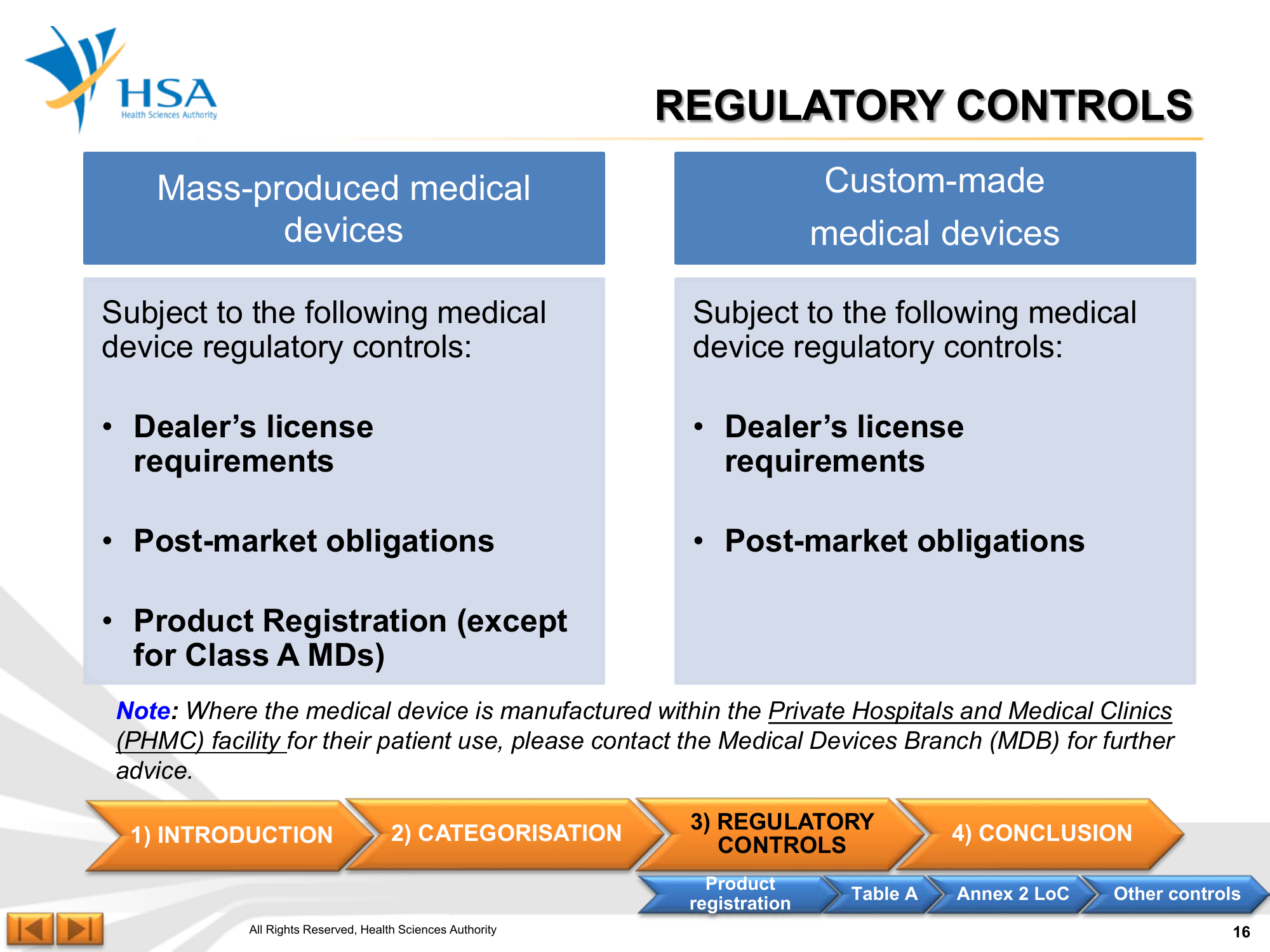
Mass-produced medical devices Subject to the following medical device regulatory controls: •Dealer’s license requirements •Post-market obligations •Product Registration (except for Class A MDs) medical devices Subject to the following medical device regulatory controls: •Dealer’s license requirements •Post-market obligations Note: Where the medical device is manufactured within the Private Hospitals and Medical Clinics (PHMC) facility for their patient use, please contact the Medical Devices Branch (MDB) for further advice.
Regulatory Guideline for 3D-Printed Medical Devices — official PDF page 16; original table columns, symbols and diagram connections
•Aswithallmedicaldevices,3D-printeddevicesareclassifiedintodifferentrisk classification(ClassAtoClassD)asper GN-13: GuidanceontheRisk ClassificationofGeneralMedicalDevices,dependingonthenatureofthe deviceanditsintendedfunctions. Inordertosupplymass-produced3D- printedmedicaldevicesin Singapore,theRegistrantis requiredtoregisterthe ClassB,C andD deviceswithHSA. •Productregistrationsubmissionrequirementsandprocesswillbeper GN-15: GuidanceonMedicalDeviceProductRegistration. •Similarly,3D-printedmedicaldevicesundergochangesaspartoftheir productlifecycleaswell.PleaserefertoGN-21: GuidanceonChange NotificationforRegisteredMedicalDevicestodeterminewhethera Change NotificationsubmissiontoHSAis requiredforspecificproposedchangestoa medicaldevicethatisregisteredontheSingaporeMedicalDeviceRegister (SMDR). •Basic considerations for all 3D-printed devices is as described in Table A. However, not all considerations described will be applicable to every device as this would be dependent on the AM technology, device type and material used. •Mass produced 3D-printed device requires product registration and the basic considerations in Table A are mapped against TR-01: Contents of a Product Registration Submission for General Medical Devices using the ASEAN CSDT. The type and amount of technical documents for product registration submission will vary depending on the intended use, risk classification and evaluation route of the device. •For custom-made MDs and Class A MDs which do not require product registration, manufacturers should still take note and comply with the applicable considerations presented in Table A for their device.
3.2 Table A: Basic considerations for all 3D-printed devices
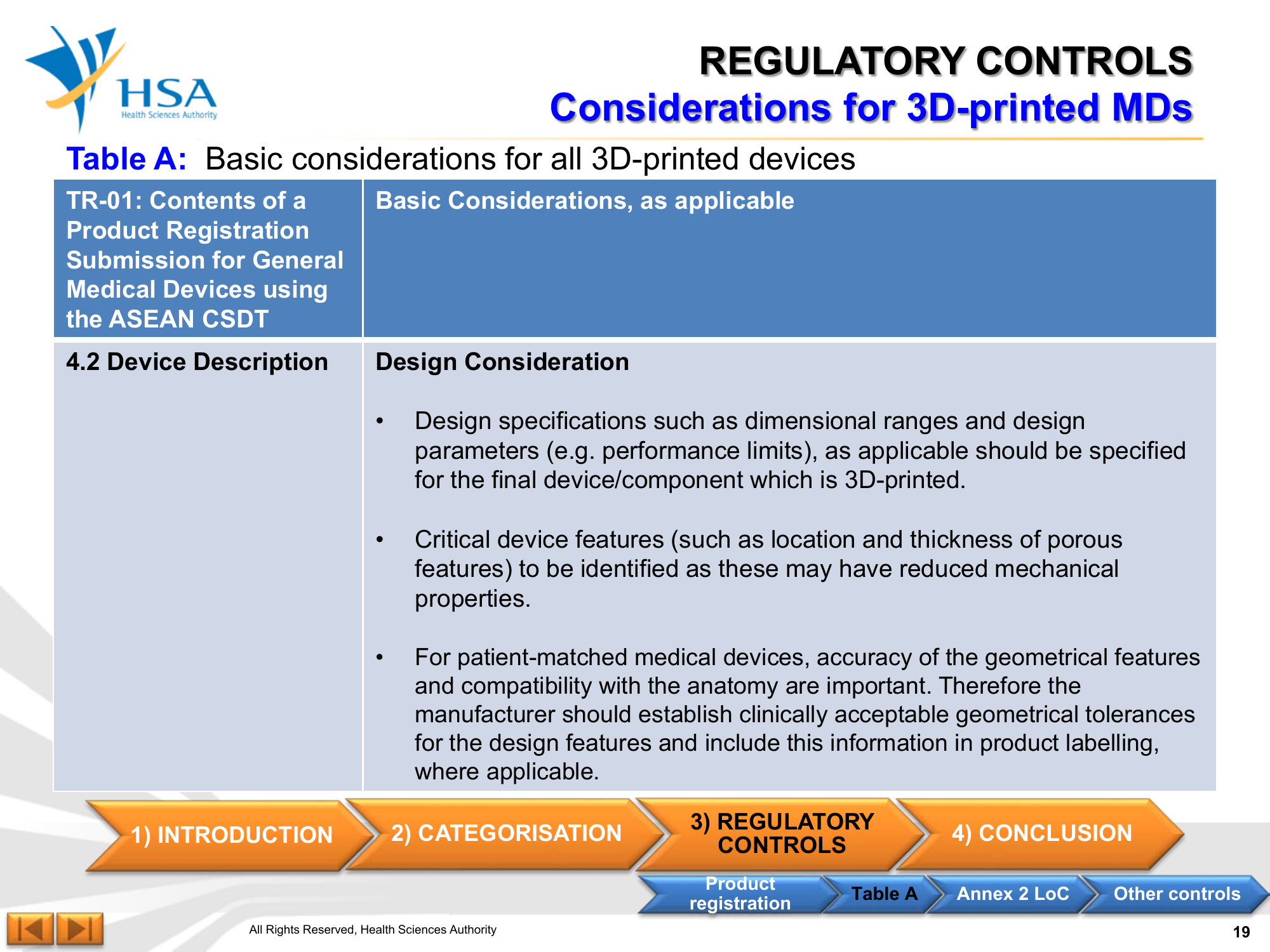
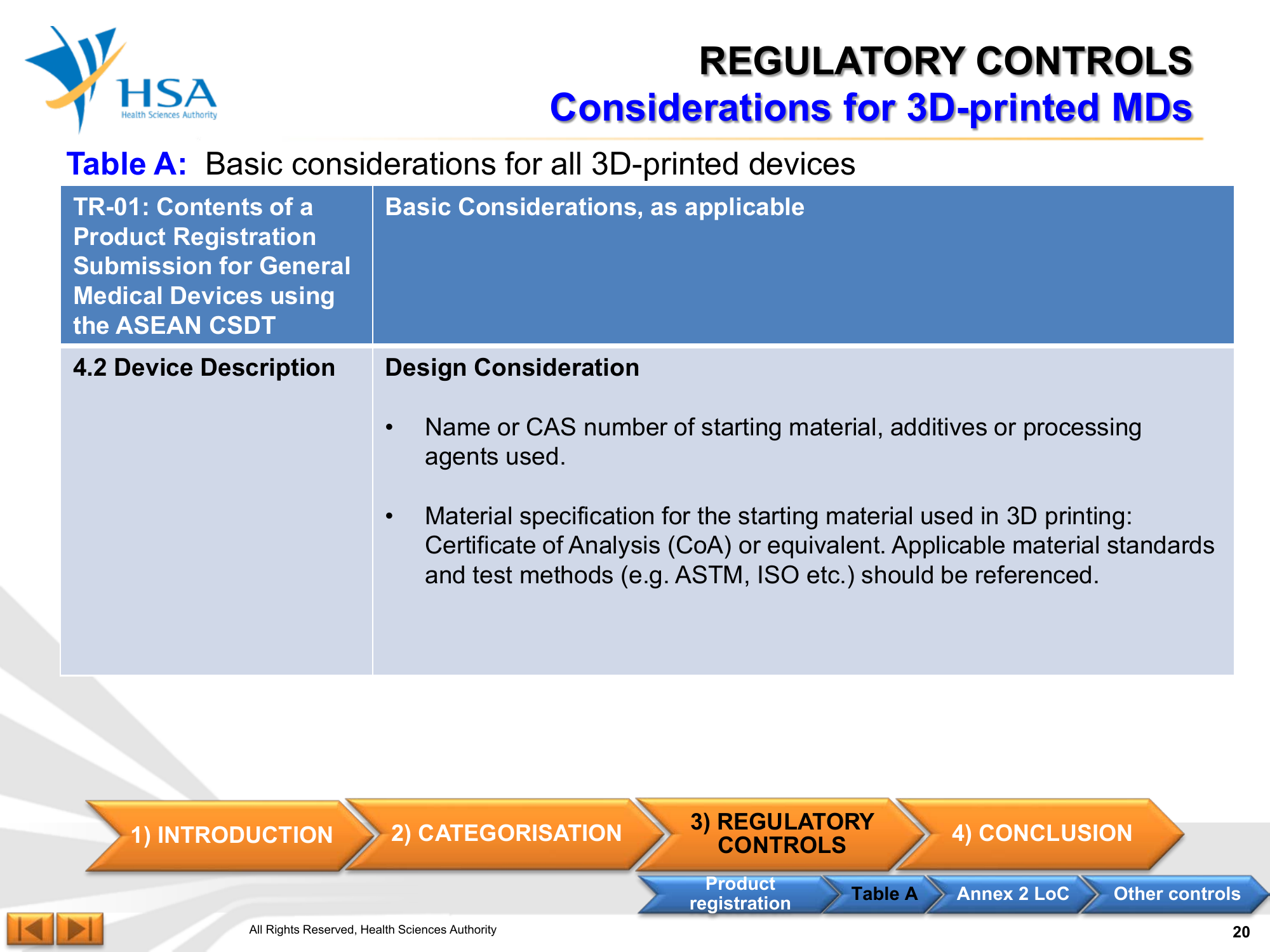
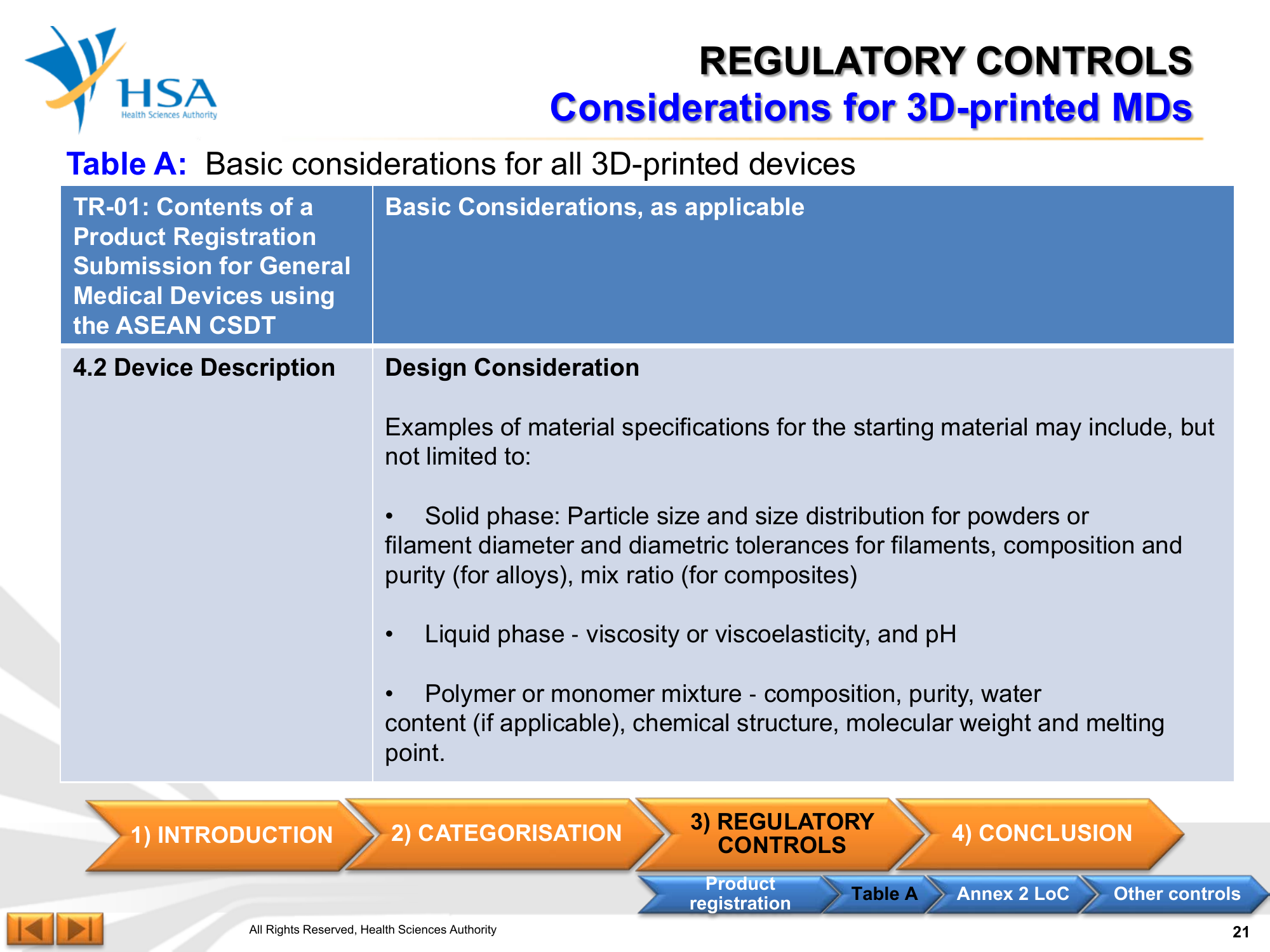
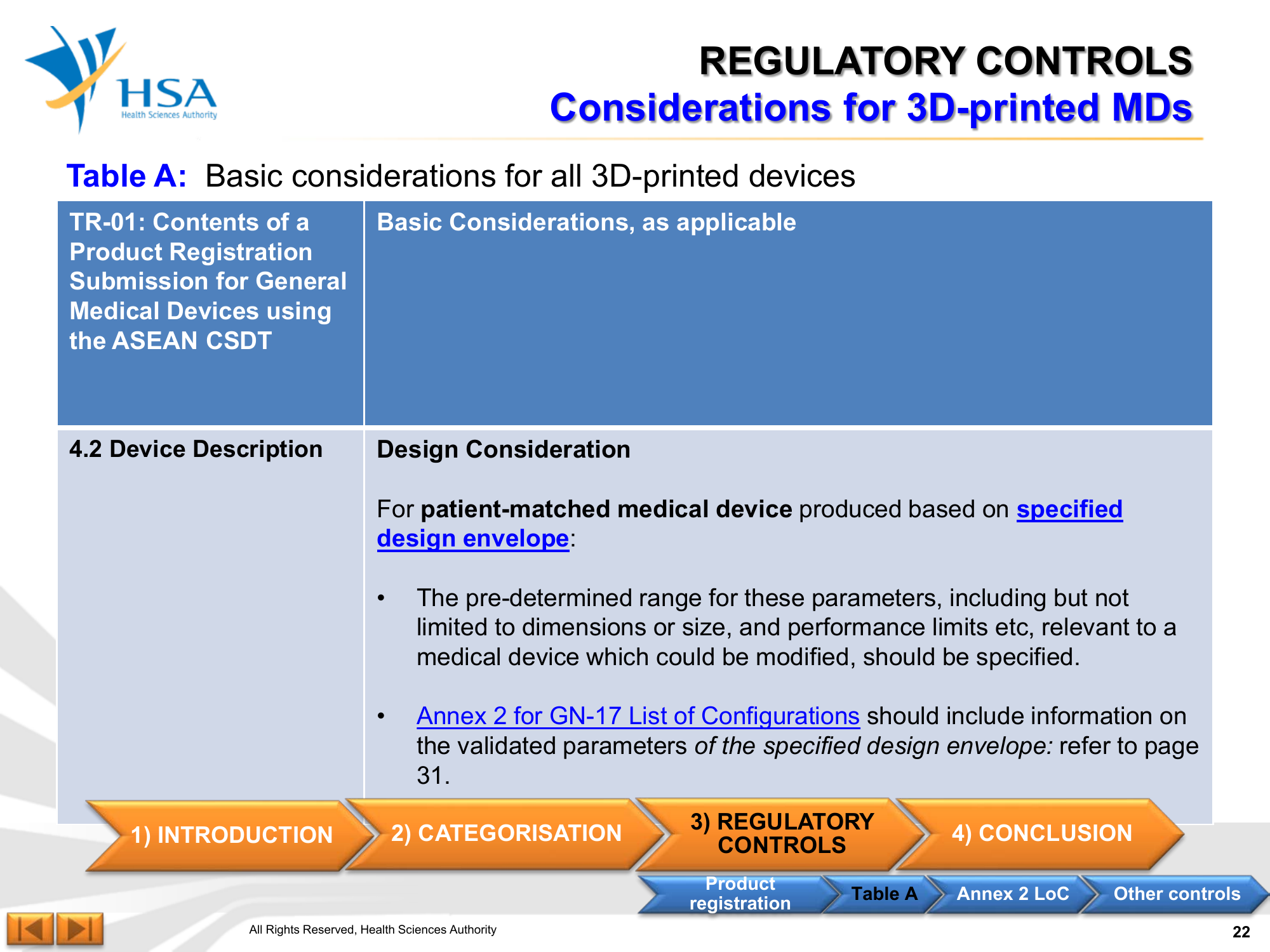
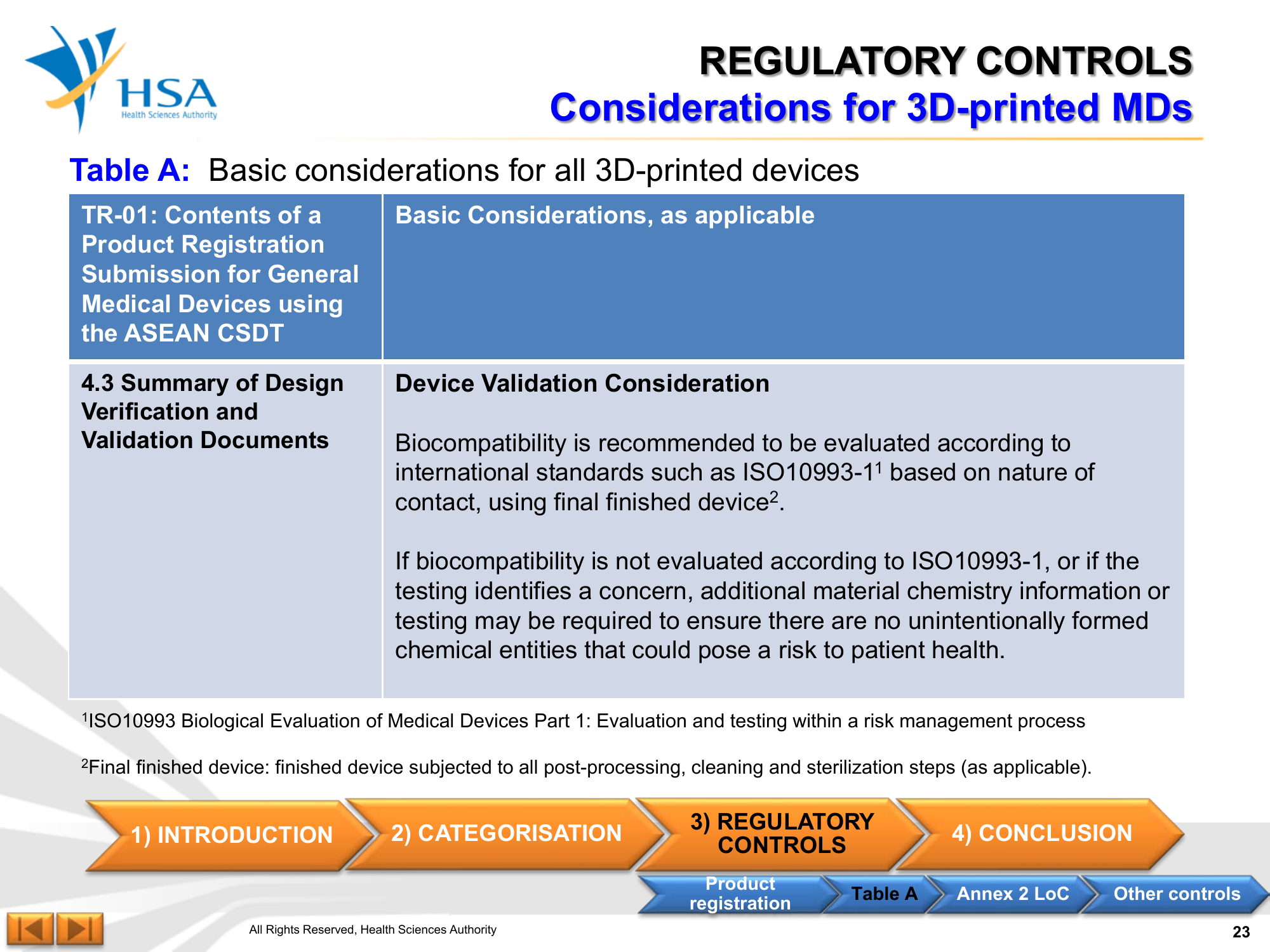
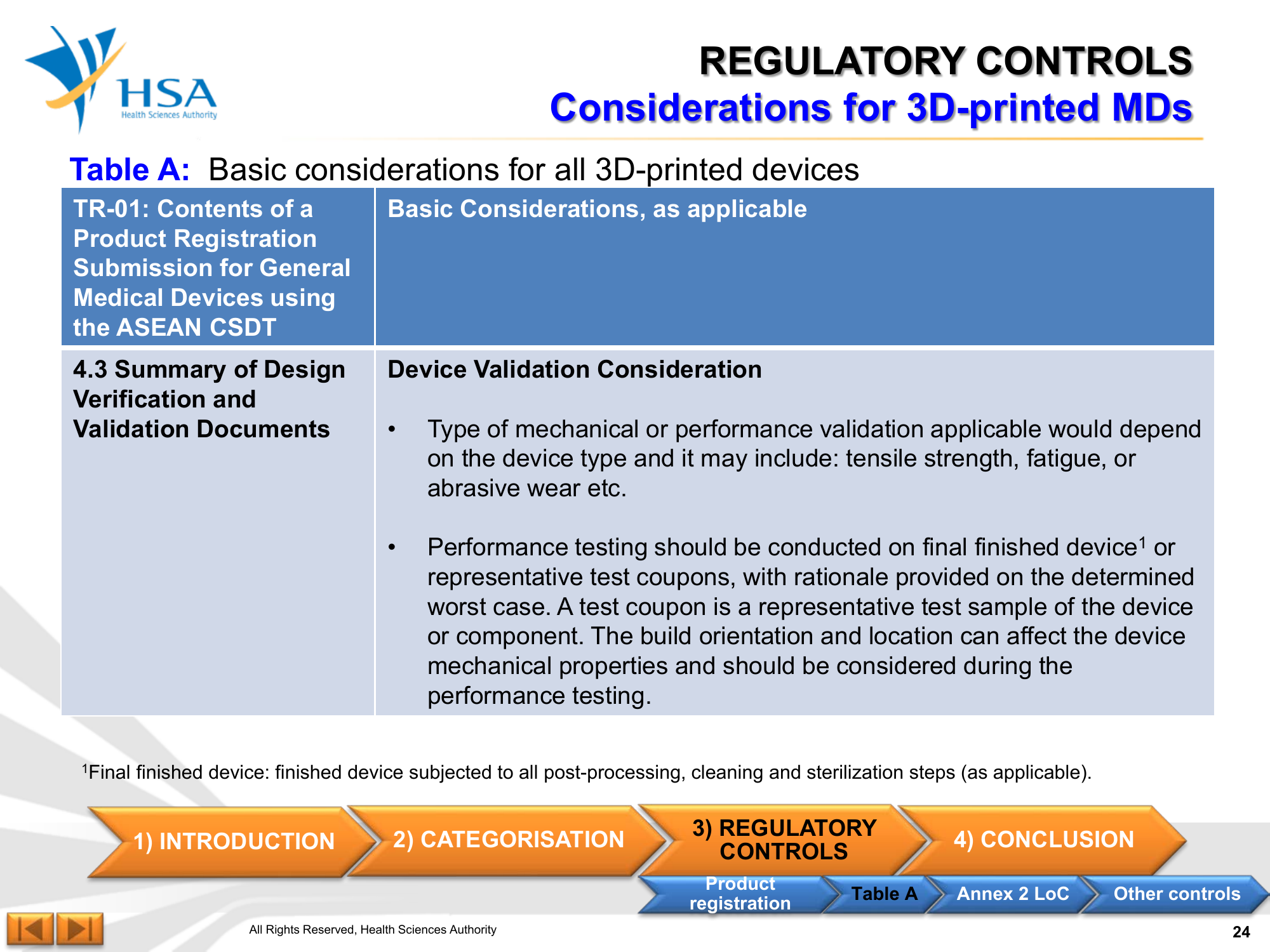
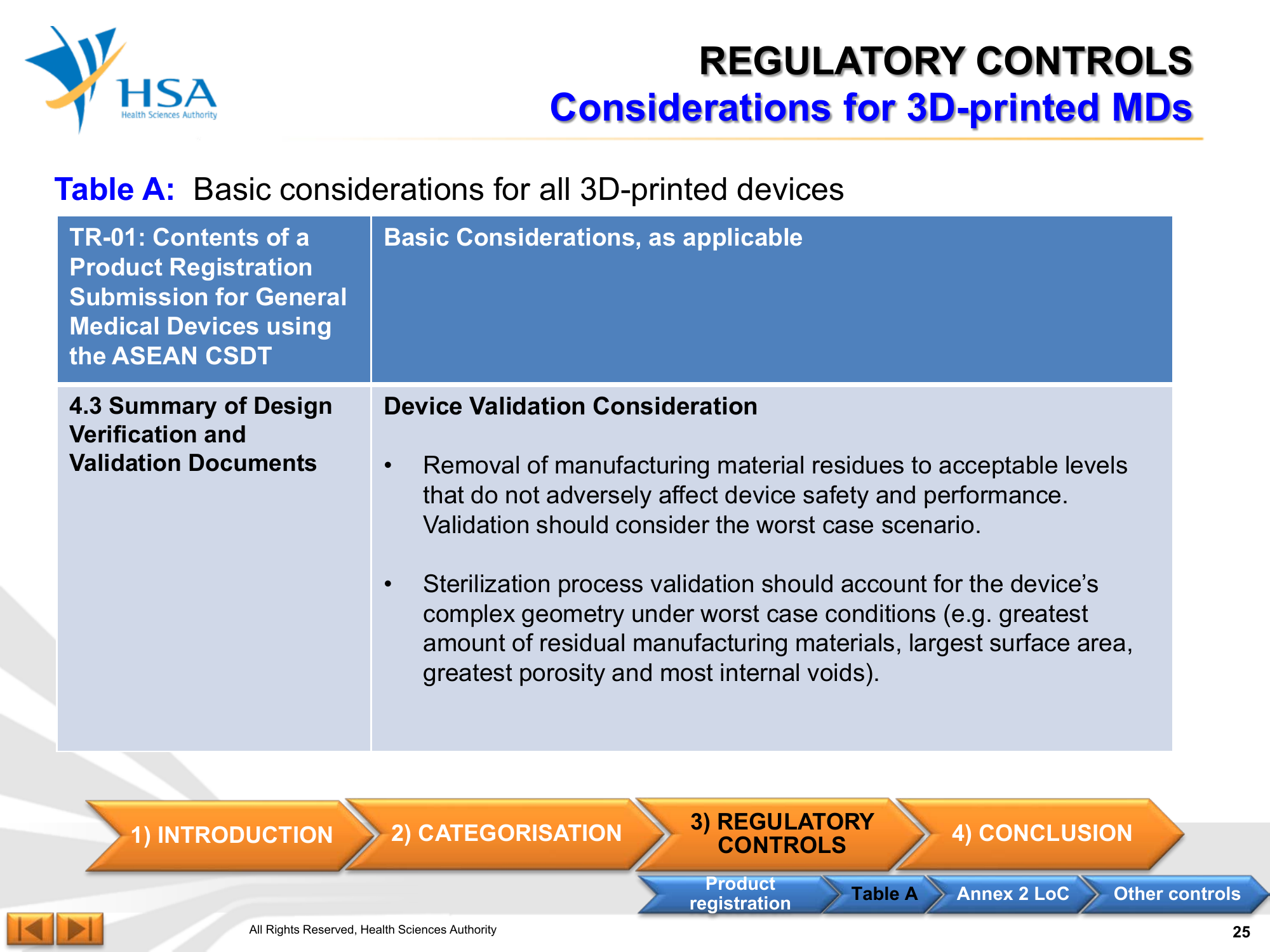
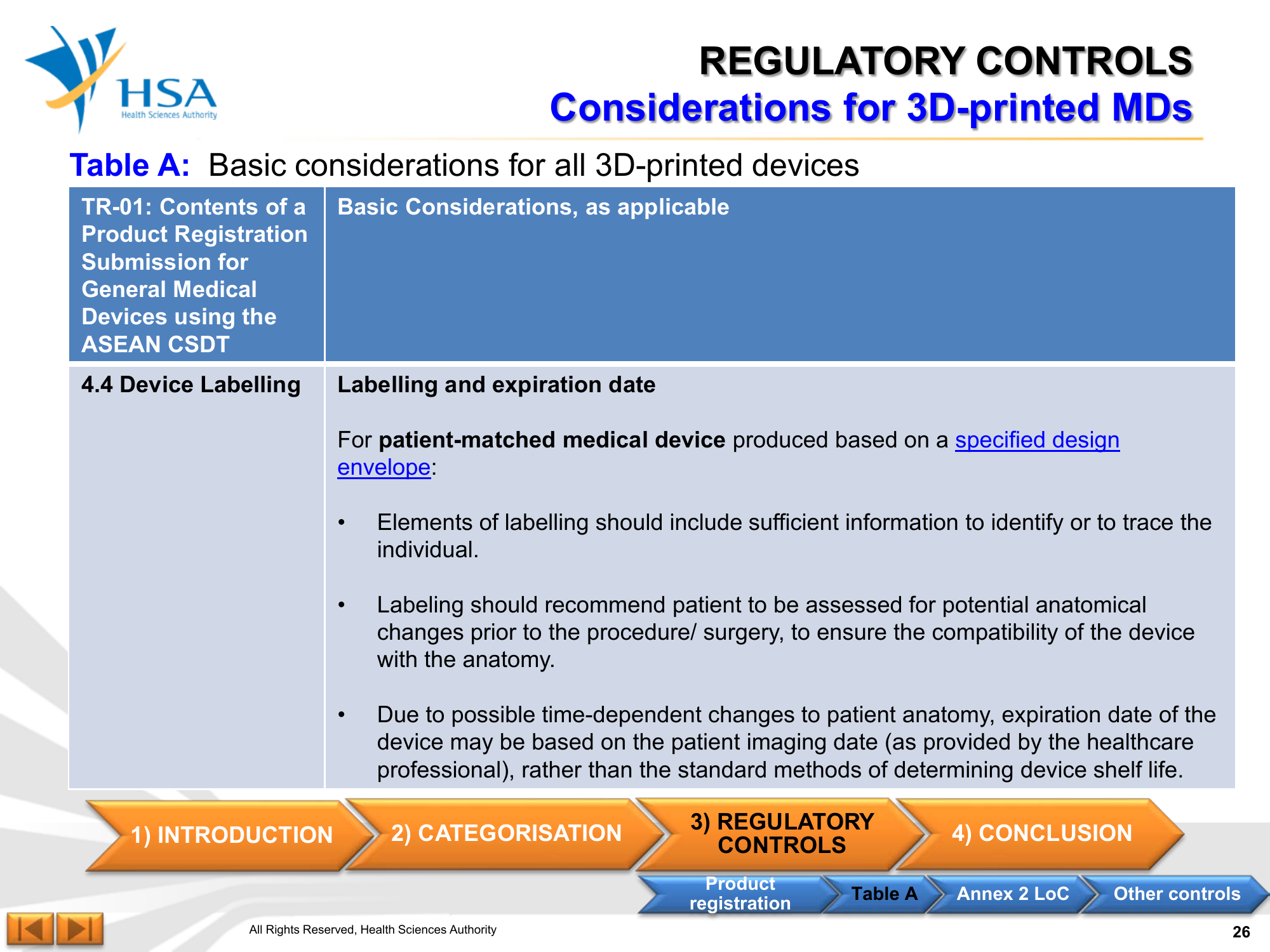
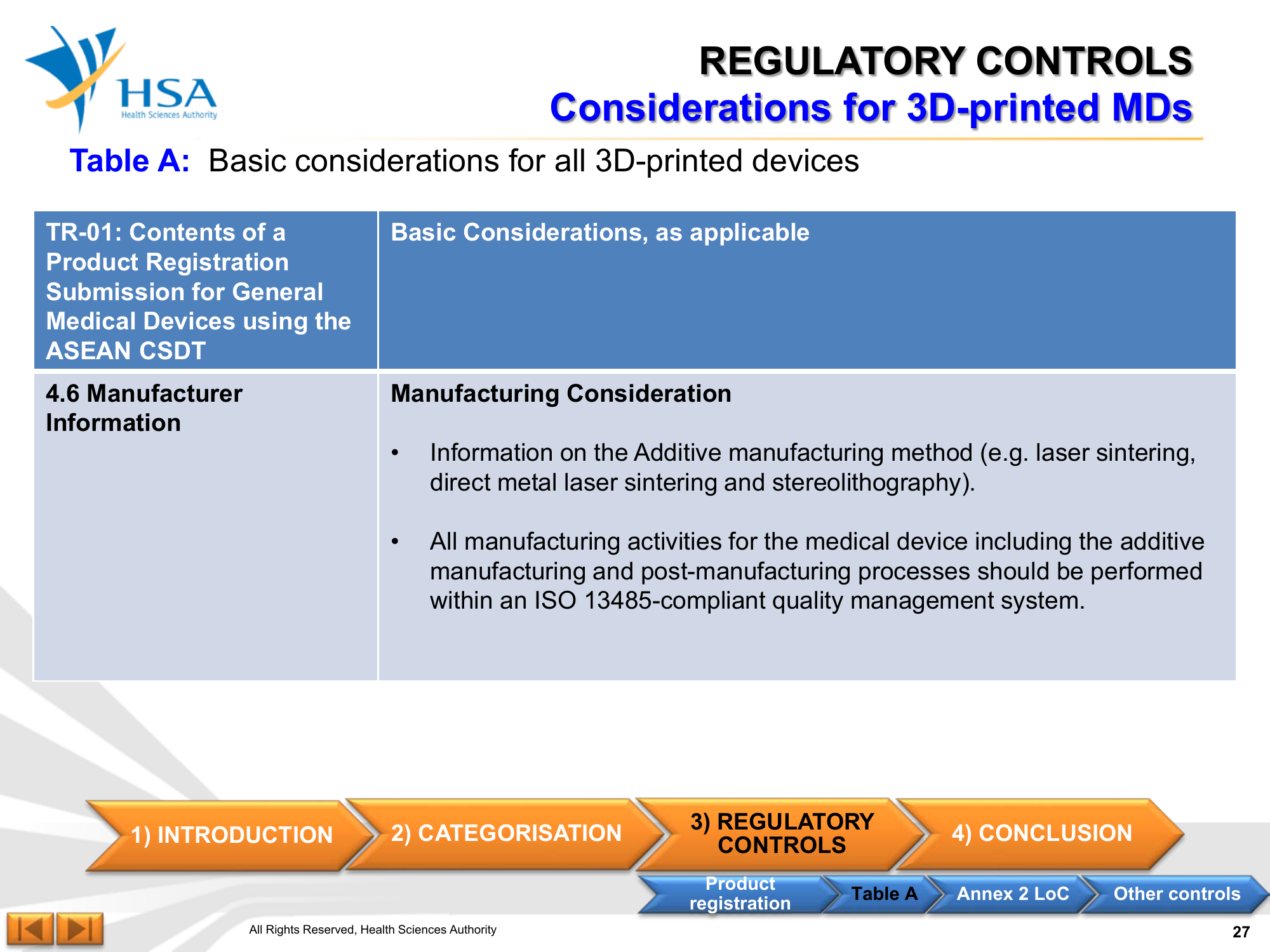
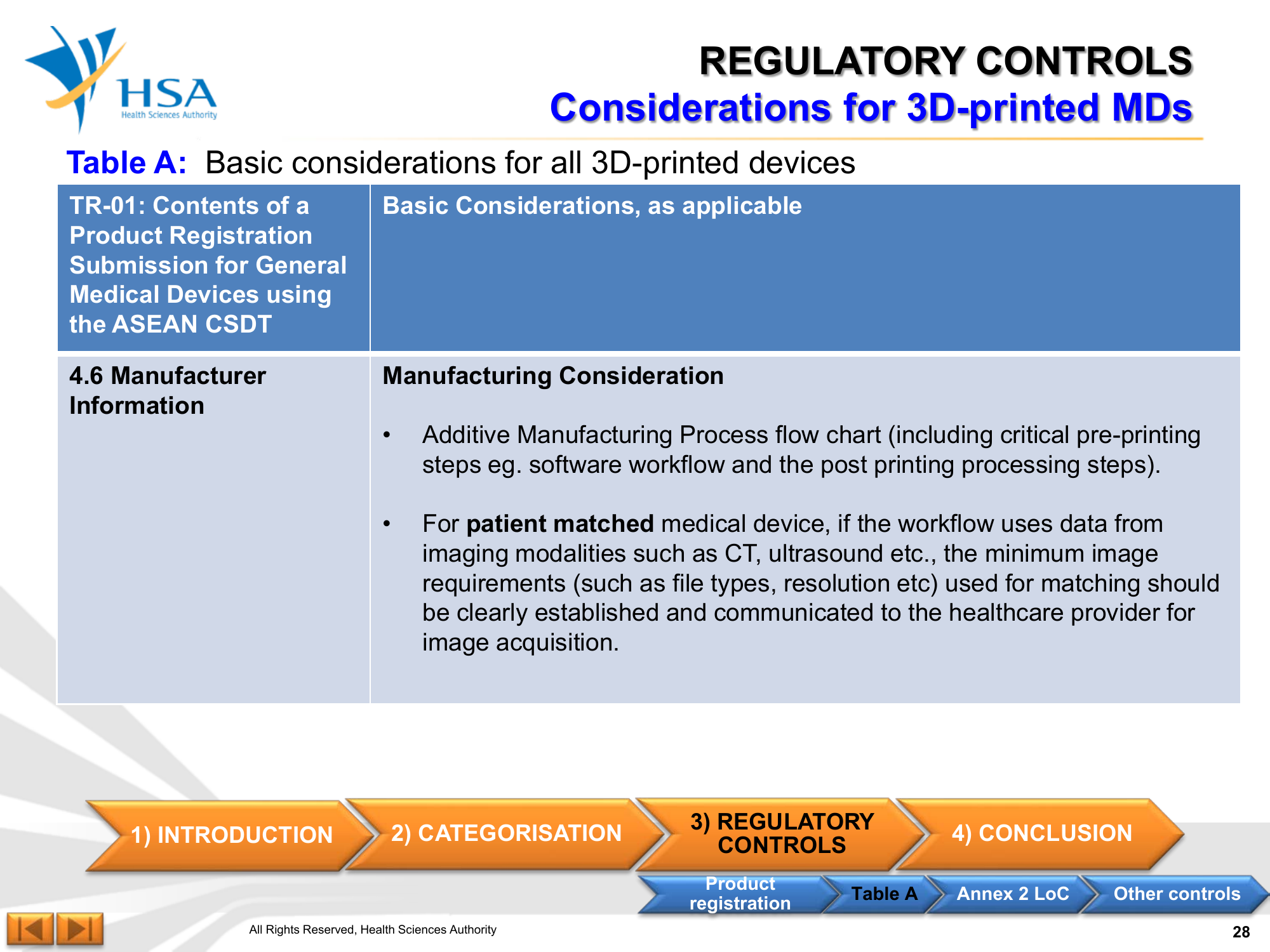
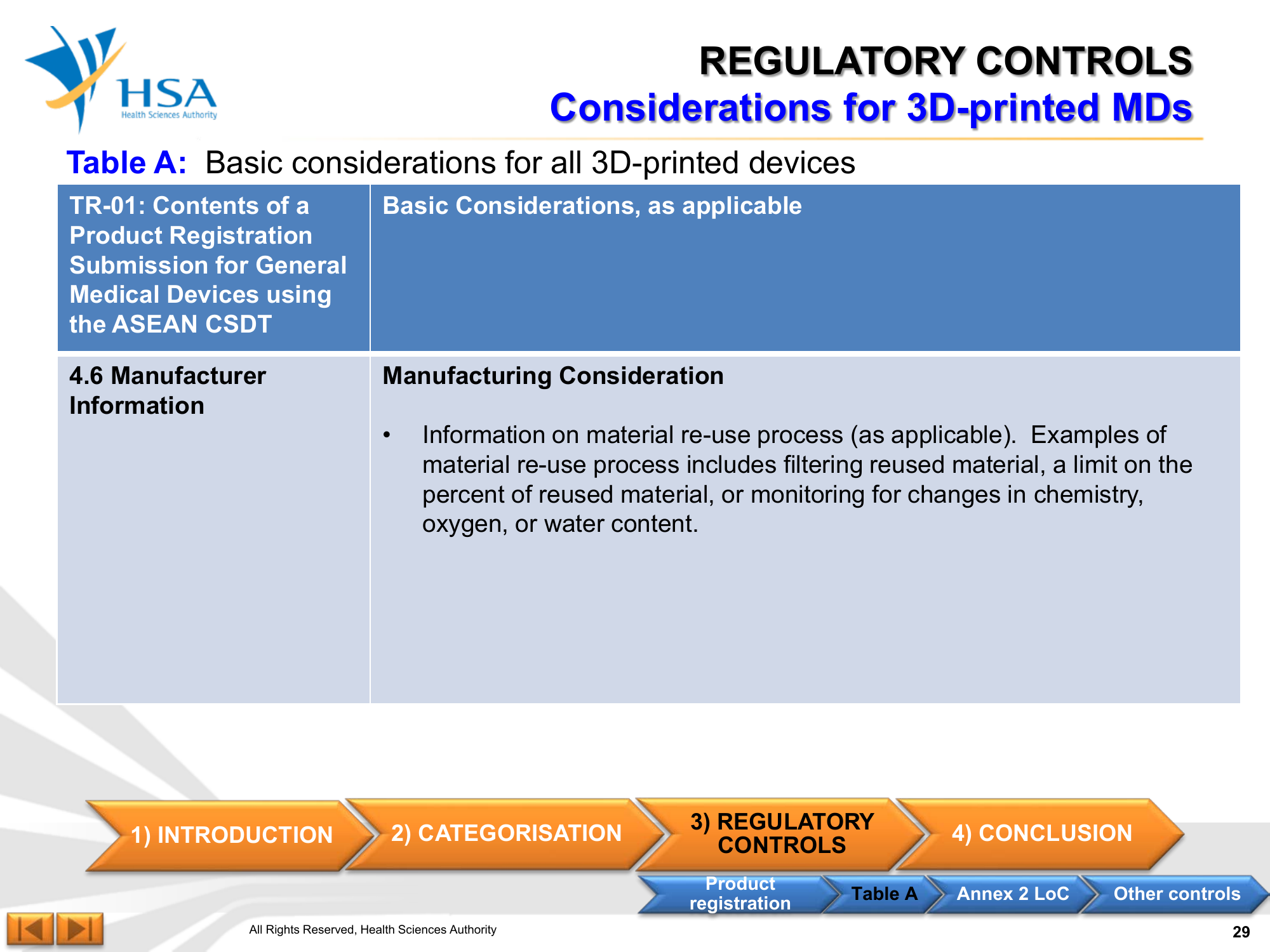
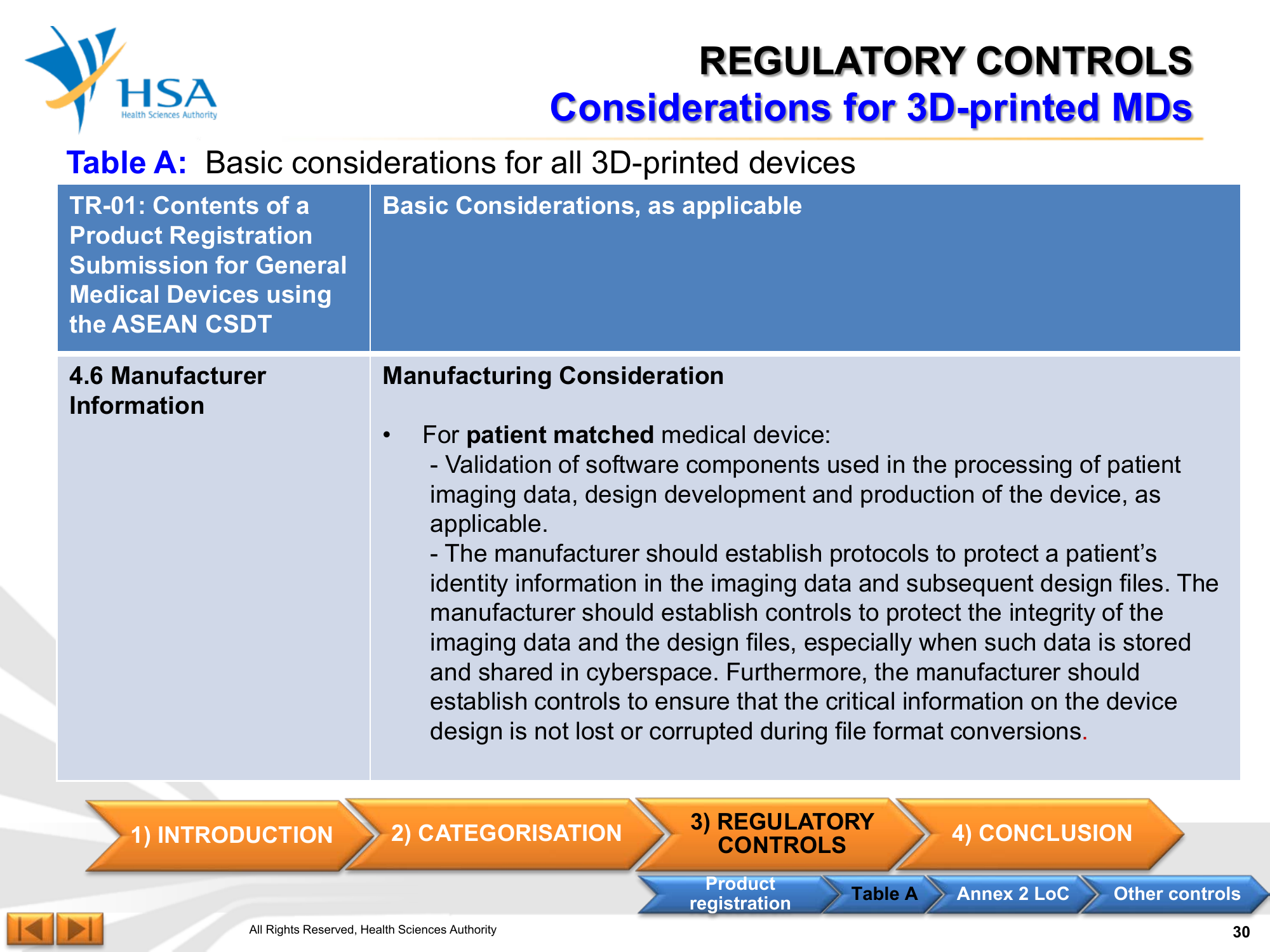
TR-01: Contents of a Submission for General Medical Devices using the ASEAN CSDT Basic Considerations, as applicable 4.2 Device DescriptionDesign Consideration •Design specifications such as dimensional ranges and design parameters (e.g. performance limits), as applicable should be specified for the final device/component which is 3D-printed. •Critical device features (such as location and thickness of porous features) to be identified as these may have reducedmechanical properties. •For patient-matched medical devices, accuracy of the geometrical features and compatibility with the anatomy are important. Therefore the manufacturer should establish clinically acceptable geometrical tolerances for the design features and include this information in product labelling, where applicable. Table A: Basic considerations forall 3D-printed devices TR-01: Contents of a Submission for General Medical Devices using the ASEAN CSDT Basic Considerations, as applicable 4.2 Device DescriptionDesign Consideration •Name or CAS number of starting material, additives or processing agents used. •Material specification for the starting material used in 3D printing: Certificate of Analysis (CoA) or equivalent. Applicable material standards and test methods (e.g. ASTM, ISO etc.) should be referenced. Table A: Basic considerations forall 3D-printed devices TR-01: Contents of a Submission for General Medical Devices using the ASEAN CSDT Basic Considerations, as applicable 4.2 Device DescriptionDesign Consideration Examples of material specifications for the starting material may include, but not limited to: •Solid phase: Particle size and size distribution for powders or filament diameter and diametric tolerances for filaments, composition and purity (for alloys), mix ratio (for composites) •Liquid phase ‐viscosity or viscoelasticity, and pH •Polymer or monomer mixture ‐composition, purity, water content (if applicable), chemical structure, molecular weight and melting point. Table A: Basic considerations forall 3D-printed devices TR-01: Contents of a Submission for General Medical Devices using the ASEAN CSDT Basic Considerations, as applicable 4.2 Device Description Design Consideration For patient-matched medicaldevice produced based on specified design envelope : •The pre-determined range for these parameters, including but not limited to dimensions or size, and performance limits etc, relevant to a medical device which could be modified, should be specified. •Annex2 for GN-17 List of Configurationsshould include information on the validated parametersof the specified design envelope: refer to page 31. Table A: Basic considerations for all 3D-printed devices TR-01: Contents of a Submission for General Medical Devices using the ASEAN CSDT Basic Considerations, as applicable 4.3 Summary of Design Verification and Validation Documents Device Validation Consideration Biocompatibility is recommended to be evaluated according to international standards such as ISO10993-1 based on nature of contact, using final finished device . If biocompatibility is not evaluated according to ISO10993-1, or if the testing identifies a concern, additional material chemistry information or testing may berequired to ensure there are no unintentionally formed chemical entities that could pose a risk to patient health. ISO10993 Biological Evaluation of Medical Devices Part 1: Evaluation and testing within a risk management process Final finished device: finished device subjected to all post-processing, cleaning and sterilization steps (as applicable). Table A: Basic considerations for all 3D-printed devices TR-01: Contents of a Submission for General Medical Devices using the ASEAN CSDT Basic Considerations, as applicable 4.3 Summary of Design Verification and Validation Documents Device Validation Consideration •Type of mechanical or performance validation applicable would depend on the device type and it may include: tensile strength, fatigue, or abrasive wear etc. •Performance testing should be conducted on final finished device or representative test coupons, with rationale provided on the determined worst case. A test coupon is a representative test sample of the device or component. The build orientation and location can affect the device mechanical properties and should be considered during the performance testing. Final finished device: finished device subjected to all post-processing, cleaning and sterilization steps (as applicable). Table A: Basic considerations for all 3D-printed devices TR-01: Contents of a Submission for General Medical Devices using the ASEAN CSDT Basic Considerations, as applicable 4.3 Summary of Design Verification and Validation Documents Device Validation Consideration •Removal of manufacturing material residues to acceptable levels that do not adversely affect device safety and performance. Validation should consider the worst case scenario. •Sterilization process validation should account for the device’s complex geometry under worst case conditions (e.g. greatest amount of residual manufacturing materials, largest surface area, greatest porosity and most internal voids). Table A: Basic considerations for all 3D-printed devices TR-01: Contents of a Submission for General Medical Devices using the ASEAN CSDT Basic Considerations, as applicable 4.4Device LabellingLabelling and expirationdate For patient-matchedmedical device produced based on a specified design envelope : •Elements of labelling should include sufficient information to identify or to trace the individual. •Labeling should recommend patient to be assessed for potential anatomical changes prior to the procedure/ surgery, to ensure the compatibility of the device with the anatomy. •Due to possible time-dependent changesto patient anatomy, expiration date of the device may be based on the patient imaging date (as provided by the healthcare professional), rather than the standard methods of determining device shelf life. Table A: Basic considerations for all 3D-printed devices TR-01: Contents of a Submission for General Medical Devices using the ASEAN CSDT Basic Considerations, as applicable 4.6 Manufacturer Information ManufacturingConsideration •Information on the Additive manufacturing method (e.g. laser sintering, direct metal laser sintering and stereolithography). •All manufacturing activities for the medical device including the additive manufacturing and post-manufacturing processes should be performed within an ISO 13485-compliant quality management system. Table A: Basic considerations for all 3D-printed devices TR-01: Contents of a Submission for General Medical Devices using the ASEAN CSDT Basic Considerations, as applicable 4.6 Manufacturer Information ManufacturingConsideration •Additive Manufacturing Process flow chart (including critical pre-printing steps eg.software workflow and the post printing processing steps). •For patient matched medical device, if the workflow uses data from imaging modalities such as CT, ultrasound etc., the minimum image requirements (such as file types, resolution etc) used for matching should be clearly established and communicated to the healthcare provider for image acquisition. Table A: Basic considerations for all 3D-printed devices TR-01: Contents of a Submission for General Medical Devices using the ASEAN CSDT Basic Considerations, as applicable 4.6 Manufacturer Information ManufacturingConsideration •Information on material re-use process (as applicable). Examples of material re-use process includes filtering reused material, a limit on the percent of reused material, or monitoring for changes in chemistry, oxygen, or water content. Table A: Basic considerations for all 3D-printed devices TR-01: Contents of a Submission for General Medical Devices using the ASEAN CSDT Basic Considerations, as applicable 4.6 Manufacturer Information ManufacturingConsideration •For patient matched medical device: - Validation of software components used in the processing of patient imaging data, design development and production of the device, as applicable. - The manufacturer should establish protocols to protect a patient’s identity information in the imaging data and subsequent design files. The manufacturer should establish controls to protect the integrity of the imaging data and the design files, especially when such data is stored and shared in cyberspace. Furthermore, the manufacturer should establish controls to ensure that the critical information on the device design is not lost or corrupted during file format conversions. Table A: Basic considerations for all 3D-printed devices
Regulatory Guideline for 3D-Printed Medical Devices — official PDF page 19; original table columns, symbols and diagram connectionsRegulatory Guideline for 3D-Printed Medical Devices — official PDF page 20; original table columns, symbols and diagram connectionsRegulatory Guideline for 3D-Printed Medical Devices — official PDF page 21; original table columns, symbols and diagram connectionsRegulatory Guideline for 3D-Printed Medical Devices — official PDF page 22; original table columns, symbols and diagram connectionsRegulatory Guideline for 3D-Printed Medical Devices — official PDF page 23; original table columns, symbols and diagram connectionsRegulatory Guideline for 3D-Printed Medical Devices — official PDF page 24; original table columns, symbols and diagram connectionsRegulatory Guideline for 3D-Printed Medical Devices — official PDF page 25; original table columns, symbols and diagram connectionsRegulatory Guideline for 3D-Printed Medical Devices — official PDF page 26; original table columns, symbols and diagram connectionsRegulatory Guideline for 3D-Printed Medical Devices — official PDF page 27; original table columns, symbols and diagram connectionsRegulatory Guideline for 3D-Printed Medical Devices — official PDF page 28; original table columns, symbols and diagram connectionsRegulatory Guideline for 3D-Printed Medical Devices — official PDF page 29; original table columns, symbols and diagram connectionsRegulatory Guideline for 3D-Printed Medical Devices — official PDF page 30; original table columns, symbols and diagram connections
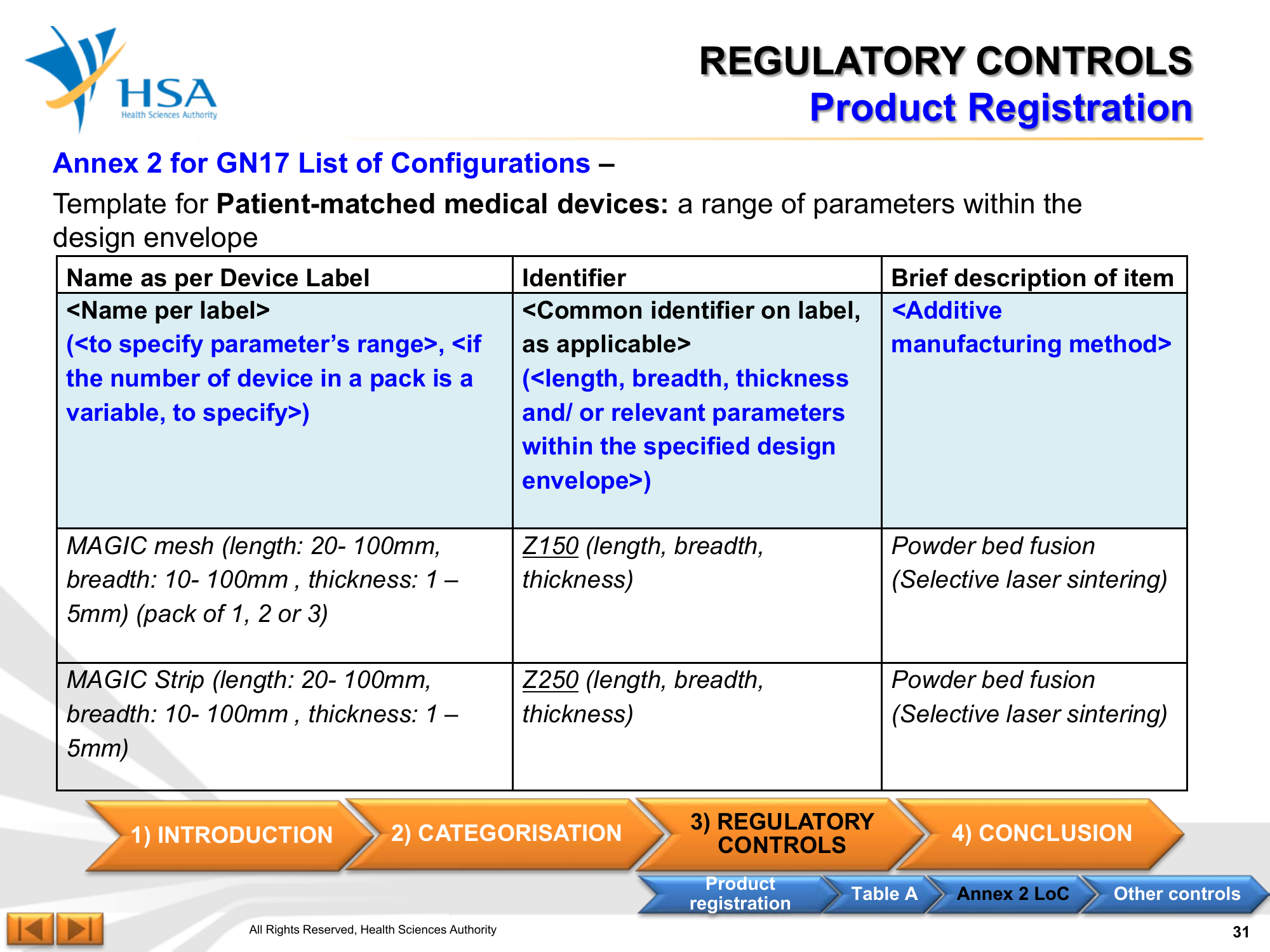
3.3 Annex 2 for GN-17 List of Configurations (patient-matched devices)
Template for Patient-matched medical devices:a range of parameters within the design envelope Name as per Device LabelIdentifierBriefdescription of item <Name per label> (<to specify parameter’s range>, <if the number of device in a pack is a variable,to specify>) <Common identifier on label, as applicable> (<length, breadth, thickness and/ or relevant parameters within the specified design envelope>) <Additive manufacturing method> MAGIC mesh (length: 20-100mm, breadth: 10- 100mm, thickness: 1 – 5mm) (pack of 1, 2or 3) Z150(length,breadth, thickness) Powder bed fusion (Selectivelaser sintering) MAGIC Strip (length: 20-100mm, breadth: 10- 100mm, thickness: 1 – 5mm) Z250(length, breadth, thickness) Powder bed fusion (Selectivelaser sintering)
Regulatory Guideline for 3D-Printed Medical Devices — official PDF page 31; original table columns, symbols and diagram connections
•To engage in the manufacture, import and/or wholesale of medical devices in Singapore, the appropriate dealer’s licences will need to be obtained from HSA. The submission requirements and process will follow as per GN-02: Guidance on Licensing for Manufacturers, Importers and Wholesalers of Medical Devices. •Dealers of medical devices are obliged to perform post-market duties, including but not limited to reporting of adverse events, defects and recall to HSA and ensuring appropriate investigation is conducted so as to ensure the continued safe use of the devices. Healthcare professionals and users of 3D-printed medical devices may also report any adverse events related to the use of a medical device or device failure related issues to HSA on a voluntary basis. •For licensed importers of custom-made devices, importers to additionally submit a list of all custom-made medical devices they are currently importing to the Medical Device Branch via hsa_md_sa@hsa.gov.sgwith the email subject “List of custom-made MDs”. Refer to this linkfor more information.
•This is the current regulatory position based on a risk-based regulatory approach and current knowledge of foreseeable risks associated with 3D-printed devices manufactured via additive manufacturing (AM). •Please note that all Class B, C and D patient-matched medical devices are required to be registered on Singapore Medical Device Register (SMDR). Companies supplying patient-matched medical devices locally, should submit their product registration application to HSA by 01 August 2022 to continue supplying their devices here. •Where deemed necessary and based on new scientific information, HSA may require additional technical documents during product registration of 3D-printed devices and/or post-market surveillance and investigationsin the interest of patient health and safety.
References IMDRF 2018 Final Document –Definitions for Personalised Medical Devices IMDRF 2020 Final Document -Personalized Medical Devices – Regulatory Pathways