1. Introduction
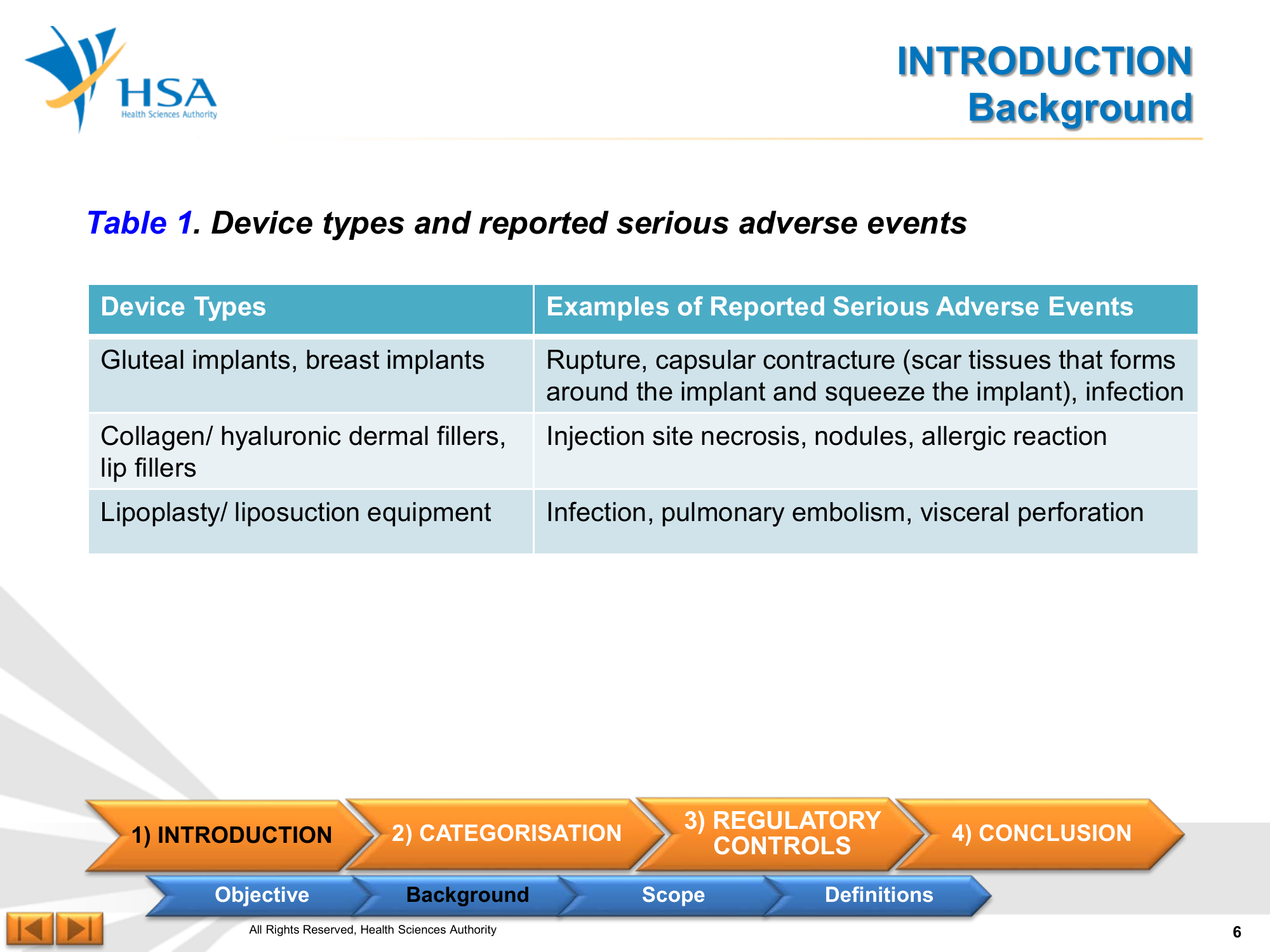
Objective The Health Sciences Authority (HSA) is issuing these guidelines to provide clarity on the types of *devices intended for modification of appearance or anatomy that are regulated as medical devices, as well as the regulatory approach and regulatory requirements for these medical devices. The guidelines reflect HSA’s current policy stance and practice, and should not be misconstrued as a new regulatory control on devices intended for modification of appearance or anatomy. * For the purpose of this guideline, devices intended for modification of appearance or anatomy refers to devices intended for aesthetic-related purposes •Devices intended for modification of appearance or anatomy include any instrument, apparatus, implement, machine or appliance intended for use on humans, for restoring, improving or modifying physical appearance. Some examples include: – treatment of wrinkles – improving skin texture – skin rejuvenation – body contouring – hair removal •As a general rule, if the device is intended by the product owner for medical andfor modification of appearance or anatomy, the device will be classified as a medical device and will be subjected to medical device regulatory controls by HSA. •There are devices which are intended by the product owner solelyfor modification of appearance or anatomy. Based on surveillance data, there have not been serious adverse events associated with the majority of such products. Background •There are also other existing regulatory oversight currently in place locally on some of these products and their use. For e.g. Singapore Medical Council (SMC) published Guidelines on Aesthetic Practices for Doctors, which lists the allowed aesthetic procedures, premises and training requirements to conduct aesthetic procedures for doctors National Environment Agency (NEA) imposes licensing requirements for individuals or facilities handling ionizing/non-ionizing radiation emitting equipment under the Radiation Protection Act Background •A review of serious adverse events reported globally on similar devices was performed (refer to Table 1) Background Table1. Devicetypesandreportedseriousadverseevents Device TypesExamples of Reported SeriousAdverse Events Glutealimplants, breast implants Rupture, capsular contracture (scar tissues that forms around the implant and squeeze the implant), infection Collagen/ hyaluronic dermal fillers, lip fillers Injection sitenecrosis, nodules, allergic reaction Lipoplasty/ liposuctionequipmentInfection, pulmonaryembolism, visceral perforation Scope This document applies to devices intended by the product owner solely for *modification of appearance or anatomy. * For the purpose of this guideline, devices intended for modification of appearance or anatomy refer to devices intended for aesthetic-related purposes Definitions PRODUCT OWNER (as stated in the Medical Device Regulations): in relation to a health product, is defined as a person who — supplies the health product under his own name, or under any trade mark, design, trade name or other name or mark owned or controlled by him; and is responsible for designing, manufacturing, assembling, processing, labelling, packaging, refurbishing or modifying the health product, or for assigning to it a purpose, whether those tasks are performed by him or on his behalf. DEVICES FOR MODIFICATION OF APPEARANCE OR ANATOMY (aesthetic- related purposes): any instrument, apparatus, implement, machine or appliance intended for use on humans, for restoring, improving or modifying physical appearance and/or anatomy.