Act 16 of 2003 — Science and Technology Act, 2003 — NCST reproduction
Currentness under review. Whether this instrument remains applicable is under review. Consult the later instruments and source context below before relying on it.
Link directly to a passage with its anchor — for example #pdf-page-1 — to open it highlighted. This reference version is generated from the authority’s publication and does not replace it. Language: English.
Contents
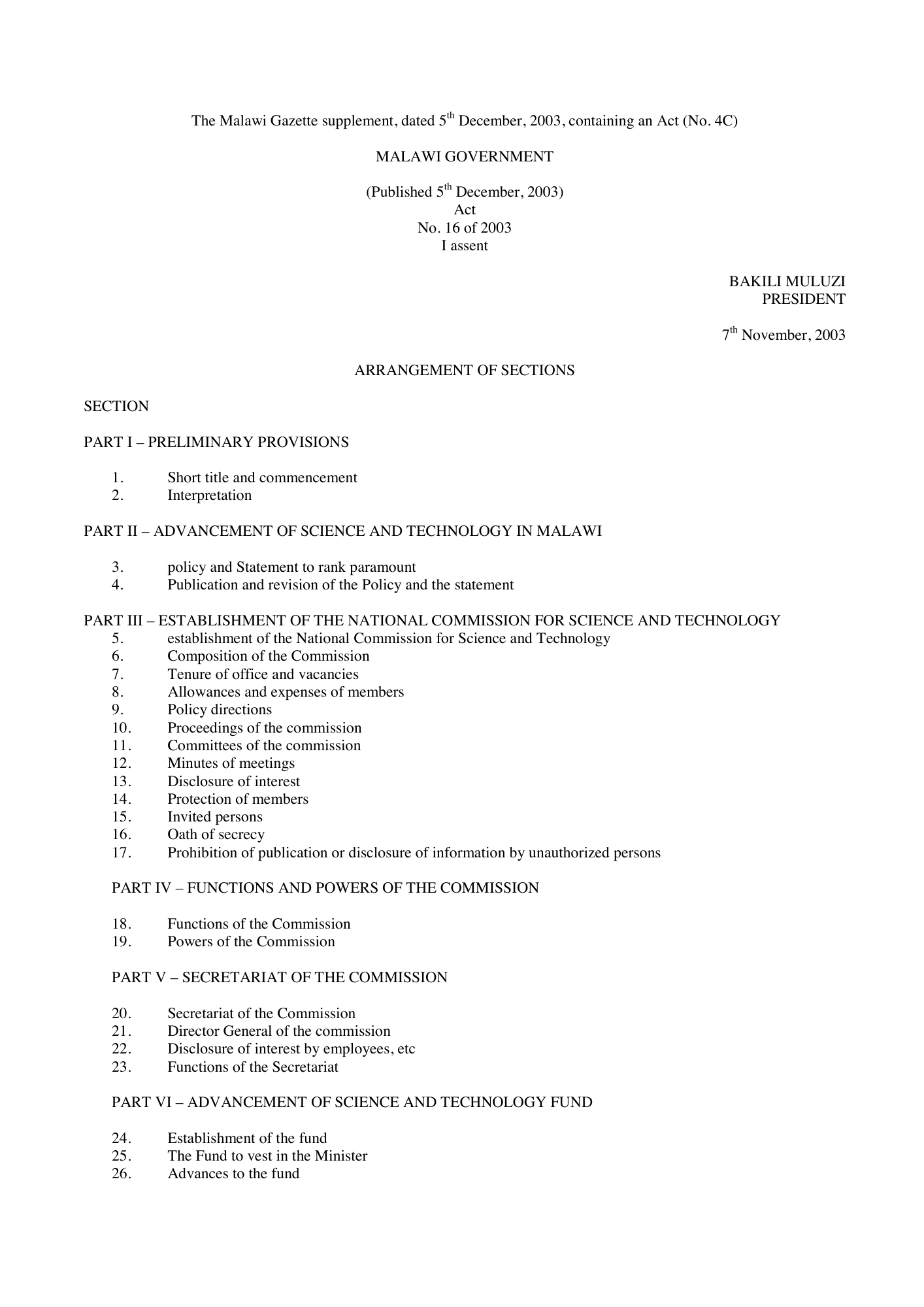
The Malawi Gazette supplement, dated 5th December, 2003, containing an Act (No. 4C)
MALAWI GOVERNMENT
(Published 5th December, 2003)
Act
No. 16 of 2003
I assent
BAKILI MULUZI
PRESIDENT
7th November, 2003
ARRANGEMENT OF SECTIONS
SECTION
PART I – PRELIMINARY PROVISIONS
1. Short title and commencement
2. Interpretation
PART II – ADVANCEMENT OF SCIENCE AND TECHNOLOGY IN MALAWI
3. policy and Statement to rank paramount
4. Publication and revision of the Policy and the statement
PART III – ESTABLISHMENT OF THE NATIONAL COMMISSION FOR SCIENCE AND TECHNOLOGY
5. establishment of the National Commission for Science and Technology
6. Composition of the Commission
7. Tenure of office and vacancies
8. Allowances and expenses of members
9. Policy directions
10. Proceedings of the commission
11. Committees of the commission
12. Minutes of meetings
13. Disclosure of interest
14. Protection of members
15. Invited persons
16. Oath of secrecy
17. Prohibition of publication or disclosure of information by unauthorized persons
PART IV – FUNCTIONS AND POWERS OF THE COMMISSION
18. Functions of the Commission
19. Powers of the Commission
PART V – SECRETARIAT OF THE COMMISSION
20. Secretariat of the Commission
21. Director General of the commission
22. Disclosure of interest by employees, etc
23. Functions of the Secretariat
PART VI – ADVANCEMENT OF SCIENCE AND TECHNOLOGY FUND
24. Establishment of the fund
25. The Fund to vest in the Minister
26. Advances to the fund
Act 16 of 2003 — official PDF page 1; original table columns, symbols and diagram connections
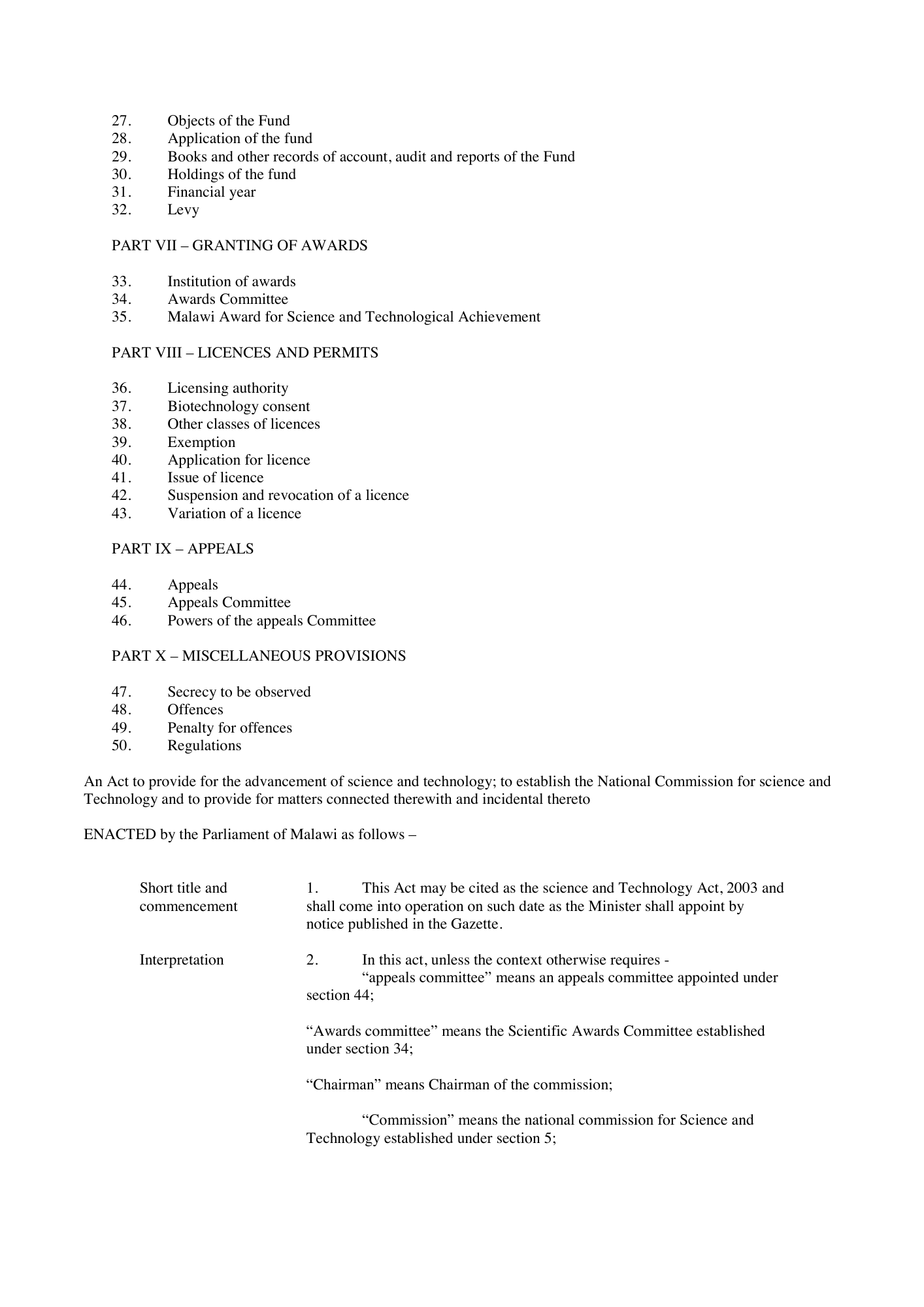
27. Objects of the Fund
28. Application of the fund
29. Books and other records of account, audit and reports of the Fund
30. Holdings of the fund
31. Financial year
32. Levy
PART VII – GRANTING OF AWARDS
33. Institution of awards
34. Awards Committee
35. Malawi Award for Science and Technological Achievement
PART VIII – LICENCES AND PERMITS
36. Licensing authority
37. Biotechnology consent
38. Other classes of licences
39. Exemption
40. Application for licence
41. Issue of licence
42. Suspension and revocation of a licence
43. Variation of a licence
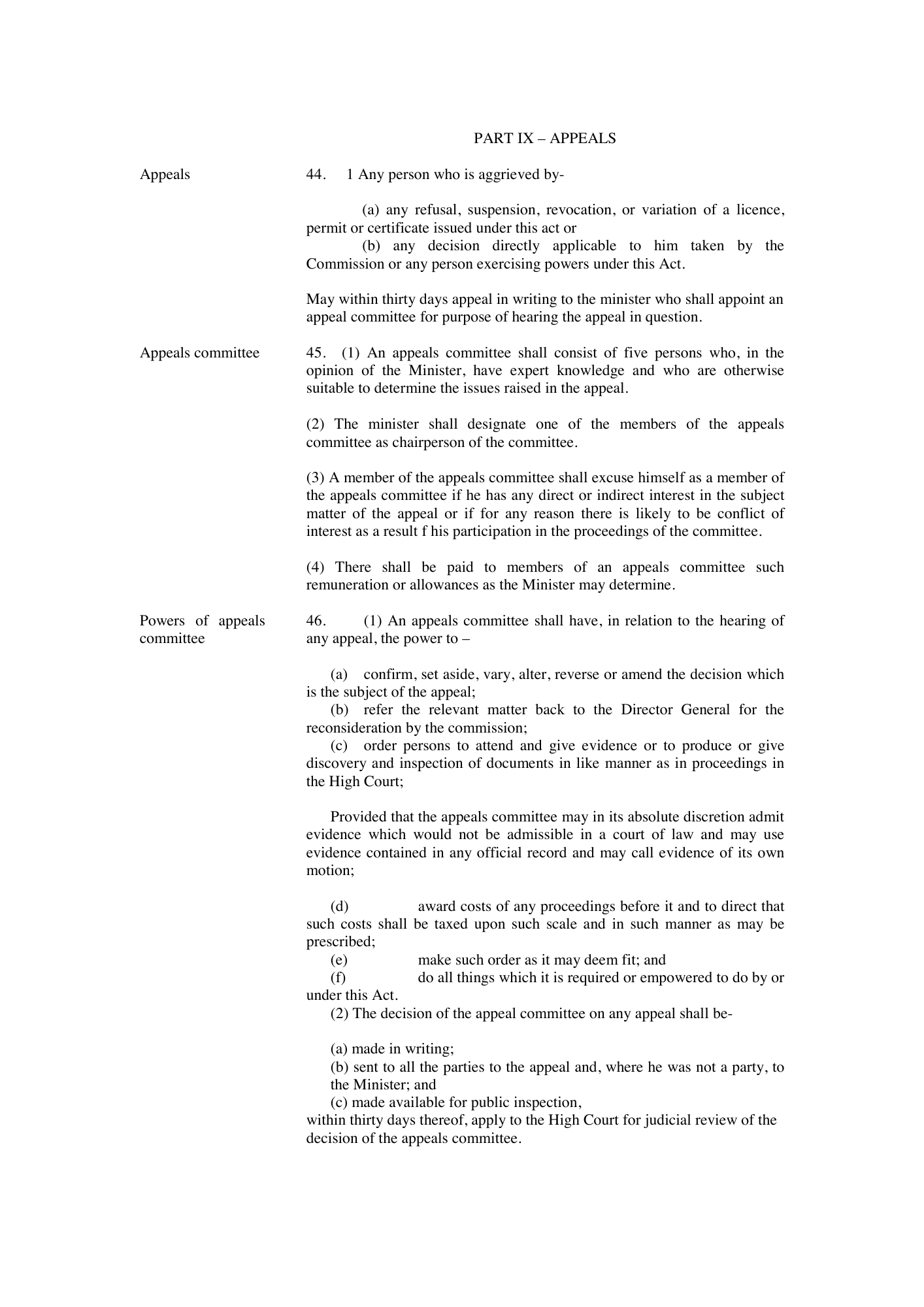
PART IX – APPEALS
44. Appeals
45. Appeals Committee
46. Powers of the appeals Committee
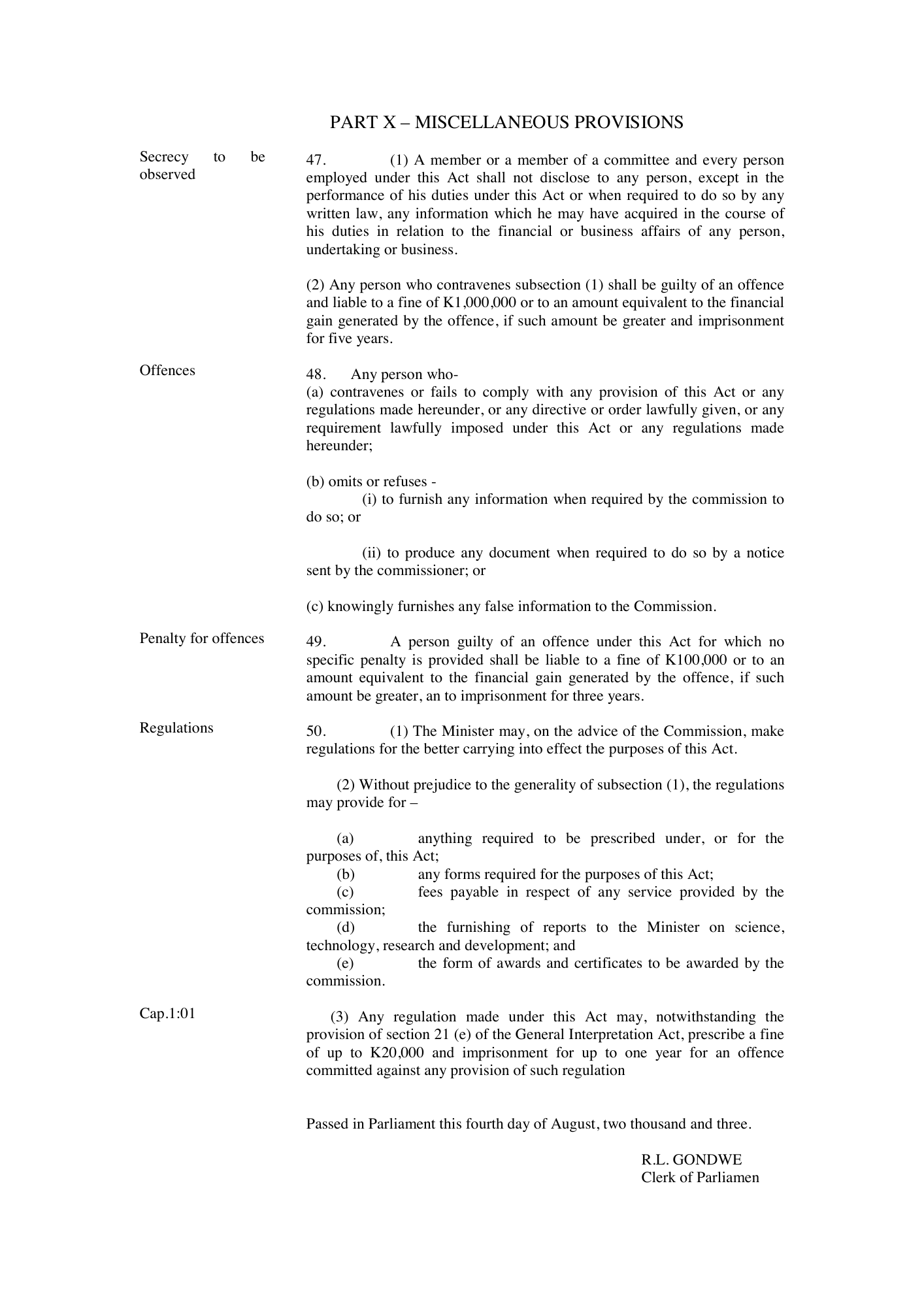
PART X – MISCELLANEOUS PROVISIONS
47. Secrecy to be observed
48. Offences
49. Penalty for offences
50. Regulations
An Act to provide for the advancement of science and technology; to establish the National Commission for science and
Technology and to provide for matters connected therewith and incidental thereto
ENACTED by the Parliament of Malawi as follows –
Short title and commencement
1. This Act may be cited as the science and Technology Act, 2003 and
shall come into operation on such date as the Minister shall appoint by
notice published in the Gazette.
Interpretation
2. In this act, unless the context otherwise requires -
“appeals committee” means an appeals committee appointed under
section 44;
“Awards committee” means the Scientific Awards Committee established
under section 34;
“Chairman” means Chairman of the commission;
“Commission” means the national commission for Science and
Technology established under section 5;
Act 16 of 2003 — official PDF page 2; original table columns, symbols and diagram connections
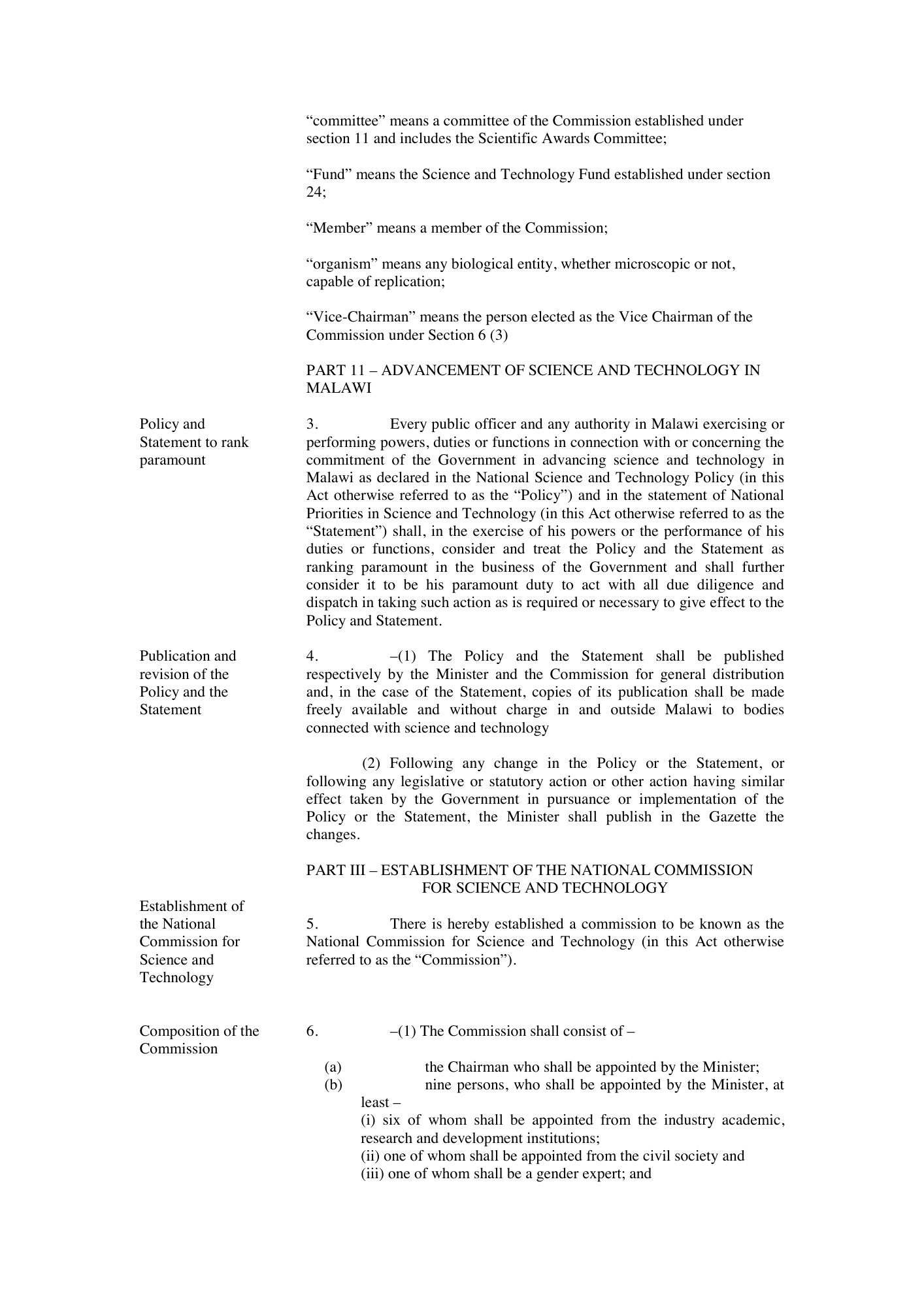
“committee” means a committee of the Commission established under
section 11 and includes the Scientific Awards Committee;
“Fund” means the Science and Technology Fund established under section
24;
“Member” means a member of the Commission;
“organism” means any biological entity, whether microscopic or not,
capable of replication;
“Vice-Chairman” means the person elected as the Vice Chairman of the
Commission under Section 6 (3)
PART 11 – ADVANCEMENT OF SCIENCE AND TECHNOLOGY IN
MALAWI
Policy and Statement to rank paramount
3. Every public officer and any authority in Malawi exercising or
performing powers, duties or functions in connection with or concerning the
commitment of the Government in advancing science and technology in
Malawi as declared in the National Science and Technology Policy (in this
Act otherwise referred to as the “Policy”) and in the statement of National
Priorities in Science and Technology (in this Act otherwise referred to as the
“Statement”) shall, in the exercise of his powers or the performance of his
duties or functions, consider and treat the Policy and the Statement as
ranking paramount in the business of the Government and shall further
consider it to be his paramount duty to act with all due diligence and
dispatch in taking such action as is required or necessary to give effect to the
Policy and Statement.
Publication and revision of the Policy and the Statement
4. –(1) The Policy and the Statement shall be published
respectively by the Minister and the Commission for general distribution
and, in the case of the Statement, copies of its publication shall be made
freely available and without charge in and outside Malawi to bodies
connected with science and technology
(2) Following any change in the Policy or the Statement, or
following any legislative or statutory action or other action having similar
effect taken by the Government in pursuance or implementation of the
Policy or the Statement, the Minister shall publish in the Gazette the
changes.
PART III – ESTABLISHMENT OF THE NATIONAL COMMISSION
FOR SCIENCE AND TECHNOLOGY
Establishment of the National Commission for Science and Technology
5. There is hereby established a commission to be known as the
National Commission for Science and Technology (in this Act otherwise
referred to as the “Commission”).
Composition of the Commission
6. –(1) The Commission shall consist of –
(a) the Chairman who shall be appointed by the Minister;
(b) nine persons, who shall be appointed by the Minister, at
least –
(i) six of whom shall be appointed from the industry academic,
research and development institutions;
(ii) one of whom shall be appointed from the civil society and
(iii) one of whom shall be a gender expert; and
Act 16 of 2003 — official PDF page 3; original table columns, symbols and diagram connections
Act 16 of 2003 — official PDF page 4; original table columns, symbols and diagram connections
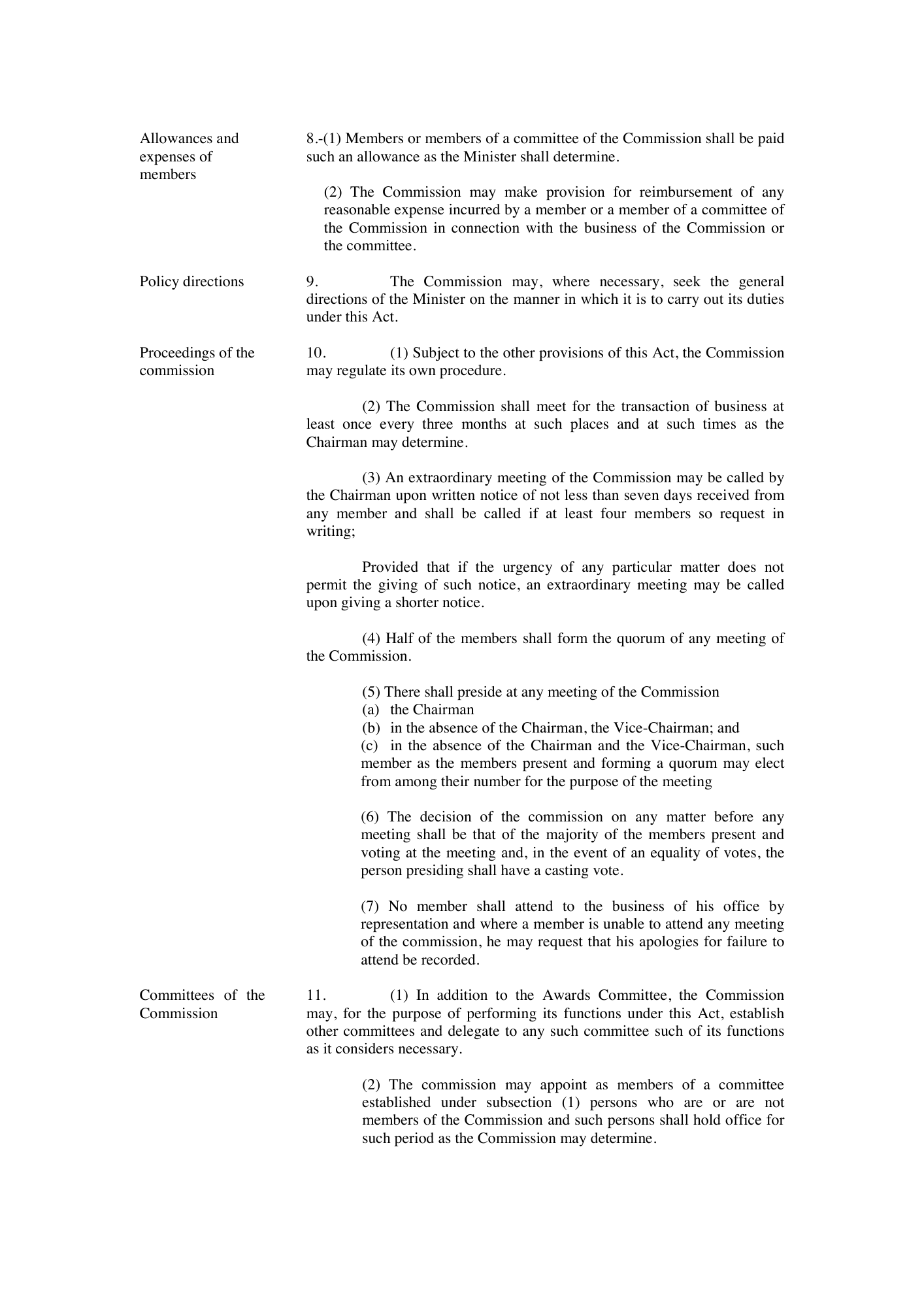
Allowances and expenses of members
8.-(1) Members or members of a committee of the Commission shall be paid
such an allowance as the Minister shall determine.
(2) The Commission may make provision for reimbursement of any
reasonable expense incurred by a member or a member of a committee of
the Commission in connection with the business of the Commission or
the committee.
Policy directions
9. The Commission may, where necessary, seek the general
directions of the Minister on the manner in which it is to carry out its duties
under this Act.
Proceedings of the commission
10. (1) Subject to the other provisions of this Act, the Commission
may regulate its own procedure.
(2) The Commission shall meet for the transaction of business at
least once every three months at such places and at such times as the
Chairman may determine.
(3) An extraordinary meeting of the Commission may be called by
the Chairman upon written notice of not less than seven days received from
any member and shall be called if at least four members so request in
writing;
Provided that if the urgency of any particular matter does not
permit the giving of such notice, an extraordinary meeting may be called
upon giving a shorter notice.
(4) Half of the members shall form the quorum of any meeting of
the Commission.
(5) There shall preside at any meeting of the Commission
(a) the Chairman
(b) in the absence of the Chairman, the Vice-Chairman; and
(c) in the absence of the Chairman and the Vice-Chairman, such
member as the members present and forming a quorum may elect
from among their number for the purpose of the meeting
(6) The decision of the commission on any matter before any
meeting shall be that of the majority of the members present and
voting at the meeting and, in the event of an equality of votes, the
person presiding shall have a casting vote.
(7) No member shall attend to the business of his office by
representation and where a member is unable to attend any meeting
of the commission, he may request that his apologies for failure to
attend be recorded.
Committees of the Commission
11. (1) In addition to the Awards Committee, the Commission
may, for the purpose of performing its functions under this Act, establish
other committees and delegate to any such committee such of its functions
as it considers necessary.
(2) The commission may appoint as members of a committee
established under subsection (1) persons who are or are not
members of the Commission and such persons shall hold office for
such period as the Commission may determine.
Act 16 of 2003 — official PDF page 5; original table columns, symbols and diagram connections
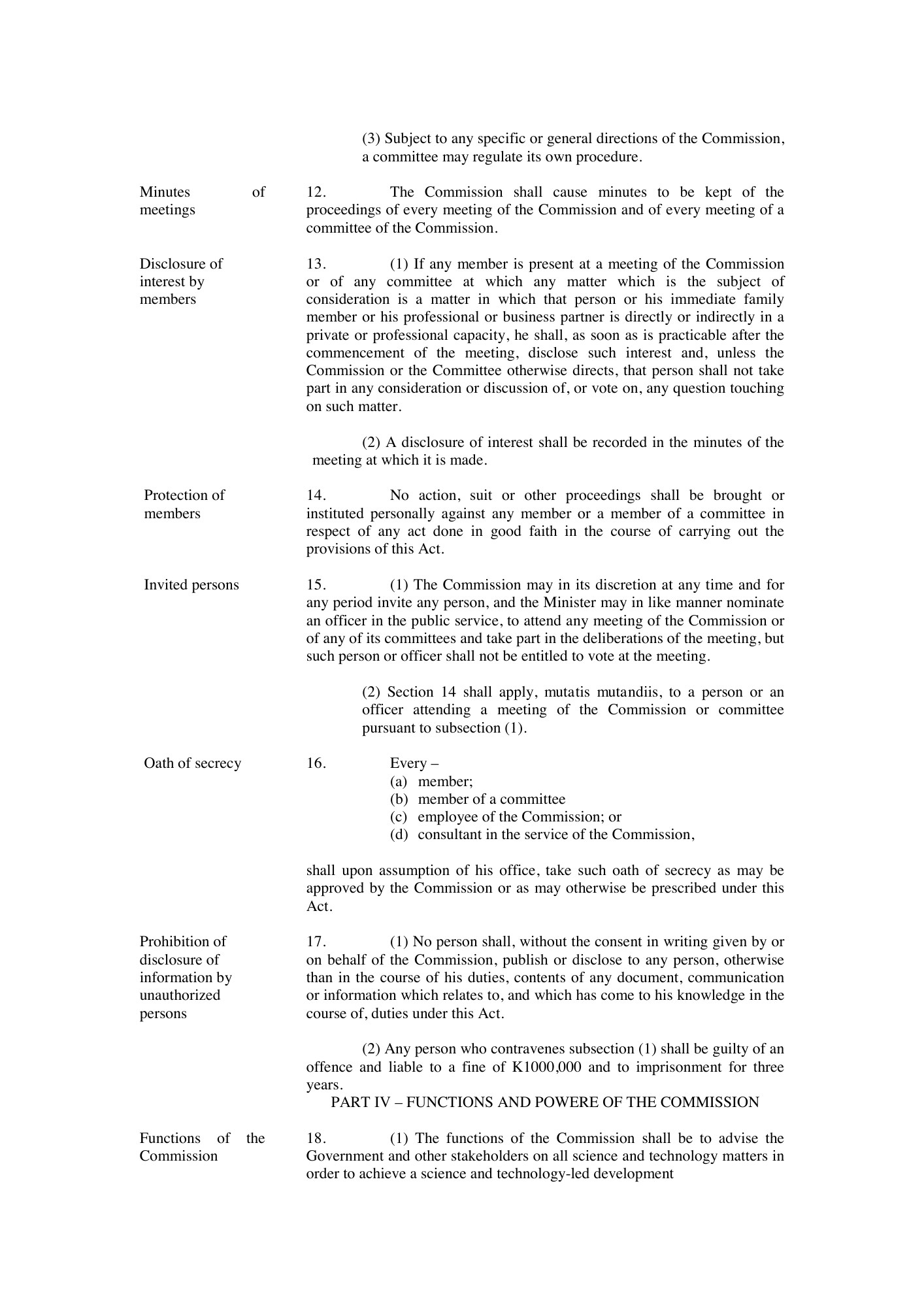
(3) Subject to any specific or general directions of the Commission,
a committee may regulate its own procedure.
Minutes of meetings
12. The Commission shall cause minutes to be kept of the
proceedings of every meeting of the Commission and of every meeting of a
committee of the Commission.
Disclosure of interest by members
13. (1) If any member is present at a meeting of the Commission
or of any committee at which any matter which is the subject of
consideration is a matter in which that person or his immediate family
member or his professional or business partner is directly or indirectly in a
private or professional capacity, he shall, as soon as is practicable after the
commencement of the meeting, disclose such interest and, unless the
Commission or the Committee otherwise directs, that person shall not take
part in any consideration or discussion of, or vote on, any question touching
on such matter.
(2) A disclosure of interest shall be recorded in the minutes of the
meeting at which it is made.
Protection of members
14. No action, suit or other proceedings shall be brought or
instituted personally against any member or a member of a committee in
respect of any act done in good faith in the course of carrying out the
provisions of this Act.
Invited persons
15. (1) The Commission may in its discretion at any time and for
any period invite any person, and the Minister may in like manner nominate
an officer in the public service, to attend any meeting of the Commission or
of any of its committees and take part in the deliberations of the meeting, but
such person or officer shall not be entitled to vote at the meeting.
(2) Section 14 shall apply, mutatis mutandiis, to a person or an
officer attending a meeting of the Commission or committee
pursuant to subsection (1).
Oath of secrecy
16. Every –
(a) member;
(b) member of a committee
(c) employee of the Commission; or
(d) consultant in the service of the Commission,
shall upon assumption of his office, take such oath of secrecy as may be
approved by the Commission or as may otherwise be prescribed under this
Act.
Prohibition of disclosure of information by unauthorized persons
17. (1) No person shall, without the consent in writing given by or
on behalf of the Commission, publish or disclose to any person, otherwise
than in the course of his duties, contents of any document, communication
or information which relates to, and which has come to his knowledge in the
course of, duties under this Act.
(2) Any person who contravenes subsection (1) shall be guilty of an
offence and liable to a fine of K1000,000 and to imprisonment for three
years.
PART IV – FUNCTIONS AND POWERE OF THE COMMISSION
Functions of the Commission
18. (1) The functions of the Commission shall be to advise the
Government and other stakeholders on all science and technology matters in
order to achieve a science and technology-led development
Act 16 of 2003 — official PDF page 6; original table columns, symbols and diagram connections
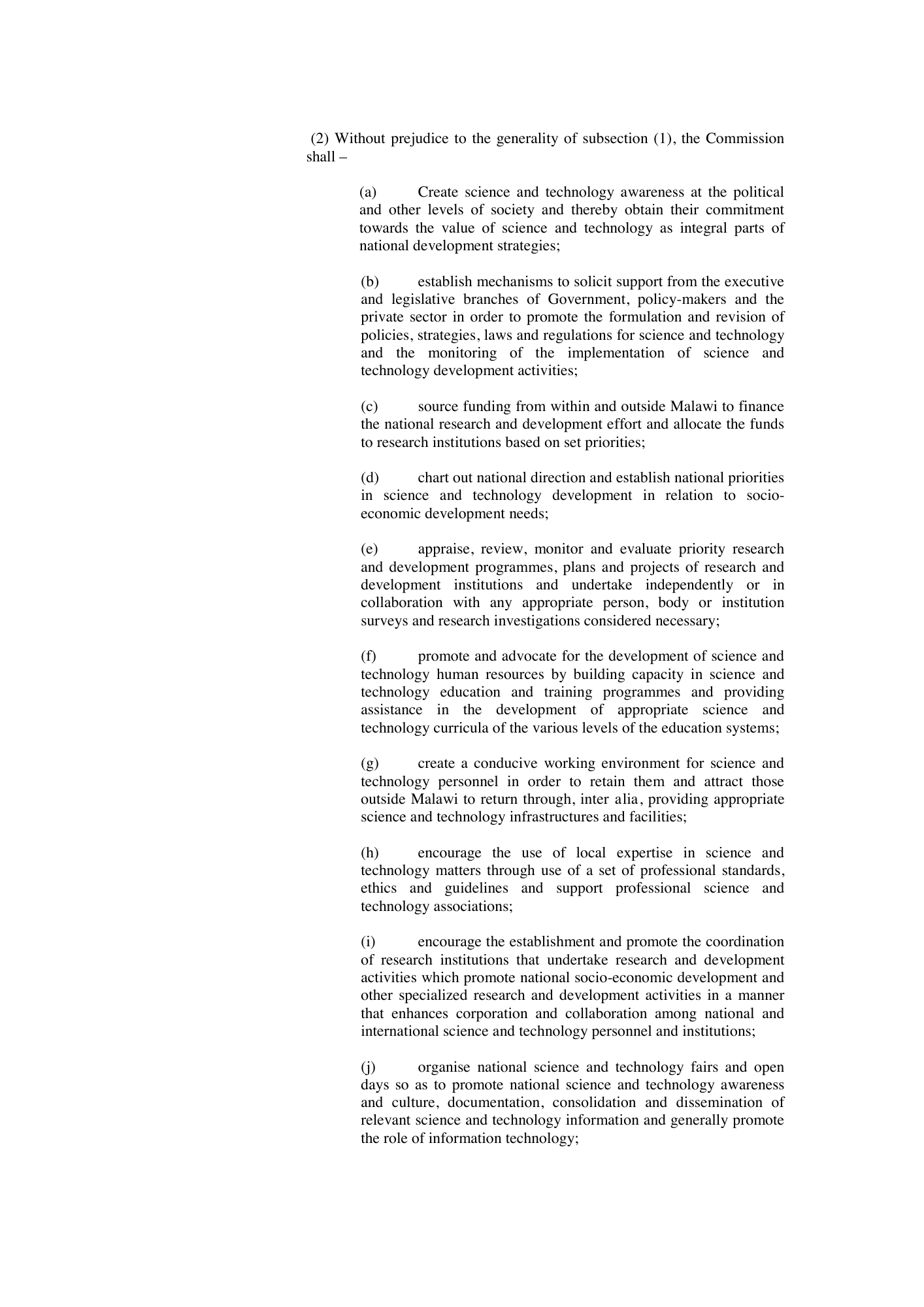
(2) Without prejudice to the generality of subsection (1), the Commission
shall –
(a) Create science and technology awareness at the political
and other levels of society and thereby obtain their commitment
towards the value of science and technology as integral parts of
national development strategies;
(b) establish mechanisms to solicit support from the executive
and legislative branches of Government, policy-makers and the
private sector in order to promote the formulation and revision of
policies, strategies, laws and regulations for science and technology
and the monitoring of the implementation of science and
technology development activities;
(c) source funding from within and outside Malawi to finance
the national research and development effort and allocate the funds
to research institutions based on set priorities;
(d) chart out national direction and establish national priorities
in science and technology development in relation to socio-
economic development needs;
(e) appraise, review, monitor and evaluate priority research
and development programmes, plans and projects of research and
development institutions and undertake independently or in
collaboration with any appropriate person, body or institution
surveys and research investigations considered necessary;
(f) promote and advocate for the development of science and
technology human resources by building capacity in science and
technology education and training programmes and providing
assistance in the development of appropriate science and
technology curricula of the various levels of the education systems;
(g) create a conducive working environment for science and
technology personnel in order to retain them and attract those
outside Malawi to return through, inter alia, providing appropriate
science and technology infrastructures and facilities;
(h) encourage the use of local expertise in science and
technology matters through use of a set of professional standards,
ethics and guidelines and support professional science and
technology associations;
(i) encourage the establishment and promote the coordination
of research institutions that undertake research and development
activities which promote national socio-economic development and
other specialized research and development activities in a manner
that enhances corporation and collaboration among national and
international science and technology personnel and institutions;
(j) organise national science and technology fairs and open
days so as to promote national science and technology awareness
and culture, documentation, consolidation and dissemination of
relevant science and technology information and generally promote
the role of information technology;
Act 16 of 2003 — official PDF page 7; original table columns, symbols and diagram connections
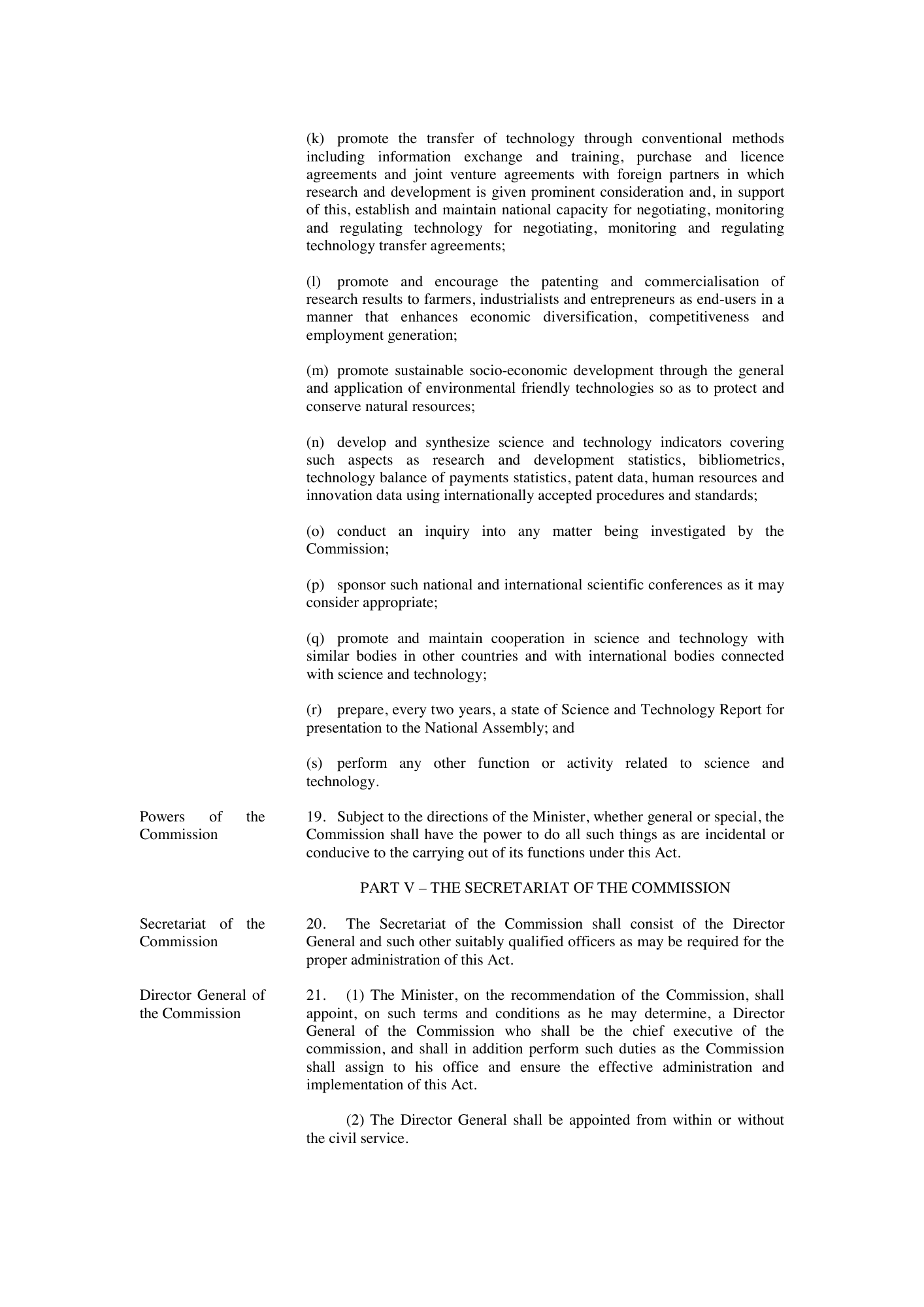
(k) promote the transfer of technology through conventional methods
including information exchange and training, purchase and licence
agreements and joint venture agreements with foreign partners in which
research and development is given prominent consideration and, in support
of this, establish and maintain national capacity for negotiating, monitoring
and regulating technology for negotiating, monitoring and regulating
technology transfer agreements;
(l) promote and encourage the patenting and commercialisation of
research results to farmers, industrialists and entrepreneurs as end-users in a
manner that enhances economic diversification, competitiveness and
employment generation;
(m) promote sustainable socio-economic development through the general
and application of environmental friendly technologies so as to protect and
conserve natural resources;
(n) develop and synthesize science and technology indicators covering
such aspects as research and development statistics, bibliometrics,
technology balance of payments statistics, patent data, human resources and
innovation data using internationally accepted procedures and standards;
(o) conduct an inquiry into any matter being investigated by the
Commission;
(p) sponsor such national and international scientific conferences as it may
consider appropriate;
(q) promote and maintain cooperation in science and technology with
similar bodies in other countries and with international bodies connected
with science and technology;
(r) prepare, every two years, a state of Science and Technology Report for
presentation to the National Assembly; and
(s) perform any other function or activity related to science and
technology.
Powers of the Commission
19. Subject to the directions of the Minister, whether general or special, the
Commission shall have the power to do all such things as are incidental or
conducive to the carrying out of its functions under this Act.
PART V – THE SECRETARIAT OF THE COMMISSION
Secretariat of the Commission
20. The Secretariat of the Commission shall consist of the Director
General and such other suitably qualified officers as may be required for the
proper administration of this Act.
Director General of the Commission
21. (1) The Minister, on the recommendation of the Commission, shall
appoint, on such terms and conditions as he may determine, a Director
General of the Commission who shall be the chief executive of the
commission, and shall in addition perform such duties as the Commission
shall assign to his office and ensure the effective administration and
implementation of this Act.
(2) The Director General shall be appointed from within or without
the civil service.
Act 16 of 2003 — official PDF page 8; original table columns, symbols and diagram connections
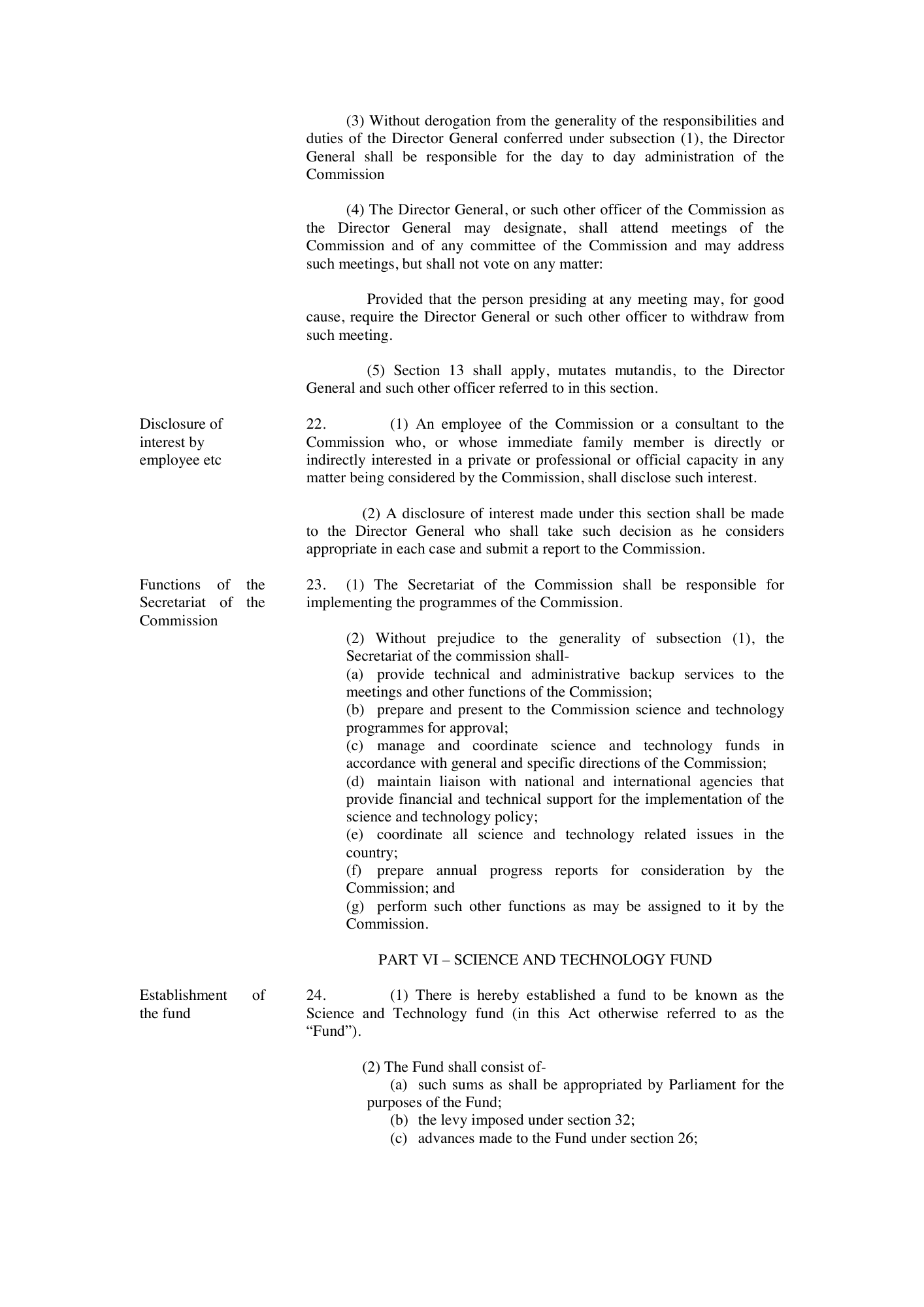
(3) Without derogation from the generality of the responsibilities and
duties of the Director General conferred under subsection (1), the Director
General shall be responsible for the day to day administration of the
Commission
(4) The Director General, or such other officer of the Commission as
the Director General may designate, shall attend meetings of the
Commission and of any committee of the Commission and may address
such meetings, but shall not vote on any matter:
Provided that the person presiding at any meeting may, for good
cause, require the Director General or such other officer to withdraw from
such meeting.
(5) Section 13 shall apply, mutates mutandis, to the Director
General and such other officer referred to in this section.
Disclosure of interest by employee etc
22. (1) An employee of the Commission or a consultant to the
Commission who, or whose immediate family member is directly or
indirectly interested in a private or professional or official capacity in any
matter being considered by the Commission, shall disclose such interest.
(2) A disclosure of interest made under this section shall be made
to the Director General who shall take such decision as he considers
appropriate in each case and submit a report to the Commission.
Functions of the Secretariat of the Commission
23. (1) The Secretariat of the Commission shall be responsible for
implementing the programmes of the Commission.
(2) Without prejudice to the generality of subsection (1), the
Secretariat of the commission shall-
(a) provide technical and administrative backup services to the
meetings and other functions of the Commission;
(b) prepare and present to the Commission science and technology
programmes for approval;
(c) manage and coordinate science and technology funds in
accordance with general and specific directions of the Commission;
(d) maintain liaison with national and international agencies that
provide financial and technical support for the implementation of the
science and technology policy;
(e) coordinate all science and technology related issues in the
country;
(f) prepare annual progress reports for consideration by the
Commission; and
(g) perform such other functions as may be assigned to it by the
Commission.
PART VI – SCIENCE AND TECHNOLOGY FUND
Establishment of the fund
24. (1) There is hereby established a fund to be known as the
Science and Technology fund (in this Act otherwise referred to as the
“Fund”).
(2) The Fund shall consist of-
(a) such sums as shall be appropriated by Parliament for the
purposes of the Fund;
(b) the levy imposed under section 32;
(c) advances made to the Fund under section 26;
Act 16 of 2003 — official PDF page 9; original table columns, symbols and diagram connections
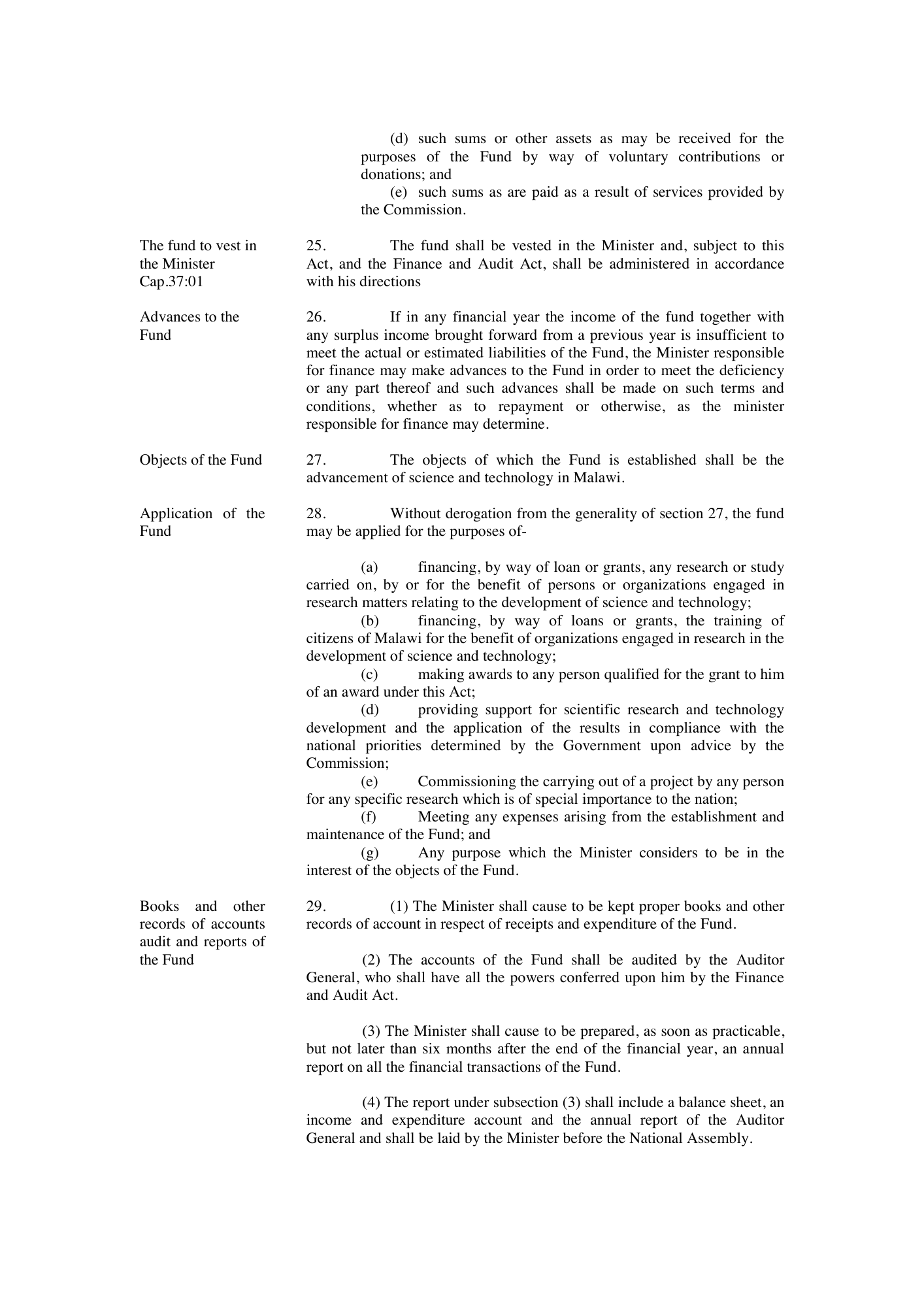
(d) such sums or other assets as may be received for the
purposes of the Fund by way of voluntary contributions or
donations; and
(e) such sums as are paid as a result of services provided by
the Commission.
The fund to vest in the Minister Cap.37:01
25. The fund shall be vested in the Minister and, subject to this
Act, and the Finance and Audit Act, shall be administered in accordance
with his directions
Advances to the Fund
26. If in any financial year the income of the fund together with
any surplus income brought forward from a previous year is insufficient to
meet the actual or estimated liabilities of the Fund, the Minister responsible
for finance may make advances to the Fund in order to meet the deficiency
or any part thereof and such advances shall be made on such terms and
conditions, whether as to repayment or otherwise, as the minister
responsible for finance may determine.
Objects of the Fund
27. The objects of which the Fund is established shall be the
advancement of science and technology in Malawi.
Application of the Fund
28. Without derogation from the generality of section 27, the fund
may be applied for the purposes of-
(a) financing, by way of loan or grants, any research or study
carried on, by or for the benefit of persons or organizations engaged in
research matters relating to the development of science and technology;
(b) financing, by way of loans or grants, the training of
citizens of Malawi for the benefit of organizations engaged in research in the
development of science and technology;
(c) making awards to any person qualified for the grant to him
of an award under this Act;
(d) providing support for scientific research and technology
development and the application of the results in compliance with the
national priorities determined by the Government upon advice by the
Commission;
(e) Commissioning the carrying out of a project by any person
for any specific research which is of special importance to the nation;
(f) Meeting any expenses arising from the establishment and
maintenance of the Fund; and
(g) Any purpose which the Minister considers to be in the
interest of the objects of the Fund.
Books and other records of accounts audit and reports of the Fund
29. (1) The Minister shall cause to be kept proper books and other
records of account in respect of receipts and expenditure of the Fund.
(2) The accounts of the Fund shall be audited by the Auditor
General, who shall have all the powers conferred upon him by the Finance
and Audit Act.
(3) The Minister shall cause to be prepared, as soon as practicable,
but not later than six months after the end of the financial year, an annual
report on all the financial transactions of the Fund.
(4) The report under subsection (3) shall include a balance sheet, an
income and expenditure account and the annual report of the Auditor
General and shall be laid by the Minister before the National Assembly.
Act 16 of 2003 — official PDF page 10; original table columns, symbols and diagram connections
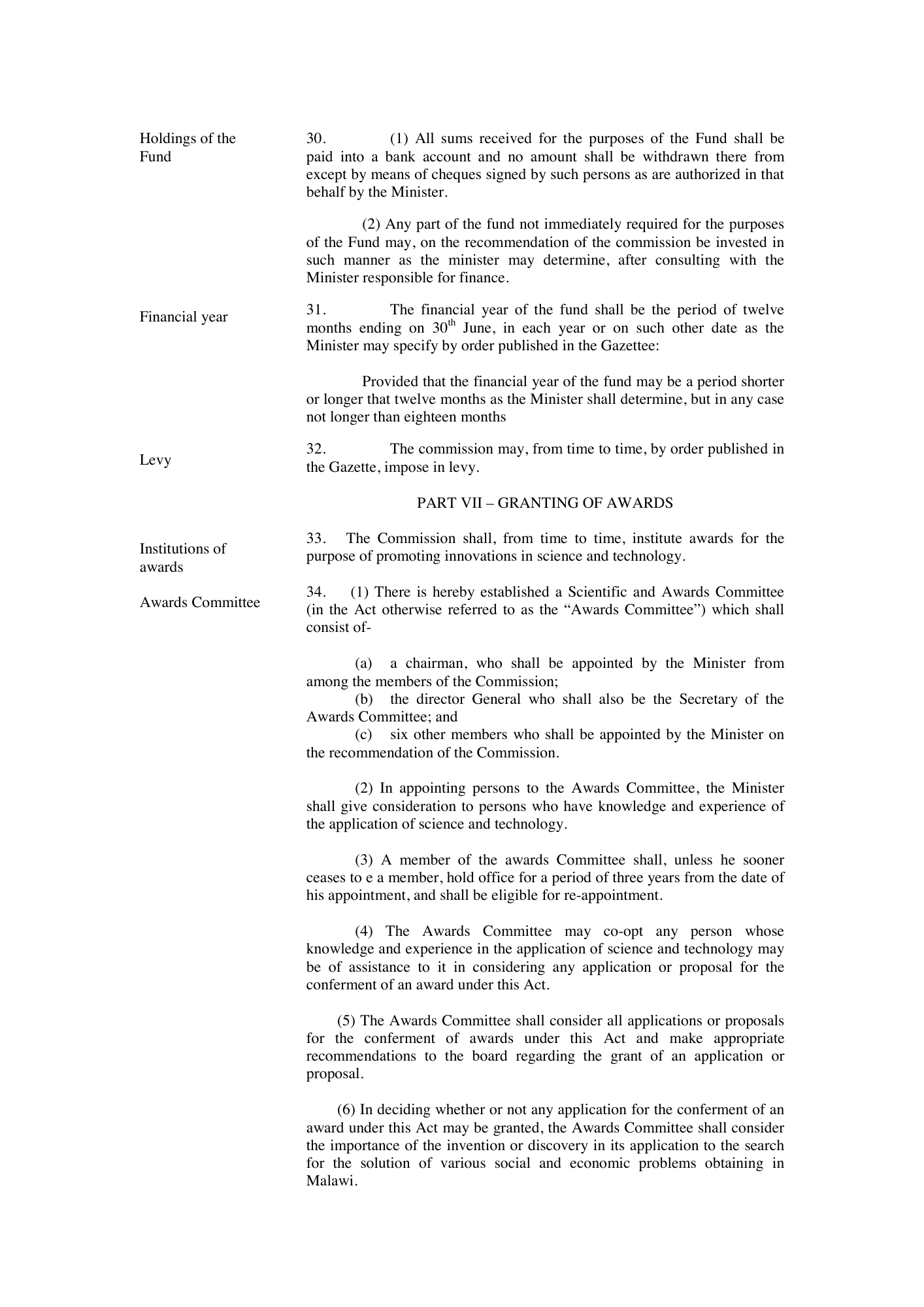
Holdings of the Fund
30. (1) All sums received for the purposes of the Fund shall be
paid into a bank account and no amount shall be withdrawn there from
except by means of cheques signed by such persons as are authorized in that
behalf by the Minister.
(2) Any part of the fund not immediately required for the purposes
of the Fund may, on the recommendation of the commission be invested in
such manner as the minister may determine, after consulting with the
Minister responsible for finance.
Financial year
31. The financial year of the fund shall be the period of twelve
months ending on 30 th June, in each year or on such other date as the
Minister may specify by order published in the Gazettee:
Provided that the financial year of the fund may be a period shorter
or longer that twelve months as the Minister shall determine, but in any case
not longer than eighteen months
Levy
32. The commission may, from time to time, by order published in
the Gazette, impose in levy.
PART VII – GRANTING OF AWARDS
Institutions of awards
33. The Commission shall, from time to time, institute awards for the
purpose of promoting innovations in science and technology.
Awards Committee
34. (1) There is hereby established a Scientific and Awards Committee
(in the Act otherwise referred to as the “Awards Committee”) which shall
consist of-
(a) a chairman, who shall be appointed by the Minister from
among the members of the Commission;
(b) the director General who shall also be the Secretary of the
Awards Committee; and
(c) six other members who shall be appointed by the Minister on
the recommendation of the Commission.
(2) In appointing persons to the Awards Committee, the Minister
shall give consideration to persons who have knowledge and experience of
the application of science and technology.
(3) A member of the awards Committee shall, unless he sooner
ceases to e a member, hold office for a period of three years from the date of
his appointment, and shall be eligible for re-appointment.
(4) The Awards Committee may co-opt any person whose
knowledge and experience in the application of science and technology may
be of assistance to it in considering any application or proposal for the
conferment of an award under this Act.
(5) The Awards Committee shall consider all applications or proposals
for the conferment of awards under this Act and make appropriate
recommendations to the board regarding the grant of an application or
proposal.
(6) In deciding whether or not any application for the conferment of an
award under this Act may be granted, the Awards Committee shall consider
the importance of the invention or discovery in its application to the search
for the solution of various social and economic problems obtaining in
Malawi.
Act 16 of 2003 — official PDF page 11; original table columns, symbols and diagram connections
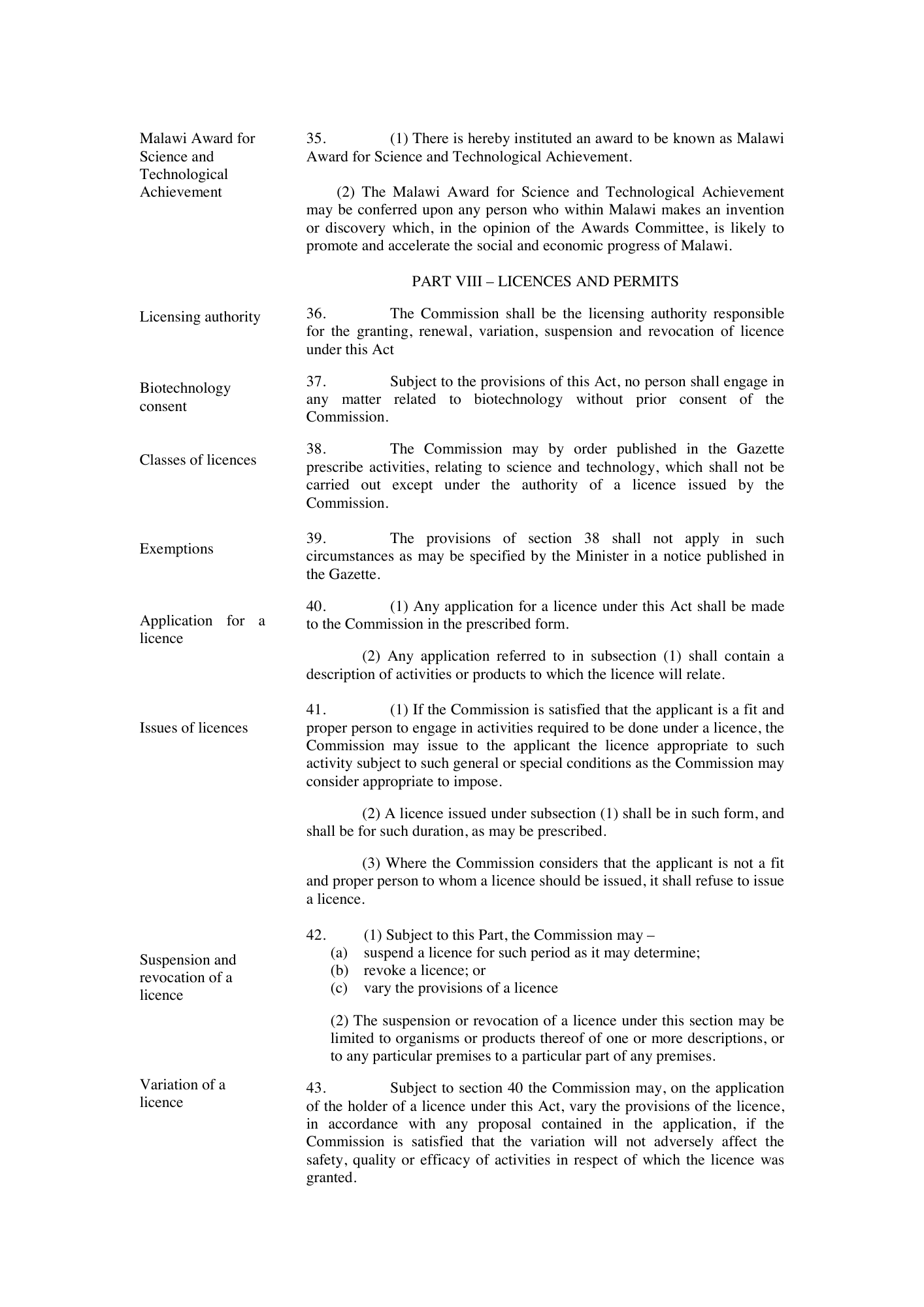
Malawi Award for Science and Technological Achievement
35. (1) There is hereby instituted an award to be known as Malawi
Award for Science and Technological Achievement.
(2) The Malawi Award for Science and Technological Achievement
may be conferred upon any person who within Malawi makes an invention
or discovery which, in the opinion of the Awards Committee, is likely to
promote and accelerate the social and economic progress of Malawi.
PART VIII – LICENCES AND PERMITS
Licensing authority
36. The Commission shall be the licensing authority responsible
for the granting, renewal, variation, suspension and revocation of licence
under this Act
Biotechnology consent
37. Subject to the provisions of this Act, no person shall engage in
any matter related to biotechnology without prior consent of the
Commission.
Classes of licences
38. The Commission may by order published in the Gazette
prescribe activities, relating to science and technology, which shall not be
carried out except under the authority of a licence issued by the
Commission.
Exemptions
39. The provisions of section 38 shall not apply in such
circumstances as may be specified by the Minister in a notice published in
the Gazette.
Application for a licence
40. (1) Any application for a licence under this Act shall be made
to the Commission in the prescribed form.
(2) Any application referred to in subsection (1) shall contain a
description of activities or products to which the licence will relate.
Issues of licences
41. (1) If the Commission is satisfied that the applicant is a fit and
proper person to engage in activities required to be done under a licence, the
Commission may issue to the applicant the licence appropriate to such
activity subject to such general or special conditions as the Commission may
consider appropriate to impose.
(2) A licence issued under subsection (1) shall be in such form, and
shall be for such duration, as may be prescribed.
(3) Where the Commission considers that the applicant is not a fit
and proper person to whom a licence should be issued, it shall refuse to issue
a licence.
Suspension and revocation of a licence
42. (1) Subject to this Part, the Commission may –
(a) suspend a licence for such period as it may determine;
(b) revoke a licence; or
(c) vary the provisions of a licence
(2) The suspension or revocation of a licence under this section may be
limited to organisms or products thereof of one or more descriptions, or
to any particular premises to a particular part of any premises.
Variation of a licence
43. Subject to section 40 the Commission may, on the application
of the holder of a licence under this Act, vary the provisions of the licence,
in accordance with any proposal contained in the application, if the
Commission is satisfied that the variation will not adversely affect the
safety, quality or efficacy of activities in respect of which the licence was
granted.
Act 16 of 2003 — official PDF page 12; original table columns, symbols and diagram connections
PART IX – APPEALS
Appeals
44. 1 Any person who is aggrieved by-
(a) any refusal, suspension, revocation, or variation of a licence,
permit or certificate issued under this act or
(b) any decision directly applicable to him taken by the
Commission or any person exercising powers under this Act.
May within thirty days appeal in writing to the minister who shall appoint an
appeal committee for purpose of hearing the appeal in question.
Appeals committee
45. (1) An appeals committee shall consist of five persons who, in the
opinion of the Minister, have expert knowledge and who are otherwise
suitable to determine the issues raised in the appeal.
(2) The minister shall designate one of the members of the appeals
committee as chairperson of the committee.
(3) A member of the appeals committee shall excuse himself as a member of
the appeals committee if he has any direct or indirect interest in the subject
matter of the appeal or if for any reason there is likely to be conflict of
interest as a result f his participation in the proceedings of the committee.
(4) There shall be paid to members of an appeals committee such
remuneration or allowances as the Minister may determine.
Powers of appeals committee
46. (1) An appeals committee shall have, in relation to the hearing of
any appeal, the power to –
(a) confirm, set aside, vary, alter, reverse or amend the decision which
is the subject of the appeal;
(b) refer the relevant matter back to the Director General for the
reconsideration by the commission;
(c) order persons to attend and give evidence or to produce or give
discovery and inspection of documents in like manner as in proceedings in
the High Court;
Provided that the appeals committee may in its absolute discretion admit
evidence which would not be admissible in a court of law and may use
evidence contained in any official record and may call evidence of its own
motion;
(d) award costs of any proceedings before it and to direct that
such costs shall be taxed upon such scale and in such manner as may be
prescribed;
(e) make such order as it may deem fit; and
(f) do all things which it is required or empowered to do by or
under this Act.
(2) The decision of the appeal committee on any appeal shall be-
(a) made in writing;
(b) sent to all the parties to the appeal and, where he was not a party, to
the Minister; and
(c) made available for public inspection,
within thirty days thereof, apply to the High Court for judicial review of the
decision of the appeals committee.
Act 16 of 2003 — official PDF page 13; original table columns, symbols and diagram connections
PART X – MISCELLANEOUS PROVISIONS
Secrecy to be observed
47. (1) A member or a member of a committee and every person
employed under this Act shall not disclose to any person, except in the
performance of his duties under this Act or when required to do so by any
written law, any information which he may have acquired in the course of
his duties in relation to the financial or business affairs of any person,
undertaking or business.
(2) Any person who contravenes subsection (1) shall be guilty of an offence
and liable to a fine of K1,000,000 or to an amount equivalent to the financial
gain generated by the offence, if such amount be greater and imprisonment
for five years.
Offences
48. Any person who-
(a) contravenes or fails to comply with any provision of this Act or any
regulations made hereunder, or any directive or order lawfully given, or any
requirement lawfully imposed under this Act or any regulations made
hereunder;
(b) omits or refuses -
(i) to furnish any information when required by the commission to
do so; or
(ii) to produce any document when required to do so by a notice
sent by the commissioner; or
(c) knowingly furnishes any false information to the Commission.
Penalty for offences
49. A person guilty of an offence under this Act for which no
specific penalty is provided shall be liable to a fine of K100,000 or to an
amount equivalent to the financial gain generated by the offence, if such
amount be greater, an to imprisonment for three years.
Regulations
50. (1) The Minister may, on the advice of the Commission, make
regulations for the better carrying into effect the purposes of this Act.
(2) Without prejudice to the generality of subsection (1), the regulations
may provide for –
(a) anything required to be prescribed under, or for the
purposes of, this Act;
(b) any forms required for the purposes of this Act;
(c) fees payable in respect of any service provided by the
commission;
(d) the furnishing of reports to the Minister on science,
technology, research and development; and
(e) the form of awards and certificates to be awarded by the
commission.
Cap.1:01 (3) Any regulation made under this Act may, notwithstanding the
provision of section 21 (e) of the General Interpretation Act, prescribe a fine
of up to K20,000 and imprisonment for up to one year for an offence
committed against any provision of such regulation
Passed in Parliament this fourth day of August, two thousand and three.
R.L. GONDWE
Clerk of Parliamen
Act 16 of 2003 — official PDF page 14; original table columns, symbols and diagram connectionsAct 16 of 2003 — official PDF page 15; original table columns, symbols and diagram connections