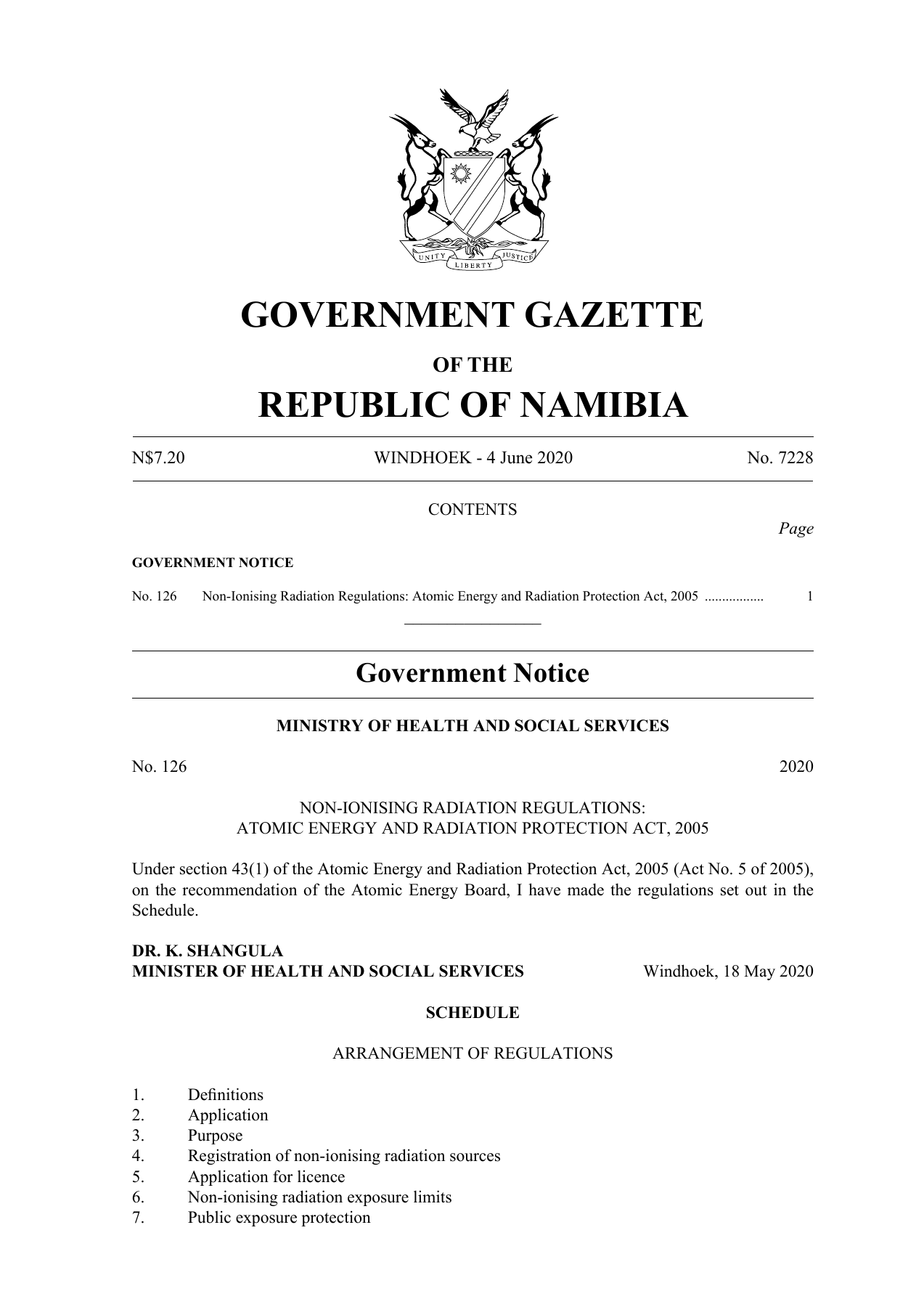
Government Notice No. 126 of 2020 — Non-Ionising Radiation Regulations: Atomic Energy and Radiation Protection Act, 2005
Currentness under review. Whether this instrument remains applicable is under review. Consult the later instruments and source context below before relying on it.
Link directly to a passage with its anchor — for example #pdf-page-1 — to open it highlighted. This reference version is generated from the authority’s publication and does not replace it. Language: English.
Contents
GOVERNMENT GAZETTE
OF THE
REPUBLIC OF NAMIBIA
N$7.20 WINDHOEK - 4 June 2020 No. 7228
CONTENTS
Page
GOVERNMENT NOTICE
No. 126 Non-Ionising Radiation Regulations: Atomic Energy and Radiation Protection Act, 2005 .................. 1
________________
Government Notice
MINISTRY OF HEALTH AND SOCIAL SERVICES
No. 126 2020
NON-IONISING RADIATION REGULATIONS:
ATOMIC ENERGY AND RADIATION PROTECTION ACT, 2005
Under section 43(1) of the Atomic Energy and Radiation Protection Act, 2005 (Act No. 5 of 2005),
on the recommendation of the Atomic Energy Board, I have made the regulations set out in the
Schedule.
DR. K. SHANGULA
MINISTER OF HEALTH AND SOCIAL SERVICES Windhoek, 18 May 2020
SCHEDULE
ARRANGEMENT OF REGULATIONS
1. Definitions
2. Application
3. Purpose
4. Registration of non-ionising radiation sources
5. Application for licence
6. Non-ionising radiation exposure limits
7. Public exposure protection
Original PDF page 1 — retained source fields, tables and layout.
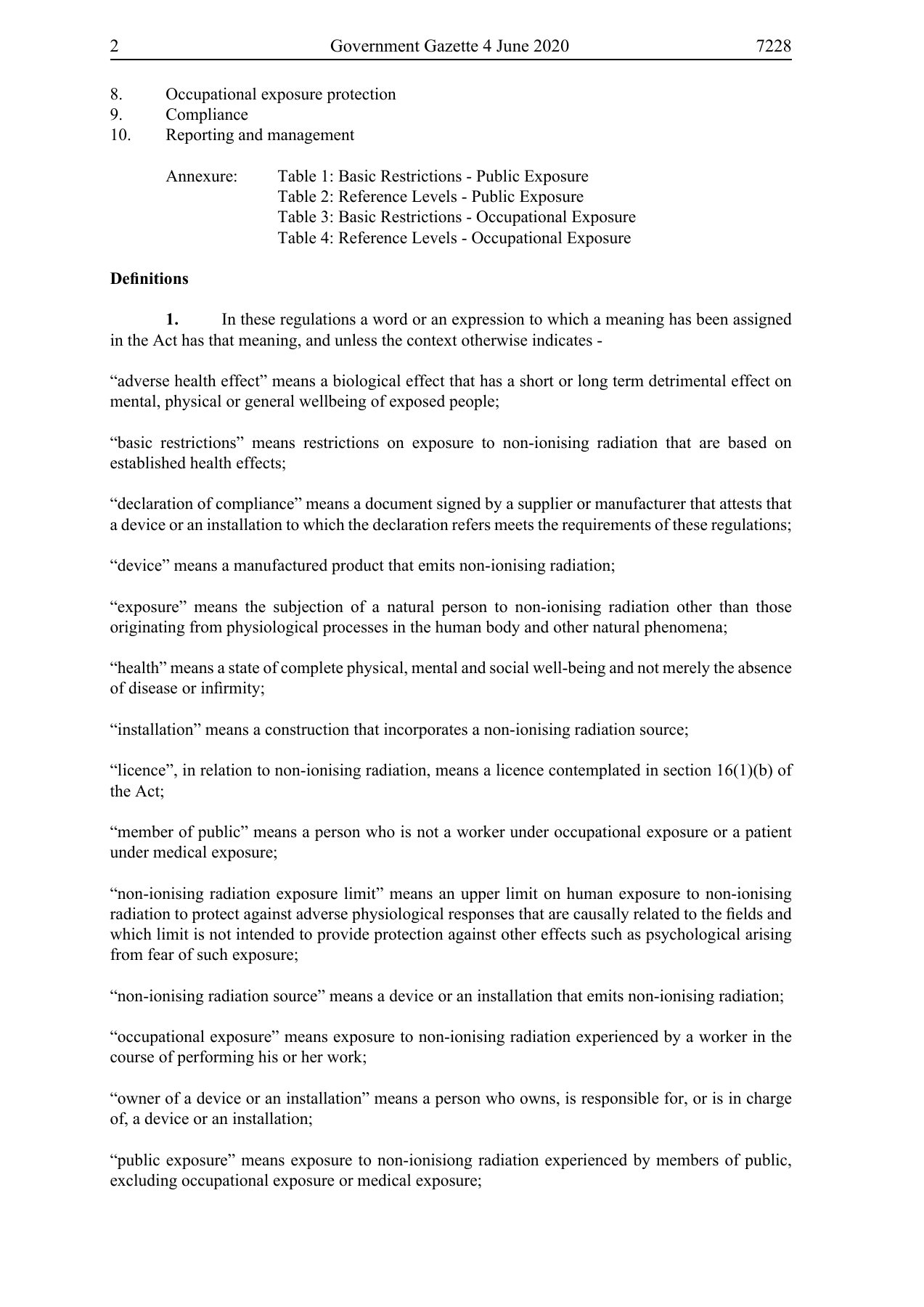
2 Government Gazette 4 June 2020 7228
8. Occupational exposure protection
9. Compliance
10. Reporting and management
Annexure: Table 1: Basic Restrictions - Public Exposure
Table 2: Reference Levels - Public Exposure
Table 3: Basic Restrictions - Occupational Exposure
Table 4: Reference Levels - Occupational Exposure
Definitions
1. In these regulations a word or an expression to which a meaning has been assigned
in the Act has that meaning, and unless the context otherwise indicates -
“adverse health effect” means a biological effect that has a short or long term detrimental effect on
mental, physical or general wellbeing of exposed people;
“basic restrictions” means restrictions on exposure to non-ionising radiation that are based on
established health effects;
“declaration of compliance” means a document signed by a supplier or manufacturer that attests that
a device or an installation to which the declaration refers meets the requirements of these regulations;
“device” means a manufactured product that emits non-ionising radiation;
“exposure” means the subjection of a natural person to non-ionising radiation other than those
originating from physiological processes in the human body and other natural phenomena;
“health” means a state of complete physical, mental and social well-being and not merely the absence
of disease or infirmity;
“installation” means a construction that incorporates a non-ionising radiation source;
“licence”, in relation to non-ionising radiation, means a licence contemplated in section 16(1)(b) of
the Act;
“member of public” means a person who is not a worker under occupational exposure or a patient
under medical exposure;
“non-ionising radiation exposure limit” means an upper limit on human exposure to non-ionising
radiation to protect against adverse physiological responses that are causally related to the fields and
which limit is not intended to provide protection against other effects such as psychological arising
from fear of such exposure;
“non-ionising radiation source” means a device or an installation that emits non-ionising radiation;
“occupational exposure” means exposure to non-ionising radiation experienced by a worker in the
course of performing his or her work;
“owner of a device or an installation” means a person who owns, is responsible for, or is in charge
of, a device or an installation;
“public exposure” means exposure to non-ionisiong radiation experienced by members of public,
excluding occupational exposure or medical exposure;
Original PDF page 2 — retained source fields, tables and layout.
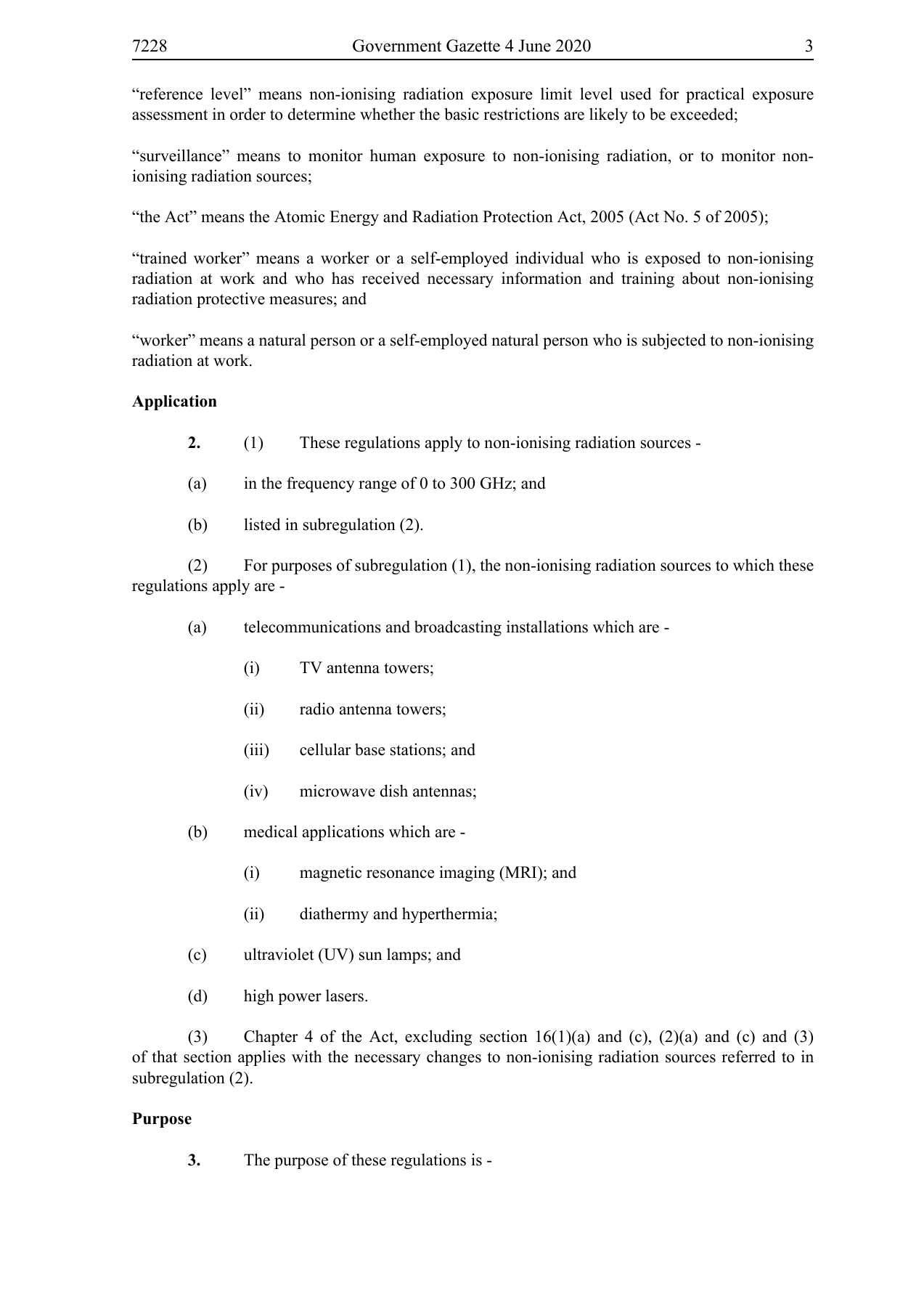
7228 Government Gazette 4 June 2020 3
“reference level” means non-ionising radiation exposure limit level used for practical exposure
assessment in order to determine whether the basic restrictions are likely to be exceeded;
“surveillance” means to monitor human exposure to non-ionising radiation, or to monitor non-
ionising radiation sources;
“the Act” means the Atomic Energy and Radiation Protection Act, 2005 (Act No. 5 of 2005);
“trained worker” means a worker or a self-employed individual who is exposed to non-ionising
radiation at work and who has received necessary information and training about non-ionising
radiation protective measures; and
“worker” means a natural person or a self-employed natural person who is subjected to non-ionising
radiation at work.
Application
2. (1) These regulations apply to non-ionising radiation sources -
(a) in the frequency range of 0 to 300 GHz; and
(b) listed in subregulation (2).
(2) For purposes of subregulation (1), the non-ionising radiation sources to which these
regulations apply are -
(a) telecommunications and broadcasting installations which are -
(i) TV antenna towers;
(ii) radio antenna towers;
(iii) cellular base stations; and
(iv) microwave dish antennas;
(b) medical applications which are -
(i) magnetic resonance imaging (MRI); and
(ii) diathermy and hyperthermia;
(c) ultraviolet (UV) sun lamps; and
(d) high power lasers.
(3) Chapter 4 of the Act, excluding section 16(1)(a) and (c), (2)(a) and (c) and (3)
of that section applies with the necessary changes to non-ionising radiation sources referred to in
subregulation (2).
Purpose
3. The purpose of these regulations is -
Original PDF page 3 — retained source fields, tables and layout.
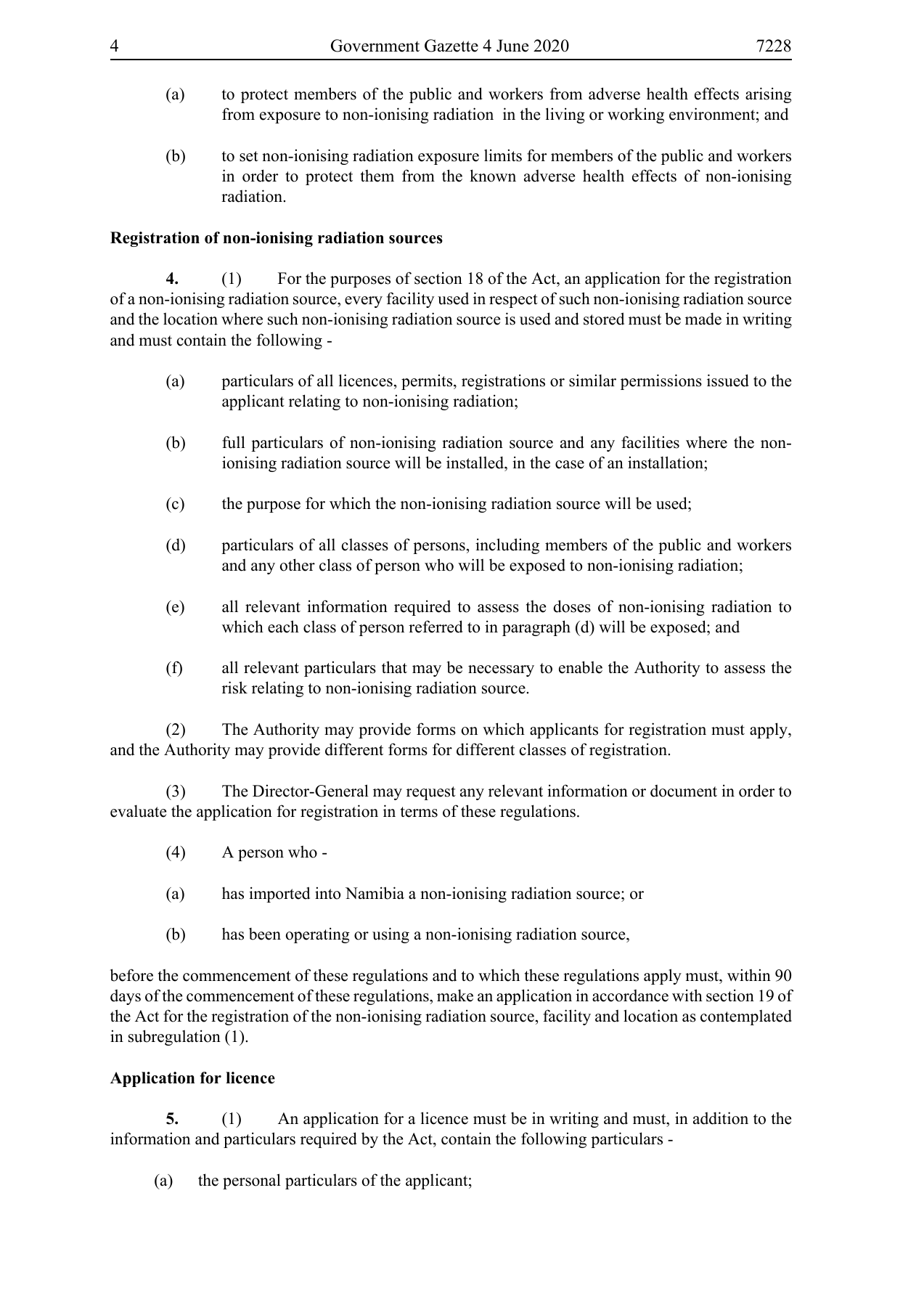
4 Government Gazette 4 June 2020 7228
(a) to protect members of the public and workers from adverse health effects arising
from exposure to non-ionising radiation in the living or working environment; and
(b) to set non-ionising radiation exposure limits for members of the public and workers
in order to protect them from the known adverse health effects of non-ionising
radiation.
Registration of non-ionising radiation sources
4. (1) For the purposes of section 18 of the Act, an application for the registration
of a non-ionising radiation source, every facility used in respect of such non-ionising radiation source
and the location where such non-ionising radiation source is used and stored must be made in writing
and must contain the following -
(a) particulars of all licences, permits, registrations or similar permissions issued to the
applicant relating to non-ionising radiation;
(b) full particulars of non-ionising radiation source and any facilities where the non-
ionising radiation source will be installed, in the case of an installation;
(c) the purpose for which the non-ionising radiation source will be used;
(d) particulars of all classes of persons, including members of the public and workers
and any other class of person who will be exposed to non-ionising radiation;
(e) all relevant information required to assess the doses of non-ionising radiation to
which each class of person referred to in paragraph (d) will be exposed; and
(f) all relevant particulars that may be necessary to enable the Authority to assess the
risk relating to non-ionising radiation source.
(2) The Authority may provide forms on which applicants for registration must apply,
and the Authority may provide different forms for different classes of registration.
(3) The Director-General may request any relevant information or document in order to
evaluate the application for registration in terms of these regulations.
(4) A person who -
(a) has imported into Namibia a non-ionising radiation source; or
(b) has been operating or using a non-ionising radiation source,
before the commencement of these regulations and to which these regulations apply must, within 90
days of the commencement of these regulations, make an application in accordance with section 19 of
the Act for the registration of the non-ionising radiation source, facility and location as contemplated
in subregulation (1).
Application for licence
5. (1) An application for a licence must be in writing and must, in addition to the
information and particulars required by the Act, contain the following particulars -
(a) the personal particulars of the applicant;
Original PDF page 4 — retained source fields, tables and layout.
7228 Government Gazette 4 June 2020 5
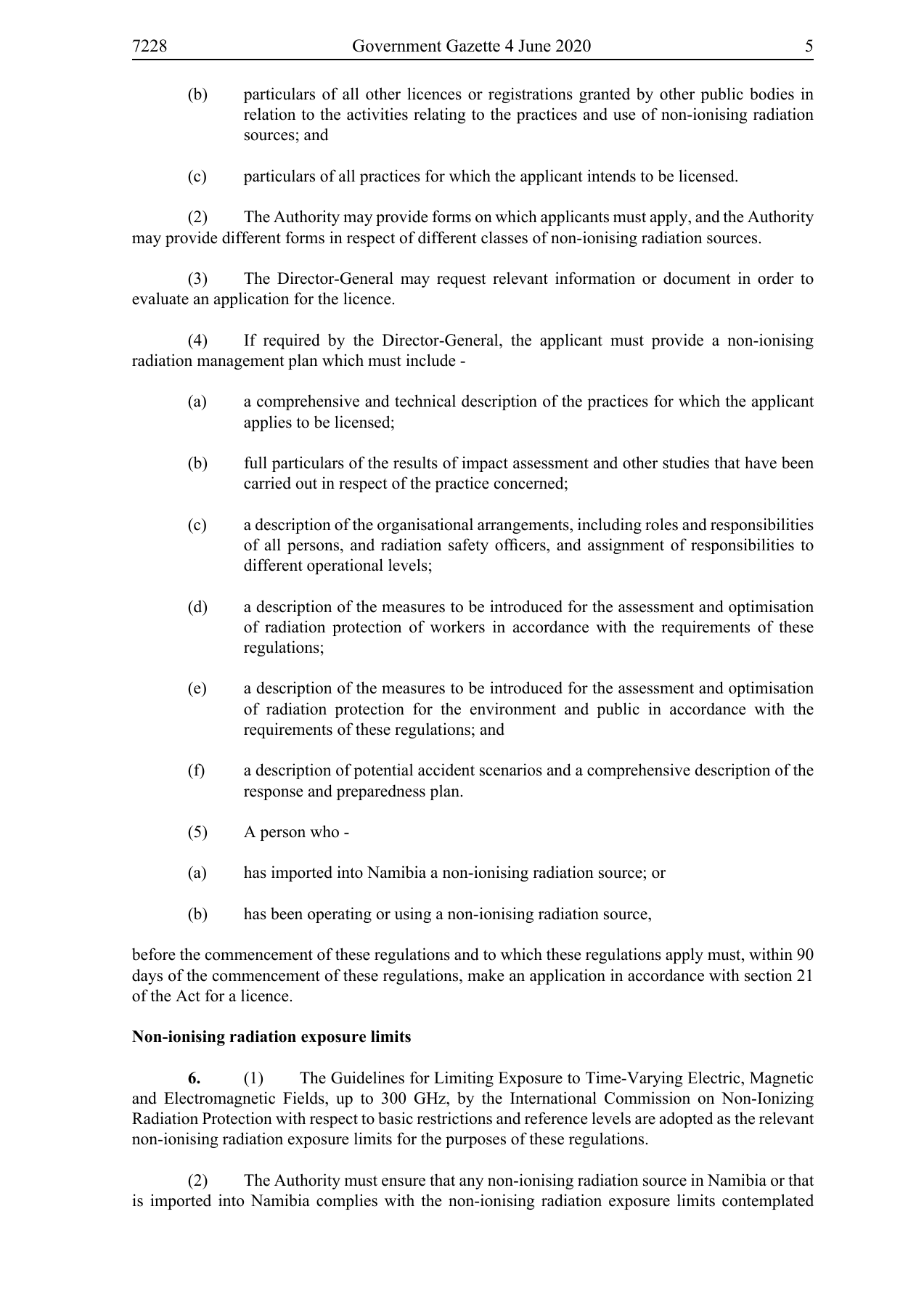
(b) particulars of all other licences or registrations granted by other public bodies in
relation to the activities relating to the practices and use of non-ionising radiation
sources; and
(c) particulars of all practices for which the applicant intends to be licensed.
(2) The Authority may provide forms on which applicants must apply, and the Authority
may provide different forms in respect of different classes of non-ionising radiation sources.
(3) The Director-General may request relevant information or document in order to
evaluate an application for the licence.
(4) If required by the Director-General, the applicant must provide a non-ionising
radiation management plan which must include -
(a) a comprehensive and technical description of the practices for which the applicant
applies to be licensed;
(b) full particulars of the results of impact assessment and other studies that have been
carried out in respect of the practice concerned;
(c) a description of the organisational arrangements, including roles and responsibilities
of all persons, and radiation safety officers, and assignment of responsibilities to
different operational levels;
(d) a description of the measures to be introduced for the assessment and optimisation
of radiation protection of workers in accordance with the requirements of these
regulations;
(e) a description of the measures to be introduced for the assessment and optimisation
of radiation protection for the environment and public in accordance with the
requirements of these regulations; and
(f) a description of potential accident scenarios and a comprehensive description of the
response and preparedness plan.
(5) A person who -
(a) has imported into Namibia a non-ionising radiation source; or
(b) has been operating or using a non-ionising radiation source,
before the commencement of these regulations and to which these regulations apply must, within 90
days of the commencement of these regulations, make an application in accordance with section 21
of the Act for a licence.
Non-ionising radiation exposure limits
6. (1) The Guidelines for Limiting Exposure to Time-Varying Electric, Magnetic
and Electromagnetic Fields, up to 300 GHz, by the International Commission on Non-Ionizing
Radiation Protection with respect to basic restrictions and reference levels are adopted as the relevant
non-ionising radiation exposure limits for the purposes of these regulations.
(2) The Authority must ensure that any non-ionising radiation source in Namibia or that
is imported into Namibia complies with the non-ionising radiation exposure limits contemplated
Original PDF page 5 — retained source fields, tables and layout.
6 Government Gazette 4 June 2020 7228
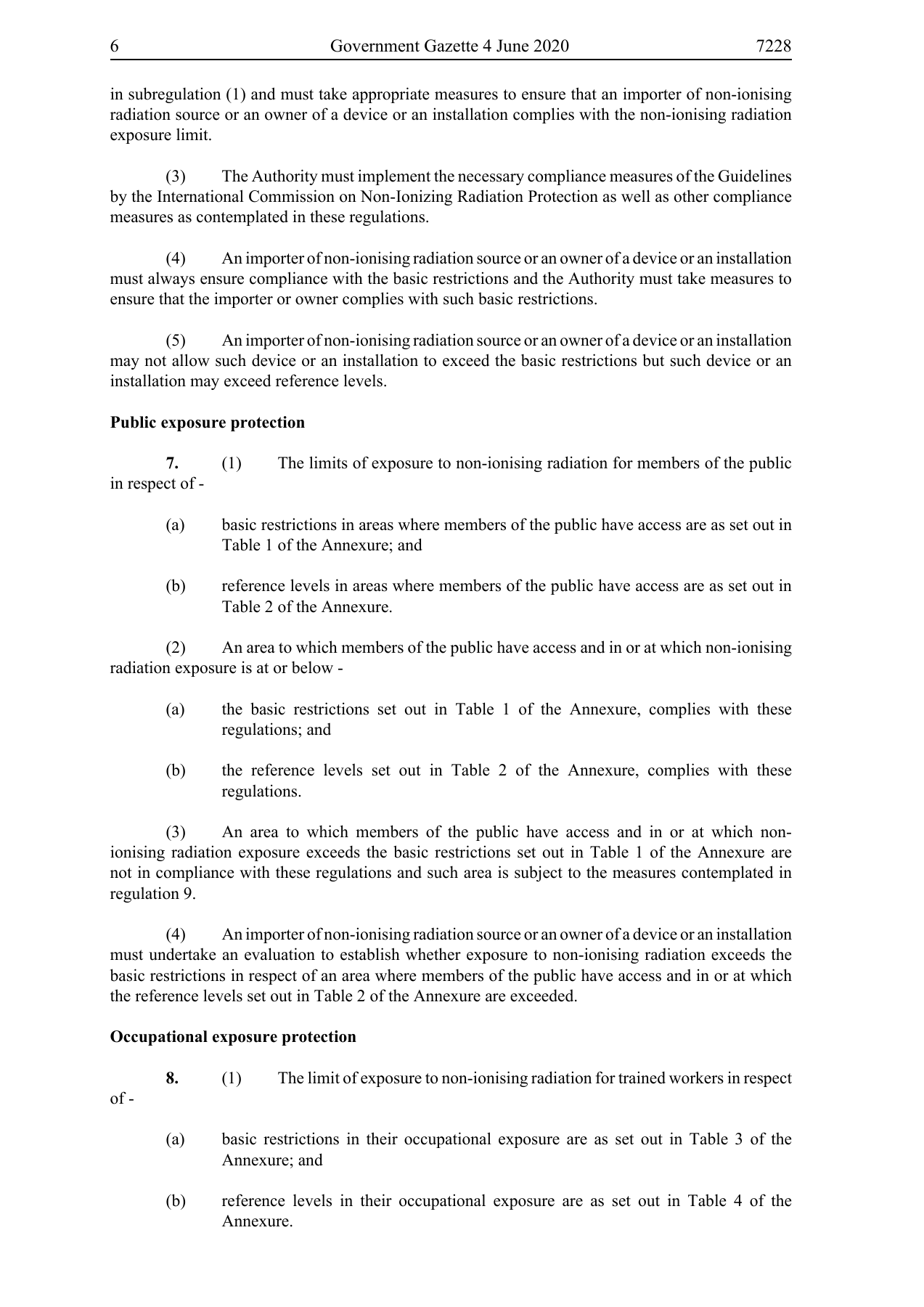
in subregulation (1) and must take appropriate measures to ensure that an importer of non-ionising
radiation source or an owner of a device or an installation complies with the non-ionising radiation
exposure limit.
(3) The Authority must implement the necessary compliance measures of the Guidelines
by the International Commission on Non-Ionizing Radiation Protection as well as other compliance
measures as contemplated in these regulations.
(4) An importer of non-ionising radiation source or an owner of a device or an installation
must always ensure compliance with the basic restrictions and the Authority must take measures to
ensure that the importer or owner complies with such basic restrictions.
(5) An importer of non-ionising radiation source or an owner of a device or an installation
may not allow such device or an installation to exceed the basic restrictions but such device or an
installation may exceed reference levels.
Public exposure protection
7. (1) The limits of exposure to non-ionising radiation for members of the public
in respect of -
(a) basic restrictions in areas where members of the public have access are as set out in
Table 1 of the Annexure; and
(b) reference levels in areas where members of the public have access are as set out in
Table 2 of the Annexure.
(2) An area to which members of the public have access and in or at which non-ionising
radiation exposure is at or below -
(a) the basic restrictions set out in Table 1 of the Annexure, complies with these
regulations; and
(b) the reference levels set out in Table 2 of the Annexure, complies with these
regulations.
(3) An area to which members of the public have access and in or at which non-
ionising radiation exposure exceeds the basic restrictions set out in Table 1 of the Annexure are
not in compliance with these regulations and such area is subject to the measures contemplated in
regulation 9.
(4) An importer of non-ionising radiation source or an owner of a device or an installation
must undertake an evaluation to establish whether exposure to non-ionising radiation exceeds the
basic restrictions in respect of an area where members of the public have access and in or at which
the reference levels set out in Table 2 of the Annexure are exceeded.
Occupational exposure protection
8. (1) The limit of exposure to non-ionising radiation for trained workers in respect
of -
(a) basic restrictions in their occupational exposure are as set out in Table 3 of the
Annexure; and
(b) reference levels in their occupational exposure are as set out in Table 4 of the
Annexure.
Original PDF page 6 — retained source fields, tables and layout.
7228 Government Gazette 4 June 2020 7
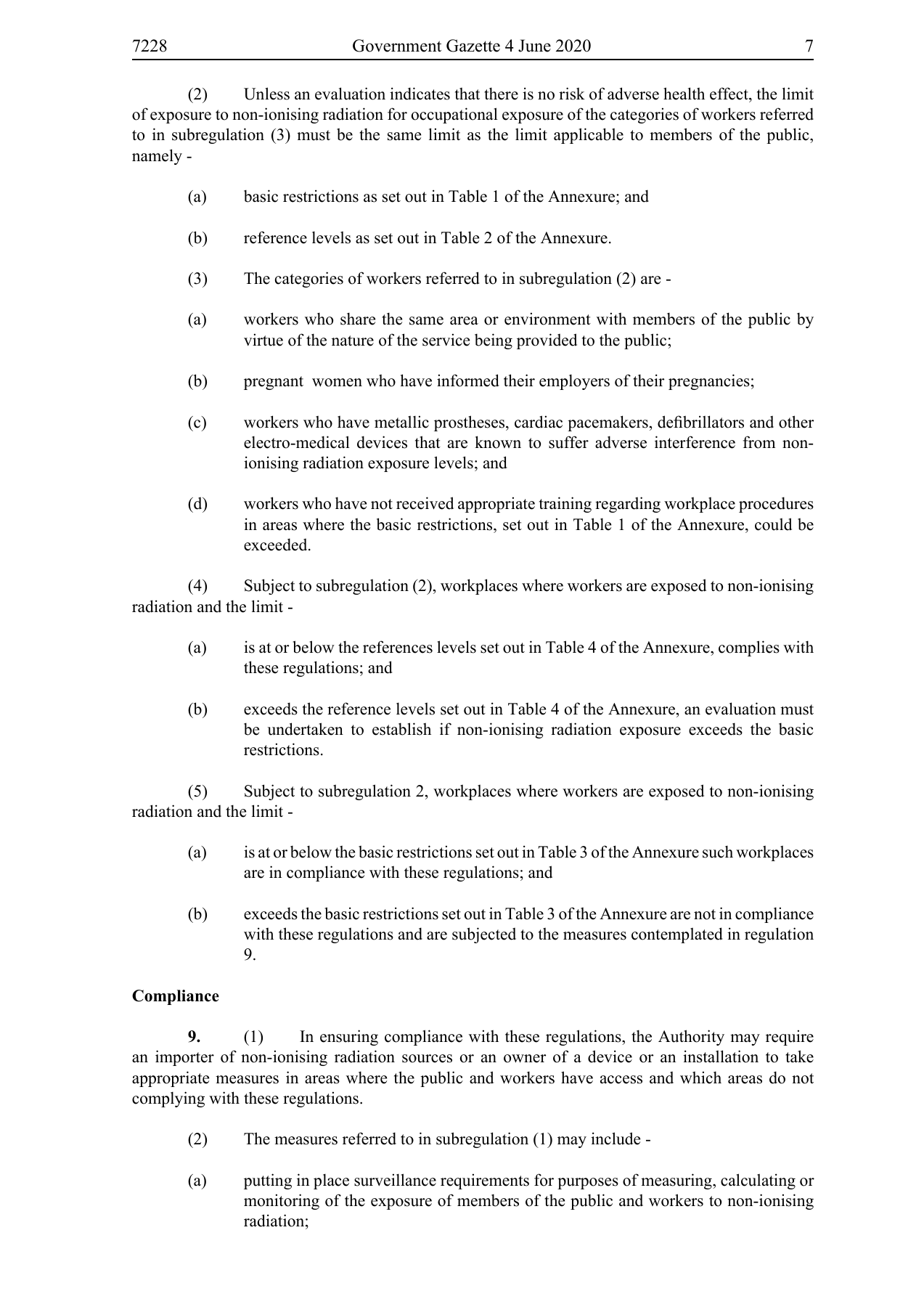
(2) Unless an evaluation indicates that there is no risk of adverse health effect, the limit
of exposure to non-ionising radiation for occupational exposure of the categories of workers referred
to in subregulation (3) must be the same limit as the limit applicable to members of the public,
namely -
(a) basic restrictions as set out in Table 1 of the Annexure; and
(b) reference levels as set out in Table 2 of the Annexure.
(3) The categories of workers referred to in subregulation (2) are -
(a) workers who share the same area or environment with members of the public by
virtue of the nature of the service being provided to the public;
(b) pregnant women who have informed their employers of their pregnancies;
(c) workers who have metallic prostheses, cardiac pacemakers, defibrillators and other
electro-medical devices that are known to suffer adverse interference from non-
ionising radiation exposure levels; and
(d) workers who have not received appropriate training regarding workplace procedures
in areas where the basic restrictions, set out in Table 1 of the Annexure, could be
exceeded.
(4) Subject to subregulation (2), workplaces where workers are exposed to non-ionising
radiation and the limit -
(a) is at or below the references levels set out in Table 4 of the Annexure, complies with
these regulations; and
(b) exceeds the reference levels set out in Table 4 of the Annexure, an evaluation must
be undertaken to establish if non-ionising radiation exposure exceeds the basic
restrictions.
(5) Subject to subregulation 2, workplaces where workers are exposed to non-ionising
radiation and the limit -
(a) is at or below the basic restrictions set out in Table 3 of the Annexure such workplaces
are in compliance with these regulations; and
(b) exceeds the basic restrictions set out in Table 3 of the Annexure are not in compliance
with these regulations and are subjected to the measures contemplated in regulation
9.
Compliance
9. (1) In ensuring compliance with these regulations, the Authority may require
an importer of non-ionising radiation sources or an owner of a device or an installation to take
appropriate measures in areas where the public and workers have access and which areas do not
complying with these regulations.
(2) The measures referred to in subregulation (1) may include -
(a) putting in place surveillance requirements for purposes of measuring, calculating or
monitoring of the exposure of members of the public and workers to non-ionising
radiation;
Original PDF page 7 — retained source fields, tables and layout.
8 Government Gazette 4 June 2020 7228
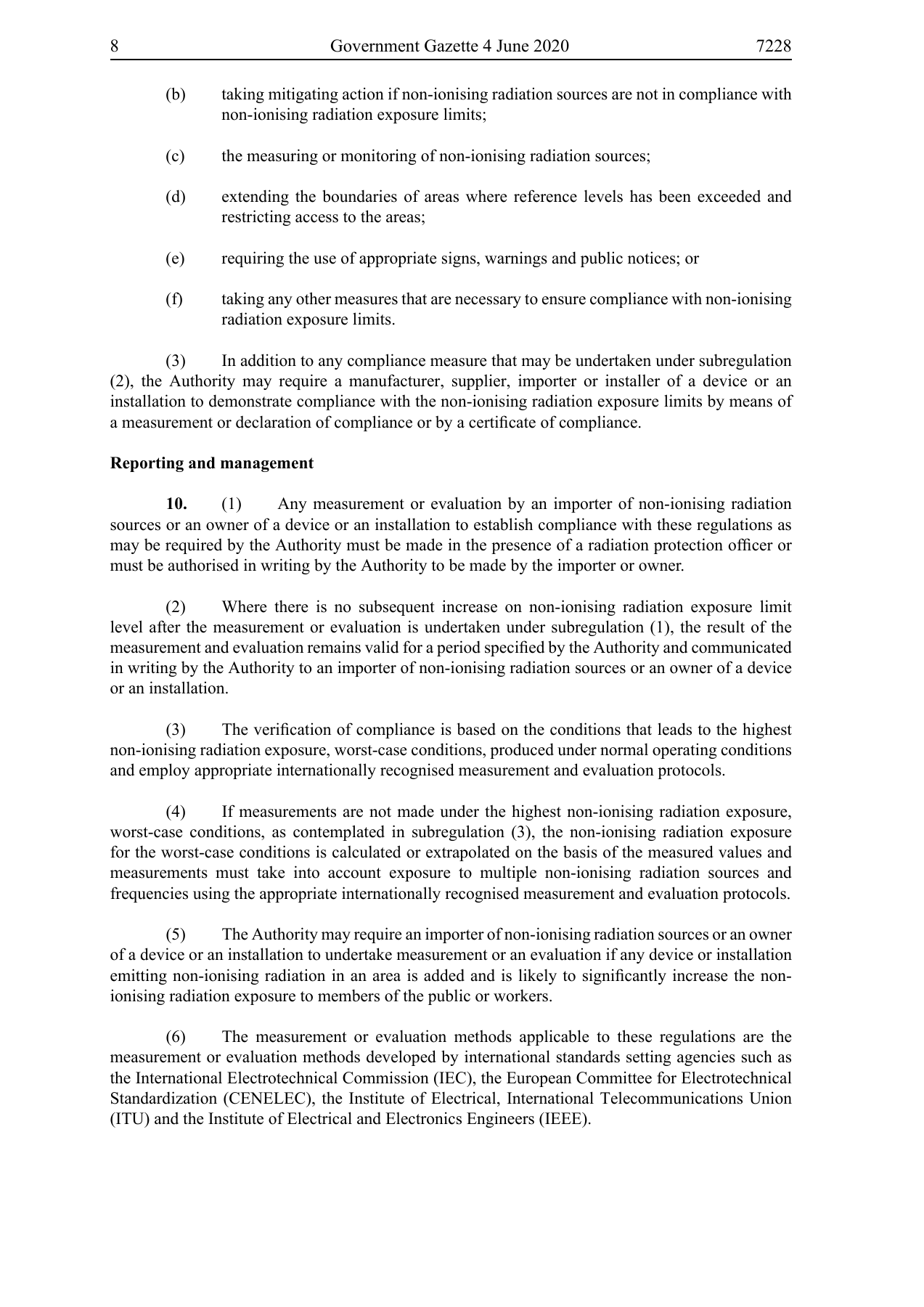
(b) taking mitigating action if non-ionising radiation sources are not in compliance with
non-ionising radiation exposure limits;
(c) the measuring or monitoring of non-ionising radiation sources;
(d) extending the boundaries of areas where reference levels has been exceeded and
restricting access to the areas;
(e) requiring the use of appropriate signs, warnings and public notices; or
(f) taking any other measures that are necessary to ensure compliance with non-ionising
radiation exposure limits.
(3) In addition to any compliance measure that may be undertaken under subregulation
(2), the Authority may require a manufacturer, supplier, importer or installer of a device or an
installation to demonstrate compliance with the non-ionising radiation exposure limits by means of
a measurement or declaration of compliance or by a certificate of compliance.
Reporting and management
10. (1) Any measurement or evaluation by an importer of non-ionising radiation
sources or an owner of a device or an installation to establish compliance with these regulations as
may be required by the Authority must be made in the presence of a radiation protection officer or
must be authorised in writing by the Authority to be made by the importer or owner.
(2) Where there is no subsequent increase on non-ionising radiation exposure limit
level after the measurement or evaluation is undertaken under subregulation (1), the result of the
measurement and evaluation remains valid for a period specified by the Authority and communicated
in writing by the Authority to an importer of non-ionising radiation sources or an owner of a device
or an installation.
(3) The verification of compliance is based on the conditions that leads to the highest
non-ionising radiation exposure, worst-case conditions, produced under normal operating conditions
and employ appropriate internationally recognised measurement and evaluation protocols.
(4) If measurements are not made under the highest non-ionising radiation exposure,
worst-case conditions, as contemplated in subregulation (3), the non-ionising radiation exposure
for the worst-case conditions is calculated or extrapolated on the basis of the measured values and
measurements must take into account exposure to multiple non-ionising radiation sources and
frequencies using the appropriate internationally recognised measurement and evaluation protocols.
(5) The Authority may require an importer of non-ionising radiation sources or an owner
of a device or an installation to undertake measurement or an evaluation if any device or installation
emitting non-ionising radiation in an area is added and is likely to significantly increase the non-
ionising radiation exposure to members of the public or workers.
(6) The measurement or evaluation methods applicable to these regulations are the
measurement or evaluation methods developed by international standards setting agencies such as
the International Electrotechnical Commission (IEC), the European Committee for Electrotechnical
Standardization (CENELEC), the Institute of Electrical, International Telecommunications Union
(ITU) and the Institute of Electrical and Electronics Engineers (IEEE).
Original PDF page 8 — retained source fields, tables and layout.
7228 Government Gazette 4 June 2020 9
ANNEXURE
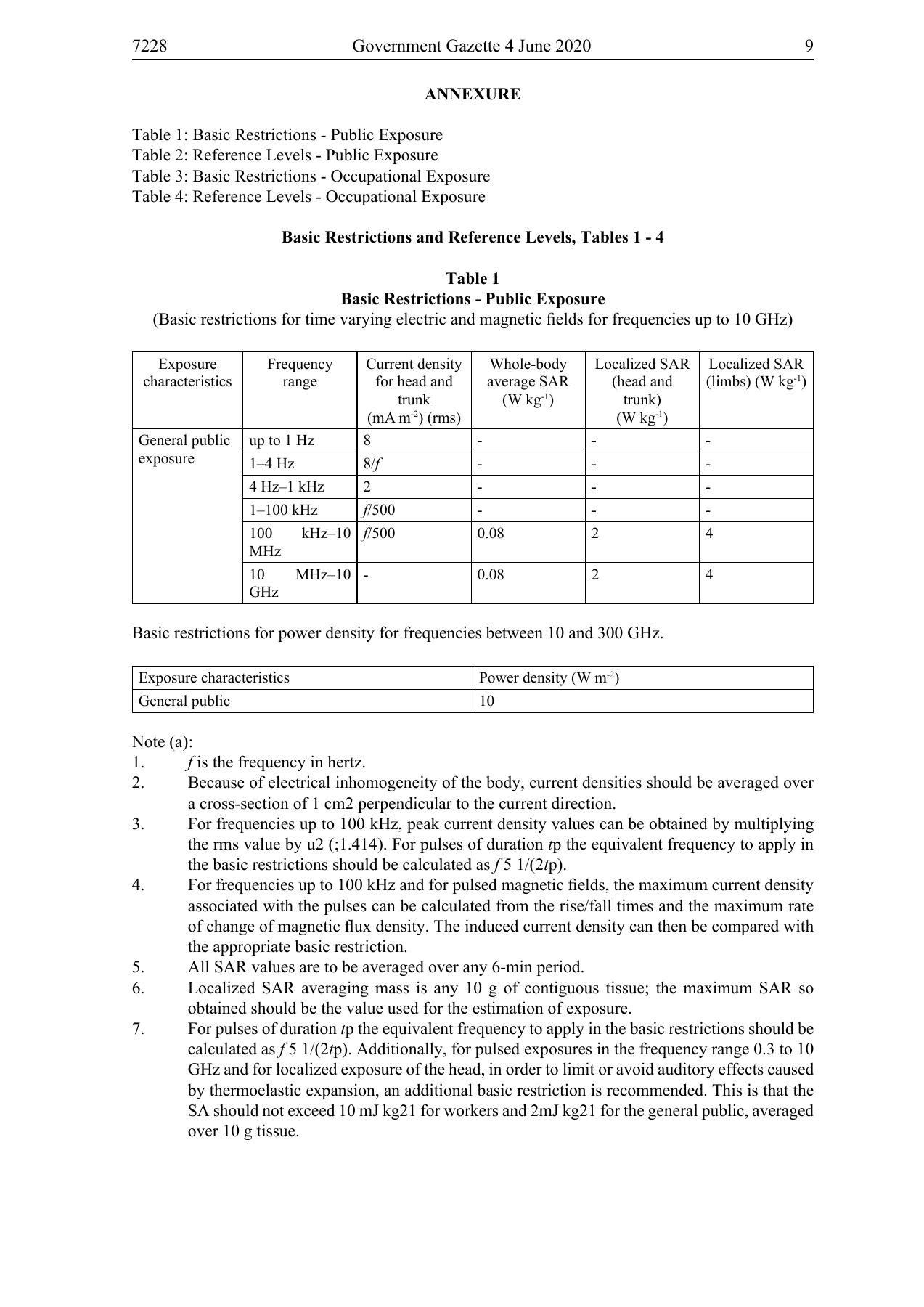
Table 1: Basic Restrictions - Public Exposure
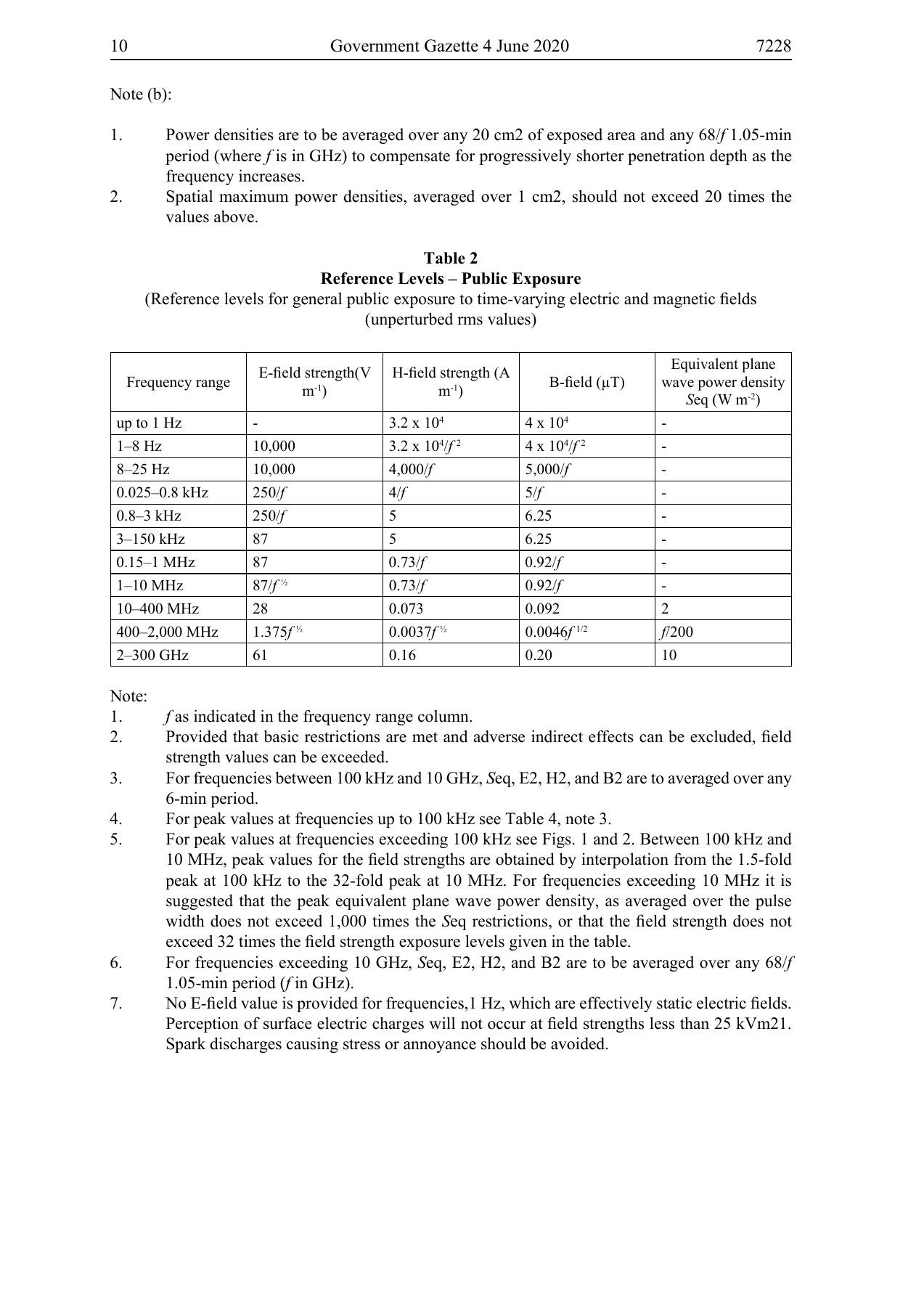
Table 2: Reference Levels - Public Exposure
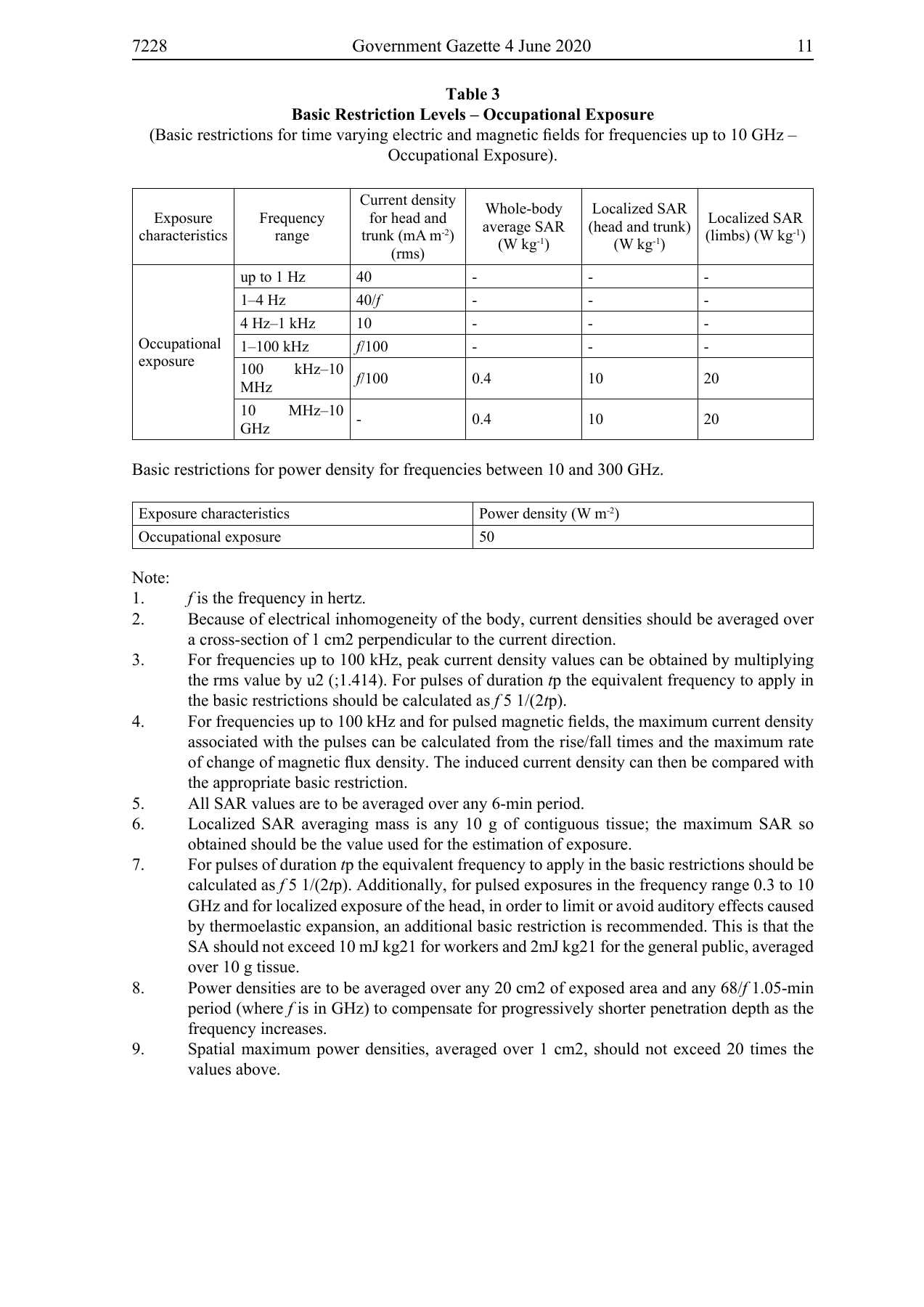
Table 3: Basic Restrictions - Occupational Exposure
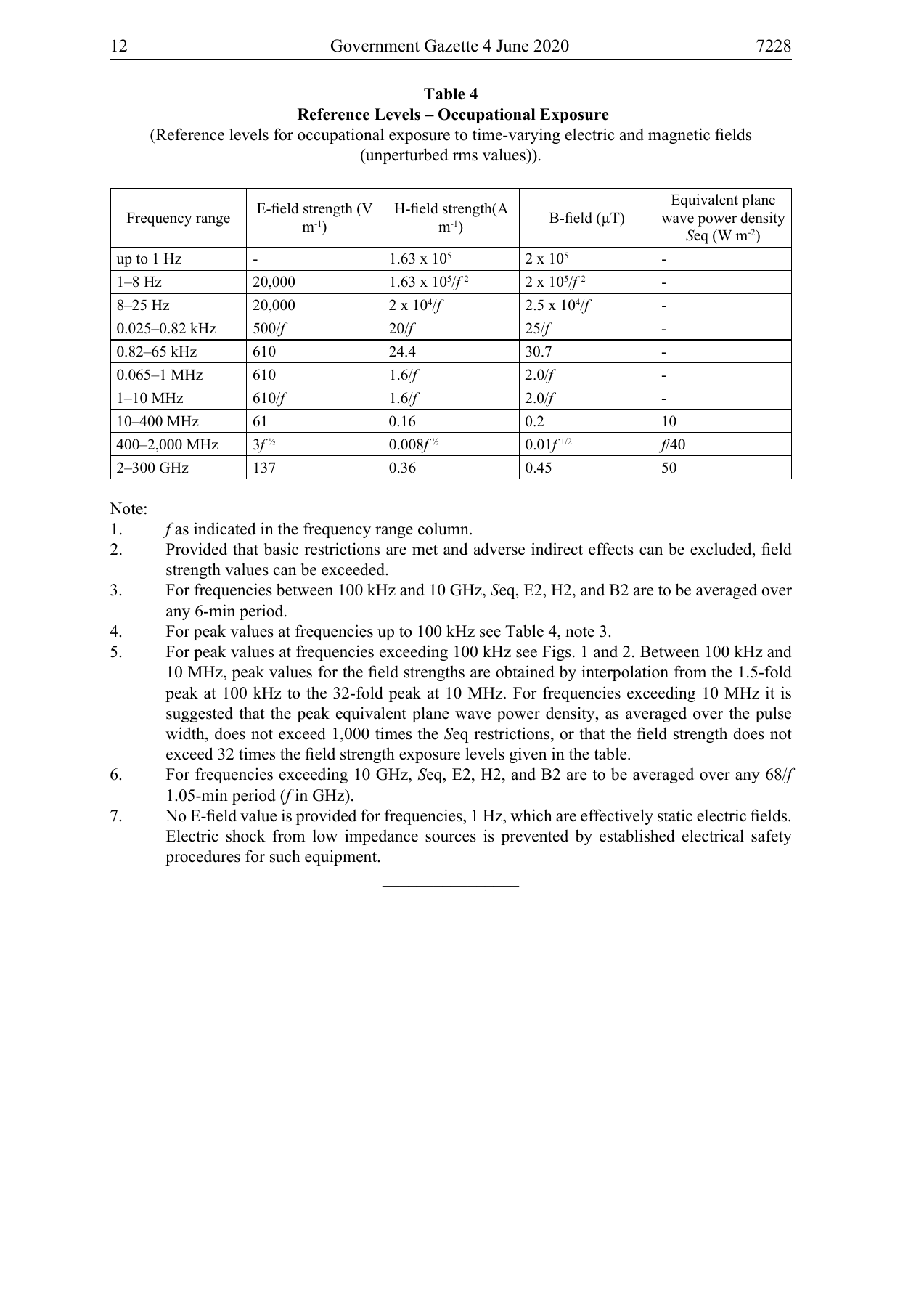
Table 4: Reference Levels - Occupational Exposure
Basic Restrictions and Reference Levels, Tables 1 - 4
Table 1
Basic Restrictions - Public Exposure
(Basic restrictions for time varying electric and magnetic fields for frequencies up to 10 GHz)
Exposure Frequency Current density Whole-body Localized SAR Localized SAR
characteristics range for head and average SAR (head and (limbs) (W kg⁻¹)
trunk (W kg⁻¹) trunk)
(mA m⁻²) (rms) (W kg⁻¹)
General public up to 1 Hz 8 - - -
exposure 1–4 Hz 8/f - - -
4 Hz–1 kHz 2 - - -
1–100 kHz f/500 - - -
100 kHz–10 f/500 0.08 2 4
MHz
10 MHz–10 - 0.08 2 4
GHz
Basic restrictions for power density for frequencies between 10 and 300 GHz.
Exposure characteristics Power density (W m⁻²)
General public 10
Note (a):
1. f is the frequency in hertz.
2. Because of electrical inhomogeneity of the body, current densities should be averaged over
a cross-section of 1 cm2 perpendicular to the current direction.
3. For frequencies up to 100 kHz, peak current density values can be obtained by multiplying
the rms value by u2 (;1.414). For pulses of duration tp the equivalent frequency to apply in
the basic restrictions should be calculated as f 5 1/(2tp).
4. For frequencies up to 100 kHz and for pulsed magnetic fields, the maximum current density
associated with the pulses can be calculated from the rise/fall times and the maximum rate
of change of magnetic flux density. The induced current density can then be compared with
the appropriate basic restriction.
5. All SAR values are to be averaged over any 6-min period.
6. Localized SAR averaging mass is any 10 g of contiguous tissue; the maximum SAR so
obtained should be the value used for the estimation of exposure.
7. For pulses of duration tp the equivalent frequency to apply in the basic restrictions should be
calculated as f 5 1/(2tp). Additionally, for pulsed exposures in the frequency range 0.3 to 10
GHz and for localized exposure of the head, in order to limit or avoid auditory effects caused
by thermoelastic expansion, an additional basic restriction is recommended. This is that the
SA should not exceed 10 mJ kg21 for workers and 2mJ kg21 for the general public, averaged
over 10 g tissue.
Original PDF page 9 — retained source fields, tables and layout.
10 Government Gazette 4 June 2020 7228
Note (b):
1. Power densities are to be averaged over any 20 cm2 of exposed area and any 68/f 1.05-min
period (where f is in GHz) to compensate for progressively shorter penetration depth as the
frequency increases.
2. Spatial maximum power densities, averaged over 1 cm2, should not exceed 20 times the
values above.
Table 2
Reference Levels – Public Exposure
(Reference levels for general public exposure to time-varying electric and magnetic fields
(unperturbed rms values)
Equivalent plane
E-field strength(V H-field strength (A
Frequency range B-field (µT) wave power density
m⁻¹) m⁻¹)
Seq (W m⁻²)
up to 1 Hz - 3.2 x 10⁴ 4 x 10⁴ -
1–8 Hz 10,000 3.2 x 10⁴/f² 4 x 10⁴/f² -
8–25 Hz 10,000 4,000/f 5,000/f -
0.025–0.8 kHz 250/f 4/f 5/f -
0.8–3 kHz 250/f 5 6.25 -
3–150 kHz 87 5 6.25 -
0.15–1 MHz 87 0.73/f 0.92/f -
1–10 MHz 87/f½ 0.73/f 0.92/f -
10–400 MHz 28 0.073 0.092 2
400–2,000 MHz 1.375f½ 0.0037f½ 0.0046f¹/² f/200
2–300 GHz 61 0.16 0.20 10
Note:
1. f as indicated in the frequency range column.
2. Provided that basic restrictions are met and adverse indirect effects can be excluded, field
strength values can be exceeded.
3. For frequencies between 100 kHz and 10 GHz, Seq, E2, H2, and B2 are to averaged over any
6-min period.
4. For peak values at frequencies up to 100 kHz see Table 4, note 3.
5. For peak values at frequencies exceeding 100 kHz see Figs. 1 and 2. Between 100 kHz and
10 MHz, peak values for the field strengths are obtained by interpolation from the 1.5-fold
peak at 100 kHz to the 32-fold peak at 10 MHz. For frequencies exceeding 10 MHz it is
suggested that the peak equivalent plane wave power density, as averaged over the pulse
width does not exceed 1,000 times the Seq restrictions, or that the field strength does not
exceed 32 times the field strength exposure levels given in the table.
6. For frequencies exceeding 10 GHz, Seq, E2, H2, and B2 are to be averaged over any 68/f
1.05-min period (f in GHz).
7. No E-field value is provided for frequencies,1 Hz, which are effectively static electric fields.
Perception of surface electric charges will not occur at field strengths less than 25 kVm21.
Spark discharges causing stress or annoyance should be avoided.
Original PDF page 10 — retained source fields, tables and layout.
7228 Government Gazette 4 June 2020 11
Table 3
Basic Restriction Levels – Occupational Exposure
(Basic restrictions for time varying electric and magnetic fields for frequencies up to 10 GHz –
Occupational Exposure).
Current density
Whole-body Localized SAR
Exposure Frequency for head and Localized SAR
average SAR (head and trunk)
characteristics range trunk (mA m⁻²) (limbs) (W kg⁻¹)
(W kg⁻¹) (W kg⁻¹)
(rms)
up to 1 Hz 40 - - -
1–4 Hz 40/f - - -
4 Hz–1 kHz 10 - - -
Occupational 1–100 kHz f/100 - - -
exposure
100 kHz–10
f/100 0.4 10 20
MHz
10 MHz–10
- 0.4 10 20
GHz
Basic restrictions for power density for frequencies between 10 and 300 GHz.
Exposure characteristics Power density (W m⁻²)
Occupational exposure 50
Note:
1. f is the frequency in hertz.
2. Because of electrical inhomogeneity of the body, current densities should be averaged over
a cross-section of 1 cm2 perpendicular to the current direction.
3. For frequencies up to 100 kHz, peak current density values can be obtained by multiplying
the rms value by u2 (;1.414). For pulses of duration tp the equivalent frequency to apply in
the basic restrictions should be calculated as f 5 1/(2tp).
4. For frequencies up to 100 kHz and for pulsed magnetic fields, the maximum current density
associated with the pulses can be calculated from the rise/fall times and the maximum rate
of change of magnetic flux density. The induced current density can then be compared with
the appropriate basic restriction.
5. All SAR values are to be averaged over any 6-min period.
6. Localized SAR averaging mass is any 10 g of contiguous tissue; the maximum SAR so
obtained should be the value used for the estimation of exposure.
7. For pulses of duration tp the equivalent frequency to apply in the basic restrictions should be
calculated as f 5 1/(2tp). Additionally, for pulsed exposures in the frequency range 0.3 to 10
GHz and for localized exposure of the head, in order to limit or avoid auditory effects caused
by thermoelastic expansion, an additional basic restriction is recommended. This is that the
SA should not exceed 10 mJ kg21 for workers and 2mJ kg21 for the general public, averaged
over 10 g tissue.
8. Power densities are to be averaged over any 20 cm2 of exposed area and any 68/f 1.05-min
period (where f is in GHz) to compensate for progressively shorter penetration depth as the
frequency increases.
9. Spatial maximum power densities, averaged over 1 cm2, should not exceed 20 times the
values above.
Original PDF page 11 — retained source fields, tables and layout.
12 Government Gazette 4 June 2020 7228
Table 4
Reference Levels – Occupational Exposure
(Reference levels for occupational exposure to time-varying electric and magnetic fields
(unperturbed rms values)).
Equivalent plane
E-field strength (V H-field strength(A
Frequency range B-field (µT) wave power density
m⁻¹) m⁻¹)
Seq (W m⁻²)
up to 1 Hz - 1.63 x 10⁵ 2 x 10⁵ -
1–8 Hz 20,000 1.63 x 10⁵/f² 2 x 10⁵/f² -
8–25 Hz 20,000 2 x 10⁴/f 2.5 x 10⁴/f -
0.025–0.82 kHz 500/f 20/f 25/f -
0.82–65 kHz 610 24.4 30.7 -
0.065–1 MHz 610 1.6/f 2.0/f -
1–10 MHz 610/f 1.6/f 2.0/f -
10–400 MHz 61 0.16 0.2 10
400–2,000 MHz 3f½ 0.008f½ 0.01f¹/² f/40
2–300 GHz 137 0.36 0.45 50
Note:
1. f as indicated in the frequency range column.
2. Provided that basic restrictions are met and adverse indirect effects can be excluded, field
strength values can be exceeded.
3. For frequencies between 100 kHz and 10 GHz, Seq, E2, H2, and B2 are to be averaged over
any 6-min period.
4. For peak values at frequencies up to 100 kHz see Table 4, note 3.
5. For peak values at frequencies exceeding 100 kHz see Figs. 1 and 2. Between 100 kHz and
10 MHz, peak values for the field strengths are obtained by interpolation from the 1.5-fold
peak at 100 kHz to the 32-fold peak at 10 MHz. For frequencies exceeding 10 MHz it is
suggested that the peak equivalent plane wave power density, as averaged over the pulse
width, does not exceed 1,000 times the Seq restrictions, or that the field strength does not
exceed 32 times the field strength exposure levels given in the table.
6. For frequencies exceeding 10 GHz, Seq, E2, H2, and B2 are to be averaged over any 68/f
1.05-min period (f in GHz).
7. No E-field value is provided for frequencies, 1 Hz, which are effectively static electric fields.
Electric shock from low impedance sources is prevented by established electrical safety
procedures for such equipment.
________________
Original PDF page 12 — retained source fields, tables and layout.